Thursday, June 07, 2018

First Taco Walk, now 1 Night Stand. It's not derogatory to suggest that no idea is safe from being hijacked by Develop New Albany.


The reason why I don't write fiction is that real life is endlessly bizarre, so let's take a look at the next purloined event from the foot-shot specialists. It's called 1 Night Stand, and if this term sounds weirdly familiar to you, keep reading.


The 1 Night Stand originated in 2009 as an idea minted by Jala Miller, a civic-minded private citizen. She proceeded to organize a sequel, or maybe two, before the notion ran its course.

Now DNA is bringing back an event that wasn't ever their intellectual property to begin with, though as we've seen so depressingly with the Taco Walk (are various walks and crawls the only thing these people can think to do?), no one at DNA seems bothered much by the blatant pilferage, and elected officials merely shrug.

Details
We’re excited to be bringing back the 1 Night Stand! This is an event that was held in Downtown years ago and we’re looking forward to reviving it. This will be a Downtown New Albany Pub Crawl. Participants will pre-purchase a wristband with drink tickets along with a t-shirt and on the day of the event, will choose where to spend their drink tickets at participating locations. We anticipate this being a big draw to Downtown during the summer and a fun event showcasing our local bar/restaurants. Any questions please email developnainfo@gmail.com or message us on Facebook. Any derogatory comments will be deleted.

Boy oh boy, those last lines: "Any questions please email developnainfo@gmail.com or message us on Facebook. Any derogatory comments will be deleted."

Our vanguard of Gahanesque party planning expertise is getting a bit touchy, don't you think? And yet, I persist, safe in the knowledge that my question wasn't derogatory, and if I asked it via e-mail, it would be ignored like all the previous ones have been.


Did the founder give explicit permission for the name to be used, or was it another instance of intellectual property appropriation? DNA has a past, folks.

A week has passed, and guess what?

No answer.


The Green Mouse tells me another local event organizer was planning on staging precisely such a pub crawl reprise later this summer, and actually asked and received permission from Jala, the founder, only to be usurped by the mayor's preferred monopolists.

My advice to all and sundry: if you have a great idea for a community event, keep it a secret. The very walls have ears -- and grubby, grasping fingers.

Here's the story of the original 1 Night Stand from NA Confidential on August 5, 2009.

---

"NA 1 Night Stand," a pub crawl, coming to downtown New Albany on August 29.

When first we heard from Jala Miller, she was moving into her new apartment in the building that houses Studio's Grille & Pub in downtown New Albany. Shortly thereafter, we were introduced, and I heard her idea for a downtown pub crawl, something that would being attention to the many new establishments coming to downtown New Albany.

Most important to me is her view of the demographics involved (her words):

To make this event a success – it is important that everyone “looks at the big picture”. The goal of this beer walk is to get the younger generation to want to visit New Albany “as a whole” – to make it a destination similar to that of Bardstown Road. In order for this to happen, the bars participating will need to be excited about it!

Jala has the plan together, and here are preliminary details. I concede that the date coinciding with Brew at the (Louisville) Zoo is inconvenient, but to be truthful, summer weekends tend to be booked from May through October in recent years. NABC will be participating in "NA 1 Night Stand" in a yet-to-be-determined fashion, hopefully with an outdoor party to serve as the trial run for similar events coming in September and October.

Event: The NA 1 Night Stand -- "Check 'em all before you fall"
What: Festival
Start Time: Saturday, August 29 at 3:00 p.m.
End Time: Sunday, August 30 at 12:00 a.m.
Where: Downtown New Albany

Description:

"The 'NA 1 Night Stand' is a one day welcome or reintroduction to downtown NA and all of the redevelopment that has been taking place. Join us on August 29th for a 'Beer Walk' different than anything NA has ever seen. Beer Olympics sign in begins at 3:00pm at Steinert's.

"Participating establishments will be featuring drink specials, food specials, and other attractions such as live music throughout the entire event day. Raffle prizes will be awarded throughout the day thanks to many local sponsors!"

Wednesday, June 06, 2018

BEER WITH A SOCIALIST: These "new rules of pub etiquette" are a must-read.


"Punter" can mean several things, but in British pub-speak it's "the regular sort of person who hangs out at places like pubs."

And: "boozer" is just a synonym for pub, and in the United Kingdom, most (maybe all) pubs are based on counter service, hence the opening section about the art of the queue.

Who’s next?
Like good guitar bands or working-class actors, Britain still produces exceptional bar staff but their numbers have dwindled alarmingly. Professionals who can process that “invisible” bar queue with the confident oversight of an air traffic controller, while filling multiple glasses with octopus-like efficiency, are now a real rarity. In most pubs, that queue has to manage itself and responsible drinkers must lead by example to ensure it does not descend into chaos.

In fact, these rules of etiquette should come across as common sense for anyone who has consumed drinks in public, anywhere at all. They're not really new, but then again, teachers teach the same topic over and over to incoming classes who are unaware of the importance. So it goes.

Read and take notes, please.

There'll be a quiz.

The new rules of pub etiquette: don't flirt with bar staff or steal the glasses, by Tony Naylor (The Guardian)

The number of UK pubs is falling and there is less consensus about how punters should behave. Here’s a guide to getting the most out of a trip to the boozer

In 2018, the pub occupies a rather uncertain place in British society. There are 50,000, nationally. But that figure has dropped by 10,500 since 2000. People are drinking less, drinking less frequently and, arguably, there is far less consensus these days about how to behave in pubs. Ahead of Beer Day Britain on 15 June then, here’s a fresh look at pub etiquette. How can we all get along in the modern boozer?

Many of you hadn't been born the last time these Schmitt Furniture windows were visible.


Almost from the inception of NA Confidential in 2004, boarded up windows (as opposed to "The Boarded Window," a short story by Ambrose Bierce) have served as metaphors for downtown degradation.

REWIND: "Windowless Views of Scribner Place." (2006)

South Side Inn to rise again -- may its reflection one day be cast in real Schmitt windows. (2007)

About this new Downtown Facade Improvement program ... our interest in the topic goes all the way back to 2004.

It's been 14 years, and the neglect still is in the active process of being reversed. Much of Schmitt Furniture's block is being overhauled as I write, with projects underway on all four sides. There's much work yet to be done, but for today, to those engaged in this process: thanks and congrats.


SHANE'S EXCELLENT NEW WORDS: London's "Gay Hussar" restaurant faces extinction, and one reason is that booze no longer animates British politics.


The Gay Hussar may be closing.

Last orders at the Gay Hussar – the left’s hotbed of plots, gossip and goulash, by Rebecca Smithers (The Guardian)

For 65 years, the Soho restaurant has been the place where Labour lunches. But next month might see it shut

The Gay Hussar is among the most celebrated restaurants in London but its fame rests not so much on the quality of its chilled wild-cherry soup and its goulash, but on its reputation as the beating heart of political gossip.

The Hungarian restaurant in the centre of Soho has played host to generations of politicians, many drawn from the left, including Aneurin Bevan, Michael Foot, Tom Driberg, Ian Mikardo and Barbara Castle. It is also rumoured to be where the Tory wets fruitlessly plotted the overthrow of Margaret Thatcher in the early 1980s.

But after 65 years as a hotbed of political plotting, backstabbing, deal-making and gossip, it is due to close its doors for the last time in June.

It's always fascinating to consider an eatery or watering hole with a back story ranging far beyond everyday food and drink, but first things first. In the present context, a "Gay Hussar" describes a merry, carefree light cavalryman, with the adjective "gay" reverting to its original use.

Gay meaning ‘homosexual’ became established in the 1960s as the term preferred by homosexual men to describe themselves. It is now the standard accepted term throughout the English-speaking world. As a result, the centuries-old other senses of gay meaning either ‘carefree’ or ‘bright and showy’ have more or less dropped out of natural use. The word gay cannot be readily used today in these older senses without arousing a sense of double entendre, despite concerted attempts by some to keep them alive. Gay in its modern sense typically refers to men (lesbian being the standard term for homosexual women) but in some contexts it can be used of both men and women

Times (and words) do change. Hussar originally described a specific sort of Hungarian horseman of the 15th century, and the term later was adopted by cavalrymen of a similar model, irrespective of national origin.

The etymology of "hussar" is muddled. The word may date to ancient Rome; at the very least, the Hungarians borrowed it from nearby Serbia, where a "husar" was a type of medieval brigand, often conducting what we'd now call "guerrilla" warfare against the Ottoman Turks.

Much later there was a popular Hungarian operetta called The Gay Hussars, written by Emmerich Kálmán, which probably accounts for the name of London's Gay Hussar restaurant, where the only beer on the menu is Czech Budvar -- but we always can make do with Bull's Blood wine from Eger.

Speaking frankly, my mouth waters while reading the menu of Hungarian dishes. What I'd give for a properly rendered töltött káposzta (cabbage roll) at this precise moment. Significantly, the author of The Economist's "Bagehot" column does not share my favorable view of Hungarian cuisine, explaining the probable demise of the Gay Hussar by reference to an alarming social trend.

Last orders for political drinking

Waning interest in booze is transforming British politics

 ... But the restaurant’s imminent death surely has something to do with the decline in political drinking. Few people went to the Gay Hussar for the food. Hungary’s is not one of the world’s great cuisines and the Gay Hussar’s rendering of it was more faithful than inspired. Nor did they go for the comfort. The tables are cramped, particularly upstairs, and the corridors are higgledy-piggledy. They went for the booze—or, more precisely, for the intoxicating mixture of drink and gossip, alcohol and plotting, that once made British politics such a joy.

Drink has certainly not disappeared from public life. The Westminster village is about to embark on a long cycle of summer parties (last July David Lidington, a Tory MP, blamed plots against Theresa May on “too much sun and too much warm prosecco”). The summer season will be followed by the even boozier party conference season. Drink still has the power to change the course of political history. Ed Miliband introduced the current system for electing the Labour leader because a drunken Labour MP, Eric Joyce, assaulted four other fellow drinkers and the party’s attempt to replace him produced fears of vote-rigging by unions. If Mr Joyce hadn’t got so sloshed, Jeremy Corbyn might still be on the backbenches, and Labour might have campaigned much more vigorously for Britain to stay in the European Union.

That said, today’s Westminster looks like a temperance meeting compared with the Westminster of old ...

The conclusion is unspeakably melancholy.

The saddest reason is the rise of a professional political class. Drink provided a link between politics and society. The Labour Party recruited MPs and activists from working men’s clubs that existed in large part to provide workers with cheap drink. Ministers routinely let their guard down when they demolished the ministerial drinks cabinet with their civil servants and advisers. Today, both Labour and the Tories recruit their MPs from think-tanks and ministers keep up their guard at all times. The decline of political drinking has snapped yet another link between the political elite and the people that they are supposed to serve.

Tuesday, June 05, 2018

ClassicX Escape radio, with new music from classic rock artists.


David Spuria is Dave, the Real Music Observer, and he makes an excellent point (above) about the classic rock radio format.

I recently heard a clip of Eddie Trunk from Sirius saying much the same thing, which is this: seeing as many of these bands and performers still are making new music, it's hard to find it on radio of any sort, whether terrestrial or streaming.

In short, classic rock radio usually plays only "classic" tracks, because that's what listeners want to hear. New music from older acts often is consigned to oblivion. As Trunk pointed out, even Sirius has no channel dedicated to such.

Hence Spuria's tout: ClassicX Radio Escape.

During my first half hour streaming earlier this afternoon, I heard recently released songs from Bob Seger, Joe Walsh, Richard Page (from Mr. Mister), Tokyo Motor Fist (with the guitarist from Trixter and the singer from Danger Danger), Robert Plant and Blondie.

All hail Clem Burke, the great drummer from Blondie. He has a documentary coming soon.

Older tunes are sprinkled through the ClassicX Radio Escape playlist; this afternoon I heard "Can't Get It Out of My Head" by ELO, albeit it last year's live version, and the 1981 Journey hit "Stone in Love," from the album Escape, on the radio station Escape -- and there's also a Journey tribute band in Ohio called ... yes, Escape.

I think this is an excellent idea, and will be streaming ClassicX Radio Escape on occasion. In closing, the Real Music Observer's videos are fun, too. Check them out at YouTube.

BEER WITH A SOCIALIST: Tom and Nick Moench collaborate on a sour beer -- and what I remember about a day with Tom in Orlando in 2006.

These two guys. From the Orange Blossom Fb page.

In 2006, when the annual family reunion took place in steamy summer Orlando, the estimable Tom Moench sacrificed an afternoon to save our lives, rescuing the Baylors from resort hotel ennui, and with it $6 half-pints of Guinness served in bizarre Belgian-style stemware at the hotel bar.

I barely knew Tom, a sixth-generation Floridian and former union stagehand, but what I did know was about him was impressive. He had long since stopped complaining about the Central Florida "beer wasteland," according to his pithy description at the time, first becoming an award-winning homebrewer, then founding a beer wholesaler, and finally getting his own Orange Blossom Pilsner recipe into regular production via contract brewing.

These days Tom "partner brews" OBP with a brewery in Lakeland, and as you're about to read, also has collaborated with his son. Nick's a brewer, too.

Tom and I originally met at Rich O’s Public House, circa 1995. He was a subscriber to the FOSSILS club newsletter during those heady pre-Internet days when we snail-mailed copies all across the country and thought we’d change the world.

Prior to our departure for the reunion, I'd put out the word that we were looking for something to do while in town. It may have been Tisha Gainey, who lived in Orlando for a while, connecting the dots for us. My memory is dim on this point.

Just understand that I was effusively grateful. The grand finale of the reunion would come at dinner on Saturday, leaving us ample time to explore. However, we had no car -- or, perhaps we did have a car and didn't want to drive it.

That thing about my memory ... again.

All I know is Tom agreed to pick us up, and we embarked on a wonderful "off the beaten path" tour of Orlando, one that took us absolutely nowhere close to anything Disneyesque. There was an exceptional package store called Knightly Spirits, then the unprepossessing but thoroughly savvy 903 Mills Market, which was a residential neighborhood, street-corner gathering place -- part funky grocery, part rock-solid deli, and with plenty of great beer.

As with Knightly Spirits, 903 Mills Market was a regular customer of Tom's distributorship. Draft OBP was being poured into plastic cups, and when my Rodger Dodger (corned beef and roast beef on marbled pumpernickel) arrived, I switched to a Boulder Mojo IPA from the bottle cooler. We sat outside at a picnic table, munching and trading war stories.

The next stop was a bar in the older part of town for a few more rounds of OBP, and things got hazy. The afternoon concluded at Tom's house. There might have been Black Russians with Stoli and Tia Maria, accompanied by a soundtrack of Buckethead guitar wizardry. When we left for the hotel, Tom handed me the compact disc as a souvenir.

We made it just in time for the main event, and to echo Caddyshack, I was hammered to the bejesus-belt. Mother seemed to be mildly disapproving, perhaps suffering traumatic flashbacks from my daze of youth.

When it came time for me to speak on the presumably safe topic of "recent family news," I went for the jugular and appended a healthy denunciation of George W. Bush, this coming before a crowd of my kinfolk leaning heavily to the GOP.

To which my mother, the eternal "yellow dog" Democrat, confided the following day: "You drink way too much, but it's about time someone told them the truth."

Thanks, mom, and thanks to Tom for getting the polemical juices flowing. My sole visit to Orlando proved memorable and forgettable, both for the very same reason of excess-as-coping-mechanism.

It's exciting to read about the continued growth of Orange Blossom Pilsner, and considering that in 2006, I seem to recall Tom coaching Nick in Little League, it has to be wonderful to collaborate on a special release beer with your son, the next brewer in the family.

Background first, then the article.

About Orange Blossom Brewing Company: Orange Blossom Pilsner, one of Florida’s first craft beers, was brewed in 1988 by Tom Moench in Orlando. In 2014, Orange Blossom Brewing Company partnered with Brew Hub in Lakeland to expand production. Along with the pilsner, offerings include OBP Squared, Toasted Coconut Porter, Back in the Day IPA and Weisse Weisse Baby. The beer is available in 1,800 locations across Florida, Georgia, Alabama, North Carolina and South Carolina.

About Inoculum Ale Works: Inoculum Ale Works, makers of Drex The Lactosaurus Rex, Kuebiko, Mother Ursa, Dreamcatcher and Spectrally Macabre, was founded in 2015 by Nick Moench. Inoculum is Florida’s first full-production sour-only brewery and is located in Spring Hill. A taproom in St. Petersburg will open in mid-June.

The story at Craft Beer:


Two Generations of Beer Makers Unveil New Sour Beer
, by Ashleigh Ostermann

Beer runs in the family for Tom and Nick Moench. The pair put their heads together, mixed their techniques and knowledge to brew Inoculated Orange Blossom Pilsner (IOBP) in time for Father’s Day.

The new refreshing sour beer is a take on Tom’s classic honey beer, Orange Blossom Pilsner (OPB). Nick took his dad’s recipe and added a custom blend of Saccharomyces cerevisiae (S. cerevisiae), Lactobacillus plantarum (L. plantarum) and Pediococcus pentosaceus (P. pentosaceus) grown by Inoculum.

Mayor Gahan AWOL as council inks corporate welfare package for Sazerac.


A few odds and ends, and then we'll all kick back to watch the epochal panacea unfold.

"Distillery to located in old Pillsbury plant."

In the newspaper's photo caption and the text, it is made perfectly clear that Sazerac will not be distilling at the former Pillsbury, and yet the subheader persists in the misconception. It also omits the second half of the verb form, but let's not be churlish.

An aside to Greg Phipps: In comparative terms, General Mills is to Pillsbury's biscuits as Sazerac is to Boston Brands of Maine's liquor (in this instance, brandy, which is a specific type of liquor). If your objective is to begin renaming streets for the mayoral victory of the moment, then at least be consistent: Buffalo Trace Lane, to replace Pillsbury Lane.

Wait -- Buffalo Trace now is an art installation by the Summit Springs Strip Mine. I prefer Southern Comfort Avenue, anyway.

But at least Phipps' commemorative instincts are modest. If left to Bob Caesar, not a street, landmark or dumpster in the city would be safe from renaming in honor of operatives affiliated with One Southern Indiana, Team Gahan, Develop New Albany, or the council itself -- though only those reliable council members like Caesar, who is to the adolescent fluffing of functionaries as Elvis was to peanut butter & 'nanner sandwiches.

Last evening's carefully choreographed incentive package spectacle might well have been the single greatest "mere formality" ballot I've witnessed in 14 years of soul-deadening council observation, but if you'll pardon the blasphemy from the village atheist, if Jesus Christ himself materialized before council to announce the second coming, at least one or two questions still should be asked prior to the pre-arranged vote.

In the case of Sazerac:

  • Are these union jobs?
  • If $24 per hour is the average, can there be a more detailed breakdown of the wages?
  • Will there be any sort of public interface, for instance, a visitor center?
  • What are the implications for the railroad spur?

So on, and so forth, not to omit the most obvious of all: if Sazerac's advent is second only to the second coming, then can Jeff Gahan show up for once and not have an underling mouth his scripted platitudes?

New Albany City Council approves incentive deal for Sazerac, by Chris Morris (Omnibus Tom May)

Distillery Bottling to to be located in old Pillsbury plant

NEW ALBANY — The Sazerac Company is coming to New Albany.

One of the oldest, family-owned distilling companies in the United States made the announcement last week that it was purchasing the old Pillsbury plant with plans to phase in two to three packaging lines. That move was contingent on the New Albany City Council approving a resolution to provide tax abatements on both personal property and real estate. The council did that Monday night by a 9-0 vote and with plenty of praise for the company and those who brokered the deal.

"In my seven years this is one of the biggest things to happen to New Albany as far as bringing jobs in," Councilman Greg Phipps said.

He said the New Albany Board of Works may want to consider renaming Pillsbury Lane, the road where the plant is located, to Bourbon Lane.

"This is a major, major win for the community," Councilman Bob Caesar said.

City Council President Al Knable said prior to the meeting the incentives offered by the city total around $3 million ...

NICK VAUGHN: RFK’s Legacy and What It Can Mean for New Albany.

RFK’s Legacy and What It Can Mean for New Albany

By guest contributor Nick Vaughn -- thanks, Nick.

Robert F. Kennedy visited New Albany three times in his political career. Once as a U.S. Senator, RFK visited New Albany High School in a lead-up to his Presidential Campaign. Twice RFK visited New Albany during the Indiana Primary Campaign, on April 24th, 1968 and May 5th, 1968.

Kennedy’s visit on April 24th is the most well-known and also has the most information regarding the visit. As I was researching and putting my thoughts together for this remembrance piece, I was able to get into contact with the John F. Kennedy Presidential Library. The wonderful people there were able to supply me with photographs as well as a detailed schedule of RFK’s visit on April 24th, 1968.

The Schedule:

"RFK arrived in New Albany around 7:00 p.m. on April 24, 1968. According to that schedule, he drove in a motorcade with Judge Paul Tegart, Leo Fentress (Floyd County Democratic Chairman), and Mary Townsend (Floyd County Democratic Vice Chairman).

"At around 7:30 p.m. they were to arrive at corner of Pearl and Norfolk Streets via the route: ‘IS 65 to 31 W - 31 W to Vincennes St. - left on Vincennes to Spring St. - right on Spring to Pearl St. - left on Pearl St. to Market St.’

"The schedule goes on to say: ‘The Senator should recognize in addition to the above three: Art Caulfield -- Dem. Treasurer of Central Committee; and John Wilcox -- Floyd County Chairman of Citizens for RFK. Judge Tegart will introduce the Senator.’

"Another copy of schedule says: '7:00 p.m. RFK speaks under auspices of Kennedy for President Committee of New Albany, at corner of Pearl and Market Streets.'

"Around 7:45 pm they left New Albany for Jeffersonville.”

(News and Tribune, 2018)

May 5th:

Kennedy’s visit to New Albany on May 5th was much more brief, and the schedule of events has been lost. However, according to the RFK Human Rights Foundation Switzerland (which has been recounting RFK’s Presidential Campaign’s day-to-day activities) “It was an airport rally.” I am unsure of what airport that could have been at, however after the airport rally Kennedy embarked on a short car ride to Jeffersonville.

(“RFK’s Plane en route to New Albany.” Courtesy of
the RFK Human Rights Foundation Switzerland)

RFK’s Legacy and New Albany:

While the exact words Kennedy spoke in New Albany are not available in any format (yet!), we can make an educated guess about the kind of remarks he delivered in our Southern Indiana city.

Kennedy’s message was that of hope, togetherness, and peace. They're three things you’d be hard pressed to find in any campaign rhetoric today. In a speech delivered at Kansas University, Kennedy said, “And this is one of the great tasks of leadership for us, as individuals and citizens this year. But even if we act to erase material poverty, there is another greater task, it is to confront the poverty of satisfaction - purpose and dignity - that afflicts us all. Too much and for too long, we seemed to have surrendered personal excellence and community values in the mere accumulation of material things.”

In this speech he underscores what is good in America as well as the issues that face America. I, like he, believe we must face these issues together. I think our community would do good to heed the words of Bobby Kennedy. At a time when we see immense discontent and unfathomable amounts of poverty across the wealthiest nation in the world, and at a time when politics divides and solutions are fickle even at the most local levels of government, we should be seeing great voter turnout and community based action.

But voter apathy in New Albany may be at an all-time high, allowing those taking us on our current trajectory to keep their status quo. Like Bobby Kennedy did in 1968, we need to run against and as far away from our current trajectory as possible. In his Presidential Campaign Announcement, Kennedy said “I do not run for the Presidency merely oppose any man, but to propose new policies.” This is what we must do.

While it may be easy to feel frustrated, disillusioned, and discontented with our current trajectory, I urge you, like Bobby Kennedy urged Americans 50 years ago, to begin coming together. The only way we can begin to heal the wounds of society are with peace, love, and togetherness.

Additionally, we should remember and find a bit of pride in the fact that Bobby Kennedy visited New Albany, because that means he believed his message would resonate with us, and I believe that message still resonates today.


Finally, in the spirit of Bobby Kennedy, and to better remember what he stood for, I ask you to not have a moment of silence today on the 50th anniversary of his death, but instead to have a moment of action. And then another. Then another. Whether we agree politically or not, we need to change the motivations in our community and beyond to the broader land we call home. Remember, celebrate, act.

I know what I will be fighting for. Do you?

Acknowledgements:

First off, I would like to thank the John F. Kennedy Presidential Library for their support via the detailed schedule and pictures (theirs unless otherwise marked).

Additionally, I would like to thank the News and Tribune for the article covering RFK’s visit to New Albany, published earlier this year. Finally, I would like to thank Roger Baylor for allowing me to continue to write (and more importantly publish) my ramblings.

For Your Further Interest:

● RFK’s Presidential Announcement
● RFK’s Remarks to Kansas University
● RFK Announcing the Death of Martin Luther King Jr.
● Columbia University Forum 1964
● The Road to Camelot, by Thomas Oliphant

Monday, June 04, 2018

Obama aide: "We’d run against Hillary eight years ago with the same message Trump had used."


Sadly accurate.

Dowd refers to a new book by former Obama aide Ben Rhodes, “The World as It Is.”

Meanwhile, Bill Clinton -- on second thought, no. It's just too depressing to contemplate.

Obama – Just Too Good for Us, by Maureen Dowd (NYT)

 ... It is stunning to me, having been on the road with Barack Obama in the giddy, evanescent days of 2008, that he does not understand his own historic rise to power, how he defied impossible odds and gracefully leapt over obstacles.

He did it by sparking hope in many Americans — after all the deceptions and squandered blood and money of the Bush-Cheney era — that he was going to give people a better future, something honest and cool and modern.

But by the end of his second term, he had lost the narrative about lifting up people, about buoying them on economic issues and soothing their jitters about globalization. They needed to know, what’s in it for them?

He pushed aside his loyal vice president, who was considered an unguided missile, and backed a woman who had no economic message and who almost used the slogan, “Because It’s Her Turn.” Then he put his own reputation for rectitude at risk by pre-emptively exonerating Hillary Clinton on the email issue, infuriating federal agents who were still investigating the case.

The hunger for revolutionary change, the fear that some people were being left behind in America and that no one in Washington cared, was an animating force at the boisterous rallies for Donald Trump and Bernie Sanders.

Yet Obama, who had surfed a boisterous wave into the Oval, ignored the restiveness — here and around the world. He threw his weight behind the most status quo, elitist candidate.

“I couldn’t shake the feeling that I should have seen it coming,” Rhodes writes about the “darkness” that enveloped him when he saw the electoral map turn red. “Because when you distilled it, stripped out the racism and misogyny, we’d run against Hillary eight years ago with the same message Trump had used: She’s part of a corrupt establishment that can’t be trusted to change.”

Bad time to figure that out.

City council tonight: "Fireball Cinnamon Whisky Presents Mayor Jeff Gahan Presenting Karaoke in Bicentennial Park."


It's my guess that at tonight's city council meeting, there'll be joyous and sweeping approval of the incentives sought by Sazerac of Indiana to complete its purchase of the former Pillsbury plant on Grant Line Road.

INTRODUCTION OF RESOLUTIONS:

R-18-04 Resolution Concerning Statement of Benefits for Real Property and Personal Property for Sazerac of Indiana, LLC by the Common Council of the City of New Albany (Caesar)

I can picture Dan Coffey asking a few questions about the wisdom of "anchoring" a local economy on booze, but beyond this, the discussion stands to be perfunctory amid palpable sighs of relief that the Indiana Economic Development Corporation has at long last bailed out a City Hall team most recently seen tossing $7 million worth of panic-stricken economic development IOUs at the exhaust fumes generated by General Mills' moving vans.

Since last week's announcement, observers have been uniformly dazzled by Sazaerac's promise of jobs with an "average" wage of $24 an hour. Cynics like me might ask whether this average is calculated by including the remuneration for William Goldring, the company's owner (worth $3.9 billion at last glance); or, perhaps more appropriately, given the union jobs lost at the defunct Pillsbury, whether any of these new jobs come with union agreements.

Brief research reveals no information for a bottling and packaging facility like that projected for New Albany. According to a 2016 article by bourbon business writer Fred Minnick, the union agreements at Sazarac's distilleries in Kentucky (1792 Barton and Buffalo Trace) are “confidential.”

At least they exist. Of course, there'll be no distilling in New Albany (except at Donum Dei, around the corner).

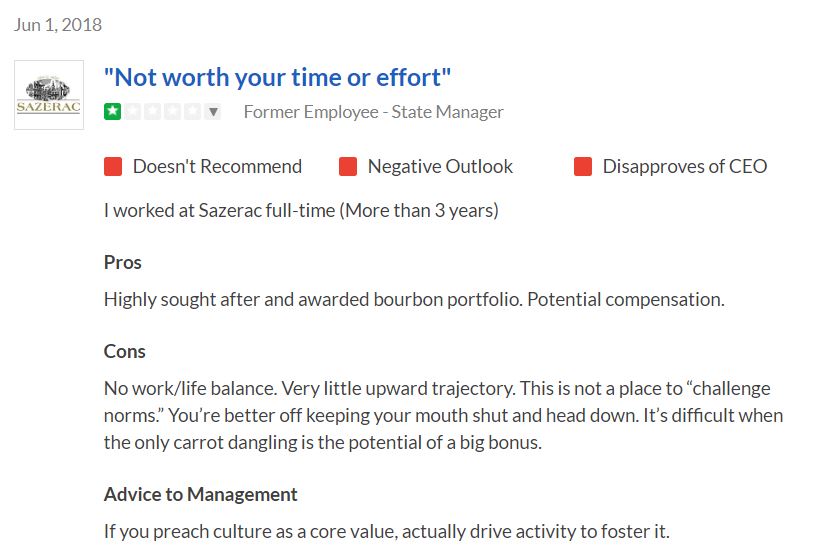
Consequently, and just for the hell of it, readers are invited to examine the statements at these two web sites devoted in part to employee ratings of the workplace environment.

Sazerac at Glassdoor


Sazerac at Indeed


I'm taking a balanced view of tonight's proceedings. The deal surely is inevitable, having been played out behind the scenes for quite some time.

Consequently, allow me to note that amid the millions of dollars involved in such a deal, and the time it typically has taken to rig them, our local elected representatives officially will have been given a whole four days to scrutinize the numbers before voting on the abatements and incentives.

Yes: it's economic boilerplate of the sort that works like Viagra for campaign finance, and surely not the first time council members have heard of Sazerac; presumably Dear Leader's minions have been speaking confidentially to those expected to rubber stamp Sazerac's arrival, and swearing them to silence.

At the same time, the public appearance is very familiar. Months-long periods of great secrecy, followed by triumphal propaganda and the pressing urgency of an immediate deadline.

$66 million bottling facility planned for former Pillsbury plant, by Marty Finley (Louisville Business First)

An international alcoholic beverage company will open a bottling facility in the former Pillsbury plant in New Albany in a $66 million investment

Metairie, La.-based Sazerac Brands LLC will create 110 jobs at the new operation, which is dependent on the project receiving approval for tax credits. The company hopes to begin operations late this year, initially with 50 employees.

The plant is expected to be fully operational by the end of 2021, and the new jobs will pay an average wage of $24 an hour plus benefits.

Sazerac's portfolio includes Pappy Van Winkle, Buffalo Trace and many other brands. The company has an office in Louisville.

The company will expand its processing, blending, packaging and distribution capabilities at the plant. It would be its first project in Indiana and expand its presence near Kentucky, where it currently employs 1,000 or more people.

Jeff Conder, vice president of manufacturing for Sazerac Co., said the type of spirits that will be processed and bottled at the facility will be determined after the company acquires the plant, which is expected to occur in the coming weeks if the incentives are approved ...

Sunday, June 03, 2018

Here's why you shouldn't mow your lawn.

From the link.

I'm delighted to say that while we still mow the lawn, that's about as far as it goes. No watering, no fertilizer. The mower's electric; no spilled gasoline.

Actually, the gist of the article isn't so much to suggest a complete departure from mowing, but rather refraining from accepting the mass consumption of trinket-driven capitalism, and stop wasting resources on a patch of grass.

Those of you who manicure your lawns with tweezers, please consider getting help.

Hate Mowing Your Lawn? Good! Don’t Do It., by Ted Steinberg and Shannon Wright (The Nib)

It’s environmentally destructive and a huge waste of time. Let it go brown.

One gorgeous afternoon at Fest of Ale.


Someone I know came up to me yesterday at Fest Of Ale, looked around, and smiled broadly.

"It's like going to a reunion each year."

This wasn't the beer speaking. I'm not the most demonstrative individual, and yet there were a goodly number of vigorous "damned glad to see you" handshakes, and more than the usual hugs.

For a very long time, I existed in the minds of many people according to a particular frame of reference, this being the milieu of beer and the NABC businesses. There may have been a element in this of being typecast, stuck in the role I created for myself, although in truth it never bothered me much.

After all, somehow managing to be remunerated for drinking beer is a damned fine gig.

I've been out of it for three years. In the beginning, it was awkward on occasion, like after a divorce. Perhaps this is why I couldn't bring myself to attend Fest Of Ale during this period. The last time before yesterday was 2014 at St. Anthony's in Clarksville, with the NABC delegation.

Consequently, it was good to see so many folks I haven't seen in a while. On the one hand, outdoor beer festivals in summer haven't entirely reclaimed their allure for me. However, it helps a lot to be within walking distance, and the heat wasn't bad yesterday.

As someone who has attended dozens of beer fests, take my word for it: Fest of Ale gets it done the right way. This really is a signature locale event, perhaps smallish by national standards, but plenty big enough to offer numerous beer sampling options without sacrificing the intimacy of an annual "reunion." The vibe was positive, and the crowd well-behaved.

That's all. Congrats for a job well done -- again -- to Todd Antz and everyone at Keg Liquors.

Melancholy reflections: "Celebrating Berlin’s Typography, Before It Vanishes."

From Atlas Obscura's article.

Perhaps we all harbor selected minor fascinations, all the while knowing we'll never gain more than an ephemeral knowledge of them. Typography's like that for me.

Ty­pog­ra­phy is the vi­sual com­po­nent of the writ­ten word.

A text is a se­quence of words. A text stays the same no mat­ter how it’s ren­dered. Con­sider the sen­tence “I like pizza.” I can print that text on a piece of pa­per, or read it aloud, or save it in a file on my lap­top. It’ll be the same text, just ren­dered dif­fer­ent ways—vi­su­ally, au­di­bly, digitally.

But when “I like pizza” is printed, ty­pog­ra­phy gets in­volved. All vi­su­ally dis­played text in­volves ty­pog­ra­phy—whether it’s on pa­per, a com­puter screen, or a billboard.

It's my guess that typography never occurred to me until I had spent ample time in Europe. At some point, I began to notice these visual distinctions. Appropriately, divided Berlin was a bountiful place to note the differences to be found between West and East.

Reading this article is a melancholy experience. Soon, when I get around to digitizing the slides from Berlin in 1989, a stiff drink may be required.

Celebrating Berlin’s Typography, Before It Vanishes, by Anika Burgess (Atlas Obscura)

A tour of the city’s most striking signs.

Jesse Simon was walking around Berlin’s Lichtenrade district one summer evening in 2016 when he had a epiphany. He’d done a lot of exploring since he’d arrived in the city four years earlier. He’d wandered through different neighborhoods and, as a former graphic designer, had noticed signs across the city: street signs, signs for public transport, storefronts. He’d even been thinking about writing a book on how Berlin’s typography contributed to its visual identity. And then he strolled past a seemingly innocuous brick-fronted store.

“I came across a sign for a shop called Betten-König, an exquisite, yellow, cursive neon sign attached to the façade of what otherwise looked to be a fairly modest shop,” Simon recalls. “Something snapped into focus.” He realized that he’d been thinking about Berlin’s civic and commercial signs only in terms of their function. And yet, “this Betten-König sign, which seemed somehow too grand and too glorious for its purpose, was doing something entirely different. It brought a kind of joyous irreverence to the street,” he says.

This realization led Simon to launch Berlin Typography, a project that documents his city’s typographic glories. “There were dozens, perhaps hundreds of similarly wonderful signs—highly individual, sometimes deeply quirky, often strikingly beautiful—scattered throughout the city. I had walked past them countless times, but had never registered quite how much they contributed to the character of the street and the city.”

There was another motivation for the project, too. Berlin currently has the fastest-growing property market in the world. Its economy is thriving, and as a city rapidly changes, so too do its signs. To Simon, Berlin’s signs “offered a direct line to a different city, a version of Berlin that had once existed but had now almost completely vanished. I felt the need to start documenting these artifacts before it was too late.”

He began to explore Berlin anew, this time armed with a camera. “Since then I’ve been trying to cover as much of the city as possible, and the more places I visit, the more I begin to understand the patterns and themes that give Berlin’s typography its own particular character.”

Simon now has, he estimates, around 3,500 photos of Berlin’s civic and commercial signs, and there is still much to document. “Instead of writing a book I ended up taking a bunch of pictures, which, in terms of writing, is an impressive feat of procrastination,” he says. “But the text will come eventually. In the meantime, there are the images, which I hope convey something of the joys and delights of Berlin’s typographic legacy.”

Atlas Obscura spoke to Simon about typographic patterns, the difference in sign styles between the former East Berlin and the former West Berlin, and how the city’s booming property market is altering its visual landscape. You can see more of Berlin Typography on Twitter or Instagram.

Top Ten posts at NA Confidential for May 2018.

Puffed-up pillars' pilferage landed at No. 1.

Thanks for reading NA Confidential, where we enjoy reconnoitering the neglected periphery for uniquely local perspectives on life in New Albany.

City Hall's allegations to the contrary, it can be grasped quite clearly that hundreds of you are reading, and we believe this fact attests to a keen ongoing interest in grassroots New Albany stories, perhaps because they're being chronically under-served elsewhere. After all, fawning stenography and inexorably multiplying religion columnists can get a newspaper only so far.

The May list begins with five "honorable mention" posts, before concluding with the Top Ten, escalating to No. 1. These statistics are derived from Google's internal accounting.

MAY HONORABLE MENTION (5)

488

Gahan Money Machine: The Beam, Longest and Neff firm takes its turn at the wheel of the mayor's gravy train.


As you might expect, crumbs from the absurdly titled Mt. Tabor Road Restoration and Pedestrian Safety Project (did Pinocchio Rosenbarger coin that gem of purely Orwellian Newspeak?) conveniently landed in the mayor's re-election piggy bank.

---

550

"Kevin Hammersmith loved the local community and Floyd County Parks system."


I'm a cynic by inclination and preference, but it doesn't preclude me from being happy that there's a park named for Kevin Hammersmith.

I'm also glad the county pushed and completed this project. If Gahan had gotten hold of it, the park probably would be called the Lanz Dome.

---

551

You keep singing "My Old Kentucky Home." I do not think it means what you think it means.


“It was a fantastic way to market Kentucky, which at the time had this reputation of being violent and corrupt and poor and a mess.”

The more things change, the more they stay exactly the same ... look, I'm always reluctant to trouble the revelers with facts, but here goes.

---

628

Comments to city council: "Let’s talk about Develop New Albany’s second edition of the Taco Walk."


I’d like to ask at what point this organization, which I believe still receives a funding tithe each year from the city, is held accountable for matters like these – like cultural appropriation and infringement of intellectual property rights, or is it fine so long as that mayoral anchor seal of approval is hanging around their necks?

---

712

This just in: "I urge We Are New Albany supporters to back LaMicra Martin in tomorrow's primary."


Moments ago, We Are New Albany posted two social media statements. Above is the list of candidates in tomorrow's primary who have made a public statement addressing the future of pubic housing in the wake of Mayor Jeff Gahan's hostile takeover of the New Albany Housing Authority.

MAY TOP TEN

744

Voter turnout yesterday in Floyd County was marginally better, but still pretty bad.


---

765

Following up: "An Indiana county is paying a steep price for burying toxic coal ash." That's us, folks.


Kudos to Bob Frederick for keeping this story alive. He went through a fair amount of crap, but today's piece in the CJ has to feel like vindication for him.

---

871

Panel of polemicists proposes an exciting non-Reisz city hall relocation idea.


These adaptive reuse pieces took a while to come together, but now it's my pleasure to offer an viable alternative to David Barksdale's City Hall's plan (or is it David Barksdale's City Hall's plan -- so very confused) to deploy millions of back-scratching dominoes (and dollars) so that the neglected/dilapidated Reisz furniture building might be used for city offices.

---

897

On Spring Street today by Breakwater, a bicyclist riding in a bike lane was hit by a driver.


A friend just wrote that her husband was riding his bike home from work this afternoon on Spring Street and was hit by a driver, who claimed to be "watching for cars, not bikes" while pulling into Spring from a side street.

---

1,031

Bicycles and sidewalks? As always, New Albany's legal stance is as clear as mud -- and City Hall gazes at the ceiling.


We've all been here before, but the fake factoids never cease, so let's have another look at the question of whether it is legal to ride a bicycle on the sidewalk in New Albany. Not unexpectedly in a state with its own contradictory laws, sections of the official code of ordinances in New Albany don't jibe.

---

1,176

From the makers of Fireball Cinnamon Whiskey: "The old Pillsbury Plant becomes the new home for Sazerac Company."


The devil remained firmly within the nooks and crannies of the details, and until we know how much Sazerac's arrival will cost us, prudence is the rule. This noted, Sazerac's investment at the former Pillsbury has the potential to be a good thing.

Let's take a brief look at Sazerac. First, the company.

---

1,624

Remembering Chloe Allen -- and the unfinished task of making streets safe for all users, not just drivers.


As the late Chloe Allen's former neighbor pointed out yesterday, the second anniversary of her tragic death fell on squarely on Mother's Day.

It's also the second anniversary of Mayor Jeff Gahan's refusal to say her name aloud, or even to acknowledge her passing.

I'm sure that's just a coincidence. I thought it prudent to wait a bit before mentioning it, and asking: Is the intersection in question safer now? Perhaps marginally. It's still a terrifying place to watch the very worst that drivers can be.

---

1,908

The former Comfy Cow location will become a bar, but we have no further details.


---

2,709

Let's all eat at Israel's Delicias de Mexico Gourmet on Saturday, May 19.


If you're not planning on Taco Walking and still need to eat at some point on Saturday, May 19, allow me to suggest that while it isn't located in the epicenter of downtown New Albany, Israel's Delicias de Mexico Gourmet (1515 E. Market Street) would be a great place to have a meal.

---

3,459

"This girl’s idea was not hers anymore": Taco Walk's real founder explains how Develop New Albany stole her idea, as Jeff Gahan looked on, grinning.


Kelly's to be commended for channeling her anger into positive action. What happened to her last year makes me want to start tossing Molotov cocktails. Team Gahan's unaccountable cliquish minions keep empowering DNA's unaccountable bad behavior, which is embarrassing by junior high school standards, much less coming from an organization that purports to "lead."

How do these people sleep at night?

Saturday, June 02, 2018

BEER WITH A SOCIALIST: That time in 2003 when we rode bicycles to Schneider Weisse.

The return to Schneider by bus in 2004.

In the summer of 2003, I packed my bicycle in the hard shell case and flew to Germany, arriving in Frankfurt and eventually riding all the way to Vienna. That's more than 500 miles. Friends joined me at various points along the way, and it was a blast. A couple of us then took the train back through Salzburg to Munich, and north to Bamberg for a few more days of riding, beer and pork -- not necessarily in that order.

The whole story lies far beyond my limited aims today, although in retrospect, it strikes me as curious that the tale is one I've seldom told, at least in writing.

Perhaps it should be noted that the stated pretext for these five weeks abroad -- my longest continuous time in Europe since the 1991-92 teaching gig in Czechoslovakia -- was to mark my divorce. Maybe that's why I've given it short shrift, although the ride was intended to be about thinking and reflecting, and this is the way it played out.

Beats me.

But: probably far more than all the psychobabble, the bicycling journey in 2003 was something I just had to do, all for myself, melding my love of travel with what, at the time, was a blossoming appreciation of the bicycle's awesomeness as a vehicle of discovery. Bikes, beer and Europe ... even 15 years later, it's hard to improve on this combination.

As an aside, in those days I didn't yet own a digital camera. Somewhere are photos waiting to be scanned. Maybe they'll reveal more.

Anyway ... at Pints&union, we'll be carrying bottled Schneider Weisse and Aventinus, two world classic wheat ales. Back in 2003 at the Public House, we'd been carrying the Schneider brewery's line since it first became available via the B. United wholesale house, and naturally it was to B. United that I directed a pre-trip inquiry: might my friends and I get a tour of Schneider while cycling?

I'd planned a route through the beautiful valley of the Altmühl River, and Kelheim marks the confluence of the Altmühl and the Danube. Just a few miles away is the Kloster Weltenberg, itself an amazing and picturesque monastery and brewery.

The brewery was amenable -- and would we like them to make reservations for us at an affiliated hostelry in Kelheim?

Summer arrived, and the three of us (Tim and Craig had merged with me at Gunzenhausen) came pedaling into Kelheim a day early, but the hotel booked by the brewery had available rooms, which meant we'd be staying three nights instead of two. The brewery tour was wonderful, and we made to Kloster Weltenberg, which was accessible by foot, bike, boat or bus.

When it came time to move on to Regensburg, there was a surprise waiting at the front desk. The bill for the three of us was zero. Null. Schneider picked up the rooms for us. I think there may have been a meal or two and some beers included.

Yes, I sold the brewery's beer in Indiana, but after three days of hospitality in Kelheim, Schneider probably lost money on the account. But I've never forgotten it, and never will.

I'm a Schneider loyalist for life. Alworth's a great writer; time to learn about German-style wheat ale.

Schneider Weisse: Wheat Beer’s Last Stand, by Jeff Alworth (All About Beer)

The village of Kelheim, smack dab in the center of Bavaria, does not appear to be hallowed ground. It has the same tidy, charming appearance of so many little towns that dot the Bavarian countryside. True, there’s a larger-than-average brewery just to the east of the town square and, true, it does announce itself as a maker of wheat ales—unexpected in lager country. But wheat beer (known variously as weizen or weissbier) is available at every beer hall in Bavaria; surely this isn’t that special?

To the contrary; G. Schneider & Sohn is where wheat beer made its last stand, and the flagship brewed there, Schneider Weisse, is one of the most interesting and important beers still made in the world.

The history, the style, and the beer are so interesting, in fact, one hardly knows where to begin.

Remember, Fest of Ale is today at the Riverfront Amphitheater.


Todd Antz posted earlier:

There are still a few Fest of Ale tickets available today at both Keg Liquors locations and online.

We also have a handful of bus tickets available from Drake's St. Matthews and Pearl Street Tap House in Jeffersonville. Bus tickets will go off sale at noon.

The fest runs from 3:00 to 7:00 p.m., and the weather looks to be ideal. I'd act quickly if you're still in need of tickets.

ON THE AVENUES: Long live Keg Liquors Fest of Ale, an indisputable annual beer institution.

If you're going to Fest of Ale today, perhaps we'll see each other. I'll be representing Food & Dining Magazine, and Joe Phillips will be on hand to chat about Pints&union.

Don't forget the after party at Gospel Bird:

Friday, June 01, 2018

Free bus rides? "It is a question of political priority."


I keep returning to stories like these.

"On July 1, the entire country of Estonia will create the largest 24/7 free public transit zone in the world."


Starting in November, Madrid will make clear that downtown streets are not for drivers.


Also, I keep returning to a rant: until the moment when the Regional Development Authority begins talking about mobility solutions that involve modes of transportation like buses and light rail, as opposed to more of the same passenger cars with only the driver inside, then I'm not taking the RDA seriously.

Dant Chesser hits the Gahan ATM and solves the oligarchs' RDA funding puzzle.


What can I say, Wendy. I'm a Europhile social democratic liberal arts/humanities major.

This Petite French Town Turned a Stadium Boondoggle Into Free Public Transportation, by Laura Bliss (CityLab)

“It is a question of political priority.”

Dunkirk is a shrinking, suburban city on the northern coast of France. It’s a car town, where public buses are a mode of last resort: They represent only five percent of trips.

But when Patrice Vergriete ran for mayor in 2014, he envisioned something different: a sustainable city that allures and serves young people, families, and the elderly alike. So he made a radical campaign promise, which he thinks helped him win: make the buses free.

“I wanted to give back purchasing power to the families,” Vergriete says in an interview at CityLab Paris.

In 2015, Vergriete’s administration launched free weekend service. It was a popular move: Saturday ridership increased by 30 percent, and Sunday ridership by some 80 percent. People loved it, telling local media that they saved money and time by avoiding the stress of parking.

What’s more, passengers diversified. Before, transit in the Dunkirk area had been solely the province of the poor, the elderly, and young students. Now professionals and families—car owners, in other words—began to ride, too. They scarcely considered transit over driving when both modes cost them money, even if bus fare was as cheap €1.40, according to Vergriete. But a totally free option “made people stop and think,” he said.

Now buses in the Dunkirk region will be fully gratis, seven days a week, starting in September 2018. Dunkirk will be the largest city in France to offer such a service (though it won’t be the first).

Some people can’t believe the metro can afford it, Vergriete says. “They think it’s like magic,” he says. “They think it’s not possible, that you are a liar. You cannot pay the salaries of the drivers, for the buses, with free transport.”

But rider fares only ever made up about 10 percent of transit’s operating budget, which is about €50 million per year, he explains. The rest come from a special transport tax levied on businesses and the regional government’s operating general budget. Transit systems all over the world operate on similar budget breakdowns, where “farebox recovery” is quite low. When riders are already paying so little, “I think mayors should think about making it free,” he said. “It’s really a choice that we are making to charge” ...

Solidarity with the Communications Workers of America union members picketing AT&T on Spring Street.


I was walking up Spring Street earlier and stopped to chat with the Communication Workers of America (CWA) union members who are on strike and picketing AT&T. I'm not positive, but I think they're from Local 4703.

It was a pleasure to hear their case, and I wish them the best. Lots of passing drivers were honking in solidarity.

This post from May 11 explains the issue.

CWA Authorizes Strike Against AT&T

The CWA takes action to speed up contract talks while filing an Unfair Labor Practice Charge against the Company

This week, CWA filed unfair labor practice (ULP) charges against AT&T and NABET-CWA employer Nexstar Media Group for refusing to provide information about each company's plan to use its tax windfall to invest in its workforce.

Before the Tax Cuts and Jobs Act passed, AT&T promised that corporations would use their massive gains from the bill to raise wages and create "7,000 good jobs for the middle class." Instead, just days after the tax bill became law, the company announced more than 1,500 layoffs, and has continued to stonewall workers fighting to protect U.S. jobs at the bargaining table – despite receiving $20 billion as a result of the tax bill.

The charges are the latest escalation of efforts to hold corporations accountable at the bargaining table for the tax bill promises they made. In recent months, CWA and other unions have filed information requests to find out if increased corporate profits from the tax bill are really going to raise wages and create jobs.

CWA's Executive Board has voted to authorize a potential strike by 14,000 workers covered by AT&T’s Midwest and Legacy T contracts, an action that gives CWA President Chris Shelton the go-ahead to set a strike date if an agreement can't be reached. Workers voted on April 10 to authorize a strike.

As AT&T faces scrutiny for paying $600,000 to Trump attorney Michael Cohen, the company continues to stonewall workers at the bargaining table over the need for good, family supporting jobs.

"AT&T paid six-figure sums to a shady consultant who provided nothing of value to the company but is unwilling to commit to family-supporting jobs in the communities that it serves," said CWA District 4 Vice President Linda L. Hinton. "If AT&T refuses to protect the good jobs that support our families and communities, our members will take action. AT&T promised to invest in its U.S. workforce if the GOP tax bill passed. We're going to hold them to that promise – even if it means going on strike."

"AT&T's claims that Michael Cohen did 'real work' for the company are laughable," said Lisa Bolton, Vice President of CWA Telecommunication and Technologies. "We know who does the real work at AT&T – our members. It's time for the company to agree to a fair contract that provides good jobs with affordable benefits."

AT&T CEO Randall Stephenson promised to create 7,000 jobs if the GOP tax plan passed. Instead, despite a $20 billion windfall as a result of tax cuts in the bill, AT&T announced thousands of layoffs. The layoffs come as the company continues to eliminate good, middle-class jobs and rely increasingly on low-wage contractors overseas, devastating families and communities across America.

Before the Republican tax bill passed, AT&T CEO Randall Stephenson promised that every $1 billion in tax savings would create “7,000 good jobs for the middle class.” Instead, just days after the tax bill became law, the company announced more than 1,500 layoffs – compounding workers’ concerns about the company’s practice of shifting work to low-wage overseas contractors, which many believe is hurting the quality of service and damaging AT&T’s brand. The company’s touted investment of just $1 billion on capital projects and one-time $1,000 bonuses to employees is equivalent to just 7% of its expected annual profit from the cuts. Overall jobs numbers at AT&T are down 29,000 from two years ago.

While AT&T refuses to release details about plans for its $20 billion in tax savings, a recent report from CWA found that AT&T has closed 44 call centers and eliminated 16,000 call center jobs in the last seven years. The report reveals the devastating impact of recent call center closures across the Midwest, an area that has been particularly hard hit by closures and layoffs. Meanwhile, the company’s latest quarterly earnings report reveals $4.7 billion in profits and indicates that AT&T is spending more than ever on dividends and buybacks.

The AT&T Midwest contract covers workers in Ohio, Michigan, Illinois, Indiana, and Wisconsin, while the Legacy T contract covers workers nationwide. Both contracts expired on April 14, 2018.

Attention, News & Tribune: "Politicos take liberties when it’s nobody’s job to hold them accountable."


"Those civic watchdogs make a difference to the bottom line."

Hence my recurring point. As newspapers like the News and Tribune become forever more oriented toward human interest stories and whatever bells and whistles impel web clicks, local government coverage devolves into stenography.

Straight up: The News and Tribune abdicates its civic watchdog role more often than not.

But you're saying wait -- this CityLab article is about newspapers that shut down; we still have half a local newspaper in New Albany

Maybe half. More like one-fourth. When the Tribune and Evening News merged, the main office was established in Jeffersonville, and I believe it's a foregone conclusion that the center of gravity shifted east with it.

Take solace. The return of the newspaper's cooking school, some sort of pet adoption scheme or even a Chalupa Walk surely lies just around the corner.

The Hidden Costs of Losing Your City's Newspaper, by Kriston Capps (CityLab)

Without watchdogs, government costs go up, according to new research.

When local newspapers shut their doors, communities lose out. People and their stories can’t find coverage. Politicos take liberties when it’s nobody’s job to hold them accountable. What the public doesn’t know winds up hurting them. The city feels poorer, politically and culturally.

According to a new working paper, local news deserts lose out financially, too. Cities where newspapers closed up shop saw increases in government costs as a result of the lack of scrutiny over local deals, say researchers who tracked the decline of local news outlets between 1996 and 2015.

Disruptions in local news coverage are soon followed by higher long-term borrowing costs for cities. Costs for bonds can rise as much as 11 basis points after the closure of a local newspaper—a finding that can’t be attributed to other underlying economic conditions, the authors say. Those civic watchdogs make a difference to the bottom line ...