Showing posts with label incentives. Show all posts

Friday, April 12, 2019

HMS Maritime's downtown expansion is a positive development, one largely omitting City Hall.


As preface, kindly note that I'm entirely down with HMS Maritime's expansion, its purchase of a downtown building and the notion of rehabbing it.

It's a perfect example of the sort of jobs that David White will be far better placed to attract to New Albany, whether by cooperating with the Indiana Economic Development Corporation (IEDC) and One Southern Indiana or on his own.

But that's a discussion for another time. As for HMS Maritime, I'm intrigued by the contrasting versions of the press release made available today.

There was a full-length press release from the IEDC amid the customary One Southern Indiana preening, but interestingly, the News and Tribune apparently edited it owing to space restrictions. In the latter's version, City Hall's role (exceedingly slight already) in enticing this expansion is rewritten and reduced to the final sentence.

The city of New Albany is considering additional incentives at the request of One Southern Indiana.

Note also the difference in banners, both identifying the company in question and stipulating finality in the transaction.

News and Tribune: "Global Marine Management and Operations Co. expanding in New Albany."

IEDC: "HMS Global Maritime Considers New Albany for Training/Customer Support Center."

Are we to surmise that with all other state incentives duly awarded, genuine "done deal" finality awaits the city's "additional incentives at the request of One Southern Indiana?"

Here's the News and Tribune text, which pleasingly omits a measure of self-glorification on the part of the suits. Congrats to whomever wielded the word ax.

---

NEW ALBANY — HMS Global Maritime, an Indiana-based marine management and operations company, and its affiliate, American Queen Steamboat Co., announced plans today to expand in New Albany, creating up to 50 new jobs by the end of 2022.

"Businesses like HMS Global Maritime and American Queen Steamboat Company are vital to Indiana’s success, helping propel the state’s economy and enriching their communities by providing quality career opportunities for Hoosiers,” said Indiana Economic Development Corporation (IEDC) President Elaine Bedel. “This commitment is an exciting step forward for Indiana, where our transportation and logistics industry is thriving in the Crossroads of America, as well as for the New Albany community, which continues to invest in its quality of place to support a growing talent base.”

HMS Global Maritime and American Queen Steamboat Co., HMS Global Maritime's overnight cruise division, plan to invest nearly $800,000 over the next few years to renovate and equip a recently-purchased, 10,000-square-foot historic building at 213 Pearl St. in downtown New Albany. The new facility will house a training and customer service center for American Queen Steamboat, which will accommodate 200 to 300 hospitality and hotel trainees annually. Construction is underway, and the new facility is expected to be fully operational by the fall of this year.

HMS Global Maritime and its affiliates, including American Queen Steamboat, employ 56 associates in Indiana across two existing New Albany facilities and a warehouse in Clark County. With this increased footprint, the companies will scale their teams in Indiana to support operations across the country. Hiring is expected to begin this summer with new positions in customer service and hospitality training. Interested applicants may go online to apply for open positions.

"At HMS Global Maritime and American Queen Steamboat Company, our philosophy is to push ourselves to not only be a world-class company, but to commit to delivering an uncompromising customer experience by providing our employees the very best in training, support and skills to be successful," said John Waggoner, HMS Global Maritime president and CEO. "This proposed training center in the heart of downtown New Albany would not only help us maintain the quality workforce we need to succeed, but also bring hundreds of visitors to our hometown annually. It is the very definition of a win-win situation."

HMS Global Maritime is a family of international, hospitality and support companies that serve government, private industry and direct consumers. The company provides a variety of services from project consulting to turn key management. HMS Global Maritime has experienced substantial growth in its overnight cruise division over the past eight years and has built the American Queen Steamboat Company from the ground up to more than $100 million in annual revenue.

The IEDC offered HMS Global Maritime up to $400,000 in conditional tax credits and up to $50,000 through the Hoosier Business Investment (HBI) tax credit program based on the company's job creation and investment plans. These tax credits are performance-based, meaning until Hoosiers are hired or until qualified investments are made, the company is not eligible to claim incentives. The city of New Albany is considering additional incentives at the request of One Southern Indiana.

Friday, March 08, 2019

"Strong Towns is taking an in-depth look at the land tax and how it can incentivize a healthier, more resilient pattern of growth and reinvestment in cities."

Why these spaces stay red.

This week Strong Towns has started a series of articles pointing to the disadvantages of property taxation in an urban context, as compared to advantages from using a land tax instead (or a hybridized approach). These issues directly address our eternal blog questions: Why isn't this building owner taking care of his property -- and why isn't THAT building owner putting something on his eyesore vacant lot?

This is utterly fascinating.

This week, Strong Towns is taking an in-depth look at the land tax and how it can incentivize a healthier, more resilient pattern of growth and reinvestment in cities.
This series is sponsored by the generous support of the Robert Schalkenbach Foundation (RSF).

As an introduction, this. I'll be re-reading all of these links -- and the series continues next week.

What's With That Empty Lot in the Heart of the City? by Daniel Herriges (Strong Towns)

 ... Taxing Building Improvements is a Gift to Speculators

A parking lot in a bustling downtown is the classic example of a property where nearly all of the value is in the land itself, not the asphalt on top of it. In a rising market, you can hold onto the land and watch its value go steadily up (thanks to all the things your neighbors are doing to make the place more productive and successful). You can collect enough in parking fees to cover the taxes, and cash out when you're ready to cash out. Your property tax bill will be relatively low, because it's based on the sum of land value and improvements. The land may be in a central, prized location, but the "improvements" on the property (that's tax-assessor speak for any sort of structure built on the land) are worth next to zero.

The result of this logic when you extend it to dozens or hundreds of properties is that land goes under-utilized, even in extremely valuable locations like downtown Austin—the fastest-growing large city in America. This kind of land speculation creates additional scarcity downtown, and pushes more new development to the outskirts of the city, where it incurs more infrastructure costs, more miles of driving on the part of individuals, and more gobbling up of farmland for suburban expansion ...

 ... Taxing Land, Not Improvements, Leads to More Productive Uses

 This doesn't have to mean raising taxes overall. Rather, cities can redistribute the burden of property taxes by either taxing only the land, or taxing the land at a much higher percentage rate than the improvements. The latter is called a split-rate property tax.

This way, those who wish to build or renovate something on their property will face no tax penalty for doing so. And those who wish to hold onto a vacant lot or use it for something low-value like parking—in effect freeloading off of the location value created by the productive uses to which their neighbors have put nearby land—will face a much higher tax burden.

Tuesday, June 05, 2018

Mayor Gahan AWOL as council inks corporate welfare package for Sazerac.


A few odds and ends, and then we'll all kick back to watch the epochal panacea unfold.

"Distillery to located in old Pillsbury plant."

In the newspaper's photo caption and the text, it is made perfectly clear that Sazerac will not be distilling at the former Pillsbury, and yet the subheader persists in the misconception. It also omits the second half of the verb form, but let's not be churlish.

An aside to Greg Phipps: In comparative terms, General Mills is to Pillsbury's biscuits as Sazerac is to Boston Brands of Maine's liquor (in this instance, brandy, which is a specific type of liquor). If your objective is to begin renaming streets for the mayoral victory of the moment, then at least be consistent: Buffalo Trace Lane, to replace Pillsbury Lane.

Wait -- Buffalo Trace now is an art installation by the Summit Springs Strip Mine. I prefer Southern Comfort Avenue, anyway.

But at least Phipps' commemorative instincts are modest. If left to Bob Caesar, not a street, landmark or dumpster in the city would be safe from renaming in honor of operatives affiliated with One Southern Indiana, Team Gahan, Develop New Albany, or the council itself -- though only those reliable council members like Caesar, who is to the adolescent fluffing of functionaries as Elvis was to peanut butter & 'nanner sandwiches.

Last evening's carefully choreographed incentive package spectacle might well have been the single greatest "mere formality" ballot I've witnessed in 14 years of soul-deadening council observation, but if you'll pardon the blasphemy from the village atheist, if Jesus Christ himself materialized before council to announce the second coming, at least one or two questions still should be asked prior to the pre-arranged vote.

In the case of Sazerac:

  • Are these union jobs?
  • If $24 per hour is the average, can there be a more detailed breakdown of the wages?
  • Will there be any sort of public interface, for instance, a visitor center?
  • What are the implications for the railroad spur?

So on, and so forth, not to omit the most obvious of all: if Sazerac's advent is second only to the second coming, then can Jeff Gahan show up for once and not have an underling mouth his scripted platitudes?

New Albany City Council approves incentive deal for Sazerac, by Chris Morris (Omnibus Tom May)

Distillery Bottling to to be located in old Pillsbury plant

NEW ALBANY — The Sazerac Company is coming to New Albany.

One of the oldest, family-owned distilling companies in the United States made the announcement last week that it was purchasing the old Pillsbury plant with plans to phase in two to three packaging lines. That move was contingent on the New Albany City Council approving a resolution to provide tax abatements on both personal property and real estate. The council did that Monday night by a 9-0 vote and with plenty of praise for the company and those who brokered the deal.

"In my seven years this is one of the biggest things to happen to New Albany as far as bringing jobs in," Councilman Greg Phipps said.

He said the New Albany Board of Works may want to consider renaming Pillsbury Lane, the road where the plant is located, to Bourbon Lane.

"This is a major, major win for the community," Councilman Bob Caesar said.

City Council President Al Knable said prior to the meeting the incentives offered by the city total around $3 million ...

Monday, June 04, 2018

City council tonight: "Fireball Cinnamon Whisky Presents Mayor Jeff Gahan Presenting Karaoke in Bicentennial Park."


It's my guess that at tonight's city council meeting, there'll be joyous and sweeping approval of the incentives sought by Sazerac of Indiana to complete its purchase of the former Pillsbury plant on Grant Line Road.

INTRODUCTION OF RESOLUTIONS:

R-18-04 Resolution Concerning Statement of Benefits for Real Property and Personal Property for Sazerac of Indiana, LLC by the Common Council of the City of New Albany (Caesar)

I can picture Dan Coffey asking a few questions about the wisdom of "anchoring" a local economy on booze, but beyond this, the discussion stands to be perfunctory amid palpable sighs of relief that the Indiana Economic Development Corporation has at long last bailed out a City Hall team most recently seen tossing $7 million worth of panic-stricken economic development IOUs at the exhaust fumes generated by General Mills' moving vans.

Since last week's announcement, observers have been uniformly dazzled by Sazaerac's promise of jobs with an "average" wage of $24 an hour. Cynics like me might ask whether this average is calculated by including the remuneration for William Goldring, the company's owner (worth $3.9 billion at last glance); or, perhaps more appropriately, given the union jobs lost at the defunct Pillsbury, whether any of these new jobs come with union agreements.

Brief research reveals no information for a bottling and packaging facility like that projected for New Albany. According to a 2016 article by bourbon business writer Fred Minnick, the union agreements at Sazarac's distilleries in Kentucky (1792 Barton and Buffalo Trace) are “confidential.”

At least they exist. Of course, there'll be no distilling in New Albany (except at Donum Dei, around the corner).

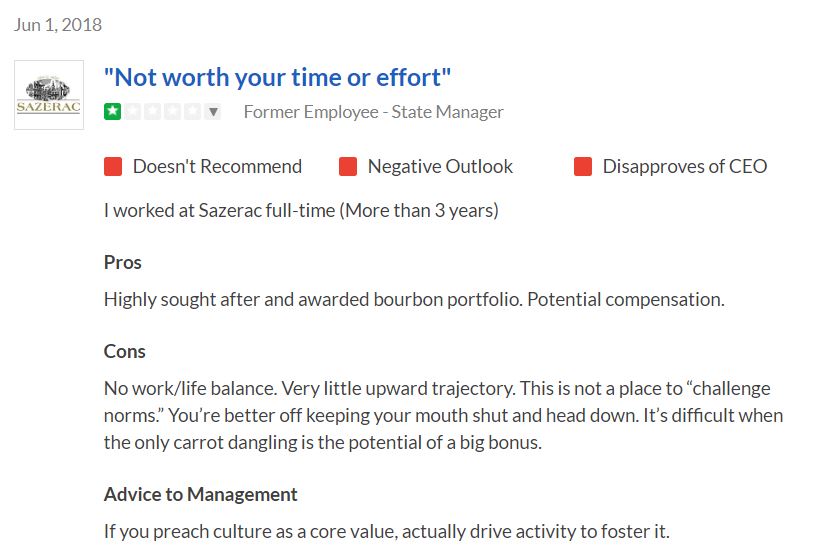
Consequently, and just for the hell of it, readers are invited to examine the statements at these two web sites devoted in part to employee ratings of the workplace environment.

Sazerac at Glassdoor


Sazerac at Indeed


I'm taking a balanced view of tonight's proceedings. The deal surely is inevitable, having been played out behind the scenes for quite some time.

Consequently, allow me to note that amid the millions of dollars involved in such a deal, and the time it typically has taken to rig them, our local elected representatives officially will have been given a whole four days to scrutinize the numbers before voting on the abatements and incentives.

Yes: it's economic boilerplate of the sort that works like Viagra for campaign finance, and surely not the first time council members have heard of Sazerac; presumably Dear Leader's minions have been speaking confidentially to those expected to rubber stamp Sazerac's arrival, and swearing them to silence.

At the same time, the public appearance is very familiar. Months-long periods of great secrecy, followed by triumphal propaganda and the pressing urgency of an immediate deadline.

$66 million bottling facility planned for former Pillsbury plant, by Marty Finley (Louisville Business First)

An international alcoholic beverage company will open a bottling facility in the former Pillsbury plant in New Albany in a $66 million investment

Metairie, La.-based Sazerac Brands LLC will create 110 jobs at the new operation, which is dependent on the project receiving approval for tax credits. The company hopes to begin operations late this year, initially with 50 employees.

The plant is expected to be fully operational by the end of 2021, and the new jobs will pay an average wage of $24 an hour plus benefits.

Sazerac's portfolio includes Pappy Van Winkle, Buffalo Trace and many other brands. The company has an office in Louisville.

The company will expand its processing, blending, packaging and distribution capabilities at the plant. It would be its first project in Indiana and expand its presence near Kentucky, where it currently employs 1,000 or more people.

Jeff Conder, vice president of manufacturing for Sazerac Co., said the type of spirits that will be processed and bottled at the facility will be determined after the company acquires the plant, which is expected to occur in the coming weeks if the incentives are approved ...

Sunday, May 20, 2018

A Sunday morning ON THE AVENUES encore: "Upscale residency at down-low prices."


The ON THE AVENUES column from 2015 reprinted here came to mind as I was reading about grassroots initiatives in Akron.

In Akron: "City hall is listening to small businesses, neighborhood groups and outside experts."

Here in New Albany, "business of residency" was an upscale Gahanesque buzz phrases for roughly ten minutes during an election year, soon to be discarded by anchor tattoos and supplanted by the mayor's hostile takeover of public housing, or, "the business of non-residency," at least for those stubbornly resisting Dear Leader's vision of upscale living for those capable of regular campaign finance installments.

Nature abhors a moron ...
-- HL Mencken

... except in New Albany.
-- Roger A. Baylor

---

February 19, 2015

ON THE AVENUES: Upscale residency at down-low prices.

A weekly web column by Roger A. Baylor.


“I am not a fan of books. I would never want a book's autograph. I am a proud non-reader of books."
– Kanye West, seeking a position in the New Albany economic development hierarchy

Previously in this space, we’ve examined the Gahan administration’s recurring vocabulary malfunction.

Who even knew that Dr. Pavlov had an office in the Elsby Building?

Obviously desperate to avoid revisiting uncomfortable days of yore in junior high, when the former Marine Corps drill instructor Mr. Buzzkilljoy required they memorize the precise meaning of words in the English language and regurgitate these definitions on demand, city officials in New Albany now delight in the deployment of banal and indeterminate code phrases suitable only for the approbation of the ever-eager stenographer cadre.

Quality of life, public safety and better access have been the most consistently overused of these meaningless bromides, and we await the inevitable resurrection of classic Orwellian gems of doublethink as local Democratic Party campaign slogans:

War is Peace
Freedom is Slavery
Ignorance is Strength
When You Wish Upon A Star/Makes No Difference Who You Are

Oops – sorry.

That last one obviously serves as the credo of the Redevelopment Commission, and any connection with the DemoDisneyDixiecrats is purely Dickeyensian.

---

Make a wish, blow out the candles, and welcome a new addition to the Gahan team’s tired lexicon.

Upscale.

Exactly what is meant by the word “upscale”? It might depend on one’s socioeconomic vantage point (rats, a penalty is assessed to me for using a seven syllable word within the city limits), but here is the dictionary’s point of view.

up•scale
ˌəpˈskāl/
adjective & adverb

NORTH AMERICAN

adjective: upscale; adverb: upscale

toward or relating to the more expensive or affluent sector of the market.

"Hawaii's upscale boutique hotels"

synonyms: deluxe, posh, ritzy, upper-class, classy, chi-chi; high-end, expensive, high-priced

Upscale is trending because just last week, in a grudgingly reluctant process akin to tapping maple trees and collecting sap, information about the proposed Coyle site development began seeping ever so slowly from City Hall’s propaganda directorate, located deep within the bowels of the Down Low Bunker.

But first, kindly note the irony.

Among other Gahan initiatives, some randomly sensible and others fully befitting the sort of vision generally experienced in the tuneless strumming of a Jimmy Buffett cover band, only the dormant-by-design Speck Downtown Street Network Plan both contextualizes and (perhaps, maybe, possibly) justifies the city’s involvement in the Coyle infill apartment project.

Naturally, while Gahan and his vacuous minions continue to treat the Speck proposals as though they were paper envelopes filled with free-range ricin, the announcement of “upscale” apartments was owned and groomed and feted by them like a Saudi sheik's first-born thoroughbred, proving yet again that they are the very worst civic actors in recent memory.

John Mattingly was positively Shakespearean by comparison ... or maybe it was Sicilian.

---

To reiterate, the major selling point of the Coyle site proposal thus far seems to rest on the undefined shoulders of that magic word.

Upscale.

The usage is intended to animate the extension of the pinky at a right angle from one’s grip of the ice-cold Bud Light longneck, to be wiggled while purring like a socialite:

“Not like those low-income housing credits, honey buns.”

Conceding that detailed plans haven’t yet found their way to NA Confidential, the problem is that early indicators like last week’s project drawings simply don’t speak to “upscale” at all, at least when the accepted meaning of words is respected. In fact, the proposed buildings don’t look appreciably different than ordinary blocks of middle class flats I’ve seen in dozens of European cities and more than a few American ones, too.

Regular reader W was specific.

When I think upscale, I think apartment balconies and patios should be deeper than the windows are wide. Just room enough for an 8" hibachi grill, maybe? The upscale apartment dwellers won't be able to sit in a lawn chair and enjoy the traffic zooming by on such a tiny sliver of concrete. That's quality of life?

Ah, but we’re still waiting on that particular definition, aren’t we?

The stacked, multi-story exterior staircases look deadly as well - "upscale" doesn't include secure elevators? Look at the end of the building, with the lovely, open air staircases.

"Hello, ‘upscale’ apartment tenant, climb the stairs with your bags of groceries that you had to drive somewhere to buy because there are no grocery stores near your ‘upscale’ apartments."

Oh, I know, all of these "upscale" tenants will eat out every night, because the tenants are just "better" - after all, they live in "upscale" apartments.

Walk up, multi-story flats aren't exactly upscale. Do you want people from the street to able to climb the stairs up to your front door and wait for you to come home when you're paying high end, "upscale" rent? What we're being told and what we're seeing doesn't add up.

Regrettably, math class posed its own grave difficulties, especially when all you wanted to do was go outside and play baseball.

The many differences between wishful-star-related thinking and hard reality also were sadly prominent the last time the city struck up a full-Sousa soundtrack and pledged fealty to a private, for-profit construction entity, this being Mainland’s ill-fated Riverview project, circa 2011-12.

Since then, there have been two major themes in what the mayor enjoys tidily euphemizing as “the business of residency” – and no, this phrase hasn’t been defined yet, either.

First, council creatures Bob Caesar and Kevin Zurschmiede would rather see a building collapse of its own neglect and/or grandiosely self-immolate than acquiesce in the consideration of low-income housing tax credits in its refurbishment.

Second, private developers like Matt Chalfant are pursuing living space rehabs without substantive financial incentivization based on a profit vs. loss instinct that looks disturbingly like capitalism.

What of City Hall's "business of residency"? Let’s go to Bluegill for the coda.

The only thing the Gahan/Duggins administration has proven particularly adept at so far is giving away massive amounts of public money to developers and corporations. This is just part and parcel.

If (developers) want to take on the risk and build within the existing rules that locals have to follow, they can build. We shouldn't be subsidizing them, especially given the many, more productive uses for local money. Honestly, we need to get over the whole upscale, raising property values gambit and all the trickle down approaches to it. You know who most cares if property values rise? People planning on taking money from the community and/or borrowing against it to go into more debt. It's just repeating the same cycle.

The only way to stop the concession extraction is to say no to concessions. Unfortunately, our current ED has spent his career doing little except for offering concessions. That's true, though, of the entire Democratic Party hereabouts. It's going to be especially funny if the Gahan administration tries to use a big handout as justification for better streets, making it about the developer rather than residents.

Is it time for an addition to A New Albanist’s Dictionary?*

Upscale
An imported construction project pursued with our own municipal funds, as opposed to state and federal low income housing tax credits, as standing in sharp contrast with the dilapidated condition of surrounding neighborhoods, which have been down so long that it looks like up to them.

Not that they'll ever read one.

---

* Volume One and Volume Two

Tuesday, October 24, 2017

Metro Louisville's pitch to Amazon promises “a quality of life second to none for every Amazonian.”


Dude.

Amazonian

Am·a·zo·ni·an

1. of, like, or characteristic of an Amazon
2. [oftena-] of an amazon; tall, strong, aggressive, etc.: said of a woman
3. of the Amazon River or the country around it

Promising (at least to me, given my proclivities), but maybe GLI, Wendy and the gang should have found a few liberal arts majors to work on the prose -- or pros, as opposed to amateurs.

Exclusive: Greater Louisville’s Amazon proposal, a great pitch, or a foul ball? (LEO Weekly)

We knew it would not be long before the local application for Amazon’s second headquarters was leaked, and it so happens that LEO got a peek at it — first.

The bid detailed on a six-part website, a collaboration of government and business leaders in Louisville, Kentucky and Southern Indiana, touts the region’s obvious, best selling point — location, location, location. It also employs expected hyperbole — “unprecedented collaboration with university and public administration partnerships, as well as strong incentives and easy transit.” Ha! “Easy transit …” And then there is the boast of “a quality of life second to none for every Amazonian.”

In what seemed like defeatist, meta, self-reflection, the introduction says picking Louisville involves “swinging for the fences” because we “may not be the obvious choice for Amazon, but we are the bold choice.” The phrasing and, as it turns out, much of the intro video, parrots Amazon CEO Jeff Bezos’ annual shareholder letter. Using his words is smart, perhaps, but once he gets the joke, will Bezos be willing to risk a $5 billion mistake… er, investment by coming here? ...

... Certainly, in the coming days and weeks, arguments will be had about the proposal’s content. We thought it would be instructive to take a critical look at how the proposal was presented — Did Louisville use its millisecond elevator pitch effectively, or has the door shut on us before we had a chance? So we asked someone from a local advertising agency for their thoughts (he asked to remain anonymous) ...

Previously:

Amazon's bid: More required reading that Wendy Dant Chesser and One Southern Indiana will add to their bonfire of the vacuities.

Friday, October 20, 2017

Amazon's bid: More required reading that Wendy Dant Chesser and One Southern Indiana will add to their bonfire of the vacuities.


Wendy is positively giddy -- and liberal arts degree holders should be scared.

Here’s what we know about Louisville’s Amazon bid, by Caitlin Bowling (Insider Louisville)

While other cities are publicly touting potential sites and incentives for Amazon’s secondary headquarters or crafting gimmicks to attract attention, the city of Louisville has remained relatively mum when it comes to its bid.

Louisville’s economic development arm Louisville Forward is spearheading the effort, but it has culled information from various other entities inside and outside of Jefferson County to help strengthen its proposal ...

... Wendy Dant Chesser, president and CEO of chamber of commerce One Southern Indiana, said the experience was fun because of the collaborative spirit surrounding it.

“If we can work together and be successful, we can all benefit from it,” she said. “We put in a package what I think is indicative of what the region has to offer. Now will it be enough? We will have to wait to hear from Amazon.”

It's always fun when you're playing with house (taxpayer) money. Now for that pesky fine print. I'm guessing there aren't copies of this article in the break room at 1Si.

Amazon’s Uneven Playing Field, by Olivia LaVecchia (Motherboard)

Amazon is looking for a big subsidy to build its new headquarters—the latest move in the company’s long history of using the government to get favors its rivals can’t.


In the hierarchy of the corporate world today, Amazon is near the top. It's one of the top five most valuable companies traded on the major exchanges, and founder and CEO Jeff Bezos is now the second-richest person in the world.

People tend to think that Amazon has gotten there simply by out-competing everyone else. But there's another part of the story of Amazon's rise. From the very beginning, a core part of Amazon's strategy has been taking advantage of public benefits not available to its competitors.

Now, bidding is set to close Thursday on the latest play in this strategy: Amazon's decision to launch a public auction for the location of its second North American headquarters. In that auction, Amazon is angling for such a substantial public handout that, as Amazon itself puts it in its Request for Proposals, the "magnitude may require special incentive legislation." Since Amazon opened bidding, more than 100 cities across the U.S. and Canada have publicly announced their interest in the Amazon sweepstakes, and have given over conference rooms and staff time to work on the bid, launched PR stunts, and started hashtags. Experts say that the end result of all of this hype could be a multi-billion dollar giveaway from taxpayers to Amazon.

Wednesday, March 08, 2017

This memo goes out to One Southern Indiana: "Handing Out Tax Breaks to Businesses Is Worse Than Useless."


With a courtesy copy to Mr. Duggins.

Handing Out Tax Breaks to Businesses Is Worse Than Useless, by Richard Florida (CityLab)

A new study exposes the futility of the $45 billion that states spend on economic development incentives.

Even before being sworn in as President, Donald Trump jumped up and down at the chance to showcase the great deal he and Vice-President Mike Pence made to keep a Carrier plant in Indiana. The company pocketed $7 million in tax breaks in exchange for about 800 jobs. But the broad consensus among economists who study the subject is that such business incentives do little to alter the location decisions of companies. In fact, they’re often worse than ineffective—they’re counterproductive. My own take on this site is that they are a useless waste of taxpayer dollars.

Timothy Bartik of the W.E. Upjohn Institute for Employment Research, who is perhaps the leading student of incentives and economic development, has a new report that provides the most detailed assessment of incentives across states and their effects on economic development. His database contributes a useful tool for state and local economic developers and others to take a hard look at incentives, what they cost, and whether they are worth it or not.

Stop me if you've heard this one before.

Basically, states hand over the money to companies and then do not even follow up to see if they are working or not. As Bartik puts it:

Incentives are still far too broadly provided to many firms that do not pay high wages, do not provide many jobs, and are unlikely to have research spinoffs. Too many incentives excessively sacrifice the long-term tax base of state and local economies. Too many incentives are refundable and without real budget limits. States devote relatively few resources to incentives that are services, such as customized job training. Based on past research, such services may be more cost-effective than cash in encouraging local job growth.

Saturday, July 09, 2016

Great Pyramid of Gahan planned for Summit Springs? Nah, it's just a Memphis thing.


It is with great hesitation that I link to this piece.

A pyramid at the apex of denuded Summit Springs would be plain tacky, although even I can see the symbolic advantages of a Sphinx ... but could we fit a Bass Pro Shop in one of those?

Pyramid Data, by Charles Marohn (Strong Towns)

... To briefly recap: A poor and declining city embracing the big project as their salvation builds a pyramid-shaped basketball stadium down on the Mississippi River in an attempt to attract an NBA team along with jobs, tax revenue and respect. NBA team relocates but is not enamored with the pyramid and winds up in a different facility. Pyramid sits empty. Silver bullet solutions abound – what else can be done when you’re this far vested – and with a disputed amount of subsidy (whenever I write about it, project proponents get angry with my numbers but we’re certainly talking in the nine digits) the pyramid is transformed into The Pyramid, a Bass Pro retail destination with amenities like a hotel, bowling alley and shooting range.

Tuesday, October 27, 2015

Large companies grab most incentives aimed at small businesses.


It shouldn't come as a surprise.

How Economic Development Incentives Hurt Small Businesses: States say they want to help independent businesses, but large companies take the majority of the dollars, by Richard Florida (City Lab)

 ... Billions of state and local economic incentive dollars seemingly aimed at small businesses flow instead to a few large, well-established, and well-connected businesses. This is yet another example of how the rapidly growing economic-development incentive game remains a perverse and useless waste of taxpayer money ...

... ultimately, the study found that large companies captured between 80 and 96 percent of these small-business incentives, depending on the state in question.

In simple terms, these large companies have become sophisticated at gaming incentive dollars—including those explicitly aimed elsewhere ...

Thursday, August 27, 2015

"How New Affordable Housing Development Incentives Could Change Louisville."

Today I'll be attending a candidate luncheon sponsored by the Southern Indiana Realtors Association. As such, this article is timely reading.

If you've ever asked the question, "But what do we do about The Project?" (code language if ever I've heard such), I'd recommend taking a look.

I don't have a simple, glib answer to this question, primarily because there isn't one. However, taking inventory of the principles involved and being willing to speak openly about them surely must constitute the first step toward understanding.

Has the local Democratic Party ever had anything coherent to say about these issues?

Didn't think so.

How New Affordable Housing Development Incentives Could Change Louisville, by Jacob Ryan (WFPL)

The Metro Council on Thursday will take up an ordinance that housing advocates say is imperative for expanding affordable housing options in the city.

At present, Louisville is a sharply segregated city with a zoning policy that may violate fair housing laws, said Cathy Hinko, executive director of the Metropolitan Housing Coalition. This vulnerability stems from zoning policies that ban development of certain housing types in some areas of the city.

The ordinance up for council consideration is seen by fair housing advocates as a first step to address these problems and give low-income residents more housing options outside of historically impoverished neighborhoods.

It’s a first step, Hinko said, but a big one.

Sunday, June 14, 2015

Whither boice.net and the Reisz Furniture Building?

The Reisz building in 2006.

The Green Mouse's ear turns to the rumorama, and specifically, a recent hint that New Albany's boice.net will purchase and rehabilitate the long-moribund Main Street structure known locally as the Reisz Furniture Building.

The rumor was relayed with a puzzling caveat: Boice would be compelled to quantify the amount of money the company intends to invest in restoring the building for contemporary use, to the tune of $3 - 4 million. But to whom is this as yet unverified commitment being made? Seller or city?

The rumor may or may not be true. However, if factual, the obvious question asks itself: Will boice.net be receiving enticement in the form of credits commensurate with sewer tap-in fees waived for the Indianapolis-based developer of apartments on the former Coyle site?

If not, a follow-up: As a city, why do we persist in subsidizing outside entities, and not empower ourselves?

At least we're not the only ones asking this question (emphasis ours).

Carmel to consider incentives for $60M development, by Chris Sikich (Indy Star)

Anderson Birkla is negotiating for tax incentives to build a mixed-use development costing up to $60 million at the former Party Time Rental site on land the city owns in Carmel.

Mayor Jim Brainard and the Carmel Redevelopment Commission have been searching for a partner to redevelop the 6.5-acre site into homes, offices and retail for years, as a component of the city's emerging downtown. The shuttered warehouse is in a prominent location along the Monon Parkway and Rangeline Road, south of City Hall and City Center.

The mayor and redevelopment officials believe the proposed public investment — valued at roughly $9.85 million — is crucial to completing the deal and adding a blighted property back onto the city's tax rolls.

"We always conduct a financial analysis of our redevelopment projects and feel strongly that this project is in the best long-term financial interest of the community," Brainard said. "Mixed-use projects such as this have consistently shown to generate far more tax revenues for the city than the amounts invested."

Critics of the mayor's redevelopment policies, though, continue to wonder how long the city will subsidize development before the private sector will build at market rate.

Saturday, May 09, 2015

The feds aren't alone in punishing small business, and locally, shift needs to happen.

Photo credit: Thought Pollution

Updated: Full text now reprinted below.

There is a persistent fallacy that small, local, independent business owners walk the earth with palms upturned, in search of easy handouts from government. It isn't true, and they don't -- although try to find larger corporations who'll be willing to even consider operating locally without the usual lush panoply of tax abatements and incentives.

In my experience, the vast majority of small, local, independent business operators seek only a level playing field, and for local government to maintain it. That's why we have police and fire departments. It's why using city streets to support grassroots economic development (the Speck plan) makes more sense than their continued existence as high-speed, pass-through routes. It's why the way we calculate sewer rates actually matters.

As it stands, New Albany's policies toward economic development sadly mirror Mitchell's central theme: They favor the bigger and more powerful, to the general exclusion of the smaller and more entrepreneurial.

Not a single Resch, Chalfant or Carter has received sewer tap-in waivers as they've invested millions in property rehabilitation, but one Indianapolis company has been given more than 150 waivers as incentive to build on the former Coyle site.

This isn't a level playing field. Not at all.

Conversely, economic localization reflects a commitment to self-sufficiency and sustainability, while also leveraging the community's chief assets in terms of talent and effort. It reinforces what makes us special, and what works right here, on the ground. It's another example of shift happening, and begs for encouragement.

When I'm mayor, you'll be seeing considerably more of it.

How Washington Punishes Small Business, by Stacy Mitchell and Fred Clements (Wall Street Journal)

Lawmakers love to talk about the little guy, but their policies routinely favor the big and powerful.

... Small businesses hold a special place in the American political imagination for reasons that go far beyond their ability to create jobs and nurture healthy neighborhoods. Two centuries ago, our forefathers and mothers dumped thousands of pounds of tea into Boston Harbor to protest British policies that gave the powerful East India Company an advantage over local tea merchants.

Ever since then we’ve rightly viewed independent businesses as essential to liberty and democracy, a safeguard against the tyranny of concentrated power. It’s time that lawmakers reflect that value, not only in their rhetoric, but in their actions.

Following is the full text of Mitchell's opinion.

Small business looms large in American political rhetoric. From the campaign trail to the floor of the U.S. House and Senate, members of Congress love to evoke the diner and dry cleaner, the neighborhood grocer and local hardware store. Ensuring the well-being of Main Street, we might easily assume, is one of their central policy aims.

The legislative track record tells another story. It is one in which the interests of big corporations are dominant, and many laws and regulations seem designed to bend the marketplace in their favor and put small, independent businesses at a competitive disadvantage.

Since the late 1990s, the overall market share of firms with fewer than 100 employees has fallen from 33% to 28%, according to U.S. Census data. There are nearly 80,000 fewer small retailers today than in 1999. Starting a new business also appears to have become harder. Despite their prominence in our tech-fueled imagination, the number of startups created annually fell by about 20% between the 1970s and the 2000s, Census data shows.

Dismissing these trends as merely the product of market forces misses the powerful way that government policy has tilted the playing field.

A report last month by the research organization Good Jobs First, for example, found that two-thirds of the $68 billion in business grants and special tax credits awarded by the federal government over the past 15 years went to big corporations. State and local economic development incentives are similarly skewed. While the members our business associations—mostly independent retailers—must finance their own growth, one of their biggest competitors, Amazon, has received $330 million in tax breaks and other subsidies to fund its new warehouses. Indiana, for example, gave the company a $5 million tax credit to open a distribution center in 2009.

Multinational companies also benefit from a host of tax loopholes. A local pharmacy or bike shop cannot stash profits in a Bermuda shell company or undertake a foreign “inversion.” The result is that small businesses pay an effective federal tax rate that is several points higher on average than that paid by big companies, according to a Small Business Administrationstudy from 2009.

At a time when price competition is fierce and margins razor thin, these cost differences have a real impact on the ability of small businesses to survive. Yet efforts to reform corporate subsidies and close tax loopholes have gone nowhere.

Congress’s tacit support for further consolidation in the banking system is also undermining small independent businesses. From our perspective, local community banks are the most important part of the financial system, because they supply the lion’s share of small business loans. Yet Congress hasn’t lifted a finger as more than 500 have collapsed since 2008, according to federal data, swept away by the aftermath of a financial crisis they didn’t create.

Our members are feeling these losses. When we surveyed them earlier this year, of those looking to grow, nearly one in three reported being unable to secure a loan.

Rather than addressing this shortage of credit, and the decline of local banks at its root, the House passed a bill in January rolling back Dodd-Frank restrictions on Wall Street’s ability to hold collateralized loan obligations and trade derivatives outside of clearinghouses. The title of the bill, believe it or not, is the “Promoting Job Creation and Reducing Small Business Burdens Act.”

Even the Small Business Administration doesn’t seem to have the backs of small businesses these days. The agency has steadily expanded its definition of “small” in a way that has shifted its support away from the businesses that are truly small. While the agency’s overall loan portfolio has grown, the number of small-dollar business loans backed by the agency—those under $150,000—fell by two-thirds between 2005 and 2013, from 74,000 loans to just 25,000.

During this time the SBA guaranteed thousands of loans to low-wage fast-food franchises, often with high failure rates. Over the last decade, the agency backed loans to 1,969 Quiznos sandwich outlets, 787 Cold Stone Creamery stores, and 129 Blimpie sub shops. Altogether more than 40% of these outlets failed. The only winners in these deals were the big franchise parent companies, which earned fees from each of these new outlets without incurring any risk or liability when the franchisees failed and defaulted on their loans.

Small businesses hold a special place in the American political imagination for reasons that go far beyond their ability to create jobs and nurture healthy neighborhoods. Two centuries ago, our forefathers and mothers dumped thousands of pounds of tea into Boston Harbor to protest British policies that gave the powerful East India Company an advantage over local tea merchants.

Ever since then we’ve rightly viewed independent businesses as essential to liberty and democracy, a safeguard against the tyranny of concentrated power. It’s time that lawmakers reflect that value, not only in their rhetoric, but in their actions.

Ms. Mitchell is co-director of the Institute for Local Self-Reliance and coordinates the Advocates for Independent Business (AIB), a coalition of 15 national small business organizations. Mr. Clements is executive director of the National Bicycle Dealers Association, a founding member of AIB.

Thursday, February 19, 2015

ON THE AVENUES: Upscale residency at down-low prices.

ON THE AVENUES: Upscale residency at down-low prices.

A weekly web column by Roger A. Baylor.


“I am not a fan of books. I would never want a book's autograph. I am a proud non-reader of books."
– Kanye West, seeking a position in the New Albany economic development hierarchy

Previously in this space, we’ve examined the Gahan administration’s recurring vocabulary malfunction.

Who even knew that Dr. Pavlov had an office in the Elsby Building?

Obviously desperate to avoid revisiting uncomfortable days of yore in junior high, when the former Marine Corps drill instructor Mr. Buzzkilljoy required they memorize the precise meaning of words in the English language and regurgitate these definitions on demand, city officials in New Albany now delight in the deployment of banal and indeterminate code phrases suitable only for the approbation of the ever-eager stenographer cadre.

Quality of life, public safety and better access have been the most consistently overused of these meaningless bromides, and we await the inevitable resurrection of classic Orwellian gems of doublethink as local Democratic Party campaign slogans:

War is Peace
Freedom is Slavery
Ignorance is Strength
When You Wish Upon A Star/Makes No Difference Who You Are

Oops – sorry.

That last one obviously serves as the credo of the Redevelopment Commission, and any connection with the DemoDisneyDixiecrats is purely Dickeyensian.

---

Make a wish, blow out the candles, and welcome a new addition to the Gahan team’s tired lexicon.

Upscale.

Exactly what is meant by the word “upscale”? It might depend on one’s socioeconomic vantage point (rats, a penalty is assessed to me for using a seven syllable word within the city limits), but here is the dictionary’s point of view.

up•scale
ˌəpˈskāl/
adjective & adverb

NORTH AMERICAN

adjective: upscale; adverb: upscale

toward or relating to the more expensive or affluent sector of the market.

"Hawaii's upscale boutique hotels"

synonyms: deluxe, posh, ritzy, upper-class, classy, chi-chi; high-end, expensive, high-priced

Upscale is trending because just last week, in a grudgingly reluctant process akin to tapping maple trees and collecting sap, information about the proposed Coyle site development began seeping ever so slowly from City Hall’s propaganda directorate, located deep within the bowels of the Down Low Bunker.

But first, kindly note the irony.

Among other Gahan initiatives, some randomly sensible and others fully befitting the sort of vision generally experienced in the tuneless strumming of a Jimmy Buffett cover band, only the dormant-by-design Speck Downtown Street Network Plan both contextualizes and (perhaps, maybe, possibly) justifies the city’s involvement in the Coyle infill apartment project.

Naturally, while Gahan and his vacuous minions continue to treat the Speck proposals as though they were paper envelopes filled with free-range ricin, the announcement of “upscale” apartments was owned and groomed and feted by them like a Saudi sheik's first-born thoroughbred, proving yet again that they are the very worst civic actors in recent memory.

John Mattingly was positively Shakespearean by comparison ... or maybe it was Sicilian.

---

To reiterate, the major selling point of the Coyle site proposal thus far seems to rest on the undefined shoulders of that magic word.

Upscale.

The usage is intended to animate the extension of the pinky at a right angle from one’s grip of the ice-cold Bud Light longneck, to be wiggled while purring like a socialite:

“Not like those low-income housing credits, honey buns.”

Conceding that detailed plans haven’t yet found their way to NA Confidential, the problem is that early indicators like last week’s project drawings simply don’t speak to “upscale” at all, at least when the accepted meaning of words is respected. In fact, the proposed buildings don’t look appreciably different than ordinary blocks of middle class flats I’ve seen in dozens of European cities and more than a few American ones, too.

Regular reader W was specific.

When I think upscale, I think apartment balconies and patios should be deeper than the windows are wide. Just room enough for an 8" hibachi grill, maybe? The upscale apartment dwellers won't be able to sit in a lawn chair and enjoy the traffic zooming by on such a tiny sliver of concrete. That's quality of life?

Ah, but we’re still waiting on that particular definition, aren’t we?

The stacked, multi-story exterior staircases look deadly as well - "upscale" doesn't include secure elevators? Look at the end of the building, with the lovely, open air staircases.

"Hello, ‘upscale’ apartment tenant, climb the stairs with your bags of groceries that you had to drive somewhere to buy because there are no grocery stores near your ‘upscale’ apartments."

Oh, I know, all of these "upscale" tenants will eat out every night, because the tenants are just "better" - after all, they live in "upscale" apartments.

Walk up, multi-story flats aren't exactly upscale. Do you want people from the street to able to climb the stairs up to your front door and wait for you to come home when you're paying high end, "upscale" rent? What we're being told and what we're seeing doesn't add up.

Regrettably, math class posed its own grave difficulties, especially when all you wanted to do was go outside and play baseball.

The many differences between wishful-star-related thinking and hard reality also were sadly prominent the last time the city struck up a full-Sousa soundtrack and pledged fealty to a private, for-profit construction entity, this being Mainland’s ill-fated Riverview project, circa 2011-12.

Since then, there have been two major themes in what the mayor enjoys tidily euphemizing as “the business of residency” – and no, this phrase hasn’t been defined yet, either.

First, council creatures Bob Caesar and Kevin Zurschmiede would rather see a building collapse of its own neglect and/or grandiosely self-immolate than acquiesce in the consideration of low-income housing tax credits in its refurbishment.

Second, private developers like Matt Chalfant are pursuing living space rehabs without substantive financial incentivization based on a profit vs. loss instinct that looks disturbingly like capitalism.

What of City Hall's "business of residency"? Let’s go to Bluegill for the coda.

The only thing the Gahan/Duggins administration has proven particularly adept at so far is giving away massive amounts of public money to developers and corporations. This is just part and parcel.

If (developers) want to take on the risk and build within the existing rules that locals have to follow, they can build. We shouldn't be subsidizing them, especially given the many, more productive uses for local money. Honestly, we need to get over the whole upscale, raising property values gambit and all the trickle down approaches to it. You know who most cares if property values rise? People planning on taking money from the community and/or borrowing against it to go into more debt. It's just repeating the same cycle.

The only way to stop the concession extraction is to say no to concessions. Unfortunately, our current ED has spent his career doing little except for offering concessions. That's true, though, of the entire Democratic Party hereabouts. It's going to be especially funny if the Gahan administration tries to use a big handout as justification for better streets, making it about the developer rather than residents.

Is it time for an addition to A New Albanist’s Dictionary?*

Upscale
An imported construction project pursued with our own municipal funds, as opposed to state and federal low income housing tax credits, as standing in sharp contrast with the dilapidated condition of surrounding neighborhoods, which have been down so long that it looks like up to them.

Not that they'll ever read one.

---

* Volume One and Volume Two

Friday, March 07, 2014

Fear.

Perhaps there are valid criticisms of the author's arguments, but to me, it's the overall tone of fear. It's especially true here in New Albany. The fear is primal.

America's Cities Are Still Too Afraid to Make Driving Unappealing, by Emily Badger (Atlantic Cities)

... My commuting choices — just like everyone's — are the sum of the advantages of one transportation mode weighed against the downsides of all other options. Or, more succinctly: my feelings about the bus are mediated by what I'm thinking about my car.

At a macro level, this decision-process implies that there are two ways to shift more commuters out of single-occupancy vehicles and into other modes of transportation, whether that's biking, carpooling, walking, or transit. We can incentivize transit by making all of those other options more attractive. Or we can disincentivize driving by making it less so. What's become increasingly apparent in the United States is that we'll only get so far playing to the first strategy without incorporating the second ...

... The question is really how far we can get down the path of least resistance, pursuing only the politically easy tactics. If the goal at the end of the day is changing behavior, how much can you really achieve by showing people a nice new bike lane?

Friday, February 21, 2014

More disgust: "New Albany City Council questions farmers market expansion."

My initial impressions were written last evening.

Disgust

Let's agree on one point: Everyone's in favor of the farmers market -- in theory, in principle, as something of value to the community.

However, favoring the farmers market does not imply a willingness to accept without questions the infuriating opacity of the funding process, which council person Baird evidently has abetted without once considering the many counter-arguments, or how the back-door budgetary conjuring of the money appears to outsiders.

For those of us kept out of this loop, it appears as though Develop New Albany is being given a blank check to "improve" an urban corner owned by the city, when the corner might be better deployed as infill, except that to determine the respective values of its use, there would need to be a plan ... and there is absolutely no downtown plan guiding this non-thought process.

Thus, the appearance is a payback to the same old grandees, plain and simple.

Another way to look at it: If the farmers market truly is as significant to downtown revitalization as its proponents claim it to be, might not we be harming its future potential by refusing to consider other options in terms of location and operation? After all, if a swimming pool is worth nine million dollars, isn't the farmers market worth a building, or a plaza, or its very own organic veggie farm at Valley View golf course?

Where is the overall downtown economic development plan?

There is a plan, right?

New Albany City Council questions farmers market expansion; Vote on funding for new police cars again tabled, by Daniel Suddeath (N and T)

 ... The suggestion that more money will be needed for the project caused some council members to question the improvements, as well as the management of the market.

“That seems terribly excessive,” Councilman John Gonder said of the estimated cost for the expansion.

The market is not being managed to its “full extent” and perhaps a separate entity should be formed to help operate the market along with Develop New Albany, Councilman Dan Coffey said.

The city is putting up a lot of money and has a responsibility to ensure its investment is being handled properly, he continued.

“I want to see what return we’re getting for our dollar,” Coffey said.

He added that downtown business owners should be more involved in the design process for the market.

Thursday, February 20, 2014

Disgust.

Unexpected controversy arose tonight when Mrs. Baird chose to disclose a shocker: Having already earmarked $270K for farmers market improvements, bids came in high, and she'd be coming back to ask the council for another $75K.

A discussion broke out, perhaps the first one to occur since the council's budget was revealed to have included a line item for this project -- a fact that at least two council persons I spoke with cannot remember ever seeing.

Mr. Duggins proceeded to mount a defense, which I'm sure Daniel Suddeath will explain in tomorrow's paper (the link will be included here), but the part of particular interest to me was Mr. Gonder's question of the city's economic development director, paraphrased: One criticism of the farmers market I've heard comes from those who run businesses downtown the year round, wondering why weekend seasonal temporary vendors merit such attention when downtown businesses are on duty every day. 

Duggins's reply, also paraphrased: It's just like the complaints about Harvest Homecoming blocking storefronts; we'll talk about it someday; and the farmers market is important, so it's different. 

Excuse my being obtuse, but permit me to ask (non-paraphrased).

How so?

And: Those complaints about Harvest Homecoming ... are they the ones not being taken seriously, yet again, for another year?

Look, it's beginning to get tragi-comic around here. The more the topic is raised, the faster they're ducking and covering.

Swimming pools have a plan. Parks have a plan. Dog runs have a plan. Industrial entities (the heroic job creators) have a plan. The farmers market has a plan. Harvest Homecoming has a plan -- a bad one, which downtown business owners widely loathe, but a plan nonetheless.

What do all these plans have in common? Money is being thrown at them.

And then there are our local, independently owned businesses downtown. They've written the book on revitalization and played a disproportionately large role in lifting the city out of its self-imposed stone age, putting us on the map for the future generations ... and nothing. Not a peep. Not even a half-hearted effort to mediate the annual Harvest Homecoming cluster; just a change of subject.

Yes, and there's the other key facet of city life subsisting without a plan. It's the street grid, with the exception of Main Street ... and that's the wrong plan.

Really? This is very discouraging.

Tuesday, February 18, 2014

Governments queuing to be pro-active as the "Craft beer business bubbles up in South Florida."

Come inside for the craft beer, tolerate typically archaic Prohibition-era blue laws and decry interference from the multinational monopolists ... but stay for the section below detailing what South Florida government is doing to lure breweries to the area.

And then there's us. We're all here because we're not all there.

How are those two way streets coming, anyway?

Craft beer business bubbles up in South Florida, by Evan Benn (Miami Herald)

... South Florida’s beer drinkers aren’t the only ones who seem to be rooting for craft breweries to succeed. Local governments also have been welcoming breweries with open arms and checkbooks.

Oakland Park, seeking to build up its downtown Culinary Arts District, sent a community-development employee to a high-end beer festival in Washington, D.C., with instructions to find a brewery to lure to the city, according to Linn. The staffer happened to run in to Ryan Sentz, who founded Funky Buddha in 2007 as a Boca Raton hookah bar that he eventually turned into a brewpub.

“The city didn’t even know about us, but we were looking for a location at that time, and we liked the Fort Lauderdale area’s central proximity to Miami and Palm Beach, so it worked,” Linn said.

Oakland Park spent $400,000 on a community plaza that doubles as Funky Buddha’s front patio and occasional band stage, he added.

Brignoni and his father, Luis C. Brignoni, opened Wynwood Brewing in October with the help of a $420,000 government loan. The seven-year, interest-free loan, which requires no payments for the first two years, came from funds from the federal government’s Community Development Block Grants but is administered by the city.

The Brignonis and their investors contributed another $900,000 to get the brewery running ...

Thursday, January 30, 2014

Feature: Jeffersonville knows what to say to small business, while New Albany says nothing.

Let's say that you'd like to start a small food and drink business, or even a taproom. Having heard that Southern Indiana (specifically, what used to be called the Falls Cities) is a good place for this sort of thing, you hit Google and search, using the term "economic incentives."

You begin with New Albany.


Not much to work with there, except references to the regional industrial park authority. Maybe Jeffersonville?


That's better. Clicking through ...


The introduction sets the requisite tone; we understand, and we can help:

"The City of Jeffersonville understands how difficult it can be to start and run a small business. To encourage the entrepreneurial spirit and help drive new businesses in the area we offer a number of incentives aimed at small businesses, new restaurants, and improved building facades. For questions about incentives contact our office at (812) 285-6406."

But you really want to give the city of New Albany a chance, and so after a few minutes refining search terms -- omitting "incentives" and using "economic development" -- you land here:


Okay, good enough start, although the prelude lacks the warmth of Jeffersonville's intro:

"The City of New Albany’s Economic Development Department is committed to serving the community by aggressively pursuing new job opportunities and quality of life amenities for our citizens. We will accomplish this goal through both increased economic development and community development projects. Our department focuses on providing necessary leadership to our existing business community to ensure a vibrant business environment in all economic climates, while aggressively seeking new companies for our community."

It;s MBA-standard bureaucratese, but that's not uncommon, and as we scroll down, looking for some meat ...


Wow.

It's probably a safe bet to doubt whether prospective small business owners have appreciable interest in CDBG rules of engagement, but even if they do, a quick glance at the calendar shows that we're arrived at 2014, not 2012.

Yes, it may be the case that the city of New Albany expects such inquiries to be directed to Develop New Albany, but even in the most charitable interpretation imaginable, how would one not already in the know glean from the city's website that prospective small business operators should check with a non-profit not directly connected to the city, and largely unfunded by it?

And if they did, what and whom among the volunteers at DNA would be helping them? Is it DNA that should be devising the incentives, and if so, with what? Confetti?

I've been pointing to this strange, perennial detachment for quite some time, and quite frankly, I'm angrier today than ever. At least Jeffersonville knows what a small business entrepreneur would like to hear, which is that the city is engaged in its prospects and ready to help. One simply cannot view New Albany's bumbling, non-informational outreach without concluding that the city doesn't really get it at all, and until a change occurs, faith in something better only reminds me of the old revolutionary slogan: Men can't eat constitutions.

Currently, the truth is this: Jeffersonville is lapping, and we're napping.

Monday, December 23, 2013

Why would Heine Brothers consider New Albany? Why, the disincentives, of course.


Hmm.

I wonder if the city of New Albany's economic development director saw this one?

City loans to boost local restaurant growth, including new Germantown pizzeria, by Steve Coomes (Food and Dining)

The past six months have seen lots of talk about a new pizzeria in Germantown, but last I spoke with one of the potential owners, she asked me to keep it on the down-low until things became more official.

Well, that day has come with the notice of two METCO loans being made to TenFiftyEight, LLC, (1045 Goss Ave.) to be applied to the future opening the aforementioned pizzeria.

According to a news release from Mayor Greg Fischer’s office, the two loans, totaling $60,000, will help “owners Laura Clemmons and Robert Neely to renovate the exterior and interior of this former VFW Post in order to open a new pizza parlor. Repairs will be made to the storefront, siding, painting and signage, as well as accessibility improvements to the restrooms.”

But wait, there’s more METCO news you’ll like. Two more loans totaling $46,660 were made to THCSJB, LLC to help “owners, Tommy and Sally Clemons, to renovate this space and expand the existing Highlands Tap Room that is next door.

Yes, yes. That's Louisville and this is Southern Indiana, and never the twain shall meet -- especially after Kerry Stemler's tolling regime takes root. And yet, hadn't I seen something similar only recently?

Sure did.

Big Four + Big Four = Evidence ... of a plan in Jeffersonville.

Previously we've noted the importance of the potential importance of the Big Four's pedestrian and bicycle access for Jeffersonville, which has always seemed to lack redevelopment focus. The bridge provides this focus, which places a rather considerable spotlight directly on revitalization-through-walkability issues -- and to the city's credit, the opportunity is being grabbed with both hands ...

... Note two things Jeffersonville does that New Albany does not: Forgivable loans, and 10K facade grants

Which, in turn, makes this one even more interesting.

Heine Brothers eyeing new coffee shop locale, by Caitlin Bowling (Business First)

Heine Brothers’ Coffee Inc. might open its 15th Louisville area location next year.

Louisville has “a very competitive coffee shop market,” but that hasn’t deterred Heine Brothers from expanding, said co-founder Mike Mays.

Mays said the company is considering adding another store during the latter part of next year ­— its 20th anniversary year ­— but hasn’t chosen a location or even area of town yet for the possible new store. There is a chance, however, it could pop up across the river.

“We like Southern Indiana,” Mays said. “We like the south end of Louisville.”

Perhaps Mike might consider a Heine Brothers location in New Albany's industrial park. After all, there we actually have economic incentives in place for businesses like his.