Showing posts with label Pillsbury. Show all posts

Tuesday, June 05, 2018

Mayor Gahan AWOL as council inks corporate welfare package for Sazerac.


A few odds and ends, and then we'll all kick back to watch the epochal panacea unfold.

"Distillery to located in old Pillsbury plant."

In the newspaper's photo caption and the text, it is made perfectly clear that Sazerac will not be distilling at the former Pillsbury, and yet the subheader persists in the misconception. It also omits the second half of the verb form, but let's not be churlish.

An aside to Greg Phipps: In comparative terms, General Mills is to Pillsbury's biscuits as Sazerac is to Boston Brands of Maine's liquor (in this instance, brandy, which is a specific type of liquor). If your objective is to begin renaming streets for the mayoral victory of the moment, then at least be consistent: Buffalo Trace Lane, to replace Pillsbury Lane.

Wait -- Buffalo Trace now is an art installation by the Summit Springs Strip Mine. I prefer Southern Comfort Avenue, anyway.

But at least Phipps' commemorative instincts are modest. If left to Bob Caesar, not a street, landmark or dumpster in the city would be safe from renaming in honor of operatives affiliated with One Southern Indiana, Team Gahan, Develop New Albany, or the council itself -- though only those reliable council members like Caesar, who is to the adolescent fluffing of functionaries as Elvis was to peanut butter & 'nanner sandwiches.

Last evening's carefully choreographed incentive package spectacle might well have been the single greatest "mere formality" ballot I've witnessed in 14 years of soul-deadening council observation, but if you'll pardon the blasphemy from the village atheist, if Jesus Christ himself materialized before council to announce the second coming, at least one or two questions still should be asked prior to the pre-arranged vote.

In the case of Sazerac:

  • Are these union jobs?
  • If $24 per hour is the average, can there be a more detailed breakdown of the wages?
  • Will there be any sort of public interface, for instance, a visitor center?
  • What are the implications for the railroad spur?

So on, and so forth, not to omit the most obvious of all: if Sazerac's advent is second only to the second coming, then can Jeff Gahan show up for once and not have an underling mouth his scripted platitudes?

New Albany City Council approves incentive deal for Sazerac, by Chris Morris (Omnibus Tom May)

Distillery Bottling to to be located in old Pillsbury plant

NEW ALBANY — The Sazerac Company is coming to New Albany.

One of the oldest, family-owned distilling companies in the United States made the announcement last week that it was purchasing the old Pillsbury plant with plans to phase in two to three packaging lines. That move was contingent on the New Albany City Council approving a resolution to provide tax abatements on both personal property and real estate. The council did that Monday night by a 9-0 vote and with plenty of praise for the company and those who brokered the deal.

"In my seven years this is one of the biggest things to happen to New Albany as far as bringing jobs in," Councilman Greg Phipps said.

He said the New Albany Board of Works may want to consider renaming Pillsbury Lane, the road where the plant is located, to Bourbon Lane.

"This is a major, major win for the community," Councilman Bob Caesar said.

City Council President Al Knable said prior to the meeting the incentives offered by the city total around $3 million ...

Monday, June 04, 2018

City council tonight: "Fireball Cinnamon Whisky Presents Mayor Jeff Gahan Presenting Karaoke in Bicentennial Park."


It's my guess that at tonight's city council meeting, there'll be joyous and sweeping approval of the incentives sought by Sazerac of Indiana to complete its purchase of the former Pillsbury plant on Grant Line Road.

INTRODUCTION OF RESOLUTIONS:

R-18-04 Resolution Concerning Statement of Benefits for Real Property and Personal Property for Sazerac of Indiana, LLC by the Common Council of the City of New Albany (Caesar)

I can picture Dan Coffey asking a few questions about the wisdom of "anchoring" a local economy on booze, but beyond this, the discussion stands to be perfunctory amid palpable sighs of relief that the Indiana Economic Development Corporation has at long last bailed out a City Hall team most recently seen tossing $7 million worth of panic-stricken economic development IOUs at the exhaust fumes generated by General Mills' moving vans.

Since last week's announcement, observers have been uniformly dazzled by Sazaerac's promise of jobs with an "average" wage of $24 an hour. Cynics like me might ask whether this average is calculated by including the remuneration for William Goldring, the company's owner (worth $3.9 billion at last glance); or, perhaps more appropriately, given the union jobs lost at the defunct Pillsbury, whether any of these new jobs come with union agreements.

Brief research reveals no information for a bottling and packaging facility like that projected for New Albany. According to a 2016 article by bourbon business writer Fred Minnick, the union agreements at Sazarac's distilleries in Kentucky (1792 Barton and Buffalo Trace) are “confidential.”

At least they exist. Of course, there'll be no distilling in New Albany (except at Donum Dei, around the corner).

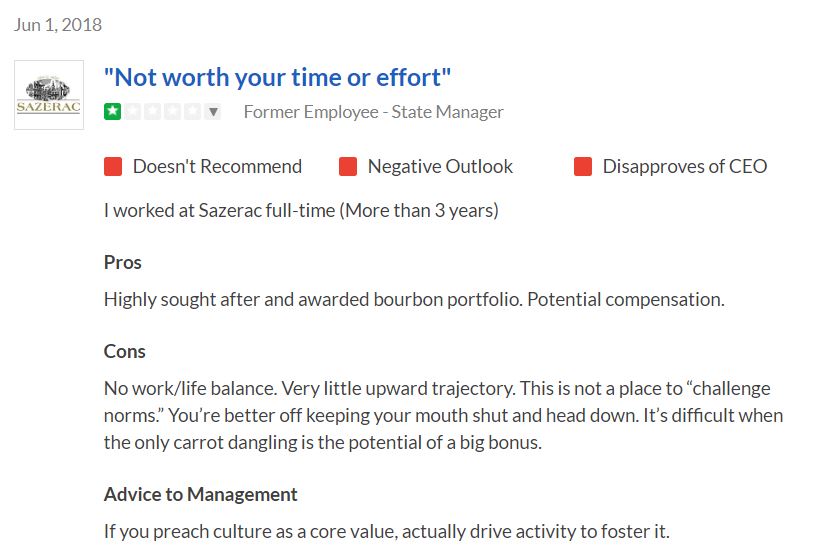
Consequently, and just for the hell of it, readers are invited to examine the statements at these two web sites devoted in part to employee ratings of the workplace environment.

Sazerac at Glassdoor


Sazerac at Indeed


I'm taking a balanced view of tonight's proceedings. The deal surely is inevitable, having been played out behind the scenes for quite some time.

Consequently, allow me to note that amid the millions of dollars involved in such a deal, and the time it typically has taken to rig them, our local elected representatives officially will have been given a whole four days to scrutinize the numbers before voting on the abatements and incentives.

Yes: it's economic boilerplate of the sort that works like Viagra for campaign finance, and surely not the first time council members have heard of Sazerac; presumably Dear Leader's minions have been speaking confidentially to those expected to rubber stamp Sazerac's arrival, and swearing them to silence.

At the same time, the public appearance is very familiar. Months-long periods of great secrecy, followed by triumphal propaganda and the pressing urgency of an immediate deadline.

$66 million bottling facility planned for former Pillsbury plant, by Marty Finley (Louisville Business First)

An international alcoholic beverage company will open a bottling facility in the former Pillsbury plant in New Albany in a $66 million investment

Metairie, La.-based Sazerac Brands LLC will create 110 jobs at the new operation, which is dependent on the project receiving approval for tax credits. The company hopes to begin operations late this year, initially with 50 employees.

The plant is expected to be fully operational by the end of 2021, and the new jobs will pay an average wage of $24 an hour plus benefits.

Sazerac's portfolio includes Pappy Van Winkle, Buffalo Trace and many other brands. The company has an office in Louisville.

The company will expand its processing, blending, packaging and distribution capabilities at the plant. It would be its first project in Indiana and expand its presence near Kentucky, where it currently employs 1,000 or more people.

Jeff Conder, vice president of manufacturing for Sazerac Co., said the type of spirits that will be processed and bottled at the facility will be determined after the company acquires the plant, which is expected to occur in the coming weeks if the incentives are approved ...

Wednesday, May 30, 2018

Sazerac's billions are headed this way, so Deaf Gahan and Dugout are foaming at the mouth and shredding the upholstery.


From the makers of Fireball Cinnamon Whiskey: "The old Pillsbury Plant becomes the new home for Sazerac Company."


High tea, low crumpets, street corner shysters, and an economic development announcement at the former Pillsbury.

From the makers of Fireball Cinnamon Whiskey: "The old Pillsbury Plant becomes the new home for Sazerac Company."


The devil remained firmly within the nooks and crannies of the details, and until we know how much Sazerac's arrival will cost us, prudence is the rule. This noted, Sazerac's investment at the former Pillsbury has the potential to be a good thing.

Let's take a brief look at Sazerac. First, the company.

Sazerac Company, Inc is a privately held American alcoholic beverage company headquartered in Metairie in the metropolitan area of New Orleans, Louisiana, but with its principal office in Louisville, Kentucky.[3] The company is owned by the family of billionaire William Goldring. As of 2017 it operated nine distilleries, had 2,000 employees and operated in 112 countries. It's one of the two largest spirits companies in the U.S. with annual revenue of about $1 billion, made from selling about 300 mostly discount brands.

Then, the chairman of Sazerac, with some insight into the business model.

US cheap-liquor billionaire looks abroad as sales slow

You may not have heard of America's richest spirits billionaire, but odds are you've sipped one of his offerings. Or, more likely, chugged it.

William Goldring, 73, built his empire on a simple model: acquire cheap brands, hype them and then stack them on the bottom shelves of liquor stores across America.

His closely held Sazerac Co has become the country's second-largest distiller by hawking discount brands such as Barton, Mr. Boston and Fleischmann's. You can buy 1.75 liters of each of his seven most popular vodka labels for a total of $80, the same price as one bottle of Absolut's premier-level Elyx.

Enough frat brothers are grabbing plastic bottles of these and Goldring's 300 or so other brands to drive his personal fortune to $3.9 billion, placing him among the world's 500 wealthiest people in the Bloomberg Billionaires Index, the first time he's landed in an international wealth ranking.

Goldring is little known outside his native New Orleans where he moves among the charity-circuit elites and has helped fund Tulane University buildings and athletic fields.

He's becoming better known now amid a year-long acquisition binge that's vaulted Sazerac into international competition.

"Bottom-shelf liquors can be tremendously profitable on the bottom line," says Jordan Simon, a New York wine and spirits writer and consultant. "They're cheap to make, cheap to sell and you get a lot of turnover."

Sazerac doesn't disclose its revenue. The figure probably reached $1 billion this year, according to data compiled by Anderson Economic Group. Both the company and Goldring declined to comment for this story.


While Sazerac also owns premium bourbon brands Blanton's, Buffalo Trace and cult favorite Pappy Van Winkle, which commands $500 a bottle or more, most of its money comes from giving unloved brands a profitable rebirth.

Sounds like a perfect fit with Gahanism: Bud Light Lime and the occasional shot of Fireball.

High tea, low crumpets, street corner shysters, and an economic development announcement at the former Pillsbury.

High tea, low crumpets, street corner shysters, and an economic development announcement at the former Pillsbury.


Perhaps a sewer tap-in waiver for the new occupant's executive washroom might do the trick, although someone needs to remind Dear Leader that those New York investment firms have the big bucks because they know when to ignore small-pond shake-downs.

Can't just call them into your office, can you?

'Economic development announcement' planned for Pillsbury plant, by Danielle Grady (CNHI, by way of Tom May's Content Plethora)

NEW ALBANY — An “economic development announcement” is scheduled tomorrow at the old Pillsbury plant in New Albany.

The event will be attended by state and local officials, including the Indiana Economic Development Corp.’s president, Elaine Bedel, according to a media advisory. The IEDC often provides incentives for businesses coming to and expanding in Indiana.

The General Mills plant has been empty since 2016 when it closed, putting about 400 people out of work. Later that year, the facility was bought by two New York investment companies: New Mill Capital Holdings and Tiger Capital Group. The new owners have been marketing the property for a buyer ever since.

Friday, December 02, 2016

Long before the Mightly Trumpolini, New Albany's Genius of the Flood Plain was tossing bales of taxpayer money at departing corporations.

First, the more topical reference.

1,000 Carrier Jobs Trump Celebrates Are Drop in the Bucket of Manufacturing Losses; Indiana alone has lost over 150,000 manufacturing jobs since 2000, by Josh Zumbrun (Wall Street Journal)

But Mayor Jeff Gahan's been there with the corporate welfare, although there were no mud anchor t-shirts to be handed out 22 months ago because Pillsbury was making like the Eagles.


As an aside, On the Border was a fine album in its day -- so fresh and vibrant, as opposed to "crony capitalism" economic development handouts.

From January 26, 2015.

---

Information about the Pillsbury "business retention and factory-modernization package."

Two morsels for thought as we await the outcome.

$7 million works out to $3,500 per worker, per year, for five years (based on 400 employees at Pillsbury and Sonoco). From Charlie White's C-J coverage:

General Mills purchased Pillsbury in summer of 2000 from British food company Diageo for $10.5 billion. In fiscal year 2014, General Mills had global net sales of $19.2 billion.

Indiana economic development officials provided General Mills more than $100,000 in incentives in the last 10 years to ensure kept its workforce of about 480. But over the last three to four years, the company shifted manufacturing of some product lines to its more modern operation in Murfreesboro, Tenn., plant. The food giant spent $100 million expanding there four years ago.

Second, there is no reference to the concurrent implications of negotiations between General Mills and the union, as mentioned previously. Is our $7 million in proposed incentives keeping pay as it is, or does it accompany concessions from the union?

In trying to educate myself about these issues, I've been wondering if there's a Bakery, Confectionery, Tobacco Workers and Grain Millers International Union local in Murfreesboro. If there is, I can't find on-line references to it.

Readers, do you know?

Worth the dough? New Albany may offer $7 million to keep Pillsbury Plant, by Daniel Suddeath (N and T)

NEW ALBANY — Last week, several New Albany City Council members pledged to diligently work on solutions to keep the General Mills plant open.
On Tuesday, the council will be asked to give its blessing for a $7 million bond package Mayor Jeff Gahan’s administration hopes will stave off the closure, which General Mills announced Jan. 8 could happen within 18 months ...

 ... "We have assembled a business retention and factory-modernization package for our friends at General Mills to consider,” Gahan stated in a news release issued Friday afternoon.

“Our goal is to keep the New Albany facility in continuous operation for as long as possible.”

Tuesday, November 15, 2016

Pillsbury plant purchased; Team Gahan livid at press release snub. In other news, sun set to rise tomorrow morning.


Well, there go the sewer tap-in waivers.

Major New Albany manufacturing plant sold, by David A. Mann (Louisville Business First)

The New Albany Pillsbury plant has been purchased.

A joint venture of New Mill Capital Holdings and Tiger Capital Group, both based in New York, purchased the former dough-products manufacturing plant from General Mills Inc., a news release said. The transaction — which included a large portion of the production equipment that was used in the plant — closed Monday for an undisclosed price.

The new owners intend to auction the remaining equipment in early 2017, and remarket the real estate for manufacturing uses.

Monday, September 26, 2016

Cousin Willie ain't no dope.

It appears that Dan Sieg has been diligently perusing back issues of NA Confidential.

Precedent suggests Duggins should have offered Sonoco roughly $1.33 million to close AFTER the election.

 ... May we surmise that a completely imaginary relief package, similar to the $7 million pretended to be thrown at Pillsbury's moving vans by Duggins and Mayor Jeff "But Water Park" Gahan, as part of crass political theater believed by absolutely no one in town not named Pat McLaughlin, is being devised for Sonoco as we speak?

Just look at the figure being sought by Ramsey Popcorn Company to facilitate its expansion at the former General Mills site.

Popcorn company one of multiple potential buyers hoping to acquire General Mills factory, by Caitlin Bowling (Insider Louisville)

According to Sieg, General Mills wanted $9 million for the facility. He is seeking $7 million from investors, which Sieg said he believes would allow Ramsey Popcorn to submit a competitive bid on the property.

Inquiring minds?

They're hungry.

Tuesday, March 15, 2016

An AWOL Jeff Gahan sends the usual subaltern to provide sound bite for newspaper article about Pillsbury's job fair.


Here's the quote:

Mike Hall, director of operations with the city of New Albany, said as far as what might replace Pillsbury, the General Mills real estate division has been showing the property.

“We're optimistic that it will be filled,” he said.

And here's the full article.

Finding closure, then work: Pillsbury holds job fair in New Albany to help displaced employees; Plant will cease operations in August, by Aprile Rickert (River Ridge Sentinal)

Leadership -- what a concept!

October 21, 2015:

Precedent suggests Duggins should have offered Sonoco roughly $1.33 million to close AFTER the election.


Wednesday, October 21, 2015

Precedent suggests Duggins should have offered Sonoco roughly $1.33 million to close AFTER the election.


We interrupt our usual discussions of political chicanery with an economic dishevelment bulletin from David "Boilerplate" Duggins.

Seems it is official: Sonoco will join Pillsbury, Indatus and StemWood as prominent businesses leaving New Albany or ceasing to exist during Duggins' watch.

May we surmise that a completely imaginary relief package, similar to the $7 million pretended to be thrown at Pillsbury's moving vans by Duggins and Mayor Jeff "But Water Park" Gahan, as part of crass political theater believed by absolutely no one in town not named Pat McLaughlin, is being devised for Sonoco as we speak?

Sonoco to close New Albany plant (Courier-Journal)

Sonoco is permanently closing its packaging plant in New Albany, Ind., and laying off all 76 employees in the process....

In a letter to the Indiana Department of Workforce Development, a human resources manager said the company has confirmed the decision to close the plant at 705 Pillsbury Lane. The plant is expected to close by the end of August 2016 and employees will all be laid off by Jan. 2, 2016.

More than 400 employees of the adjacent General Mills-Pillsbury plant are facing layoffs, after plans to close it were announced in February. Sonoco was contracted to make the paper and metal cans for dough products and deliver them by conveyor to the Pillsbury plant. Pillsbury is also expected to close by mid-2016.

Thursday, February 12, 2015

It's a done deal: Pillsbury closing is confirmed.

Now that the choreographed City Hall gesture has been dismissed, we have $7 million toward independent small business incentivization.

Right?

Pillsbury plant 2016 closure agreement signed, by Charlie White (C-J)

More than 400 union workers at General Mills' Pillsbury plant in New Albany and neighboring Sonoco in New Albany face layoffs after union officials confirmed Thursday morning that the plant will close in 2016.

"The plant is closing," union head Roger Miller said Thursday morning following talks last week. "We have negotiated the closing agreement and I'm presenting it to the members today."

Wednesday, January 28, 2015

City council agrees to proceed with a $7 million bond for General Mills, but there are dissenters.

Daniel Suddeath explains the 5-2 vote in favor of proceeding with a $7 million offer to General Mills.

NEW ALBANY — There’s no guarantee the facility won’t close, or that the bond will pass, but the New Albany City Council agreed Tuesday to proceed with the steps to foot a $7 million bond in hopes it will convince General Mills to keep the Pillsbury plant open.

By a 5-2 vote, the council approved a nonbinding resolution that stated its support of moving forward with the bond. The council and likely the New Albany Redevelopment Commission will have to cast ballots on the $7 million bond before it becomes official.

Councilmen Kevin Zurschmiede and Greg Phipps voted against the resolution, saying they need more details about the bond package before agreeing to use taxpayer funds to support a business.

Meanwhile, an academic rushed in where the politicians feared to tread ... except Zurschmiede and Phipps.

Should New Albany be giving General Mills $7 million?, by David A. Mann (Louisville Business First)

... But such offers aren't necessarily beneficial for cities. In general, this kind of move doesn't really pay off for cities because they will never recoup their investment through higher tax revenue, he said.

"They're just handing a company a pile of money," (Josh) Pinkston said. "If that's a good idea … why just General Mills? Why not hand out a big pot of money for other companies in New Albany?"

He described an incentive package such as this one as political risk management. City leaders do not want to be seen as the guys who let General Mills leave, he said. But paying companies to stay is not really efficient economic development policy.

"This is $7 million they are taking away from the taxpayers of New Albany and giving it to General Mills," Pinkston said. And, he wonders what the long-term cost of that would be.

Then again, Phipps is an academic, too. Perhaps we need more of them.

Monday, January 26, 2015

Information about the Pillsbury "business retention and factory-modernization package."

Two morsels for thought as we await the outcome.

$7 million works out to $3,500 per worker, per year, for five years (based on 400 employees at Pillsbury and Sonoco). From Charlie White's C-J coverage:

General Mills purchased Pillsbury in summer of 2000 from British food company Diageo for $10.5 billion. In fiscal year 2014, General Mills had global net sales of $19.2 billion.

Indiana economic development officials provided General Mills more than $100,000 in incentives in the last 10 years to ensure kept its workforce of about 480. But over the last three to four years, the company shifted manufacturing of some product lines to its more modern operation in Murfreesboro, Tenn., plant. The food giant spent $100 million expanding there four years ago.

Second, there is no reference to the concurrent implications of negotiations between General Mills and the union, as mentioned previously. Is our $7 million in proposed incentives keeping pay as it is, or does it accompany concessions from the union?

In trying to educate myself about these issues, I've been wondering if there's a Bakery, Confectionery, Tobacco Workers and Grain Millers International Union local in Murfreesboro. If there is, I can't find on-line references to it.

Readers, do you know?

Worth the dough? New Albany may offer $7 million to keep Pillsbury Plant, by Daniel Suddeath (N and T)

NEW ALBANY — Last week, several New Albany City Council members pledged to diligently work on solutions to keep the General Mills plant open.
On Tuesday, the council will be asked to give its blessing for a $7 million bond package Mayor Jeff Gahan’s administration hopes will stave off the closure, which General Mills announced Jan. 8 could happen within 18 months ...

 ... "We have assembled a business retention and factory-modernization package for our friends at General Mills to consider,” Gahan stated in a news release issued Friday afternoon.

“Our goal is to keep the New Albany facility in continuous operation for as long as possible.”

Friday, January 23, 2015

Gahan's plan for keep Pillsbury: A $7 million bond issue.

Props to the News and Tribune's Daniel Suddeath, who is tweeting about the city's offer to General Mills.

New Albany City Council to consider $7 million bond package Tuesday to update Pillsbury Plant in hopes of keeping facility open.

The bond incentive resolution for General Mills deal states the Pillsbury plant in New Albany would have to stay open a min. of 5 years.

If resolution approved, New Albany Redevelopment Commission and NA Council would have to take additional votes, same as any bond issue.

According to city, Pillsbury plant paid $661k in property taxes in 2014 and $7 million over last decade.

The financing plan would be a mix of tax-increment financing and possibly EDIT money, per David Duggins, city economic development director.


Friday, January 16, 2015

An elegiac Pillsbury evening in the council chamber.


As the reporter White points out, the union's contract with General Mills stipulates discussions in the event of a "decrease" in production.

At last evening's city council meeting, somewhere between 75 and 100 Pillsbury workers were in attendance to support a resolution of municipal solidarity authored by CM Bob Caesar. For the first time in months, Mayor Jeff Gahan was present as a council meeting. The resolution passed unanimously, and a joint committee was formed.

Perhaps as befitting the long odds of inducing a corporate climbdown, the atmosphere leaned toward the funereal. I choose this analogy on purpose, because funerals are where people gather to lament the passing, while celebrating the life of the deceased. Probably everyone in the room last night understands that whatever Hail Mary might occur to maintain jobs and production at Pillsbury, there will be no turning back the clock to the era of good unionized jobs.

After all, the gist of statewide economic policy in Indiana is to discourage these sorts of good union jobs, and has been for years. Insofar as local elected officials have appealed to the state for assistance, the help (if any) is likely to come primarily in the form of "retraining" or "outplacement" services. There'll be other companies negotiating to resume work at Pillsbury -- with the explicit acceptance of a non-union labor force.

It would be easy to bash the city for not paying attention, but I won't. None of us were. In the end, we're all dealing with decisions taken far away, with local ramifications that matter very little to the decision-makers. That's the problem. Perhaps in the future, there can be a better way.

Bakery union to talk with General Mills in Feb., Charlie White (C-J)

Discussions are tentatively scheduled early next month between General Mills and the union that represents 335 workers at its Pillsbury plant in New Albany, as well as 80 workers at neighboring Sonoco Products whose jobs also could be jeopardized if the plant closes next year.

Roger Miller, president of the Bakery, Confectionery, Tobacco Workers and Grain Millers International Union Local 33G, said Thursday he also plans to meet Friday with Sen. Joe Donnelly, who contacted him after hearing the news of General Mills' plan last week to close the plant.

Miller has also received calls from Rep. Todd Young and state Sen. Ron Grooms, both of whom he hopes to meet with soon about the plant, Floyd County's fifth largest manufacturing employer.

Saturday, January 10, 2015

Pillsbury: Is General Mills being honest?

There seems to be a pre-determined trajectory to the Pillsbury story, in terms of our reactions and also as it pertains to peeling back the layers of what (sadly) is another corporate decision made far, far away, and impacting lives in this community. During the Vietnam War, Country Joe memorably asked, "What are we fighting for?"

Pillsbury's maneuverings compel an echo chorus: "Who (and what) are we working for?"

Daniel Suddeath informs us:

Gahan meets with union officials, Lt. Gov. over plant closure

 ... Gahan announced he will be taking steps to try to stave off the closure of the plant, which employs about 400 people at a facility located off Grant Line Road.

Let's hope the mayor's team is reading from the General Mills playbook (i.e., its annual report), as a frequent reader has been doing. He contributes this comment.

(Note that his reference to trans fat comes from the reported Pillsbury explanation to local employees, to the effect that there is production redundancy when consumers no longer prefer trans fat-laden products)

Pillsbury (General Mills) isn't being honest - two facts from their 2014 annual report:

1) Pillsbury enjoys a whopping 70% market share of ALL refrigerated baking products sold in America and Pillsbury refrigerated biscuits are their single best selling refrigerated baking product.

2) The company has been closing all manufacturing facilities in America that are over 50 years old; no depreciation value left. The NA plant was built in 1959.

One fact from their corporate website:

1) Pillsbury Grands® Flaky Layers Original Biscuits (one of their best selling products in history) contains NO trans fats.

Every variant (all 13 lines of biscuits) have no trans fats in their recipe.

Folks are being bought off with easy "facts".

Another pertinent question: "Didn't we as a county and a state rebuild the rail spur and highway to accommodate General Mills needs in 2009 - 2010?"

There remains much fog around this story, but at the present juncture, the reactions I'm hearing are variations on a theme of "how many carrots do we have left, and can we use them, given that we have no sticks?"

Friday, January 09, 2015

On Pillsbury: "Fine-grained" isn't just about bread any more.

As we contemplate the likelihood of Pillsbury closing its venerable plant on the North Side, the human element obviously is most important: These have been good union jobs for a long time, and now they may be going away. If so, it's going to hurt lots of families.

As Greater New Albany points out, there isn't a great deal we can do about this when the corporate decision-making process is not designed to take local needs into consideration. Employees and community alike have been cogs in a much larger and far less responsive machine.

“Everyone with a heart for the welfare of our citizens needs to educate themselves on what governments can and should do to create a sustainable business environment,” says Smith. “Sustainability through local ownership can help us avoid the worst effects of closures like the one at Pillsbury.”

What happens next, both short-term, and in the future?

The harsh reality is that we as a city typically offer subsidies, abatements and incentives to "create" industrial park jobs at the now customary non-union pay scales. In this sense, Pillsbury is an old-school anomaly, and because most of us understand this even if we don't speak of it aloud given the acceptance of an anti-union climate in Indiana, the Pillsbury closing strikes us as the end of an era.

What can we learn from it, in the sense of economic development? There's far too much to capture at a sitting, but in 2015, perhaps we can expand the dialogue and consider what we mean when we toss out phrases like "economic development."

When I asked him yesterday, JeffG recommended this article at Strong Towns as a good starting point. It is titled "Fine Grained."

Great cities are incubators of capitalism - where everyone has a fair chance to move up the economic ladder, not just the ones that started out at the top. How easy it for someone that likes cutting hair to open their own barber shop or salon? What does it take to start selling groceries in your area? What about some light manufacturing (such as making dolls or bird houses?)

Cities are the physical manifestation of the economy. A fine grained city represents a fine grained economy. Early American towns and cities have a lot of buildings and streets that are very fine grained - in that each building itself is narrow and small - and I can imagine that a century ago the average person within their lifetime could afford to buy a plot of land about 20 feet wide and open a shop or lease out the bottom while they lived upstairs ...

... There's a complex system of lenders, zoning and land use regulations, and cultural attitudes at play here, but we need to focus on becoming more fine grained. Creating a fine grained economy and fine grained urbanism run hand in hand with lowering the cost of entry - be it for starting a business or for developing property. By doing so, we will create an environment that better spreads the wealth that is created, will allow us all to become more prosperous, and gives everyone a fair chance at achieving the American Dream, not just those already born into it.

Jeff added these thoughts of his own.

The beginning gist: Spread the risk, spread the reward.

Though we tend to make a big deal of the big players, most jobs in the country come from very small businesses. If you spend money on infrastructure/education/etc. that positively impacts 100 businesses with two to four jobs each, that's 200 to 400 jobs. If half of them fail, you still have 100 to 200 jobs and spaces/places/skills that other locals and small investors can afford to take advantage off-- more realistic, constant, and sustainable regeneration. Lots of small biz can use a vacant 2,000 sq.ft. building on a street with lots of people traffic. What are they gonna do with 20,0000 sq.ft. in comparative isolation on the outskirts of town?

... Busy, dense places generate more personal and public revenue per square foot than do big, industrial park build outs.

What our current mayor might begin doing, and what future occupants must, is reformat the very nature of economic development.

Greater New Albany: "Pillsbury closing a symptom of failed economic development."

More comments can be found here. To paraphrase the axiom, if we don't learn from Pillsbury's departure, we're sure to repeat it. A prime point of discussion in New Albany during the year 2015 must be a reconsideration of the very nature of our "economic development" efforts. 

---

PILLSBURY CLOSING A SYMPTOM OF FAILED ECONOMIC DEVELOPMENT

NEW ALBANY, Ind. – The anticipated closure of General Mills’s Pillsbury manufacturing plant in New Albany exposes weaknesses in the city’s economic development program according to a newly-formed social welfare group called Greater New Albany.

New Albany city government has, according to public affairs director Randy Smith, rejected the advice of respected national organizations like the Institute for Local Self Reliance (ILSR.org), which endorses “local ownership [that] ensures that important decisions are made locally by people who live in the community and who will feel the impacts of those decisions.”

“We were just as blindsided by the announced closing as anyone,” Smith said. “In our discussions, the plight of those workers and their families is our first concern and we hope General Mills and the state of Indiana can step up to soften the blow.”

It’s not known whether the city has the tools to reverse the decision or to mitigate the negative effects, but Greater New Albany sees this moment as a good time to reevaluate the city’s efforts to sustain the local economy.

“Everyone with a heart for the welfare of our citizens needs to educate themselves on what governments can and should do to create a sustainable business environment,” says Smith. “Sustainability through local ownership can help us avoid the worst effects of closures like the one at Pillsbury.”

Influencing city elections by means of voter education campaigns is a primary goal of Greater New Albany.

The organization is currently evaluating potential candidates in the 2015 New Albany city elections and intends to work for the election of those whose positions align with Greater New Albany’s objectives.

CONTACT: randysmith(at)outlook(dot)com

Thursday, January 08, 2015

WDRB says: "Pillsbury plant in New Albany to close soon."

In the early days of Sportstime Pizza, when Kate's and Amy's father kept it open 24 hours a day, seemingly all of Pillsbury's third shift gathered at 7:00 when the drinking lamp was lit. They had good union jobs, and paid some of our salaries, to boot.

It's true that 300 jobs aren't chump change, although objectively, this closure probably has less impact now than it would have two decades ago. Still, as a business owner on the GL corridor, I genuinely hate to see it happen, especially union jobs.

Pillsbury plant in New Albany to close soon (WDRB-41)

... An employee that contacted WDRB says the announcement was made during a meeting Thursday morning. That's where Pillsbury officials told workers they plan to phase phase out operations at the plant and close over the next 18 months.

Here's the single most interesting pull:

Employees were told there were other plants across the country that already make the same products. Since most of those products are loaded with carbohydrates and trans fat, they are becoming less popular with the public.

The dough boy has a cholesterol problem? Sounds to me like Pillsbury isn't keeping up with contemporary consumer demand.