Showing posts with label tax abatements. Show all posts

Tuesday, June 02, 2020

What budgetary crisis? Nawbany nickel-and-dimes 50K for the homeless, then awards $2.2 million in tax abatements for Sazarac NOD.

Did former conservative Jason Applegate check Sazarac's "economic development" numbers as closely as he examined Rev. Moon's last time out?

Is Applegate still selling advertising for his magazine? But let's not go there. Rather, let's "extol" the virtues of the council's lone "no" vote on Monday night. Take it away, Josh Turner.

I feel the need to make a comment to explain my reasoning on being the only “No” vote tonight on the Sazerac Tax Abatement Resolution.

I am happy that Sazerac has set up shop here in our city. I am excited to see them grow and create 50 new local high paying jobs.

However, I care deeply about where we stand financially as a city and I care about our home grown, locally owned, small businesses. As many of you know, I have had a difficult time acquiring city financials since I have taken office. With the lack of access to these records I do not truly know where we stand financially as a city. The one thing that is certain is during this pandemic and the impending bridge closure is that we will lose small businesses, the life blood of our community, and major jobs creator. I could not in good conscience vote “Yes” to giving 2+ million dollars of tax revenue to a company that made around a billion dollars in revenue last year.

I initially moved to table this vote until I could review financials and make an informed decision. Unfortunately, it did not get a second, and I was forced to make the only responsible decision in my opinion at the time without having all of the facts.

Tuesday, June 05, 2018

Mayor Gahan AWOL as council inks corporate welfare package for Sazerac.


A few odds and ends, and then we'll all kick back to watch the epochal panacea unfold.

"Distillery to located in old Pillsbury plant."

In the newspaper's photo caption and the text, it is made perfectly clear that Sazerac will not be distilling at the former Pillsbury, and yet the subheader persists in the misconception. It also omits the second half of the verb form, but let's not be churlish.

An aside to Greg Phipps: In comparative terms, General Mills is to Pillsbury's biscuits as Sazerac is to Boston Brands of Maine's liquor (in this instance, brandy, which is a specific type of liquor). If your objective is to begin renaming streets for the mayoral victory of the moment, then at least be consistent: Buffalo Trace Lane, to replace Pillsbury Lane.

Wait -- Buffalo Trace now is an art installation by the Summit Springs Strip Mine. I prefer Southern Comfort Avenue, anyway.

But at least Phipps' commemorative instincts are modest. If left to Bob Caesar, not a street, landmark or dumpster in the city would be safe from renaming in honor of operatives affiliated with One Southern Indiana, Team Gahan, Develop New Albany, or the council itself -- though only those reliable council members like Caesar, who is to the adolescent fluffing of functionaries as Elvis was to peanut butter & 'nanner sandwiches.

Last evening's carefully choreographed incentive package spectacle might well have been the single greatest "mere formality" ballot I've witnessed in 14 years of soul-deadening council observation, but if you'll pardon the blasphemy from the village atheist, if Jesus Christ himself materialized before council to announce the second coming, at least one or two questions still should be asked prior to the pre-arranged vote.

In the case of Sazerac:

  • Are these union jobs?
  • If $24 per hour is the average, can there be a more detailed breakdown of the wages?
  • Will there be any sort of public interface, for instance, a visitor center?
  • What are the implications for the railroad spur?

So on, and so forth, not to omit the most obvious of all: if Sazerac's advent is second only to the second coming, then can Jeff Gahan show up for once and not have an underling mouth his scripted platitudes?

New Albany City Council approves incentive deal for Sazerac, by Chris Morris (Omnibus Tom May)

Distillery Bottling to to be located in old Pillsbury plant

NEW ALBANY — The Sazerac Company is coming to New Albany.

One of the oldest, family-owned distilling companies in the United States made the announcement last week that it was purchasing the old Pillsbury plant with plans to phase in two to three packaging lines. That move was contingent on the New Albany City Council approving a resolution to provide tax abatements on both personal property and real estate. The council did that Monday night by a 9-0 vote and with plenty of praise for the company and those who brokered the deal.

"In my seven years this is one of the biggest things to happen to New Albany as far as bringing jobs in," Councilman Greg Phipps said.

He said the New Albany Board of Works may want to consider renaming Pillsbury Lane, the road where the plant is located, to Bourbon Lane.

"This is a major, major win for the community," Councilman Bob Caesar said.

City Council President Al Knable said prior to the meeting the incentives offered by the city total around $3 million ...

Monday, June 04, 2018

City council tonight: "Fireball Cinnamon Whisky Presents Mayor Jeff Gahan Presenting Karaoke in Bicentennial Park."


It's my guess that at tonight's city council meeting, there'll be joyous and sweeping approval of the incentives sought by Sazerac of Indiana to complete its purchase of the former Pillsbury plant on Grant Line Road.

INTRODUCTION OF RESOLUTIONS:

R-18-04 Resolution Concerning Statement of Benefits for Real Property and Personal Property for Sazerac of Indiana, LLC by the Common Council of the City of New Albany (Caesar)

I can picture Dan Coffey asking a few questions about the wisdom of "anchoring" a local economy on booze, but beyond this, the discussion stands to be perfunctory amid palpable sighs of relief that the Indiana Economic Development Corporation has at long last bailed out a City Hall team most recently seen tossing $7 million worth of panic-stricken economic development IOUs at the exhaust fumes generated by General Mills' moving vans.

Since last week's announcement, observers have been uniformly dazzled by Sazaerac's promise of jobs with an "average" wage of $24 an hour. Cynics like me might ask whether this average is calculated by including the remuneration for William Goldring, the company's owner (worth $3.9 billion at last glance); or, perhaps more appropriately, given the union jobs lost at the defunct Pillsbury, whether any of these new jobs come with union agreements.

Brief research reveals no information for a bottling and packaging facility like that projected for New Albany. According to a 2016 article by bourbon business writer Fred Minnick, the union agreements at Sazarac's distilleries in Kentucky (1792 Barton and Buffalo Trace) are “confidential.”

At least they exist. Of course, there'll be no distilling in New Albany (except at Donum Dei, around the corner).

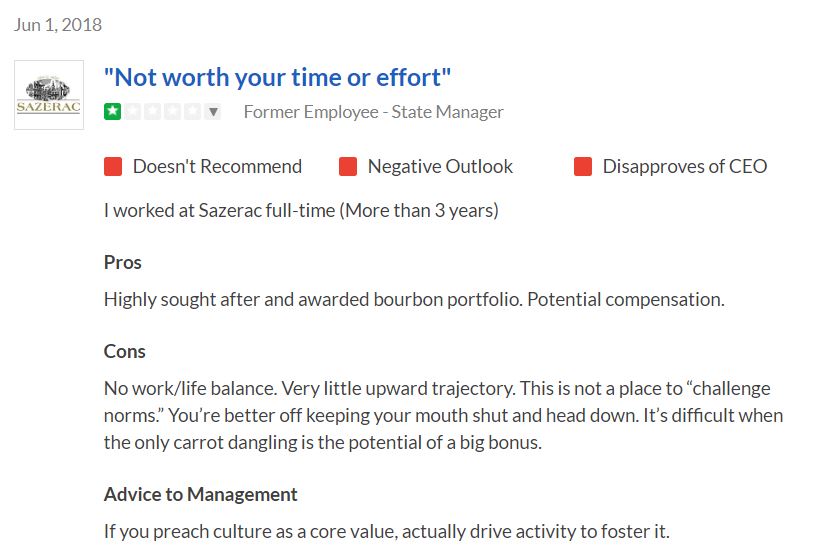
Consequently, and just for the hell of it, readers are invited to examine the statements at these two web sites devoted in part to employee ratings of the workplace environment.

Sazerac at Glassdoor


Sazerac at Indeed


I'm taking a balanced view of tonight's proceedings. The deal surely is inevitable, having been played out behind the scenes for quite some time.

Consequently, allow me to note that amid the millions of dollars involved in such a deal, and the time it typically has taken to rig them, our local elected representatives officially will have been given a whole four days to scrutinize the numbers before voting on the abatements and incentives.

Yes: it's economic boilerplate of the sort that works like Viagra for campaign finance, and surely not the first time council members have heard of Sazerac; presumably Dear Leader's minions have been speaking confidentially to those expected to rubber stamp Sazerac's arrival, and swearing them to silence.

At the same time, the public appearance is very familiar. Months-long periods of great secrecy, followed by triumphal propaganda and the pressing urgency of an immediate deadline.

$66 million bottling facility planned for former Pillsbury plant, by Marty Finley (Louisville Business First)

An international alcoholic beverage company will open a bottling facility in the former Pillsbury plant in New Albany in a $66 million investment

Metairie, La.-based Sazerac Brands LLC will create 110 jobs at the new operation, which is dependent on the project receiving approval for tax credits. The company hopes to begin operations late this year, initially with 50 employees.

The plant is expected to be fully operational by the end of 2021, and the new jobs will pay an average wage of $24 an hour plus benefits.

Sazerac's portfolio includes Pappy Van Winkle, Buffalo Trace and many other brands. The company has an office in Louisville.

The company will expand its processing, blending, packaging and distribution capabilities at the plant. It would be its first project in Indiana and expand its presence near Kentucky, where it currently employs 1,000 or more people.

Jeff Conder, vice president of manufacturing for Sazerac Co., said the type of spirits that will be processed and bottled at the facility will be determined after the company acquires the plant, which is expected to occur in the coming weeks if the incentives are approved ...

Wednesday, March 08, 2017

This memo goes out to One Southern Indiana: "Handing Out Tax Breaks to Businesses Is Worse Than Useless."


With a courtesy copy to Mr. Duggins.

Handing Out Tax Breaks to Businesses Is Worse Than Useless, by Richard Florida (CityLab)

A new study exposes the futility of the $45 billion that states spend on economic development incentives.

Even before being sworn in as President, Donald Trump jumped up and down at the chance to showcase the great deal he and Vice-President Mike Pence made to keep a Carrier plant in Indiana. The company pocketed $7 million in tax breaks in exchange for about 800 jobs. But the broad consensus among economists who study the subject is that such business incentives do little to alter the location decisions of companies. In fact, they’re often worse than ineffective—they’re counterproductive. My own take on this site is that they are a useless waste of taxpayer dollars.

Timothy Bartik of the W.E. Upjohn Institute for Employment Research, who is perhaps the leading student of incentives and economic development, has a new report that provides the most detailed assessment of incentives across states and their effects on economic development. His database contributes a useful tool for state and local economic developers and others to take a hard look at incentives, what they cost, and whether they are worth it or not.

Stop me if you've heard this one before.

Basically, states hand over the money to companies and then do not even follow up to see if they are working or not. As Bartik puts it:

Incentives are still far too broadly provided to many firms that do not pay high wages, do not provide many jobs, and are unlikely to have research spinoffs. Too many incentives excessively sacrifice the long-term tax base of state and local economies. Too many incentives are refundable and without real budget limits. States devote relatively few resources to incentives that are services, such as customized job training. Based on past research, such services may be more cost-effective than cash in encouraging local job growth.

Saturday, July 16, 2016

"If Gahan and the council were so damned concerned about school funding mechanisms, they wouldn't pass out unchecked property tax abatements and TIF development deals like candy."


Adding to this ...

Proposed city council resolution urges public support for the New Albany-Floyd County School referendum.


 ... our friend Bluegill adds a succinct and necessary postscript:

To former Mayor Doug England's credit, he publicly lobbied the school board to not close the schools we already had as a first step in this ill conceived, unsustainable suburbanization plan. In Jeffersonville, Mayor Mike Moore represented the public, asking pertinent questions of the school administration. When they went unanswered, he joined the resistance, as did Jeffersonville Main Street. Gahan, and potentially the council next, just mouth the platitudes and roll on. If Gahan and the council were so damned concerned about school funding mechanisms, they wouldn't pass out unchecked property tax abatements and TIF development deals like candy. "Let's not collect the money but let's spend it anyway." That's not sustainable, either.

Tuesday, September 30, 2014

Duggins: 100% compliance rate on tax abatements we seldom bother auditing.

Because after all, businesses can be trusted not to lie.

What we've learned since our friend Mark Cassidy began demanding simple attention to detail from city officials and the common council is that tax abatements have not always been filed correctly, with the incorrect filings being rubber-stamped along with the rest ... until Mark's questions started.

During meetings in August and September, the council tabled several abatement renewal requests because the forms were incomplete. The abatements had been suggested for approval by the administration, though they lacked information about job totals and other information.

“I think that if we’re going to give somebody a tax abatement, it’s not asking too much to have forms filled out correctly,” said Mark Cassidy, a New Albany resident who has asked the council and administration multiple times to pay closer attention to the abatements they reward.

By signing the forms, the companies are essentially promising that the job totals are correct. But how does the city really know?

“It’s illegal to sign an [abatement] form that’s not correct. That’s also true about filling out your income tax form, but they still do random audits of income tax forms,” Cassidy said.

It would create more public trust in the program if the city randomly audited the abatement-receiving businesses to ensure the job totals they are vouching for are correct, he continued.

In which case, if the forms cannot be filled out correctly, how do we know they're truthful in the sense of tax abatement conditions being fulfilled?

And, as such, how utterly vacuous is the highlighted statement by the city's chief tax abatement rewards desk clerk, David Duggins?

The city hasn’t voided any abatements since Mayor Jeff Gahan took office, and it’s quite uncommon for cities to take away a tax cut for a business, Duggins said.

Pulling an abatement could lead to a business closing its doors, and so the city’s procedure has been to meet with companies struggling to match their job levels and assist them instead of ending their credits, he continued.

“No company [in New Albany] has warranted having their abatement removed,” he said.

But if no one ever checks the veracity of the information, how can there be this level of certainty?

Is there a magic wand?

If so, might it be wielded in the general direction of independent local businesses in downtown, which have collectively enabled the ongoing revitalization that this and other administrations love to take credit for impelling, but have actually done next to nothing to assist, because there is no economic development plan for downtown New Albany?

The article: New Albany touts tax abatements; some want more oversight, by Daniel Suddeath (Royse City Herald Banner)

Sunday, August 29, 2010

If you say it really fast, TG Missouri almost sounds homespun.

When the story about the proposed subsidization of TG Missouri was published, some small details were left out.

TG Missouri is owned by Toyoda Gosei Co., LTD (Japan).


According to their 2009 annual report (PDF):

They have 25,792 employees.

Capital Investments (2009) [like air conditioning!]: $682,818,091.00

NET Assets (2009): $6,411,685,341.00

Average NET Income per year (2005-2009): $168,475,391.00


According to 1Si, the England Administration, and the Daniels Administration:

Toyoda Gosei can't justify what for them is an infinitesimal expansion without public assistance. (A potential $3 million investment represents .004% of their capital investment for 2009.)

The England administration thinks a $150,000 deal is a make it or break it proposition when they make location decisions.

The Daniels administration thinks giving them a tax break is the way to go, even though they depreciated and amortized $419,994,000 in assets last year alone.

I'm guessing 1Si's Kathleen Crowley didn't exactly highlight any of that during her advocacy because, you know, 1Si is the voice of Southern Indiana's small businesses-- especially if they're a multi-billion dollar Japanese multinational corporation with a really Midwestern sounding name.

Thursday, March 20, 2008

Council takes on tax abatements

New Albany's City Council will hold a work session concerning tax abatements tonight at 6:00 p.m. prior to their regularly scheduled meeting with Thomas A. Pitman, a partner from the Indianapolis law firm of Baker and Daniels.

Council President Jeff Gahan says the Council has lacked consistency when dealing with the incentive and is attempting to be more fair. To that end, council members requested a training session to ensure evenhandedness.

Regular council meeting attendees might be surprised to learn that CM Dan Coffey has declared the Baker and Daniels firm "an acknowledged expert" on state taxes prior to the meeting. Given that Coffey once accused bond firm Ice Miller's Buddy Downs of not being as familiar as he was with some of the state finance rules that Downs himself helped to write, these guys must be the shit.

Other business, including the potential expansion of the Park East Industrial Park TIF district, will be handled during the regular 7:30 meeting. Both the work session and the meeting will be in the assembly room on the third floor of the City County Building.

New Albany examines tax policy by Dick Kaukas, Courier-Journal