Showing posts with label driving habits. Show all posts

Sunday, April 26, 2020

"The coronavirus shutdowns are making more obvious a pre-existing epidemic of reckless street design."


A related story yesterday:

The future of work, and of commuting to work, surely will be different.

It should surprise no one that in New Albany, a political process currently being held hostage by mayor and city council president has no room for responsiveness on ANY matter of importance, much less the perennially abused street grid.

I doubt their automobile centrism has abated with quarantine. We'll see. My own period of detachment from involvement with public affairs originally was slated to expire on June 30.

We'll see about THAT, too. Let's have a look at genuine leadership out in Oakland.

Drivers Not Wanted on Oakland’s ‘Slow Streets’, by Laura Bliss (CityLab)

The California city isn’t the first to experiment with car restrictions in the coronavirus pandemic, but its plan to discourage drivers is the most extensive.

Last week, Oakland, California, announced a bold answer to shelter-in-place coronavirus claustrophobia: To create more outdoor space and safer corridors for essential travel by foot or bike, the city would restrict access to vehicles on nearly 74 miles of city street — about 10% of the city’s street network.

“In this unprecedented moment we must do everything we can to ensure the safety and well-being of all families across our city,” stated Mayor Libby Schaaf. “Closing roads means opening up our city.”

The “slow streets” initiative, which began on Saturday and will roll out in four segments through the duration of the coronavirus emergency, comes in response to citizen concerns about overcrowded conditions in parks and on sidewalks during the coronavirus lockdown. It’s not really a “closure,” despite the mayor’s phrasing: Emergency vehicles like police cars, fire trucks and ambulances are still permitted to enter these new pedestrian corridors, as are delivery vehicles and residential traffic. In fact, no drivers will be ticketed if they do drive on these streets.

The change is mostly a firm psychological nudge, said Warren Logan, the director of mobility policy and interagency relations in the Oakland mayor’s office. Confronted by a pair of traffic signs and a barricade blocking one lane, drivers now have to think twice about entering these streets. Many will consider taking a different route. And all will hopefully drive more mindfully when they enter a slow-streets zone — an increasingly important concern in cities where the relative absence of traffic has inspired a wave of speeding violations. “When they do turn into the street, they do it carefully,” Logan said.

After a week in action, Oakland officials say the streets are working as planned — no collisions, no reported instances of unsafe gathering, and more families able to move (and dance) at spacious distances. As if out of an earlier era, small children are riding bikes in the middle of the street without their parents needing to worry. “This is an opportunity to remember that these are our streets, not just streets for cars,” Logan said.

The same flawed HWC Engineering campaign donations-meet-street grid bait 'n' switch that wasn't working prior to the pandemic hasn't grown any more sensible with sheltering at home. It was crap then, and so it remains. 

Have Coronavirus Shutdowns Prompted an Epidemic of Reckless Driving? by Daniel Herriges (Strong Towns)

Reports from many cities indicate a surge in aggressive speeding, and with it, automobile crashes. The statistics are remarkable and alarming in light of how much traffic itself has declined, with many businesses closed and residents sheltering at home ...

... The most common tendency I've seen in reporting of this phenomenon is to blame "reckless driving." In other words, it's just that people who have sociopathic and destructive urges are out there on the empty roads playing Ricky Bobby and indulging them, to tragic effect. Is that the whole story?

This pat answer is consistent with our societal bias toward always talking about traffic violence in terms of individual behavior: either it was just a tragic accident, or the people involved should have been paying more attention. Mainstream media rarely interrogate how street design induces drivers to behave in certain ways. Yet we've written about this again and again on Strong Towns, because the evidence is clear: when you design streets to make high speeds comfortable, you make tragedy statistically inevitable.

Over 40,000 Americans die in traffic in a normal year. The number of pedestrians alone killed by U.S. drivers from 2008 to 2017 averages out to one every 1 hour and 46 minutes. If we're appalled by the level of carnage on our roads while most of us are sheltering in place, we should certainly be appalled by the level of carnage the rest of the time. If we think there's an epidemic of reckless driving right now, it's just a continuation of the epidemics of reckless driving that we witnessed in America in 2019, and 2018, and 2017, et cetera. The status quo isn't anything to want to return to here.

The coronavirus shutdowns are making more obvious a pre-existing epidemic of reckless street design.

Tuesday, April 17, 2018

"It turns out the rich really are different from you and me. They drive like entitled jerks."


Without further comment.

It's official: The fancier the car, the more likely the driver's a jerk, by Alfred Lubrano (Philly News)

It turns out the rich really are different from you and me. They drive like entitled jerks.

They’re middle-finger-pointing, ride-up-your-trunk-bullying, outta-my-way motorists.

That’s the authoritative word from researchers who keep track of this sort of thing.

Three studies over the last five years show that people driving expensive cars were more likely to cut off other motorists and less likely to stop for pedestrians in crosswalks ...

Saturday, January 16, 2016

"What Do Drivers Really Think About Cyclists?"


Progress takes education, and education takes leadership.

When a city's "leadership" cannot see any need to educate -- itself or others -- there'll be no progress.

As in "New Gahania: Since 1813, Anchored In Our Bunker."

What Do Drivers Really Think About Cyclists?, by Eric Jaffe (City Lab)

Drivers and cyclists don’t always get along, nor do they shy from critiquing one another’s road behavior in words unfit for print. But it’s nice to think that maybe somewhere, deep down, they hold a grudging respect for the fact that the other group is just trying to get around, day to day, on frustrating city streets.

Nice, but evidently wrong. For a new survey, presented this week during a transportation conference, researcher Tara Goddard and colleagues at Portland State University asked drivers and cyclists to rate how well both mode groups are able to “follow the rules of the road” or to be “predictable” on the street. While neither group scored great in the exercise, cyclists scored way worse—especially in the eyes of drivers who never ride a bike.

Wednesday, July 15, 2015

"The Clearest Explanation Yet for Why Millennials Are Driving Less."

In New Albany's case, information such as this might come in handy when the familiar refrain is heard: "We need more parking."

No, we don't. We need to do a better job with what we have.

The Clearest Explanation Yet for Why Millennials Are Driving Less: Shifting demographics matter, but shifting attitudes may matter more, by Eric Jaffe (City Lab)

... McDonald’s work isn’t likely to put the debate about Millennial driving habits to rest, but it does add a highly informed layer to the discussion. And her advice about what planners and cities can do while all the data points find their place—encourage alternative travel modes, and improve forecasts about driving trends—is sound regardless of the exact reasons behind the shifts.

Friday, March 07, 2014

Fear.

Perhaps there are valid criticisms of the author's arguments, but to me, it's the overall tone of fear. It's especially true here in New Albany. The fear is primal.

America's Cities Are Still Too Afraid to Make Driving Unappealing, by Emily Badger (Atlantic Cities)

... My commuting choices — just like everyone's — are the sum of the advantages of one transportation mode weighed against the downsides of all other options. Or, more succinctly: my feelings about the bus are mediated by what I'm thinking about my car.

At a macro level, this decision-process implies that there are two ways to shift more commuters out of single-occupancy vehicles and into other modes of transportation, whether that's biking, carpooling, walking, or transit. We can incentivize transit by making all of those other options more attractive. Or we can disincentivize driving by making it less so. What's become increasingly apparent in the United States is that we'll only get so far playing to the first strategy without incorporating the second ...

... The question is really how far we can get down the path of least resistance, pursuing only the politically easy tactics. If the goal at the end of the day is changing behavior, how much can you really achieve by showing people a nice new bike lane?

Friday, January 24, 2014

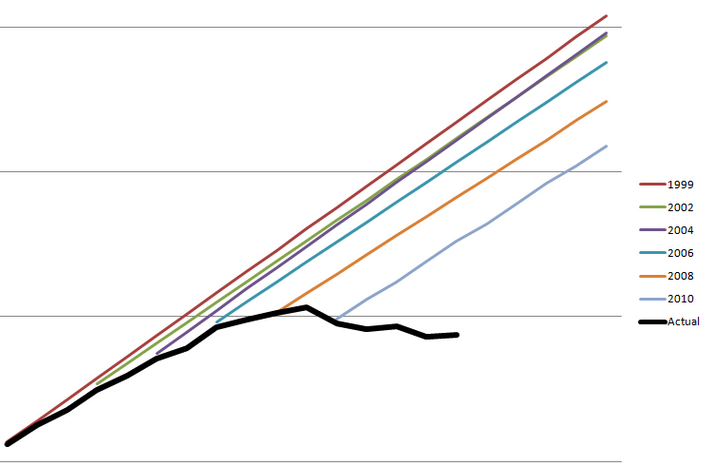
Look out your window at the one-way street, while absorbing this: "The Government Is Really Bad at Predicting Americans' Driving Habits."


Follow the link for the full grandeur. In essence, the miscalculated uppermost lines are the basis of various excuses to build two unneeded bridges, and in turn, are just as likely to preface calculations aimed at preserving New Albany's antiquated one-way street grid. That's because the same old faces doing the studies tend toward the accepted miscalculations, as above, which are more profitable for all concerned than actual truth. Thus, dysfunction is perpetuated amid shrugs that "after all, the numbers don't lie."

Except they do.

What was that?

This is just now coming to your attention?

The Government Is Really Bad at Predicting Americans' Driving Habits, by Emily Badger (The Atlantic Cities)

... What's startling about this latest chart isn't the difference between that thick black line and the 2010 projection. It's the fact that the government seems to have made the exact same miscalculation repeatedly, and despite growing evidence that something quite different is going on. These projections also aren't wobbling off course years after they were first produced (no one expects a prognosticator to perfectly predict what will happen 10 or 20 years from now). They've turned out to be grossly inaccurate sometimes months after their release.