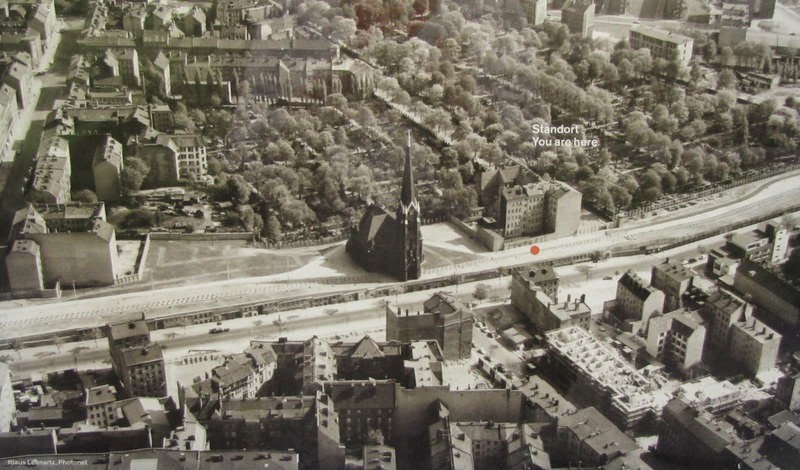
Showing posts with label Berlin Germany. Show all posts

Wednesday, August 19, 2020

Roman God-Like Man.


"A monument is not a descriptive account of history, but instead a historical artifact that tells a story about power."


I have a new bucket list destination: the Citadel Museum.

The eight-ton Lenin's head used to be attached to the statue of the Soviet leader that stood at Leninplatz, in East Berlin, which as you'll recall is where I worked while employed for three weeks by the parks department in the capital of the GDR in the summer of 1989.

The statue was taken down after unification in spite of neighborhood opinion in favor of it remaining, and it would appear to have been dismembered. The head was exhumed in 2015.

I highly recommend clicking through and reading the article.

The Museum Where Racist and Oppressive Statues Go to Die, by Daniela Blei (Atlas Obscura)

Germany has found ways to display problematic monuments without elevating them.

LAST YEAR, URTE EVERT RECEIVED a 400-pound church bell imprinted with a small but unmistakable swastika, and she faced a conundrum. Evert is the director of the Citadel Museum in the Berlin suburb of Spandau, and the bronze bell—cast in 1934 for the ascendant Nazi regime—hung at the nearby Evangelical Church of Hakenfelde until the astonishingly recent date of 2017. Evert hoped to add the Nazi artifact to the museum’s permanent collection of toxic monuments: busts of militaristic Prussian rulers; statues of Aryan athletes and warriors; and an eight-ton granite head of Vladimir Lenin, which took two years of political and bureaucratic wrangling to dig out of the ground. But first, Evert had to weigh the risks of exhibiting a church bell installed during the Nazi period. What would the bell represent, and what could visitors learn from it? And could it become a kind of shrine for members of far-right or neo-Nazi groups?

Evert’s job at the Citadel Museum, which is housed in the former provisions depot of a Renaissance-era fortress, is to critically examine the culture of monuments. Rather than scrubbing the area of statues that symbolize racism, antisemitism, and other forms of violence and oppression, the museum aims to contextualize the past, putting uncomfortable realities on display in productive, educational, and sometimes challenging ways.

“Inside the museum, visitors confront at eye level statues and monuments that used to represent power,” Evert says. “You can touch everything. Nothing is put on a pedestal. You can talk about what makes you mad.” Since December, the Nazi church bell has been on permanent loan. It inspired a special exhibition on Spandau’s churches under National Socialism, a collaboration between college students and the museum ...

... The idea for a museum of spurned monuments came from Andrea Theissen, the former director of the Spandau Citadel, who curated the opening in 2016. Each statue was left in the condition she received it—many were dismantled under orders from the Allies—complete with bullet holes and damage from bombs. The museum’s message is clear: A monument is not a descriptive account of history, but instead a historical artifact that tells a story about power. In a setting that invites scrutiny, visitors can study Berlin’s monuments to grasp more clearly who had power and how that power was used.

Saturday, August 31, 2019

Did I pass Victor Grossman on the street in East Berlin in August, 1989?

East Berlin, 1989.

I've heard of Victor Grossman, recalling his name from the period in the late 1980s when I abstracted geopolitical and current events magazine articles.

My job was discarded in order to travel abroad in 1989, a trip that included my first and only month in East Germany, where I spent three weeks as a paid employee of the East Berlin Parks Department. The Berlin Wall fell just before I returned home circa November.

As someone fascinated by the place and the period, I find this interview with Grossman to be compelling. Much of what he says strikes me as plausible in the sense that East Germany surely did establish a level playing field for much of its population with respect to fundamental living conditions.

But whatever the word "freedom" actually means, and we might debate this until the end of time, there wasn't enough of it in East Germany.

If there had been, East Germans eager for something more wouldn't have been streaming across the Hungarian border into Austria, in route to West German citizenship. The hemorrhaging was something ongoing during my stay in East German, although I didn't really understand it; speaking no German explains part of the fog, with the remainder owing to the fact of there being no independent sources of media information.

It was pre-internet, and you couldn't just go to a newsstand and pick up a diverse assortment of publications. At any rate, three decades later Grossman speaks for himself quite capably. Geography, politics and history buffs, you'll want to click through, read and absorb. Who knew Grossman was even still alive?

From Harvard to East Berlin: An Interview with Victor Grossman, by Julia Damphouse and David Broder (Jacobin)

In 1952 the Harvard grad Victor Grossman defected to East Germany, hoping to help build socialism on the ruins of Nazism. Thirty years after that state collapsed, he insists that we should see it as a land of contradictions, not just a totalitarian monolith.

Victor Grossman is the only person to have earned degrees from both Harvard and East Germany’s Karl Marx University. Born in New York in 1928, he joined the Communist Party as a Harvard economics student before being drafted as a GI in occupied Germany. From there he defected to the East, swimming across the Danube into the Soviet-controlled part of Austria before making his home in the self-styled German Democratic Republic (GDR).

Having been an eyewitness to the postwar Red Scare in the United States and the onset of McCarthyism, Grossman became an ardent defender of East German socialism. Even after the fall of the Berlin Wall in 1989, which brought the GDR to its final collapse, he has continued to live in the former East Berlin, writing of the social hardships caused by the sell-offs of formerly publicly owned workplaces, services, and housing.

Grossman recently toured the United States to promote his latest book, A Socialist Defector: From Harvard to Karl-Marx-Allee. Jacobin’s Julia Damphouse and David Broder met up with him to discuss the successes and darker aspects of the GDR, his own experience as an American on the “wrong side” of the Cold War divide, and what legacy the twentieth-century left has for the recent resurgence of socialism in the United States.

Saturday, March 09, 2019

Berlin is doing something about public transportation, bicycling safety and housing.


Berlin is a special case; it's a place near and dear to my heart, a capital city, and boasts a population of 3.5 million. By comparison, the entire Louisville metropolitan area has a population of 1.3 million. 

By the way, there no longer is a wall in Berlin. The 30th anniversary of its removal falls later this year.

Here are three reports from Berlin about the city's efforts to improve the lives of its citizens over above cults of personality and "luxury" aquatic centers.

---

Berlin Will Spend €2 Billion Per Year to Improve Public Transit, by Feargus O'Sullivan (CityLab)

The German capital plans to make major investments to expand bus and rail networks, boost frequency, and get ahead of population growth. Are you jealous yet?

When it comes to public transit, you can’t accuse Berlin of holding back on cash.

This week, the city announced its transit masterplan for 2019 to 2023 (with a period of focus that actually extends to 2035), and a major overhaul of the city’s transit networks is in the cards. The funds allocated are generous, to say the least: Berlin is committing a remarkable €28.1 billion, or just under $32 billion, to transportation projects.

That huge investment won’t all come in one burst, of course, but will be spread out over the years between now and 2035. That still means a phenomenal €2 billion every year pumped into the system until 2035, a level of consistent investment that would make the average American public transit official weep with envy ...

---

Berlin’s brave bikers: The German capital wants drivers to stop killing cyclists (The Economist)

If the streets are safer, more people will pedal

 ... Berlin’s state government, a three-way Social-Democrat, Green and Left Party coalition, is promising a “transport revolution” to reduce the number of road deaths to zero. Last year 45 people died in traffic accidents in Berlin, 11 of them on bikes. (In London, a city nearly three times bigger, 10 cyclists were killed in 2017). In June Berlin passed a law to make driving less attractive. The aim is to turn the city into a sea of Lycra. “Privileging cars has to stop,” says Matthias Tang of Berlin’s department for transport and the environment.

Busy intersections are being redesigned for bikes. Some main roads are getting two-metre-wide cycle-paths that are separated from traffic by bollards, to stop motorists parking on bike-paths, a common outrage. Over 100km of bike-only highways into the city will be built, and secure bicycle storage set up at train stations. Officials say safer roads will encourage people to swap petrol for pedal-power, thereby reducing pollution and congestion ...

 ... Berlin’s population is growing and the economy is doing well. More workers mean that once-quiet streets are getting congested. Rising rents are pushing residents out of the centre, increasing the number of car-commuters and making trains and buses more crowded. More Berliners would no doubt like to get out and feel the breeze in their hair—if they were less worried about being mown down by motorists ...

---

Berlin Builds an Arsenal of Ideas to Stage a Housing Revolution, by Feargus O'Sullivan (CityLab)

The proposals might seem radical—from banning huge corporate landlords to freezing rents for five years—but polls show the public is ready for something dramatic.

As Berliners grow increasingly frustrated with rising rents, there’s a question making the rounds in local politics that could seriously shake things up: Should there be a limit to how much housing a landlord can own?

Following months of intense debate (and some action), the German capital is considering whether landlords with more than 3,000 units should be barred from operating in the city. Opinion polls show a majority of Berliners favor such a move, and activists are about to start preparations for a referendum on the subject. If voted through, the plan could give citizens the power to make Berlin’s biggest landlords break up their portfolios, in the hope that this could prevent galloping rent rises and provide tenants with better service ...

Sunday, February 17, 2019

At Deutsche Welle: "A two-part documentary uses criminal cases to paint a picture of Berlin during the Weimar Republic."


I'm not a devotee of the "true crime" genre. Appropriately, this two-part documentary by Deutsche Welle provides broader historical context about Berlin during the period 1918-1931, which balances the crime accounts.

There is sadness and irony in the account. From the chaos of the post-war period, life in Berlin (and by extension, the Weimar Republic) improved, and a few insightful policemen like Ernst Gennat instituted modern crime-fighting techniques -- only to be undone and purged by the biggest criminal element of them all, Hitler's Nazis.

A useful 90 minutes, indeed.

Berlin during the ‘Golden Twenties’ was regarded as the most modern metropolis in Europe. People flocked to nightclubs to enjoy raucous, uninhibited and decadent parties.

Berlin might have struggled to adapt to the fledgling democracy of the Weimar Republic, but it had less difficulty enjoying the freedoms it brought. In the 1920s, Berlin was regarded as the most modern metropolis in Europe. Life was described as a "dance on a volcano." People flocked to nightclubs to enjoy raucous, uninhibited and decadent parties. But the capital was also rife with poverty, misery and violence. Crime was epidemic. The Sass brothers, two bank robbers, became urban legends, and the specter of serial killers haunted the city. Ernst Gennat, head of the criminal police, was a gifted criminologist with an exceptional solve rate. He revolutionized forensic investigation practices and laid the foundations for modern profiling. The two-part documentary uses criminal cases to paint a picture of Berlin during the Weimar Republic, reconstructing events with the help of documentary photographs from 1918 to 1933, interviews with experts and case files.

Friday, September 07, 2018

Berlin looks to Communist-era "slab buildings" to alleviate a housing shortage.


If I seem to be a tad fascinated by the topic of post-WWII communist times in eastern/central Europe, it's because I've never been able to shake the impressions left by traveling there in the late 1980s.

It's a kinky urbanist streak in my character, but here are a handful of links to past posts tangentially related to housing in these places.

History & photography: "What East Germany Was Really Like."

Khrushchyovka! The rise and fall of typical Soviet-era housing in Russia.

ON THE AVENUES: Two books about truth and housing.

Estonia Spring Break 2016: Day Five (2 of 2), featuring a bus ride to the 'burbs and two Old Town pubs.

"Life Behind the Berlin Wall" and other documentaries about East Germany, all of them ideal for history obsessives like me.

This latest amazing revelation includes a useful reminder, in that when these structures first were raised, they were regarded as luxurious examples of modern housing in the context of previous domiciles.

This doesn't excuse Soviet colonial rule or domestic repression. It just helps explain a few things.

A Second Life For Berlin’s Plattenblau, by Feargus O'Sullivan (CityLab)

The city is looking to the ubiquitous building type from its Communist past to help solve a housing crunch.

Yesterday, Berlin’s Senate announced a project to add more units on top of already existing buildings in the city’s east, with a possible capacity of up to 50,000 new homes. The plan to add floors isn’t novel in itself, of course, even in Berlin. What’s striking is the specific type of building chosen for the experiment: East Berlin’s Plattenbau. These mass produced, partly prefabricated modernist apartment complexes (the name translates as “slab buildings” in reference to the concrete panels that form their walls) were put up in huge numbers during the Communist era. When a German thinks of a Communist-era building, a Plattenbau likely springs to mind.

After reunification, however, Plattenbau were heavily derided as dreary, meretricious, and frequently remodeled, demolished, or reduced in size. Now, it seems these buildings are set for another reversal, rising high again as their role in providing decent housing is reassessed ...

Sunday, June 03, 2018

Melancholy reflections: "Celebrating Berlin’s Typography, Before It Vanishes."

From Atlas Obscura's article.

Perhaps we all harbor selected minor fascinations, all the while knowing we'll never gain more than an ephemeral knowledge of them. Typography's like that for me.

Ty­pog­ra­phy is the vi­sual com­po­nent of the writ­ten word.

A text is a se­quence of words. A text stays the same no mat­ter how it’s ren­dered. Con­sider the sen­tence “I like pizza.” I can print that text on a piece of pa­per, or read it aloud, or save it in a file on my lap­top. It’ll be the same text, just ren­dered dif­fer­ent ways—vi­su­ally, au­di­bly, digitally.

But when “I like pizza” is printed, ty­pog­ra­phy gets in­volved. All vi­su­ally dis­played text in­volves ty­pog­ra­phy—whether it’s on pa­per, a com­puter screen, or a billboard.

It's my guess that typography never occurred to me until I had spent ample time in Europe. At some point, I began to notice these visual distinctions. Appropriately, divided Berlin was a bountiful place to note the differences to be found between West and East.

Reading this article is a melancholy experience. Soon, when I get around to digitizing the slides from Berlin in 1989, a stiff drink may be required.

Celebrating Berlin’s Typography, Before It Vanishes, by Anika Burgess (Atlas Obscura)

A tour of the city’s most striking signs.

Jesse Simon was walking around Berlin’s Lichtenrade district one summer evening in 2016 when he had a epiphany. He’d done a lot of exploring since he’d arrived in the city four years earlier. He’d wandered through different neighborhoods and, as a former graphic designer, had noticed signs across the city: street signs, signs for public transport, storefronts. He’d even been thinking about writing a book on how Berlin’s typography contributed to its visual identity. And then he strolled past a seemingly innocuous brick-fronted store.

“I came across a sign for a shop called Betten-König, an exquisite, yellow, cursive neon sign attached to the façade of what otherwise looked to be a fairly modest shop,” Simon recalls. “Something snapped into focus.” He realized that he’d been thinking about Berlin’s civic and commercial signs only in terms of their function. And yet, “this Betten-König sign, which seemed somehow too grand and too glorious for its purpose, was doing something entirely different. It brought a kind of joyous irreverence to the street,” he says.

This realization led Simon to launch Berlin Typography, a project that documents his city’s typographic glories. “There were dozens, perhaps hundreds of similarly wonderful signs—highly individual, sometimes deeply quirky, often strikingly beautiful—scattered throughout the city. I had walked past them countless times, but had never registered quite how much they contributed to the character of the street and the city.”

There was another motivation for the project, too. Berlin currently has the fastest-growing property market in the world. Its economy is thriving, and as a city rapidly changes, so too do its signs. To Simon, Berlin’s signs “offered a direct line to a different city, a version of Berlin that had once existed but had now almost completely vanished. I felt the need to start documenting these artifacts before it was too late.”

He began to explore Berlin anew, this time armed with a camera. “Since then I’ve been trying to cover as much of the city as possible, and the more places I visit, the more I begin to understand the patterns and themes that give Berlin’s typography its own particular character.”

Simon now has, he estimates, around 3,500 photos of Berlin’s civic and commercial signs, and there is still much to document. “Instead of writing a book I ended up taking a bunch of pictures, which, in terms of writing, is an impressive feat of procrastination,” he says. “But the text will come eventually. In the meantime, there are the images, which I hope convey something of the joys and delights of Berlin’s typographic legacy.”

Atlas Obscura spoke to Simon about typographic patterns, the difference in sign styles between the former East Berlin and the former West Berlin, and how the city’s booming property market is altering its visual landscape. You can see more of Berlin Typography on Twitter or Instagram.

Saturday, March 31, 2018

Even as we foresee the Champs-Ély-Jéffrey, Berlin "contends with street names of a brutal, overlooked past."


As we know, it isn't about street names alone. The recent trials and tribulations of Confederate statuary in Louisville are well documented.

Statue removal? Yes, the Civil War was about slavery -- and I'm just fine with tracing it all the way back to the Founders. Now, let's all go read a book.


LEO Weekly's current annual "fake" issue eloquently addresses the point.

Castleman Statue Replaced With Muhammad Ali Punching A Klansman Statue

Now defaced twice, the John B. Castleman statue, which for many represents the worst of Jim Crow America’s whitewashing, has been removed and replaced by a statute of the Double Greatest punching a member of the KKK in the dick.

As for Berlin, you're sentenced to the personal chronology.

Lenin's head finally is located, and will be displayed in Berlin.

The story of the toppled 60-foot tall statue of Vladimir Ilyich Lenin that formerly stood in East Berlin where the Volkspark Friedrichshain (extant) faced Leninplatz (defunct) is such a central part of my personal travel mythology that I've long since abandoned any effort to be rational about it.

Lenin's statue came down, but Karl-Mark-Allee remains. As CityLab's reporter notes (below), Berlin has purged itself of reminders as they pertain to Communism and Fascism, but not pre-WWI Marxism.

In New Albany, we have a few heroic amphitheater plaques, but no sculptural paeans to ward-heelers past -- at least not yet. Ill-advised anchors proliferate like toxic weeds, and they serve the same purpose as a red star; someday we'll be compelled to scrub them clean, while remaining vigilant to the DemoDisneyDixiecratic Party's future plan to name a roundabout after Herr Duggins.

Back in Berlin, there's this little matter of a colonial legacy most have forgotten.

Berlin Contends With Street Names of a Brutal, Overlooked Past, by Feargus O'Sullivan (CityLab)

 ... Germany’s grim colonial record was characterized by incredible levels of cruelty, exploitation, and violence. Under German rule in what is now Namibia, for example, the country’s forces pursued a campaign of wholesale land grabs, enslavement, forced labor, and rape. Facing organized resistance from indigenous people, the Germans quashed opposition by pursuing genocide against the region’s Herero and Namaqua people. Between 1904 and 1907, the Germans intentionally confined their opponents within a waterless desert, launching attacks on them during which, according to official orders, women and children were not spared.

Many thousands more died of disease, starvation, and violence in concentration camps, where mortality rates reached as high as 74 percent. This created an overall death toll of between 34,000 and 110,000 deaths, and a system of murder that—with its concentration camps and medical experiments on prisoners—clearly foreshadowed the Holocaust.

Three people involved in this process are still commemorated in Berlin’s African Quarter. Adolf Lüderitz and Gustav Nachtigal, who first acquired the land for Germany’s southwest African colony on a fraudulent contract, still have a street and a square apiece. Around the corner is an avenue commemorating Carl Peters, a notoriously brutal colonist in East Africa who committed psychopathic acts of violence and was known by locals as “Mkono Wa Damu”—bloody hands.

SNIP

This debate is familiar to cities and countries everywhere, with the result being called in both directions. In the U.S., it’s about monuments and street names associated with the Confederacy. In the U.K., a campaign to remove an Oxford statue of African colonist and diamond trader Cecil Rhodes sparked a similar debate two winters ago, with the statue nonetheless remaining in place. On the European mainland, Poland’s removal of communist-associated place names continued into this decade, while Spain’s attempts to remove names associated with Francisco Franco are ongoing—and by no means unanimously accepted.

In Berlin, recent history makes it difficult to sustain the argument that such names can remain to reflect history, rather than endorse it. The city has already changed so many names associated with Nazis and Soviets (albeit retaining names associated with Marxism). To draw the line at colonialism, whose effects were similarly catastrophic for its victims, would suggest a double standard that would be hard to justify, and harder to stomach. While the replacement names have not yet been confirmed, Berliners living in the area could soon find themselves waking up on Rudolf-Manga-Bell-Strasse or Maji-Maji-platz very soon.

Thursday, September 21, 2017

ON THE AVENUES with THE BEER BEAT: Getting in tune with the straight and narrow.

ON THE AVENUES with THE BEER BEAT: Getting in tune with the straight and narrow.

A weekly column by Roger A. Baylor.

Really, has it been three years?

The following essay has not been published previously at NA Confidential, though it appeared on September 29, 2014 at The Potable Curmudgeon.

In the interim, time has a habit of marching on. Stone Brewing Company's location in Berlin has opened, bringing San Diego-style IPA to the German capital.

U2's 2014 album was received with indifference, and earlier in 2017, Daisy retired.

Last fall for our Sicilian excursion, I finally got around to taking my iPhone across the pond.

My attitude? It remains unchanged, thank you.

---

ON THE AVENUES with THE BEER BEAT: Getting in tune with the straight and narrow.

“You can feel that there’s something coming,” said Johannes Heidenpeter, who opened one of Berlin’s newest craft breweries, Heidenpeters, in the gritty-but-hip central neighborhood of Kreuzberg last December. “I think the time is good to change the taste of beer.”

Mr. Heidenpeter may represent the most iconoclastic and cosmopolitan take on Berlin’s newly developing beer culture: instead of traditional German lager yeast, he praises the aromas from the Belgian and English ale yeasts, and he eschews his own country’s favorite pale lager style of pilsner, or pils. Instead, as he explained when we met up the next day, his brewery offers an American-style pale ale as its standard pint, which uses non-German hops such as Cascade and Amarillo.

Yeah, well – I missed it.

In fact, while visiting the German capital for two enlightening days in September, I missed all the rest of the varied outposts of the Berliner New Beer Wave, too.

However, to be perfectly honest, my neglectful attitude toward this rebellion-in-progress was not intended as an overt political statement of any sort. It’s just that there was no time, this time.

My last visit to Berlin came way back in 1999, and an alarming quarter-century has elapsed since I spent a whole month in the then-divided city, just prior to the fall of the Berlin Wall. With only two days on the ground in 2014, what my soul (?) needed most of all was a refresher – a worldview booster, an agitprop enhancer, and perhaps a final contextual putting to rest of those ghosts inhabiting my beer cultures passed … except that some of them still flourish.

And so it was, quite successfully.

---

My 34th in a series of European vacations served both as reunion and greatest hits tour. Little new music was performed, apart from selective embellishments to arrangements tried and true – a new breakfast room at Brauerei Spezial, Schlenkerla’s youthful heir to the crown, and a Belgian-hopped beer and food pairing on the Grote Market in Poperinge.

The rich history of my connections with these beers, places and persons dates back to the late 1980s and early 1990s. In terms of impact on the course of my own beer business career, they were to me what the Ramones and the Clash were to U2 – and like the latter’s new album, it's all about these and other formative influences, invaluable and impossible to overstate:

Berliner Weisse … long before sour was cool, with the many choices of syrup entirely optional.

Those sublime smoked beers in Bamberg, the centuries of diligent craftsmanship they represent, and the local thirsts they slake.

Crisp, subtle Kölsch on a gorgeous autumn day, in the shadow of Cologne’s mountainous cathedral.

The amazing, unchanging Daisy Claeys and her life’s work of art, the seemingly eternal Brugs Beertje café in Brugge.

The stolid crossroads town of Poperinge, observing its hoppy heritage every third year with one of the most genuine and honest fests known to the world of beer.

Food and drink, too, in abundance: Escargot and beefsteak with De Dolle Oerbier; Leberkäse and Spezial Rauchbier; East Prussian meatballs with white caper sauce, beetroot and Berliner Pilsner … pork shoulder and mussels, Mahrs Ungespundet and Rochefort 10, espressos and currywurst, tartare and Hommel Bier, and a Doner Kebab for good measure.

---

It seems to me we’re all guilty at times of espousing a false dichotomy, in which there is mass-market corporate swill on one side and exuberant, innovative craft beer on the other, but the problem with hegemonic Cold Beer War dualism like this is that it utterly excludes a beer like Schlenkerla Märzen. Maybe it fits rather comfortably in the same metaphor with non-aligned nations of the 1970s.

Schlenkerla obviously isn’t swill, and it’s hardly innovative in the newspeakable sense of a hyacinth-infused, dry-meringued Triple India Pale Ale. Schlenkerla is as craft-based and traditional as tradition possibly can be, fully guaranteed to offend any oblivious beer drinker who believes that Bud Light represents brewing nobility (tell it to the AB-InBev global shareholders, dumbass), and yet is often ignored by today's hoarding narcissists precisely because excellence on purely traditional grounds isn’t sexy enough for selfies.

Yes, I’m slightly exaggerating, although I believe it to be the immutable case that both here in America and elsewhere, an informed grounding in certain eternal beer truths helps provide perspective when gauging flavors-of-the-moment in an understandably changing world. It’s what I’ve tended to forget, and what the September journey helped me to recall.

It was off the grid. I didn’t carry a phone, and there were no books available to consult. The object was to survey classic European beer styles, in their ancient, preferred public settings (with one exception, an amazing bottled Trois Monts from Northern France, supplied by my friend Jeff), and to go with my gut.

My gut turns out to have remarkably good taste, not that there were many doubts in my other mind.

Don’t get the wrong idea. Naturally, I support the continued innovative advance of “craft” beer. At the same time, it strikes me that the very last thing I want to see happen is every beer drinker in Bamberg waking one morning to the conclusion that India Pale Ale is the only beer for them. It’s a nightmare scenario.

Let there be an artisan working his or her side of the marketplace, providing alternatives for contrast and comparison, but don’t sacrifice those elements of tradition which still function as fundamental cultural markers, especially when they're doing as good or better a job of defining "craft" as the majority of "craft" brewers everywhere.

A damned fine Pilsner still is, and it pulls the Baltic right out of the Matjes herring. If I return to Berlin 25 years from now, I hope the pairing still works, and maybe I’ll have time to visit Heidenpeter’s newer tradition, too.

---

Recent columns:

September 14: ON THE AVENUES with THE BEER BEAT: Beef Steak and Porter always made good belly mortar, but did America’s “top” steakhouses get the memo?

September 7: ON THE AVENUES with THE BEER BEAT: We are dispirited in the post-factual beer world.

August 31: ON THE AVENUES: On a wig and a prayer, or where's the infidel gardening column?

August 26: ON THE AVENUES SATURDAY SPECIAL: One-ways on the way out, because with downtown at a crossroads, they simply had to be exterminated.

Sunday, May 21, 2017

From Berlin to Budapest to New Orleans: "Historically, Confederate symbols have appeared at times of racial discord."

A concise, yet comprehensive essay about symbolism.

‘They were not patriots’: New Orleans removes monument to Confederate Gen. Robert E. Lee, by Janell Ross (Washington Post)

NEW ORLEANS — They are all gone now. On Friday, the statue of Confederate Gen. Robert E. Lee became the last of New Orleans’s four contested monuments to go, an end to more than 130 years of publicly honoring a man who embodied Southern pride and racial oppression.

Getting down to the heart of the matter:

Carol Anderson, a historian and professor of African American studies at Emory University, says that the various reasons given for defending Confederate monuments and symbols share a common underlying expectation — that even in an increasingly diverse democracy, power and influence should remain unchanged.

Speaking personally, my feeling for the "heritage" argument runs to a temperature far less than zero.

However, I'll concede to a shade of appreciation for the "landscape-defining art" defense, because while in East Berlin in 1989, I was intimately acquainted with an example of it.*


Lenin was removed shortly after German unification, and this is how it looked in 2014.


At the time, the multi-story apartment building would have been among the sleekest and most modern in East Berlin. The statue was placed to be framed by this structure, with the greenery of the adjacent public park softening the harshness of the concrete. The plaza and postwar Communist buildings facing Lenin's statue were all of a piece, flowing outward from the statue.

It may have been totalitarian, but there was a unity of purpose in design. When Lenin was toppled, there remained a pedestal with nothing, like a missing limb. You wouldn't need to know a statue stood in this spot without feeling something is missing.

Is there symbolism in omission?

A fair number of neighborhood activists opposed the statue's removal on precisely these grounds of landscape-defining art. They also made an argument worthy of reasoned consideration: we can't scrub the past entirely clean, and shouldn't try. Reminders of bad times are needed, so as to avoid their repetition.

Had the Lenin statue remained in place, would it have served as a shrine for remaining Communists? Perhaps, though it might also have been deployed in the manner chosen by the Hungarians. In 2002 while in Budapest, my tour group visited Statue Park (now apparently rebranded as Memento Park).

Memento Park in Budapest

Displayed in the Park are 42 pieces of art from the Communist era between 1945 and 1989, including allegorical monuments of “Hungarian-Soviet Friendship” and “Liberation”, as well as statues of famous personalities from the labour movement, soldiers of the Red Army and other gigantic pieces: Lenin, Marx, Engels, Dimitrov, Captain Ostapenko, Béla Kun and other “heroes” of the communist world. A favourite with visitors is the Liberation Army Soldier. A hammer-and-sickle flag in its hand and a cartridge-disc machine pistol hanging in its neck make the statue complete. This 6-meter tall statue of the evil-eyed Soviet soldier once stood on the top of Gellért Hill in central Budapest, well-seen from every direction.

When facing it, the main entrance bears the image of a monumental classicist building. Looking behind it, though, it resembles a 12-meter high, under-propped communistic scenery ? a perfect introduction into the nature of dictatorship.

The words of architect Ákos Eleőd, the conceptual designer of Memento Park serve as its motto: “This Park is about dictatorship. And at the same time, because it can be talked about, described and built up, this Park is about democracy. After all, only democracy can provide an opportunity to think freely about dictatorship. Or about democracy, come to that! Or about anything!”

Here are two photos from our visit, taken from the Tom Henderson Collection.


Ironically, the late Jim Scott (second from the right) lived in New Orleans.

For now, New Orleans will store the four Confederate monuments in an undisclosed location, due to threats made against city officials, activists, contractors and work crews involved in taking them down. City officials announced late Thursday that an unspecified water feature will replace the Lee statue, and an American flag will fly where the Davis fixture once stood. Nonprofits and government agencies will eventually be allowed to submit plans that would put the statues on private property. City Park officials will decide what will replace the Beauregard statue.

Symbolism matters, but at the same time, if we're determined not to learn lessons from 152 years ago, symbolism just might be the least of our concerns.

---

* The oft-told story of how I came to be in East Germany in 1989 can be found at these links.

Pilsners with Putin: 1989 Revisited (Part One).

Pilsners with Putin: 1989 Revisited (Part Two).

Pilsners with Putin: 1989 Revisited (Part Three).

Pilsners with Putin: 1989 Revisited (Part Four).

Friday, May 05, 2017

As "Berlin's Streetcars Go West," we've been going south.

Photo credit.

It's what we're missing in this desolate, auto-centric idiocracy. Except that once upon a time, we had it.

Enjoy driving to Derby, suckers.

Berlin's Streetcars Go West, by Feargus O'Sullivan (CityLab)

While East Berlin's streetcars soldiered on under communist rule, West Berlin tore up the tracks. Now, the city is correcting its mistake.

This spring, Berlin agreed to correct a 50-year-old mistake.

Back in 1967, in a city divided between the powers of the Cold War, West Berlin canceled its last streetcar services, focusing its transit network on trains, subways, and buses. Meanwhile, East Berlin’s streetcars soldiered on, resulting in a tram system that today is largely nonexistent in the city’s former western sector.

But 28 years after reunification, the city has realized its error. Between now and 2026, the German capital is set to greatly expand its streetcar network, with the western region receiving most (if not all) of the new connections. Starting in 2021, streetcars will roll back out along the western streets, with officials hopeful that they will streamline the local transit, and maybe even reduce crime in some areas.

Wednesday, September 14, 2016

"Ms Liimatainen’s documentary is an absorbing journey through the present and past of the conflict zones of the Cold War."

The classic photo of Roger & Jammin' Jeff.

Kirsi Marie Liimatainen's ID card from the Free German Youth (FDJ) shows her term expiring in 1989 just two weeks before my arrival in East Berlin for a month-long volunteer program with the very same organization.

It's been 27 years, and I've long since concluded that almost nothing in all my European travels has moved me as much as August, 1989. As I've learned more and more about what came before and after in the GDR, this has been re-contextualized again and again.

I need to see this documentary.

Marxist-Leninist nostalgia: “Comrade, where are you today” by Prospero (The Economist)

Kirsi Marie Liimatainen wrote the little poem when she was eight. Now a film-maker living in Berlin and Helsinki, she was born in 1968 in Tampere, a town nicknamed the “Manchester of Finland” for its industrial past. “We were really poor,” she says.

Her poem introduces her documentary “Comrade, Where Are You Today?” which premiered in Berlin on August 11th. “There were two possibilities for poor people in Finland: One either went to church or to the communists.” Her grandparents decided for the latter. “They wanted a paradise on earth, and not after death.”

About my time in the GDR:

Pilsners with Putin: 1989 Revisited (Part One).


Sunday, April 03, 2016

Finally, some love for Karl-Marx-Allee: "Berlin's Best Street Is a Communist-Era Boulevard."

(Wikipedia)

We've all had experiences that define us, whether for better or worse. They generate instant snapshots in the memory.

Regular blog readers know that my summer of '89 in the East Bloc generated powerful ghosts that remain with me to this very day. For three months that year, I was in Czechoslovakia, the USSR, Poland, Hungary and East Germany.

Most of August was spent working for the East Berlin Parks Department, buffing and polishing V. I. Lenin’s shoes, as attached to a gargantuan statue of the Soviet Union's founder, standing prominently at the entrance to the Volkspark Friedrichshain.

It has since been removed.

The ultimate objective of my voluntarily proffered shoeshine -- and tree planting, and landscaping -- was to make things look tidy and respectable in the Volkspark, which was cleverly reclaimed atop mounds of bombed-out rubble from World War II, and served afterward as the front yard for a hospital that often disgorged armless and legless pensioners into the summer sun for their afternoon constitutionals.

The whole story is here:

Pilsner, Putin and Me (Part One).
Pilsner, Putin and Me (Part Two).
Pilsner, Putin and Me (Part Three).
Pilsner, Putin and Me (Part Four).

The volunteers, both East German students and foreigners, lived together in a military-issue tent camp. The various groups were expected to commute to job sites by public transport, which wasn't difficult, but on the first day, my unit was met at the camp by a work vehicle.

It was the East German equivalent of a heavy-duty pickup truck, and we all hopped into the back, to be driven to orientation at the Volkspark prior to being handed our shovels.

In front with the driver was the park's reigning Communist party functionary, an older man with ludicrous hair dyed jet black. His orientation lecture about the importance of labor was openly mocked by the East German student assigned to translate his utterances. After all, the functionary couldn’t speak a word of English. Years later, it was revealed to me that the translator was a Stasi informer.

Back to those defining experiences.

We were in the back of the truck on a beautiful, warm August day, and turned onto a ridiculously wide boulevard with hardly any traffic. It was Karl-Marx-Allee, and I'll never forget the the feeling of passing through the shadows of the over-sized apartment tower blocks, built during the period just after the war, before building techniques devolved into mass shoddiness.

Surely the chosen route was intentional. It showed off the best that the DDR had to offer. A quarter century later, I returned and talked the missus into accompanying me. It was a moving experience, confronting those ghosts.

2014 Euro Reunion Tour, Day 4: To Leninplatz and the Imbiss, 25 years later.


Bizarrely, Karl-Marx-Allee is garnering belated recognition. It doesn't excuse the many and varied abuses of the system that produced it, although once again, it becomes apparent to us that even a stopped clock is right twice a day.

Berlin's Best Street Is a Communist-Era Boulevard, Says a Leading Architect, by Feargus O'Sullivan (City Lab)

What Berlin needs to thrive is more communist-style development. That’s the verdict pronounced by one of Germany’s leading architects this week. Writing in the newspaper Tagesspiegel, Hans Kollhof (responsible for many of the new buildings at Berlin’s central Postdamer Platz) says that Berlin needs a “new Karl-Marx-Allee,” referring to the monumental Stalin-era avenue carved through ruined East Berlin in the early 1950s. Nothing Berlin has built since, Kollhof insists, comes close to its quality, against which today’s constructions measure up very poorly indeed.

“What now comes as luxury in German city centers turns out to be uptight, prettified project housing. Hidden behind a tired packaging of science fiction motifs or Styrofoam classicism…[by contrast] Karl-Marx-Allee is the only example of German urban planning and architecture that continues the great tradition of the 19th century, that needn’t shy away from comparisons with American and other European cities.”

Friday, September 11, 2015

Lenin's head finally is located, and will be displayed in Berlin.

The story of the toppled 60-foot tall statue of Vladimir Ilyich Lenin that formerly stood in East Berlin where the Volkspark Friedrichshain (extant) faced Leninplatz (defunct) is such a central part of my personal travel mythology that I've long since abandoned any effort to be rational about it.

One year ago today, we boarded a plane from Newark bound for Berlin, where there was a pilgrimage to the pedestal: 2014 Euro Reunion Tour, Day 4: To Leninplatz and the Imbiss, 25 years later.

Just before departing last year, the statue's "remains" were the subject of a hot dispute (see the full text below), but now Lenin's head has been found, and will be featured in the exhibition after all.

Giant head from Lenin statue unearthed for exhibition in Berlin; Statue of former Soviet leader was buried after fall of Berlin Wall in 1989. His head will be displayed in the city’s Spandau district (Reuters, via The Guardian)

Twenty-four years after it was buried, the head of a giant statue of Soviet revolutionary leader Vladimir Lenin was dug up from woodland on the outskirts of Berlin on Thursday to be displayed at an exhibition in the German capital.

The monument was unceremoniously torn down two years after the 1989 fall of the Berlin Wall. Its demolition, depicted in the German blockbuster movie Good-bye, Lenin!, became a symbol of the end of East Germany and downfall of Communism in Europe.

Meanwhile, Vladimir Putin still won't answer my calls.

---

August 21, 2014:
The Berliners came to bury Lenin, not exhume his statue. But I remember it well.

As it looked then. 

It was 25 years ago this month that I was in East Berlin, tidying the vicinity of this very decapitated statue in preparation for the celebration of East Germany's 40th birthday, at which Mikhail Gorbachev famously wagged his finger at Erich Honecker.

Berlin's giant Lenin statue may have been lost, say city authorities; Monument torn down in 1991 was buried and cannot be dug up for exhibition, according to officials, by Philip Oltermann (Guardian)

It was the star of Good Bye Lenin, Wolfgang Becker's tragicomedy set around the fall of the Berlin Wall: a statue of Vladimir Ilyich Lenin, suspended from a helicopter, seemingly waving goodbye to the crumbling socialist republic.

But more than two decades after it was torn down, Berlin authorities have admitted the giant monument may be lost in storage.

Curators of an exhibition about the German capital's monuments had proposed including the Russian revolutionary's 1.7-metre (5.6ft) head in their show, scheduled for spring 2015. Between 1970 and 1991, the statue had stood on Lenin Square in Berlin's Friedrichshain district. After its removal, it was cut into 129 pieces and buried in a pit in Köpenick.

My work duties at Leninplatz and the adjacent Friedrichshain public park as a temporary employee of the East Berlin Parks Department, culminating in a beer with Vladimir Putin in Dresden, were documented previously at NAC way back in 2008 (and revised in 2014 for reposting).

Pilsner, Putin and Me (Part One).

Pilsner, Putin and Me (Part Two).

Pilsner, Putin and Me (Part Three).

Pilsner, Putin and Me (Part Four).

I'll be back in Berlin soon for the first time in 15 years, and plan on visiting the empty space.

Ghosts affect me that way.

Friday, July 17, 2015

The correct decision: "Berlin Saves the Communist-Era Buildings of Alexanderplatz."


The photos above were snapped around Alexanderplatz during our visit to Berlin last fall.

2014 Euro Reunion Tour, Day 4: To Leninplatz and the Imbiss, 25 years later.

To me, these views are just as iconic as Times Square, and it pleases me to see the preservationist instinct applied to Alexanderplatz.

Berlin Saves the Communist-Era Buildings of Alexanderplatz, by Feargus O'Sullivan (City Lab)

Berlin has just said “yes” to Communist-era blocks and “no” to more new skyscrapers. On Monday, the city announced that it was listing some key Communist-era structures in Alexanderplatz, East Berlin’s central square, as historical monuments. It is an irremovable nail in the coffin of a 22-year-old plan to demolish the square and replace it with a “little Manhattan”—a set of 10 new 150-meter high towers. The decision is a contentious one: the new monuments just confirmed are in a late-1960s modernist style that many people still hate.

Tuesday, November 04, 2014

"The Berlin Wall in the cold war and now - interactive."


The Guardian's "Photography then and now" is the perfect vehicle to chronicle the city of Berlin, then and now, as depicted in photos of the Berlin Wall, past and present.

Having visited Berlin 25 years ago, in 1989, just before the Wall's demise, and again in September of 2014, I confess that the anniversary of this pivotal event moves me deeply. The photos tell the story far better.

The Berlin Wall in the cold war and now - interactive

The city of Berlin will commemorate the 25th anniversary of the fall of the Berlin Wall in November. The wall split the city from 1961 to 1989 and became the iconic symbol of the cold war. Sean Gallup has photographed locations around Berlin today to match with archive images of when the city was divided

Monday, September 29, 2014

Of ghost stations and other subterranean public spaces.

On the day of our visit to where the Wall was, and isn't, Diana and I discussed this very phenomenon of ghost stations. I remember them from 1989.

This exhibition, on display at the historical site of the Nordbahnhof S-Bahn station, recalls a special chapter in Berlin’s history of division: the closed-down and heavily guarded train stations of the U-Bahn and S-Bahn lines in East Berlin. The stations were only used by trains coming from the West. The exhibition describes underground escape attempts and the border fortifications built to prevent them.

The exhibition in the Nordbahnhof station shows the absurdity of the division on the basis of three U-Bahn and S-Bahn lines that crossed through East Berlin while traveling from one end of West Berlin to the other. Between 1961 and 1989 these lines had a special status within the city’s public transportation system that was otherwise divided. The trains of these lines (today’s subway lines U6 and U8 and the north-south rail of the S-Bahn) no longer stopped at the deserted train stations in East Berlin and could not be used from there. For West Berliner’s, the daily passage beneath East Berlin continued to be a strange experience. The closed-down stations came to be known as “ghost stations” in West Berlin.

But who knew that Cincinnati has a 90-year-old unused subway?

The weird afterlife of the world's subterranean 'ghost stations', by Drew Reed (Guardian)

In 1920, construction began on what was to become an important new transportation system for Cincinnati, Ohio. Local voters had given near-unanimous support to a $6m (£3.7m) municipal bond, and despite wartime restrictions and shortages, the project began. Little did the city’s officials know that the system they were building would never carry a single passenger.

Five years later, the money had run out, the federal government refused to help and construction was halted. Today, there is an entire six-mile subway system abandoned underneath the Cincinnati streets.

Though Cincinnati’s empty subway is an extreme example, it’s part of a global phenomenon that’s actually quite common. Underground travel has become a familiar routine for millions of urban dwellers, but most commuters are unaware that lurking on the other side of the walls are the remains of abandoned stations, slowly deteriorating. Known as “ghost stations”, they are silent but powerful reminders of forgotten history.

Saturday, September 13, 2014

2014 Euro Reunion Tour, Day 4.5: Where the Wall was, and isn't.


Without planning to visit, we stumbled across the Berlin Wall Memorial on Bernauer Strasse.


When the Berlin Wall was erected, the Church of Reconciliation fell right on the dividing line and was incorporated into the death strip. Eventually it was demolished by the East Germans, and now a reconciliatio chapel has been built on the spot.


As the years went past and East Germany continued "improving" the wall, fewer people were killed in the act of trying to escape. That's because fewer made the attempt. Up until the last months prior to the regime's collapse, it constantly sought better ways of ensuring that its own citizens would be kept inside.

On a lighter note after viewing the memorial, it was time for an evening meal, which was taken at one of my favorite 1980s Berlin hangouts at Savignyplatz: Dicke Wirtin. There was Matjes herring, potatoes and wheat ale, and life was good.


Saturday concluded with a walk past Zoo Station, back to our lodging. It will be quite some time before I wrap my contemporary brain around the images and experiences of 1989 and a quarter-century ago.

2014 Euro Reunion Tour, Day 4: To Leninplatz and the Imbiss, 25 years later.


From 2014 back to 1989.


Throughout our two days in Berlin, I was unable to break the habit of referring to "East" and "West," even though these distinctions became moot so very long ago. On Saturday, we bought an all-day transit pass and headed for Alexanderplatz, and an appointment with ghosts.

The structural topography of eastern Berlin areas built during DDR times is distinctive and unmistakable, and will continue to be in spite of various methods, paint, architectural embellishments and newer construction. East Germany remade its Berlin zone into a showplace for a certain way of urban thinking, as the following illustrate.


The world clock stood during the 1980s. East Germans morosely noted that it showed the time in all those place they weren't allowed to go.

A short distance away, Karl Marx Allee (no, the name has not been changed) and Strausberger Platz were built in an earlier, 1950s-era totalitarian model. I've seen examples of architecture of this type scattered across the former East Bloc.


From Strausberger Platz, it's only a short walk to the site where the Lenin statue once stood. The area around it, both inside and outside Volkspark Friedrichshain, was where I worked during August, 1989. Below, a view of the building where several days were spent tidying and pruning.


Just within the Volkspark was the Imbiss where my work crew drank lunch. It has been replaced by a pleasant beer garden and year-round restaurant and small events hall. A more peaceful location to enjoy an indigenous Berliner-style wheat ale seemed unimaginable.


In Germany, beer gardens invariably boast children's play areas. It's a sane way of acknowledging that drinking beer and enjoying one's family are not mutually exclusive. However, I must admit that the placement of the cigarette machine was cause for mirth.


On Sunday, a train to Bamberg awaited.

Pilsners with Putin: 1989 Revisited (Part Four).

In 1989, Dresden was the sort of destination that merited two days of sightseeing before rejoining the train for Prague or Berlin. Before World War II, the city’s history, architecture and position astride the Elbe prompted frequent comparisons with the Czech capital. These comments largely ceased following the still controversial Allied bombings in February, 1945, which killed perhaps 40,000 residents, reduced the city’s center to kindling, and were witnessed by Hoosier soldier Kurt Vonnegut, who incorporated his experience in his 1969 novel, Slaughterhouse-Five.

To this very day, feelings are hard. In 1989, the East German the sluggish regime was lightning fast when it came to exploiting the past for political purposes.

It should suffice to say that with the exception of the Zwinger Palace and Opera House, the GDR didn’t make a truly serious effort to restore Dresden’s grandeur during the Communists’ 40-year run. Bits and pieces of pre-war Dresden, most of them pockmarked by unrepaired bombing damage, survived, resting uneasily alongside shoddy Communist-built, high-rise buildings built from unpainted, pre-fabricated concrete.

Culturally, the city was in a time warp even by the GDR’s standards, situated such that it was popularly reckoned to be the only part of East Germany unable to receive West German television transmissions – and in Communist countries, it wasn’t possible to stroll to the neighborhood Engels-Mart and buy a satellite dish.

But … there were certain advantages.

Maybe just one.

Analogous to West Germany, where the beer always seemed better in the southern region of Bavaria, the beer brewed in and around Dresden tasted better, and none more so than Radeberger Pilsner, brewed just outside Dresden, and served in the city’s most user friendly beer drinking venue, the Radeberger Keller. It was a below-ground restaurant downtown, and we went there every night of our stay to cool our heels, kill time and drink what for us was extremely cheap, good beer.

We had little else to do, although one evening Jeff and I entertained our fellow foreigners, especially the heavy drinking Finn, with a bout of “drinking wine spo-dee-o-dee, which we defined as alternate shots of Cuban dark rum and Bulgarian cabernet.

The service staff at the Radeberger Keller was a shade surly and inefficient in the typical fashion of the Bloc, which didn’t institutionally value such merits of customer service, but traditional beer hall etiquette was honored, and we were allowed to seat ourselves wherever open spaces permitted, with one exception.

One seating area, a gallery off to the side, was perpetually festooned with “Reserviert” signage, and not coincidentally, it was always filled with the privileged caste. In East German terms, this meant the friendly faces, brown uniforms and dingy black suits of the Soviet officers and bureaucrats who liberated Dresden from the Nazis in 1945, and never bothered to leave.

In 1989, there were almost 500,000 Soviet troops stationed in East Germany, and a sizeable contingent resided near Dresden, where a branch office of the KGB maintained a fraternal presence, and although there’d have been no way of my knowing it then, at least one of those KGB officers assigned to the area had come to develop as much affection for Radeberger Pilsner as my motley group of Western volunteer workers.

None other than Vladimir Putin, in fact.

You may recall that Putin became acting President of Russia on the last day of 1999 and was legally elected to the office a few months later. Around this time, an English language translation of a slim Putin biography appeared, and my friend Jon loaned me his copy. Putin’s first-person testimony about his six years as one of the KGB’s men in Dresden included the frank admission that he found Radeberger delightful, so much so that it threatened the continued viability of his slim, athletic build by distracting him from exercise. Furthermore, when not dieting, he confessed to frequenting the Radeberger Keller.

As an aside, having visited the former Soviet Union on three occasions prior to the 1989 stay in Dresden documented here, I can say with perfect candor that Soviet beer was wretched, indeed, and in general terms didn’t rise to the level even of the bilious beer occasionally brewed in East Germany. But Radberger was a famous export label, and there was profit to be derived from it, so the brand was not degraded. Presumably the hoarded hops were going in the Radeberger instead of the people’s lager.

In retrospect, Putin’s fascination with Radeberger seems quite reasonable to me in the context of the time and place. After all, I was right there in the same beer hall, equally fascinated, though not only by the merits of the beer, also by the denizens of that perpetually reserved gallery off to the side, with the officers and bureaucrats of what in effect was an occupying power, albeit in one with a steadily ticking shelf life, drinking beer and having it all in a captive foreign land.

And so, in the final, authorized version of my five days in Dresden in 1989, there can be no confirmation that Putin was ever among those fellow Russians in the Radeberger Keller’s reserved seating area, much less that he and I drank beer together. I still believe it, anyway. The only famous person I ever met was Alvin Dark, manager of the 1974 Oakland A’s world championship club, and laying claim to beers with the future president of Russia is both more interesting and validates the way I spent the late summer of 1989.

Along with the rest of his statue, Lenin’s shoes were removed from the Volkspark entrance after unification. I’d have liked to have them as souvenirs of one of the most unforgettable times ever.

I wonder what Putin remembers?