Showing posts with label building and construction. Show all posts

Wednesday, August 14, 2019

Which is it, Deaf Gahan? Is INDOT fining E&B Paving or is the city?


Obviously Deaf Gahan wants you to think he's losing sleep safeguarding your money, and yes, the Green Mouse is told that the contractor on the Market Street beautification project has also been threatened lest it not be completed on time for the requisite campaign photo-ops.

The problem: What Deaf's propaganda minions are saying contradicts what his own city engineer told the Bored of Works.

Gahan predictably credits himself here:

Grant Line Road Contractor Fined $3000 Per Day for Missed Schedule

The contractor completing the Grant Line Road Improvement Project is currently being fined by the city $3000 per day for failing to meet the scheduled completion date. The contractual date for completion of the project was June 18, 2019. Beginning June 19, the city has fined the contractor $3000 per day for failing to complete the project, per contractual agreements. Starting August 18th, if the project is still not completed, fines are increased to $5000/day.

Since these fines have been initiated, the city has seen increased activity from the contractor and crews along Grant Line Road. “We will continue to insist on a timely completion of the work, and ensure that the work is of the highest quality,” stated Mayor Jeff Gahan.

But Larry Summers did not even mention Dear Leader's name here:

Grant Line Road contractor being fined, by Chris Morris

NEW ALBANY — It looks like the Grant Line Road project won't be finished until mid-November.

But the contractor is being strongly encouraged to get it done faster.

City engineer Larry Summers told the New Albany Board of Public Works & Safety Tuesday that E&B Paving is being fined $3,000 a day by the Indiana Department of Transportation for not having the project finished by the scheduled completion date.

Someone's fudging, eh?

Tuesday, August 13, 2019

Shock waves at the golf course as Gahan fines Grant Line Road contractor for failure to make campaign donations on time.


(update -- late this afternoon The Hanson Sermonizer confirmed that E & B Paving is taking the hit, as surmised below)

Every project in the city is late, and SOMEONE has to take the blame -- because you know damn good and well John Rosenbarger isn't going to take a sword for anyone or anything save his own massive ego -- and probably not even that.

I suppose the master coordinating contractor for the Grant Line Road project is the one regularly reporting to BOW. That's (gasp) Jacobi Toombs Lanz -- Gahan’s top all-time campaign finance contributor (for the Mt. Tabor project, United Consulting, and for Slate Run Road, Beam Longest Neff, both among the upper echelon of Gahan's political patronage pay-to-play elves).

However, it's hard to fathom significant fines being dispatched to the privileged heights of Jorge Lanz. Other contractors working on the Grant Line project include Dan Cristiani and E & B Paving. The latter is a company from Anderson IN with no known record of contributing to Dear Leader's re-enthronement -- although we won't see another contribution report until October.

Funny that the city doesn't identify the contractor. How are we to know it isn't yet another in a long series of bogus facts uttered by Gahan's re-election team?

The contractor completing the Grant Line Road Improvement Project is currently being fined by the city $3000 per day for failing to meet the scheduled completion date.

The contractual date for completion of the project was June 18, 2019. Beginning June 19, the city has fined the contractor $3000 per day for failing to complete the project, per contractual agreements. Starting August 18th, if the project is still not completed, fines are increased to $5000/day.

Since these fines have been initiated, the city has seen increased activity from the contractor and crews along Grant Line Road.

“We will continue to insist on a timely completion of the work, and ensure that the work is of the highest quality,” stated Mayor Jeff Gahan.

Sunday, March 31, 2019

"Domicology" is a new way to fight blight before buildings are even constructed.

I'm sure this number will jump out at you, too: "The U.S. reached a record high of 7.4 million abandoned homes in 2012."

Homelessness and a housing crisis, and yet ...

There is much to think about in this essay. Obviously "domicology" is a practice that must take hold on the front end of the building process; it will be decades down the road before the real benefits are felt. 

(cue the symphony of nail guns on the matchstick construction)

Domicology: A new way to fight blight before buildings are even constructed, by Rex LaMore, George H. Berghorn and M.G. Matt Syal (The Conversation)

Detroit has been demolishing about 200 vacant houses per week since December 2014, with a goal to take down 6,000 houses in one year. Much of the demolition work is concentrated in about 20 neighborhoods where the blight removal is projected to have immediate positive effects of improving remaining property values and clearing land for future development.

While Detroit may be an extreme example, economic decline, disinvestment, racial segregation and natural and human-made disasters have left other American communities with unprecedented amounts of structural debris, abandonment and blight, too.

As scholars who focus on understanding the complex circumstances that have led to blight, we also have some ideas about potential solutions that could prevent this cycle the next time around.

We’ve coined the term domicology to describe our study of the life cycles of the built environment. It examines the continuum from the planning, design and construction stages through to the end of use, abandonment and deconstruction or reuse of structures.

Domicology recognizes the cyclical nature of the built environment. Ultimately we’re imagining a world where no building has to be demolished. Structures will be designed with the idea that once they reach the end of their usefulness, they can be deconstructed with the valuable components repurposed or recycled.

Thinking about the end at the beginning

The U.S. reached a record high of 7.4 million abandoned homes in 2012. When people leave homes, the local commercial economy falters, resulting in commercial abandonment as well. The social, environmental and economic consequences disproportionately affect already struggling communities. Abandoned buildings contribute to lower property values and are associated with higher rates of crime and unemployment. Due to the scale of the problem, local governments are often unable to allocate enough resources to remove blighted structures.

All human-made structures have a life cycle, but rarely do people embrace this reality at the time of construction. The development community gives little thought to the end of life of a structure, in large part because the costs of demolition or deconstruction are passed on to some future public or private entity.

Currently, publicly financed demolition and landfilling are the most frequent methods used to remove abandoned structures, but these practices generate a huge amount of material waste. Upwards of 300,000 houses are demolished annually, which generates 169.1 million tons of construction and demolition debris – about 22 percent of the U.S. solid waste stream.

Here’s where a shift to a new domicology mindset can help. Unlike demolition, deconstruction is a sustainable approach to systematically disassembling buildings, which can result in up to 95 percent material reuse and recycling ...

Saturday, March 10, 2018

Ever wondered how those huge medieval cathedrals were built? Watch this and find out.


The video is ten years old, but it's the first time I've seen this uncommonly clear an explanation of some of the techniques used 1,000 years ago by mere mortals to construct immense buildings dedicated to unprovable religious teachings.

BBC Four: How to Build a Cathedral

The great cathedrals were the wonders of the medieval world - the tallest buildings since the pyramids and the showpieces of medieval Christianity. Yet they were built at a time when most of us lived in hovels. Architectural historian Jon Cannon explores who were the people that built them and how were they able to achieve such a bold vision.

Saturday, November 04, 2017

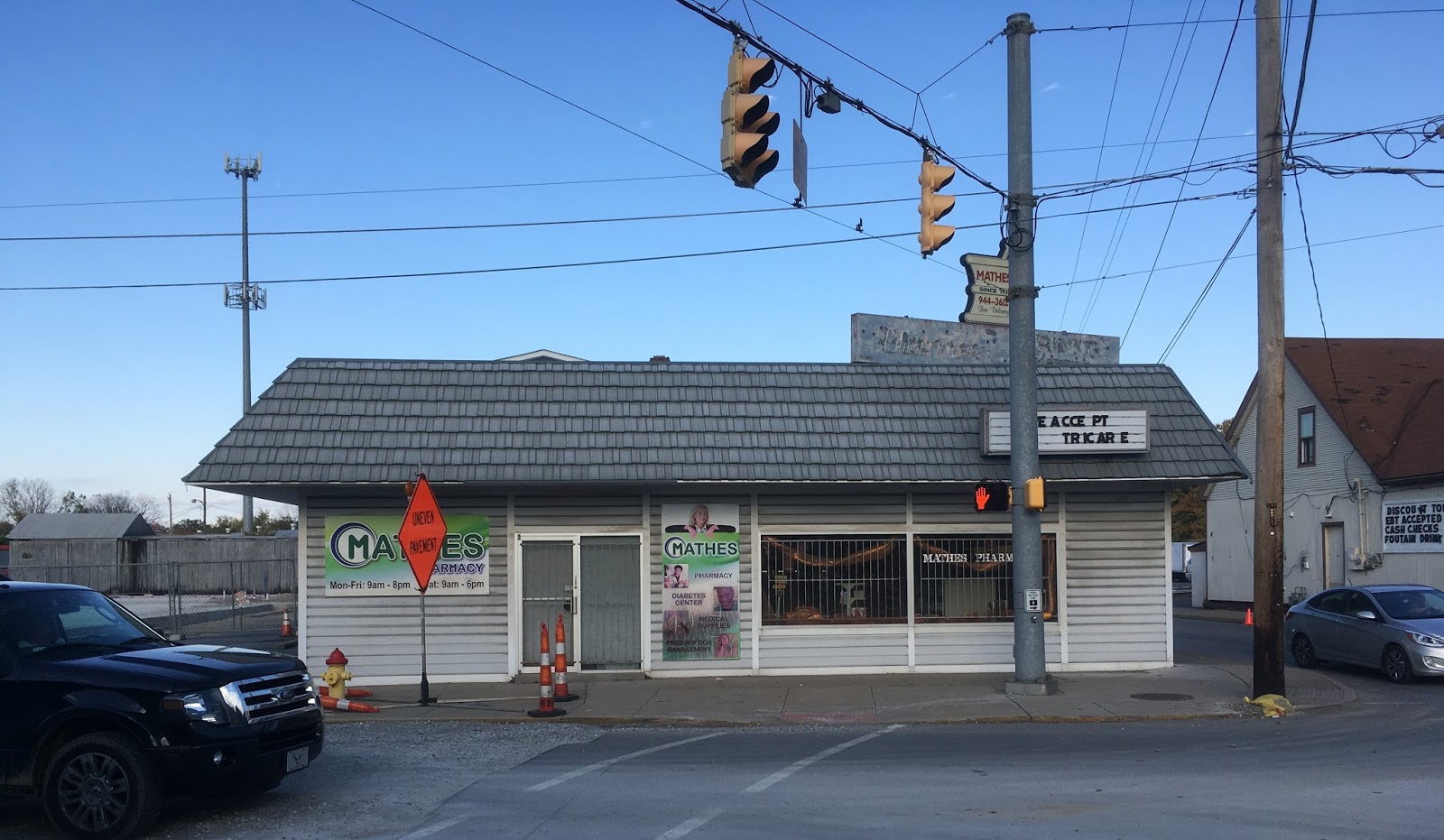
Mathes Pharmacy will expand into a new building. Congrats to a New Albany indie stalwart.


Mathes is my pharmacy.

It's about a 20-minute walk from our house. I'm unrepentant as it pertains to advocating independent small businesses. It's hard to see how Joe could do other than erect a new building and replace the old one with parking. I wish them all the best and look forward to continue doing business.

Disclaimers aside, I'd be lying if I said it's not decidedly bittersweet to see an older corner building be replaced by a parking lot. There's too much of that in New Albany already.

But: Rock on, Mathes. Having an indie pharmacy is very important to the Confidentials, and it should be to you, too.

Mathes Pharmacy tearing down shop, building new one, by Danielle Grady (Hanson Raycom Generator)

NEW ALBANY — When Mathes Pharmacy opened in 1931, there were several independent pharmacies in New Albany.

Today, only a few, including Mathes, remain — thanks in part to embracing of change.

Mathes continues to innovate under the leadership of Joe Dones, who became the sole owner of the business in 2004. His most recent project is tearing down Mathes’ old building of 29 years and doubling its space with an entirely new building in the back.

The project will mean more room for Mathes’ clinical services, including its diabetes center, vaccinations and blood pressure and cholesterol testing. Joe will also be moving Mathes’ medical supplies store, currently located across the street from the main pharmacy, into the new building.

Sunday, April 30, 2017

Shared points of value: "Taking Sides? With Walkability, There’s No Need."


Given our own perennially miserable Rosenbargerian experience locally, it's an almost revolutionary idea.

To get walkable places, advocates of good urbanism have to answer “What’s the value to me?” for both developers and the public.

The author's three-part format identifies the topic and provides points of value for developers and the public alike.


Walkability
Quality Building Fabric
Open Space and Trails
Frontages
Variety of Housing Types

It is clear and concise, and accordingly, there's almost no chance Deaf Gahan can hear it.

Taking Sides? With Walkability, There’s No Need, by Arti Harchekar (Opticos Design)

As advocates of walkable, livable places, we’ve been involved in urban design discussions around the country and worldwide, observing, learning and understanding firsthand the key steps to successfully creating walkable places—and supporting existing ones.

Form-Based Coding is a key tool to unlocking walkability, but we’ve found simply having empathy for all parties at the table can be paramount. While almost always interested in building the long-term value of a community, administrative staff may be facing certain political pressures in the present. At the other end of the room, developers are often focused more on a near-term gain than long-term assets. Working through design alternatives that positively impact both of these interests can be challenging.

A rule of thumb? To get walkable places, advocates of good urbanism have to answer “What’s the value to me?” for both developers and the public. Here are some of the top discussion points we’ve seen gain traction with both “sides” of the urban design discussion.

Walkability

What Is It? Having amenities and jobs close to housing; building activity geared to the public realm; a physical environment that’s nice to be in, not just pass through

Developer Value: Walkability adds long-term value by catering to the 50% of the population that considers being able to walk to daily goods and services a high priority. Near-term value is gained through narrower streets in well-connected networks by generating better access to the lot and adjacent lots, reducing traffic speeds, reducing stormwater runoff and reducing cost for construction and maintenance. Reductions in traffic speed can potentially increase adjacent residential property values. Long-term value is gained through the ability of such a network to be able to adapt more easily to unexpected market shifts.

Public Value: An interconnected network of streets with pedestrian-oriented characteristics adds long-term value by creating a better balance of land uses and economic generators. Narrower streets in well-connected networks decrease accident rates, facilitate mobility choice, and enable the reduction of vehicular miles traveled.

Sunday, July 10, 2016

For better or worse, there'll be a brand new auto-centric White Castle at an already dangerous and muddled intersection.

Panicked rumors began surfacing on social media yesterday afternoon, and thanks to my neighbor Matt, we now see the apocalypse indeed is nigh, for the White Castle at the corner of Spring and Vincennes has closed ... but only temporarily.

The current building is to be demolished and a new one built. I heard this discussed at a Board of Public Works meeting some months back, but forgot about it. I'm told that new White Castle buildings like the one destined for this spot are modeled somewhat on the original castle-like cartoon outline.

I'm not sure if that's better or worse than what's there now.


From the standpoint of this street corner, the real issue remains the intrinsic danger of this intersection, and the fact that Rally's, Walgreen's and White Castle each boast drive-thru windows, translating into greater automotive traffic and a boost in hazards for non-vehicular users, as it's also one of the few places in the city where people walk from adjacent neighborhoods.

"New Albany has a long way to go on street safety," says Broken Sidewalkin an understatement for the ages.


In a much larger sense, I'm an indie kind of guy -- but we all have our exceptions. When it comes to the Porcelain Palace ... the WC Lounge ... it's really hard for me to say "death to chains."

This intersection is such a mess that it's even harder for me to refrain.

Thursday, May 12, 2016

Balsa shoddy plywood. Break wind? At least the elevator shaft is built to last.

Buildings built hundreds of years ago, in it for the long haul.


Buildings being built for the life of a TIF subsidy. A decade of "luxury" -- and then what?


A street paved to last six months. But it sure looked good just before the 2015 election.


Paging Mayor Shoddy ... try stealing your ideas from the Old Town, not the 1986 Soviet rabbit hutch.

Sunday, April 03, 2016

Finally, some love for Karl-Marx-Allee: "Berlin's Best Street Is a Communist-Era Boulevard."

(Wikipedia)

We've all had experiences that define us, whether for better or worse. They generate instant snapshots in the memory.

Regular blog readers know that my summer of '89 in the East Bloc generated powerful ghosts that remain with me to this very day. For three months that year, I was in Czechoslovakia, the USSR, Poland, Hungary and East Germany.

Most of August was spent working for the East Berlin Parks Department, buffing and polishing V. I. Lenin’s shoes, as attached to a gargantuan statue of the Soviet Union's founder, standing prominently at the entrance to the Volkspark Friedrichshain.

It has since been removed.

The ultimate objective of my voluntarily proffered shoeshine -- and tree planting, and landscaping -- was to make things look tidy and respectable in the Volkspark, which was cleverly reclaimed atop mounds of bombed-out rubble from World War II, and served afterward as the front yard for a hospital that often disgorged armless and legless pensioners into the summer sun for their afternoon constitutionals.

The whole story is here:

Pilsner, Putin and Me (Part One).
Pilsner, Putin and Me (Part Two).
Pilsner, Putin and Me (Part Three).
Pilsner, Putin and Me (Part Four).

The volunteers, both East German students and foreigners, lived together in a military-issue tent camp. The various groups were expected to commute to job sites by public transport, which wasn't difficult, but on the first day, my unit was met at the camp by a work vehicle.

It was the East German equivalent of a heavy-duty pickup truck, and we all hopped into the back, to be driven to orientation at the Volkspark prior to being handed our shovels.

In front with the driver was the park's reigning Communist party functionary, an older man with ludicrous hair dyed jet black. His orientation lecture about the importance of labor was openly mocked by the East German student assigned to translate his utterances. After all, the functionary couldn’t speak a word of English. Years later, it was revealed to me that the translator was a Stasi informer.

Back to those defining experiences.

We were in the back of the truck on a beautiful, warm August day, and turned onto a ridiculously wide boulevard with hardly any traffic. It was Karl-Marx-Allee, and I'll never forget the the feeling of passing through the shadows of the over-sized apartment tower blocks, built during the period just after the war, before building techniques devolved into mass shoddiness.

Surely the chosen route was intentional. It showed off the best that the DDR had to offer. A quarter century later, I returned and talked the missus into accompanying me. It was a moving experience, confronting those ghosts.

2014 Euro Reunion Tour, Day 4: To Leninplatz and the Imbiss, 25 years later.


Bizarrely, Karl-Marx-Allee is garnering belated recognition. It doesn't excuse the many and varied abuses of the system that produced it, although once again, it becomes apparent to us that even a stopped clock is right twice a day.

Berlin's Best Street Is a Communist-Era Boulevard, Says a Leading Architect, by Feargus O'Sullivan (City Lab)

What Berlin needs to thrive is more communist-style development. That’s the verdict pronounced by one of Germany’s leading architects this week. Writing in the newspaper Tagesspiegel, Hans Kollhof (responsible for many of the new buildings at Berlin’s central Postdamer Platz) says that Berlin needs a “new Karl-Marx-Allee,” referring to the monumental Stalin-era avenue carved through ruined East Berlin in the early 1950s. Nothing Berlin has built since, Kollhof insists, comes close to its quality, against which today’s constructions measure up very poorly indeed.

“What now comes as luxury in German city centers turns out to be uptight, prettified project housing. Hidden behind a tired packaging of science fiction motifs or Styrofoam classicism…[by contrast] Karl-Marx-Allee is the only example of German urban planning and architecture that continues the great tradition of the 19th century, that needn’t shy away from comparisons with American and other European cities.”

Thursday, December 10, 2015

As the Gospel Bird build-out nears completion, the restaurant now is a Morris solo gig with Ethan Ray as acting executive chef.


Today on my way to coffee, I happened upon Steve Resch, and eventually wandered over to 207 - 209 Main Street to check on his build-out of the forthcoming Gospel Bird restaurant.

We welcome Staggers, Morris and the Gospel Bird with open arms and our senseless one-way streets.

Liftoff is scheduled for mid-January, with the rear outdoor patio to follow at some point before Derby. Later in the day, Eric Morris adjusted the restaurant's operational narrative, saying he wanted "New Albany to know first."

I just wanted to let you know that Dustin Staggers is no longer a part of this project and that I will be doing this on my own. Ethan Ray will be the acting executive chef. 

Thanks, Eric. New Albany is appreciative. As Kevin Gibson recently noted, Ethan Ray is a Louisville culinary legend, so I'm thinking the kitchen's in great hands. Noting that the former Parthenon next door is not slated to be connected to the Gospel Bird, here are two photos of work in progress. The west side will be the dining room ...


 ... and the east side the kitchen and bar.


Steve observed that they're at the stage of construction when things begin happening quickly, so stay tuned.

Parting glass: We recently took a look at previous occupants of the Bader Building's commercial space.

The Gospel Bird is coming, so let's remember what preceded it in the Bader Building and Parthenon.

Tuesday, September 08, 2015

"Small-scale developers around the county ... organizing around their central goals of revitalizing communities, one small lot at a time."

“There is no lack of places in the country where there is opportunity to renew more walkable communities, places that have the bones for this kind of economic success. People have lived in these places a long time, but they haven’t had the benefit of building the wealth for living there a long time.”
-- Jim Kumon (from the article)

As Jeff G pointed out on Fb, New Albany already has the bones, as well as a handful of precisely such developers. In fact, together with local entrepreneurs, they're responsible for a disproportionately high percentage of projects that have combined to create a measure hope for the historic business district.

And yet, the emphasis remains on corporate welfare and the usual smorgasbord of abatements and incentives for big ticket, plaque ready projects. I differ with this attitude. Given that these small-scale developers don't depend on corporate welfare, I think it's the city's job to get the other pieces of the puzzle, primarily infrastructure, into place.

This article is a great example of how little bits of progress add up to tangible and sustainable gains, resulting in the sort of business floor, upon which the large projects can be conceived and implemented organically, without so much need for taxpayer-subsidized fertilizer.

Developers Build Walkable Neighborhoods With Focus on Community Wealth, by Oscar Perry Abello (Next City)

 ... (Monte Anderson is one of a growing group of small-scale developers around the county that is organizing around their central goals of revitalizing communities, one small lot at a time. They typically don’t rely on local tax subsidies or other incentives, and beneficiaries are usually local entrepreneurs and neighborhood residents. They favor walkable, mixed-use, mixed-income, racially diverse communities.

Through the Congress for the New Urbanism, several of them got together and this year began gathering common resources and organizing a small-scale developer program, including small-scale developer boot camps. The first boot camp was in Duncanville, Texas, one of the communities where Anderson works. There are two more scheduled for later this month in Maine and New Hampshire, and one in Atlanta, Georgia, in October ...

Wednesday, June 25, 2014

Two C-J article chart a housing "boomlet" in downtown New Albany, coincidentally making the case for complete two-way streets.


Dude: Grace Schneider just lapped the 'Bune, although to be fair, the latter has been quite busy cheerleading in Jeffersonville lately.

First, there's this, in which it is revealed that after two and a half years on the job, the city's economic development officials at long last want to know all about the moribund Reisz building on Main:

Shining new light on an old store in New Albany

Then this, collating numerous recent building and property acquisitions into a coherent whole, including the (gasp) prospect of infill construction:

Boomlet begins in New Albany

Random observations after reading these two pieces ...

1. Nowhere is it mentioned that Chalfant, Carter or other investors require a $12 million parking garage as collateral for money they don't have. How very refreshing. What's DNA have to say?

2. Implicit acknowledgement abounds: Without previous entrepreneurial investments in restaurants, bars and shops (largely unassisted by the city) over a period of eight year, there'd be no demand for living space.

3. Yet again, the city is coming in on the tail end of something already begun. Charitably stated, it is belatedly asking what it can do to help, which brings us to the single most obvious answer ...

4. ... the fact that taken as a whole, Grace's two write-ups constitute some of the best slam dunk evidence yet of the pressing need for two-way street conversions and complete streets in New Albany.

5. In part, this is because the developers see the presence of an untolled bridge as highly beneficial, meaning you should reread #4 as the corrective for the problems we'll experience along with the upside.

6. Noted in passing: The prospect of infill construction nearby on the 300 block Main is the best reason offered to support this blog's position on the farmers market location. Anchoring the farmers market to its current spot means sacrificing infill potential, and there's a municipal lot behind Wick's that is far better suited for the permanent farmers market location.

I might continue; feel free to comment here or at Fb.

Wednesday, April 23, 2014

Speaking of infill housing for those vacant lots ...


Mr. and Mrs. Confidential have decided this would be our chosen design if we were to downsize and build a house on one of the vacant lots that Dan Coffey mentioned yesterday at the redevelopment meeting.

Don't you think it's time to spice up the historic areas with some punchy, efficient modern design?

Photo credit

Dan Coffey says sensible things about infill.

On duty at yesterday's redevelopment confab, during which most of the time was spent accepting bids from the usual construction and design suspects, councilman Dan Coffey got real.

EMPTY HOUSES

Commission and New Albany City Council members Dan Coffey and John Gonder will head up a committee to look at ways to partner with private contractors to build homes in empty lots around the city.

“The city owns hundreds of lots,” Coffey told the members. “I would like to work with the public and private sector where a builder could buy a lot for a nominal fee and try to get some houses built instead of torn down.”

The committee will gather the information and report back to the commission.

Thursday, January 10, 2013

Delightful for a layman like me: "The Genius of Traditional Buildings."

Sharpe provides simplicity and clarity in answering questions we've all asked from time to time. His conclusion: "Traditional building developers used their limitations as advantages, making the most out of known technology and social behavior."

Now that's revolutionary.

The Genius of Traditional Buildings, by Graeme Sharpe (Urban Indy)

Have you ever been to a old downtown and marveled at the historic buildings? Have you ever wondered how they could create such beautiful buildings on such small budgets, compared to the placeless architecture we are told is barely affordable today?

The truth is that those multi-story, mixed-use buildings lining the street were built by a different culture. We are a different people now, and we demand different things from our built environment.

But that old American culture was a very clever one, and we can profit from studying what they did right, and how they did it. So here is their basic recipe ...

Thursday, June 16, 2011

Walls and dominoes falling at the corner of 8th and Culbertson.

In today’s newspaper, Daniel Suddeath charts the status of the partially collapsed building at the corner of 8th and Culbertson, and in the process of doing so provides readers with enough smelly discussion points to last the whole day through.

New Albany spending $35,000 to save dilapidated house; Historians tout importance of 1858 structure to neighborhood

It is conceded by all interested parties that the historic building in question has been the victim of long and sustained neglect, and in fact was “out of code.” The owner is a legendary, notorious absentee slumlord. Yet, no enforcement mechanisms were exercised, and nothing was done until after Mother Nature provided the necessary cue.

Was the slumlord a Democratic Party donor, or is it just another case of the New Albany Syndrome?

And so: The city having yet again enabled a slumlord through non-enforcement, and with the familiar result of chronic neglect leading first to disaster, and then the piety of newfound urgency, the fund-raising for Band-Aids begins anew.

Grumbling all the way, the Redevelopment Commission is tapped for some CDBG cash, and Indiana Landmarks tithes its share, which in an interesting twist is revealed to be coming from the sale of a long dormant Landmarks-owned property on the 1600 block of East Spring.

Wonder what the purchasing developer's plan is for that one?

The politician/realtor handling the transaction of the East Spring property for Landmarks makes a requisite appearance to promote the fundraising effort, and no one blinks an eye.

Carl Malaysz off-handedly remarks that more of the needed restoration money might come from the Horseshoe Foundation, or better yet the Urban Enterprise Zone, the current administration’s recurring and handy ATM in times of need. Everyone agrees to be more diligent and pro-active in the future, and nothing at all changes.

In Jeffersonville, the slumlord giggles. Again.

Speaking personally, of course I want to see the building saved. But will anything ever be learned here? As a friend observed on Twitter:

"When will New Albany figure it out? Consistent code enforcement is cheaper than spending money to 'save a dilapidated structure' ... and it becomes really expensive to pay a building commissioner and code enforcement officers to essentially do as little as possible."

Tuesday, August 17, 2010

Shane Gibson: "Tolls are not good for the majority of citizens or businesses in Floyd County and New Albany."

If you're just tuning in, Shane Gibson is the New Albany city attorney, and the Democratic candidate for the Indiana House of Representatives District 72 seat in the approaching fall election. The Republican incumbent is Ed Clere, who toppled political veteran Bill Cochran two years ago.

In today's Tribune guest column, Gibson begins by somewhat awkwardly touting the building of an Education and Technology Building at Indiana University Southeast, basing his advocacy exclusively on the grounds of short-term construction jobs and their benefit to the local economy, while not commenting at all on the intrinsic long-term benefits of the structure within the context of the university's mission.

Presumably, IUS stands to be strengthened by the classrooms to be housed within the building, and the instruction to be enabled by it, but we read none of this. Obviously, building a new Education and Technology Building at IUS will put people to work – for a while, at least – but how will having the building assist the university’s future educational mission? How will having such a building help us down the road, by adding value to the university, and by creating jobs that are not temporary?

The problem with Gibson arguing the desirability of jobs created by a construction project without consideration of merits of the project itself is that there’ll be people, among them far too many building and construction “leaders” standing to profit mightily from the largesse, making the very same claim about the Ohio River Bridges Project.

(How these “leaders” politically manipulate institutions such as One Southern Indiana in pursuit of future largesse is another topic for another day).

Gibson concludes his column with the first tangible indication that maybe, just maybe, the somnolent local Democratic establishment finally has noticed the low hanging fruit of an emerging campaign issue: No Tolls.

I will reiterate that while tolls stand to be devastating to Southern Indiana small business, "no tolls" as political phraseology means less than nothing if it does not bring the listener into the tent for a broader discussion of the inexcusably massive boondoggle of the ORBP, a chat which must include straight talk about innovative 21st-century mass transportation solutions, not the planned obsolescence of 20th-century initiatives to reinforce automotive-fueled sprawl, ones that possess all the vision and deftness of Stalinist dam-building projects, even if they generate lucrative pork for the members of 1SI’s non-transparent public policy committee.

GIBSON: Time to get to work on a new IUS facility

... Only when people don't get what they want do they say it is “all or nothing.” Why is that the case? In the end, tolls are not good for the majority of citizens or businesses in Floyd County and New Albany.