Showing posts with label Tallinn Estonia. Show all posts

Tuesday, November 01, 2016

"The Tallinn experiment: what happens when a city makes public transport free?"

Waiting for the bus in Tallinn, April 2016.

Plenty of pros, and a few cons, too. During our spring break getaway in Tallinn ...

All the Estonia links are here, in one place.

... we used inexpensive public transportation day passes, and adored them.

The Tallinn experiment: what happens when a city makes public transport free? by Maeve Shearlaw (The Guardian)

Since Estonia’s capital started providing free public transport for residents in 2013, it claims to have turned a €20m a year profit each year. But has the scheme achieved its ambitions of reducing traffic and saving people money?

In London a monthly travel card for the whole city costs almost £200. In Copenhagen, a city a fraction of the size, you’ll pay £160. So when you ask the residents of Tallinn about the benefits of free travel across the city, it’s a surprise to be met with a roll of the eyes or a sarcastic smile.

The capital of Estonia introduced free public transport at the beginning of 2013 after their populist mayor Edgar Savisaar called a referendum on the decision, dismissed by critics at the time as a political stunt that the city couldn’t afford.

Three years on Savisaar has been suspended amid allegations of corruption, but the city remains committed to the programme – claiming that instead of it costing them money, they are turning a profit of €20m a year.

To enjoy Tallinn’s buses, trams, trolley buses and trains for free you must be registered as a resident, which means that the municipality gets a €1,000 share of your income tax every year, explains Dr Oded Cats, an expert who has conducted a year long study on the project. Residents only need to pay €2 for a “green card” and then all their trips are free.

Since the scheme launched, an additional 25,000 people have registered in the city that previously had a population of 416,000, but this is where the tension lies. The more money for the city of Tallinn, the less there is for the places they leave behind, explains Cats, “so it’s not hard to see why the government and the mayor’s office might see things differently”.

Thursday, May 12, 2016

Balsa shoddy plywood. Break wind? At least the elevator shaft is built to last.

Buildings built hundreds of years ago, in it for the long haul.


Buildings being built for the life of a TIF subsidy. A decade of "luxury" -- and then what?


A street paved to last six months. But it sure looked good just before the 2015 election.


Paging Mayor Shoddy ... try stealing your ideas from the Old Town, not the 1986 Soviet rabbit hutch.

All the Estonia links are here, in one place.


All the Estonia links are here, in one place. The photo was taken on the Baltic beach in Tallinn. I just looked outside, and it appears to be New Albany. This apparently means vacation is over, and with it the coffee break.

We're back on our heads.

Estonia Spring Break 2016: Day One, and the joys of steerage class.


Estonia Spring Break 2016: Day Two, and an orientation walk through Tallinn's Old Town.


Estonia Spring Break 2016: Day Three, with a thrift store visit and the Museum of the Occupations.


Let's have a look at "The Singing Revolution" and Estonia's historical experience.


Estonia Spring Break 2016: Day Four ... the old and the new; the beach and the beer.


Estonia Spring Break 2016: Day Five (1 of 2) ... a fish market and the exceedingly bizarre Linnahall.


Estonia Spring Break 2016: Day Five (2 of 2), featuring a bus ride to the 'burbs and two Old Town pubs.


Estonia Spring Break 2016: Day Six, and a big surprise in Helsinki.


Estonia Spring Break 2016: Day Seven -- odds, ends, kelders and kvass.


Estonia Spring Break 2016: Day Eight, and home, though not before a few reflections.


Old and new in Tallinn, Estonia, 2016.


Thursday, May 05, 2016

A visit to Tallinn reinforces the need for safe, walkable streets in downtown New Albany.


We just returned from a week in Tallinn, Estonia. During peak times, traffic is heavy in the downtown area, and it's obvious that the country's relatively recent affluence is being manifested by the "dream" of auto ownership.

That said, public transportation is pervasive, and walkers are numerous, even outside the dense, medieval old town, where cars are almost non-existent. While there were fewer bicycles than I'd expected, it was an amazing experience to learn that where a crosswalk is designated by striping, drivers yield to walkers without flashing lights and signage to command them.

Evidently they'll be held responsible if they don't. What a concept!

At several tram stops in downtown Estonia, the doors open directly into a street with moving traffic -- and again, drivers yield to those exiting the tram.

The lesson for New Albany isn't that it needs to happen here. We already know it. Rather, downtown NA's merchants need to work together to insist on walkability, from a safety standpoint as well as their own self-interest.

So long as merchants, residents and other downtown stakeholders continue to swallow Team Gahan's perpetual excuses for non-prioritization of complete streets, they'll be denied the benefits of a walkable downtown. What we have now is unsafe and unsustainable. What we have now works daily to suppress the return on investments that we've all combined to make.  

It needs to change, now.
 
Transportation Officials Weigh In on Redesigning Tomorrow’s Streets, by Jen Kinney (Next City)

... Shared transit right-of-ways, active transportation lanes and safe intersections that allow all transit modes to intersect peacefully are all detailed in the Transit Street Design Guide. The guide complements NACTO’s Urban Bikeway Design Guide and Urban Street Design Guide, both of which advise cities on creating multimodal streets.

With the new guide, NACTO focuses on strategies to prioritize transit on existing urban right-of-ways.

Wednesday, May 04, 2016

Old and new in Tallinn, Estonia, 2016.

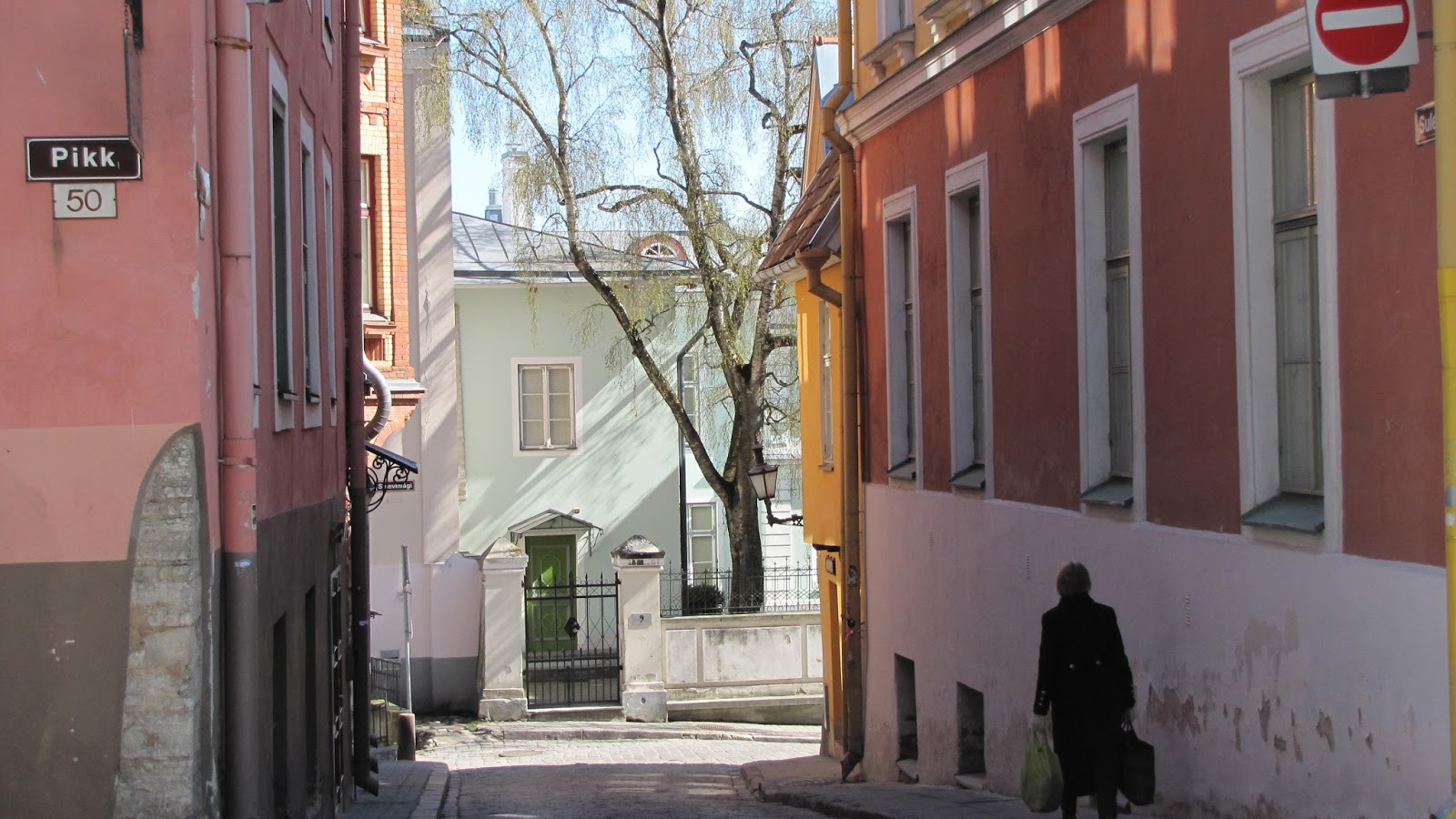
More later, but first, here's a Tallinn teaser.


Pear cider and dark lager in the old town.


Hanseatic Tallinn in the foreground, and the modern city rising behind it.


Soviet-era vending machine. You were served fizzy water in a common glass.


View from the cafe on the 24th floor of the Radisson hotel, where we had lunch.


After a week of enjoying a comprehensive and efficient public transportation network, it's back to cars ... and more cars ...

Tuesday, May 03, 2016

Estonia Spring Break 2016: Day Eight, and home, though not before a few reflections.


(As is my custom when posting trip summaries, I'm backdating them to the actual day of occurrence. Previously: Day Seven)

You know the drill: Cram the suitcase extra full, flag a taxi to the airport, and relish a day filled with shoe, belts and sanity removed for scrutiny. We were on a KLM flight from Amsterdam to Atlanta. The cans of Heineken were free, and so I drank way too many. In other words, in spite of airBaltic on the opening leg, it was routine.

So, Estonia.

Perhaps an offbeat choice for a trip -- neither Cancun nor Disney World, just daily reality in a nation of relatively recent vintage, filled with people who've been speaking that "devilishly difficult" language for thousands of years.

"Their biggest problem," says Mailis Sutiste, "is the letter 'Õ.'" " Õ" as in " Õun" (apple). " Õ" like "Õde" (sister), or "Õnn" (happiness). In fact, Sutiste's profession - " Õpetaja" (teacher) is even a difficulty for her students to pronounce in a way that is mutually understood amon Estonians to be the true "Õ ."Sure her Estonian class at Tallinna Keeltekool can reshape their "O's" - cut them down, swallow them whole - but they still can't get that "Õ" sound - though they get very close.

Regardless of the " "s - for Sutiste, as well as for other teachers of Estonian, the fact that people are trying to learn their language - and not only Russian-speakers studying to pass the state examination to get full citizenship - is a bit flattering. There is an interest in learning Estonian in Estonia that has never really existed before.

The Baltic Germans spoke German, the Soviets Russian. Estonian was always a "native" or "peasant" tongue. Now it stands alone as the official language of Estonia, and that has created an interest in learning it, an interest that Sutiste says is increasing as Estonia gets closer to becoming an official language of Europe - that is, a European Union language.

Never mind that English is the de facto second tongue, and Estonians tend to speak our language better than we do. The history of the country is aptly summarized by these three paragraphs, highlighting Estonians, Baltic Germans, Russians -- and now, Europeans.

In 1991, Estonia regained its independence, only to be presented with a thorny problem. Exactly how does one recover from 50 years of Sovietization? In broad terms, Estonia's answer was avoid shortcuts and endure whatever pain was necessary in the short term in order to gain a long-term objective of inclusion in the European project. Consequently, it took only 13 years to gain membership in the EU.

In contrast, it's been ten years of recovery in New Albany, and the streets still run one way.

The usual disclaimers apply: But of course Estonia could achieve this. Emerging from communism, the country remained culturally and linguistically homogeneous in spite of an alien (read: Russian) minority. Estonia's cousins in Finland stood by, ready to invest. It was in the EU's (and NATO's) best interest to transform Estonia into a buffer against bordering Russia. And so on.

But the ditches still need to be dug and fiber optic lines buried. Speaking for myself, this American saw something in Estonia rarely witnessed back home: A remote semblance of shared values and purpose. If we're the most powerful country in the world, can't we have an encrypted on-line passport?

Perhaps the memory of oppression remains sufficiently fresh, and by oppression I mean the genuine article, not the ludicrous suffocation purely imagined by so many of my fellow white males in the States.

I'm also aware of that 20-odd percent of Estonians who are Russian. It's sometimes hard to separate national characteristics of Russia from the lives of ordinary Russians, who are warm, passionate and welcoming people. In fact, the same might be said of Americans, which is why I persist in thinking that Russians and Americans have much in common if their governments might only leave the room and allow us to communicate with each other.

In Estonia, it's more complicated, although arguably less so for the young. In the Estonian context, reasons for Russian immigration differ markedly from those bringing Mexicans to the United States, because the Soviet Union shifted its own people from place to place for cynical political reasons, not in response to market forces.

I'm not sure any of it matters. Whether Russian or Mexican, if you've lived in a place long enough to consider it home and follow the rules, isn't it home?

Yes, I know. The devil resides in the details. It's why we have barrooms.

Next up for the Confidentials: A touch of Sicily in the fall. Mt. Etna's on my bucket list, and the eating and drinking ...

Monday, May 02, 2016

Estonia Spring Break 2016: Day Seven -- odds, ends, kelders and kvass.


(As is my custom when posting trip summaries, I'm backdating them to the actual day of occurrence. Previously: Day Six)

Everything we'd read about Estonia prior to arrival indicated that it has become one of the most pervasively "wired" countries in Europe. Estonians have an encrypted on-line passport; they vote and pay taxes on line, and the entire country is a WiFi hotspot.

Consequently, the Baylors being a cantankerous duo, we resolved to honor tradition and remain off the grid for the duration of our stay -- no cell phones, laptops or e-mail checks. Photos would be taken the old-fashioned way, with a stand-alone camera. I left the hotel phone number with selected folks back home, and off we went.

Predictably, on Monday morning, this Luddite determination came back to spite us. Being so close to the airport, and with public transit passes still valid, it seemed to make perfect sense to check in there for Tuesday's flight, physically and "in person" -- except that even in Tallinn, which airBaltic (a Latvian carrier) classifies as a secondary hub, public terminals and available staff were of almost no help.

Finally we were told that in-person, physical Tallinn Airport check-in for airBaltic was theoretically possible, albeit it for a 30 Euro fee per person. Incredulous, we rode the bus back to the hotel and checked in quickly and easily via the hotel's lobby laptop.

My consolation was this: While airBaltic might have been a bizarre experience, during Soviet times we'd have been dealing with Aeroflot, an experience likely to have pole-vaulted over merely weird, all the way to terrifying. Perspective matters.


The remainder of the day was spent in a sort of valedictory rambling, with periodic bouts of cafe hopping. The weather was perfect (again), and Tallinn's core Old Town couldn't be better for strolling. A highlight was the Estonian History Museum in the Great Guild Hall.

Monday had started in the Baieri Kelder, the Hotell St. Barbara's Bavarian-style restaurant and taproom in the basement, which doubles as the (bountiful) buffet breakfast area. Both hotel and restaurant date from 1997, just after Estonian independence, and the Baieri Kelder is safely above average for a hotel restaurant and bar. Here are a few photos to illustrate the point.


The coffee machine is a commercial model very much like the "home" model we have in the kitchen.


As a final hotel note, one of the minor fascinations I've accrued from 30 years of European travel is the typical Central and Northern European window. It makes so much sense that I want to scream.


Basically, it's an insulated window with a handle movable to three positions: Locked, opening outward (hinges on the side) and opening upward (hinges on the bottom). It's entirely sensible, as well as potentially compatible with screens, although there were no screens in place at the St. Barbara.

Do we even have such options in America?

For our final meal in Tallinn, we opted for Kuldse Notsu Kõrts, or the Golden Piglet Inn. On the Old Town side of the underground pedestrian passage to Freedom Square, the skateboarders were coming together. Do architects realize what they're building?


The Golden Piglet Inn is not the type of restaurant most amenable to those in the habit of counting calories.

Using recipes that have been passed down from our grandmothers and our grandmothers’ grandmothers, this authentic restaurant is popular with locals as well as tourists. All meals are prepared with fresh products from local farms, accompanied by a variety of Estonian drinks.
My bill of fare included sauerkraut soup, salted herring and two very regional drinks, mead (in this instance, a fermented combination of malt and honey) and kvass.

Kvass is a lightly fermented soft drink made from dark bread and yeast, with a myriad of other additional ingredients, as befits a product traditionally made at home. We think of kvass as Russian, though many Baltic and Eastern European countries have their own versions (in Estonian it's called kali).

To create that tangy fermented flavor, kvas makers start with Russian brown bread. You soak it in water, and then add some yeast (other additions — raisins, honey, mint — vary from recipe to recipe). The whole mixture ferments for a few days, a process that creates a natural carbonation, as well as a distinctive sour flavor.

According to Russian writer Alexander Genis, that sourness is beloved in the region. "The sour is the taste of Russia — everything is supposed to be sour for Russian taste. Like sour cream, for example, or pickled cucumber. Cabbage, mushroom."

Given that one of the glories of Estonia is its dense, moist black bread, kvass/kali is a natural. The commercial version available at Golden Piglet actually lacked the tang of what I remembered at a street stand in Moscow, circa 1999. It was sweeter, but no less delicious, and would be an apt thirst quencher in summertime.


With dusk making its long approach, there was a final glimpse of  Freedom Square.


Well, you simply don't always see brick statuary like this.


At the Baieri Kelder, and an inevitable nightcap.


Mine was a straight and tasty golden lager from A. Le Coq -- common, but still "the beer from here."


The clock on the wall read: "Time for packing and some sleep before you fly home."

Next: Tuesday (Day Eight), and the flight back to America.

Saturday, April 30, 2016

Estonia Spring Break 2016: Day Five (2 of 2), featuring a bus ride to the 'burbs and two Old Town pubs.


(As is my custom when posting trip summaries, I'm backdating them to the actual day of occurrence. Previously: Day Five, 1 of 2)

Pulling ourselves away from the weirdness of Linnahall, it was well before lunch and we'd done enough walking, so we hopped a tram to a bus stop and rode #42 toward the southern and western outskirts of Tallinn, through Nõmme (Estonian for "heath") and Mustamäe to the end of the line at Haabersti.

Perhaps because Nõmme is the ritziest borough in Tallinn, it boasts an excellent open air market with kiosks for year-round sales.


Nõmme also is known as the "forest town," sits at a high point of elevation, and thus overlooks the western districts of Tallinn. Many people live in these areas, residing in vast housing estates of variable quality erected during the Soviet period. In effect, neighborhoods like Mustamäe and Haabersti are the places for affordable housing in Tallinn. Google street views provide a glimpse.


I'm seldom in the habit of defending the development strategies of the Soviet bloc, but I will say this. As bleak as these blocks might appear to us, at least they were built to be serviced by public transportation, and equipped with retail and shopping options, often within walking distance of one's flat.

Granted, none of it was "free" market in orientation (although it is now), and the shops might have been empty in the bad old days. Still, it might help to take a balanced view.

At this point in our day, it still wasn't 2:00 p.m. We circled back to the center on another bus, and walked into the Old Town to find the Hell Hunt, which bills itself as "The First Estonian Pub," founded in 1993.


It's a first-rate watering hole, with house "label" beers of its own (I had pints of ale and dark lager), solid pub grub (fried Russian dumplings with sour cream), and an NBA playoff repeat (Charlotte and Miami) on the biggest screen.


With tiring feet inexorably guiding us in the direction of the southern gates, a familiar site came into view below the Toompea ridgeline.


The hanging barrel marks the location of Põrgu Brasserie, where we'd snacked and imbibed the previous evening. Back for some more? Of course.


The pork ribs are Diana's, and the delicate anchovy sandwiches are mine. My two Estonian-brewed ales were Saaremaa Koduolu, a farmhouse-style Saison from the Taako Pihtla brewery, and Sori "Winter Gorilla" Baltic Porter.

A nightcap at the hotel's subterranean Bavarian cellar was followed by an early bedtime. We had a boat to catch first thing Sunday morning.

Next: Sunday (Day Six), and a sea voyage to Helsinki for a big surprise.