Showing posts with label Russia. Show all posts

Tuesday, March 31, 2020

Welcome to the Twilight Zone and "Russian experiments in life after death."


Photos: Lenin's Mausoleum, 1989, from my collection. Indoor photography was not allowed, to put it mildly.

If it's really strange reading you're looking for, may I suggest this review in The Nation of a book by Anya Bernstein called The Future of Immortality: Life and Death in Contemporary Russia. The review begins with cryogenics and then really leaves the tracks.

The Collective Body: Russian experiments in life after death, by Sophie Pinkham

... This practice (of life-extending blood transfusions) has its origins in a truly utopian and egalitarian, if even more biologically suspect, experiment. Aleksandr Bogdanov, a prominent early Bolshevik and science fiction writer, investigated the rejuvenating properties of blood transfusions in the 1920s, though he soon died after exchanging blood with a tubercular student. As anthropologist Anya Bernstein discusses in The Future of Immortality: Remaking Life and Death in Contemporary Russia, Bogdanov’s hope was not merely to prolong the lives of individuals; he envisioned a sanguine communism in which all were granted an equal share of society’s collective health through blood exchanges.

You only thought you knew why the USSR failed.

“All social doctrines … all the social utopias humanity has tried to achieve have stumbled up against the short-breathedness of man,” (Anastasia) Gacheva tells the crowd. “The utopias stumbled on man’s deepest misfortune, which is his mortality. Mortal man cannot be made happy. This is why communism did not succeed.” Needless to say, this is a novel diagnosis of communism’s failure. It wasn’t the command economy, the Cold War, or growing popular resistance that brought the Soviet Union down but rather the failure to achieve eternal life. Until all people unite in the common cause—the struggle against death—the world will be rife with conflict, whether or not the state professes itself a utopia.

I'm headed back to reread this essay, this time with a couple belts of vodka.

Friday, December 13, 2019

"American conservatives who find themselves identifying with Putin’s regime refuse to see the country for what it actually is."


Here's the pitch.

The belief that Russia is on our side in the war against secularism and sexual decadence is shared by a host of American Christian leaders, as well as their colleagues on the European far right.

Then this.

I his book, (Paul) Hollander described the prestige that Albanian communism once enjoyed in Sweden and Norway. Few Scandinavians had ever been there, but that didn’t matter: “Albania is picked up simply because it seems to be a club with a particularly sharp nail at the end of it with which to beat one’s own society, one’s own traditions, one’s own parents.” Now (Tucker) Carlson is using Russia as a club with which to beat his own society and his own traditions.

Whenever I hear the likes of Franklin Graham referred to as an "intellectual," I reach for my flask and eat lots of garlic. Thanks to the Bookseller for pointing the way to this fine read.

The False Romance of Russia, by Anne Applebaum (The Atlantic)

American conservatives who find themselves identifying with Putin’s regime refuse to see the country for what it actually is.

... Fortunately for all such critics, they don’t have to spend much time in the country they are “rooting” for, because there is no greater fantasy than the idea that Russia is a country of Christian values. In reality, Russia has one of the highest abortion rates in the world, nearly double that of the United States. It has an extremely low record of church attendance, though the numbers are difficult to measure, not least because any form of Christianity outside of the state-controlled Orthodox Church is liable to be considered a cult. A 2012 survey showed that religion plays an important role in the lives of only 15 percent of Russians. Only 5 percent have read the Bible.

If American Christians would find little to cheer for in Vladimir Putin’s Russia, American white nationalists would be disappointed too. Carlson has wondered aloud about America’s racial mix, asking, “How precisely is diversity our strength?” He would have a real dilemma in Russia. Nearly 20 percent of Russian citizens do not even identify as Russian, telling pollsters that they belong to different nationalities, ranging from Tartar and Azeri to Ukrainian and Moldovan; more than 6 percent of Russians are Muslims, as opposed to 1.1 percent of the U.S. population. And that might be a gross underestimate of the actual number of Russian Muslims, since in some parts of the country, Muslims are off-limits to census takers. Remember all those phony stories about Swedish and British neighborhoods that are supposedly no-go zones ruled by Sharia law? Russia has an actual province, Chechnya, that is officially ruled by Sharia law. The local regime tolerates polygamy, requires women to be veiled in public places, and tortures gay men. It is a no-go zone, right inside Russia.

As for Putin himself, there is no evidence that this former KGB officer has actually converted, but plenty of evidence that Putin’s recent public displays of Christianity are just as cynical as Stalin’s vaunted love for the working classes. Among other things, they are useful precisely because they can hoodwink naive foreigners. But you don’t need to listen to me say so. Listen, instead, to the words of a young Russian, Yegor Zhukov, who was put on trial for publishing videos critical of the regime. In an extraordinary courtroom speech, he addressed the loud support for “the institutions of the family” that Putin often offers in Russia, and contrasted it with reality ...

Wednesday, March 27, 2019

Russiagate: "The question now is, has the Mueller report finally freed up the rest of us to challenge the more insane flights of fantasy?"

But was it consummated?

As usual The Onion wins.

Shocked Vladimir Putin Slowly Realizing He Didn’t Conspire With Trump Campaign (The Onion)

‘Who The Hell Was I Working With Then?’ Asks Russian President

MOSCOW—Saying that he had been “totally blindsided” by the revelations from the recently released findings of the Mueller investigation, a shocked Vladimir Putin reportedly came to the realization Tuesday that he didn’t conspire with Donald Trump’s 2016 presidential campaign after all ...

... "I spent so much time emailing back and forth with DonaldTrump46@hotmail.com about compromising the democratic voting process, and now it turns out it was all fake?"

America spent the Cold War exaggerating the capability of our Soviet foes, so I suppose we might as well travel the same path with Putin and today's Russians. Concurrently I loathe Trump, but persist in believing we must do things for the right reason -- or it's just more fake news. 

This essay from an old Russian hand amid the journalistic ranks hits all the correct notes. Russiagate has been a massive distraction from discussions that should have been taking place since The Donald became president.

Russiagate: The Great Tragic Comedy of Modern Journalism, by Matt Bivens (Medium)

 ... I was not surprised to see politicians up on their hind legs, panting mindlessly about Russians. But to see journalists at CNN, The New York Times, NPR, MSNBC, competing to be even dumber … hot on the trail of a non-story, recklessly discarding fairness and professionalism … dragging us gleefully down every rabbit hole … applauding the collateral damage to bystanders, as they indulge their collective rage against Donald Trump, their hysterical certainty that he must be a Russian asset … What can I say? It’s been heart-breaking.

I know of smart, progressive-leaning journalists who politically oppose Donald Trump, but who feel like strangers in their own newsrooms, afraid to speak out against this mob psychosis. When I meet old colleagues, we have to feel each other out cautiously, until with relief we realize: Thank God, you’re not one of them — not one of the pod people from “Invasion of the Body Snatchers” that might point at me and scream.

I would hear their tales of the lunacy in their journalistic operations, shake my head in concern, wish them the best. And then I’d go back to my job in the emergency department, taking care of people with heart attacks and strokes and broken bones.

Watching from afar, I would cheer on those few brave enough to ask questions — people like Glenn Greenwald of The Intercept, Aaron Maté of The Real News, John Solomon of The Hill, Masha Gessen at The New York Review of Books, and my old friends Leonid Bershidsky at Bloomberg and especially Matt Taibbi of Rolling Stone. And I would wait for the madness to end. But it didn’t.

And then Stephen Cohen of The Nation, another voice of reason, sent me a copy of his book, “War With Russia?” It’s a collection of his heretical writings about our new, unnecessary Cold War, and the opening essay, adapted from a talk he gave in Washington D.C., made me ashamed of my silence.

“Some people who privately share our concerns — again, in Congress, the media, universities and think tanks — do not speak out at all. For whatever reason — concern about being stigmatized, about their career, personal disposition — they are silent. But in our democracy, where the cost of dissent is relatively low, silence is no longer a patriotic option,” Cohen wrote, adding, “We should exempt from this imperative young people, who have more to lose. A few have sought my guidance, and I always advise, ‘Even petty penalties for dissent in regard to Russia could adversely affect your career. At this stage of life, your first obligation is to your family and thus to your future prospects. Your time to fight lies ahead’.”

Well, what was my excuse?

Special Prosecutor Robert S. Mueller has now turned in his findings, and there’s not much there. For weeks beforehand, mainstream media warned about this — exhorting readers against succumbing to feeling “disappointed”.

Disappointed? I guess, as my friend Taibbi has noted, it would have been an immense relief had the U.S. president been found to be a high-level traitor. We could have all brought picnic lunches to his execution.

Right before the species-ending war with Russia.

In their fanatic loyalty to the narrative, what used to be my favorite media have stridently reminded us that, Mueller aside, “it’s not over!” The “focus of the investigation” will move now to the New York prosecutors, to House committees. The American intelligentsia will continue to dream up wild theories — they’ll be Scotch-taped on every vertical surface, connected by bits of yarn and magic marker scribbles and hyperverbal mania.

The question now is, has the Mueller report finally freed up the rest of us to challenge the more insane flights of fantasy? Or is it instead so close to the 2020 presidential elections — and so legally dangerous for some of the intelligence insiders who have tried to bring down the president — that skeptical journalists more than ever will be bullied to keep silent?

Wednesday, December 13, 2017

LIVE TO EAT (AND DRINK): "Three Days of Vodka With Gary Shteyngart."


I've been researching vodka for a future free-lance article, and was thinking back to the unexpectedly tasty way straight firewater accompanies little nibbles. In the case of Russia, these are called zakuski, which I recalled in this installment of the Euro '87 travelogue.

Soviet restaurants certainly had menus, though they tended to be approximations, particularly in the case of foreigners who spoke no Russian. Even if the restaurant was able to serve a dozen main courses, the selection likely would be narrowed to simpler options, like either beef or fish.

Probably everyone involved understood the nature of the exercise, and you'd take what you were served, beginning with drinks and zakuski. In Russia, zakuski are appetizers both hot and cold, though often featuring pickled and smoked vegetables, cheese and fish.

The practice of zakuski apparently originated among the landowning classes as a reflection of Russia's vastness and a mutually beneficial obligation to provide hospitality to travelers. In short, snacks and vodka were kept at the ready. These would sustain tired visitors until the kitchen could be animated to produce a full meal.

As meant to be taken with vodka, zakuski often proved to be the high point of restaurant meals in the Soviet Union.

Diners were given ample time to graze the zakuski and empty their bottles before the indifferent entree would appear, usually only after diners were sufficiently well lubricated to be grateful for belly mortar irrespective of quality. There'd usually be dessert, often ice cream.

Bopping around in search of information, I happened upon this old article at Slate -- and it's a hoot. I've read Shteyngart's books The Russian Debutante’s Handbook and Absurdistan, and he's a fine writer. So is Troy Patterson.

Read this and know what a Russian vodka session is like. These days, it isn't likely I could keep up, though never say нет.


Three Days of Vodka With Gary Shteyngart
, by Troy Patterson

A boozy trip down memory lane—and through Russian history—with the author of Little Failure.

 ... Gary Shteyngart picks up a menu printed with the Russian Vodka Room’s logo, in which the savage hammer and sickle garnish a cocktail served up at the center of a Soviet star. Across the room, a fat man limbers his fingers and eyes a black piano. Gary Shteyngart receives his brief: The job tonight is to help me explain to myself and everyone exactly what vodka is.

Of course, everyone knows what vodka is. Defined by law to be a neutral spirit “as tasteless and odorless as possible,” it is the best-selling liquor in the U.S.—“the backbone of the spirits industry.” You don’t need Gary Shteyngart to tell you why such a bland booze should be so successful, but he’s here, so why not? “It’s utility. Vodkas mix well because they have so little personality.”

Around the world, vodka is an icon and emblem of Russia, where it is variously lyricized and decried, both a poem and a problem. There could have been vodka without Russia; both Poland and Ukraine have staked plausible claims of historical precedence. But there could not have been the grandeur of the Grand Duchy of Moscow, nor the evil of the USSR, nor the mystery of the steppes, nor the mystique of the onion dome, without vodka. “It’s the curse and liberation of Russia,” as the British writer Colin Thubron once put it. Gary thinks of Russia’s relationship with vodka in parallel terms: “It’s very Homer-Simpsonian: The cause of, and solution to, all of life’s problems.”

The Russian Vodka Room lists 44 commercial vodkas on its menu, including Smirnoff (the pioneer licensed for U.S. consumption in the 1930s), Tito’s (distilled in Texas), and Ciroc (from Diddy, because every third celebrity has a vodka these days; recent weeks have brought news of labels launched by a retired Piston, a former Patriot, and New Hampshire’s Old Man in the Mountain). “The difference among vodkas is not that great,” Gary says, “but Russian Standard is the best. It doesn’t have a story about how it’s been triple-filtered through a diamond in a rhinoceros's asshole, but it gets the job done.”

We, however, are here to drink the house-infused stuff. You may have gotten the idea—what with recent atrocities regarding vodkas flavored to taste of whipped cream and peanut butter and shopping-mall cinnamon buns—that infused vodkas are relatively new and very often gross, but distillers have been at it since the 1400s, and there is nobility in the tradition. Ordering in Russian, Shteyngart gets us a 7-ounce carafe of the horseradish and a few bites to eat.

The vodka arrives. He pours it but does not drink. “We’re gonna wait for some toasts.” The booze cannot go into his mouth until a proper salute has flowed from his heart—and the drinks cannot go down the hatch until the barman puts out our food, our zakuski: “that which you follow the vodka with.” The most important part of Russian drinking is Russian eating. A zakuska is a sine qua non, with an exception allowed for very tough economic times, when it’s acceptable to chase the vodka with a sniff of your own overcoat ...

Thursday, April 06, 2017

Wastin' away again in Nizhny Novgorod: "Putin Derangement Syndrome Arrives."

As I remember him (photo credit).

Since I've been to Russia a few times ...

Euro ’85, Part 30 … Or, as it was called at the time, Leningrad.

"My shoes are filled with Volga mud ... "

 ... and once might well have enjoyed fine East German beer in the same room as Vladimir Putin ...

Pilsners with Putin: 1989 Revisited (Part One).

Pilsners with Putin: 1989 Revisited (Part Two).

Pilsners with Putin: 1989 Revisited (Part Three).

Pilsners with Putin: 1989 Revisited (Part Four).

 ... I'm designating myself the reigning local expert. As such, my expertise compels me to defer to a journalist who actually lived in Russia for a long time. Ladies and gentlemen, the inimitable Matt Taibbi.

Putin Derangement Syndrome Arrives, by Matt Taibbi (Rolling Stone)

 ... Even I think there should be a legitimate independent investigation – one that, given Trump's history, might uncover all sorts of things. But almost irrespective of what ends up being uncovered on the Trump side, the public prosecution of this affair has taken on a malevolent life of its own.

One way we recognize a mass hysteria movement is that everyone who doesn't believe is accused of being in on the plot. This has been going on virtually unrestrained in both political and media circles in recent weeks.

Friday, February 24, 2017

Khrushchyovka! The rise and fall of typical Soviet-era housing in Russia.


The video here offers an "upscale" example, based on what I've seen.

Khrushchyovka! Typical USSR Apartment Building. "Real Russia" ep.17

In this video we'll show you how is the famous typical USSR apartment building, known as "Khrushchyovka" looks like and visit my friend Nataly, who lives in one of Khrushchyovka apartments that to show you how it looks like not only outside but inside as well.

"Khrushchyovka" is a type of low-cost, cement-paneled or brick three- to five-storied apartment building which was developed in the USSR during the early 1960s, during the time its namesake Nikita Khrushchev directed the Soviet government.

Hope you enjoy!

Now that you've seen a typical Khrushchyovka ...

Moscow to demolish 8,000 Soviet-era housing blocks

Moscow city authorities are to tear down about 8,000 blocks of flats built in the 1950s and 1960s in a major clearance programme that will involve rehousing 1.6 million people in the coming years, it's reported.

Mayor Sergei Sobyanin told a council meeting on Wednesday that the decision follows a positive review of an earlier, more modest demolition of about 1,700 of the low-rise prefabricated buildings known throughout the former Soviet states as "Khrushchyovkas", Komsomolskaya Pravda newspaper reports.

Back in 2012, I read a book about manufactured housing in the former Czechoslovakia, and reviewed it in ON THE AVENUES. It is reprinted here.

---

The late Vaclav Havel famously referred to them as “rabbit hutches,” and even today, more than two decades after the end of the Communist period, one-third of all Czechs inhabit pre-fabricated, modular housing blocks, particularly ones erected with increasing haste and decreasing art from the 1960’s through the 1980’s.

To stand on Castle Hill in the middle of architecturally glorious Prague and look outward toward the suburbs is to view what first appears to be a gray wall around the city. Actually, the wall is an optical illusion, a composite of these modular housing blocks in seemingly endless rows.

All across the former East Bloc, the Communist period witnessed the construction of high-rise housing units like these, quickly manufactured elemental housing that left travelers with an indelible image of a commensurately grim and manufactured life, but as Kimberly Elman Zarecor explains in her book, “Manufacturing a Socialist Modernity: Housing in Czechoslovakia, 1945-1960”, the story was at least a bit different there.

Because Czechoslovakia was the industrial heartland of the deceased Austro-Hungarian Empire, its income levels and educational attainment were above the norm during the period between the wars. Avant-garde and modernist schools of architecture in German, Scandinavia and France were represented by Czechoslovak architects in their projects of the time, and overall, the future seemed bright for the country’s development as a stable, liberal democracy.

Successive Nazi and Soviet occupations deferred this dream for almost a half-century, with a lasting and sometimes quite ugly contribution to the area’s physical landscape.

In the immediate aftermath of World War II, with a pressing need for housing reconstruction, and amid the forced imperative to organize the economy according to Communist principles of heavy industry, Czechosolvak architects fought gamely, for the most part as socialist loyalists, to retain their interwar aesthetic. There were some initial successes, but their influence steadily declined as Communist rule tightened and five-year production quotas submerged all other considerations.

After Stalin’s death put an end to the worst excesses of enforced socialist realism, which in practice meant emulating the Soviet dictator’s grandiose, leaden, Commie Gothic personal tastes, housing in Czechoslovakia became an exercise in the rapidity of modular manufacturing, with assembly-line construction far more utilitarian than any purpose-designed building, and on the cheap, with sloppily pre-cast concrete panels bolted together in stacks as high as engineering principles permitted.

Manufactured housing in Communist Czechoslovakia may have been inevitable, but Zarecor deftly shows that the route from free-form blueprint to rabbit hutch was more winding than commonly assumed, even if the end results were the same. What will the outskirts of Prague look like in twenty more years? I can only hope I’m still around to return there, and to experience the visceral reaction at another, perhaps less jarring, time.

Tuesday, May 03, 2016

Estonia Spring Break 2016: Day Eight, and home, though not before a few reflections.


(As is my custom when posting trip summaries, I'm backdating them to the actual day of occurrence. Previously: Day Seven)

You know the drill: Cram the suitcase extra full, flag a taxi to the airport, and relish a day filled with shoe, belts and sanity removed for scrutiny. We were on a KLM flight from Amsterdam to Atlanta. The cans of Heineken were free, and so I drank way too many. In other words, in spite of airBaltic on the opening leg, it was routine.

So, Estonia.

Perhaps an offbeat choice for a trip -- neither Cancun nor Disney World, just daily reality in a nation of relatively recent vintage, filled with people who've been speaking that "devilishly difficult" language for thousands of years.

"Their biggest problem," says Mailis Sutiste, "is the letter 'Õ.'" " Õ" as in " Õun" (apple). " Õ" like "Õde" (sister), or "Õnn" (happiness). In fact, Sutiste's profession - " Õpetaja" (teacher) is even a difficulty for her students to pronounce in a way that is mutually understood amon Estonians to be the true "Õ ."Sure her Estonian class at Tallinna Keeltekool can reshape their "O's" - cut them down, swallow them whole - but they still can't get that "Õ" sound - though they get very close.

Regardless of the " "s - for Sutiste, as well as for other teachers of Estonian, the fact that people are trying to learn their language - and not only Russian-speakers studying to pass the state examination to get full citizenship - is a bit flattering. There is an interest in learning Estonian in Estonia that has never really existed before.

The Baltic Germans spoke German, the Soviets Russian. Estonian was always a "native" or "peasant" tongue. Now it stands alone as the official language of Estonia, and that has created an interest in learning it, an interest that Sutiste says is increasing as Estonia gets closer to becoming an official language of Europe - that is, a European Union language.

Never mind that English is the de facto second tongue, and Estonians tend to speak our language better than we do. The history of the country is aptly summarized by these three paragraphs, highlighting Estonians, Baltic Germans, Russians -- and now, Europeans.

In 1991, Estonia regained its independence, only to be presented with a thorny problem. Exactly how does one recover from 50 years of Sovietization? In broad terms, Estonia's answer was avoid shortcuts and endure whatever pain was necessary in the short term in order to gain a long-term objective of inclusion in the European project. Consequently, it took only 13 years to gain membership in the EU.

In contrast, it's been ten years of recovery in New Albany, and the streets still run one way.

The usual disclaimers apply: But of course Estonia could achieve this. Emerging from communism, the country remained culturally and linguistically homogeneous in spite of an alien (read: Russian) minority. Estonia's cousins in Finland stood by, ready to invest. It was in the EU's (and NATO's) best interest to transform Estonia into a buffer against bordering Russia. And so on.

But the ditches still need to be dug and fiber optic lines buried. Speaking for myself, this American saw something in Estonia rarely witnessed back home: A remote semblance of shared values and purpose. If we're the most powerful country in the world, can't we have an encrypted on-line passport?

Perhaps the memory of oppression remains sufficiently fresh, and by oppression I mean the genuine article, not the ludicrous suffocation purely imagined by so many of my fellow white males in the States.

I'm also aware of that 20-odd percent of Estonians who are Russian. It's sometimes hard to separate national characteristics of Russia from the lives of ordinary Russians, who are warm, passionate and welcoming people. In fact, the same might be said of Americans, which is why I persist in thinking that Russians and Americans have much in common if their governments might only leave the room and allow us to communicate with each other.

In Estonia, it's more complicated, although arguably less so for the young. In the Estonian context, reasons for Russian immigration differ markedly from those bringing Mexicans to the United States, because the Soviet Union shifted its own people from place to place for cynical political reasons, not in response to market forces.

I'm not sure any of it matters. Whether Russian or Mexican, if you've lived in a place long enough to consider it home and follow the rules, isn't it home?

Yes, I know. The devil resides in the details. It's why we have barrooms.

Next up for the Confidentials: A touch of Sicily in the fall. Mt. Etna's on my bucket list, and the eating and drinking ...

Friday, March 06, 2015

ON THE AVENUES SPECIAL EDITION: Adam's rib tips.

ON THE AVENUES SPECIAL EDITION: Adam's rib tips.

A weekly web column by Roger A. Baylor.


In a response to yesterday’s column, in which I discussed the movie Animal House in the context of our forthcoming mayoral race in New Albany, a reader made an unflattering analogy, comparing the incumbent mayor to Flounder by way of Dean Wormer’s admonition: “Fat, drunk and stupid is no way to go through life.”

I disagree with this characterization, and to explain, please permit me to propose a different theory to explain the past three wasted years.

But first, an interesting episode from Imperial Russian history.

---

It was the year 1905. The war with Japan was going badly for Tsar Nicholas II, and there was social unrest on the home front. Revolutionaries of many stripes sought to co-opt workers and peasants, and often, the alliances were cynical, with the revolutionaries perfectly willing to wield the masses as human shields in pursuit of their greater aims.

Amid poverty, illiteracy and ignorance, many of Russia’s peasants still viewed the Tsar with reverence, seeing him as their “Little Father,” one endowed by God with a heartfelt concern for the well-being of his people, yet unable to address obvious evils and inequalities through no fault of his own. Rather, he was prevented from seeing the problems owing to the venality and corruption of functionaries and intermediaries at the royal court.

How might the oppressed move past the tight cordon of self-interest, so as to tell the Tsar what he so desperately needed to know?

Finally an Orthodox priest named Father Georgi Gapon seized upon wintertime hunger and disaffection to write a petition intended to be conveyed directly to the Tsar, bypassing the underlings, and asking for the Tsar’s help in redressing the grievances of the peasants. A very large number of unarmed, ordinary people peacefully marched to the Winter Palace to present the petition.

The Tsar looked on with a shrug, and the petitioners promptly were attacked by police, resulting in a massacre known as Bloody Sunday. Twelve years later, the Romanov dynasty was toppled by the Bolsheviks, who bloodily settled accounts. It was a story later told not by Walt Disney, but Warren Beatty in his film Reds, which I heartily recommend.

---

Now, to the real point of this digression: When grading the mayor of New Albany, think less of Flounder’s grade point average than fraternity chapter president Hoover’s: Four Cees and one Eff. That’s because you’re only as mediocre as your handlers.

What if Jeff Gahan has been chosen as “best available figurehead,” an amiably willing pawn content to be advised by those operatives fancying themselves as Democratic Party power brokers?

In short, what if Gahan is Adam Dickey’s ongoing laboratory experiment?

When you look at the aim of Gahan’s dubious “quality of life” expenditures; the enhanced monetization of government activity for the sake of fundraising; the outsourcing of social media as perpetual campaign fodder; the behind-the-scenes-edict style of “governance” by the appointed, by-passing the elected council unless either a rubber stamp or shared responsibility is needed – all of it adds up to Gahan-as-cabal’s-puppet more so than the mayor as master strategist.

In fact, the mayor seems oblivious to it all, benignly drifting through his term as though unaware that a real world exists outside the bubble he’s allowed himself to be defined and surrounded by. Incredibly, he actually seems to believe he is venerated by the unwashed masses.

This is why our ongoing “mayor as mere hologram” theory isn’t too far off the mark. Undoubtedly, Gahan has been enticed to cooperation by being told that the future payback for (in effect) serving as the appointed Dickey’s elected stand-in is a bright future in statewide politics. Just one more term can he, too, can be Ed Clere or Ron Grooms.

To understand Gahan’s time in office, one first must consider Dickey’s view of himself as latest in a line of best and brightest disciples of the current New Age party line nationally.

He’s attended the seminars, read the e-books and savored the Kool-Aid, and now Gahan is his pet hamster on a spinning wheel, with the overarching notion being the retention of municipal power for the purpose of redistributive largesse, though not to the “little people” formerly comprising the DemoDisneyDixiecratic Party’s bedrock, but rather to whichever segments of the regional economic oligarchy currently are in need of deep greasing beyond what the Republicans already apply before breakfast each morning.

It goes without saying that such a methodology of governance need never be bothered with the demeaning annoyance of standing behind strong principle or stated platform. Vague and amorphous platitudes will do just fine – right, George Orwell?

Gahan’s term as stand-in also makes little sense without acknowledging the centrality of Disney to Dickey. After all, apart from Walt’s fascistic and anti-Semitic leanings, what was he if not a master illusionist? There’s always an impression of what might seem like real life, but only for an instant. When the house lights come on, it’s all revealed to be a trick of the puppeteer -- just like the engineering papier-mâché otherwise known as the Main Street “improvement” project.

Remember the Alamo? I’d prefer we just never, ever forget Main Street.

Dickey probably thinks that we, as untutored provincial dullards, can’t ever see past the glimmer and sparkle of his Magic Kingdom, past the underachieving shadows, into the very heart of vapid. He may be right, but I hope not.

Granted, it’s Gahan’s name on the dotted line, and it’s his ultimate responsibility. But you see, Adam’s a bright boy! Gahan remains entirely disposable, while the Machiavellian weaver of intrigue lurks in the gloaming, always the biggest fish in the smallest pond, plotting the next move on the chessboard of self-advancement.

You can’t fool Senator John Blutarsky, because New Albany’s curse is far less the footprint of Gahan’s ambition than Dickey’s.

The good news: At least we can fire ONE of them in November.

---

Recent ON THE AVENUES columns:

ON THE AVENUES: It's just like when the Germans bombed Pearl Harbor.


ON THE AVENUES: As Admiral Gahan steers his Speck study into the Bermuda Triangle, crewmen Padgett, Stumler and Caesar grimly toss all the rum overboard.


ON THE AVENUES: Upscale residency at down-low prices.


ON THE AVENUES: Street “sweeping” epitomizes the degradation of governance in New Albany.

Sunday, July 27, 2014

From Königsberg to Kaliningrad, but not back again, though maybe ...


The building to the rear, which never has been used, testifies to the vitality of one-party rule. Give Floyd County Democrats a chance to copy it, and it will be standing where the Reisz building is now.

Given the pervasiveness of geographical ignorance, Kaliningrad's existence probably is unknown to most Americans. Given the ubiquity of historical ... well, that Kaliningrad once was Königsberg, and much of what is now Poland was Germany before WWII are two other facts obscured by the need to dine sumptuously at Zaxby's.

Never mind.

I mean, literally.

Resurrecting Königsberg: Russian City Looks to German Roots, by Susanne Beyer in Kaliningrad, Russia (Spiegel Online International)

The Allies bombed the Prussian city of Königsberg into the ground in 1944. Residents of what is today the Russian exclave of Kaliningrad, a desolate Soviet landscape, are considering rebuilding the city center to reflect some of its historical German architecture.

Friday, July 18, 2014

“I will always be convinced that I gave the right order.”

Your high school literature teacher tried his best to explain foreshadowing. Consider this obituary from July 1, 2014.

Anatoly Kornukov, Who Led Russian Air Force, Dies at 72, by Margalit Fox (NYT)

Gen. Anatoly Kornukov, a retired commander in chief of the Russian Air Force who in 1983 relayed the order to shoot down Korean Air Lines Flight 007 as it strayed into Soviet airspace, killing all 269 aboard, died on Tuesday in Krasnogorsk, near Moscow. He was 72.

As the songwriter observed, we have all been here before ... and that's regrettable.

Monday, May 28, 2007

REWIND: "My shoes are filled with Volga mud ... "

(Originally written in 1999, and published here on Dec. 4, 2005. It came to mind as I've been reading articles about the remaking of Moscow)
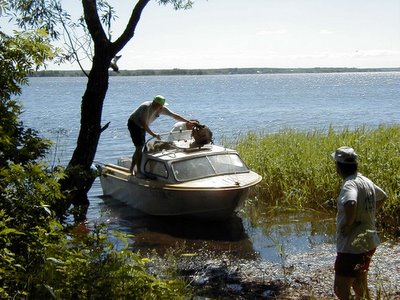
I knew we were in trouble when I saw the weather-beaten boat that had been hired by Allan Gamborg to take us out into the expanse of water that he swore was a river, but looked to me like a vast inland ocean.

A handful of pasty white male natives in flowery swimming trunks eyed us with curiosity from behind reeking cigarette stubs. There was an odor of gasoline in the air … or was it vodka?

It had taken more than three hours just to reach the village. We began the day in central Moscow on the inner ring road, with Allan pointing the car north through seemingly limitless, shabby cement towers, until at some point approaching sheer urban claustrophobia, we reached the open countryside.

A couple of reform-proof collective farms were bisected, and we probably passed through a time zone or two before arriving eventually at the Russian equivalent of Kentucky’s Land Between the Lakes, a big piece of land wedged between the confluence of three rivers, terrain dotted with venerable rural homes made of peeling painted wood, weekend houses (dachas) of the high-rolling city folk, and numerous indications that the short-term visitor would be utterly removed from the fast pace of urban life.

Allan’s dacha, a nicely built house of recent vintage, was being tended in his absence by a neighbor. Among her advance instructions were to garner and prepare food in anticipation of the arrival of the vacationing foreigners: The two oversized Americans (myself and Barrie Ottersbach), as well as Allan’s fellow Dane, the ever-energetic Kim Wiesener.

Scouting opportunities for profit, a stereotypically scarfed, elderly woman met us at the rickety gate of the compound, displaying a rather large and odiferous fish that she excitedly explained might well be the highlight of our visit to all of Russia. Allan bought it for mere kopecks, and with only slight trepidation it was slated for the outdoor grilling of meat and vegetables set to follow the boat trip to Sand Island.

Settling into our evening accommodations, we secured the perimeter of the kitchen against horse flies and bees, then examined the afternoon’s provisions. Bottles of expensive imported Budvar beer (each costing the equivalent of 50 cents, American), peppercorn-encrusted salami (already road gnawed), hunks of regional cheese and crusty bread were thrown into a bag. I slammed a clip into my camera and reached for Bulgakov’s "The Master and Margarita," some sunscreen and a vial of insect repellant.

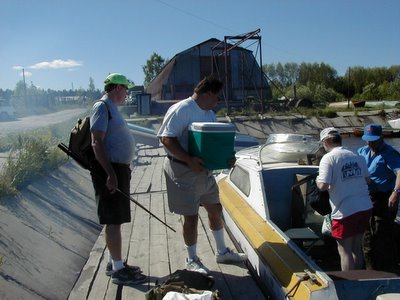
The four of us strolled down a gentle slope to the marina, which proved to be a rectangular patch of murky river water enclosed by a roughly reinforced concrete wall, all gray and rust, perhaps a suitable home for pocket submarines during the late, lamented Cold War. It isn’t known whether our small boat was named the Minnow, but its tiny, coughing outboard motor sputtered like a leftover Trabant. The grizzled captain welcomed us aboard, his metal teeth shining, and our Volga cruise began.
The motor died more than once, but the captain expertly revived it when necessary, and the boat was steered into the middle of a huge open lake -- an impoundment, to be sure; even Russians don’t make rivers that big. It was a brilliant, sunny summer’s day with enough wind to create choppy waves that our small craft struggled valiantly to conquer. After twenty-five minutes, we slowed and began chugging toward a long, low island carpeted with pine trees.

When we closed to within a hundred yards, I noticed something peculiar about the shoreline ahead: There was no dock jutting out from it. In fact, there appeared to be no structure of any kind of the sort that would calm the nerves of an inveterate non-swimmer. Actually, being neither a swimmer nor a naturalist of any remote sort, I asked Allan: "Uh, well, exactly where’s the dock?"

"There is no dock," he said cheerfully.

We’d have to wade in like so many Douglas MacArthurs, except we’d be bearing beers and sausages, not guns, and we’d be wading right back out whenever Captain Ahabski returned for us – assuming, of course, that his long-suffering outboard didn’t go the way of Dzerzhinsky’s toppled statue in front of the Lubyanka prison back in Moscow.

It was later that Allan made the offhand comment that proved to be the mantra of the trip: "My shoes are filled with Volga mud." I could accept that, just so long as my lungs weren’t filled with Volga water. In the meantime, I held my Budvar close to my heart and stuck a naked toe over the side.
The Future Is the Past?

From the beginning of the trip, it seemed a strange sensation to be finally returning to a land that had captivated me so intensely earlier in my life.

In particular, it seemed quite wrong to be entering Russia by plane. Before, back in the dark ages of the 1980’s, I’d arrived after long journeys by bus or train, the latter taking me eastward through ever more mysterious and primitive circles of east central Europe. Being able to effortlessly glide into an airport in the belly of a Swissair jet seemed corrupt and decadent by comparison.

Sprawling, brooding Moscow remains the imperial capital of Communism, at least in physical appearance. Seventy years of urban methodology has been loosely draped with the familiar veneer of the capitalist west’s victory in the long running Cold War saga. Garish neons, intrusive billboards, cellular phones, even the occasional coat of paint -- all conspire to trick the unthinking visitor into believing that Moscow has become somehow Western.

Don’t believe it.

Perhaps it will never be possible for me to fathom Moscow with the precise clarity of an objective, unbiased eye. I first visited the Soviet Union when I was young and impressionable, during a time of geopolitical ubiquity, when hardly a press conference passed without Ronald Reagan making one reference or another to the evil empire centered in a city neither Napoleon nor Hitler could capture and hold.
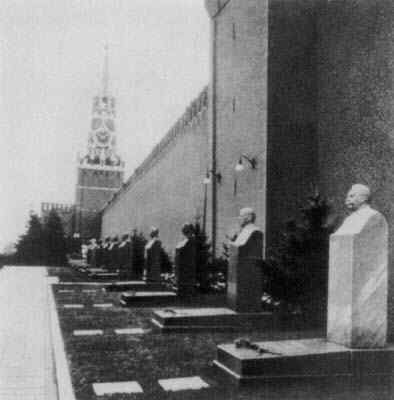
In 1987, people queued around the block to glance for fleeting, rushed seconds at the mummified remains of Lenin, the founder’s fist clenched beneath the eerie glass. Exiting Lenin’s mausoleum in the shadow of the massive red brick Kremlin Wall, the pilgrim walked past idealized busts and burial places of the Soviet Union’s friends and luminaries ("there … that’s John Reed’s slot … "), then spilled out onto Red Square and girded for the inevitable bargaining for jeans and shirts and shoes.

Perhaps the hushed conversation was taken off the crowded street and into a dirt-cheap and dirty stand-up eatery, with the deal being sealed later over a shared bottle of vodka while seated on a park bench, watching the dignified old folks shuffle past, the ones who worked so hard for so little building the nation, their grandchildren circling them like tiny ice cream smeared Sputniks.

In 1999, with the long and fevered century coming to a close, my days in Moscow were spent thinking and drinking, a bit part from a Dostoevsky screenplay, flashing backward and forward from the eighties to the present, haunted by the past, confused by the present, but glad that it no longer was necessary to buy beer from the trunk of a cabdriver’s car or the hard currency shop.

Contemporary capitalism was user-friendly: Merely find the nearest kiosk, spend the ruble equivalent of $5.00, and walk away with more bottles of beer than could be comfortably carried.

Our Friends Share Their Knowledge.

In 1999, both Allan and Kim were living and working in Moscow, where they had first met in the 1980’s while studying at Moscow State University. Better hosts could not be imagined.

Barrie and I were taken for a tour of the KGB museum. We were hustled to the affluent northwestern outskirts for a meal in a theme restaurant where servers in peasant blouses ladled out ridiculously overpriced game dishes to mafia bosses, who were seated astride an artificial, babbling brook.

We viewed thousands of bootleg compact discs that were being hawked at the huge weekend open-air music mart somewhere west of the center, bought a few, and enjoyed the marvelous Kvass (a lightly fermented, carbonated beverage made from bread and malt) being dispensed from one of the old streetside tanks.

We visited a brewpub that could be reached only after passing through a metal detector, where the beer was mediocre, but the selection of pro-am prostitutes was diverse and entertaining, providing us with many new ideas for marketing like-sized American brewing establishments.

We walked along the Moscow River, viewed the city from the Lenin Hills, found the Patriarch’s Ponds, seemingly straight from Bulgakov’s novel, and drank good draft beer on a hot summer’s night while seated on a cement wall at the foot of Kim’s apartment complex, laughing heartily about the proximity of public toilets – out that way, behind the untrimmed shrubbery, where the light bulbs all had been broken.
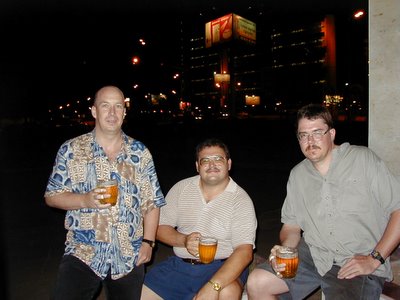
Still, the excursion into the Russian countryside was the best part of the itinerary.

Beer Hunters Lurking.

I awoke groggy and disoriented. We had retreated indoors quite early the previous evening, aiming to avoid mosquitoes of Biblical proportions, and sat inside talking and drinking Baltika Porter from St. Petersburg in the odd glow of a never quite black summer’s night.

Allan’s local helper had been commissioned to prepare fish soup for a midday meal to be consumed just prior to making the drive back to Moscow, and this left us with several hours to explore. Allan proposed a drive to a nearby town.

Armed with bootlegged Jackson Browne and Bad Company CD’s that had been procured for next to nothing at the thriving music market back in Moscow, we set out for the trek to Kolyazin, a dusty and isolated provincial town that has the eternal good fortune to be dusty and isolated less than four hours away from Moscow – this being “good” because a brief look at any reputable map of Russia will reveal there to be hundreds of Kolyazins, most of them located in places that are so lost in the middle of nowhere that they might as well be on another planet.

The open road led through another unreconstructed Soviet-era plantation, then into the "city" limits. A right turn, a rutted dirt street sloping downhill, cracked and peeling pre-revolutionary houses … and at the bottom the street abruptly stopped at the water’s lazy edge. Ahead of us, one hundred yards from dry land, completely surrounded by water, was the steeple of an Orthodox church, which had been converted into an island by the river’s impoundment some years before, no doubt pleasing numerous atheistic bureaucrats at the time of construction.
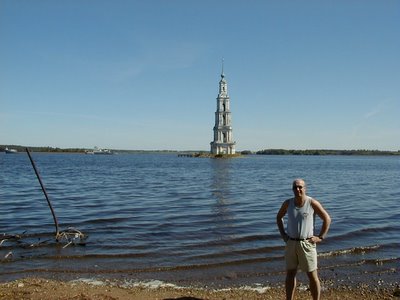
Kolyazin’s bleak main square still was being overseen by V. I. Lenin, his statue no more weed-encrusted and neglected than the remainder of town. The market showed a few more signs of life. Accompanied by children who had sold their services as "protection" for a few cents – they were supposed to be guarding the car, but kept wandering off to invest their newfound wealth in ice cream cones -- Barrie and I bought a few bottles of beer and surveyed the trinkets.

Allan had determined that beer was available in one or all of three places: The market itself, a nightclub, and on draft in a genuine tavern, which was rare in the countryside. The market had bottles of Baltika (a good sign), and the nightclub was closed (also good, judging from the appearance). The tavern was located in a relatively new addition to an older building and appeared positively upscale compared to the surroundings, but once inside, the ambience was late Spartan: A few wooden tables, plastic chairs, and a window to order and collect the beers.

A young, engaging woman served us from behind the counter, noting to the ever-solicitous Allan that the beer was brewed locally and giving him vague directions to the site. As he relayed this information, I saw Barrie’s eyes following something at the base of the wall. It was an adapted garden hose, now serving as the line carrying the beer from the cellar to the tap. Nonetheless, it wasn’t bad golden lager, a bit yeasty and perhaps on the green side, but fresh tasting and refreshing. We resolved to find the brewery.

Back on the main highway in the outskirts of Kolyazin, we followed the barmaid’s ambiguous directions. Eventually Allan pulled over to the shoulder to ask a pair of slack-jawed pedestrians if they knew the location of the brewery, and in opportunistic fashion, they offered us this critical information in exchange for a small fee: A ride.

Moments later the car came to rest in front of what appeared to be a collective farm storage building, more gray concrete with rusty port wine stains down the sides, and no discernable activity on the premises. Our sweaty passengers swore to the authenticity of the site, and suggested that we ask for the proprietor in a cluster of houses at the end of a muddy lane that was sufficiently booby-trapped with potholes that Allan correctly feared for the life of the car. It was midday, and there were few signs of people to ask directions, so we elected to abandon the brewery chase.

Allan drove back down the dirt road to the highway, and as we pulled out I happened to see a hand-lettered, cardboard sign with an arrow pointing to the left and a single word in Russian, one announcing the site of the Grail: Pivo.

That’s “beer” in the Russian tongue.

It was a roadside beer stand, the mysterious local brewery’s de facto open-air tap room, nestled under the welcomed shade of trees in a farmyard littered with puddles, chicken droppings and fish bones, where a lady poured beer from a rigged faucet attached to a single keg, minus the needless expense of extras like refrigeration or television advertising.

At her disposal were six mugs, a basin of well water for rinsing them, and a bowl of rubles for making change. A half-liter of draft beer cost 25 cents, and the origin of the bones was revealed when I offered her a 20-ruble banknote for two beers, and in lieu of coins, she offered two small, leathery smoked fish in return.

Barrie and I chewed on the pungent freshwater fish jerky as Allan conversed with the proprietor, learning that the building we had found indeed was the brewery, that is was operated by a Moscow man who’d moved to the countryside, and that the business was growing.

The beer itself was the same fresh, golden, unfiltered lager that we’d sampled back in the Kolyazin pub. How good was it? I feel that it would be wise to subordinate any critique to the uniqueness of the setting, in this case sitting on a wooden bench, washing away the dust and midday heat with a cool (not cold) beer, and watching two hilariously drunk local farm workers in action.

Their extended liquid lunch break apparently having come to an end, along with the bulk of their money, the two staggered to their feet. One of them pressed coins into the hand of an old man seated nearby, who nodded and disappeared around the corner. Within minutes the old man reappeared, bearing a washtub filled with water, which he proceeded to dump over the heads of the delighted drunks. Soon their ancient Lada sputtered out onto the highway, and when we also left soon after, we were careful to drive the opposite direction.

Mother Russia & Sand Island.

The boat drifted toward shore, the engine was cut, and we were as close as we were going to get to Sand Island. If I intended to make the picnic and enjoy my salami and Budvar, I’d have to get my feet wet. To the surprise of none, Barrie had no doubts: "I’m going in," he announced, and commenced swaggering through the knee-deep water.

As so often before, I was quite happy to let Barrie do the blocking, and after my initial hesitation, I found the layers of black mud and decomposing leaves to be reassuringly soft between my toes.

Clambering up the wooded hillside, we established camp in a sandy clearing and watched through the gently swaying branches as the boat disappeared over the horizon. It was as peaceful an idyll as I’d ever known. The salami was greasy, the Budvar beer outstanding, the company of my good friends valued, and the mud – the timeless Volga mud clinging to my feet – unexpectedly reassuring.
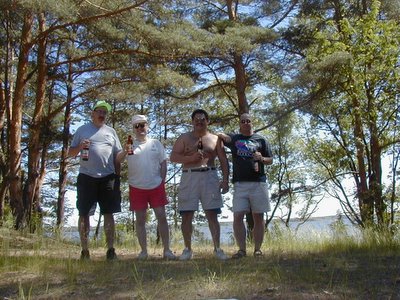
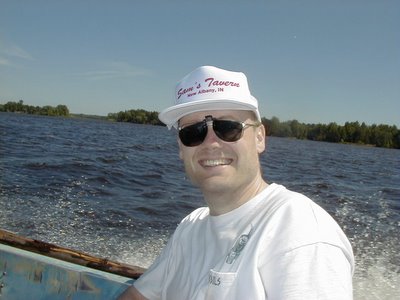
Photos by Allan Gamborg, except for the Kremlin wall, which was borrowed from the Lenin Mausoleum website. Here we are (l to r): Roger, Kim, Barrie and Allan.