Showing posts with label Czechoslovakia. Show all posts

Thursday, October 01, 2020

Prague’s concrete paneláks aren't finished yet.


Having grown up under the tutelage of a father who went out of his way to avoid urban areas, and this being America, my exposure to urban settings began in 1985 during my first visit to Europe. Near the end of the trip on a bus into Leningrad, we rolled through acre after acre of high-rise Soviet suburbs; then in 1987 and 1989, I spent much of my travel time behind the Iron Curtain in Eastern Europe.

To put it mildly, the world of panelák apartments (and their brethren outside Czechoslovakia) fascinated me. 

Khrushchyovka! The rise and fall of typical Soviet-era housing in Russia.

Gdansk and the Falowiecs: "Can Poland’s Faded Brutalist Architecture Be Redeemed?"

Berlin looks to Communist-era "slab buildings" to alleviate a housing shortage.


Seemingly everywhere, Havel's "rabbit hutches" (see below) are making a comeback, even in Prague.

design-behind-prague-s-concrete-apartments" style="font-weight: bold;" target="_blank">
design-behind-prague-s-concrete-apartments" style="font-weight: bold;" target="_blank">Prague’s Communist-Era Apartments Get a Second Life, by Feargus O'Sullivan (CityLab)

Outside the picturesque city center, Prague’s concrete panelák apartments solved a need for fast, modern housing in the Communist era. They’re still thriving today.

If you want to see where the average Prague resident lives, you’ll have to put in more effort than a quick trip around the city’s historic heart.

Jump on a tram heading out of the Czech capital’s tourist-filled center and pre-1914 tenements soon give way to something very different: large complexes of modernist apartment blocks, their concrete often brightly painted after recent renovations, looming over greenery set back from the main road. Look closely at these apparently endless tiers of blocks that provide a rampart around the city, and you’ll see they are composed of row after row of concrete panels that give this type of building its Czech name — panelák.

I took this photo from Castle Hill in Prague in 1989. You can see them clearly.


Back in 2012, I read a book about manufactured housing in the former Czechoslovakia, and reviewed it in my ON THE AVENUES column. 

It is reprinted here.

---

The late Vaclav Havel famously referred to them as “rabbit hutches,” and even today, more than two decades after the end of the Communist period, one-third of all Czechs inhabit pre-fabricated, modular housing blocks, particularly ones erected with increasing haste and decreasing art from the 1960’s through the 1980’s.

To stand on Castle Hill in the middle of architecturally glorious Prague and look outward toward the suburbs is to view what first appears to be a gray wall around the city. Actually, the wall is an optical illusion, a composite of these modular housing blocks in seemingly endless rows.

All across the former East Bloc, the Communist period witnessed the construction of high-rise housing units like these, quickly manufactured elemental housing that left travelers with an indelible image of a commensurately grim and manufactured life, but as Kimberly Elman Zarecor explains in her book, Manufacturing a Socialist Modernity: Housing in Czechoslovakia, 1945-1960, the story was at least a bit different there.


Because Czechoslovakia was the industrial heartland of the deceased Austro-Hungarian Empire, its income levels and educational attainment were above the norm during the period between the wars. Avant-garde and modernist schools of architecture in German, Scandinavia and France were represented by Czechoslovak architects in their projects of the time, and overall, the future seemed bright for the country’s development as a stable, liberal democracy.

Successive Nazi and Soviet occupations deferred this dream for almost a half-century, with a lasting and sometimes quite ugly contribution to the area’s physical landscape.

In the immediate aftermath of World War II, with a pressing need for housing reconstruction, and amid the forced imperative to organize the economy according to Communist principles of heavy industry, Czechosolvak architects fought gamely, for the most part as socialist loyalists, to retain their interwar aesthetic. There were some initial successes, but their influence steadily declined as Communist rule tightened and five-year production quotas submerged all other considerations.

After Stalin’s death put an end to the worst excesses of enforced socialist realism, which in practice meant emulating the Soviet dictator’s grandiose, leaden, Commie Gothic personal tastes, housing in Czechoslovakia became an exercise in the rapidity of modular manufacturing, with assembly-line construction far more utilitarian than any purpose-designed building, and on the cheap, with sloppily pre-cast concrete panels bolted together in stacks as high as engineering principles permitted.

Manufactured housing in Communist Czechoslovakia may have been inevitable, but Zarecor deftly shows that the route from free-form blueprint to rabbit hutch was more winding than commonly assumed, even if the end results were the same. What will the outskirts of Prague look like in twenty more years? I can only hope I’m still around to return there, and to experience the visceral reaction at another, perhaps less jarring, time.

Thursday, December 05, 2019

ON THE AVENUES: Ladislav's language, 1989 - 1990 (Part 2).

Ostrava, 1989.

Having resolved to resume contact with my Czech acquaintance Ladislav in the post-Velvet Revolution, pre-Internet winter of 1989-90, I counted myself fortunate to still have his postal address. It had somehow survived unscathed when most of my belongings were stolen in Madrid the previous November. In January, I took pen in hand to congratulate him on the wonderful transformations in Czechoslovakia.

In those archaic times, mail could take ten days or more each way, back and forth across the Atlantic, and so it wasn’t overly alarming when no immediate response was forthcoming. Perhaps the seismic shift in Czechoslovakia had impacted the recovering country’s mail carriers, or more likely, Ladislav’s obvious connections to a now discredited ruling order were such that he wasn’t in a good position to answer.

Granted, there’d been almost no violence during a remarkably peaceful, orderly changeover in Czechoslovakia, hence the revolution’s “velvet” descriptive tag, and yet … who really knew? It was a long way off, scores were being settled in various ways, and communications were not instantaneous like today. Even phone calls could be difficult to place to a country where the totalitarian structure had routinely monitored them only a short time before.

Twice more in early 1990 I wrote to Ladislav, each time enclosing souvenirs from Indiana and Kentucky, including American beer coasters for use in his Tiki Bar, but still there was only silence in return. Soon an entire year had passed since our chat, and the usual stressors of everyday living gradually displaced the glories of my 1989 journey to Europe. Back into the workaday grind I sank, and memories of Ladislav grew increasingly dim.

One day in July, my roomie phoned to announce that the mail had included a letter from Czechoslovakia. Upon closer examination, the return address was mysterious, and the message inside, written by an English-speaking friend of Ladislav’s daughter from a small town near Ostrava, was unexpected.

She thanked me for the letters and gifts, but regretted to say that Ladislav had died of a heart attack, aged 65, in July – of 1989! Remarkably, his sudden death had come less than a month after I departed Ostrava for a wedding in Prague, and then to Moscow.

I was crestfallen to realize that he had been denied the chance to witness the change he’d been so sure was imminent. With sadness, I drove to Sportstime Pizza for a few rounds of Pilsner Urquell as an impromptu memorial.

---

Still reeling from the bad news, I arrived home the very next day to find yet another letter for me. This time it was a big manila envelope from an organization called Education for Democracy (EFD), and inside was the information I’d supposedly requested, which was fine, except I’d never, ever heard of EFD and assuredly had not asked for anything to be sent to me, but just the same, quite soon my heart was racing with excitement.

This unsolicited letter described the outline of an unprecedented opportunity for Americans to volunteer for placement in Czechoslovakia as conversational English instructors. No licenses or credentials were required, although previous teaching experience of any sort was a plus. It was a development made possible by the cooperation of American and Czech academics, who sought to take advantage of the Velvet Revolution’s opening by bringing people together ... to learn and speak English.

The words, the ideas, the sentiments – all of it had been discussed with Ladislav that night at the Tiki Bar in Ostrava, with shots of Havana Club in hand. Now with the providential mailing spread before me on the table, my immediate reaction was to thank Ladislav profusely for referring me to the organization, and yet there was a small, nagging problem: He was dead.

Not only was he dead, but he had died five months before the abrupt success of the Velvet Revolution made the EFD program and others like it possible. He could not have known, and yet there was no rational explanation for the unsolicited mailing. It made me pause. I’m not the sort to believe in ghosts, but there are exceptions for everything, and this one handily fit the bill.

My lethargy jolted, I wrote back to Ladislav’s daughter, thanking her for telling me about his death, and then phoned the EFD office (in Mobile, Alabama, of all places) to put my name on the list. Planning immediately began for teaching English in Czechoslovakia in 1991. It was to be the fruition of a dream for me, and in my addled mind, albeit irrationally, I knew Ladislav was the man to thank for it.

---

In the end, rationality was restored, in the form of a telephone call a week or so later from a Floridian with whom I’d stayed in touch after we traveled together in a group to the USSR in 1987.

A teacher himself, he remembered that I’d been a substitute and had an interest in the East Bloc, and when he caught wind of the EFD program’s advent, he’d taken it on himself to send the organizers my address. In turn, they’d forwarded me the manila envelope, and its arrival a day after learning of Ladislav’s passing was a mere coincidence, nothing more.

But as you can imagine, it always will be more than a simple fluke to me. These events rekindled my fighting spirit, and for the following twelve months, working two jobs and saving as much money as possible, an expedition took shape.

In early September, 1991, I was on the ground in Košice, the second largest city in what now is independent Slovakia, almost the farthest point east in what was then Czechoslovakia, and a very long way from both Prague and Ostrava. My assignment was to teach English to medical personnel in the city’s university hospital.

And so, Ladislav, here’s a tipple to your memory. It’s a shame you didn’t live to see it, but the plot worked out just the way you predicted.

Thanks.

(This story was originally published in October, 2011. This winter I'll be digitizing the slides from the time of the teaching gig in Košice)

---

Recent columns:

November 28: ON THE AVENUES: Ladislav's language, 1989 - 1990 (Part 1).

November 21: ON THE AVENUES: Rest in peace, Kevin Hammersmith. Eight years later, you're very much missed.

November 14: ON THE AVENUES: The famous mishap in Madrid, November, 1989.

November 7: ON THE AVENUES: Pay attention, students, because voter turnout went UP in New Albany.

Thursday, November 28, 2019

ON THE AVENUES: Ladislav's language, 1989 - 1990 (Part 1).

Ostrava, 1989.

Ladislav was a trim, polite, vaguely aristocratic older gentleman who lived in a peculiarly oversized flat amid a modern suburb of Ostrava, the epicenter of communist Czechoslovakia’s steel making and coal mining industries. If I correctly recall the circumstances, he was a retired educator, discretely moonlighting as an English tutor for my immigrant Czech friend’s mother.

We had been invited to his place for a social evening, perhaps because in that particular socialist neighborhood, visiting Americans were rather rare in 1989.

Knowing there would be drinks served, we didn’t dare drive, choosing instead to board the handy tram, and wind through the industrial landscape of the municipality. Ladislav answered the door promptly, and after pleasantries and the ritual exchange of small gifts, he escorted us back outside and downstairs, to a semi-detached building with garage doors.

Right there in landlocked, socialist Central Europe, taking up precious square meters normally reserved for a Czech male’s single most prized possession (his Škoda automobile), Ladislav had constructed a genuine Tiki Bar, complete with bamboo and plasticized tropical plants. But his equatorial showplace, while initially puzzling, actually made perfect sense in the Bloc’s skewed international scheme of things.

Ladislav had traveled to Cuba as part of a cultural exchange program, and the journey made a deep impression on him. Cuban “guest” workers lived and worked in Ostrava; one afternoon, I drank beer with one of them. Like most Czechs, Ladislav grasped the irony of the enduring blockade that kept Cuban goods, which were available throughout both European geopolitical camps, safely out of American hands, and so a bottle of Havana Club rum was sitting on his back bar alongside an array of Cohibas, all earmarked for the occasion of my visit. It was a reverse black market, and a much appreciated gesture.

Sufficient storage space remained in the garage for Ladislav’s bicycles, for he was an avid cyclist. Apart from his set of metal dentures, and what appeared to be a rather hopeless nicotine addiction, he looked the lean and ruddy part of an athlete. The countryside was hilly and rolling, with mountainous areas nearby: Jeseniky to the west, and Beskydy to the southeast. Apart from Ostrava’s wretched air quality, it appeared to be appropriate terrain for challenging riding.

Specific memories of this long evening at Ladislav’s Ostrava Cubano Tiki Bar are fleeting. The revel extended so far into the cool, wet June night that we came very close to missing the last tram to the Motyčka home, located all the way across town, adjacent to the sprawling Nové hutě Klementa Gottwalda – the steel mill named for Czechoslovakia’s indigenous, long-dead, personal Stalin.

However, one part of our conversation never left my mind in all the years to follow, because after all his other guests except for my escorts had offered their goodbyes, it emerged that Ladislav – whose lifestyle plainly suggested an access to privileges of the sort enjoyed by party members – was disinterested in the past. Rather, he wanted to talk about the future.

He engaged me at length about hope, openness and reform, and about Mikhail Gorbachev’s “new” USSR, with glasnost and perestroika breaking out within the bastion of Czechoslovakia’s imperial overlord to the east. He was highly complimentary about my desire to visit the remainder of his country outside the boundaries of Prague, and thought that when westerners did so, and were able to meet normal working Czechs and Slovaks, artificial political barriers irrevocably fell no matter what his or any other government might say about it.

Ladislav, who of course spoke perfect British English, passionately believed language aptitude to be the key to furthering the fall of impediments to good relations between the diverse peoples of the world. He described his vision of the coming time when Americans exactly like me would come to Eastern Europe as English language instructors, and by doing so, further the process of reform and regeneration.

Granted, it was 1989, and the rigid and toadying Husak regime would never permit such linguistic and cultural incursions, but Ladislav was certain that Gorbachev’s revitalization movement eventually would spill out from the Soviet Union, into the satellite nations, and when it did … well, when it finally did, he fully expected to see me again, this time as a fellow teacher, working alongside him in his homeland.

I enthusiastically agreed, dumbstruck at the ease with which Ladislav, a complete stranger, managed to read my mind. While never an accredited teacher, I’d dabbled in education as a substitute. Back home in a file cabinet was a bulging folder of information on various ways to get “English as a second language” teaching certification. My long-held fascination with East-Central Europe was a given. How did he fathom my innermost thoughts?

We said our goodbyes, and a few days later, it was time to depart Ostrava on a roundabout journey to Moscow for Russian language instruction of my own. Weeks passed, life and travel went on, and by late November, I was home again in Indiana, watching CNN with amazement as the last bits of the Berlin Wall fell, and shortly thereafter, tearfully gladdened when the Velvet Revolution swept Czechoslovakia.

The playwright and intellectual Vaclav Havel, whom Ladislav had described to me in glowing terms as the impetus for Charter 77 and a hero of the opposition, suddenly became president of Czechoslovakia. It was incredible to imagine that Havel had been imprisoned as recently as April of 1989, just before I entered the country. Truly, all things seemed newly possible, and as a new year of 1990 dawned, I started wondering what Ladislav had to say about it.

I’d write to him, and find out.

(Part 2 next week. This story was originally published here in October, 2011)

---

Recent columns:

November 21: ON THE AVENUES: Rest in peace, Kevin Hammersmith. Eight years later, you're very much missed.

November 14: ON THE AVENUES: The famous mishap in Madrid, November, 1989.

November 7: ON THE AVENUES: Pay attention, students, because voter turnout went UP in New Albany.

October 31: ON THE AVENUES: In which Team Gahan's looming appointment with unemployment is examined.

Friday, August 30, 2019

The Good Soldier Švejk, and why "dimwittedness -- genuine or feigned -- is a vaccine against epidemics of madness that grip nations."

By artist Josef Lada, from the linked article.

Ignore the essay's title and forget progressive or regressive shadings, because this isn't about modern political definitions. Švejk is universal, because idiocy is everywhere -- on all sides, in each nook and every cranny.

I, too, have been fixated on Švejk for a very long time. Way back in the beginning of Rich O's Public House I borrowed Švejk's face from an illustration in one of Michael "Beer hunter" Jackson's books and used it to adorn the beer list. Švejk was never far from my own thoughts during those sessions in traditional Prague pubs during my communist-era travels.

That's why I say Švejk Day surely is a promotion Pints&union should consider staging annually. The Pilsner Urquell awaits, and Chef Dalton can conjure the pork.

This needs to happen. In the interim, this is a classic essay about an equally timeless fictional creation. I can't hope to summarize it, so I'll merely show you the way.

Why Every Progressive Should Read The Good Soldier Švejk (Literary Hub)

Paul Goldberg on How to Stay Sane in a World Besieged by Idiocy

A copy of The Good Soldier Švejk and His Fortunes in the World War—a classic comedy by Jaroslav Hašek, a countryman, contemporary and peer of Franz Kafka—is never far from my desk.

I leaf through it, check out the ditties, drink in the cartoony illustrations, get a bolus of inspiration from a page or two.

Huck Finn defines America. Eugene Onegin defines Russia. Josef Švejk, a professional dog thief and, literally, a certified dimwit who stumbles through World War I, is the quintessential Czech. As it serves up bawdy tales and run-on non-sequiturs, this novel accomplishes much more than to define a nation.

It defines the idiocy of war and the men who wage it, and not just the Great War, but all war. And not just the idiocy of war, but idiocy itself—the big “I.”

Wednesday, August 22, 2018

Three reminders of rock music's role in defeating the Communist bogey man.


I intend to watch this soon.

​FREE TO ROCK is a documentary film directed by 4-time Emmy winning filmmaker Jim Brown and narrated by Kiefer Sutherland. Rock & Roll spread like an uncontrollable virus across Eastern Europe despite Communist attempts to outlaw it. Thousands of underground bands and millions of young fans who yearned for Western freedoms and embraced this music as the Sound of Freedom, helped fuel the nonviolent implosion of the Soviet regime. Free to Rock features Presidents, diplomats, spies and rock stars from the West and the Soviet Union who reveal how Rock & Roll music was a contributing factor in ending the Cold War.

I intend to read this soon.

BURNING DOWN THE HAUS: Punk Rock, Revolution, and the Fall of the Berlin Wall, by Tim Mohr (Kirkus)

How a forbidden punk-rock underground fomented rebellion against totalitarian East Germany.

A translator and former Playboy staff editor and club DJ in Berlin, Mohr carefully documents a rousing, little-known Cold War story, showing how alternative culture developed in the Eastern Bloc in a similarly grass-roots fashion as elsewhere but for greater stakes. “The ethos of East Berlin punk,” he writes, “infused the city with a radical egalitarianism and a DIY approach to maintaining independence.” But during the 1980s, homegrown punks were seen as both a nuisance and threat, worthy of repression. Based in part on interviews with survivors, Mohr ably documents how regional small-scale punk scenes grew and connected nonetheless. From the start, he notes, “groups of punks started to attract attention from security forces everywhere they went.” East Germany provides a vivid backdrop to the narrative. Conformity to state-supervised existence was enforced by surveillance and informants, so punks’ embrace of abrasive music and fashion was inherently political ...

And, I haven't forgotten the Plastic People.

How a Revolutionary Czech Rock Band Inspired Vaclav Havel, by James Sullivan (Rolling Stone)

Havel met the Plastic People of the Universe in 1976

It took a Czechoslovakian rock band that worshipped Frank Zappa and the Velvet Underground to make Vaclav Havel realize the true power of rebellion. Havel, the Czech playwright, humanitarian and political revolutionary who died yesterday, put his movement on the line with the manifesto known as Charter 77, which was directly inspired by an underground rock band called the Plastic People of the Universe.

Named after a Zappa song, the Plastic People formed in 1968, shortly after the suppression of the uprising known as the Prague Spring. They played a psychedelic brand of garage rock like their American heroes, including the Velvets, Captain Beefheart and the Fugs, says Paul Wilson, a Canadian who was teaching in Prague at the time. Wilson joined the band in 1970 at the request of their manager, Ivan Jirous, a culture critic who acted as a kind of art director for the group, much as Andy Warhol did for the Velvet Underground ...

Tuesday, March 13, 2018

It can't happen here? Kundera's novel and the repressive politics of "normalization" in Red Czechoslovakia.


It occurs to me that it has been 30-odd years since my first reading of The Unbearable Lightness of Being, Milan Kundera's renowned novel. It would have occurred in the mid-1980s, prior to my first two visits to then-Communist Czechoslovakia.

The second of these trips came in 1989, as facilitated by my friend Jiří (George), who had recently arrived in New Albany after defecting from Czechoslovakia. I spent a month with his family in Prague and Ostrava, and remain eternally grateful for the opportunity.

Kundera's novel and my friend George intersect because of "normalization," as it was called in Czechoslovakia between the aftermath of the Prague Spring in 1969 and the transformative Velvet Revolution two decades later (and six months after my stay).

Note from the outset that this term is pejorative.

In April 1969 ... the (Gustáv) Husák regime reversed virtually all of the Prague Spring reforms under the guise of “normalization” of political and economic life. Censorship of the press and creative arts was re-imposed, and a bleak period of Czechoslovak history began. Widespread political apathy set in among the population, as most Czechs and Slovaks accepted the modestly improved living standard and availability of consumer goods provided by the regime in exchange for their passive acceptance of the Soviet-dominated rule of the KSČ, which had expelled the members of its former liberal wing. The small number of dissidents, such as Václav Havel, who refused to accept this cynical social contract with the regime were subjected to secret police harassment, expulsion from their professions, assignment to menial jobs, and sometimes arrest and imprisonment. The normalization period lasted throughout the 1970s and 1980s, until the Velvet Revolution of 1989 finally restored a democratic political system in Czechoslovakia.

See also "Normalisation - Everyday Life."

In Kundera's novel, the successful surgeon Tomáš runs afoul of normalization after authoring a letter critical of the Communist Party, which is published in a radical newspaper. Asked to sign groveling statements recanting his views and expressing loyalty to the USSR as a precondition of resuming his medical career, he chooses instead to abandon his field and become a window washer.

George, who was but a child during the Prague Spring, nonetheless was tagged with a black mark owing to the involvement of family members he barely knew, if at all. Owing to this, he was denied the ability to study the career path of his preference. He came to America penniless and with almost no English, and has since garnered multiple university degrees as an absolute paragon of what the melting pot of immigration is all about.

The point to all this is that the crackdown on dissent in the post-Prague Spring era on the part of the Communist apparatus included the regime's utterly self-defeating tactic of vocational punishment, at times targeted but also random and scattershot.

In short, it was more important to maintain ideological uniformity than to allow a gifted surgeon to do what he had the aptitude for, and had been trained to do, or to reap the societal benefits of permitting an extremely intelligent blue-collar lad from Ostrava to choose his own professional pathway. Had this been the case, George may never have left.

Leave it to the otherwise dull Czechoslovak party apparatchiks to devise a purely Kafkaesque solution to the problem of dissent; you usually wouldn't be run out of town, but forced to remain -- compelled by law to have a job and maintain employment, just not in the field of your proven expertise.

At the same time, signing the proffered apologies was tantamount to "selling out" in the eyes of friends and colleagues, as well as being acts of acquiescent muzzling. You'd be unlikely to protest again, or so the thinking went. 

These many years later, I remember Kundera's characterization of the surgeon Tomáš as manual laborer more vividly than the novel's numerous sex scenes (as a serial philanderer, the former doctor soon learns that window washing enables his erotic hobby more abundantly than those hours spent in the operating theater).

Maybe it's time for a second reading of the novel.

Saturday, July 15, 2017

30 years today on THE BEER BEAT: The Automat Koruna, one of my favorite pubs (?) in the world.

Previously: 30 years ago today: Prague's Old Town Square, and why we didn't see it in 1987.

It has been 30 years since my first visit to Prague and Plzen in 1987, and as I’ve belatedly digitalized my old slide film, I’ve been writing about it.

Unsurprisingly, beer has dominated the Czech narrative. To understand what it was like for a beer drinker to be traveling in a place like Czechoslovakia in 1987, you must begin by forgetting almost everything you’ve learned during our contemporary "craft" beer era.

In 2017, there are at least 5,300 breweries in the Unites States. 30 years ago, there were approximately 150 in all of America. Roughly half of them had come into existence during the preceding decade.

That’s right. When I started college in 1978, there weren’t 100 breweries in the whole country.

In 1987, there were around 70 breweries in Czechoslovakia, a country of a mere 15,000,000 inhabitants, as opposed to 242,000,000 in America. The per capita rate of beer consumption was far higher in Czechoslovakia than in the USA, especially in the Czech lands of Bohemia and Moravia, not as much in Slovakia.

Beer and brewing culture were omnipresent and pervasive in Czechoslovakia, although limiting in terms of stylistic diversity – except that in 1987, we’d yet to be conditioned to expect dozens of styles from which to choose when going out for a pint.

In Belgium, maybe, but in Czechoslovakia, one happily endured numerous hop-accented golden variations on a theme of Pilsner Urquell. Notably, no other Czechoslovak brand referred to itself as "Pilsner" – this honor and appellation was reserved for the Plzen-brewed original – and yet the majority were similar, brewed to varying strengths.

The British traveler and beer writer Ronald Pattinson explains a key point.

In 1988 many Czech breweries were almost unchanged from the 1930's. While productivity may have been low, there was no argument about the quality of the beers brewed. Open fermenters, long lagering times and absence of pasteurisation produced distinctive and flavoursome beers. No other country came even vaguely close to the general high standard of Czech lager. It was impossible to find bad beer.

The larger regional breweries - Staropramen, Gambrinus, Velké Popovice and, of course, Pilsner Urquell - had national distribution. Even in a town like Prague, where there were several large local breweries, there was a good choice of beer from the whole of Czechoslovakia.

There also were some dark lagers, which tended to be of lower gravity and exhibiting malty sweetness, as well as the occasional “black” lager of better balance and increased potency. Even an old-fashioned bottom-fermented porter might pop up out of nowhere to surprise you.

Still, drinking beer in Czechoslovakia in 1987 meant sampling the same basic style brewed by different breweries. The fun part was roaming cities like Prague in search of the pub on the back street that served one you hadn't seen previously.

---

Barrie and I dropped into several of the more famous Prague taverns during our brief stay in 1987: U Dvou Koček, U Pinkasů and U Fleků among them. The latter was (and remains) a brewery, and in case you were wondering, it helps to know that in Czech, “U” means “at” and is incorporated as a pub name prefix.

Communism was all about investing in selected economic goals, and disinvesting in others. As Pattinson observes, this actually had the curious effect of helping to maintain overall beer quality in Czechoslovakia, in the sense that in the absence of abundant capital for modernization, the older and slower ways persisted. "Old school" wasn't a cliche. It was every day.

As economics pertained to taverns and watering holes, it was a mixed bag. Even the venerable beer shrines reflected the realities of their time, and some were in better repair than others. In most cases, there was lots of wood, plaster and cigarette smoke. The vibe tended to be relaxed and quiet, and inexpensive beer prices were somewhat uniform everywhere you went.

Granted, waiters were prone to padding checks with hidden cover charges, but the prices were so low you seldom noticed – and as noted above, the beer was unfailingly wonderful.

If I’m to be honest about our time in Prague in July, 1987, it’s highly doubtful we dropped into the drinking establishment that subsequently became a great personal favorite of mine, the Automat Koruna. After three weeks in Prague in 1989, the workers probably knew me by sight, if not by name.

In the off chance that Barrie and I enjoyed a beer or two at the Automat Koruna (1931 – 199_?), here is an overview.

---

Prague’s famous Wenceslas Square (Václavské náměstí) was the city’s original horse market, and isn’t a square at all. It’s a boulevard, originating atop a gentle rise in front of the Czech National Museum, then descending to where the Old Town begins. At this intersection (Václavské náměstí 1), just a few feet from the subway stop, is a sizeable Art Nouveau building called the Koruna Palace, which opened in 1914.

Photo credit: Koruna Palace

Strictly speaking, an “automat” is a vending machine. The first such automat for food and drink was introduced in Berlin in 1895. From what I can tell, the Automat Koruna followed suit from its inception in 1931, though the Koruna Palace was such a large building that there were other food service businesses inside it. It's never been clear to me where originally one of them ended, and the next began.

Photo credit.

Whatever the ultimate disposition of the vending machines and the timing of the conversion, by the time I experienced the Automat Koruna (sometimes referred to as the Buffet Koruna), it was a high volume, self-service, cafeteria-style eatery with multiple counters, where customers could buy nibbles, full meals, sweets, coffee and the Koruna’s famous strawberry milkshakes.

I almost forgot: It had beer, too.

Photo credit.

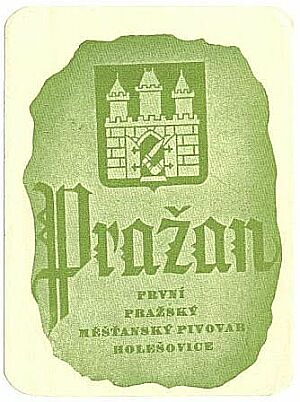
You told the cashier what you wanted and paid, to be given a receipt, then waited in a customarily long line, handing the receipt to one of the white-smocked beer pourers. The reward was a cool half-liter (or more) of golden, pilsner-style Pražan beer, brewed a few miles away in Holešovice district of Prague.

You consumed your Pražan and also ate while standing at a stainless steel table. There may have been chairs at the Automat Koruna, but if so, I can’t remember them, at any rate, I didn’t ever sit. Crowds were a constant, and stand-up space sometimes at a premium.


Photo credit (and preceding).

The ambiance at Automat Koruna was urban, frenetic and often claustrophobic – but I loved it, and what a place to drink beer and people-watch during Prague’s latter communist years! The clientele reflected an indisputably egalitarian ideal, although for communism’s usual litany of wrong reasons.

Military men with medal-filled chests jostled for space with long-haired students. Backpacking tourists and pretty shop clerks stood side by side. Brown-suited functionaries left scraps on their plates, and scruffy street people scooped them up before the busser came to visit. It was ill-advised to step away from your beer, because they’d drain unguarded remnants in milliseconds.

Moreover, it’s worth noting that these perfectly presentable half-liter local draft beers were three to a dollar. Cheap beer hasn't ever been this good.

It's a wonder I lived through it.

Next: The long-awaited Pilsner Urquell pilgrimage

Thursday, July 13, 2017

30 years ago today on THE BEER BEAT: The finest restorative Pilsner Urquell ever, upon arrival in Prague.

Our Warsaw hotel room.

Previously: 30 years ago today: Both Auschwitz and Lanzmann's Shoah.

Sunday, July 12 and Monday, July 13

At some point in the evening on Saturday, a sweaty quartet of exhausted Krakow sidetrippers returned to the Hotel Nowa Praga in Warsaw, just in time for the official end-of-tour departure party. Only one indelible memory remains of this event.

Among us was a college-aged San Franciscan of Polish extraction, who'd devoted time during our absence in Krakow to exploring family connections. During the course of his wanderings, whether by design or happenstance, natives had undertaken to tell him the story of Jerzy Popiełuszko, whose grave he visited.

Jerzy Popiełuszko (Polish pronunciation: [ˈjɛʐɨ popʲɛˈwuʂkɔ]; 14 September 1947 – 19 October 1984) was a Polish Roman Catholic priest who became associated with the opposition Solidarity trade union in communist Poland. He was murdered in 1984 by three agents of Służba Bezpieczeństwa (Security Service of the Ministry of Internal Affairs), who were shortly thereafter tried and convicted of the murder.

I recall the two of us talking at length during the party about the deep and sudden impact of Popiełuszko's legacy on my fellow traveler, and what it meant in the context of Polish freedom. Combined with my own morose reaction to Auschwitz earlier in the day, it may have been the most sober drunken evening of them all.

On Sunday afternoon, most of the group departed by bus for the airport to return to Copenhagen. I hadn't arrived in Moscow with the group, and I wouldn't be leaving with it. Barrie and I had tickets for the overnight train to Prague, and a there were a few hours left to kill.

A few of our tour mates also remained on hand; like us, they had planned differing exits. Our Polish tour guide Bozena was around, too, and so the stage was set for a carefree late afternoon and early evening. One by one, goodbyes, farewells and amens were said, until only two Hoosiers remained.

Dazed by meal of spaghetti and inexpensive Bulgarian cabernet, amazed at having uncovered a few bottles of Austrian-brewed Kaiser Bier at the Hotel Forum’s foreign currency bar, and largely unfazed at the prospect of the long trip ahead, Barrie and I stood alone in the shadow of the monstrous Stalinist Gothic Palace of Culture in downtown Warsaw.

We bowed to the edifice, and walked to the central train station to hop the sole overnight non-express to Czechoslovakia.

These being the days of waning Communism, our jovial mood couldn’t have lasted very long. Although our essential documents – passports, Czechoslovak visas, train tickets and couchette reservations – were in order, we had neglected to pack food and drink for the journey.

It was Sunday night. All the stores were closed, and mini-marts were in short supply in Communist Poland in 1987. Oddly, convenience had yet to be written into the five-year plan.

My backpack and Barrie's duffel bag bulged with Soviet black market booty, and we strained to lug them along while desperately foraging for victuals in the vicinity of the rail station’s platforms. Even with handfuls of colorful złoty, there was nothing to purchase except grainy licensed Swiss chocolate and returnable bottles of imitation cola.

The final whistle blew. We boarded hungry, and did the best we could to sleep in the stifling summer heat.

Twelve hours later the marathon rail crawl finally ground to a halt, and we stumbled into Praha hlavní nádraží station looking like bedraggled refugees from a war zone. Stomachs audibly growling, poorly rested, filthy and quite thirsty, the sodas having long since been drained, we dragged our belongings to the baggage storage check and lightened the load.

Departing the station, we were treated to our first glimpses of Prague’s timeless majesty and the city’s then-current reality: Standing in front of the museum at the top of the long, gentle rise of Wenceslas Square, against a backdrop of the old city sparkling in a bright morning sun, a taxi driver sidled over and asked us if we’d like to change money.

Several minutes later, one of the three official room finding agencies placed us for three nights in an athletic club dormitory on the far outskirts of the city. It would be several hours before we could check into the room, and probably another hour to get there.

Starving and parched, we were cast into the mysterious, gorgeous, crumbling city to fend for ourselves.

Exhilaration temporarily overcame fatigue as we ventured into the winding streets, over cobbled roadways and through strange arches. Soon, to our growing excitement, we found that the city boasted more than spires, spies, stucco and scaffolding – beer was all around us, and at last, pubs were in abundance.

After two weeks in the Polish and Soviet lands, where vodka reigned supreme, we were in Bohemia, the Euphrates of European lager brewing tradition, and the home of the original Pilsner beer.

We resolved to walk a just bit more before finding a good place to enjoy a draft beer – preferably Pilsner Urquell or Staropramen, or another Prague brand if necessary.

Armed only with an inadequate tourist map, Barrie and I crossed the Vltava River on the famed Charles Bridge, ascended Castle Hill, wandered down the other side, crossed the river again at a second bridge, and finally were devoured by the twisting alleyways that we knew eventually led back to Wenceslas Square.

A garden variety sight during our walk.

At length, having paused briefly two hours earlier for sausages dispensed from a tiny streetside window, we glimpsed the familiar green script of Pilsner Urquell adorning the façade of a faded, orange-and-pink-painted building.

Fate at Two Cats.

The final steps were the hardest. We passed through the stout wooden doors of U Dvou koček (At Two Cats), where Pilsner Urquell indeed was the house beer, the daily beer, and in fact the only beer available.

Blissfully unaware of protocol, we slumped heavily into wooden benches in an interior hallway. Unconsciously drooling, our beleaguered senses slowly were revived by the cozy, smoky, conspiratorial warmth of the main room, where clusters of Czech workers, students, soldiers and officials sat conversing.

Huge platters of pork and dumplings sat before many of the customers, but to man, each and every patron cradled an indescribably lovely mug of beer – and make no mistake: They were glass mugs, not the more stylish half-liter glasses that supplanted them not long afterward. It seemed too good to be true … and almost was.

Alarmingly, the waiters completely ignored us.

I limped to the long, imposing counter where a brawny, mustachioed man stood next to a pair of matching taps, both pouring the exact same nectar, and with a wheeled cart filled with clean mugs. Mustering my courage, I flashed four fingers and muttered, “Pivo, prosim,” having miraculously recalled the proper words without stealing a glance at the guidebook buried somewhere in my day pack.

He looked at me quite seriously, then smiled and complied, relieving me of roughly $2.00 while pushing four half-liter drafts across the slick countertop.

The brilliant golden liquid was cool, not ice-cold; frozen beer only numbs the palate, and though appropriate for Pabst, it certainly isn’t necessary for anything as grand as Urquell.

The noble hop aroma was evident and enticing, fighting through the billowing white head to reach my nose even at arm’s length.

Everything about the beer itself and the venue in which it was about to be consumed spoke of quality, respect, tradition, and the sheer, unbridled joy that one feels to be an adult and to think, feel and understand what is good about life.

When Barrie saw me approach, he bolted from the wooden bench and fell to his knees in a spontaneous demonstration of faith and appreciation that I’ve seldom witnessed in any church – such was the genuine, heartfelt intensity prefacing his gesture of supplication.

Seconds later I spotted his eyes, wet with unrestrained tears, his cheeks flecked with beer foam, all visible through the thick base of an empty upturned mug.

Needless to say, my reaction was comparable. I’ll never forget this moment of triumph and revelation, of this sense of beer ecstasy that will never be understood or truly appreciated by anyone who defines beer by the number of calories it contains or the volume of advertising revenue it commands.

Ominously, the alcohol went straight to my head ... and we still had to find our lodgings.

Next: Our sports club beds, glorious Prague and beers at U Fleků.

Saturday, June 24, 2017

THE BEER BEAT: I'm curious about the origins of the smooth, crisp and milky Pilsner Urquell pours.

Czech for Pilsner Urquell; a 1987 teaser. Photos to come.

The last time I had the pleasure of visiting the Czech Republic was 2006. That's a long time.

My most recent visit to Plzen, home of Pilsner Urquell?

Probably 1999; almost two decades. As I've been digilizing my 1980s-era slides, there has been plenty of opportunity to ruminate about the incredible changes that have occurred in a place like Plzen since 1987.

Back then the country was called Czechoslovakia, and it was Communist. In spite of this, or maybe because of it, the beer was out of this world. Pair it with pork and dumplings, and repeat as often as possible.

In July, 1987 Barrie and I took the train to Plzen from Prague, found the brewery, and enjoyed a leisurely afternoon with multiple portions of the nectar, first in the former brewery tap outside the factory gate, then a few yards away in another pub long since supplanted by a roadway improvement project.

To me, it seems like yesterday. At the first stop, the coat check attendant told us she remembered the arrival of Patton's 3rd Army in Plzen during WWII. At the second, we were joined by a cab driver, who had chucked work for the day and was ferrying his buddies from pub to pub, drinking with them. None of them spoke English, and we spoke no Czech.

Rather, beer was spoken.

I watched quite a few Pilsner Urquells being poured that day, and would continue to do so in the years to come, hence the point of today's digression.

I've been vaguely aware that the Pilsner Urquell international distribution effort of late has been emphasizing the "three pours" draft approach. I'm all aboard, and want to learn more.

If my pub sanctuary project-in-development gets off the ground, this will be my daily classic house lager -- and make no mistake, Asahi as Urquell's new owner ranks nowhere near AB-InBev's level of multinational swinishness.

Besides, there'll be just a few changeable taps, and frequent excuses to pour Prima Pils, Goodwood's Louisville Lager and other beers in a similar range. What there won't be is a spinning wheel rotational approach.

As ever, I digress.

All I can ever remember ever seeing during all those times traveling in the Czech lands are were faucets pulled up, down or sideways to full bore as numerous glasses were filled with half-beer, half-foam, and then topped off. It seemed a reflection of having just one or two beers on tap, and numerous thirsty customers.

It occurs to me that I may be be missing something. Most readers already know that while I was in the beer biz for many years, it's been a while since I paid very much attention to a topic like this, even though there was a time when the Public House was the top Pilsner Urquell draft account in Indiana (if memory serves).

In this ongoing process of rediscovering bits and piece of life that were shunted aside during my should-have-known-better, trench warfare craft beer phase, I'm curious how long the Pilsner Urquell three-pour approach has been a factor.

Twenty years, maybe? Ten?

Or was it always a fact, just honored in the breach during Communist times, perhaps owing to the overall degradation?

Maybe I wasn't paying attention at all. It wouldn't be the first instance. If you know anything about this topic, please share it with me. As noted, it is my earnest wish to pour Pilsner Urquell again some day, hopefully soon.

Enjoy these two videos ...


 ... and two articles about the same.

Mastering the Pilsner–And Drinking Pure, Delicious Foam, by Nate Hopper and Eric Vilas-Boas (Esquire)

THE 3 PILSNER URQUELL POURS + WHEN YOU SHOULD DRINK THEM, by John (The Everyday Man)

Friday, February 24, 2017

Khrushchyovka! The rise and fall of typical Soviet-era housing in Russia.


The video here offers an "upscale" example, based on what I've seen.

Khrushchyovka! Typical USSR Apartment Building. "Real Russia" ep.17

In this video we'll show you how is the famous typical USSR apartment building, known as "Khrushchyovka" looks like and visit my friend Nataly, who lives in one of Khrushchyovka apartments that to show you how it looks like not only outside but inside as well.

"Khrushchyovka" is a type of low-cost, cement-paneled or brick three- to five-storied apartment building which was developed in the USSR during the early 1960s, during the time its namesake Nikita Khrushchev directed the Soviet government.

Hope you enjoy!

Now that you've seen a typical Khrushchyovka ...

Moscow to demolish 8,000 Soviet-era housing blocks

Moscow city authorities are to tear down about 8,000 blocks of flats built in the 1950s and 1960s in a major clearance programme that will involve rehousing 1.6 million people in the coming years, it's reported.

Mayor Sergei Sobyanin told a council meeting on Wednesday that the decision follows a positive review of an earlier, more modest demolition of about 1,700 of the low-rise prefabricated buildings known throughout the former Soviet states as "Khrushchyovkas", Komsomolskaya Pravda newspaper reports.

Back in 2012, I read a book about manufactured housing in the former Czechoslovakia, and reviewed it in ON THE AVENUES. It is reprinted here.

---

The late Vaclav Havel famously referred to them as “rabbit hutches,” and even today, more than two decades after the end of the Communist period, one-third of all Czechs inhabit pre-fabricated, modular housing blocks, particularly ones erected with increasing haste and decreasing art from the 1960’s through the 1980’s.

To stand on Castle Hill in the middle of architecturally glorious Prague and look outward toward the suburbs is to view what first appears to be a gray wall around the city. Actually, the wall is an optical illusion, a composite of these modular housing blocks in seemingly endless rows.

All across the former East Bloc, the Communist period witnessed the construction of high-rise housing units like these, quickly manufactured elemental housing that left travelers with an indelible image of a commensurately grim and manufactured life, but as Kimberly Elman Zarecor explains in her book, “Manufacturing a Socialist Modernity: Housing in Czechoslovakia, 1945-1960”, the story was at least a bit different there.

Because Czechoslovakia was the industrial heartland of the deceased Austro-Hungarian Empire, its income levels and educational attainment were above the norm during the period between the wars. Avant-garde and modernist schools of architecture in German, Scandinavia and France were represented by Czechoslovak architects in their projects of the time, and overall, the future seemed bright for the country’s development as a stable, liberal democracy.

Successive Nazi and Soviet occupations deferred this dream for almost a half-century, with a lasting and sometimes quite ugly contribution to the area’s physical landscape.

In the immediate aftermath of World War II, with a pressing need for housing reconstruction, and amid the forced imperative to organize the economy according to Communist principles of heavy industry, Czechosolvak architects fought gamely, for the most part as socialist loyalists, to retain their interwar aesthetic. There were some initial successes, but their influence steadily declined as Communist rule tightened and five-year production quotas submerged all other considerations.

After Stalin’s death put an end to the worst excesses of enforced socialist realism, which in practice meant emulating the Soviet dictator’s grandiose, leaden, Commie Gothic personal tastes, housing in Czechoslovakia became an exercise in the rapidity of modular manufacturing, with assembly-line construction far more utilitarian than any purpose-designed building, and on the cheap, with sloppily pre-cast concrete panels bolted together in stacks as high as engineering principles permitted.

Manufactured housing in Communist Czechoslovakia may have been inevitable, but Zarecor deftly shows that the route from free-form blueprint to rabbit hutch was more winding than commonly assumed, even if the end results were the same. What will the outskirts of Prague look like in twenty more years? I can only hope I’m still around to return there, and to experience the visceral reaction at another, perhaps less jarring, time.

Sunday, November 22, 2015

Michael Hutchence died 18 years ago today, and as yet, there is "Not Enough Time."

Michael Hutchence died 18 years ago today.

In 2012, INXS finally had the good sense to give it a rest, and the convergence of the band's retirement with the anniversary of its singers's untimely death prompted a series of reflections. These are linked below.

This recurring fixation goes back to my salad days as a younger man in Europe during the 1980s, coinciding with the band's period of peak popularity. Simply stated, the older I get, the more I realize how much my inner life still incorporates the personally written mythology centering on my relationship with the city of Prague. The singer's band accidentally wrote the soundtrack, so now it's all been mashed together as one.

Here are the series links.

REWIND: Not Enough Time, Part One.


REWIND: Not Enough Time, Part Two.


REWIND: Not Enough Time, Part Three.

Thursday, May 29, 2014

ON THE AVENUES: A summer abroad in 1989.

ON THE AVENUES: A summer abroad in 1989.

A weekly web column by Roger A. Baylor.

Right about now -- at some point near the end of May, but 25 years ago -- I was on my way to Berlin, with a stated intention of remaining in Europe for seven months.

It astounds me that a quarter-century has passed since that momentous time, one made far more meaningful than the mere ramblings of a 20-something American traveler by the fact that 1989 was the year when the Soviet Bloc collapsed.

Berlin wasn’t the capital of Germany in 1989, at least in part because there were two Germanys … and two Berlins. Bonn was the capital of the Federal Republic, known to us as West Germany. My flight in May, 1989, landed in West Berlin, a municipality entirely surrounded by the territory of the German Democratic Republic, or communist East Germany, of which East Berlin was the capital.

Berlin remained divided into zones of occupation, as administered by the triumphant Allies of World War II. The western side included American, British and French zones, and representatives of the three countries still met at regular intervals to discuss their stewardship.

To the east, continuing all the way to Vladivostok, was the Soviet zone. The Berlin Wall was the line of demarcation between the Allied zones and the sovereign territory of the GDR. It had graffiti on one side, and machine guns on the other.

In short, it was the Cold War in everyday life, although those first three days in May were intended only as a teaser. A return was planned for August, when I’d arranged a month-long stay in East Berlin. I’ve written previously about my experiences working for Herr Honecker, and hope to repost the essays later this year. For now, I’ll sketch the 1989 trip’s overall parameters.

Quite early in the morning of June 2, 1989, I tiptoed out of my West Berlin hostel dorm and took to the street, where I caught the first bus of the day into the center of the city. At Zoo Station (later immortalized by the U2 song), there was a suburban rail (S-Bahn) train to catch, a few stops east, above the wall, into the Friedrichstrasse station in East Berlin.

Clambering off the train, I found myself standing on a sealed platform. It was possible to transfer to other commuter trains (and subways) headed to destinations in West Berlin, but not to walk out onto the street outside without passing through passport control and customs. Such was the bizarre transport arrangement reflecting the city’s division.

I had a time-sensitive transit visa for East Germany, allowing me to pass through the country without stopping. My ultimate destination was Prague, in the nation then known as Czechoslovakia. After a brief orientation stroll and gut check (the streetscape in East Berlin was so different from what I’d experienced less than a mile westward that it might have been another planet), it was back onto an “Ossie” S-Bahn to a different train station, and my rail connection via Dresden.

---

For the next five weeks, Czechoslovakia was my home, courtesy of the family of by dear friend George Hrabcak, who at the time was a criminal defector who’d have been arrested and incarcerated had he so much as set foot in his homeland. There is no telling how many miles I covered walking during two weeks in amazing Prague, followed by the same amount of time exploring Ostrava, then the Pittsburgh of Czechoslovakia.

Pork, dumplings and delicious Pilsner beer were consumed in abundance. It was a very happy time.

In early July came the long-awaited 36-hour “express” train from Prague to Moscow. “Back in the USSR,” indeed. In theory, my time in the Soviet metropolis was supposed to be spent learning conversational Russian as part of a program at Moscow State University. It was an experimental teaching method, and it didn’t much appeal to me, especially considering the lessons (and foment) waiting to be learned outside the classroom during the high point of glasnost.

I’ll share just one anecdote about my time in Moscow in 1989. Several fellow students planned to leave the city heading in the same direction, and our sponsoring organization helped arrange train tickets back to East Berlin, but we had to obtain a Polish transit visa on our own. Three of us arrived at the Polish embassy, only to find a block-long line composed primarily of Soviet citizens and foreign students from socialist countries (i.e., Cuba, Ethiopia and Vietnam) seeking visas.

After standing for a very long time, some English-speaking Russians nearby advised us to walk to the front of the line and ask (in English) to be allowed to skip the long queue and enter. We shrugged it off … for about another hour, and then we took their advice.

The Polish military guards were delighted to see us, and we were processed within minutes. It was a valuable metaphor about imperialism, and how in those days, it ran in both directions.

---

After another week in West Berlin, it was August, and time to cross into East Berlin for my work assignment. By early September, I was in Copenhagen visiting friends. There followed a swing through Western Europe and Ireland, and a brief foray back into Czechoslovakia and Hungary. In mid-November, somewhat exhausted, I was back in Denmark.

Snacks and beers were gathered, and we sat around the television and watched news reports of the Berlin Wall being pulled down. Briefly we debated boarding a ferry and train to go there ourselves. It was only five or six hours away, and looked like a wonderful party. In the end, we decided against it. It was a party, but it was theirs, not ours.

Certain things were ending, and others beginning – both with Europe, and my own life. I returned home, and the cycle of trip planning began anew.

Thursday, December 20, 2012

ON THE AVENUES: The best beer ever.

ON THE AVENUES: The best beer ever. 

A weekly web column by Roger A. Baylor.

Last week I found myself in the highly peculiar position of agreeing with Charlie Papazian, founder of the Brewers Association, in reference to the great "craft versus crafty" controversy of 2012.

Given my rhetorical history with Charlie, which began in 1994 with (shall we say) differing opinions of the longstanding brand name dispute between the two Budweisers, Czech and American, this occurrence left me a wee bit disoriented.

As if on cue, the Internet promptly disgorged evidence that the Bud War rages on, eighteen years after Charlie refused to discuss it with me.

Talks collapse in fight over Budweiser name (USA Today)

CESKE BUDEJOVICE, Czech Republic (AP) — They've been arguing about a name for 106 years. A small brewer in the Czech Republic and the world's biggest beer maker have been suing each other over the right to put the word Budweiser on their bottles.

The dispute appears likely to continue a while longer now, because settlement talks between state-owned Budejovicky Budvar and Anheuser-Busch, a U.S. company now part of AB InBev, have collapsed, according to Budvar's director general, Jiri Bocek.

I was compelled to unearth "Anheuser-Busch, Gone Home," an essay from 1997, to illustrate that I'd been right all along, and Charlie wrong, which got me thinking about Ceske Budejovice and the great times I've had there, which in turn reminded me that those three lagers from Kout na Šumavě that we're pouring at the Public House now are quite good ... and boy, could I use some good, old-fashioned Boemian pork and dumplings with a side of head cheese, vinegar and onion.

And to wash it down, Pilsner Urquell -- the way I remember it. The story of why I remember it like I do is one of my fondest travel memories.

----

The times of one’s life, the places, and the people. To be as precise as possible, the best beer I’d ever tasted (at the time) was consumed at two o’clock in the afternoon on Monday, July 13, 1987. The beer was draft Pilsner Urquell, known in its native Czech as Plzensky Prazdroj, and the setting was an old tavern in that great brewing nation’s lovely capital, Prague.

In June, 1987, I joined my good friend and longtime drinking companion Barrie Ottersbach for a group tour of the Soviet Union that began in Moscow, passed through Leningrad (now St. Petersburg), Latvia and Lithuania, and ended in Warsaw, Poland. As evening approached on July 12, Barrie and I stood alone in the shadow of the monstrous Stalinist Gothic Palace of Culture in downtown Warsaw, having concluded the tour in appropriate fashion with a session at the hard currency bar of a nearby hotel. We bowed to the edifice, and set off by foot for the central train station to hop the sole overnight non-express to Czechoslovakia.

We’d been dazed by an afternoon of inexpensive Bulgarian cabernet, amazed at having uncovered a few bottles of Austrian-brewed Kaiser Bier at the Hotel Forum’s foreign currency bar, and largely felt unfazed at the prospect of the trip ahead.

Of course, these being the days of waning Communism, our jovial mood couldn’t have lasted very long. Although our essential documents – passports, train tickets and couchette reservations – were in order, we had neglected to pack food and drink for the journey. It was Sunday. All stores were closed, and mini-marts were in short supply in Communist Poland in 1987; in fact, so short that they had yet to be written into the five-year plan.

Our backpacks bulged with Soviet black market booty, and we strained to lug them along while desperately foraging for victuals in the vicinity of the rail station’s platforms. Even with handfuls of colorful Zloty, there was nothing to purchase except grainy licensed Swiss chocolate and returnable bottles of imitation cola. The final whistle blew. We boarded hungry, and did the best we could to sleep in the stifling summer heat.

Twelve hours later the marathon rail crawl finally ground to a halt, and we stumbled into Prague’s Hlavni nadrazi station looking like bedraggled refugees from a war zone. Stomachs audibly growling, poorly rested, filthy and quite thirsty, the sodas having long since been drained, we dragged our belongings to the baggage storage check and lightened the load.

Departing the station, we were treated to our first glimpses of Prague’s timeless majesty and the city’s then-current reality: Standing in front of the museum at the top of the long, gentle rise of Wenceslas Square, against a backdrop of the old city sparkling in a bright morning sun, a taxi driver sidled over and asked us if we’d like to change money.

Several minutes later, one of the three official room finding agencies placed us for three nights in an athletic club dormitory on the outskirts of the city. It would be several hours before we could check into the room. Starving and parched, we were cast into the mysterious, gorgeous, crumbling city to fend for ourselves.

Exhilaration temporarily overcame fatigue as we ventured into the winding streets, over cobbled roadways and through strange arches. Soon, to our growing excitement, we found that the city boasted more than spires, spies, stucco and scaffolding – beer was all around us, and pubs were in abundance!

After two weeks in the Polish and Soviet lands, where vodka reigned supreme, we were at long last in Bohemia, the Euphrates of European lager brewing tradition, and the home of the original Pilsner beer. We resolved to walk a bit more before finding a good place to enjoy a draft beer – preferably Pilsner Urquell or Staropramen, or another Prague brand if necessary.

Armed only with an inadequate tourist map, Barrie and I crossed the Vltava River on the famed Charles Bridge, ascended Castle Hill, wandered down the other side, crossed the river again at a second bridge, and finally were devoured by the twisting alleyways that we knew eventually led back to Wenceslas Square. At length, having paused briefly two hours before for a sausage dispensed from a tiny streetside window, we glimpsed the familiar green script of Pilsner Urquell adorning the façade of a faded, orange-painted building.

The final steps were the hardest. We passed through the stout wooden doors of U Dvou Kocek, where Pilsner Urquell indeed was the house beer, the daily beer, and in fact the only beer available.

Blissfully unaware of protocol, we slumped heavily into wooden benches in an interior hallway. Unconsciously drooling, our beleaguered senses slowly were revived by the cozy, smoky, conspiratorial warmth of the main room, where clusters of Czech workers, students, soldiers and officials sat conversing.

Huge platters of pork and dumplings sat before many of the customers, but to man, each and every patron cradled an indescribably lovely mug of beer – and make no mistake: They were glass mugs, not the more stylish half-liter glasses that supplanted them not long afterward. It seemed too good to be true … and almost was.

Alarmingly, the waiters completely ignored us.

We opted for direct action. I limped to the long, imposing counter where a brawny, mustachioed man stood next to a pair of matching taps, both pouring the exact same nectar, and with a wheeled cart filled with clean mugs. Mustering my courage, I flashed four fingers and muttered, “Pivo, prosim,” having miraculously recalled the proper words without stealing a glance at the guidebook buried somewhere in my day pack.

He looked at me quite seriously, then smiled and complied, relieving me of roughly $2.00 while pushing four half-liter drafts across the slick countertop.

The brilliant golden liquid was cool, not ice-cold; frozen beer only numbs the palate, and though appropriate for Pabst, it certainly isn’t necessary for anything as grand as Urquell. The noble hop aroma was evident and enticing, fighting through the billowing white head to reach my nose even at arm’s length. Everything about the beer itself and the venue in which it was about to be consumed spoke of quality, respect, tradition, and the sheer, unbridled joy that one feels to be an adult and to think, feel and understand what is good about life.

When Barrie saw me approach, he bolted from the wooden bench and fell to his knees in a spontaneous demonstration of faith and appreciation that I’ve seldom witnessed in any church – such was the genuine, heartfelt intensity prefacing his gesture of supplication. Seconds later I spotted his eyes, wet with unrestrained tears, his cheeks flecked with beer foam, all visible through the thick base of an empty upturned mug.

Needless to say, my reaction was comparable. I’ll never forget this moment of triumph and revelation, of this sense of beer ecstasy that will never be understood or truly appreciated by anyone who defines beer by the number of calories it contains or the volume of advertising revenue it commands.

Cherish. That's the word I use.

Saturday, November 24, 2012

Not Enough Time, rewound: The final words belong to Bono and the Edge.


To my readers: Thanks for indulging my Thanksgiving week bout of nostalgia. To close it, here are a few subjective observations.

My personal favorite INXS album is "Welcome to Wherever You Are," released in 1993. It strikes me as the perfect synthesis of a band at the crossroads.

"Never Tear Us Apart" is my favorite INXS song, primarily because the older I get, the more I realize what this entire saga of singer, publican and city really is about: Prague circa 1989 and the Publican are forever inseparable. It's my personal myth, and that's that.

My favorite song ABOUT Michael Hutchence? It's a very easy call; see above.

Here are the series links.

REWIND: Not Enough Time, Part One.


REWIND: Not Enough Time, Part Two.


REWIND: Not Enough Time, Part Three.

Friday, November 23, 2012

REWIND: Not Enough Time, Part Three.


Part Two, yesterday

PART THREE ... NOT ENOUGH TIME

Among my vague, alcohol-soaked recollections of 1987 is one in which Barrie and I were walking through a vast square with a statue in the middle. Virtually every building in the square, including at least two churches and the town hall, was entirely cloaked by impenetrable scaffolding.

Old Town Square. According to remarks on the map, it was considered one of the most beautiful in Czechoslovakia, and perhaps in all of Europe, but it was impossible to make a judgment given the area’s bandaged and mummified appearance.

Besides, owing to the sloth of Communism, the square probably had been under repair for decades, and would be for decades to come. We forgot about it, and went off in search of another pub – itself perhaps the best in all Europe; who would know until it was visited?

Shortly we came to the venerable Charles Bridge across the Vltava River, and all I could think about was the majestic Vltava section of “Ma Vlast,” the Czech national tone poem written by the beloved 19th century composer Smetana, who is buried on a nearby hilltop overlooking the river.

We left town and resumed our journey westward. Time passed, and eventually I found myself in Europe for the third time.

Very little about Prague had changed when I returned in 1989; the city still seemed to be a time capsule in a myriad of senses, both good and bad, but when I returned first thing to the bridge and set my sights on the incomparable skyline of spires along the river, and the looming presence of the Prague Castle perched atop the opposite bank, the familiar soundtrack recording of Smetana’s Vltava refused to play.

Instead of the expected soft rippling of orchestral strings imitating the flow of the river itself, I heard a snappy synthesized cadence, and the words and music of a light pop ballad that might not have attracted my attention if not for the visual content of the accompanying video, which had played on MTV for months prior to my trip, and that always compelled me to lecture bystanders about the beauty of Prague.

“There, look!” I would scream, pointing at the television, and everyone in the room would melt away in search of phone books to read.

“It’s Prague!”


The song was “Never Tear Us Apart” by INXS, the band’s only #1 hit in the United States. The video had been filmed in Prague some time during 1988, and it featured Hutchence and his band mates in dark and serious poses that were meant to convey at least part of the city’s very real, dark and nervous Cold War feeling, beginning on the Charles Bridge, then down the street from the Jewish Cemetery, and finally ending with the camera at the corner of the glockenspiel on the Old Town Hall for an incredible closing pan of the fully renovated and stunningly beautiful Old Town Square, with nary a scaffold in sight.

Viewing the video today, it strikes me in much the same way as my old passport photo does: Youthful, pretentious, and innocent (at least in relative terms) in roughly equal measure. There was no deeply philosophical significance to any of it, and yet I could not extricate the sound and the sight of INXS’s creation from my mind as I walked the streets of Prague in the summer of 1989 – and I haven’t been able to avoid thinking about it since, although now Smetana’s tone poem has returned to its rightful place in the canon, and can again be summoned on demand.

----

Where has all of it gone?

Prague is free. The city’s store shelves now are brimming over with international brands of toothpaste, the beer dispensed in its taverns grows colder and dumber each year, and once again the buildings on the Old Town Square are hidden, this time not by scaffolding, but by crowds of tourists who make it impossible to walk over the Charles Bridge in midday, and who have no memory of the cheap eats at the Automat Koruna, long deceased, to be replaced by a trendy boutique entirely without sausages, dumplings and draft beer.

Just overpriced clothes, handbags and hip-hop blaring from the sound system.

Hutchence is dead, and with him INXS. His scandal plagued final years, coupled with his band's decline in popularity, have ensured a healthy degree of post mortem savagery on the part of the media and those whose lives are defined by the mass mailing of e mail jokes. What did this drug and sex crazed has been do for anyone lately, except provide Britain's tabloids with headlines? Not a lot, I guess, but in spite of it all and most importantly, in spite of my cynicism he gave me a pleasant memory of a vanished time, and I still enjoy much of his music. That's enough for me. It's more than most ever get.

As for myself ...

That's the hardest part. The young kid trying to bore holes through the camera with his eyes has ceased to exist in every bit as much a way as Czechoslovakia's socialist system and the chances for an INXS reunion tour date at the Phoenix Hill Tavern, but I don't really know how to gauge the distance or decide whether his disappearance is good or bad, worth recapturing, or best for¬gotten.

When I'm depressed, over worked, exhausted and painfully aware of my shortcomings, I want desperately to take back a piece of that time, to pull the covers up over my head and to live again out of my backpack. When things are going well, I'm thankful for the experience without wishing to relive it, knowing that the years since have given me so much more knowledge, so many more friends and loved ones, and so many reasons for wanting to live in the present, to seek the future with confidence, and not to dwell in the past.

One desire has remained constant throughout the years that have passed and the changes that have occurred, and that's the desire to travel and to willingly undergo the process of self examination that is inexorably linked to it.

We return, then, to the notion of travel.

You might choose to return to the place where you started, but if the path of the voyage is followed with diligence and commitment and with a bit of luck you'll find that you're not the same person you were when you set out, and that sometimes you even end up with a song, or a city, to prove it.