Showing posts with label cafeterias. Show all posts

Saturday, November 03, 2018

Eight Days of Gdansk, November 3: Food, dining and the institution of the Polish "milk bar."


The first sentence below encapsulates one of those basic truths that tend to be forgotten in the current era of plentiful food and a global economy.

Geographical and political factors had a strong influence on Polish cuisine. The country is located in a climatic zone with cool and barren winters. From that reason in traditional Polish meals vegetables, fruits and fish which can be easily preserved and stored for 3–4 months period played the great role (pea, the broad bean, kohlrabi, or the turnip). The food was preserved above all with readily available fossil salt and usually with drying, pickling or slight fermentation. After implementation of cooling and tinned technologies in the 20th century salting, drying and pickling were kept in the Polish cuisine by the account of historic habits and from the will of keeping traditional tastes – impossible to obtain with those new, technological ways.

Other geographical facet – large areas of forests – had to influence Polish diet and recipes. Sylvan fruits (wild strawberries, blueberries, currants, raspberries, wild black raspberries and others) have always been popular and so they are today. The Polish cuisine has an interesting wild mushrooms table d'hôte. It seems to be unique since wild, edible mushrooms are completely undervalued in Western Europe. On the other hand the game constituted a delicacy for the Polish gentry from always. Today however, the tradition of hunts seems to be in the disappearance.

Poland repeatedly in history lost the access it the Baltic Sea because of wars. For this reason the Polish cuisine is dominated by freshwater fishes. Amongst saltwater fishes once herring enjoyed the greatest popularity. Today – beside herring – fish like codfish, dory pollack, sprat and sole play the special role on the Polish table.

This provides an ideal segue into our destination of the moment.


The multicultural cuisine of coastal Gdańsk
(Link to Poland)

The multicultural cuisine of coastal Gdańsk has always been based on fish. Herring, Baltic salmon, sprats, eel, sturgeons and above all cod, turbot and various kinds of flounder types of fish have appeared on tables, served in thousands of ways.

Recipes were based mainly on Kashubian, German and Jewish cuisine and consumption was always accompanied by alcohol – beer, wine and spirits.

While I didn't spend a great deal of time in Poland during my 1980s-era travels, I knew what a "milk bar" was then -- and now.

Each of the communist countries had their own variation of the workers' cafeteria, and I ate in many of them while in Hungary, Czechoslovakia, Yugoslavia, and even once in Bulgaria. 

Nostalgia in a Polish Milk Bar, by Rick Steves

 ... Sometimes my nostalgia for the old times confounds my Polish hosts. In Kraków, my friend Kasia, wanted to treat me to a fine dinner and asked where I'd like to eat. I said a "milk bar." Kasia said her mother would never forgive her if I took her American friend to one of these bleak government-subsidized workers' diners. I begged, promising I'd never tell, and Kasia agreed.

For me, eating at a bar mleczny (milk bar) is an essential Polish sightseeing experience. These super-cheap cafeterias, which you'll see all over the country, are a dirt-cheap way to get a meal...and, with the right attitude, a fun cultural adventure.

In the communist era, the government subsidized the food at milk bars. The idea: to allow lowly workers to afford a meal out. The tradition continues, and today Poland still foots the bill for most of your milk-bar meal. Prices remain astoundingly low — my bill usually comes to about $3 — and, while communist-era fare was less than lively, today's milk-bar cuisine is more tasty.

Milk bars offer many of Poland's traditional favorites. Common items are delicious soups, a variety of cabbage-based salads, fried pork chops, pierogi (ravioli with various fillings), and pancakes. At the milk bar, you'll likely see glasses of watery juice and — of course — milk, but most milk bars also stock bottles of water and Coke. Try a Polish pastry, especially the classic paczki, a glazed jelly doughnut typically filled with a wild-rose jam.

Returning to the Baltic coast, Bar Mleczny Neptun in Gdańsk gets pride of place in this story.

Gdańsk remains pristine and pure to its roots; right in the middle of its most popular tourist street, Ulica Długa, is a cheap and cheerful Polish Milk Bar. This is Bar Mleczny Neptun, a real gem of a place, if you are able to find it. Get excited about delicious pierogi, soup, salad and meat dishes served from 7:30 am in an old two-story building.

If we have the opportunity ...

Saturday, July 15, 2017

30 years today on THE BEER BEAT: The Automat Koruna, one of my favorite pubs (?) in the world.

Previously: 30 years ago today: Prague's Old Town Square, and why we didn't see it in 1987.

It has been 30 years since my first visit to Prague and Plzen in 1987, and as I’ve belatedly digitalized my old slide film, I’ve been writing about it.

Unsurprisingly, beer has dominated the Czech narrative. To understand what it was like for a beer drinker to be traveling in a place like Czechoslovakia in 1987, you must begin by forgetting almost everything you’ve learned during our contemporary "craft" beer era.

In 2017, there are at least 5,300 breweries in the Unites States. 30 years ago, there were approximately 150 in all of America. Roughly half of them had come into existence during the preceding decade.

That’s right. When I started college in 1978, there weren’t 100 breweries in the whole country.

In 1987, there were around 70 breweries in Czechoslovakia, a country of a mere 15,000,000 inhabitants, as opposed to 242,000,000 in America. The per capita rate of beer consumption was far higher in Czechoslovakia than in the USA, especially in the Czech lands of Bohemia and Moravia, not as much in Slovakia.

Beer and brewing culture were omnipresent and pervasive in Czechoslovakia, although limiting in terms of stylistic diversity – except that in 1987, we’d yet to be conditioned to expect dozens of styles from which to choose when going out for a pint.

In Belgium, maybe, but in Czechoslovakia, one happily endured numerous hop-accented golden variations on a theme of Pilsner Urquell. Notably, no other Czechoslovak brand referred to itself as "Pilsner" – this honor and appellation was reserved for the Plzen-brewed original – and yet the majority were similar, brewed to varying strengths.

The British traveler and beer writer Ronald Pattinson explains a key point.

In 1988 many Czech breweries were almost unchanged from the 1930's. While productivity may have been low, there was no argument about the quality of the beers brewed. Open fermenters, long lagering times and absence of pasteurisation produced distinctive and flavoursome beers. No other country came even vaguely close to the general high standard of Czech lager. It was impossible to find bad beer.

The larger regional breweries - Staropramen, Gambrinus, Velké Popovice and, of course, Pilsner Urquell - had national distribution. Even in a town like Prague, where there were several large local breweries, there was a good choice of beer from the whole of Czechoslovakia.

There also were some dark lagers, which tended to be of lower gravity and exhibiting malty sweetness, as well as the occasional “black” lager of better balance and increased potency. Even an old-fashioned bottom-fermented porter might pop up out of nowhere to surprise you.

Still, drinking beer in Czechoslovakia in 1987 meant sampling the same basic style brewed by different breweries. The fun part was roaming cities like Prague in search of the pub on the back street that served one you hadn't seen previously.

---

Barrie and I dropped into several of the more famous Prague taverns during our brief stay in 1987: U Dvou Koček, U Pinkasů and U Fleků among them. The latter was (and remains) a brewery, and in case you were wondering, it helps to know that in Czech, “U” means “at” and is incorporated as a pub name prefix.

Communism was all about investing in selected economic goals, and disinvesting in others. As Pattinson observes, this actually had the curious effect of helping to maintain overall beer quality in Czechoslovakia, in the sense that in the absence of abundant capital for modernization, the older and slower ways persisted. "Old school" wasn't a cliche. It was every day.

As economics pertained to taverns and watering holes, it was a mixed bag. Even the venerable beer shrines reflected the realities of their time, and some were in better repair than others. In most cases, there was lots of wood, plaster and cigarette smoke. The vibe tended to be relaxed and quiet, and inexpensive beer prices were somewhat uniform everywhere you went.

Granted, waiters were prone to padding checks with hidden cover charges, but the prices were so low you seldom noticed – and as noted above, the beer was unfailingly wonderful.

If I’m to be honest about our time in Prague in July, 1987, it’s highly doubtful we dropped into the drinking establishment that subsequently became a great personal favorite of mine, the Automat Koruna. After three weeks in Prague in 1989, the workers probably knew me by sight, if not by name.

In the off chance that Barrie and I enjoyed a beer or two at the Automat Koruna (1931 – 199_?), here is an overview.

---

Prague’s famous Wenceslas Square (Václavské náměstí) was the city’s original horse market, and isn’t a square at all. It’s a boulevard, originating atop a gentle rise in front of the Czech National Museum, then descending to where the Old Town begins. At this intersection (Václavské náměstí 1), just a few feet from the subway stop, is a sizeable Art Nouveau building called the Koruna Palace, which opened in 1914.

Photo credit: Koruna Palace

Strictly speaking, an “automat” is a vending machine. The first such automat for food and drink was introduced in Berlin in 1895. From what I can tell, the Automat Koruna followed suit from its inception in 1931, though the Koruna Palace was such a large building that there were other food service businesses inside it. It's never been clear to me where originally one of them ended, and the next began.

Photo credit.

Whatever the ultimate disposition of the vending machines and the timing of the conversion, by the time I experienced the Automat Koruna (sometimes referred to as the Buffet Koruna), it was a high volume, self-service, cafeteria-style eatery with multiple counters, where customers could buy nibbles, full meals, sweets, coffee and the Koruna’s famous strawberry milkshakes.

I almost forgot: It had beer, too.

Photo credit.

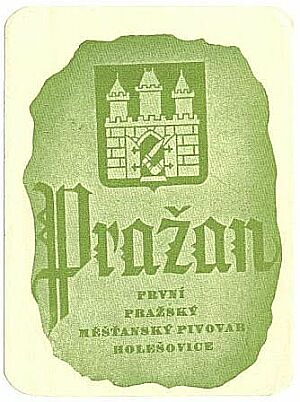
You told the cashier what you wanted and paid, to be given a receipt, then waited in a customarily long line, handing the receipt to one of the white-smocked beer pourers. The reward was a cool half-liter (or more) of golden, pilsner-style Pražan beer, brewed a few miles away in Holešovice district of Prague.

You consumed your Pražan and also ate while standing at a stainless steel table. There may have been chairs at the Automat Koruna, but if so, I can’t remember them, at any rate, I didn’t ever sit. Crowds were a constant, and stand-up space sometimes at a premium.


Photo credit (and preceding).

The ambiance at Automat Koruna was urban, frenetic and often claustrophobic – but I loved it, and what a place to drink beer and people-watch during Prague’s latter communist years! The clientele reflected an indisputably egalitarian ideal, although for communism’s usual litany of wrong reasons.

Military men with medal-filled chests jostled for space with long-haired students. Backpacking tourists and pretty shop clerks stood side by side. Brown-suited functionaries left scraps on their plates, and scruffy street people scooped them up before the busser came to visit. It was ill-advised to step away from your beer, because they’d drain unguarded remnants in milliseconds.

Moreover, it’s worth noting that these perfectly presentable half-liter local draft beers were three to a dollar. Cheap beer hasn't ever been this good.

It's a wonder I lived through it.

Next: The long-awaited Pilsner Urquell pilgrimage