Showing posts with label architecture. Show all posts

Monday, October 26, 2020

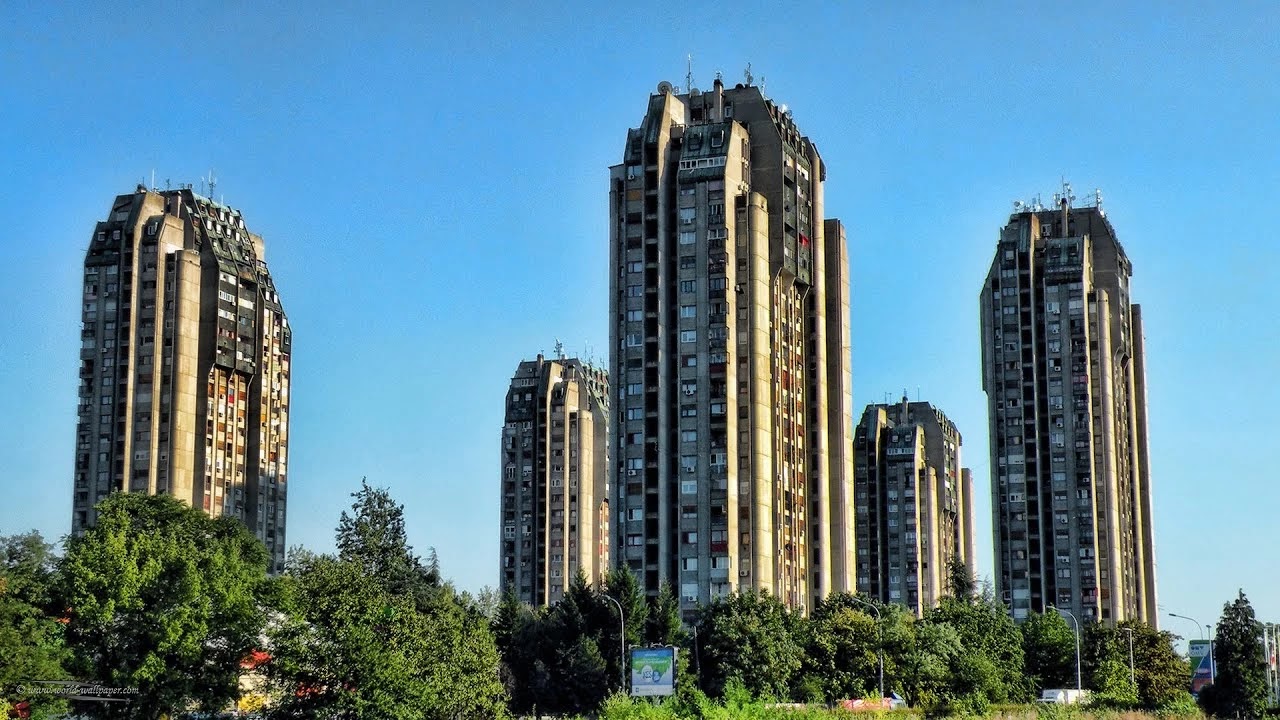
An absolute fascination with "The 15 Tallest Skyscrapers of Yugoslavia."

If Donald Niebyl created a calendar with these images I'd snatch one up. 

My only visit to Yugoslavia when constituted as such came in 1987, for only a couple of weeks, and these buildings fascinated me, as did the "Spomenik" monuments Niebyl has been chronicling the past few years. This link from March, 2020 also includes a summary of my chronology on the topic.

Farewell to the Hotel Zlatibor in Užice, Serbia ... and further tales of the spomeniks (memorials) in former Yugoslavia.

I've never had a sufficient grounding in architecture to know very much about any of this. But the interest remains just as strong.    


Among the most monumental and landmark structures ever built during the era of Yugoslavia were its many soaring high rise towers and skyscrapers, of which many pushed the envelope of engineering and inspired a nation to look towards the future. While the country of Yugoslavia has ceased to exist for nearly three decades now, the many iconic and charismatic skyscrapers built during that era continue to inspire and speak to not only the old Yugoslav generation, but also the new youth generation who never lived in that former nation, as well as people around the world who are drawn in by their unique and bold architecture. However, for all of the fame and fan-fare surrounding many of these structures, many have barely been written about and few meaningful words dedicated to their history. In fact, my entire impetus for writing this article was that when searching for a listing of the seemingly straightforward query of "what were the tallest buildings of the Yugoslav-era", I found no authoritative articles related to that question or any serious investigation into the topic.

Thursday, October 01, 2020

Prague’s concrete paneláks aren't finished yet.


Having grown up under the tutelage of a father who went out of his way to avoid urban areas, and this being America, my exposure to urban settings began in 1985 during my first visit to Europe. Near the end of the trip on a bus into Leningrad, we rolled through acre after acre of high-rise Soviet suburbs; then in 1987 and 1989, I spent much of my travel time behind the Iron Curtain in Eastern Europe.

To put it mildly, the world of panelák apartments (and their brethren outside Czechoslovakia) fascinated me. 

Khrushchyovka! The rise and fall of typical Soviet-era housing in Russia.

Gdansk and the Falowiecs: "Can Poland’s Faded Brutalist Architecture Be Redeemed?"

Berlin looks to Communist-era "slab buildings" to alleviate a housing shortage.


Seemingly everywhere, Havel's "rabbit hutches" (see below) are making a comeback, even in Prague.

design-behind-prague-s-concrete-apartments" style="font-weight: bold;" target="_blank">
design-behind-prague-s-concrete-apartments" style="font-weight: bold;" target="_blank">Prague’s Communist-Era Apartments Get a Second Life, by Feargus O'Sullivan (CityLab)

Outside the picturesque city center, Prague’s concrete panelák apartments solved a need for fast, modern housing in the Communist era. They’re still thriving today.

If you want to see where the average Prague resident lives, you’ll have to put in more effort than a quick trip around the city’s historic heart.

Jump on a tram heading out of the Czech capital’s tourist-filled center and pre-1914 tenements soon give way to something very different: large complexes of modernist apartment blocks, their concrete often brightly painted after recent renovations, looming over greenery set back from the main road. Look closely at these apparently endless tiers of blocks that provide a rampart around the city, and you’ll see they are composed of row after row of concrete panels that give this type of building its Czech name — panelák.

I took this photo from Castle Hill in Prague in 1989. You can see them clearly.


Back in 2012, I read a book about manufactured housing in the former Czechoslovakia, and reviewed it in my ON THE AVENUES column. 

It is reprinted here.

---

The late Vaclav Havel famously referred to them as “rabbit hutches,” and even today, more than two decades after the end of the Communist period, one-third of all Czechs inhabit pre-fabricated, modular housing blocks, particularly ones erected with increasing haste and decreasing art from the 1960’s through the 1980’s.

To stand on Castle Hill in the middle of architecturally glorious Prague and look outward toward the suburbs is to view what first appears to be a gray wall around the city. Actually, the wall is an optical illusion, a composite of these modular housing blocks in seemingly endless rows.

All across the former East Bloc, the Communist period witnessed the construction of high-rise housing units like these, quickly manufactured elemental housing that left travelers with an indelible image of a commensurately grim and manufactured life, but as Kimberly Elman Zarecor explains in her book, Manufacturing a Socialist Modernity: Housing in Czechoslovakia, 1945-1960, the story was at least a bit different there.


Because Czechoslovakia was the industrial heartland of the deceased Austro-Hungarian Empire, its income levels and educational attainment were above the norm during the period between the wars. Avant-garde and modernist schools of architecture in German, Scandinavia and France were represented by Czechoslovak architects in their projects of the time, and overall, the future seemed bright for the country’s development as a stable, liberal democracy.

Successive Nazi and Soviet occupations deferred this dream for almost a half-century, with a lasting and sometimes quite ugly contribution to the area’s physical landscape.

In the immediate aftermath of World War II, with a pressing need for housing reconstruction, and amid the forced imperative to organize the economy according to Communist principles of heavy industry, Czechosolvak architects fought gamely, for the most part as socialist loyalists, to retain their interwar aesthetic. There were some initial successes, but their influence steadily declined as Communist rule tightened and five-year production quotas submerged all other considerations.

After Stalin’s death put an end to the worst excesses of enforced socialist realism, which in practice meant emulating the Soviet dictator’s grandiose, leaden, Commie Gothic personal tastes, housing in Czechoslovakia became an exercise in the rapidity of modular manufacturing, with assembly-line construction far more utilitarian than any purpose-designed building, and on the cheap, with sloppily pre-cast concrete panels bolted together in stacks as high as engineering principles permitted.

Manufactured housing in Communist Czechoslovakia may have been inevitable, but Zarecor deftly shows that the route from free-form blueprint to rabbit hutch was more winding than commonly assumed, even if the end results were the same. What will the outskirts of Prague look like in twenty more years? I can only hope I’m still around to return there, and to experience the visceral reaction at another, perhaps less jarring, time.
Sunday, September 20, 2020

Where there are wine windows, there might be beer windows.


"Wine windows" in Florence and a handful of nearby locales date to a time when nobles were granted a concession to sell their wine in sizes no larger than the aperture through which commerce was transacted. They came in handy during times of plague, and some are being used again during the COVID-19 pandemic. 

In Tuscany, Renaissance-Era Wine Windows Are Made For Social Distancing, by Sylvia Poggioli (NPR
At the Vivoli café, an artisanal ice cream landmark, its tiny window had long been boarded up, says Giulia Gori, daughter of the owner. "But during the lockdown, we started using it again," she says. When the Italian government allowed restaurants and cafés to take orders to go, the café started offering takeout. "The customer rings the bell, places an order and we put the ice cream cup on the sill, avoiding direct contact with the customer." It's not exactly curbside pickup, but is as close as can be approximated in a centuries-old city not designed for cars ...

Tuesday, July 28, 2020

Ambiance Eyenga.


This piece from mid-June explains one reason why Black Lives Matter reaches all the way to Belgium -- a very solid reason, in fact:

"A renewed global focus on racism is highlighting a violent colonial history that generated riches for Belgians but death and misery for Congolese."

Later that month:

King Philippe of Belgium on Tuesday expressed his “deepest regrets” for his country’s brutal past in a letter to the president of the Democratic Republic of Congo, the first public acknowledgment from a member of the Belgian royal family of the devastating human and financial toll during eight decades of colonization.

The king’s letter, issued on the 60th anniversary of Congo’s independence, acknowledged the historical legacy and pointed out continuing issues of racism and discrimination, though it stopped short of the apology that some, including the United Nations, had asked for.

Among the legacies of Belgium's colonial experience called rightly into question is the "official" museum in Brussels, which has struggled to rebrand in recent years.

"Belgium’s revamped Africa Museum is a magnificently bizarre hybrid."

In Congo itself, it's perhaps surprising that there'd be a city with 100 surviving Art Deco structures. We harbor so many misconceptions about Africa. One is size; Congo is 3.5 times larger than Texas, and that's huge. It is striking, and also slightly puzzling, that some people in Bukavu view the legacy of these buildings as something worthy of protection. Maybe they view it in the context of cultural education. In spite of what I've been told the past few days, history is important.

The Art Deco Capital of Central Africa, by Carly Lunden (Atlas Obscura)

In Bukavu, beautiful buildings have an ugly colonial history. But locals want to save them.

... Bukavu has more than 100 Art Deco buildings. Walking through its streets, you see geometric lines, chevron motifs, stepped rectangles, curved walls with cylindrical roofs. But most of these structures, with the notable exception of the Cathedral, are now dusty and beginning to crumble. “People used to call this city the ‘Switzerland of Congo,’” says Pierre Mpemba, 55, a local historian. “We were known for all these beautiful buildings. But that’s disappearing.”

Too often, this architectural history is forgotten in a city that outsiders associate with endangered gorillas, Africa’s First World War, the 2018 Nobel Peace Prize winner Denis Mukwege, and the ongoing presence of humanitarian agencies and UN peacekeepers.

Beginning in Europe in the 1920s and 30s, Art Deco symbolized modernism, the technological future, the “machine age.” All clean and curved lines, geometric shapes, bright colors and glamour, the style was meant to signal wealth and sophistication. As it spread from Europe to places that Europeans colonized, it also symbolized and beautified imperial domination, according to scholars such as Swati Chattopadyay in the Routeledge Companion to Art Deco ...

Saturday, June 06, 2020

Design Justice seeks to dismantle the privilege and power structures that use architecture as a tool of oppression and sees it as an opportunity to envision radically just spaces centered on the liberation of disinherited communities.


Greg Fischer stopped reading after the first paragraph and went back to pretending he actually matters.

Do better than Fischer. Read the entire essay, and think about it.

America’s Cities Were Designed to Oppress, by Bryan Lee Jr. (City Lab)

Architects and planners have an obligation to protect health, safety and welfare through the spaces we design. As the George Floyd protests reveal, we’ve failed.

This moment is heartbreaking. Again. It is emotionally exhausting. Again. It is enraging to watch yet another black body plead not to be executed in public. Again.

There is nothing more representative of the state of and abuse of power in America than the scene that transpired in Washington, D.C. on Monday night: After watching U.S. cities erupt for days with pain and grief in response the police murder of George Floyd, President Donald Trump emerged from his White House bunker to forcibly remove clergy and tear-gas Black Lives Matter protesters — all in order to pose with a Bible in front of D.C.’s St. John’s Church. The Episcopal diocese oversees the 1815 structure and has expressed outrage at the action. It’s important to understand his intentions, as the president did all of this to marshal the physical architectural symbolism of the church to buttress his claims of moral, political, and racial authority. It was an escalation on the highest level, from the highest office.

For nearly every injustice in the world, there is an architecture that has been planned and designed to perpetuate it. That’s a key principle of the Design Justice movement, upon which I base my practice. Design Justice seeks to dismantle the privilege and power structures that use architecture as a tool of oppression and sees it as an opportunity to envision radically just spaces centered on the liberation of disinherited communities ...

Tuesday, November 26, 2019

Baylor Family Croatia, Slovenia and Trieste 2019, Chapter 2: The amazing public market in Zagreb.


Previously, we arrived belatedly into Zagreb to begin our vacation.

Tuesday 26 November
A few morning hours in Zagreb before departing for Ljubljana, Slovenia. 

I spent a day in Zagreb in the spring of 1987, and as we strolled into the center in the winter of 2019, I realized with sadness that after 32 years very few firm memories remained. In fact the only solid recollection of my previous visit to be conjured here and now is a stint drinking draft beer outside the train station restaurant. It's possible I ate food there, too.

That train station eatery no longer exists, but the vacant space inside can be easily spotted. I'd have been seated outdoors behind the protective bus canopy to the right in this photo.


Two hours isn't enough time to learn very much, although in the sense of atmospherics, Zagreb's central zone made a deep impression. Architectural styles range from a handful of pre-19th century icons to 19th-century standard Central European, and from Slumlord Bauhaus in the Yugoslav period, right up to new construction of the past 25 years.


Our biggest memory of downtown Zagreb on a winter's morning in 2019 almost surely will be the market, outdoors as well as indoors, and vibrant to the point of pulsating. Combined with the decorative preparations for Christmas occurring on and near the main square, it's indelible.


By noon on Tuesday we were at the train station, having bid farewell to the Hotel Esplanade ...


... and ready for the two-hour ride to Ljubljana.


More about that in the next installment.

Tuesday, November 19, 2019

Under threat: "Why Venice Is Disappearing."


Ten million tree trunks, or in short, what's underneath most of the buildings in the city of Venice.

First a short and very informative documentary from Deutsche Welle.

Under threat: Venice's need to rescue its future

Built on small islands and mud banks, Venice is slowly sinking. More than ever before, the pearl of the Adriatic is under threat. Having recently been hit by its most severe floods and with a state of emergency declared, what is being done to combat this?

Well over a thousand years ago the first wooden huts were built out on the middle of a lagoon off the coast of northern Italy. The archives tell us these were the homes of people fleeing barbarian invasions in the aftermath of the collapse of the Roman Empire. Later, with land in short supply, man-made areas were developed. But construction was far from easy; the bed of the lagoon consisted of sediment and mud, forming a foundation that was constantly moving. Yet Venetian architects managed to build the city’s palaces, towers, and cathedrals. Venice stands on a forest of wooden piles which anchor the buildings to the lagoon’s muddy bed. The buildings themselves are constructed in such a way that they can compensate for movement, even earth tremors, without suffering noticeable damage.

But the water the Venetians built their city on is becoming more and more of a threat. Industrialization has played its part in disturbing the natural balance of the lagoon: The sea bed has subsided and the effect of the tides has changed, resulting in a water level in the city’s canals that is 24 centimeters higher than when they were first built.

Added to that is the controversial presence in the lagoon of giant cruise ships: A source of income for the city, but also one that contributes to atmospheric pollution, as well as causing wake damage.

Also an article that amplifies a few of the video's points.

Why Venice Is Disappearing, by Jeff Goodell (Rolling Stone)

Flooding in the historic city is about more than climate change — bad engineering and corruption are also to blame

On Tuesday night, as epic floodwaters were rising in Venice, Italy, members of the Veneto regional council gathered in their chambers on Venice’s Grand Canal and, incredibly enough, voted to reject measures to battle climate change. Within two minutes, according to council member Andrea Zanoni, water started pouring in, flooding the chambers with several feet of murky lagoon water.

Coincidence? Maybe. But it almost makes you believe there is a god, and she is laughing hysterically at how foolish humans can be in the face of the climate crisis.

What’s happened in Venice this week, however, is no joke. High winds in the Adriatic Sea drove six feet of water into the city, causing the worst flooding the city has seen in more than 50 years. Tourists took selfies in San Mark’s Basilica in waist-deep water (one man swam across St. Mark’s Square – likely the first, but surely not the last, person ever to do that). Eighty-five percent of the city flooded; at least two deaths were reported. The floodwaters did incalculable damage to the foundations and structural integrity of the 1,000-year-old city’s most iconic buildings, including St. Mark’s Basilica. “These are the effects of climate change,” Venice mayor Luigi Burganaro said as he waded through the flooded city.

But the tragedy of Venice is about more than climate change and the power of rising seas. It’s about how bad engineering, combined with greed and incompetence, can make the climate crisis we are facing so much worse ...

Saturday, November 09, 2019

Russian photographer Arseniy Kotov and his ode to everyday Soviet architecture.

Volgograd, Russia; from the article.

It's a book to add to the must-have list in 2020. Meanwhile click through to Atlas Obscura and check out the images.

A Photographer’s Ode to Everyday Soviet Architecture, by Winnie Lee (Atlas Obscura)

Arseniy Kotov finds inspiration in urban exploration and concrete cityscapes.


Concrete is a common, humble material—sand, gravel, and cement—but Soviet leader Nikita Khrushchev sang its praises for the better part of a passionate, detailed, two-hour speech he delivered to an industrial conference in 1954. He proposed that concrete should be used for anything and everything, especially prefabricated and standardized buildings that would help accelerate construction and development. It was, he argued, absolutely vital to the Soviet project. The subsequent boom in mass housing was described by The New York Times in 1967 as an “architectural sputnik.” (Though the piece did also state, “There is no real style in Soviet cities yet.”)

Concrete is abundantly present in the contemporary cityscapes of Russian photographer Arseniy Kotov. Images from his upcoming book, Soviet Cities: Labour, Life & Leisure, often depict rows and rows of high-rises, marching endlessly across the horizon. Yet within the cold-looking concrete blocks, he also manages to capture the warm glow of life in apartment windows.

Kotov was born in 1988, so he did not experience much of Soviet life, but he admires the period’s “great civilization” of architectural and cultural heritage. The country is changing fast, but nostalgia for Soviet aesthetics is strong.

Kotov traveled to hundreds of Russian cities over three years, and plans to visit more. “Every new place hides its secrets,” he says via email. “It is normal here (in ex-USSR cities) to feel yourself like an archaeologist, who came to the ruins of great ancient civilization, and didn’t know what you would find!”

The photographer spoke with Atlas Obscura about his enthusiasm for Soviet history, fascination with rockets, and nighttime adventures. His book will be published in 2020 by FUEL Design & Publishing ...

Monday, July 22, 2019

Everyday architecture deserves respect, like these modular Yugoslav kiosks.

K57 modular kiosk, from the article.

My attention was grabbed by the article's lead photo (above), which immediately got me thinking about the two days I spent in Slovenia 32 years ago (below).


Looks like the same model to me, grouped at the market square in Ljubljana. There is less similarity with the ones I saw in Skopje, Macedonia, but it's close.


The article is fascinating with numerous links.

Why Everyday Architecture Deserves Respect, by Darran Anderson (CityLab)

The places where we enact our daily lives are not grand design statements, yet they have an underrated charm and even nobility.

Architecture is not simply the stage set in which we live our lives. It is also a reflection of how we live our lives and who we are. An integral aspect to this is the unfolding of time. What happens when our needs, desires, and beliefs change, and the structures we have built no longer facilitate them?

Architectural preservation is often an issue of grandeur, both in a sense of size and richness, and decay. When we think of buildings that already been lost, they are almost always imposing structures—cathedrals, skyscrapers, temples. Yet the places where we enact our daily lives, and which reflect them even more than grand architectural statements, are smaller, more seemingly trivial and thus more vulnerable.

To appreciate the charms of small structures, it is useful to remind ourselves that we primarily interact with architecture from a ground level rather than the god’s-eye view employed in films and renderings. The architecture of day-to-day urban life is driven by utility and merges so integrally into our tasks that we barely notice it as architecture. There have been visionary architects who have recognized and celebrated the underrated nobility of everyday life, and there are some superlative little wonders scattered around our cities.

Specifically ...

Le Corbusier’s seaside Cabanon remained a curious and charming one-off wooden cabin, despite his intention to roll it out as a series of nearby holiday homes. By contrast, there’s the streamlined fiberglass K67 kiosk by Saša J. Mächtig that flourished, for a time, in Slovenia. Being modular, adapting to fit the role and size required, the kiosk allowed “the possibility of growth and change,” in the words of the architect.

Thursday, February 07, 2019

Learning to love examples of architectural Modernism and Brutalism, and lamenting a missed opportunity to emulate Kaliningrad.

All the way back in 2014, I had a stunning Brutalist vision for our municipal overlords.

From Königsberg to Kaliningrad, but not back again, though maybe ...

The building to the rear, which never has been used, testifies to the vitality of one-party rule. Give Floyd County Democrats a chance to copy it, and it will be standing where the Reisz building is now.


Alas, they're far more brutal as bribe-engorged political hacks than architectural thinkers. It must be something in the water(y beer). Just imagine if Kaliningrad's unfinished House of the Soviets inspired Jeff Gahan's House of the Anchors. 

Ah, but I digress and proffer an apology to Brutalists who are sure to express outrage at being compared with New Albany's "Mayor for the Eternal TIF."

21 ‘Ugly’ Buildings That Aren’t Ugly at All, by Eric Grundhauser

Atlas Obscura readers share their love for specific structures they feel have been unfairly maligned.

IT’S EASY TO PUT TOGETHER collections of beautiful, soaring buildings that perfectly encapsulate today’s hottest architectural trends. But who will speak for the edifices that have gone largely out of favor since they were first constructed? The imposing behemoths and the strangely angled stars of yesteryear’s design fads? Atlas Obscura readers, that’s who. We recently asked members of our community to tell us about the “ugly” buildings they love, and you weren’t shy in sharing your appreciation for your favorite misunderstood structures.

While the style certainly doesn’t have a monopoly on unconventionally attractive architecture, the majority of the responses we received pointed to brutalist institutional buildings—especially those featured on college campuses. But overall, what all of your nominees ultimately have in common is a way of inspiring devotion in spite of (or sometimes because of) the way they appear on the outside ...

A sad story from Scotland:

Modernist ruin is an 'albatross around our neck' says church (BBC)

St Peter's Seminary in Cardross, near Dumbarton, was built in 1966 as a training college for priests.

It was once described as a "modernist masterpiece" but closed in the 1970s and lay empty until a plan emerged to turn it into a cultural centre.


However, that plan was shelved and the building is now set to remain a ruin.

Speaking personally, I've developed a liking for certain examples of Brutalism, some of which are just as deserving of preservation on grounds of "history" as the usual examples preferred locally. Personal evolution. Imagine THAT. 

---

Related:

Brutalism: If we're intent on spending $10,000,000 ... might as well make it interesting.

1987 European Summer: "Skopje, capital city of Macedonia, is a dream world for lovers of cosmic concrete communist-era architecture."

But Black Sabbath: "Britain's Second City Fights to Save Its Brutalist Architecture."

More brutalism in sclerotic thinking than architecture, at least in Nawbony.

Wednesday, December 19, 2018

Bavarian Christmas Interlude 2018, Wednesday: A sensory overload of Munich history and beer.


Diana and I visited Bavaria (Munich and Bamberg) just before Christmas. Prior to departure, there was a series entitled Munich Tales 2018. This is the second of seven installments summarizing what we did, saw, ate and drank. They're being back-dated to the day we were there.

Previously: Arrival and ample Christmas marketeering.
Next: An excursion to my beloved Bamberg.


Wednesday began with a walk, and somehow the walk lasted almost the entire day with two beer stops in between. In effect, we were viewing Munich's centuries prior to World War I, which prompts a useful reminder: Bavaria was an independent kingdom until German unification circa 1871, and even after this, the Bavarian royal family remained intact until 1918.

The Kingdom of Bavaria (German: Königreich Bayern; Austro-Bavarian: Kinereich Bayern) was a German state that succeeded the former Electorate of Bavaria in 1805 and continued to exist until 1918. The Bavarian Elector Maximilian IV Joseph of the House of Wittelsbach became the first King of Bavaria in 1805 as Maximilian I Joseph. The crown would go on being held by the Wittelsbachs until the kingdom came to an end in 1918.

Our walk went something like this.


1. Hotel to Hauptbahnhof to Königsplatz, or King's Square, built in the 19th-century according to neoclassical design. Munich's arts and museum quarter begins here.


2. To Odeonsplatz via Briennerstrasse, stopping first at the Christmas market at Wittelsbacherplatz (the equestrian statue is Maximilian I).


Odeonsplatz was built in the early 19th century on the site of the Schwabing Gate, to serve as the starting point of a royal route along what is now Briennerstrase, from the Residenz (winter palace) to Schloss Nymphenburg (the summer palace).


When World War I began in 1914, huge crowds gathered at Odeonsplatz to hear the announcement. Much later, historians examining photos of the occasion found Adolf Hitler in the crowd.


3. Next, Hofgarten Park and the adjacent Residenz (and another Christmas market in the courtyard there). Of personal importance to me is the building to the rear of the Hofgarten, now called the Bayerische Staatskanzlei. The domed section in the middle originally was part of the Bavarian army museum, constructed in 1905 and largely destroyed during World War II. In 1985, when I visited Munich for the first time, it was a ruin, and I was absolutely fascinated by it. The new building dates from 1989-1993; the central dome was preserved, and modern glass and steel wings added on both sides.


The Christmas market tucked into the Residenz was a delight. Observe the cow's udder method of applying mustard and ketchup to delectable grilled sausages.


4. To Marienplatz and Viktualienmarkt and a second round of perusing the Christmas markets there.


5. For lunch, to the amazing Schneider Bräuhaus restaurant. Prior to the war, the wheat ale specialist brewer Schneider was one of the major players in the Munich brewing scene. It was destroyed by bombs, and production moved to Kelheim on the Danube, where the family owned an intact brewery. The restaurant was rebuilt, and I'd just as soon patronize it as any of the other Munich brewery restaurants.


6. To Isartorplatz, then the Deutsche Museum, then a brief walk along the Isar River. The reconstructed Isartor (Isar Gate) was one of the main gates to the city in medieval times. The nearby Isar River rises in the Tyrolean Alps and flows through Munich in route to its junction with the Danube. In recent years, substantial progress has been made toward restoring the Isar's natural condition, and making it suitable for bathing in summer.


7. To the Platzl, a small square disproportionately famous (infamous?) for the presence of the Hofbräuhaus am Platzl.

The Hofbräu brewery is an anachronism. It began as the royal court brewery, and to this very day is an arm of Bavarian government. We took a walk-through of the Hofbräuhaus, which was a veritable zoo of humanity; we might have gone upstairs to the more civilized dining area, but Ayinger has maintained a presence on the Platzl for many years, and the Wirtshaus Ayinger am Platzl was a far safer haven for contemplative beers and snacks.


Devotees of the Public House will recognize the concept of the Anstich keg, hauled atop the counter, tap applied with mallet, and poured by gravity feed. Of course this was the way it was done every day for centuries, and remains the daily custom at places like Schlenkerla in Bamberg. At Ayinger am Platzl, as at numerous other establishments in Munich nowadays, there's a daily 5:00 p.m. tapping, with the unfiltered golden lager being poured into the stoneware.


It was delicious.


8. Now well after dark, we concluded the day's eight-hour, seven-mile hike by ambling back to the Hauptbahnhof, cutting through it and south to the hotel.

I remember sleeping very, very well.