Showing posts with label Munich Germany. Show all posts

Thursday, December 05, 2019

Baylor Family Croatia, Slovenia and Trieste 2019, Chapter 21: The capricious gods of travel complicate our lives, but we make it safely home anyway.


Food and drink led the way during our last day in Trieste.

From the very moment in October when we rejigged our trip to accommodate the bankruptcy of Adria Airways (Slovenia) by round-tripping flights via Zagreb, there was one small problem.

Our flight from the Croatian capital was scheduled to depart on Thursday, December 5 at 1:00 p.m., and we'd be starting the day in Trieste, in Italy, from whence the prevailing rail schedules simply did not offer a way to Zagreb during the required window.

Buses were an option, to be sure, but the most efficient way (although not the cheapest) was to hire a transfer -- a driver and a car for a trip that takes roughly 2.5 hours on the autobahn.


This we did, via Daytrip, Uber-like web site in Europe that connects travelers with drivers who speak their language, with options to add sightseeing stops. We winced, paid the fee for a straight transfer (circa $200) and were rewarded with the delightful wit, humor and professionalism of Davor, a native of Croatia who owns his own travel agency (Adria Private Tours) as well as Lupo, a small bar and cafe near his neighborhood in Zagreb's southern suburbs.

As Davor explained to us, Daytrip merely makes the connection and takes a finder's fee. For him it's a good way to odd-job the off-season and keep his own contacts constant. I feel fortunate that we made his acquaintance, and there'll be no hesitation contacting him should we ever tackle Croatia in greater detail.

Diana and I exited the Hotel Roma in Trieste at just before 7:00 a.m. after breakfast, and within minutes Davor materialized. Quickly the ride began, with Davor cutting against incoming morning drive-time traffic by means of back alleys and short cuts, up the escarpment to Villa Opicina and the gateway to the Karst plateau, through the cursory border checkpoint with Slovenia and merging onto the four-lane for a trouble-free passage past Ljubljana to Zagreb.

Tram in Villa Opicina.

Davor was a font of information and I peppered him with questions about the life and times of Croatia. It was fascinating. As we approached Zagreb he asked if we might be interested in a brief detour to his cafe for a coffee, and this respite reminded me a great deal of olden times in the (now former) socialist burbs.


Lupo is located in the patchwork residency quilt where tiny old villages were surrounded first with a sprinkling of Yugoslav-era housing blocks, then newer private homes and condos dating from Croatia's post-1991 independence. Davor's bar, agency and home all are situated close to the airport, and only two miles from Zagreb's city center. He has it figured out.

The ride was a great start for our journey home, and once we arrived at the airport, checked in, cleared security and relaxed with our books and coffees, everything went to straight to shit and stayed that way for 30 hours.


Foggy weather in Munich meant the arriving plane was late to Zagreb, which made us late to Munich, where we had only an hour and 45 minutes to make our transatlantic flight to Chicago. By the time we were in the Munich terminal, the Chicago plane was gone, but thankfully Lufthansa rebooked us to Washington DC, the last plane of the day to depart for America.

There was only one difficulty: No one told us. No personnel were at the gate, and the only official in sight waved us to the rebooking desk, where we waited for more than an hour, only to be told by the horrified woman at the desk that we'd missed the rebooked flight, too.

Now there was no choice except spending the night and catching the first flight back on Friday, and this was accomplished with Lufthansa's assistance: taxi, hotel and meal vouchers, and be back Friday at 6:00 a.m.

Welcome to the ultimate in good news/bad news paradigms.


  • The bad news is you can't make it home.
  • The good news is there'll be a night in Munich! 
  • The bad news is your free hotel is at the airport, too far away to make anything of a public transit jaunt into the city center when it's already 7:00 p.m. 
  • The good news is your hotel has Bavarian food and beer. 
  • The bad news is they're serving only a Rotary Club-style buffet which isn't Bavarian at all.
  • The good news is at least Paulaner is on tap, and so you drink as many of those as possible to ease the pain.

Before we redeemed the taxi voucher with a pissed-off elderly former hippie driver, there was time to examine Airbräu, the world's first airport brewery. Actually it was the smaller "satellite" of the two airport locations; the latter has a brewery, restaurant, Tenne (barn), Stube (reconstructed 19th-century Alpine private room), another snug outfitted like the gondola of a balloon, and a 600-seat beer garden, all facing the Munich airport center.


The beer was delicious.


Our request for the earliest flight possible to the States on Friday morning was honored, and our departure to Charlotte was 9:00 a.m. The hotel shuttle delivered us to the airport at 6:00 a.m., and of course the flight was late -- every single one of the seven legs we flew on this trip was delayed.

Desperate for reasons to be optimistic about life, I was delighted to see a traditional Munich breakfast being offered by the kiosk in our arm of the terminal: Weißwurst (white sausage), special sweet mustard (Senf), a nice little Brezel and a Hofbräu Hefeweizen. The key to proper dining in this instance is to score the sausage skin and remove the succulent contents. An unexpected detour, perhaps but glorious localism for Frühstück.


At long last returned to American soil, and yet again late, we were in the position of being forced to sprint from one side of Charlotte's airport to the other. We arrived in the nick of time for boarding to Louisville to begin -- then waited almost two more hours for boarding actually to start.

However, as you already know, in due time we made it home safely.

The morning after the return from Croatia, Slovenia and Trieste.


THE END

Tuesday, December 25, 2018

Christmas 2018: From Munich to New (and Old) Albania, with Vietnam Kitchen to follow.

Chinesischer Turm in Englischer Garten, Munich.

Give or take a few beers, we completed the 10,000 mile loop back to Louisville at 9:45 p.m. on Christmas Eve. The sheer awesomeness of Bavaria still was throbbing in the rear-view mirror.

It was a bittersweet homecoming, as we already knew the amazing Miss Nadia had used up her ninth life during our absence. Nadia's passing was unexpected, if not surprising at the age of 16. There'll be more to say about this, but not quite yet, apart from expressing eternal thanks to the Bluegill family for care-giving in our absence.

The year 2018 was Diana's first visit to Munich. Our days were spent wandering Christmas markets and pausing frequently for principled refreshments. It's hard to imagine better "together" time.

I hadn't been to Munich in 14 years, and found myself reflecting about the way things were in 1985, and my initial experience with hoisting steins in the city's amazing traditional beer palaces (and equally enjoyable tiny nooks). There have been a zillion changes during 33 years, and yet the combo of cool lager and steaming pork remains wonderfully timeless.

Now it's Christmas Day, and it would be futile to attempt to deal with the jumble of emotions crowding my noggin. I may have to chip away at them over the coming days, knowing all the while that the year to come probably is going to be even more exhausting than the one about to pass.

But there are a few billion people out there who have it worse off than us, and I try never to forget it -- whether a holiday or any other day when we roll out of bed and seek yet again to finesse the rough edges of the existential dilemma.

The following thoughts are a variation of ones previously posted.

---

Often I’m asked: Roger, why not relent and embrace the Christmas spirit?

Would it be so hard to be human, just for once?

Contrary to popular perception, I do relent – after a fashion – and in spite of my best efforts, Vulcan-caliber logic continues to elude me. It is enjoyable to have a (relatively) work-free day, to spend time with loved ones, to plan parties, to eat and drink, and to do what anyone else does on a holiday.

But you see, as an unbeliever, I simply cannot indulge the Christian aspect of the day as it pertains to my sphere of individual conscience. For the same reason, I cannot support Christian displays in the sphere of public property. There is secular rule of law in America, and it reaffirms and protects an individual’s religious or non-religious conscience, whether it speaks to no gods or many.

Without this fine line, theocrats like Mike Pence really will try to tell me which church to attend – or else.

At Christmas time, I respect the wants and needs of the genuinely devout, for whom the day is an expression of deeply held belief. More grudgingly, I acknowledge with deep groans the annual recitation by Ayn Rand fetishists of a belief in hyper-consumerism and pervasive materialism as a capitalistic manifestation of self, one worth glorifying in priestly fashion.

Maybe, but only up to a point. In 2015, Rolling Stone's Matt Taibbi contributed a thoughtful essay linking consumer Christmas to the stoking of irrational fears: This Christmas, Tune It All Out.

As for the rest of that shopaholic, mall-rushing craziness that can make this holiday so stressful, it turns out that it's optional. Switch off the wi-fi for a few days, turn off the TV, and it's amazing how much more reasonable the world instantly seems.

Supernaturally, just know that you can count me out. Perhaps religion remains the preferred opiate because too much of the profit from consumerism remains in the hands of the 1 per cent.

---

In fact, I do have a favorite Christmas story.

My sole “corporate” day job lasted from 1988 to 1989, with a solitary Christmas in between. So it was that in 1988, management at our office in downtown Louisville declared a contest for best work station decoration.

With entirely uncharacteristic zeal, my friend and co-worker Jeff Price, who was well-connected within local radical leftist circles and later would meet me in East Germany to take part in the “summer of ‘89” volunteer student brigade, went to work toward his stated goal of winning first prize.

He soon appeared with scissors, glue, armloads of construction paper and dusty old copies of the English-language edition of the “New Albania” propaganda magazine, as borrowed from a socialist workers group somewhere in town.

Who even knew Louisville had such an organization?

Come the day of judgment, Jeff had transformed his pod into a veritable showplace of dully-colored agitprop, with a few bright red placards bearing impenetrable phrases in the Albanian language, photocopies of stiffly posed Communist leaders like Enver Hoxha and Ramiz Alia, and a genuinely demented final touch, which I’ll never forget.

Snaking along the tops of the dull gray office partitions stretched strands of coiled barbed wire fashioned from silver holiday tinsel.

Jeff’s display was dubbed Christmas in Albania – at the time, the world’s only officially atheist state – and while the judges could not quite bring themselves to give him the top prize, second place was decreed his, from sheer perverse creativity alone.

In short, exactly my kind of Christmas, but please, feel perfectly free to enjoy yours.

Christmas Day means Vietnam Kitchen, which will be open from 11:00 a.m. to 5:00 p.m. We'll be there.

In the absence of farm-raised Slovak carp, it'll have to do. To refresh your memory about this hallowed yuletide practice, go here: Carp in a bathtub.

Photo credit: Peter Dedina, in Košice, Slovakia.

Monday, December 24, 2018

Bavarian Christmas Interlude 2018, Monday: 39 up, 39 down. What's next?


Diana and I visited Bavaria (Munich and Bamberg) just before Christmas. Prior to departure, there was a series entitled Munich Tales 2018. This is the last of seven installments summarizing what we did, saw, ate and drank. They're being back-dated to the day we were there.

Previously: Cool Paulaner and some delicious döner kebap.

---

A few random thoughts to close this series ...

On Monday morning we rose, gathered our belongings and made the short walk to the Hauptbahnhof, where the automated machine disgorged two tickets for the S-Bahn to the airport. Departure rituals are hard, and I always feel conflicting emotions when it comes time to leave Europe and return home.

Our short trip to Munich in December was the 39th visit to Europe for me, with the first one occurring in 1985. That's easily north of $150,000 invested on a return of absolutely nothing  -- apart from memories and experience, which are priceless. I have no regrets whatever.

Being in Munich for the first time in 1985 had lots more to do with drinking, as opposed to thinking. In those days most of what we assumed about planetary beer culture revolved around a dead certainty that America had been Bavaria at one time in terms of beer & bratwurst, then somehow lost its mojo after Prohibition amid a sea of lightweight swill and fast food chains.

Of course, the 33 years of my life elapsing since then have been devoted to finally grasping that we always had been guilty of oversimplification. Germans and other immigrants came to America and kept some of their traditions intact, but in a metaphysical sense they were no longer German (or Vietnamese, or Indian). They were American, and being American was something different.

Returning to Munich in 2018 was a chance to see how those beer traditions were holding up there -- not in America. The most honest answer is they are, except when they're not. There'll probably come a time when I'll step into a Munich beer hall and (a) see televised sports, (b) order an India Pale Ale, and (c) eat Buffalo wings. I hope not, but it's likely.

And when it happens, I'll probably cry. They won't be tears of joy.

Happily we're not there yet, and ultimately I don't know what any of it means. I'm grateful that we had the chance to go to Munich, especially during the Christmas season, because it seems less commercialized than the way we do it -- outdoor markets notwithstanding, and anyway, those markets are about drinking and socializing as much as anything else.

Our sole evening in Bamberg served to reinforce a truth of which I've been aware for quite some time: If either of us ever won the lottery, or inherited vast wealth, there'd be a cloud of dust from which we'd emerge in Bamberg to stay.

Although Diana might want to go to the United Kingdom, and that's fine; naturally Belgium and Netherlands would be marvelous, and there's always Copenhagen. But it's surely too late for me to be an expatriate, and I'm not sure what I think of this.

The lead-in selfie was taken at the Murphy's theme pub inside Schiphol (Amsterdam), where we changed for the flight home to Detroit. Come to think of it, Ireland would be good for this expatriate-minded Nawbanian, too.

Sunday, December 23, 2018

Bavarian Christmas Interlude 2018, Sunday: Winding down with a cool Paulaner and some delicious döner kebap.

Christmas at Paulaner Nockherberg.

Diana and I visited Bavaria (Munich and Bamberg) just before Christmas. Prior to departure, there was a series entitled Munich Tales 2018. This is the sixth of seven installments summarizing what we did, saw, ate and drank. They're being back-dated to the day we were there.

Previously: English Garden, Chinese Tower, Bavarian Christmas market, among others.
Next: Time to go home, alas.


The weather forecast for Sunday, our last day in Munich, was for steady rain by late afternoon. We reckoned on a half day of sight seeing if we were lucky, then a return to the hotel for a casual evening. Having slept in, our start came late ... at lunch.

Munich always has been about the major brewers whose presence has done so much to make the city a beer lover's pilgrimage site.

Paulaner and Hacker-Pschorr merged a long time ago, and the received wisdom nowadays is that almost all the beer for both breweries is brewed at the Hacker-Pschorr facility, with the exception of what amounts to a brewpub-sized system at Paulaner's Nockherberg restaurant and beer garden.

The name of the Nockherberg and two nearby streets can be traced back to the banking family Nockher. The family had settled in Munich in the 18th century and built a summer house on the eastern Isar heights in 1789, the so-called ‘Nockher palace’. It was located on the street known today as 'Am Nockherberg'.

From the U-Bahn station we walked up the hill and through a serpentine park area with fine views of Munich's central spires to the north.

And bicycles.


I can't remember whether my previous visit to Nockherberg came in 1995 or 1997, but it definitely was during Starkbierzeit (strong beer time) in March. I can remember drinking a liter Mass of Salvator, Paulaner's signature Doppelbock, and thinking this was an incredible feat owing to the 7.9% alcoholic strength. Gravity Head, as well as hundreds of 10% - 12% specialties, came to the vicinity of my beer appreciation somewhat later, although in fairness, we never drank beers like those from liter mugs.

At any rate, a fire in 1999 completely destroyed Paulaner's old, dark beer hall on Nockherberg, and it was rebuilt along more modern lines, then again remodeled a few years ago. The contemporary feel is of a classic Munich brewery merged with a "craft beer" standard brew/gastropub, with a bright and airy interior ambiance featuring almost Scandinavian furnishings and lighter shades of woodwork. The old-school beer garden is intact, just outside.

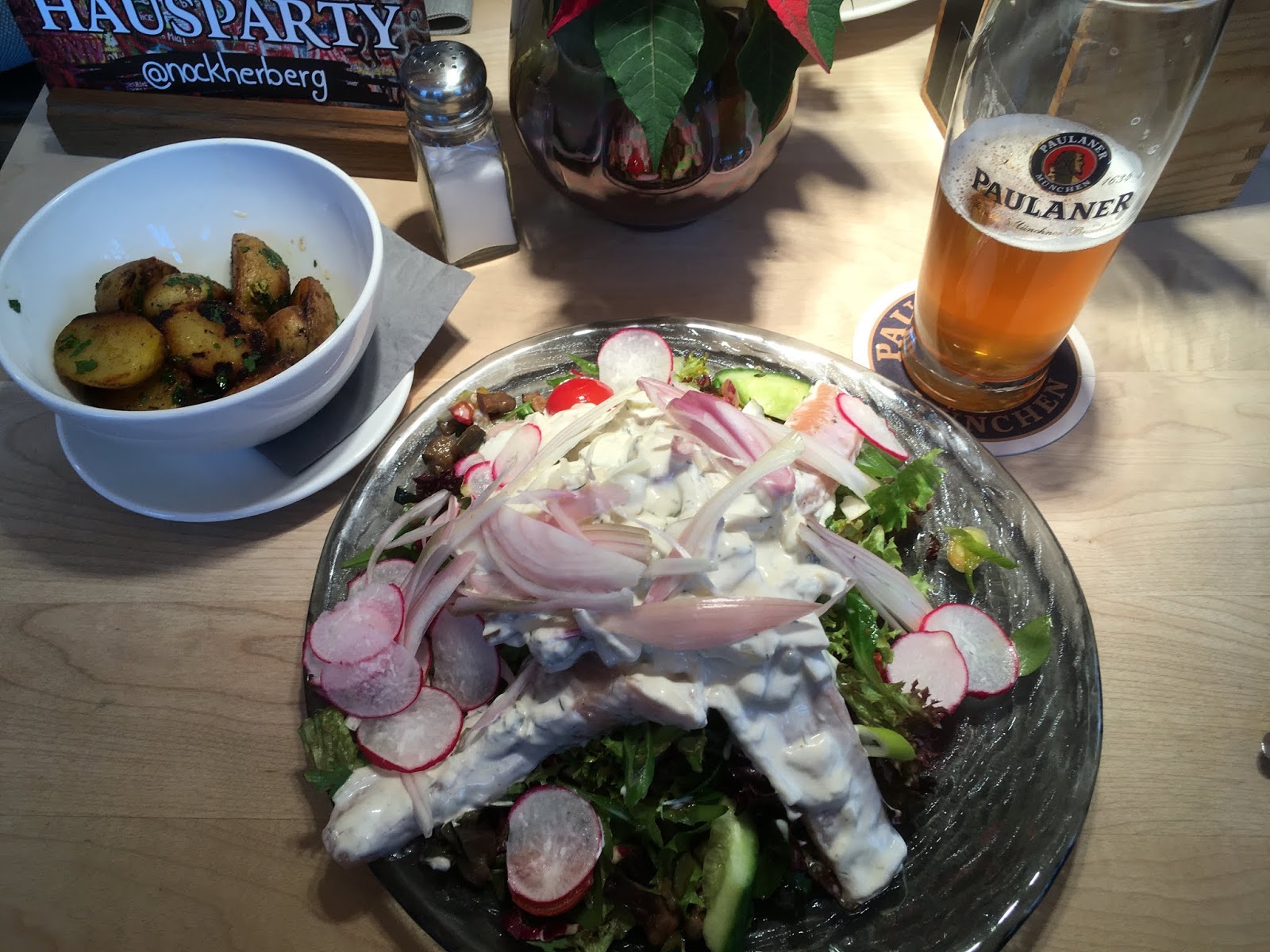
Overall it's an interesting reinterpretation of tradition -- and the herring salad was very good.


Diana again opted for Currywurst, this time of a more gourmet variety. It's hard to resist it, whether served as street food or in a sit-down setting.


From the maker of Salvator comes this seasonal Helles Bock, clocking in at a deceptive 10% abv, and delicious. Note the quarter-liter pour, a far cry from those big boy tankards of old.


A Radler is a bicyclist, and the beer mixture of the same name is familiar to most of us by now. Perhaps less obvious are Russ and Cola Weizen.


After lunch we opted for a final glimpse of the Marienplatz Christmas market. I was struck by an example of exterior artwork on a building, glimpsed along the way.


The rain was belated, but once it started there was no stopping. It still was raining on Monday morning when we rose to make our airport commute. On Sunday evening, we stayed close to the hotel. It had a Euro coin operated bottled beer vending machine in the lobby, and there were several "take away" döner kebab (or kebap) restaurants in the vicinity.

It’s nearly impossible to visit Germany and not eat Currywurst or Bratwurst, two ubiquitous sausage dishes. But regardless of the sausage’s fame, it seems that Germans can’t get enough of the döner kebab.

The nation of 82 million people consumes two million kebabs a day, according to Gürsel Ülber, spokesman for the Association of Turkish Döner Producers in Europe (ATDiD). Safe to say, the thinly sliced meat – cooked on a vertical spit, wrapped in pita or flatbread and topped with salad – overrules the sausage-duo as a preferred fast-food option; a prominent symbol of the cultural and economic influence of Turkish immigration on German society.


I believe the one I chose is called Bistro Lavash, and there were plenty of Turkish specialties at the steam table, in addition to the ubiquitous döner. What I liked most about the eatery was its multicultural clientele; rather like tacos in America, döner creates level playing fields, especially for those who've been drinking.

It's so very sad approaching the end of an excursion ...

Saturday, December 22, 2018

Bavarian Christmas Interlude 2018, Saturday: English Garden, Chinese Tower, Bavarian Christmas market, more beer, and just a little bit of food.


Diana and I visited Bavaria (Munich and Bamberg) just before Christmas. Prior to departure, there was a series entitled Munich Tales 2018. This is the fifth of seven installments summarizing what we did, saw, ate and drank. They're being back-dated to the day we were there.

Previously: EuroLeague basketball game between Bayern München and Real Madrid.
Next: Wrapping it up with a visit to Paulaner Nockherberg.


Through the end of our stay, rain was predicted. It held off on Saturday, and so we chose to roam in mechanized fashion, as opposed to Tuesday's and Wednesday's long walks. It was decided to enhance our mobility on Saturday by purchasing a day pass on public transit. Until midnight, the two of us would be able to ride to our heart's content for slightly less than $20.

Boarding a convenient bus, we set off for Englische (or Englischer) Garten, where I'd last set foot in 1989.

The Englische Garten (“English Garden”) is one of the largest urban parks in the world. The layout has undergone constant change throughout the centuries as new buildings and green spaces were added time and again.

It all started in 1789 when Elector Carl Theodor ordered that a public park be established along the Isar River. He put the project in the hands of the Briton Benjamin Thompson, who worked at the time for the Bavarian Army. The park was given the name Englische Garten because it was laid out in the style of an English country park.

Today the Englische Garten offers numerous leisure time activities. Cyclists and joggers train on the 78-kilometer-long (48.5 miles) network of paths, and amateur soccer players meet on the fields for recreational games. A beautiful vista of the city if offered by the Monopteros, which was added to the park landscape along with the hill in 1836.

I remember the beer garden very well, and recall it serving Löwenbräu in those days.

With 7,000 spots, the beer garden in the Englische Garten, right by the Chinese Tower, is Munich’s second largest. This distinctive pagoda is 25 meters (approx. 75 feet) high and is based on a design from 1789. The tower has burned down several times over the years, but each time it has been rebuilt true to the design of the original.

Although we knew there was a Weihnachtsmarkt (Christmas market) at the Chinesischer Turm (Chinese Tower), expectations were low -- and yet it was our favorite.


A Munich Christmas Market at the Chinese Tower
, by Helen Page

The Chinesischer Turm Weihnachtsmarkt (Chinese Tower Christmas Market) is an unusual name for a German Christmas Market and it is so called because in the middle of the market grounds stands a giant Chinese pagoda. The 25-metre high wooden Chinese Tower is one of the attractions in Munich’s famous Englischer Garten (English Garden) and, except for the Christmas season, it is also the venue of one of the largest beer gardens in the city ...

 ... Although the Chinese Tower Christmas Market is not well-known to international visitors, it is very popular with locals and we arrive at the market to see streams of cars queueing to get into the carpark. It is quite a busy market and being Sunday, families come to have their lunch here, catch up with friends and relatives and to do some last minute Christmas shopping.

Here's the overview.


That's right: curling.


After an orientation of the market, we walked a 30-minute loop through the garden.


Afterwards, it was lunch time, beginning with a big red bratwurst for me, Currywurst for Diana, and a Hofbräu Hefeweizen each.


Then I noticed the Schupfnudeln.


These are little potato finger dumplings, cooked with sauerkraut and gravy from pork drippings in a enlarged pan, like paella, then topped with grated cheese.

I don't say "OMG" often, but will in this instance. Sated, we caught another bus and worked our way toward the Maximilianeum, a 19th-century behemoth squatting atop the ridge on the right bank of the Isar.


To the rear of the Maximilianeum on Innere Wiener Strasse lies the Hofbräukeller am Wiener Platz. Generally in Bavarian beer-speak, a "Keller" isn't specifically intended to imply a cellar of the sort used to age lager beer. Rather, it's the brewery's beer garden.

Accordingly, that's how we approached the inside -- from the outside, through the beer garden, where men in a tent with heaters were busy drinking beer outdoors.

I didn't take their picture.


This classy, traditionalist's location of the Hofbräu empire is vastly superior to the rowdy, over-touristed Hofbräuhaus nearer the center. My friend Kim Andersen made the recommendation, and he was spot on, as usual. My only regret in this, as with many of the other beer spots we visited, is that it wasn't ideal "beer garden" weather -- because drinking beer outside is one of the undisputed glories of Bavarian beer culture.

Perhaps if we'd brought heaters and a tent.

In due course we made it back to the hotel for afternoon nap time. Later in the evening came the day's final act, and a session at Augustiner Keller, on Arnulfstrasse near the Hauptbahnhof. There was liver dumpling soup and Münchner Schnitzel, which is made with horseradish and mustard prior to the battering.


The Augustiner was huge, packed and festive. I'll always remember that.