Showing posts with label döner kebab. Show all posts

Sunday, December 23, 2018

Bavarian Christmas Interlude 2018, Sunday: Winding down with a cool Paulaner and some delicious döner kebap.

Christmas at Paulaner Nockherberg.

Diana and I visited Bavaria (Munich and Bamberg) just before Christmas. Prior to departure, there was a series entitled Munich Tales 2018. This is the sixth of seven installments summarizing what we did, saw, ate and drank. They're being back-dated to the day we were there.

Previously: English Garden, Chinese Tower, Bavarian Christmas market, among others.
Next: Time to go home, alas.


The weather forecast for Sunday, our last day in Munich, was for steady rain by late afternoon. We reckoned on a half day of sight seeing if we were lucky, then a return to the hotel for a casual evening. Having slept in, our start came late ... at lunch.

Munich always has been about the major brewers whose presence has done so much to make the city a beer lover's pilgrimage site.

Paulaner and Hacker-Pschorr merged a long time ago, and the received wisdom nowadays is that almost all the beer for both breweries is brewed at the Hacker-Pschorr facility, with the exception of what amounts to a brewpub-sized system at Paulaner's Nockherberg restaurant and beer garden.

The name of the Nockherberg and two nearby streets can be traced back to the banking family Nockher. The family had settled in Munich in the 18th century and built a summer house on the eastern Isar heights in 1789, the so-called ‘Nockher palace’. It was located on the street known today as 'Am Nockherberg'.

From the U-Bahn station we walked up the hill and through a serpentine park area with fine views of Munich's central spires to the north.

And bicycles.


I can't remember whether my previous visit to Nockherberg came in 1995 or 1997, but it definitely was during Starkbierzeit (strong beer time) in March. I can remember drinking a liter Mass of Salvator, Paulaner's signature Doppelbock, and thinking this was an incredible feat owing to the 7.9% alcoholic strength. Gravity Head, as well as hundreds of 10% - 12% specialties, came to the vicinity of my beer appreciation somewhat later, although in fairness, we never drank beers like those from liter mugs.

At any rate, a fire in 1999 completely destroyed Paulaner's old, dark beer hall on Nockherberg, and it was rebuilt along more modern lines, then again remodeled a few years ago. The contemporary feel is of a classic Munich brewery merged with a "craft beer" standard brew/gastropub, with a bright and airy interior ambiance featuring almost Scandinavian furnishings and lighter shades of woodwork. The old-school beer garden is intact, just outside.

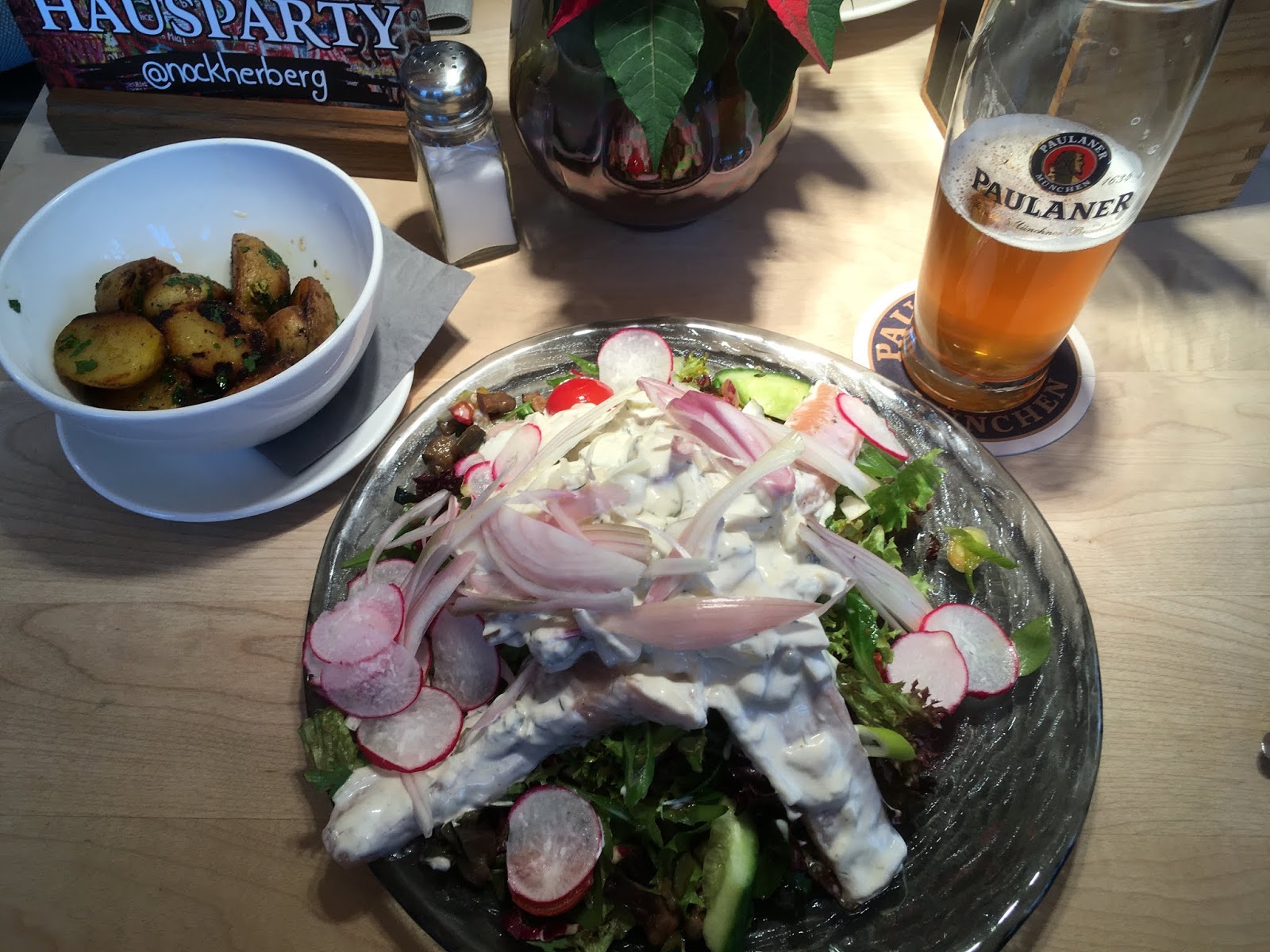
Overall it's an interesting reinterpretation of tradition -- and the herring salad was very good.

Diana again opted for Currywurst, this time of a more gourmet variety. It's hard to resist it, whether served as street food or in a sit-down setting.


From the maker of Salvator comes this seasonal Helles Bock, clocking in at a deceptive 10% abv, and delicious. Note the quarter-liter pour, a far cry from those big boy tankards of old.


A Radler is a bicyclist, and the beer mixture of the same name is familiar to most of us by now. Perhaps less obvious are Russ and Cola Weizen.


After lunch we opted for a final glimpse of the Marienplatz Christmas market. I was struck by an example of exterior artwork on a building, glimpsed along the way.


The rain was belated, but once it started there was no stopping. It still was raining on Monday morning when we rose to make our airport commute. On Sunday evening, we stayed close to the hotel. It had a Euro coin operated bottled beer vending machine in the lobby, and there were several "take away" döner kebab (or kebap) restaurants in the vicinity.

It’s nearly impossible to visit Germany and not eat Currywurst or Bratwurst, two ubiquitous sausage dishes. But regardless of the sausage’s fame, it seems that Germans can’t get enough of the döner kebab.

The nation of 82 million people consumes two million kebabs a day, according to Gürsel Ülber, spokesman for the Association of Turkish Döner Producers in Europe (ATDiD). Safe to say, the thinly sliced meat – cooked on a vertical spit, wrapped in pita or flatbread and topped with salad – overrules the sausage-duo as a preferred fast-food option; a prominent symbol of the cultural and economic influence of Turkish immigration on German society.


I believe the one I chose is called Bistro Lavash, and there were plenty of Turkish specialties at the steam table, in addition to the ubiquitous döner. What I liked most about the eatery was its multicultural clientele; rather like tacos in America, döner creates level playing fields, especially for those who've been drinking.

It's so very sad approaching the end of an excursion ...

Wednesday, August 29, 2018

SHANE'S EXCELLENT NEW WORDS: What's the difference between a Gyro and a Shawarma?


They're all Döner Kebap to me, but Mike Sajaja has a better answer.

People always ask what is the difference between a Gyro and a Shawarma?

Invented in Turkey in the 18th or 19th century, the doner kebab, meaning “rotating grilled meat.” came into existence. When the same concept was introduced to Greece, the locals named it “gyros,” the Greek word for “turning.” Likewise, when it spread through the Middle East, it was called “shawarma,” an Arabic word for “turning.”

So now you know. No matter what you call it, it is one of the best, and most popular, foods on the planet. Get yours at Aladdin's today.

For a tad more depth, visit Plated.

The gyro and the shawarma are two staples of Mediterranean/Middle Eastern cuisine that have gone mainstream in the United States. But even though some gyro-producing companies can make enough meat to crank out 600,000 sandwiches a day, we often don’t inquire about what goes into either of these dishes. However, we at Plated like to uncover every technique and mystery food has to offer, so we’re about to reveal what’s actually wrapped up in that pita.

Earlier in the year, longtime Louisville-based food writer Robin Garr stopped by Aladdin's and filed a favorable report in LEO.

I was still jonesing for labneh, so went for the full plate, an $8 appetizer. The thick, creamy white cheese reminded me of quality whole-milk ricotta in texture, but its yogurt base added a tangy high note to the sweet dairy flavor. It was spooned onto a shallow dish and generously topped with fruity greenish olive oil, with a single black olive for garnish,

I usually say ho-hum hummus, but Aladdin’s version ($7) may rank as the best I have ever had. Remarkably creamy and smooth, it boasts a rich tahini-to-chickpea ratio, and I’m fine with that. Both apps came with plenty of excellent, thick and fluffy pitas.

Finally, in the local chain newspaper, Danielle Grady explains Aladdin's recent addition of a store in the space next door.

Aladdin's new corner market stocked with homemade favorites

NEW ALBANY — Before Mike Sajaja and his family opened Aladdin’s Mediterranean & Middle Eastern Cuisine in New Albany five years ago, many residents in the area hadn’t heard of labneh or foule mudamas or kibbeh.

Now, they know what it is, Mike says with a pinch of pride in his voice. But with that, came a problem: His customers wanted their eastern favorites for themselves. In their cabinets.

Sajaja’s long-time-coming solution? A corner store and juice bar stocked with all the homemade, signature items that Aladdin’s fans love, located right next to the New Albany restaurant in its Underground Station, 37 Bank St., home.

The miniature/a> market opened last week, and the Sajajas are slowly stocking it with new items. The natural juice bar will open within the next couple weeks (if not before, Mike said) ...

Sunday, July 28, 2013

Needed is döner kebab, or perhaps falafel, maybe Cornish pasties.

It was quarter to 8 on Friday night. I was with Blake at Party Time Liquor in Greenville, wrapping a beer tasting, and neither of us had eaten since lunch.

Was there any way we could grab a quick bite in downtown New Albany without eating chain fast food, and still make the beer stand in the alley at Bicentennial Park in time to have Houndmouth or two?

My first thought was DP UpDogs.

I searched the web on my i-Phone and couldn’t find the hours of operation; the phone kept ringing, so apparently our best bet wasn’t open. The problem is that downtown’s sit-down indie restaurants are packed on Friday (that’s a very good problem to have, by the way), and it would be unlikely to score a carry-out sandwich quickly at any of them.

Granted, we were grilling out in the beer garden at Bank Street Brewhouse, but I dislike getting in the way of paying customers, of whom there were a few queued up as we arrived. In the end, we each drank two hygienic plastic cups of dinner amid the music, and resolved to snack at home. That’s okay. We’re trained professionals. I can’t speak for Blake, though I had cheese and crackers.

The gospel of the free market suggests that this situation eventually will solve itself. The solution might come more quickly if the city completes downtown streets, and the number of walkers and bikers escalates. At some point there will be a food truck, or existing establishments will do what we’re trying to do with the grilling program, at least in fair weather.

But what I really, really wish we had here was döner kebab, just like in good ol’ Germany … with a streetside window.

online.wsj.com/article/SB10001424052702304432704577350194262835880.html">There's Nothing More German Than a Big, Fat Juicy Döner Kebab, by James Angelos (WSJ)

In fast food, Germany is better known for wurst. But few German street snacks are more appreciated than the Turkish döner kebab.

Brought to Germany four decades ago, the döner is to Berlin what pizza is to New York: a transplanted food that has taken on a new life in its adopted land. Today, there are more döner stands in Berlin than in Istanbul. And about 720 million servings are sold nationally each year according to an industry association.

German-style döners are seasoned meat processed into a large cylindrical loaf, roasted on a vertical spit, then thinly sliced with a long knife and wrapped in flat bread with vegetable toppings and, sometimes, a spicy sauce.