Showing posts with label recycling. Show all posts

Thursday, November 28, 2019

Baylor Family Croatia, Slovenia and Trieste 2019, Chapter 8: Weird circular Yugoslav garage architecture and an invigorating walk by the river.


Wednesday had ended with a tour at the Pivovarna (brewer) Union.

At sunup on Thursday, something strange happened because the sun actually came out. It did so again several times during the day, although we were destined to glimpse only a few patches of truly blue sky until arriving in Trieste.

Our chosen sleeping spot, the Hotel Park, refers to itself as the "most urban and green hotel in the centre of Ljubljana," and this description seems fairly accurate. We enjoyed it.

View from the hotel
window on Thursday afternoon.

It's an extensively remodeled late 1960s-era Yugoslav high rise in the middle of a regular neighborhood, quiet and well-situated near the epicenter of town, as well as only a short distance from the railroad station. As already noted, the hotel restaurant is quite good. In addition to a menu of Slovenian standards, there's an entire selection of Indian food. It turns out the chef is from the subcontinent.


With the weather finally clearing, we resolved to spend a casual day walking, resting and snacking while deciding where to partake of Thanksgiving dinner. This brought us back to Slovenska hiša, this time for breakfast.

Nice eggs.


We began our stroll in the old town below the castle, by the market, river and downtown shopping streets.


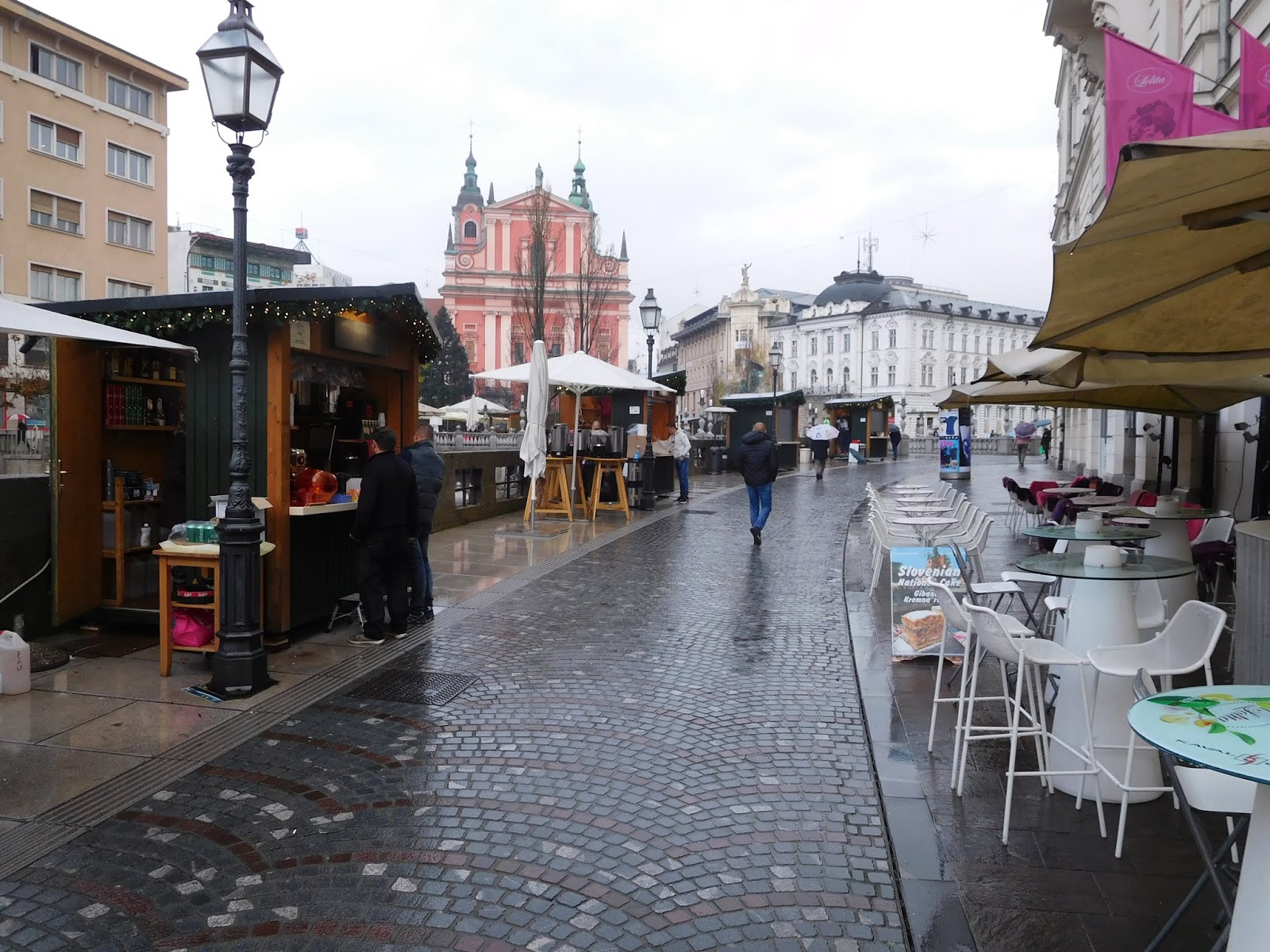


See the knives and forks?


Then had a morning coffee.


The underground bins are one component of a comprehensive municipal commitment to reducing waste. Learn more at The Guardian: From no recycling to zero waste: how Ljubljana rethought its rubbish.

The longer 25-minute walk riverside walk then began.


Now about that strange double circular structure. It is a parking garage, not a place of residence.


It was confusing at first sight, as it's not easy to see actual automobiles without looking closely. Rather, the individual spaces have all manner of stored items stacked near the windows. Consequently the notion of "parking garage" in this sense seems more about replicating one's home garage rather than temporary hourly or even longer term parking.

TGH-48 Car Park
Garažna hiša TGH-48

Architect: Savin Sever
Address: Ambrožev trg 4, Ljubljana, Slovenia
Completion: 1969

Here the problem of parking in the city was solved with the extremely efficient use of space. Sever developed a system whereby the number of car parking spaces could optionally be increased by adding new stories. The only limitation on adding the stories is the height of the stairways and length of the vehicle access. The two-way traffic system, internal communications, and spacious parking spaces allow safe and simple parking.

I was fascinated by these nearby structures under repair, which turn out to a former sugar refinery dating to 1834 called the Cukrarna.


Our original walking destination was a second-hand shop, which offered this old radio among numerous other trinkets.


By the time we found the shop, the scene had turned almost suburban.


Returning to the city center, we ambled past houses, a hospital and an old industrial space subdivided into art studios, performance venues and a skate park.


For my pal Roz.


A late lunch followed, just salads and drinks. LOO-BLAH-NAH is a local craft brewery; I had a pale ale as well as an IPA, both solid. Diana's choice was rum tea.


Passing through the market again to buy souvenirs, we smelled a stall: fresh kraut.


Nearby is the place that sells wine and fish.


And always another castle view.


After a siesta, Thanksgiving dinner in Slovenia.

Sunday, March 31, 2019

"Domicology" is a new way to fight blight before buildings are even constructed.

I'm sure this number will jump out at you, too: "The U.S. reached a record high of 7.4 million abandoned homes in 2012."

Homelessness and a housing crisis, and yet ...

There is much to think about in this essay. Obviously "domicology" is a practice that must take hold on the front end of the building process; it will be decades down the road before the real benefits are felt. 

(cue the symphony of nail guns on the matchstick construction)

Domicology: A new way to fight blight before buildings are even constructed, by Rex LaMore, George H. Berghorn and M.G. Matt Syal (The Conversation)

Detroit has been demolishing about 200 vacant houses per week since December 2014, with a goal to take down 6,000 houses in one year. Much of the demolition work is concentrated in about 20 neighborhoods where the blight removal is projected to have immediate positive effects of improving remaining property values and clearing land for future development.

While Detroit may be an extreme example, economic decline, disinvestment, racial segregation and natural and human-made disasters have left other American communities with unprecedented amounts of structural debris, abandonment and blight, too.

As scholars who focus on understanding the complex circumstances that have led to blight, we also have some ideas about potential solutions that could prevent this cycle the next time around.

We’ve coined the term domicology to describe our study of the life cycles of the built environment. It examines the continuum from the planning, design and construction stages through to the end of use, abandonment and deconstruction or reuse of structures.

Domicology recognizes the cyclical nature of the built environment. Ultimately we’re imagining a world where no building has to be demolished. Structures will be designed with the idea that once they reach the end of their usefulness, they can be deconstructed with the valuable components repurposed or recycled.

Thinking about the end at the beginning

The U.S. reached a record high of 7.4 million abandoned homes in 2012. When people leave homes, the local commercial economy falters, resulting in commercial abandonment as well. The social, environmental and economic consequences disproportionately affect already struggling communities. Abandoned buildings contribute to lower property values and are associated with higher rates of crime and unemployment. Due to the scale of the problem, local governments are often unable to allocate enough resources to remove blighted structures.

All human-made structures have a life cycle, but rarely do people embrace this reality at the time of construction. The development community gives little thought to the end of life of a structure, in large part because the costs of demolition or deconstruction are passed on to some future public or private entity.

Currently, publicly financed demolition and landfilling are the most frequent methods used to remove abandoned structures, but these practices generate a huge amount of material waste. Upwards of 300,000 houses are demolished annually, which generates 169.1 million tons of construction and demolition debris – about 22 percent of the U.S. solid waste stream.

Here’s where a shift to a new domicology mindset can help. Unlike demolition, deconstruction is a sustainable approach to systematically disassembling buildings, which can result in up to 95 percent material reuse and recycling ...

Monday, February 20, 2017

Down with the Courier-Journal's blue-bag-recycling-hypocrisy. Fact is, it's litter.

Free speech my ass: The Courier-Journal can spin this any way it likes, but it's litter, plain and simple. Why do we allow representatives of the newspaper to trash the city? I'm not sure, but perhaps the city council's forthcoming litter ordinance will take this into consideration.