Showing posts with label Budapest Hungary. Show all posts

Friday, June 23, 2017

30 years ago today: Saying goodbye to Budapest, and an era now long gone.


Previously: The time when the ghost of Yuri Andropov tried to punch me out, up in the Buda Hills.

As I write, it is the year 2017. I'll be 57 years old in August. 30 years ago, when I visited Hungary for the first time, a 57-year-old resident of Budapest looking back on his or her life might have noted these occurrences.

  • Europe's version of the Great Depression
  • The right-wing Hungarian dictatorship of Admiral Horthy
  • Budapest's devastation in fighting near the conclusion of World War II
  • Subsequent occupation by the Red Army
  • Communism's forcible implementation
  • The anti-Soviet Hungarian Uprising of 1956, which was savagely repressed by the USSR

At the point of failed revolution in 1956, our imaginary Budapester would have been all of 26 years old; if not already killed, maimed, purged or repressed, his or her whole adult life remained to be lived -- and by the time I arrived on the scene, much of it had indeed passed.

Hungary had been a relatively stable country for 25 years, and the citizen in question was close to retirement.

And yet, communism was inexorably eroding, and the Hungarians incessantly pushing the boundaries. Just three years later, in 1990, it was a whole new era, and everything had changed. Older people had it tougher when capitalism returned. By 2004, now 74, this retiree lived in a country that belonged to NATO and the European Union.

When I went to places like Hungary in 1987, these are the thoughts that filled my head as I wandered the streets.

At the time, so many Americans would have asked why Hungarians weren't fighting for "freedom." Actually, some were. Others accepted the status quo and went about their tasks. I was no fan of the system, and had little use for the regime. I was there to see how it worked, or didn't, and I tried to bear in mind that it takes all types to make a world.

Hungary was the sort of place I wanted to visit, not because I wanted it to be just like America, but precisely because it wasn't like America.

---

I spent far more time in Pest than Buda, and stayed in Óbuda my last six days in town. These areas weren't officially combined into one city until 1873. Pest's ample flat ground meant more space for building and growth than hilly Buda, and by the late 19th-century it had become the unified city's business district and commercial hub.

One of my favorite worker's cafeterias and a well stocked ABC supermarket were situated just down the way from the Dohány utcai Zsinagóga, or the Great Synagogue on Dohány Street, the largest synagogue in Europe and second biggest in the world. I walked past the Moorish-style building often.

The story of the Holocaust in Hungary doesn't make for pleasant reading, and that's why there's always the need for a refresher course.


Right around the corner from the synagogue is a major intersection in Pest. Turning left from Károly körút is Rákóczi út, and a straight shot to the Keleti pályaudvar rail station. That's the station with the big window, way on down the street.

Keleti is where I caught my train to Moscow, after foraging up and down this street for provisions. The church on the corner is the Chapel of St. Roch, originally built as part of a hospital complex.


A right hand turn puts you on Kossuth Lajos utca, leading west to the Danube, and access to Buda via the Erzsébet Bridge. This photo of the 19th-century ambiance was taken close to the bridge. It's called Ferenciek tere and has been extensively revamped in recent years. It's hard to see but the Fountain of the Nereids is in the middle of the photo.


Perhaps two miles northeast of Ferenciek tere (take the subway) is Hősök tere (Heroes' Square), which is adjacent to Budapest's roomy Városliget (City Park). The inept photo doesn't properly highlight the Hősök tere's famous statues of the Seven Chieftains of the Magyars, but it does provide a glimpse of rush hour traffic.


Andrássy út begins at Hősök tere, running straight into the heart of Pest, with the city's first subway line directly underneath the street.


In 1987, I was unable to visit what has become one of Andrássy út's biggest tourist attractions, the House of Terror Museum.

House of Terror is a museum located at Andrássy út 60 in Budapest, Hungary. It contains exhibits related to the fascist and communist regimes in 20th-century Hungary and is also a memorial to the victims of these regimes, including those detained, interrogated, tortured or killed in the building.

I'm left with a few vignettes from my time in Budapest.

One day I happened upon an old-fashioned, coin-operated weighing scale and inserted my nominal forints. The result was 89.8 kilos, or 198 pounds.

30 years ago today, I may have weighed less than 200 pounds, and if so, it would be the most recent verified instance, and perhaps the last. I'm not sure I can lose 50 pounds at this stage.

Another time I was walking down the steps from the Fisherman's Bastion when a bearded man who looked remarkably like Ernest Hemingway stopped me to ask in perfect American if I also hailed from America. This was confusing at first, at least until I realized that he'd been drinking, and simply wanted someone to talk to.

We went to a wine cellar and each had a glass of Tokaj. He told me he was part of the Budapest community of expatriate American retirees who'd found it so cheap to live in Communist Hungary that a couple hundred of them were in Budapest alone.

I wonder what became of him (and the others) when the living got more expensive, a few years hence?

I also wonder what happened to the old woman with whom IBUSZ placed me. Her flat was a couple floors up in a 1920s-era building on a sedate, leafy street in Pest. I made it through the first night, then rinsed out a few smaller articles of clothing, placing them on the windowsill to dry.

Rest assured, I was very fastidious when it came to Woolite in the sink. In tight spaces, I'd towel-dry first; there'd be no dripping. Nonetheless, my laundry evidently ran counter to her policy, because she was waiting for me when I returned from a morning walk, literally throwing my belongings at me as I beat a hasty retreat from an eagerness to evade responsibility for her fatal heart attack.

Back at the IBUSZ office, staff already had been alerted. Their eyes were rolling, and the English speaker was apologetic. It wasn't the first time, and something would have to be done about the old woman. In the meantime, would a quiet suburb in Óbuda suffice for new digs?

It would, and while more isolated, the house and neighborhood were excellent, and downtown still accessible by tram and bus.

Obviously, my cranky temporary landlord would have been in her prime during the time of the Hungarian Uprising in 1956. If you're interested in learning more about what happened in 1956, the late Tony Judt had much to say, as in this excerpt from his book Postwar.

A few Western observers tried to justify Soviet intervention, or at least explain it, by accepting the official Communist claim that Imre Nagy had led—or been swept up in—a counter-revolution: Sartre characteristically insisted that the Hungarian uprising had been marked by a ‘rightist spirit’. But whatever the motives of the insurgents in Budapest and elsewhere—and these were far more varied than was clear at the time—it was not the Hungarians’ revolt but rather the Soviet repression which made the greater impression on foreign observers. Communism was now forever to be associated with oppression, not revolution. For forty years the Western Left had looked to Russia, forgiving and even admiring Bolshevik violence as the price of revolutionary self-confidence and the march of History. Moscow was the flattering mirror of their political illusions. In November 1956, the mirror shattered.

I also recommend Under the FrogTibor Fischer's hilarious, poignant and informative novel, for insight into the post-war period. Fischer was born in London after his Hungarian parents fled their country in 1956.

Shortlisted for the Booker Prize, Under the Frog follows the adventures of two young Hungarian basketball players through the turbulent years between the end of World War II and the anti-Soviet uprising of 1956. In this spirited indictment of totalitarianism, the two improbable heroes, Pataki and Gyuri, travel the length and breadth of Hungary in an epic quest for food, lodging, and female companionship.

The novel's title is taken from an old Hungarian saying: "The worst possible place to be is under a frog's arse down a coal mine."

Next: Train Whistle Reds, or my journey from Budapest to Moscow by rail in June, 1987.

Thursday, June 22, 2017

ON THE AVENUES: Train Whistle Reds, or my journey from Budapest to Moscow by rail in June, 1987.

ON THE AVENUES: Train Whistle Reds, or my journey from Budapest to Moscow by rail in June, 1987.

A weekly column by Roger A. Baylor.

Today's column is one in a linked series of narratives about my 1987 European summer. Previously, I said goodbye to Budapest, and an era now long gone. Next: In the Soviet Union for a "good morning to Moscow."

As though to refute a litany of preconceived notions, the train arrived on time. It eased into Kievsky Station in Moscow at precisely 11:10 a.m. on June 28, 1987, roughly 36 hours after departing Budapest.

Not all of these many moments were spent in forward motion. The border crossing between Hungary and the USSR, bosom fraternal allies bound by the solemnity of the Warsaw Pact, took three full hours in the dead of night at the edge of nowhere between Zahony and Čop.

Saying goodbye to tourist-friendly Hungary was relatively seamless. By contrast, entering the Soviet Union prompted a bout of nervousness. My ream of papers had every appearance of being in order – passport, visa, tour group documents and a pristine $10 bill to change officially for rubles while aboard the train.

After all, upon arrival in Moscow I’d need enough spare change to buy ice cream, vodka and subway tickets. After that the flourishing black market would satisfy my extended banking needs at a far preferable rate of exchange.

When leaving the USSR, one could convert rubles back into hard currency, though only for the exact amount of legal, sanctioned, rubber-stamped transactions. Laundering black rubles wasn’t possible, but I fully intended to get my ten-spot back before passing into Poland in early July.

Meanwhile at the border, there was palpable trepidation. Those Cold War spy tales had left an indelible impression, and not many Americans entered the USSR by rail from Hungary. Furthermore, I didn’t know enough Russian to hold a meaningful conversation with soldiers, whether or not they were carrying guns.

My fears were unfounded during the document check, which went swimmingly. Then a stone-faced Ivan Drago lookalike appeared, wielding grunts and gestures to convey to me that my nifty interior frame backpack should be presented and opened for immediate inspection.

Gazing sternly at my motley collection of belongings, he lifted a t-shirt and found the artfully concealed bottle of marvelous Egri Bikaver wine – and I could have sworn he was suppressing a smile somewhere behind a very stiff upper lip. The border check proceeded quickly and efficiently, and only after it had concluded did one of my two seatmates turn and address me in serviceable English.

There’d have been no compelling reason to make himself look suspicious until the other formalities were concluded.

Perhaps a tad paranoid, though in 1987 it had been only 34 years since Uncle Joe Stalin died, and memories were long.

In 2017, it's been 33 years since Bruce Springsteen released "Born in the U.S.A." -- and memory has ceased to be any factor in our lives.

The primary reason our border stop lasted so long was the need for something called a bogie exchange. It had nothing to do with Casablanca or Lauren Bacall. Simply stated, the standard Soviet rail gauge is wider than the gauge used in both Eastern and Western Europe (with the exception of Spain and Portugal).


Bogie exchange is a system for operating railway wagons on two or more gauges to overcome difference in the track gauge. To perform a bogie exchange, a car is converted from one gauge to another by removing the bogies or trucks (the chassis containing the wheels and axles of the car), and installing a new bogie with differently spaced wheels.

Rather than switch trains, the train switches wheels. In 1987, I must have been asleep and missed it. In 1989, at Brest on the USSR’s border with Poland, I was able to see a bogie exchange up close and personal.

Crews went into the compartments at each end of the railway wagon and detached the outermost passenger seat assembly. Below each of these was a mechanism resembling an oversized cotter pin, which was removed.

The wagon was lifted by the arms of hydraulic jacks and the narrower gauge bogies pushed out, to be replaced by wider ones rolled into position by means of dual tracks. The wagon was lowered, and the cotter pins replaced.

Off we went, back into the USSR.

In practical terms, wider wagons meant just enough extra inches to comfortably stretch my six-foot, four-inch frame to full extension, something rarely enjoyed inside Western European sleeper compartments.

With little else to do, my plan for two evenings on a Soviet train was to sleep as much as possible … and eat, and drink. I’d brought my own victuals from Budapest: a half-kilo of salami, bread, sweets, cherries, apples and wine.

One delightful difference on a Soviet train was overstaffing, with at least two attendants per carriage. At one end of each carriage there was a nook with a built-in samovar, the classic Russian vessel for making tea. Almost any time of day or night, piping hot tea was available for the asking at a ridiculously low price of a few cents American. It came in a real glass, inserted in a podstakannik (подстака́нник), the characteristic metal tea glass holder.

The sunrise on June 27 was unforgettable. We were eastbound in the foothills of the Carpathians, and I shuffled out into the corridor to hug a window and view scenery that reminded me of Wyoming or South Dakota. Soon the heights yielded to the plains and farms of Ukraine, interrupted occasionally by pine woods, and through these landscapes we would continue rolling all the way to Moscow via the historic cities of Lvov and Kiev.

I brought two books, a Russian language instructional text and Tolstoy’s War and Peace. There was plenty of time for reading them. I’d taught myself the Cyrillic alphabet, which came in handy when pronouncing words, though less so when I still didn’t know what the words meant.

---

This train trip was the centerpiece of my eastern strategy in 1987. I’d prepaid a “youth and student” tour of Moscow, Leningrad (St. Petersburg), Riga and Vilnius (now independent Latvia and Lithuania, respectively) and Warsaw. My old pal Barrie Ottersbach would be joining the tour in Copenhagen, and flying to Moscow with the group.

I’d been on the road for two months, largely incommunicado, and needed to connect to the tour group in Moscow from somewhere in Eastern Europe. I’d learned that booking such an East Bloc connection from the United States was highly problematic, and stupidly expensive whenever possible, but far easier in Western Europe by means of the official government-run travel agencies of the Warsaw Pact countries.

The first month of my trip unfolded in Western Europe, and I diligently procrastinated. Then I was in Yugoslavia and Bulgaria, and still did nothing. Typically for a last-minute type of guy like me, I waited until all conceivable inexpensive choices narrowed to just one flip of the coin.

Either something or someone in Budapest would sell me a train ticket to Moscow, or I’d be spending more money than I could afford on an airplane ticket.

I began with the ticket windows at Keleti Station and was ingloriously repulsed. Next came multiple locations of IBUSZ (EE-boos), the officially sanctioned national tourist office. Traveling in Communist countries meant developing a forager’s aptitude. The trick was to be persistent; just because one worker said it was impossible didn’t mean the next one wouldn’t be helpful.

In fact, one English-speaking IBUSZ clerk flatly informed me that a train ticket to Moscow simply couldn’t be managed so close to the departure date, still three whole weeks away.

Finally it occurred to me to visit the office of the Hungarian youth and student travel agency, which I believe was called Express. On the one hand, I no longer was a student. On the other, I’d registered for a spring semester class at IU Southeast, found a friendly face in the bursar’s office to verify the application, and then dropped the class with a full refund, though not before obtaining an internationally-recognized student ID from the accrediting agency in New York City.

Lo and behold, the helpful clerk at Express fixed me up lickety-split. It was a morale boost, and I felt extremely worldly for once. A 36-hour train ride with two nights in a three-bedded compartment ultimately cost me less than $25, including the salami, wine and multiple servings of tea.

However, the single most daunting task was yet to come.

I’d given Barrie a date and a window for expecting a phone call for reconfirming our arrangements prior to his departure. Had I been ensconced at the Budapest Hilton, making this call probably would have been easy, but I was a budget traveler sleeping in someone’s guestroom in Obuda and making lots of 15-cent tram rides.

It was generally accepted that in 1987, international phone calls were problematic to the point of insanity at a Hungarian streetside pay phone, even from Budapest, and so on the 22nd of June, one of the tourist offices directed me to a large centrally located telecommunications center where Hungarians queued to speak with the outside world.

It was a cavernous hall with a well-worn counter and numerous semi-private phone booths paneled in old school veneer. At the counter, you handed over the number to be dialed and paid for your fixed call duration. You were given a booth number, which would be called over the loudspeaker when the connection had been made.

It all sounds easy, except that the number 18 in Hungarian is spelled tizennyolc, and pronounced --- how, exactly?

I’d paid the lady, and now all I had to do was find my phone booth when prompted. The next twenty minutes were spent with my phrasebook, drilling the syllables TEEZ-en-yolts over and over again.

But when the speaker finally crackled, “achtzehn” came spilling out. Thank heavens for Frau Leach’s college German; it transpired that the Hungarian woman behind the counter was trying to help a foreigner as best she could, making eye contact to ensure I knew her German even if she didn’t know my English.

Barrie answered, and we coordinated plans in the scant minutes before the connection fizzled and crashed. I didn’t demand a refund.

Karma, after all.

There was a worker’s cafeteria not too far away from the telecommunications center, and it was time for a few of those chilly Borsodi drafts at the low daily price of a quarter each.

I'd be missing Hungary, for sure.

---

Recent columns:

June 15: ON THE AVENUES: Hi there, NAHA wastrels. My name is Peter Principle, and these are my friends Deaf and Dugout.

June 8: ON THE AVENUES: Since 2004, "Two way, better way."

June 1: ON THE AVENUES: Take this cult of personality and shove it.

May 25: ON THE AVENUES: Welcome to wherever you are, and come to think of it, Ljubljana will do nicely.

Wednesday, June 21, 2017

30 years ago today: The time when the ghost of Yuri Andropov tried to punch me out, up in the Buda Hills.


Previously: 30 years ago today: Thought and reflection in Kerepesi Cemetery, Budapest.

My digressions can be impenetrable, so bear with me.

In 1982, when Yuri Andropov replaced the enfeebled Leonid Brezhnev as leader of the USSR, there was no way of knowing that the ex-KGB operative's stint at the top would last a scant 15 months. Andropov's severe health problems were never made public, but he was dying almost from the moment of his accession to the red throne.

When yet another wheezing and debilitated party boss (Konstantin Chernenko) assumed the leadership position in 1984, anything even remotely resembling the forthcoming roller coaster ride of the Gorbachev era would have been regarded as an impossible dream.

Decades later, we can see that while Andropov was no cuddly liberal, his many years in the KGB and frequent travels through the East Bloc had provided him with a realistic perspective – in context.

Andropov's methods of "reform" within the Soviet Union surely would have been brutally repressive; after all, he was Moscow's man on the scene during the Hungarian revolt of 1956, and yet he seems to have grasped the fundamental need for reform, something eluded the ossified Brezhnev gerontocracy.

This isn't to imply that cosmetic reform had any real chance of success; such were the fundamental contradictions of localized Communism in a steadily evolving neoliberal "global" economic system. It remains that while Andropov utterly lacked photogenic flair, he was Mikhail Gorbachev's crucial patron, without whom Gorbymania would have been stillborn.

A few years back, I read a political biography of Andropov written in 1983 by a husband and wife team of exiled Soviet journalists. The book purported to help Westerners understand the milieu of Ronald Reagan's new adversary in the Kremlin, and it is a fascinating account of the deadly, Byzantine maneuverings behind the scenes in times and places that seem impossibly dated today.

Coincidentally, I received my degree from Indiana University Southeast in 1982, stepping into a world defined by these geopolitical matters. Upon resolving to become a European traveler, I also would come to be defined by the Cold War, whether I knew it or not.

Chernenko's final resting place in the Kremlin Wall barely had been sealed and his plaque mounted when I entered the USSR for the first time in August, 1985. Gorbachev had been in charge for only six months. Crossing the border from Finland aboard a bus bound for Leningrad, the route took us through the Finno-Russian area known as Karelia, which I later learned was Andropov's first power base in the Soviet hierarchy.

The bus was mostly filled with young Americans like myself, but I made friends with an Aussie named Mark, who helped me celebrate by 25th birthday at a Leningrad restaurant, where we negotiated an all-you-can-drink meal (with a few little bits of purely optional food included) for something like a tenner each -- dollars, not rubles.

This and other vignettes are related here: Euro ’85, Part 31 … Leningrad in three vignettes.

Saturday, August 3, 1985 was my 25th birthday, and when Mark found out, he couldn’t contain his enthusiasm. A splurge was merited, and my meal was his treat. We’d heard about Baku, an Azerbaijani restaurant on Sadovaya Street, close to Nevsky Prospekt, and arrived there hopeful of somehow gaining entry.

Two years later I made my debut in Budapest, scene of Andropov's defining ambassadorial experience in 1956.

(Andropov's) big contribution - the thing that made his masters in Moscow respect him - must have been tough, accurate appraisals of the situation in Budapest. The key lesson of that episode is not the arrival of the Soviet tanks, which was obviously decided upon at a much higher level than the embassy, but what came after the tanks.

What came after the tanks was János Kádár. With Andropov's crucial support, Kádár was installed as Hungary's Communist kingpin in the aftermath of the failed uprising, and he remained atop the heap until 1988, dying the following year just before the heap collapsed into rubble.

Even now, Kádár's legacy is complicated. In the beginning, he readily authorized arrests, imprisonments, purges and violent reprisals against his own countrymen, as considered necessary to restore order to a Soviet satellite and appease his overlords in Moscow.

Having done so, Kádár then began loosening the reins in 1962, producing what came to be known as "Goulash Communism," or a limited measure of economic decentralization. This allowed small-scale "free" markets and private ownership in some retail and service sectors, accompanied by massive loans from foreign interests eager to reward comparatively "good" Commie behavior.

The result was a higher standard of living in Hungary than in other Eastern European countries. Kádár's Hungary was said to be the "happiest barracks in the socialist camp," and his tacit "deal" with the Hungarian people an inversion of the repressive axiom: "If you're not against us, you're for us."

Consumer goods were in greater supply in Hungary than its COMECON allies. The household items depicted on the side of this building surely were manufactured by the state.


Conversely, these three businesses probably were in private hands, although I'm a bit suspicious about the Arany Hordó wine cellar, located near the castle and a bit too swank to be completely sure.


Obviously, as I wandered through Budapest in June of 1987, Kádár as yet retained the keys to the executive washroom. Gorbachev's policies of glasnost and perestroika were changing the Bloc's dynamic, and his unlamented predecessor Andropov was long gone.

Absolutely none of this back story occupied my thoughts as June 26 drew steadily closer. On the 26th, I'd commence a 36-hour train trip to Moscow to meet the Danish-operated tour group. In the interim, I'd been living on solid but basic cafeteria fare, acceptable meals for the dirt cheap price and drinking lots of beer.

On June 21, I decided to splurge at a much praised, privately-owned restaurant in the Buda Hills, the sort of place that ordinary Hungarians could ill afford on their paltry salaries, but I could easily manage periodically on a budget. The prospect of rich, savory, lard-laden Hungarian cuisine off the cafeteria assembly line was a strong motivator, indeed.

On a quiet and sunny Sunday, I boarded the tram and rode almost to the end of the line, hopped off, and quickly found the recommended eatery. As customary, the full menu was posted by the front gate, and I was studying the possibilities when there was a commotion at the entrance, which was hidden in tall shrubbery perhaps thirty feet away.

An older man dressed in regulation rumpled Communist party gray suit came staggering out toward the sidewalk. I could smell the alcohol on his breath all the way from the street. The man was mumbling in Hungarian, that most incomprehensible of languages, transported to the Danube by the westward migration of Asiatic peoples a thousand years ago,.

What struck me immediately as he lurched in my direction was that this sodden suited Hungarian looked more like the deceased Andropov than the Soviet leader did while he was alive. It was uncanny. A long-lost son, perhaps?

Finally the man made it to the gate, where I persisted in trying to translate the menu. Stumbling on a cobblestone in the process, he slurred something angrily in Magyar-speak, leaned back, and launched an attempted slow-motion haymaker in my general direction.

The punch didn't come anywhere close to landing, and the force of his fist's impact with the stale evening air caused him to completely lose balance and fall to his knees, where he was briskly intercepted by the group of comrades who had come running behind him. Two of them packed the old man off into an adjacent Lada, and two others began apologizing profusely to me in approximate German.

I was confused, not upset, and responded in Hoosier-laced American. This caused them even more consternation, and as they huddled to sort things out, one sidled over and whispered, "We like your Mister Reagan."

Their communication skills were inadequate to convey why the Andropov lookalike wanted to slug me. I'd already decided that plainly, he didn't like Germans.

As it turned out, the first beer inside the restaurant was on them, and the Chicken Paprika and sour cherry soup that followed on my own forints were damned good, too. In the end, it gave me an atmospheric story to tell two years later, in August of 1989, when I sat drinking beer with Vladimir Putin (another of Andropov's KGB men) at the Radeberger beer cellar in Dresden, German Democratic Republic.

Pilsners with Putin: 1989 Revisited (Part One)

Part Two

Part Three

Part Four

Unfortunately, my camera wasn't with me that evening at the restaurant, so following are standard tourist photos from the Buda side of the Danube.

The Buda Castle complex is situated atop the hills rising from the western bank of the Danube. Matthias Church shares this hilltop to the north of the castle (behind it in this photo, taken from Gellért Hill to the south). This district is the core of historic Budapest.


Here is the view south toward Gellért Hill, in a photo take from the castle parapet. The Citadella (Citadel) is on top of Gellért Hill,


The modern Citadel dates from the mid-1800s. After World War II, the requisite "hail to our Soviet liberators" monument was built on the eastern side of Gellért Hill, facing the greater portion of the city as intended to be a constant reminder of the (then) new world order.


The Liberty Statue (above) is surrounded by smaller metaphorical statuary, as with the hero smiting the fascist dragon.


The origins of Matthias Church go back more than a thousand years. It's a Roman Catholic shrine, and the place where Hungarian kings were crowned. The terrace known as the Fisherman's Bastion is perched on the hillside to the church's rear. Behind them is the Hilton Hotel.


The Fisherman's Bastion was built during the period 1895 - 1902.


In this view from the Fisherman's Bastion, Matthias Church and the Hilton are seen.


An example of Kádár's efforts to strike trade deals with non-Communist economic interests, the Hilton Budapest was built in 1976, incorporating 13th-century Dominican abbey ruins. Recent renovations have focused on highlighting the ruins, and the history of this adaptive undertaking is fascinating.


The Erzsébet híd (Elisabeth Bridge) from Buda to Pest originally was built in 1903, and was destroyed during WWII. It was rebuilt in the early 1960s.


Construction of the neo-Gothic Hungarian Parliament was completed in 1902. In 1987, I settled for outside views like this one from Castle Hill, but in 2002, one of my small tour groups received a wonderful guided tour thanks to Jeno Ats.


The Széchenyi Chain Bridge is considered one of the most distinctive symbols of Budapest. It was completed in 1849, and rebuilt after being almost completely destroyed in WWII. Pest lies on the other side, and my narrative will end there, next time.


Next: 30 years ago today: Saying goodbye to Budapest, and an era now long gone.

Tuesday, June 20, 2017

30 years ago today: Thought and reflection in Kerepesi Cemetery, Budapest.


Previously: THE BEER BEAT: 30 years ago today, labels from beer hunting in Red Hungary ... and töltött káposzta at Czarnok Vendéglő.

The basics, according to Lonely Planet:

Budapest’s equivalent of London's Highgate or Père Lachaise in Paris, this 56-hectare necropolis was established in 1847 and holds some 3000 gravestones and mausoleums, including those of statesmen and national heroes Lajos Kossuth, Ferenc Deák and Lajos Batthyány. Maps indicating the location of noteworthy graves are available free at the entrance. Plot 21 contains the graves of many who died in the 1956 Uprising.

According to numerous recent photographs available for viewing on-line, Kerepesi Cemetery is a pristine place these days.

We are only 600 meters away from the polluted bustle of Budapest's Keleti station but we could be on the other side of the world. Kerepesi cemetery is a nature reserve, a botanical garden and a history museum - the perfect place to escape for a moment of peace and reflection when the city hysteria becomes overwhelming.

It was much this way in 1987, though far "wilder" in the context of a nature reserve. The gist of it is that during the period of Communism, vast sections of the cemetery were neglected and allowed to become overgrown, and there was even talk of demolishing it, precisely because it represented the "bad" (pre-Communist) history of Hungary.


As this instructive essay explains, even the Communists themselves weren't able to decide exactly how to bury their movement's own martyrs, especially amid ever shifting ideological winds. You remained quite dead, but one deceased day you were "in," and the next you were "out."

For many decades, the Pantheon of the Labour Movement situated in the Kerepesi Cemetery of Budapest was regarded by the then ruling Hungarian Communist Party as one of its principal commemorative constructions. Nowadays the building stands abandoned.

On the day of  my visit to Kerepesi Cemetery, one perfectly clear message emerged. The graves of the Red Army soldiers who died during the course of liberating (and subsequently occupying) Hungary at the end of World War II were kept immaculate.


As time passed and the extent of my travels widened, cemeteries became a marquee attraction for me. Different cultures do death differently. In Budapest in 1987, my Kerepesi visit lasted only an hour or two.

For whatever reason, perhaps the contrast alone, Lieutenant N.J. Bobkov's marker has stuck with me during all the years since.

Previously: 30 years ago today: The time when the ghost of Yuri Andropov tried to punch me out, up in the Buda Hills.

Monday, June 19, 2017

THE BEER BEAT: 30 years ago today, labels from beer hunting in Red Hungary ... and töltött káposzta at Czarnok Vendéglő.


This article is one of a series documenting my 1987 journeys in Europe. 

Previously: Genesis live in Budapest on June 18, 1987.
NextThought and reflection in Kerepesi Cemetery, Budapest.

---

According to my scant notes, the day after the Genesis concert was devoted to "Genesis recovery, organ recital, good dinner with cabbage dish and a Pilsner Urquell nightcap."

I can recall absolutely none of this except maybe the cabbage. More about this in a moment.

When I rolled back into Budapest on June 15 after a marvelous respite in Kőszeg, the nearest IBUSZ state tourist agency office booked me into a private room in Buda, so now a primer on Budapest's composition.

The Chain Bridge was opened in 1849, with the aim of helping Óbuda, Buda and Pest to merge more quickly. In 1867 Emperor Franz Joseph I and Empress Elisabeth ("Sissi") were crowned in Matthias Church. The Austro-Hungarian monarchy of the Danube came into being. In the history of Budapest the year 1872 stands out as a milestone, for it was then that the three separate settlements of Pest, Buda and Óbuda (literally "Old" Buda) were united into one city with a population of more than 150,000. Budapest officially became the capital city of Hungary, and underwent rapid growth in size and eminence.

Buda is the hilly right bank of the Danube, with castle, cathedral and citadel. Óbuda lies a bit to the north on flatter ground; it's the site of the original Roman settlement. Pest is across the Danube on a riverside plain ideal for 19th-century housing and industry.

During the course of my stay in the city, I resided in each of these areas, and found reason to be fascinated by each, for varying reasons.

I fell into the habit of taking ridiculously long walks during the course of typical tourist activities, all the while snooping into shops and stores, looking for bottled beers and picnic edibles. I'd try to eat at a workers' cafeteria for a big, inexpensive midday meal of soup, main course and dessert, then sample the forager's bounty in the evening.

At this juncture, it's worth remembering that in spite of "Goulash Communism," which described the relatively mild reforms enabling a degree of private enterprise, Hungary was a firmly collectivist nation in 1987. Boundaries were being pushed, but there were limits. Larger enterprises remained nationalized; smaller retail and service businesses might be privately owned, or not.

Hungary was a member of COMECON, the Communist trading bloc, and so goods from other member nations could be found, from Chinese canned vegetables to Cuban orange juice. Owing to the comparative economic differences between East and West, there were very few items from West Germany, France or the United Kingdom. These were diverted to hard currency stores; if your cousin abroad sent you dollars, they could be used to buy these scarce "luxury" articles.

Somehow I'd decided that my goal for the trip was to drink a different brand of beer for every day spent traveling. It quickly became evident that inventory controls and supply chains simply didn't exist in the same sense as home. A truck pulled up to a supermarket and unloaded, and the staff sold whatever came off it.

As a visiting beer drinker, this was both frustrating and exciting. Never knowing what was available was an adventure for anyone who didn't have to live there year-round or couldn't afford to buy Carlsberg at the hard currency store, and so my daily beer hunting became an obsession.

Sturdy half-liter returnable bottles were the norm. There were a handful of breweries in Hungary, including the once-dominant Dreher plant in the Kobanya district. The beers they brewed were lagers in the broad German and Austrian tradition, with an occasional dark or bock included in the range. "Imported" beer meant brands from Czechoslovakia, East German and Poland.

Here's a brief vocabulary.

világos = pale
barna = brown or dark
bak = goat (bock)
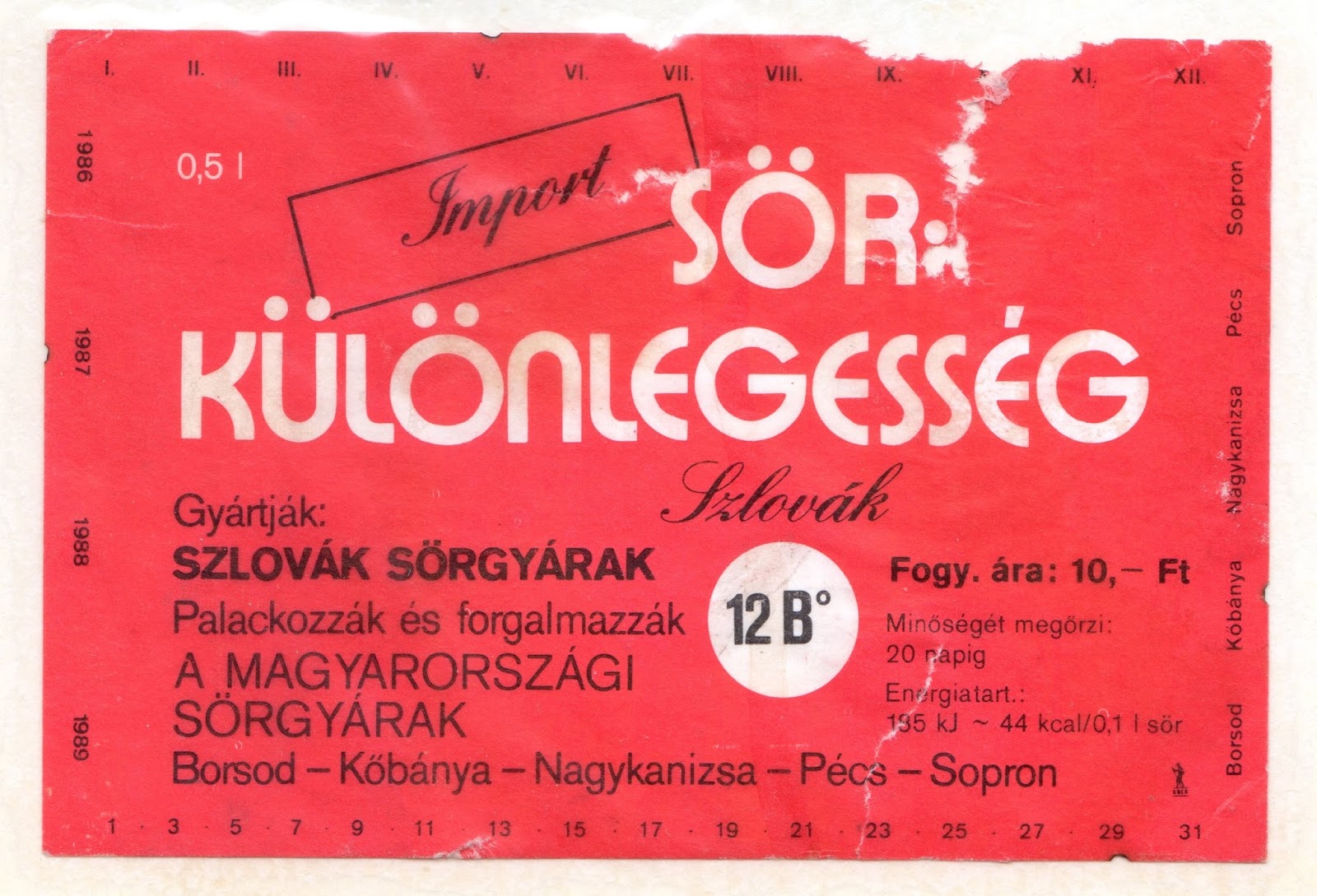
különlegesség = speciality
sörgyárak/sörgyár = brewery
gyartjak = manufactured
palackozzák es forgalmazzák = bottled and distributed by

Finally, this: It had become apparent to me that paper labels on bottles meant ultimately for reuse often came loose in a humid breeze. I became a label collector, and here are some of them, hand-soaked in basins throughout Hungary.

We begin with the home country.


Following are some labels from Czechoslovakia, as marked for sale in Hungary. The first two merit analysis; they're identified as imports from Moravia (Czech lands) and Slovakia, but the labels indicate they were bottled and distributed by Hungarian breweries.

Tanker transport?


Next, imports from Hungary's fraternal socialist allies in the German Democratic Republic, including a pleasingly archaic Köstritzer Schwarzbier.


One day I strolled into the big market hall in Buda and saw a stack of Okocim crates from Poland. I bought a few bottles, and returned next day -- foolishly, as all were gone. I never saw a Polish beer again while in Budapest.


Now, about the cabbage.

My artist friend Mike from St. Louis was good company for a few days. He introduced me to an establishment located behind the American Embassy in downtown Pest, called Czarnok Vendéglő (inn), enticing me by saying it served draft German beer.

My head filled with thoughts of Beck's or Paulaner, I met him at the inn and found the beer in question to be from Karl Marx Stadt, formerly (and now again) Chemnitz -- in East Germany, of course.

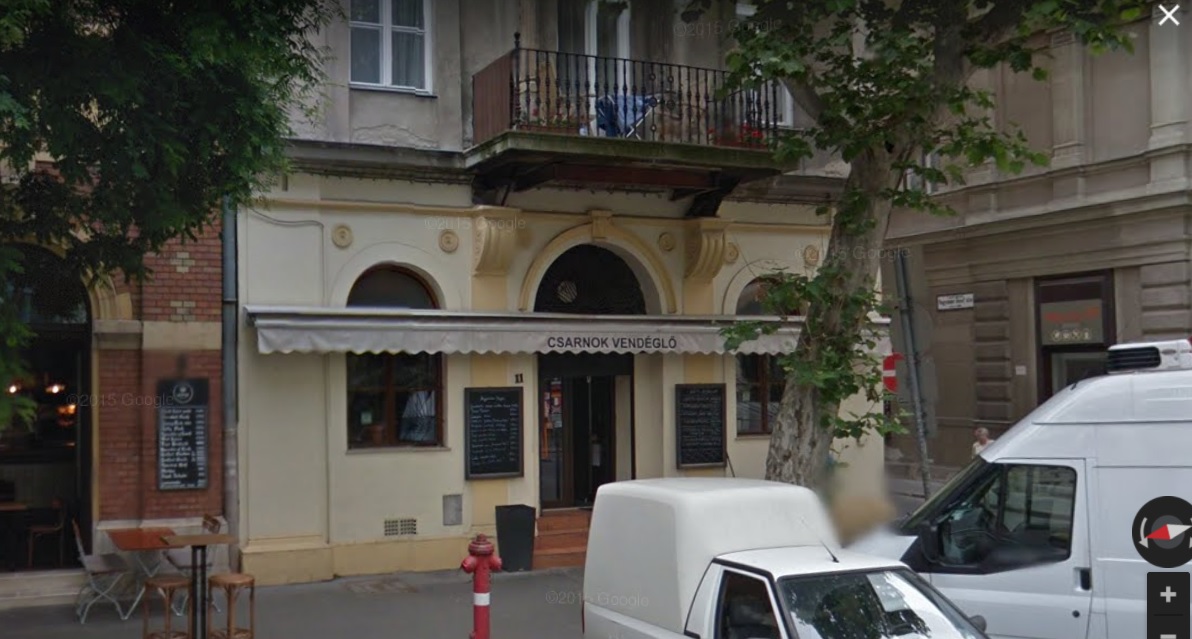
But the golden lager beer was good, and the töltött káposzta (cabbage roll) was even better. Here's the Czarnok Vendéglő in 1987 ...


... and still going strong today (2014, courtesy of Google's street view).