Wednesday, September 06, 2017

Your brain (injuries) on football: "Perhaps evolving standards of decency will reduce football to a marginalized spectacle, like boxing."

I'll keep it brief.

In recent years, I’ve turned away from football because of the increasingly well-documented, regrettable, lifelong physical toll suffered by the players. It isn't just the professional game. The more I read about youth football injuries, the greater my disconnection.

We begin to see difficult subsequent lives, erratic adulthoods, and eventual dementia in a different light, and it’s easier to look away – not from the sadly afflicted, but from the violence of the game itself.

The gladiator as macho metaphor stops being entertaining when the suffering and death are real, not just implied in a voice over.

Click here for a list of NAC articles with the search label "brain injuries."

At any rate, George F. Will's opening paragraph is worth the price of admission. Most readers will remain undeterred. To me, the world already is cruel enough without entertainment that cripples.


Football’s enjoyment is on a fade pattern, by George F. Will (Washington Post)


This combination of photos provided by Boston University shows sections from a normal brain, top, and from the brain of former University of Texas football player Greg Ploetz, bottom, in stage IV of chronic traumatic encephalopathy. 

Autumn, which is bearing down upon us like a menacing linebacker, is, as John Keats said, a season of mists and mellow fruitfulness and chronic traumatic encephalopathy (CTE). Actually, Keats, a romantic, did not mention that last part. He died before the birth of the subject of a waning American romance, football. This sport will never die, but it will never again be, as it was until recently, the subject of uncomplicated national enthusiasm.

CTE is a degenerative brain disease confirmable only after death, and often caused by repeated blows to the head that knock the brain against the skull. The cumulative impacts of hundreds of supposedly minor blows can have the cumulative effect of many concussions. The New York Times recently reported Stanford University researchers’ data showing “that one college offensive lineman sustained 62 of these hits in a single game. Each one came with an average force on the player’s head equivalent to what you would see if he had driven his car into a brick wall at 30 mph.”

Boston University researchers found CTE in 110 of 111 brains of deceased NFL players. In 53 other brains from college players, 48 had CTE. There was significant selection bias: Many of the brains came from families who had noticed CTE symptoms, including mood disorders and dementia. A Boston University researcher says, however, that a 10-year NFL linebacker could receive more than 15,000 sub-concussive blows ...

SHANE'S EXCELLENT NEW WORDS: Blood, sweat and tears ... with accompaniment.

It's a potpourri kind of day, crisply perfect for catching up on hastily scribbled notes.

Recently the mayor's twitterganger used an uncommon word.


Back Monday from August vacation. What did I miss? Thank my stars every day that I serve the most anosmatic town in Midwest. #reek

The nose knows -- or in this case, does not.

anosmia

/ænˈɒzmɪə; -ˈɒs-/

noun

1. (pathol) loss of the sense of smell, usually as the result of a lesion of the olfactory nerve, disease in another organ or part, or obstruction of the nasal passages

Derived Forms

anosmatic (ˌænɒzˈmætɪk), anosmic, adjective

Wiktionary adds:

From French anosmatique (“anosmatic”), coined by French anthropologist, anatomist and physician Pierre Paul Broca (1824–1880) in Revue d’Anthropologie (2nd Series), volume II, page 398); analysable as an- +‎ osmatic.

Oddly, Ronnie Van Zant never even met Hizzoner.


It isn't known whether Elton John was a Skynyrd fan, although as Sir Elton once observed, "It's sad; so sad. It's a sad, sad situation -- and it's getting more and more absurd."


lachrymose


[lak-ruh-mohs]

adjective

1. suggestive of or tending to cause tears; mournful.
2. given to shedding tears readily; tearful.

Origin of lachrymose

Latin, 1655-1665 < Latin lacrimōsus, equivalent to lacrim(a) tear (see lachrymal ) + -ōsus -ose1

Related forms

lachrymosely, adverb
lachrymosity [lak-ruh-mos-i-tee], noun

As I write, the temperature outside is comfortably in the 50s Fahrenheit, but just a few days ago it was prime Ohio Valley-caliber sticky and disgusting, and a friend was overheard to say he was "sweating like a pig."

I've heard this phrase my entire life, and have been meaning to look it up for years. Follow the link for the precise explanation; while convoluted, it makes sense.

The Expression "Sweating Like a Pig" Has Nothing to Do with Pigs, by John Farrier (Neatorama)

Pigs don't sweat much, so they wallow in the mud to cool off their bodies. So how did the English language expression "sweating like a pig" develop? It's actually a reference to pig iron, which is form of iron smelting ...

Finally, long before Blood Sweat and Tears was a rock group with horns ...


... it was an inspirational phrase uttered by Winston Churchill in 1940 ... except the famous British prime minister did not coin it.
The first occurrence of the expression that I can find in print is in Sermons on Various Subjects by Christmas Evans, translated from the Welsh by J. Davis, 1837:

Christ the High Priest of our profession, when he laid down his life for us on Calvary, was bathed in his own blood, sweat and tears.

Evans, a.k.a. 'The John Bunyan of Wales' (25 December 1766 - 1838) was an eccentric but widely admired preacher. We can't now be sure if it was he who coined the phrase or his translator. Either way, we can be sure that the phrase was in the language by 1837.

Tuesday, September 05, 2017

Them's fightin' words: "Streets are for everyone, not just motorists."


At the risk of repeating myself, allow me to repeat myself.

From Victoria, British Columbia, comes another reinforcement of well-reasoned points that consistently elude so many New Gahanians as they stare at their phones while driving.

A few bucks more for complete streets?

Of course. We have a hundred years of redress to accomplish.

Comment: Streets are for everyone, not just motorists, by Todd Litman (Times Colonist)

... Many urban streets are becoming more complete and multi-modal, including better sidewalks and crosswalks, bike lanes, bus lanes and bus stops.

Some people assume that this harms motorists. They are wrong. Everyone benefits from improved travel options that reduce traffic and parking congestion, increase road safety and reduce motorists’ chauffeuring burdens. Most people will experience times when they cannot drive; better mobility options prepare our community for our future selves.

Of course, roadway changes are disruptive, but please give them a chance. Slowly but surely, complete-streets policies are helping to create more efficient and complete communities.

Thanks Victoria, for improving walking, cycling and public transit. Please don’t stop.

Branding Columbus? New Gahania brands, too, albeit with the dullest of bright shiny objects.


In a moment, Aaron M. Renn is going to comment on branding challenges in the context of two cities, both called Columbus, but first a digression.

Whether or not "branding" in this context is desirable or even necessary for New Albany is a topic we can discuss at a later date. For the moment, let's accept that it is, at least to some extent.

So far we're not branding -- and yet we are, just the same.

The last time a comprehensive civic "branding" campaign was proposed hereabouts was 2011, when King England III reigned. The comprehensively horrendous "Come to City" proposal was botched so thoroughly by Team England and Develop New Albany that perhaps it's understandable no one wants to be seen touching the branding notion again.

The Gahan regime has tossed out several half-baked marketing ideas, "where you want to be," HarvestHomeComingStan and the more recent hashtag #OurNA among them, but there is no mistaking these scattershot placeholders for a coherent, unified municipal branding campaign.

However, stealth branding is another matter.

Sadly, as David Duggins always insisted, our proliferation of mud-stuck anchors, currently affixed to every city-owned object without the good sense to duck, is in fact our brand.

In short, here we are, anchored in place -- without the approval of a single, solitary elected official save Jeff Gahan himself.

Furthermore, both Gahan and his chosen cudgel, Develop New Albany, largely have substituted themselves and their self-branding schemes for an organized campaign in the larger civic sense.

In this, we're getting exactly what we're paying for ... good and hard.

Since Gahan took office in 2012, there has been no substantive public dialogue about any topic pertaining to branding. Six years later, we have anchors galore and Gahan "presenting" everything from the daily rising of the sun to concerts he didn't himself finance.

Gahan's cult of personality is so surreal that NAC's satire can't come close to keeping up with it.

Columbus, Indiana has world-renowned architecture as its brand. New Albany has a tarnished, tinpot, quasi-Third World-bureaucrat's face, wrapped around an anchor embracing all the wrong metaphors.

Well, I suppose it worked for Alfredo Stroessner -- and Trumpolini, too.

The Columbus, Ohio Branding Problem Illustrated, by Aaron Renn (Urbanophile)

If you want to get a sense of the branding challenge facing Columbus, Ohio, consider this:

This weekend in Columbus, Ohio people will be watching a film called “Columbus” that is set in Columbus…..Indiana.

People don’t like it when I point out that internationally, more people are probably familiar with Columbus, Indiana (pop 46,850 in a metro of 81,402) than Columbus, Ohio (pop 860,090 in a metro of over two million).

And this:

Or, as one local talked about in a recent article about the identity of the city, you have to put a flag in the ground – a really, really good flag – and make your stand.

Obviously this takes time. These recent Columbus, Indiana items were built on the architectural legacy from long ago. But you have to start somewhere.

Luddites wail, but Market Street slated to return to rationality next Tuesday morning.

BoW approves the mayor's celebratory motorcade.

The newspaper's Morris attended this morning's piano anniversary meeting, and he reports that Market Street's reversion to two-way traffic will come next Tuesday, September 12, to be followed by Elm Street at an undisclosed date thereafter.

Market Street in New Albany to be converted to two-way traffic Sept. 12, by Chris Morris (Double the Christianity, Double the Phun)

 ... Paul Lincks with HWC Engineering, said the plan is to convert Market Street, from State Street to Vincennes Street, Sept. 12. Work will begin that morning at 7 a.m. and will include restriping angle parking spots in the downtown area for westbound traffic. The work should be finished by 12 p.m.

ASK THE BORED: Gripped with nostalgia, we remember the Great Street Piano Meltdown of 2015.


Came the reminder: two years ago today was the belated (to put it mildly) dedication ceremony for the street piano that produced so much labored consternation in the Down Low Bunker.


This post from July 26, 2016 explains what happened.

Shouldn't Street Piano Day be a civic holiday?

---

An omen is an event regarded as a portent of good or evil, and sometimes both.

This morning it dawned on me that I have failed to receive the weekly e-mail agenda of the Board of Public Works and Safety's Tuesday meeting.

No doubt this is a providential omen, freeing me from the crushing burden of observing the bureaucracy of local infrastructure, and suggesting that I make better different use of my time this morning.

Keep the questions coming. Meanwhile, let's take a fond look back to last year, and the Bored's bumbling performance in the legendary case of the New Albany Street Piano.


The following three posts include most of the other links to this most enduring and hilarious of stories.

As a refresher, here is Bluegill's summary.

First, there was a request to place a piano on a public sidewalk in New Albany; a fun, harmless, and completely normal happening around the world. Then there were months of city officials sidestepping and ignoring that request. Then there were additional weeks and multiple meetings of artificially constructed and wholly irrelevant hurdles put in place. Then there was media attention and, by New Albany standards, an expression of public support for the piano and exasperation with the City sizable enough to embarrass the officials involved. And then there was finally approval, with an almost equally embarrassing rearguard attempt to claim officials had supported it all along. I wish any of that was out of the ordinary but it's a near perfect example of what ordinary is here, even and especially when the stakes are much higher. Playing a new tune couldn't be any more welcome.

And the links ...

Bored of Works no more: Today at 4:00 p.m., the New Albany Street Piano becomes a reality.


Fundamentally delayed: The New Albany Street Piano "Grand Opening" is Saturday, September 5.


Celebrate the New Albany Street Piano, while remembering Team Gahan's dismal reaction to it.


Grid Control, Volume 25: If Breakwater's overflow parking has been "donated" by AT&T, why weren't crosswalks installed for residents to access it?


I'll keep this one brief.

Looking back to September 1, 2015, we find city officials answering prospective Breakwater parking concerns. The critical passage is underlined.


New Albany apartments receive zoning approval, by Daniel Suddeath (Free pass for DNA Digest)

Project cost now up to $26 million

 ... New Albany Planning Director Scott Wood acknowledged there will likely be a "battle" for on-street parking, but added that's a concern Flaherty and Collins will have to address if it becomes a problem.

Residents moving into a higher market-rate facility will expect adequate parking, and if it's not provided, the apartment owner will hear about it, Wood continued.

"It's going to regulate itself," he said.

He added the apartments constructed adjacent to Sam Peden Community Park were also approved with a parking unit ration of just more than one-to-one per unit, and that the proposed development downtown is in a more pedestrian-friendly environment.

AT&T, which has a location across from the development, donated a 24-space lot to the city to be utilizes specifically for the development.

Flaherty and Collins — which had initially announced a $16 million project before additional features were added bringing the cost to $26 million — also has plans for a 1,600 square foot retail space on the site.

It will likely be occupied by a coffee shop or small restaurant, and would only require eight spaces under city ordinance, representatives with the development team said.

The New Albany City Council approved in July a financing package that will allow Flaherty and Collins to payoff up to $4.9 million in debt for the development utilizing tax dollars earned through the project. The developer will be allowed to use tax-increment financing, or TIF, funds raised through the increased property values from the site to pay back the debt.

The New Albany Redevelopment Commission voted to include the Coyle property in a TIF district prior to the bond vote by the council.

So, if Breakwater residents park across Spring Street amid one of the most poorly maintained corporate structures in the city, the most direct path to their cars does not involve walking one or two blocks east or west, then doubling back, but heading right across the street -- a street recently rebuilt without crosswalks in this spot.

But didn't we just vanquish one-way streets for the stated purpose (among others) of eliminating unnecessary "round the block" trips for drivers?

What about walkers?

Moreover, shouldn't the stop light (or four-way stop) be at 8th Street, not 7th, and shouldn't there be an "enhanced" (hint: enforced) crosswalk opposite Breakwater?

Mark my words: two-way calming effects aside, vehicular speed once again will become an issue on Spring Street from 15th to 7th, and from 7th to 4th, and as high speeds pertains to the latter, it will be on a stretch of street running between 200 - 300 apartment residents and the most direct route both to parking and downtown amenities.

It makes very little sense, though it probably testifies to Jeff Gahan's befuddled desire to do the impossible by making the city walkable without inconveniencing drivers.

---

Previously:

Grid Control, Vol. 24: Deliver me this.


Grid Control, Vol. 23: City's fuddy-duddies losing their minds as the debut for a two-way Spring Street is pegged at August 29.

Grid Control, Vol. 22: City engineer Larry Summers answers our questions about intersection striping errors and the "No Trucks" sign removal.


Grid Control, Vol. 21: Murderous intersection at Spring & 10th to be repaved and restriped -- and, the hocus-pocus with a disappearing "No Trucks" sign at Spring & Vincennes.


Grid Control, Vol. 20: As Team Gahan dawdles, another bicyclist is crushed into mincemeat at 10th & Spring's dangerous dogleg.


Grid Control, Vol. 19: In a positive move, HWC begins righting the wrong cross hatching on Spring Street.


Grid Control, Vol. 18: Finally a few BoW street grid project answers, almost all of them citing "contractor error."

Grid Control, Vol. 17: Judging by the misdirection of this "CROSS TRAFFIC DOES NOT STOP" sign, we now reside in the British Empire.


Grid Control, Vol. 16: What about HWC's cross hatching correction? Will this be finished before or after Team Gahan declares victory?


Grid Control, Vol. 15: Dooring enhancement perfectly epitomizes Deaf Gahan's "biking last" approach to grid modernization.

Grid Control, Vol. 14: Yes, you can still park on the south side of Spring Street during the stalled two-way grid project.

Grid Control, Vol. 13: "Dear Deaf Gahan and minions: FOR THE LOVE OF PETE, STOP TRYING TO BE COOL AND DESIGNER-ISH. YOU'RE NOT, AND IT'S EMBARRASSING ALL OF US."


Grid Control, Vol. 12: Meet the artistic crosswalk design equivalent of dogs playing poker.

Grid Control, Vol. 11: HWC Engineering meets with St. Marks, city officials nowhere to be found.

Grid Control, Vol. 10: City officials predictably AWOL as HWC Engineering falls on its sword over striping errors.

Grid Control, Vol. 9: "This was supposed to be discussed with us," but Dear Leader doesn't ever discuss, does he?


Grid Control, Vol. 8: City Hall characteristically mum as HWC Engineering at least tries to answer the cross-hatching question.


Grid Control, Vol. 7: What will the Board of Works do to rectify HWC's striping errors on the north side of Spring Street, apart from microwaving another round of sausage biscuits?


Grid Control, Vol. 6: Jeff Speck tweets about NA's grid changes, and those missed bicycling opportunities.


Grid Control, Vol. 5: Egg on HWC Engineering's well-compensated face as it botches Spring Street's westbound bike buffer cross hatching.


Grid Control, Vol. 4: But this actually isn't a bus lane, is it?


Grid Control, Vol. 3: TARC's taking your curbside church parking, says City Hall.


Grid Control, Vol. 2: Southsiders get six more parking inches, but you gotta love those 10-foot traffic lanes on Spring.


Grid Control, Vol. 1: You people drive so freaking horribly that someone's going to die at Spring and 10th.


Monday, September 04, 2017

Closing thoughts on Labor Day by Dan Canon.


I looked but could find no evidence that Mayor Jeff Gahan has thoughts.

About Labor Day.

---

A couple of thoughts about Labor Day:

I've represented workers against big business here in my community for a decade now. Union folks don't often get to me, because they have a line of job protection that most American workers don't have. Most of the employment protections non-union folks *do* have were also a direct result of the labor movement. Overtime pay, workplace safety rules, anti-retaliation provisions - these are all thanks to unions, and affect most workers whether they've ever paid dues or not.

The issues brought to the fore by labor unions are more important now than ever. As plenty of people have rightly pointed out, our insane wealth gap has just emboldened the rich to take even more, not to generously lavish the working class with raises and pensions, because almost no one is telling them they can't. Labor unions tell them they can't. So oligarchs over the last decade or so have been pretty brazen about trying to break the back of organized labor as a whole. They keep the concentration of wealth at the top from getting even worse, and the top is pretty adamant that they'd *like* for it to get worse.

But it's too simplistic to say that the effort to gut unions is just based on greed. It's also part and parcel of the GOP/new-American-fascist agenda. Down here, if we are organized, we are a threat to the top. The more and better we are organized, the more of a threat we pose. And so naturally, the more divided we are, the less a threat we pose to an increasing concentration of wealth and power at the top. In fact, if we are very divided, we might not even notice such concentration at all. We might deny that it exists. We might think it doesn't affect us. We might not have time to care.

This is why there's a concerted effort to divide us up. Black v. white, Christian v. Muslim, straight v. gay, cis v. trans, etc. It makes us disorganized. Unfocused. Weak.

Where would you start a campaign of disorganization, were you to run one? Who would be among your primary targets? I bet one would be: the folks who have already known how to organize and get results for more than a century.

That's the reason we see our friends, families, and neighbors in the labor movement under attack. It's not just about making a few more dollars at the expense of someone else's hard work. It's about perpetuating divisions and preventing the amalgamation and galvanization of those of us down here below.
Let's all buy a drink for a union member and tell 'em we've got their backs. They've had ours for more than a hundred years.

If local Democrats can't honestly address Jeff Gahan's public housing putsch, how can they "resist" Trump?


Once again, I asked.

"C'mon down, Floyd County Democrats. If you're a FCDP type of guy or gal AND support Mayor Gahan's plans for (and handling of) the New Albany Housing Authority, let us know why. Gahan describes himself as a public housing 'advocate.' How so? I keep asking, and crickets keep chirping, but surely there's a Democrat out there willing to make the case. Thanks in advance."

Once again, only the dulcet tones of pins dropping came back to my yearning ears. A Facebook conversation developed, albeit with no one actually answering the question I posed.

Then Susan, one of the few prescient and consistent progressive Democratic commentators in New Albany, especially since Deaf Gahan's Public Housing Putsch 2017 got under way, made this comment.

"I have been asking the same question. We keep waiting for Republicans to recognize what is going on with Trump. Strikes me that this is a similar situation."

It strikes me, too.

The oddest thing about Gahan's public housing housing land grab is the deafening silence emanating from his own Democratic Party camp. If it's the best policy, shouldn't Gahan's allies be out in force, lifting anchors and praising Dear Leader's unerring judgment?

And yet they're not. In fact, they're not uttering a single muffled peep.

Voices in opposition have come from a broad array of society: a holdover board member, former NAHA employees, social workers, activists, honest Democratic Party progressives like Susan, and even a couple of non-office-holding Republicans.

What you permit, you promote -- and silence is complicity.

It makes sense to me why most Republicans would clam up; after all, a Democrat's doing something they agree with, and politically, there's no point in agreeing publicly.

But shouldn't the hosannas be sounding for Gahan from the Democratic rank and file?

Or are they just too damned embarrassed?

And, whether they're supportive of the putsch and somehow to shy to show it, or opposed to the shambles and weirdly unwilling to utter it, how can the party even pretend to be marching to Adam Dickey's hyperbolic "resistance" campaign against The Donald?

There's something nasty and Trumpian worthy of resistance right here in New Albany, but because Gahan's one of them, lots of spines aren't showing up on the x-rays.

Has the Floyd County Democratic Party ever been this hypocritical and useless?

When humans outrank anchors 'n' autos: "It’s not about making all cities like Amsterdam. It’s about making them better versions of themselves.”


Well, at least the hue and cry over Spring Street bike lanes recently repainted  (they've actually been there since 2009) has lessened the customary terminal anguish over roundabouts.

Previously, we learned about ...

Leotards, brimstone and "How Amsterdam became the bicycle capital of the world."

"The prevalence of bicycle use in Amsterdam and the Netherlands more generally is a reason why I will never move back to the UK. It is only when you've experienced living in a city that is not dominated by the motorcar do you realise the immense impact it has on your quality of life. The UK now looks like a hellish, backwards, aggressive place full of people who have failed to realise that they've partly created the hell they're living in."

After all, since escaping a culture of car-centric dominance offers further benefits extending in all directions, not merely a bicycle lane or two alone, there's this.

Sharing Amsterdam’s story of transformation into a city for people (Daily Hive)

 ... The experience of living and working in Amsterdam was transformational, shifting her focus from one of environmental sustainability to urban livability. Securing a job as a tour guide to supplement her income, she would show historical photographs of the city’s car-choked streets to tourists, and their reactions were almost entirely uniform: “They would almost always say the exact same thing: ‘That looks an awful lot like my city,’” remembers Dinca.

Dinca and her Californian partner briefly moved back to North America for nine months in 2013, drawn by Vancouver’s reputation for world-class quality of life and progressive politics. But a frustrated stint into the bicycle advocacy scene – including the fledgling Streets for Everyone – would often end in the same reaction from local leaders: “This isn’t Amsterdam”. But, drawing on those archival photos she had collected over the years, Dinca reminded them that, as recently as the 1980s, neither was Amsterdam.

And so, rather than continue down that rather unproductive and unsatisfying path, Dinca decided it was time to return to her adopted home, and complete her Master’s in Urban Planning at the University of Amsterdam, with an emphasis on exploring the (often undervalued) connection between transportation and land use planning.

When it came time to select her thesis project, Dinca recalled the old black-and-white photos that she would show to tourists, and asked herself a compelling question: “Why don’t cities learn from their peers’ historical mistakes and successes?”

She knew, for example, there was intense opposition and outrage at the removal of car parking at the time, while, decades later, almost all Amsterdammers would enthusiastically agree it was a positive step. So she set about better defining and quantifying these dramatic steps towards a city for people, and the average person’s reaction to them.

The workers' holiday? That'd be May 1 -- and American workers did that.


Just as long as we're clear about the fact of the matter, I'm down with today.

Labor Day is May 1, by Jonah Walters (Jacobin)

Today is a boss's holiday.

 ... Tragically, our labor movement was never strong enough to buck the tyranny of capitalism for good. And today, with union membership in dramatic decline and workers under sustained attack from the political establishment, this militant past often feels like a distant, even irretrievable, memory.

But American workers did contribute at least one lasting legacy to the international movement for working-class liberation — a workers’ holiday, celebrating the ideal of international solidarity, and eagerly anticipating the day when workers might rise together to take control of their own lives and provide for their own well-being.

That holiday is May Day, not Labor Day.

A new book: Gorbachev: His Life and Times, by William Taubman.

Just before the deluge.

I'll never cease to be fascinated by this era.

My European travels during the decade of the 1980s began in 1985, when Mikhail Gorbachev had been in power only a few months, and ended in 1989, with the Berlin Wall reduced to rubble and the Soviet satellite nations falling like dominoes. Two years later, so ended the USSR.

From an older book ...


Ronald Reagan was widely eulogized for having won the cold war
, liberated Eastern Europe and pulled the plug on the Soviet Union. Margaret Thatcher, Joe Lieberman, John McCain, Charles Krauthammer and other notables offered variations of The Economist‘s cover headline: “The Man Who Beat Communism.”

Actually, Jack F. Matlock Jr. writes in Reagan and Gorbachev, it was “not so simple.” He should know. A veteran foreign service officer and respected expert on the Soviet Union, he reached the pinnacle of his career under Reagan, serving first as the White House’s senior coordinator of policy toward the Soviet Union, then as ambassador to Moscow. In both the title of his memoir and the story it tells, he gives co-star billing to Mikhail Gorbachev.

Reagan himself went even farther. Asked at a press conference in Moscow in 1988, his last year in office, about the role he played in the great drama of the late 20th century, he described himself essentially as a supporting actor. “Mr. Gorbachev,” he said, “deserves most of the credit, as the leader of this country.”

... to this new one, which I'll be purchasing. Is the bookseller reading?

How Mikhail Gorbachev ended the cold war

The peasant boy turned Communist Party boss who liberated his people from 70 years of lies and buried the Soviet Union

... Ever since the end of the Soviet Union, the question of “why” has lingered in Western, Russian and Chinese minds. Why did a man at the head of a superpower undermine his own authority? Did he simply fail to understand the consequences of his actions, or did he act out of courage and vision? How did Mr Gorbachev, the peasant boy turned Communist Party boss in a fedora, become the statesman who liberated his people from 70 years of lies and fear, end the cold war and bury the Soviet Union? Was he a product of the Soviet system, as he claimed, or its “genetic error”, as Andrei Grachev, an earlier biographer described him? What made Gorbachev Gorbachev?

Sunday, September 03, 2017

Just a very private joke.


Very early color "home movies": The Thirties in Colour.


Or, wealthy folks taking "home movies" in the 1930s with expensive color film. A four-part BBC video documentary is embedded here.

BBC In Colour: Vivid images of a vanished decade, by Dominic Cavendish (The Telegraph)

"The earlier In Colour series rely overwhelmingly on still colour photographs from one source - the Albert Kahn archives in France," he says. "These only run up to 1930. After making contact with most of the world's major film archives, it became apparent that colour documentary film from the 1930s is very scarce indeed. In fact, the only colour images that I was aware of were the famous shots of Hitler at the Berghof - his home in Bavaria - which we show again. Apart from that, we had to cast our net very wide and trust our instincts. As a result, we managed to unearth some hidden treasures."

I could watch this sort of documentary all day long.

---

The Thirties in Colour

Four-part series using rare, private and commercial film and photographic archives to give poignant and surprising insights into the 1930s, a decade which erupted into colour as polychromatic photographic technology came of age and three important processes - Dufaycolour, Technicolor and Kodachrome - were patented and brought to the market.

Episode 1: A World Away

This opening part looks at the work of socialite and amateur film-maker, Rosie Newman, who used her high society contacts to secure extraordinary access to the social elite. Between 1928 and her retirement in the 1960s, Newman criss-crossed the globe and shot some of the most important colour documentary footage of the period.

Some of her colour films have been seen before, but this programme features some of Newman's work that has never been broadcast and has not been seen publicly for over 70 years.


---

Episode 2: Wright Around the World
Together with his younger brother Bolling, the American industrialist Harry Wright was wealthy enough to indulge his twin passions for travel and filmmaking. Both siblings collected and shot films that captured the world at a pivotal time in history.

They captured astonishing images acquired and filmed in the islands of the South Pacific, Papua New Guinea and Indonesia, as well as South Africa, Morocco, Palestine, and several countries in Europe, including Britain. These destinations were visited during the golden age of ocean travel, when the well-off could escape the Great Depression and travel the world on luxury cruise ships.

The sea had become a playground but it would soon become a battleground, as the world lurched towards the bloodiest war in history.


---

Episode 3: Adventures in the Americas

One of the most prolific collectors of colour film in the period was the American industrialist Harry Wright. A self-made millionaire with a passion for film, he acquired and commissioned hundreds of films, which he screened for guests at the private cinema he had built in his home in Mexico City.

The programme examines Wright's extraordinary colour films of Africa and Central America, including his so-called Ethnographic Series of Unknown Mexican Indians, a unique visual record of the lives and customs of indigenous peoples living in the remote rural regions of Mexico.


---

Episode 4: End of an Era

It was Golden Age for international travel, a decade when advanced transport systems allowed people to journey all over the world. Travellers with the means recorded their experiences by using the new colour film technologies. Often unintentionally, their home movies captured defining moments at a time when the nations of Europe were about to be plunged into the disaster that was the Second World War.

The final episode features colour films shot by travelling film-makers in Europe, including footage shot on the streets of Berlin decked in red swastikas at the time of the Olympic Games, rare pictures of the Jewish quarter in Warsaw just weeks before the Nazi invasion and, in London, tourists wearing gas masks amid fears of imminent bombing raids by the German Luftwaffe.


---

Finally, fast-forwarding to the 1950s, a bonus selection.


Six decades ;ater,it would be next to impossible to replicate this feat, given wars and closed borders.

BBC Timeshift: The Lost Road - Overland to Singapore

In 1955 young producer of Travellers' Tales David Attenborough was persuaded by six Oxbridge undergraduates to give some money & filmstock so they could film their unique overland journey by Land Rover from London to Singapore.

The team fly across the Channel, travel through France, brewing tea at the foot of the Eiffel Tower. Then onward through Germany, Yugoslavia, Greece and Turkey. They inspect ancient ruins in Syria, learn to waterski in The Lebanon and spend time a Nairn Bus workshop in Iraq. They demo the landrovers to the Iranian Army, travel through Pakistan to India where they visit the Taj Mahal and the tea plantations of Darjeeling. Onto previously inaccessible Nepal and through fairly incessible Burma. There they are escorted by soldiers whose jeep they have to repair. Then through Malaya and onto the Singapore causeway where a welcoming committee awaits.

Very early color photos: "Documentary series about Albert Kahn's photographic Archive of the Planet."


That's right: pre-WWI color photos, commissioned and collected by a wealthy Frenchman who largely is forgotten.

The Dawn of the Color Photograph: Albert Kahn's Catalog of Humanity, by Maria Popova (The Atlantic)

In 1909, millionaire French banker and philanthropist Albert Kahn decided to enlist the era's burgeoning photographic technology in a mission far greater than aesthetic fetishism, and set out to use the new autochrome—the world's first true color photographic process, invented by the Lumière brothers in 1903 and marketed in 1907—to produce a color photographic record of human life on Earth as a way of promoting peace and fostering cross-cultural understanding. For Kahn, photography was a way of cataloging the human "tribes" of the world and constructing a vibrant, colorful quilt of our shared humanity.

Over the next two decades, until he was ruined by The Great Depression, Kahn dispatched a crew of photographers to more than 50 countries around the world, shooting more than 100 hours of film footage and 72,000 images in what became the most important and influential collection of early color photographs of all time. Yet, for decades, the collection—which spanned everything from religious rituals to cultural customs to watershed political events—remained virtually unknown, until it was rediscovered in the 1980s ...

There's a five-part BBC video series chronicling all this. Parts four and five leave a bit to be desired in terms of reproduction, but it's better than nothing. Rather than embedding the vids, I'm linking you to YouTube.

---

Edwardians in Colour: The Wonderful World of Albert Kahn

Documentary series about Albert Kahn's photographic Archive of the Planet. For a quarter of a century, Kahn supplied a team of photographers with the world's first colour camera system and dispatched them across the globe. Their films and 72,000 photographs offer a unique insight into the formative years of the 20th Century.

Episode 01: A Vision of the World
This episode shows the pictures Kahn produced the first time he took his autochrome plates abroad during an epic round-the world trip in 1908.

Episode 02: Men of the World
This part tells the story of the circumnavigation of the globe by Kahn and his chauffeur, and the 1913 journey of Stephane Passet to China, Mongolia and India.

Episode 03: Europe on the Brink
When Auguste Leon visited Scandinavia in 1910, he found widespread deprivation and famine. In the Balkans he recorded the increasing volatility of Europe on the eve of war.

Episode 04: The Soldiers' Story
During the First World War, Kahn dispatched his photographers to the battlefields, where they recorded in remarkably intimate detail the everyday lives of French troops fighting on the Western Front. The Soldiers' Story shows the poignant images they captured as they journeyed through shattered landscapes of Eastern France. Their remarkable pictures also document the horrifyingly crude medical procedures at field hospitals; the first aeroplanes and the heavy armaments that were appearing in the war zone; the heroism of the nurses; and the endurance of an army which sustained more casualties than any other during The Great War.

Episode 05: The Civilians' Story
Throughout the Great War, Kahn's photographers travelled throughout France, documenting the impact of the conflict on non-combatants in the towns and villages.

THE BEER BEAT: Remembering Michael Jackson and revising the beer tasting syllabus.


On August 23, I conducted a beer tasting (with yummy appetizers) at Mesa: A Collaborative Kitchen in New Albany.

THE BEER BEAT: Thanks to Mesa (A Collaborative Kitchen) for a great inaugural beer night.

It had been a while since I led a sampling that wasn't filled with NABC beers, these occasions having devolved somewhat into urgent (futile?) salesmanship as much as balanced education, so it seemed prudent to rethink the approaching evening in thematic terms.

Given the bewildering complexity of the beer world these days, what are the essential points, apart from information about the specific beer being sampled?

The brewing process, of course. Just the basics about ingredients and their use in the brewhouse, as would be offered on any brewery tour, without going into mind-numbing detail.

As a corollary, the difference between ales and lagers. Why the yeast and fermentation temperature matter, and how this played out over the history of brewing, especially in Central Europe when "lager" as we know it originated.

Local brewing history, or in our specific case, how those German lager brewers came here and recreated their world, with similarities and differences.

How these factors and so many more come together in terms of beer style, reflecting my fundamental belief that in a majority of cases, human beings must know the rules before they break them -- and, moreover, that familiarity with styles makes one a happier consumer.

In short, it's back to basics, both for me and anyone else who is interested in thinking a bit about where we've been, so as better to see where we're going, and toward this end I took my archival copy of Michael Jackson's original book The World Guide to Beer to the tasting and passed it around.

Most attendees hadn't ever seen it, and accordingly the book will be a staple at all future tastings.

The Mesa gig was on August 23. I knew the 10th anniversary of Jackson's passing was coming soon, but wasn't sure exactly when; while eating lunch at Brugge Brasserie on Wednesday, I glanced at my e-mail and saw the notification of Tom Acitelli's letter perfect tribute in All About Beer, linked here.

In fact, Acitelli's essay is a "must read" for anyone seeking the rounded, "whole beer" experience. Jackson was a memorable prose stylist, but moreover, he systematized a language of style that beer people speak every day without once reflecting about its origins. I think we need to know these origins.

You are commanded to click this link, now. Read first, drink beer later. I'm hoping to do another Mesa tasting in October, and I'll keep you posted.

REMEMBERING THE BARD OF BEER: WHY THERE WILL NEVER BE ANOTHER MICHAEL JACKSON

 ... “If a brewer specifically has the intention of reproducing a classical beer, then he is working within a style.” That was Jackson toward the start of World Guide.

With a generation’s hindsight, it’s an unremarkable statement. But in 1977, it was positively revolutionary. Jackson was the first critic to write for a consumer audience about beer styles in much the same way that wine critics had long written of wine styles. Before Jackson, beers were fitted into “divisions,” “species,” “types,” “varieties” and “classes,” but never styles.

That etymological flourish by itself would have made his contribution to the beery canon memorable. But he spent the next three decades refining and expanding it, putting on quite an intellectual performance for a subject not used to the scrutiny.

The painter Bruegel might come up in a discussion of lambic, or topography in an examination of the origin of lager, or immigration in the rise of beer in the U.S. Throughout, too, Jackson dove into the technical nitty-gritty of Plato, IBU, ABV, etc., as well as the back stories of breweries and brewers, hop farmers and beer merchants.

The New Albany location of Urban Bread Co. has closed, meaning that a restaurant opportunity just opened downtown.


Keeping it short and sweet: The Urban Bread Co. location at 145 East Main Street has officially closed, according to Jeff Mouttet, owner of Match Cigar Bar and the departing eatery's landlord.

I hate to see closings, but we've seen them before, and will again. I'm assuming the restaurant's other locations remain open, so if you're an Urban Bread Co. fan, there's always Flat12 in Jeffersonville.

Mouttet says the vacated restaurant space at 145 E. Main remains viable and fully equipped, virtually a turnkey operation. This is an ideal opportunity for someone in the food biz who wishes to be downtown, and if you're that someone, call Jeff Mouttet at 502-643-0093.

Saturday, September 02, 2017

The Warm Showers Community: " For Road-Weary Cyclists, a Room, a Couch, Maybe Even a Meal."

Who wouldn't want to host these upstanding citizens? (Tournai, Belgium in 2004)

Boy, did we need this (or something like it) in the Czech Republic in 2006.

Warm Showers

The Warm Showers Community is a free worldwide hospitality exchange for touring cyclists. People who are willing to host touring cyclists sign up and provide their contact information, and may occasionally have someone stay with them and share great stories and a drink. All members agree to host others either now or in the future, but for some members hosting may be in years or even decades in their future.

The mainstream media coverage has commenced.

For Road-Weary Cyclists, a Room, a Couch, Maybe Even a Meal, by Katie Kramon (New York Times)

 ... Warm Showers started small in 1993, but its website now lists 39,000 hosts and 89,000 bicycle tourers — people who hit the road for extended long-distance trips — in 175 countries. It is built, the website says, “on 100 percent reciprocal hospitality.” Hosts offer what they can: a couch, a room, or a place outside to pitch a tent, and sometimes meals, too. They receive no benefit other than the chance to make new friends and hear stories of the road. And unlike the for-profit Airbnb, Warm Showers is run by volunteers.

A wonderful ideal, indeed.

“In our society right now, we don’t know our neighbors, and we aren’t looking out for each other,” he said. “Warm Showers reminds me of something I loved as a child: trust, and taking care of each other, and stopping by the side of the road to help someone in trouble. That’s the kind of world I want to live in.”

The Putsch Man Cometh: Jeff Gahan waxes delusional about being a public housing "advocate," then cheerfully explains why he should be summarily deposed in 2019.


The Courier-Journal's Justin Sayers surveys the corroded tinpot grandeur of Jeff Gahan's Public Housing Putsch 2017, and both the mayor and his servile, bootlicking minions predictably emerge on a subterranean par with Donald Trump and his motley band of societal looters.

Despite reassurances, plan to scatter public housing spreads fear across Louisville

 ... (resident Candace) Brewer started circulating a petition in early July that asks Gahan to not "tear down public housing without a plan to replace it." She got 400 signatures from New Albany residents in the first month.

Gahan, who said his parents were in public housing for a time, considers himself an advocate for it.

Gahan's utterly unqualified but extravagantly over-compensated operative Dugout also is an advocate ... of the Scarecrow's predicament in The Wizard of Oz.

(David) Duggins said the goal is to move residents into more mixed-income living spaces and neighborhoods. He acknowledged that it could be difficult for residents but said the conditions in the new units would be better than they are currently.

“If you would offer the opportunity for that family or that individual to move to a new location and a new unit, to me, that’s a no-brainer," he said.

There's something to be said for intimate personal experience.

Others have taken note of the New Tidal Wave of Gahan's bobble-headed sycophants on the NAHA board, and meanwhile, the mayor styles himself as a Great Communicator, which is so obvious a contrived whopper that I won't waste readers' time refuting it.

Brewer and (resident Shirley) Fitzgerald lamented changes on the authority's board and police presence at its meeting, calling it an intimidation tactic.

Gahan said he does not believe he and the housing authority have hidden their plans — he said the housing authority sent letters to every resident notifying them of the plan and that he published a letter in local newspaper the News and Tribune prior to a vote to move forward with the plan.

He called the presence of police typical for every city board meeting but said he was concerned by residents' feelings that they were being intimidated. He added that he would look into it and "not one time will we not be listening to people.” There were no police officers at the next meeting.

Allow me to fix that: "Not one time will we begin listening to people, here or elsewhere in the city."

Intent on adding self-insult to injury, Gahan proceeds to explain to Sayers exactly why he should not serve a third term as Anchor in Chief.

This public housing plan is spreading fear across Louisville. Here's what you need to know

 ... Gahan told the Courier-Journal that Lane was fired because he needed to ensure that the plan had the support of the housing authority's director. Lane declined to comment when reached by the Courier-Journal.

“We’re moving forward with a plan that needs the support of a lot of people and it certainly needs the support of the director," Gahan said. "I think sometimes changes are necessary especially when an organization has been pursuing certain plans for a long time."

Credit Gahan for being able to tell the truth at least once during the course of his chats with Sayers, and thanks to the reporter for capturing the intellectual carnage.

Finally, let's look at what 9th District congressional aspirant Dan Canon, a genuine real-life Progressive Democrat, had to say about Bob Hall's Gahanesque tactics v.v. Pleasant Ridge Lebensraum in Charlestown (Charlestown's Bob Hall channels his inner Gahan. Are the cattle cars on their way?)


Unbelievable. This guy has no shame about driving the working class out of the city by destroying entire neighborhoods. I am trying to avoid the internet this weekend but this is so appalling I can't stand it.

Mayor Hall: consider that if the torches and pitchforks come (and let me be clear that progressives are trying to stop that from happening), they are coming first for elected officials who wipe out the working poor to accommodate the wealthy. You can only take so much from your own people. Taking their homes is going too damn far.

Tell it to Gahan, and tell me, Adam Dickey: How is it that a regressive like Jeff Gahan and a progressive like Dan Canon can somehow co-exist in your hypocritical, tottering party tent?

How many masters can you personally serve before the whole rotten edifice comes crashing down around your slickly ambitious earlobes?

Now more than ever, local progressives worthy of the name have a clear dual mandate:

Do whatever is possible to seat Canon in 2018 -- and to unseat Gahan in 2019. 

Pusillanimous prioritization? Nickels and dimes later, it remains that we need HUNDREDS of trees planted yearly, not a few dozen.

This is what the two Rogers are talking about.


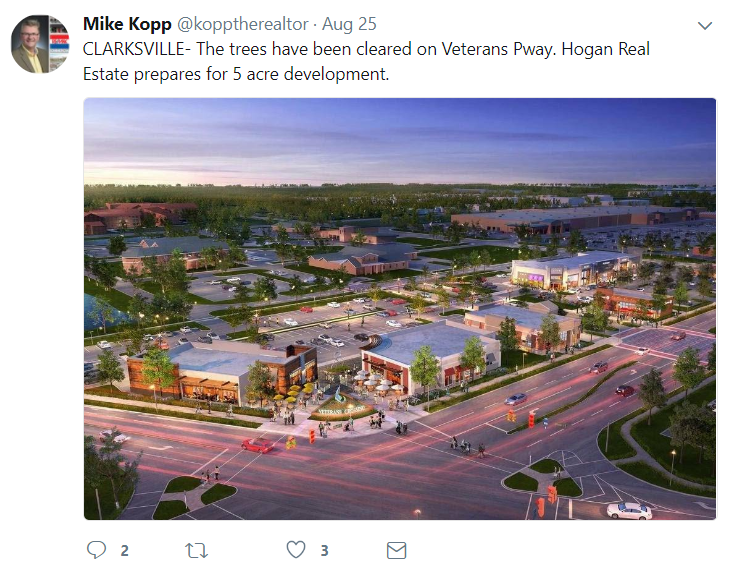
Let's pop the champagne -- the trees have been cleared!

Wait ... two Rogers?

Really?

So it seems. Meet this other Roger, who has written an excellent letter to the otherwise somnolent newspaper.


Need more green space, not less

Have you driven by the Clarksville Municipal Center property facing Veterans Parkway? It is sad to see the destruction of all the lawnscape and trees. We need to have more green space, not less. It is an unobstructed view of blight by our elected politicians in selling public domain land paid for by the taxpayers. Our politicians seem to chase the “almighty dollar.”

I have several questions. Did they have the right to sell the property? Why wasn’t the public better informed of this sale? Should we start to worry about other lands, Lapping Park, the golf courses, the area around the swimming pool? All of these properties supposedly belong to “all of us.”

What kind of absolute power have we given these politicians? I will express my displeasure with this event next time at the ballot box.

— Roger Cross, Clarksville

For a very long, I've been curious how many trees are planted in New Albany annually, and what role (if any) an obviously under-funded Tree Board plays in any of it.


Team Gahan has clear-cut virtually the entire city, so it's the perfect time to begin pretending the junta cares about trees.


Surely not since the founding Scribners set out to clear land for the civic forerunner of present-day New Gahania have so many trees fallen as during the reign of Jeffrey I.

He insists more trees have been planted than cut, though the documentary evidence of such remains hidden safely within the labyrinthine bowels of Lawyer Gibson's Information Protection Program.

Witness the information I asked of the Tree Board in April of 2016. Sixteen months later it presumably reposes on a shelf in Gibson's bookless study, gathering dust, right there next to the remaining Bicentennial coffee table tomes that Bob Caesar insists were sold out to an eager public at $50 a pop, later to be handed out like lollipops at ribbon cuttings even as Caesar and associates denies the existence of any records pertaining to the Bicentennial Commission's activities.

Recent city council budget hearings provide an answer.


Mr. Streips stated they (Tree Board) have planted around 70-75 trees around town and their goal by the end of the year is 100 new plantings.

Mr. McLaughlin asked if they could do anything like a "buy a tree" fundraiser.

There it is, in a nutshell. The city needs hundreds of trees planted, not a few dozen, and confronted with this fact, the city council president can think of nothing more relevant to suggest than a bake sale.

Presumably we can hold this nickel-and dime event in July amid the urban heat island. Or, we might fund the Tree Board to succeed -- and if city officials ever stepped outside their air conditioned cars and walked a few blocks, they might grasp the need.