Showing posts with label planting trees. Show all posts

Monday, August 31, 2020

Chainsaw ... or, actually planting trees can make cities more equitable.


Jeeebus, these people in Nawbany love their damn chainsaws. It really must have something to do with potty training.


Can Planting Trees Make a City More Equitable?
, by Patrick Sisson (Bloomberg)

Cities across the U.S. are pledging to plant trees and restore urban forests to combat climate change and cool off disadvantaged communities.

As the U.S. grapples with natural disasters and racial injustice, one coalition of U.S. cities, companies and nonprofits sees a way to make an impact on both fronts: trees.

Specifically, they committed to planting and restoring 855 million of them by 2030 as part of the Trillion Trees Initiative, a global push to encourage reforestation to capture carbon and slow the effects of global heating. Announced on Thursday, it’s the first nationwide pledge to the program, and additionally noteworthy because the U.S. group — which includes Microsoft Corp. and Mastercard Inc. — will focus on urban plantings as means of improving air quality in communities that have been disproportionately affected by pollution and climate change.

“We’re passionate about urban forestry and the goal of tree equity,” says Jad Daley, president and chief executive officer of American Forests, the longtime conservation group that’s helped organize the pledge. “It’s not just about more trees in cities. If you show me a map of tree cover in any city, you’re showing me a map of race and income levels. We see this as nothing less than a moral imperative” ...

Wednesday, January 15, 2020

Planting trees as resistance and empowerment? In Nawbany, we just make stumps.


Wait, am I reading this correctly?

"Trees as an instrument of civil disobedience, empowerment, and emancipation, advancing democracy, human rights, and environmental justice."

In Kenya, maybe. In New Albany, we can rely on our ruling elites to display zero comprehension about trees apart from chopping then down at an unprecedented rate even as the urban heat island effect escalates.

Consequently, we look to Africa. Thanks to W for this link.

Planting Trees as Resistance and Empowerment: The Remarkable Illustrated Story of Wangari Maathai, the First African Woman to Win the Nobel Peace Prize, by Maria Popova (Brain Pickings)

“A tree is a little bit of the future.”

Walt Whitman saw in trees the wisest of teachers and Hermann Hesse found in them a joyous antidote to the sorrow of our own ephemerality. “The tree which moves some to tears of joy is in the eyes of others only a green thing which stands in the way,” William Blake wrote in his most beautiful letter. “As a man is, so he sees.”

Many tree-rings after Blake and Whitman and Hesse, another visionary turned to trees as an instrument of civil disobedience, empowerment, and emancipation, advancing democracy, human rights, and environmental justice.

Born near a holy fig tree in the central highlands of Kenya twenty years after the country became a British colony, Wangari Maathai (April 1, 1940–September 25, 2011) went on to become the first African woman to win the Nobel Peace Prize, awarded for her triumph of promoting “ecologically viable social, economic and cultural development” by founding the Green Belt Movement responsible for planting 30 million trees and empowering women to partake in social change — an act of courage and resistance for which she was beaten and imprisoned multiple times, but which ultimately helped defeat Kenya’s corrupt, authoritarian president and blazed a new path to ecological resilience ...

Tuesday, November 28, 2017

For a second consecutive day, City Hall ineffectually defends its abysmal record of tree abuse.


It's worth remembering the project's grandiloquent official title: Mt. Tabor Road Restoration and Pedestrian Safety Project.

Except that in today's City Hall spoon-feeding, nothing much is written about "safety." There's a small bit about "restoration," then the tired blurb flies off the rails with another rote defense of Jeff Gahan's amazing, quasi-Biblical record of inerrancy.

This time it's Krisjans Streips' turn to reveal that City Hall is developing an escalating sensitivity about Gahan's horrid deforestation habit.

Of course, it should be a relatively simple matter to ask for evidence of all these tree replantings. Surely the Tree Board and all of Gahan's overstuffed contractor buddies have retained records, correct?

Which reminds me: I did ask, 18 months ago.

2016 council budget hearing: Money for the Tree Board to cut trees, or plant them?

Back in May I attended a Tree Board meeting in search of information about its meetings, which I requested from the board's staff person, Krisjans Streips. This particular ray of sunshine has yet to break through Team Gahan's patented Transparency Prevention Modulator, but I digress.

You already know the answer: zilch; nada; ничего ... crickets chirping, pins dropping, and somewhere a lonesome mutt wailing.

Thanks for reading NA Confidential, dudes. The more you ignore us, the closer we get.

Mt. Tabor Road Project to Begin in Summer 2018

 ... In preparation of the project and to accommodate utility relocation, a contractor will be trimming and removing certain trees within the right-of-way along Mt. Tabor Road. By performing the utility relocation in advance of the full project, the city hopes to reduce the construction time of the overall project. These trees will be marked in advance. All property owners were compensated for trees that will be removed as part of the project, and the city will make efforts, similar to other areas and projects around New Albany, to repopulate the tree canopy.

“The City is making it a priority to improve the tree canopy,” stated stated Krisjans Streips, Chief City Planner and Tree Board Administrator. “Hundreds of trees have been planted in parks and on the Greenway, and trees will be replaced along the public right of way at a 3:1 ratio. This is a great safety, drainage, and road reconstruction project all rolled into one.”


Wednesday, September 06, 2017

Earth to Gahan: Street trees increase home prices, shade trees reduce household energy use, and these effects can be measured and expressed in dollars.


Following up on Saturday's post ...

Pusillanimous prioritization? Nickels and dimes later, it remains that we need HUNDREDS of trees planted yearly, not a few dozen.

There it is, in a nutshell. The city needs hundreds of trees planted, not a few dozen, and confronted with this fact, the city council president can think of nothing more relevant to suggest than a bake sale.

Presumably we can hold this nickel-and dime event in July amid the urban heat island. Or, we might fund the Tree Board to succeed -- and if city officials ever stepped outside their air conditioned cars and walked a few blocks, they might grasp the need.

... our friend W found two informative links. First, what it costs to plant trees.

Tree Planting Costs

Tree planting is a special task that can add to property value and increase curb appeal of the property, and may also serve to better separate your property from neighbors.


Average cost of a 4’ - 6’ tree, planted (about $ 106 each)

Then, how to determine what these trees are worth in cold, hard cash value.

Calculating the Green in Green: What's an Urban Tree Worth?

For urban dwellers, trees soften a city’s hard edges and surfaces, shade homes and streets, enhance neighborhood beauty, filter the air, mitigate storm runoff, and absorb carbon dioxide. Trees may even reduce crime and improve human health. However, these benefits have not been well quantified, making it difficult for urban planners and property owners to weigh their costs and benefits or assess tree cover against competing land uses.

New research from the Pacific Northwest (PNW) Research Station demonstrates that street trees increase home prices in Portland, Oregon, that shade trees reduce household energy use in Sacramento, California, and that these effects can be measured and expressed in dollars.

A study led by economist Geoffrey Donovan, research forester with the PNW Research Station, determined that trees planted on the south and west sides of Sacramento houses reduced summertime electricity bills by an average of $25.16. In a second study in Portland, Donovan’s team found that street trees growing in front of or near a house added an average $8,870 to its sale price and reduced its time on the market by nearly 2 days. These economic benefits spilled over to neighboring properties: a neighborhood tree growing along the public right¬of-way added an average of $12,828 to the combined value of all the houses within 100 feet.

Saturday, September 02, 2017

Pusillanimous prioritization? Nickels and dimes later, it remains that we need HUNDREDS of trees planted yearly, not a few dozen.

This is what the two Rogers are talking about.


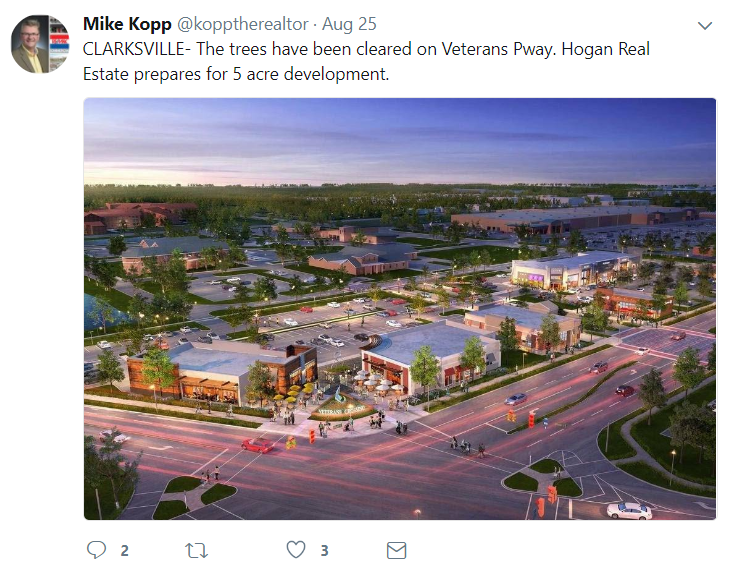
Let's pop the champagne -- the trees have been cleared!

Wait ... two Rogers?

Really?

So it seems. Meet this other Roger, who has written an excellent letter to the otherwise somnolent newspaper.


Need more green space, not less

Have you driven by the Clarksville Municipal Center property facing Veterans Parkway? It is sad to see the destruction of all the lawnscape and trees. We need to have more green space, not less. It is an unobstructed view of blight by our elected politicians in selling public domain land paid for by the taxpayers. Our politicians seem to chase the “almighty dollar.”

I have several questions. Did they have the right to sell the property? Why wasn’t the public better informed of this sale? Should we start to worry about other lands, Lapping Park, the golf courses, the area around the swimming pool? All of these properties supposedly belong to “all of us.”

What kind of absolute power have we given these politicians? I will express my displeasure with this event next time at the ballot box.

— Roger Cross, Clarksville

For a very long, I've been curious how many trees are planted in New Albany annually, and what role (if any) an obviously under-funded Tree Board plays in any of it.


Team Gahan has clear-cut virtually the entire city, so it's the perfect time to begin pretending the junta cares about trees.


Surely not since the founding Scribners set out to clear land for the civic forerunner of present-day New Gahania have so many trees fallen as during the reign of Jeffrey I.

He insists more trees have been planted than cut, though the documentary evidence of such remains hidden safely within the labyrinthine bowels of Lawyer Gibson's Information Protection Program.

Witness the information I asked of the Tree Board in April of 2016. Sixteen months later it presumably reposes on a shelf in Gibson's bookless study, gathering dust, right there next to the remaining Bicentennial coffee table tomes that Bob Caesar insists were sold out to an eager public at $50 a pop, later to be handed out like lollipops at ribbon cuttings even as Caesar and associates denies the existence of any records pertaining to the Bicentennial Commission's activities.

Recent city council budget hearings provide an answer.


Mr. Streips stated they (Tree Board) have planted around 70-75 trees around town and their goal by the end of the year is 100 new plantings.

Mr. McLaughlin asked if they could do anything like a "buy a tree" fundraiser.

There it is, in a nutshell. The city needs hundreds of trees planted, not a few dozen, and confronted with this fact, the city council president can think of nothing more relevant to suggest than a bake sale.

Presumably we can hold this nickel-and dime event in July amid the urban heat island. Or, we might fund the Tree Board to succeed -- and if city officials ever stepped outside their air conditioned cars and walked a few blocks, they might grasp the need.

Sunday, March 13, 2016

Down-low forestry: "Plant some trees to save a town from flooding? Not a bad idea."


I'll just leave this here.

On occasion, when one of us criticizes another round of downtown chop-down forestry, we're assured that the trees are diseased, and that more will be replanted. I don't doubt they are. Is it enough, with a canopy so damaged by weather and negligence?

Yes, there's a tree board. Periodically a power-that-be mentions it. Is it too much to ask for this body to share with the public the precise nature of the master tree-plant-plan?

And, while we're on the topic, perhaps the stormwater utility can explain how it ties these together, trees and flooding prevention. Invariably, stormwater management is presented to us as engineering alone, much as the health care industry talks about drugs to cure conditions that might have been avoided through better personal health practices.

Surely Team Gahan can determine a way to monetize future campaigns via trees.

Plant some trees to save a town from flooding? Not a bad idea, by Nick Cohen (The Guardian)

... People in Keswick are more forthcoming and will tell you that, six years and one major flood later, nothing has been planted apart from a few trees on the lower slopes of Skiddaw. Last week, the Environment Agency showed that the state-sponsored neglect that afflicts the Lake District afflicts the rest of Britain too. The agency’s geographers argued that new woodlands could slow the rush of rainwater across much of the country. Forestry was not a cure-all, but an essential part of a wider response to climate change. Nothing will be done, of course. As the agency said: “There were insufficient funds to attempt the scale of works proposed in this report.”

Tuesday, October 16, 2012

Gonder: "The Tree Board will plant 150 Chestnut trees at Binford Park."

I guess John's went and broke the NA political family tradition ... planting trees instead of cutting them. Erika is sure to be outraged, at least between smoke breaks.

Tree Planting October 20, 2012

With the week ahead still a clean slate, as people plan what to do for next weekend, I'll offer the following suggestion. The suggestion is one which can truly and positively change our little plot of earth for decades to come.

The Tree Board will plant 150 Chestnut trees at Binford Park. These starts are cross-bred, disease resistant trees ( American Chestnuts with Chinese). The trees have been secured by Bryan Slade of EcoTech as part of that company's plan to plant 10,000 trees, 1,000 a year for 10 years to celebrate the company's anniversary.