Showing posts with label urban canopy. Show all posts

Monday, August 31, 2020

Chainsaw ... or, actually planting trees can make cities more equitable.


Jeeebus, these people in Nawbany love their damn chainsaws. It really must have something to do with potty training.


Can Planting Trees Make a City More Equitable?
, by Patrick Sisson (Bloomberg)

Cities across the U.S. are pledging to plant trees and restore urban forests to combat climate change and cool off disadvantaged communities.

As the U.S. grapples with natural disasters and racial injustice, one coalition of U.S. cities, companies and nonprofits sees a way to make an impact on both fronts: trees.

Specifically, they committed to planting and restoring 855 million of them by 2030 as part of the Trillion Trees Initiative, a global push to encourage reforestation to capture carbon and slow the effects of global heating. Announced on Thursday, it’s the first nationwide pledge to the program, and additionally noteworthy because the U.S. group — which includes Microsoft Corp. and Mastercard Inc. — will focus on urban plantings as means of improving air quality in communities that have been disproportionately affected by pollution and climate change.

“We’re passionate about urban forestry and the goal of tree equity,” says Jad Daley, president and chief executive officer of American Forests, the longtime conservation group that’s helped organize the pledge. “It’s not just about more trees in cities. If you show me a map of tree cover in any city, you’re showing me a map of race and income levels. We see this as nothing less than a moral imperative” ...

Tuesday, October 09, 2018

Silence at home, but in Nashville TN, a "campaign to restore and enlarge the city’s tree canopy."


New Albany has a Tree Board, and over the years, I've experienced a great deal of trouble when trying to learn from it exactly what the city's urban canopy plan is, and where the plan (if any) is lodged.

Could I have a look?

I started asking for information two years ago, and never received it. We see dozens of trees being felled all around the city, and some of them replanted, but in spite of requests to be shown the comparative numbers, there remains no accurate public accounting.

In the past, I have suggested that little more can be expected from public officials who don't go outside often enough to know the difference between standing in the sun and standing in the shade -- who drive and never walk, who react and never think. I may or may not have been too harsh.

However, one thing cannot be disputed: while other cities make their tree canopy plans available and go so far as to enlist public participation (see below), ours keeps its urban canopy goals (whatever these might be) safely under wraps, as though they were a state secret.

In New Albany at the present time, there is only one consistent City Hall policy unifying the mayor's stewardship: control in the person of the mayor himself and the mayor's closest confidantes. Whether good, bad or indifferent, all decisions emanate from this need to keep a tight lid on information, and to allow citizen participation only under intricately proscribed and mostly inane conditions.

Residents may or may not find this situation conducive to their lives. I'd merely make the point that there is another way, and there will be alternatives come 2019, and our next round of municipal elections.

Meanwhile, there's Nashville.

More Trees, Happier People, by Margaret Renkl (New York Times)

When cities grow, green space dies. Replanting it has been shown to lift the human spirit.

NASHVILLE — The scene in a tiny pocket park outside Plaza Mariachi here on Nolensville Pike last Wednesday was like a tableau from a Norman Rockwell painting, 21st-century style. Surrounded by signs advertising the Hispanic Family Foundation, Dubai Jewelry, the Dominican Barber Shop and restaurants offering Peruvian, Chinese, Mediterranean and Indian food — as well as a Game Stop franchise and H&R Block — was a small sign that read, “Today: Free trees.”

The arrow on the sign pointed to a pop-up canopy where the Nashville Tree Foundation was hosting its fourth tree giveaway of October. A family standing under the canopy was posing for a photo with the sapling they had just adopted. Carolyn Sorenson, executive director of the foundation, was taking the picture: “Say ‘trees’!” she said.

The tree giveaway at Plaza Mariachi happened to fall on the very day that Nashville’s mayor, David Briley, announced a campaign to restore and enlarge the city’s tree canopy. The effort, called “Root Nashville,” will be overseen by the city and the Cumberland River Compact, an environmental nonprofit, and funded through a combination of public, corporate, foundation and private dollars. Together with several municipal departments and other nonprofit organizations, the initiative aims to plant 500,000 trees in Davidson County by 2050 ...

Friday, August 17, 2018

Seismologists record earthshaking Tree Board orgasms as Schoolmaster Barksdale's chain saw strikes again.


It's been a tough week if you're a downtown New Albany street tree.

When one of your brethren decided to strike a blow against car-centrism, it was inevitable that hostages would be taken, tried, sentenced and quickly dispatched.

No last meals or final requests, just those signature red plastic bands -- and the sound of chortling from Schoolmaster Barksdale as his trademark Husqvarna was lubed and revved for duty.


Early this morning, the latest round of carnage was complete on the orphaned south side of Market, by Hannegan Hall.


Fellow street tree, your appointment with the Robespierres of the Tree Board will soon be processed.

But for now, there goes your brother, off to be rendered into firewood, with the proceeds destined to be deposited into Dear Leader's burgeoning re-election fund.


Earlier in the week, for no apparent reason, this row of street trees on Elm Street by the former St. Mary's school received the condemned terrorist treatment.


Sarcasm aside, if once -- just once -- an elected or appointed city official would mention aloud the issue of urban heat islands (to cite one relevant example), and display a semblance of awareness of the implications, then I'd be more inclined to accept his or her persistent tree removal reasoning.

But when the rationale for removal embraces the crazed notion that trees must be removed so our precious historic buildings can be properly viewed by people in passing cars who are too lazy (or overheated) to get out and walk, then I call bullshit -- and will continue to do so.

Previously:

Earth to Gahan: Street trees increase home prices, shade trees reduce household energy use, and these effects can be measured and expressed in dollars.

Chainsaws are the soundtrack to our anchors: "How Should We Pay for Street Trees?"

#FlushTheClique

Friday, December 08, 2017

Gahan Doublespeak Blues (Husqvarna Mix): Say goodbye to your trees, Mt. Tabor Road residents, because it's time again to "improve the tree canopy" by flattening a few hundred of them.

Develop New Albany welcomes Summit Springs
to the donor list.

Team Gahan has developed its own peculiar localized variant of Newspeak, with inflections borne of hunker-down-low bunker origins.

 ... George Orwell explains that Newspeak usage follows most of the English grammar, yet is a language characterised by a continually diminishing vocabulary; complete thoughts reduced to simple terms of simplistic meaning.

In Orwell's novel 1984, the term "doublethink" is introduced; when paired with Newspeak, the result is "doublespeak," defined here by political economist Edward S. Herman.

What is really important in the world of doublespeak is the ability to lie, whether knowingly or unconsciously, and to get away with it; and the ability to use lies and choose and shape facts selectively, blocking out those that don’t fit an agenda or program.

The drill has become familiar by now.

For instance, to "improve housing conditions and supportive services" means earmarking half of public housing units for demolition without a coherent plan for rehousing.

Tireless "efforts to improve the tree canopy" means flashing a nice stock photo like this ...


... as scrubbed-clean Disneyesque cover for lubing up the chainsaws to facilitate tree removal, clearcutting and deforestation. Perhaps the finest example of Gahan's skills at doublespeak occurred in 2016, when hundreds of trees were cleared to build a "greenway" safe for speeding motorists.


Residents of Mt. Tabor Road were informed yesterday (December 7) that lumbering begins on Monday, December 11.


Oddly, the fliers were stuck in mailboxes sans stamps, which I'd been told was strictly illegal during my run for mayor in 2016. The Board of Works already had picked and grinned its way through approval for the latest round of destroying the tree canopy to save it.

ASK THE BORED: It's Mt. Tabor Road's turn to be pillaged as our lumberjack fetishist mayor readies another round of clear-cutting -- for the sake of the cars, of course.

It's been four months since the mayor triumphantly announced what amounts to a survey of previously sawed stumps; having felled hundreds and perhaps thousands of trees during the course of his Ceausescu-esque TIF and Green(!)way projects, he'd now prove there was the beginning of the precursor to an embryonic "master" plan to reforest the city by 2065 or so ...


It can't be denied that Jeff Gahan is remaking the city in his own image. What could possibly go wrong when mendacity, narcissism and mediocrity are chief characteristics of the model?

Tuesday, November 28, 2017

For a second consecutive day, City Hall ineffectually defends its abysmal record of tree abuse.


It's worth remembering the project's grandiloquent official title: Mt. Tabor Road Restoration and Pedestrian Safety Project.

Except that in today's City Hall spoon-feeding, nothing much is written about "safety." There's a small bit about "restoration," then the tired blurb flies off the rails with another rote defense of Jeff Gahan's amazing, quasi-Biblical record of inerrancy.

This time it's Krisjans Streips' turn to reveal that City Hall is developing an escalating sensitivity about Gahan's horrid deforestation habit.

Of course, it should be a relatively simple matter to ask for evidence of all these tree replantings. Surely the Tree Board and all of Gahan's overstuffed contractor buddies have retained records, correct?

Which reminds me: I did ask, 18 months ago.

2016 council budget hearing: Money for the Tree Board to cut trees, or plant them?

Back in May I attended a Tree Board meeting in search of information about its meetings, which I requested from the board's staff person, Krisjans Streips. This particular ray of sunshine has yet to break through Team Gahan's patented Transparency Prevention Modulator, but I digress.

You already know the answer: zilch; nada; ничего ... crickets chirping, pins dropping, and somewhere a lonesome mutt wailing.

Thanks for reading NA Confidential, dudes. The more you ignore us, the closer we get.

Mt. Tabor Road Project to Begin in Summer 2018

 ... In preparation of the project and to accommodate utility relocation, a contractor will be trimming and removing certain trees within the right-of-way along Mt. Tabor Road. By performing the utility relocation in advance of the full project, the city hopes to reduce the construction time of the overall project. These trees will be marked in advance. All property owners were compensated for trees that will be removed as part of the project, and the city will make efforts, similar to other areas and projects around New Albany, to repopulate the tree canopy.

“The City is making it a priority to improve the tree canopy,” stated stated Krisjans Streips, Chief City Planner and Tree Board Administrator. “Hundreds of trees have been planted in parks and on the Greenway, and trees will be replaced along the public right of way at a 3:1 ratio. This is a great safety, drainage, and road reconstruction project all rolled into one.”


Monday, November 27, 2017

ASK THE BORED: It's Mt. Tabor Road's turn to be pillaged as our lumberjack fetishist mayor readies another round of clear-cutting -- for the sake of the cars, of course.


See, it's right there on the agenda for tomorrow morning's meeting.


But there's more.

Today at Gahanskaya Pravda there occurred what I believe is the auto-erotic (in more ways than one) City Hall rag's first ever reprint.


It's been four months since the mayor triumphantly announced what amounts to a survey of previously sawed stumps; having felled hundreds and perhaps thousands of trees during the course of his Ceausescu-esque TIF and Green(!)way projects, he'd now prove there was the beginning of the precursor to an embryonic "master" plan to reforest the city by 2065 or so.


Okay, okay. We already knew there'd been an anti-climactic midsummer's announcement about a flaccid urban canopy inventory grant that does nothing to dull Gahan's overworked chain saws.

Question: So, why repeat the story four months later?

Answer: Minions at City Hall, who refuse to concede they read NA Confidential, know via telepathy, osmosis or maybe just their surreptitious reading of NA Confidential that NA Confidential dutifully reads the weekly Board of Public Works and Safety packet.

In short, today's rerun was pre-emptive, and all we can say in response is this most heartfelt of sentiments:

Thanks for reading NA Confidential

When's the last time they had to work this cleverly in order to upstage, pre-empt or even show the vaguest awareness of the local chain newspaper?

---

Previously: 

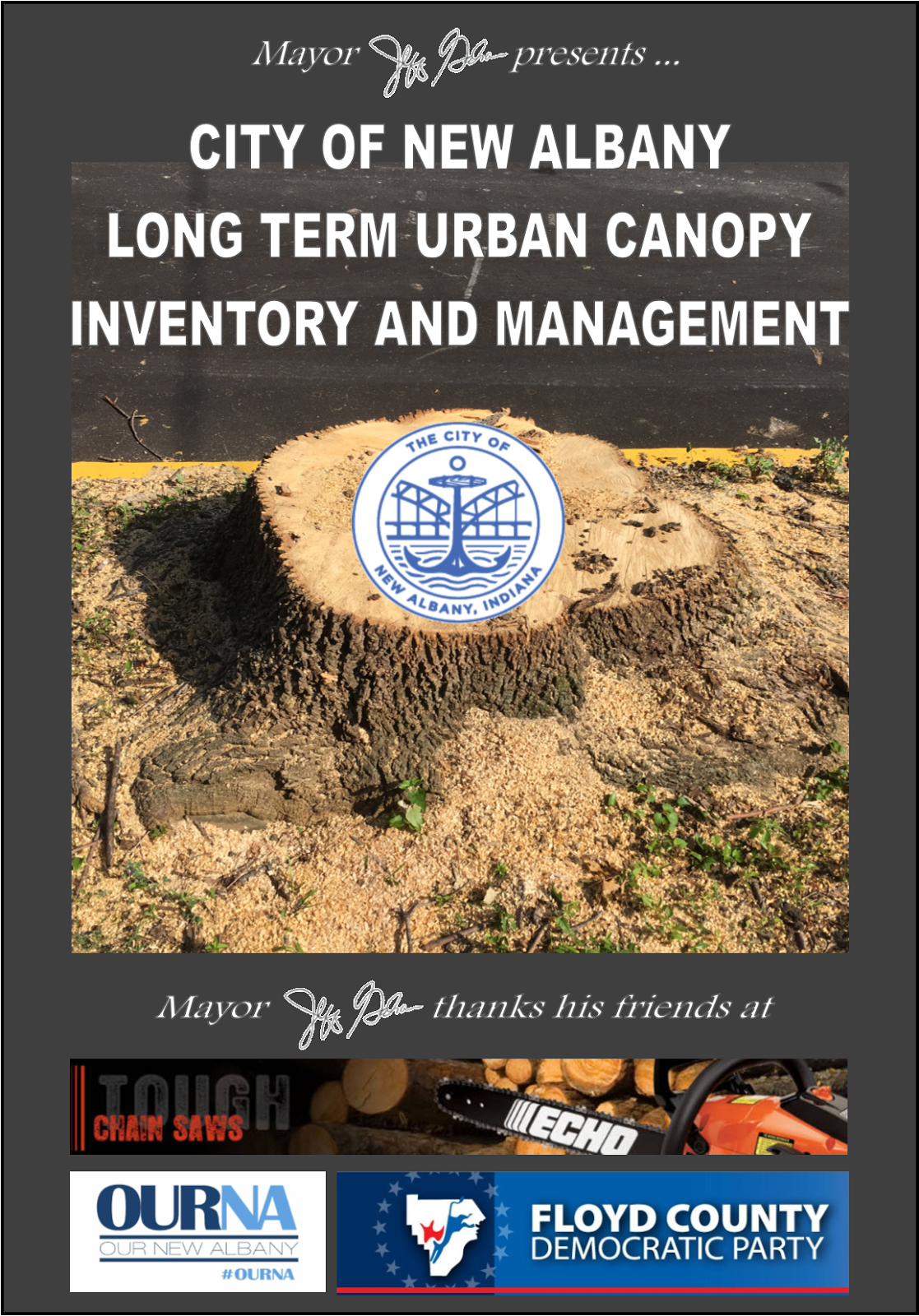
BIG LEAK! The Green Mouse has obtained an advance copy of Deaf Gahan's "Long Term Urban Canopy Inventory and Management."


The simple fact is we've all become numb to Jeff Gahan's signature Shade Eradication Program.

Pusillanimous prioritization? Nickels and dimes later, it remains that we need HUNDREDS of trees planted yearly, not a few dozen.

Team Gahan has clear-cut virtually the entire city, so it's the perfect time to begin pretending the junta cares about trees.

Chainsaws are the soundtrack to our anchors: "How Should We Pay for Street Trees?"

Wednesday, October 04, 2017

Chainsaws are the soundtrack to our anchors: "How Should We Pay for Street Trees?"

Don’t ask Jeff Gahan about tree canopies or heat islands. He can’t hear you for the pervasive sound of chainsaws.


Yes, I understand that articles like this one speak of matters from the perspective of larger urban entities than New Albany.

And I also understand that an urban canopy cannot be funded as part of a city's public health infrastructure when no such thing even exists. Work with the Floyd County Heath Department? It's one instance where I'd laugh along with Deaf Gahan.

My point: the Tree Board can be funded to do more than it does at present, and what it does at present needs to be open and transparent. Currently it is neither, and that's why until Gahan proves he isn't the most profound serial feller of trees in the city's recent history, I'll keep suggesting he is.

Urban canopy master plan, anyone?

How Should We Pay for Street Trees? by Teresa Mathew (CityLab)

A new report argues that the urban canopy should be considered—and funded—as a part of a city’s public health infrastructure.

Trees have proved to aid mental health, decrease obesity and other health risks, and just generally make people happier. But they are often thought of as a luxury rather than a vital component of healthcare or urban infrastructure. In a new report, The Nature Conservancy, a conservation-focused nonprofit, argues that trees are an important public health asset and should be funded as such.

“Just like the public health sector has gotten used to thinking about walkable cities as something they need to care about, we’re advocating that they need to think about nature and parks as part of that quest,” says Robert McDonald, a lead scientist at The Nature Conservancy and co-author of the report.

McDonald hopes that cities will start to integrate urban forestry into their other health, wellness, and environmental initiatives. Despite the benefits, there are multiple reasons why tree planting falls by the wayside. For one, it’s a process that often requires the coordination of multiple agencies—not just forestry, but other departments like transportation and water. “We’ve set up our cities so there’s one agency to manage trees and parks, and they don’t have a health mandate. Other agencies do care about health, but don’t have a mandate to plant trees,” McDonald explains. Cities often do not see the link between residents’ health and the presence of trees.

Wednesday, August 09, 2017

The simple fact is we've all become numb to Jeff Gahan's signature Shade Eradication Program.


What Judge Cody wants, Judge Cody gets -- with valet efficiency. The remainder of us wait years for our stumps to be ground and replantings to occur.

Meanwhile, Gahan's shadeless semi-walkability proceeds apace. It's an exquisitely banal dictatorship ... but it's our exquisitely banal dictatorship, with anchor cuff links and everything.


Team Gahan has clear-cut virtually the entire city, so it's the perfect time to begin pretending the junta cares about trees.


Surely not since the founding Scribners set out to clear land for the civic forerunner of present-day New Gahania have so many trees fallen as during the reign of Jeffrey I.

He insists more trees have been planted than cut, though the documentary evidence of such remains hidden safely within the labyrinthic bowels of Lawyer Gibson's Information Protection Program.

Monday, August 07, 2017

Team Gahan has clear-cut virtually the entire city, so it's the perfect time to begin pretending the junta cares about trees.


Surely not since the founding Scribners set out to clear land for the civic forerunner of present-day New Gahania have so many trees fallen as during the reign of Jeffrey I.

He insists more trees have been planted than cut, though the documentary evidence of such remains hidden safely within the labyrinthic bowels of Lawyer Gibson's Information Protection Program.

Witness the information I asked of the Tree Board in April of 2016. Sixteen months later it presumably reposes on a shelf in Gibson's bookless study, gathering dust, right there next to the remaining Bicentennial coffee table tomes that Bob Caesar insists were sold out to an eager public at $50 a pop, later to be handed out like lollipops at ribbon cuttings even as Caesar and associates denies the existence of any records pertaining to the Bicentennial Commission's activities.

Our last comprehensive survey of Gahan's urban canopy impotence came on March 7 of this year.

ASK THE BORED: You can't always get tree stumps zapped when you want, but if you're a V.I.P. -- well, you get what you need.

(Always) bear in mind that even as Jeff Gahan's "parks and recreation" fetish -- which always was more about power than production -- has occupied a disproportionate place in his agenda, hundreds of trees outside the boundaries of his suburban-flavored parks have fallen. Some were dead, others living.

A huge number were brought down for the noble cause of making a Greenway auto-friendly.

During a time of enhanced urban heat island effect, and as the mayor plays his oblivious daily shell game about "walk-ability," which can be translated as "drive-ability," seeing as he hasn't once grasped what it really means, these (shade) trees generally have not been replanted until the cost can be shifted elsewhere, as with grandiose street reconstruction projects financed by the federal government.

In short, under Gahan, the urban tree canopy has received far more contempt than scant attention.

Naturally, with mayor pattern baldness now prevalent throughout the city, the time has come to unleash the propaganda commissariat to issue stirring declarations of victory amid the stumps.

City Receives Grant for Tree Inventory to Promote Long-Term Urban Canopy Strategy

In January of 2017, the City of New Albany received a $20,000 matching grant from the Indiana Department of Natural Resources, Division of Forestry, as part of the 2016 Community and Urban Forestry Assistance grant project.

Meanwhile, proof again that books don't line any of their shelves.


Scientists Discover Yet Another Reason Cities Need More Trees
, by Katharine Schwab (Co.Design)

Using a computer model, scientists quantified how trees impact local weather and save energy.

Trees make neighborhoods look beautiful and feel safe. They can also play a key role in reducing the impact of wind in cities.

That might seem inconsequential at first. But wind can affect things like humidity, temperature, how pleasant it is to walk around outside, and even the pressure gradient between the interior and exterior of buildings. When there’s a larger gradient, more air from outside will enter a building through small gaps and openings, requiring greater energy consumption to heat or cool the building. Researchers from the University of British Columbia created a computer model showing that when there are no trees in a neighborhood, that pressure gradient goes up by a factor of four. Because wind pressure can be the root cause for about a third of a building’s energy consumption, the finding means that if there are no trees around, the cost to maintain a building’s temperature can rise. The researchers estimate that trees in the Vancouver neighborhood they modeled save 15% on your energy bill in the summer and 10% in the winter.

Here's your bibliography.

Got any readers down there in the Down Low Bunker?

---

A SELECTION OF PREVIOUS ARTICLES

ASK THE BORED: Years and years later, finally those stumps in the verge have been pulped.

Unheard of in New Albany: "Going forward, I will be more sensitive to the spectrum of concerns regarding trees."


At least this time Pinocchio felled his OWN tree.


"Eventually there'll be a plan to replant" the clear-cut tree cover, but of course no one can say what or when that might be.


Politics, good judgment, social media, and why I refrained from voting in the Floyd Circuit Judge race.


2016 council budget hearing: Money for the Tree Board to cut trees, or plant them?


Placing a dollar value on the services that street trees perform.


Unlike New Albany, "The people of Somerville, Massachusetts really, really care about trees."


New Albany's Tree Board -- statute, staff and board members.


Whatever happened to the Tree Board, anyway?

Tuesday, July 04, 2017

ASK THE BORED: Years and years later, finally those stumps in the verge have been pulped.

They're literally on the verge of vindication.


Or maybe this swing era song is better. We need change only one word.

Grind me, baby, eight to the bar.


There must have been a leak, and someone was told about my stump stenciling plan.

Ah, but you see, I merely planted the rumor in order to impel them to ridiculously belated action. Devilishly clever of me.


Back in March, the whole story was unspooled.

ASK THE BORED: You can't always get tree stumps zapped when you want, but if you're a V.I.P. -- well, you get what you need.

Contrast this level of prompt, efficient service with the half-block of Spring between my house and 11th Street, where there exist eight stumps of indeterminate vintage (dead trees taken down within the last six or seven years), and perhaps two living replacements.

I believe they got seven of eight stumps on Monday morning. There was a car parked in front of one. The whole process took about an hour. I'm not sure who to thank, but thanks.

Now, about those replacement trees ...

(BOW meets on Wed., July 5 owing to the fireworks holiday)

Sunday, March 19, 2017

Tree-based sexism: "Decades of urban landscaping sexism are partly to blame for high pollen counts."


Yes, of course I have a link to match the meme.

Sniffling and sneezing? Too many male trees are (partly) to blame, by Aimee Custis (Greater Greater Washington)

With February's early warm weather, DC's pollen counts are climbing earlier than usual. What you might not know is that decades of urban landscaping sexism are partly to blame for high pollen counts.

That's tree-based, not people-based, sexism. Some common types of trees used in urban landscaping are dioecious, meaning individual trees are either male or female.

When it comes to dioecious plants, cities tend to prefer planting males to females because females drop fruit or seeds that the city then needs to clean up. The most notorious female offenders are gingko trees, whose undesirable smelly fruit plague residents with "strong notes of unwashed feet and Diaper Genie, with noticeable hints of spoiled butter."

But male dioecious trees don't drop seeds or fruit. Instead, in the spring, they release pollen.

With February's early warm weather, DC's pollen counts are climbing earlier than usual. What you might not know is that decades of urban landscaping sexism are partly to blame for high pollen counts.

That's tree-based, not people-based, sexism. Some common types of trees used in urban landscaping are dioecious, meaning individual trees are either male or female.

When it comes to dioecious plants, cities tend to prefer planting males to females because females drop fruit or seeds that the city then needs to clean up. The most notorious female offenders are gingko trees, whose undesirable smelly fruit plague residents with "strong notes of unwashed feet and Diaper Genie, with noticeable hints of spoiled butter."

But male dioecious trees don't drop seeds or fruit. Instead, in the spring, they release pollen.

Horticultural epidemiologist Tom Ogren traces the modern preference for male trees to around 1950, when the USDA released a book that promoted planting male trees over female trees for easy, litter-free maintenance. The idea caught on with private homeowners, nursery suppliers, and city planners. At the time, Dutch Elm disease was on the uptick, and swaths of trees in US cities were being replaced. Today, DDOT's Design and Engineering Manual (section 47.4.4) confirms that "...trees near walks should be thornless and fruitless to minimize maintenance," though of course there are plenty of fruitless trees that aren't dioecious males.

Favoring male trees isn't a bad idea in itself, and Ogren believes no one had any bad intentions. "But when a city does this on a massive scale, it has a huge impact on the health of the people who live there," he said to Governing. Ogren, who developed the Ogren Plants Allergy Scale (OPALS) used by the USDA and American Lung Association, says planting more female trees will reduce the pollen count in a city.

That makes sense. The job of female trees is to capture pollen, essentially acting as natural air filters. But when they're nearly non-existent, we're left with a ton of pollen in the air with no females to trap it ...

Tuesday, March 07, 2017

ASK THE BORED: You can't always get tree stumps zapped when you want, but if you're a V.I.P. -- well, you get what you need.

As we enter Year Six of the Chronicles of Gallant New Gahania, the perennially moribund Tree Board is showing a faint glimmer of life despite Adam Dickey's presence in a seat.

(see the bibliography at article's end) 

As you read Elizabeth Beilman's February 9 newspaper coverage, bear in mind that even as Jeff Gahan's "parks and recreation" fetish -- which always was more about power than production -- has occupied a disproportionate place in his agenda, hundreds of trees outside the boundaries of his suburban-flavored parks have fallen. Some were dead, others living.

A huge number were brought down for the noble cause of making a Greenway auto-friendly.

During a time of enhanced urban heat island effect, and as the mayor plays his oblivious daily shell game about "walk-ability," which can be translated as "drive-ability," seeing as he hasn't once grasped what it really means, these (shade) trees generally have not been replanted until the cost can be shifted elsewhere, as with grandiose street reconstruction projects financed by the federal government.

In short, under Gahan, the urban tree canopy has received far more contempt than scant attention. Maybe that's changing.

New Albany reenergizes tree protection efforts; Grant to fund tree inventory, management plan, by Elizabeth Beilman (N and T)

NEW ALBANY — The New Albany Tree Board is preparing to take on a larger presence in the community, and it will start by taking stock of city trees.

A $20,000 federal grant from the Indiana Department of Natural Resources will allow the tree board to conduct an inventory of trees planted on city property and then create an urban tree management plan.

"We want to take on a bigger role, because we are losing trees at a fast rate, and we want to make sure that we plant more than we're losing," tree board member and New Albany City Councilman David Barksdale said.

Once the city has a management plan, it will be eligible to receive more grants to buy trees.

"The average person is not going to see this management plan," arborist and tree board adviser Greg Mills said. " ... What you're going to see is the trees that get planted later as a result."

In essence, kudos to anyone who gives a damn, because the upper echelons of Team Gahan clearly do not, and probably won't respond to any tree-related issues -- unless, of course, you're an insider.

Last May, I attended a Tree Board meeting, intent on gathering information (stop me if you've heard THIS one before) which does not exist on-line. By the way, I've never gotten the info -- and curiously, Bob Caesar isn't even on the Tree Board.

The mayor appoints the members of the Board of Works. The mayor appoints the members of the Tree Board.

Whatever work the Tree Board does with respect to cutting, planting and maintaining trees on publicly owned lands and right-of-way is at the behest of the Board of Works, which is given marching orders by the mayor. Shocking, isn't it?

The Tree Board is lamentably understaffed and mostly non-funded. Currently it is short a board member, and to hurriedly arrive at a conclusion for this extremely depressing digression, it comes down to Oz's Whim.

In short, Team Gahan decides whether a tree stays or goes, irrespective of whether the tree is healthy or dying, and quite apart from extraneous considerations of aesthetics, storm water abatement or Urban Heat Islands.

I’ve no reason to believe the Tree Board isn’t well-meaning, or doesn’t try its best. I'm satisfied it does what it can -- and what it can do is highly circumscribed.

Judge Terry Cody also was there at the May meeting. Because there was no quorum, nothing official was decided, but an informal discussion occurred as to Cody's desire to have the trees by his Green House removed. Apparently there was an issue with roots. Heads nodded. The plan was already in its secure pipeline.

As I awaited requested information that never arrived, by November the first three of Cody's city street trees disappeared from the 3rd Street side.


Two months later, the stumps were gone and the sidewalk had been poured without cutouts for replanting. Three down, none to come.


Contrast this level of prompt, efficient service with the half-block of Spring between my house and 11th Street, where there exist eight stumps of indeterminate vintage (dead trees taken down within the last six or seven years), and perhaps two living replacements.


Ironically, my council representative lives as I do within spitting distance of these stumps, but apparently they've escaped his scrutiny. Naturally, this is a scene repeated up and down Spring Street, throughout Greg Phipps' district. Those pesky details.

Yes, we understand that a previous generation of city planners serially botched tree plantings.

It's understood that they planted the wrong trees, perhaps because someone could make a few quid off his brother-in-law's nursery business.

That's right; a monoculture was created, and it's expensive to reverse the process, especially when the mayor insists on funding golden statues of himself rather than eco-friendly aids to urban existence.

We even understand that it's the way of the world when someone like Cody receives preferential treatment -- not so much owing to his position or family history, but as a member of an endangered species, the Floyd County Democratic Party.

And yet ...

Couldn't the city at least remove the effing stumps after a year or two or eight?

I'm told that the city doesn't even own a stump grinder. It rents one when needed. You'd think there'd be chump change left over from the $19 million "green space" TIF bond expenditure for minor considerations like this.

A SELECTION OF PREVIOUS ARTICLES

Unheard of in New Albany: "Going forward, I will be more sensitive to the spectrum of concerns regarding trees."


At least this time Pinocchio felled his OWN tree.


"Eventually there'll be a plan to replant" the clear-cut tree cover, but of course no one can say what or when that might be.


Politics, good judgment, social media, and why I refrained from voting in the Floyd Circuit Judge race.


2016 council budget hearing: Money for the Tree Board to cut trees, or plant them?


Placing a dollar value on the services that street trees perform.


Unlike New Albany, "The people of Somerville, Massachusetts really, really care about trees."


New Albany's Tree Board -- statute, staff and board members.


Whatever happened to the Tree Board, anyway?