Showing posts with label May Day. Show all posts

Monday, September 07, 2020

Fire in the Hole.


Just a wee bit of clarity, then some music, and finally a benediction. The content herewith is derived from past posts.

Labor Day is May 1, by Jonah Walters (Jacobin)

Today is a boss's holiday.

 ... Tragically, our labor movement was never strong enough to buck the tyranny of capitalism for good. And today, with union membership in dramatic decline and workers under sustained attack from the political establishment, this militant past often feels like a distant, even irretrievable, memory.

But American workers did contribute at least one lasting legacy to the international movement for working-class liberation — a workers’ holiday, celebrating the ideal of international solidarity, and eagerly anticipating the day when workers might rise together to take control of their own lives and provide for their own well-being.

That holiday is May Day, not Labor Day.
---


Fathom the note on Woody Guthrie's guitar, and follow the link to hear the songs.

Top Ten Labor Day Songs, by Peter Rothberg (The Nation)

In honor of Labor Day, I’ve revised a previous attempt at the impossible task of naming the best songs ever written about working people. The list is highly debatable; songs about work and working people cut across genres and generations. I know it’s a travesty to neglect “Which Side Are You On?” and Johnny Paycheck’s classic “Take This Job and Shove It.” It also seems impossible that I’ve excluded Bruce Springsteen, Billy Bragg, Nina Simone, and John Mellencamp, and given such short shrift to the rich history of punk rock odes to the insanity of wage slavery. Hopefully, these songs will get people thinking about their own favorite musical celebrations of the working condition.


Dan Canon's congressional campaign was in full swing on Labor Day, 2017, and the candidate (he lost in the 2018 primary) had cogent thoughts about Labor Day. Well, it's about time someone around here did, and consequently, I believe they're worth repeating.

---

A couple of thoughts about Labor Day:

I've represented workers against big business here in my community for a decade now. Union folks don't often get to me, because they have a line of job protection that most American workers don't have. Most of the employment protections non-union folks *do* have were also a direct result of the labor movement. Overtime pay, workplace safety rules, anti-retaliation provisions - these are all thanks to unions, and affect most workers whether they've ever paid dues or not.

The issues brought to the fore by labor unions are more important now than ever. As plenty of people have rightly pointed out, our insane wealth gap has just emboldened the rich to take even more, not to generously lavish the working class with raises and pensions, because almost no one is telling them they can't. Labor unions tell them they can't. So oligarchs over the last decade or so have been pretty brazen about trying to break the back of organized labor as a whole. They keep the concentration of wealth at the top from getting even worse, and the top is pretty adamant that they'd *like* for it to get worse.

But it's too simplistic to say that the effort to gut unions is just based on greed. It's also part and parcel of the GOP/new-American-fascist agenda. Down here, if we are organized, we are a threat to the top. The more and better we are organized, the more of a threat we pose. And so naturally, the more divided we are, the less a threat we pose to an increasing concentration of wealth and power at the top. In fact, if we are very divided, we might not even notice such concentration at all. We might deny that it exists. We might think it doesn't affect us. We might not have time to care.

This is why there's a concerted effort to divide us up. Black v. white, Christian v. Muslim, straight v. gay, cis v. trans, etc. It makes us disorganized. Unfocused. Weak.

Where would you start a campaign of disorganization, were you to run one? Who would be among your primary targets? I bet one would be: the folks who have already known how to organize and get results for more than a century.

That's the reason we see our friends, families, and neighbors in the labor movement under attack. It's not just about making a few more dollars at the expense of someone else's hard work. It's about perpetuating divisions and preventing the amalgamation and galvanization of those of us down here below.
Let's all buy a drink for a union member and tell 'em we've got their backs. They've had ours for more than a hundred years.

Monday, September 02, 2019

Labor Day 2019: It SHOULD be honored on May 1. Today is a boss's holiday, but we'll celebrate with songs about working people, and thoughts by Dan Canon.


Just a wee bit of clarity, then some music, and finally a benediction. The content herewith is derived from past posts.

Labor Day is May 1, by Jonah Walters (Jacobin)

Today is a boss's holiday.

 ... Tragically, our labor movement was never strong enough to buck the tyranny of capitalism for good. And today, with union membership in dramatic decline and workers under sustained attack from the political establishment, this militant past often feels like a distant, even irretrievable, memory.

But American workers did contribute at least one lasting legacy to the international movement for working-class liberation — a workers’ holiday, celebrating the ideal of international solidarity, and eagerly anticipating the day when workers might rise together to take control of their own lives and provide for their own well-being.

That holiday is May Day, not Labor Day.
---


Fathom the note on Woody Guthrie's guitar, and follow the link to hear the songs.

Top Ten Labor Day Songs, by Peter Rothberg (The Nation)

In honor of Labor Day, I’ve revised a previous attempt at the impossible task of naming the best songs ever written about working people. The list is highly debatable; songs about work and working people cut across genres and generations. I know it’s a travesty to neglect “Which Side Are You On?” and Johnny Paycheck’s classic “Take This Job and Shove It.” It also seems impossible that I’ve excluded Bruce Springsteen, Billy Bragg, Nina Simone, and John Mellencamp, and given such short shrift to the rich history of punk rock odes to the insanity of wage slavery. Hopefully, these songs will get people thinking about their own favorite musical celebrations of the working condition.


Dan Canon's congressional campaign was in full swing on Labor Day, 2017, and the candidate (he lost in the 2018 primary) had cogent thoughts about Labor Day. Well, it's about time someone around here did, and consequently, I believe they're worth repeating.

---

A couple of thoughts about Labor Day:

I've represented workers against big business here in my community for a decade now. Union folks don't often get to me, because they have a line of job protection that most American workers don't have. Most of the employment protections non-union folks *do* have were also a direct result of the labor movement. Overtime pay, workplace safety rules, anti-retaliation provisions - these are all thanks to unions, and affect most workers whether they've ever paid dues or not.

The issues brought to the fore by labor unions are more important now than ever. As plenty of people have rightly pointed out, our insane wealth gap has just emboldened the rich to take even more, not to generously lavish the working class with raises and pensions, because almost no one is telling them they can't. Labor unions tell them they can't. So oligarchs over the last decade or so have been pretty brazen about trying to break the back of organized labor as a whole. They keep the concentration of wealth at the top from getting even worse, and the top is pretty adamant that they'd *like* for it to get worse.

But it's too simplistic to say that the effort to gut unions is just based on greed. It's also part and parcel of the GOP/new-American-fascist agenda. Down here, if we are organized, we are a threat to the top. The more and better we are organized, the more of a threat we pose. And so naturally, the more divided we are, the less a threat we pose to an increasing concentration of wealth and power at the top. In fact, if we are very divided, we might not even notice such concentration at all. We might deny that it exists. We might think it doesn't affect us. We might not have time to care.

This is why there's a concerted effort to divide us up. Black v. white, Christian v. Muslim, straight v. gay, cis v. trans, etc. It makes us disorganized. Unfocused. Weak.

Where would you start a campaign of disorganization, were you to run one? Who would be among your primary targets? I bet one would be: the folks who have already known how to organize and get results for more than a century.

That's the reason we see our friends, families, and neighbors in the labor movement under attack. It's not just about making a few more dollars at the expense of someone else's hard work. It's about perpetuating divisions and preventing the amalgamation and galvanization of those of us down here below.
Let's all buy a drink for a union member and tell 'em we've got their backs. They've had ours for more than a hundred years.

Wednesday, May 01, 2019

Our annual May Daze observance puts the workers back into Hauss Square -- I mean, no labor union donations for Gahan eh?


This essay is reprinted or linked yearly, attesting to my eagerness to remind you that on May Day, while the Louisville area eschews productive labor and focuses its partying proclivities on the ponies, most of the rest of the world takes a holiday amid thoughts about the nature of work itself.

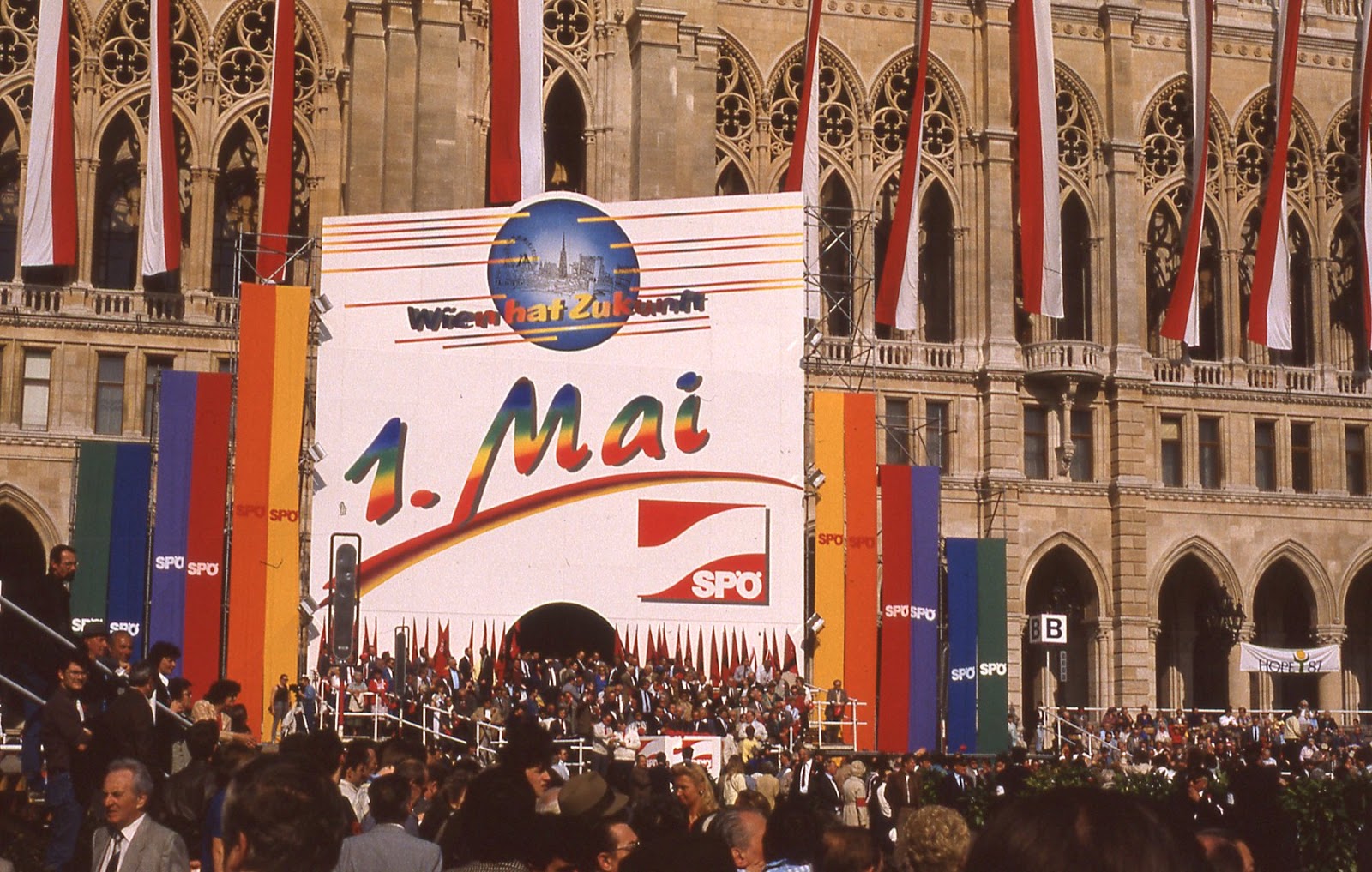
Thanks to the wonders of digitalization, there's now a stand-alone post for photos of the Vienna May Day celebration in 1987.


For more vague linkages, see Hunter's Double D and Seattle Slew Kabobs, please.

Three years have passed, and still 2016 remains a tough act to follow. It may have been the finest season ever for personal May Day celebrations.

For one thing, Bernie Sanders was running for president that year. As an independent senator and avowed socialist, the fact that Sanders even exists in the American political non-spectrum is as good an introduction as any to the "real" international workers' holiday.

As an added bonus, we weren't in America at all when May 1, 2016 rolled around. Rather, it was the occasion of our Spring Break in Estonia, and two big surprises during a day trip to Helsinki: Kim Andersen's presence and a delightful though short left-wing May Day parade.


Now that Pints&union exists, and we put our first May Day to bed today, perhaps the tradition of May Day parades can be restored to eternally somnolent New Albany in 2020. One time around a city block would suffice to start. I'm sure Develop New Albany stands ready to get on board with this idea, just as long as they can promote tacos.

The Economist offers a short but entertaining briefing: Fire, flowers, fertility: summer’s here.

For many people May 1st is synonymous with Labour Day, but the date also signifies the onset of summer in the northern hemisphere.

Let the Commie festivities begin!

---

ON THE AVENUES: May Daze.

By the summer of 1987, when I first visited the geopolitical conglomeration formerly known as the Soviet Union, the country’s annual May Day parade in Moscow had long since ceased to be a showcase of international socialism.

Rather, it had reverted to the overt, and was staged as an ideological pageant of nationalistic fervor – a genuine, old-fashioned, patriotic flag-waver for Mother Russia.

For the bedrock Soviet worker, who according to prevailing mythology was the chief beneficiary of international socialism, May Day’s single biggest selling point was being able to avoid the drudgery of the factory for a few precious hours. He’d have rather been on the beach at a posh Black Sea resort in Bulgaria, but what could be done?

At least for a while he could forget about the dystopian Five Year Plan by hopping the subway from his cookie-cutter, high-rise suburb to the historic center of the city, queuing with fellow vodka-bearers, plodding behind the massive missiles through cobblestoned Red Square, and then finally passing the reviewing stand arranged atop Lenin’s Mausoleum for a fleeting glimpse of the jowly old men in furry caps, grimacing arthritically as they waved vacantly into space.

The parade was a choreographed set piece, of course, one fraught with symbolic properties, both for natives seeking clues to the direction of their country apart from the stultifying daily propaganda, and for observers elsewhere, like professional Kremlinologists in the employ of Western intelligence agencies.

These consulting spooks subsequently would examine film of the May Day parade, reshuffle their tea leaves, and strain them through a few hoary apocryphal algorithms. Passwords would be repeated, reports submitted, meetings held, and murmured decisions reached.

In appropriately clandestine fashion, money would be exchanged, and a hush briefly might descend, until suddenly, somewhere in the world, a legally elected government was overthrown – first one of the Capitalist paymasters’ choosing, then another selected by the Communists, each in its own turn, serving the dual purpose of preserving the status quo, and stimulating both full erections and full employment among participating secret agents.

---

Long before the decade of the 1980’s, the workers of the world – be they in Akron, Cape Town or Tashkent – already understood that they neither had become united, nor shed their chains in any fashion sufficient to exercise control over the means of production.

The stewards of the world’s two great economic “-isms” had divided the planet into manageable spheres of influence, with the non-aligned throngs always ripe for recruitment and exploitation. At the end of a day’s toil, the best way for just plain folks to endure the enforced pieties of a May Day parade -- or a 4th of July picnic -- was to remain under the influence.

As Ernest Hemingway reminds us, the bottle is a blessed means of sovereign action. You first drink from it, and then throw it in the direction of the oppressor. In cases of rotgut, you can drink some of it, and then set the remainder aflame just prior to tossing (see “cocktails, Molotov”).

During the Cold War, Russians and Poles chose vodka. Cubans opted for rum. I always imagined the Czechs and Hungarians to be more fortunate than most, seeing as they possessed beer (Pilsner Urquell) and wine (Egri Bikaver) of a higher uniform quality than produced by Warsaw Pact neighbors.

For Americans, there’d be gallons of insipid ice cold light lager and a few pints of Jack Daniels. Choices from our NATO allies might have ranged from English cask bitter to ouzo in Greece, and from schnapps (Germany) to cider (Spain).

It goes to show that as opiates go, booze is vastly preferable to religion.

---

To recap, May Day takes place on May 1, and generally refers to springtime public holidays in the northern hemisphere, where the cultural tradition began long before Marx, Engels and Gus Hall.

For more than 125 years, May Day also has been considered International Workers' Day, which we Americans eventually chucked to another time on the calendar (Labor Day, at summer’s end) so as to avoid confusion with the Commies. Why? Labor and left-wing political movements first established May 1 as International Workers’ Day in memory of those who were killed and wounded during the Haymarket Massacre in 1886, which took place in Chicago.

In all my trips to Europe, only once did I find myself in position to physically attend a May Day parade. It was in Vienna, in 1987. I got up early and walked into the city center from my hostel across from Westbahnhof, finding a comfortable place to stand along the Ringstrasse near City Hall.

The various unions, workplaces and numbered districts each were represented, and at the end, after the sanctioned social elements had marched past, there were series of menacing, piggybacking trailers: Anarchists, Maoists, random radicals and even a mob of hooded Muslim extremists.

Ah yes, I remember it well. Afterwards, I splurged on schnitzel and local draft beer, reflecting on the way that America’s customarily oblivious exceptionalism has detached its labor holiday from the rest of the world’s.

It’s too bad.

For us.

Monday, September 03, 2018

Labor Day should be May 1. Today is a boss's holiday, but we'll celebrate with songs about working people, and thoughts by Dan Canon.


Just a wee bit of clarity, then some music, and finally a benediction. The content herewith is derived from past posts.

Labor Day is May 1, by Jonah Walters (Jacobin)

Today is a boss's holiday.

 ... Tragically, our labor movement was never strong enough to buck the tyranny of capitalism for good. And today, with union membership in dramatic decline and workers under sustained attack from the political establishment, this militant past often feels like a distant, even irretrievable, memory.

But American workers did contribute at least one lasting legacy to the international movement for working-class liberation — a workers’ holiday, celebrating the ideal of international solidarity, and eagerly anticipating the day when workers might rise together to take control of their own lives and provide for their own well-being.

That holiday is May Day, not Labor Day.
---


Fathom the note on Woody Guthrie's guitar, and follow the link to hear the songs.

Top Ten Labor Day Songs, by Peter Rothberg (The Nation)

In honor of Labor Day, I’ve revised a previous attempt at the impossible task of naming the best songs ever written about working people. The list is highly debatable; songs about work and working people cut across genres and generations. I know it’s a travesty to neglect “Which Side Are You On?” and Johnny Paycheck’s classic “Take This Job and Shove It.” It also seems impossible that I’ve excluded Bruce Springsteen, Billy Bragg, Nina Simone, and John Mellencamp, and given such short shrift to the rich history of punk rock odes to the insanity of wage slavery. Hopefully, these songs will get people thinking about their own favorite musical celebrations of the working condition.


Dan Canon's congressional campaign was in full swing on Labor Day, 2017, and the candidate (he lost in the 2018 primary) had cogent thoughts about Labor Day. Well, it's about time someone around here did, and consequently, I believe they're worth repeating.

---

A couple of thoughts about Labor Day:

I've represented workers against big business here in my community for a decade now. Union folks don't often get to me, because they have a line of job protection that most American workers don't have. Most of the employment protections non-union folks *do* have were also a direct result of the labor movement. Overtime pay, workplace safety rules, anti-retaliation provisions - these are all thanks to unions, and affect most workers whether they've ever paid dues or not.

The issues brought to the fore by labor unions are more important now than ever. As plenty of people have rightly pointed out, our insane wealth gap has just emboldened the rich to take even more, not to generously lavish the working class with raises and pensions, because almost no one is telling them they can't. Labor unions tell them they can't. So oligarchs over the last decade or so have been pretty brazen about trying to break the back of organized labor as a whole. They keep the concentration of wealth at the top from getting even worse, and the top is pretty adamant that they'd *like* for it to get worse.

But it's too simplistic to say that the effort to gut unions is just based on greed. It's also part and parcel of the GOP/new-American-fascist agenda. Down here, if we are organized, we are a threat to the top. The more and better we are organized, the more of a threat we pose. And so naturally, the more divided we are, the less a threat we pose to an increasing concentration of wealth and power at the top. In fact, if we are very divided, we might not even notice such concentration at all. We might deny that it exists. We might think it doesn't affect us. We might not have time to care.

This is why there's a concerted effort to divide us up. Black v. white, Christian v. Muslim, straight v. gay, cis v. trans, etc. It makes us disorganized. Unfocused. Weak.

Where would you start a campaign of disorganization, were you to run one? Who would be among your primary targets? I bet one would be: the folks who have already known how to organize and get results for more than a century.

That's the reason we see our friends, families, and neighbors in the labor movement under attack. It's not just about making a few more dollars at the expense of someone else's hard work. It's about perpetuating divisions and preventing the amalgamation and galvanization of those of us down here below.
Let's all buy a drink for a union member and tell 'em we've got their backs. They've had ours for more than a hundred years.

Tuesday, May 01, 2018

Our annual May Daze observance puts the workers back into Walpurgis.


This essay is reprinted or linked yearly, attesting to my eagerness to remind you that on May Day, while the Louisville area eschews work and focuses its partying proclivities on the ponies, most of the rest of the world takes a holiday amid thoughts about the nature of work itself.

Thanks to the wonders of digitalization, there's now a stand-alone post for photos of the Vienna May Day celebration in 1987.


For more vague linkages, see Hunter's Double D and Seattle Slew Kabobs, please.

The year 2016 is a tough act to follow. It may have been the finest season ever for personal May Day celebrations.

For one thing, Bernie Sanders was running for president last year. As an independent senator and avowed socialist, the fact that Sanders even exists in the American political non-spectrum is as good an introduction as any to the "real" international workers' holiday.

As an added bonus, we weren't in America at all when May 1, 2016 rolled around. Rather, it was the occasion of our Spring Break in Estonia, and two big surprises during a day trip to Helsinki: Kim Andersen's presence and a delightful though short left-wing May Day parade.


If Ainslie's Tavern comes into being by May 1, 2018, perhaps the tradition of May Day parades can be restored to eternally somnolent New Albany. One time around a city block would suffice to start. I'm sure Develop New Albany stands ready to get on board with this idea.

The Economist offers a short but entertaining briefing: Fire, flowers, fertility: summer’s here.

For many people May 1st is synonymous with Labour Day, but the date also signifies the onset of summer in the northern hemisphere.

Let the Commie festivities begin!

---

ON THE AVENUES: May Daze.

By the summer of 1987, when I first visited the geopolitical conglomeration formerly known as the Soviet Union, the country’s annual May Day parade in Moscow had long since ceased to be a showcase of international socialism.

Rather, it had reverted to the overt, and was staged as an ideological pageant of nationalistic fervor – a genuine, old-fashioned, patriotic flag-waver for Mother Russia.

For the bedrock Soviet worker, who according to prevailing mythology was the chief beneficiary of international socialism, May Day’s single biggest selling point was being able to avoid the drudgery of the factory for a few precious hours. He’d have rather been on the beach at a posh Black Sea resort in Bulgaria, but what could be done?

At least for a while he could forget about the dystopian Five Year Plan by hopping the subway from his cookie-cutter, high-rise suburb to the historic center of the city, queuing with fellow vodka-bearers, plodding behind the massive missiles through cobblestoned Red Square, and then finally passing the reviewing stand arranged atop Lenin’s Mausoleum for a fleeting glimpse of the jowly old men in furry caps, grimacing arthritically as they waved vacantly into space.

The parade was a choreographed set piece, of course, one fraught with symbolic properties, both for natives seeking clues to the direction of their country apart from the stultifying daily propaganda, and for observers elsewhere, like professional Kremlinologists in the employ of Western intelligence agencies.

These consulting spooks subsequently would examine film of the May Day parade, reshuffle their tea leaves, and strain them through a few hoary apocryphal algorithms. Passwords would be repeated, reports submitted, meetings held, and murmured decisions reached. In appropriately clandestine fashion, money would be exchanged, and a hush briefly might descend, until suddenly, somewhere in the world, a legally elected government was overthrown – first one of the Capitalist paymasters’ choosing, then another selected by the Communists, each in its own turn, serving the dual purpose of preserving the status quo, and stimulating both full erections and full employment among participating secret agents.

---

Long before the decade of the 1980’s, the workers of the world – be they in Akron, Cape Town or Tashkent – already understood that they neither had united, nor shed their chains in any fashion sufficient to exercise control over the means of production.

The stewards of the world’s two great economic “-isms” had divided the planet into manageable spheres of influence, with the non-aligned throngs always ripe for recruitment and exploitation. At the end of a day’s toil, the best way for just plain folks to endure the enforced pieties of a May Day parade -- or a 4th of July picnic -- was to remain under the influence.

As Ernest Hemingway reminds us, the bottle is a blessed means of sovereign action. You first drink from it, and then throw it in the direction of the oppressor. In cases of rotgut, you can drink some of it, and then set the remainder aflame just prior to tossing (see “cocktails, Molotov”).

During the Cold War, Russians and Poles chose vodka. Cubans opted for rum. I always imagined the Czechs and Hungarians to be more fortunate than most, seeing as they possessed beer (Pilsner Urquell) and wine (Egri Bikaver) of a higher uniform quality than produced by Warsaw Pact neighbors.

For Americans, there’d be gallons of insipid ice cold light lager and a few pints of Jack Daniels. Choices from our NATO allies might have ranged from English cask bitter to ouzo in Greece, and from schnapps (Germany) to cider (Spain).

It goes to show that as opiates go, booze is vastly preferable to religion.

---

To recap, May Day takes place on May 1, and generally refers to springtime public holidays in the northern hemisphere, where the cultural tradition began long before Marx, Engels and Gus Hall.

For more than 125 years, May Day also has been considered International Workers' Day, which we Americans eventually chucked to another time on the calendar (Labor Day, at summer’s end) so as to avoid confusion with the Commies. Why? Labor and left-wing political movements first established May 1 as International Workers’ Day in memory of those who were killed and wounded during the Haymarket Massacre in 1886, which took place in Chicago.

In all my trips to Europe, only once did I find myself in position to physically attend a May Day parade. It was in Vienna, in 1987. I got up early and walked into the city center from my hostel across from Westbahnhof, finding a comfortable place to stand along the Ringstrasse near City Hall.

The various unions, workplaces and numbered districts each were represented, and at the end, after the sanctioned social elements had marched past, there were series of menacing, piggybacking trailers: Anarchists, Maoists, random radicals and even a mob of hooded Muslim extremists.

Ah yes, I remember it well. Afterwards, I splurged on schnitzel and local draft beer, reflecting on the way that America’s customarily oblivious exceptionalism has detached its labor holiday from the rest of the world’s.

It’s too bad.

For us.

Monday, September 04, 2017

The workers' holiday? That'd be May 1 -- and American workers did that.


Just as long as we're clear about the fact of the matter, I'm down with today.

Labor Day is May 1, by Jonah Walters (Jacobin)

Today is a boss's holiday.

 ... Tragically, our labor movement was never strong enough to buck the tyranny of capitalism for good. And today, with union membership in dramatic decline and workers under sustained attack from the political establishment, this militant past often feels like a distant, even irretrievable, memory.

But American workers did contribute at least one lasting legacy to the international movement for working-class liberation — a workers’ holiday, celebrating the ideal of international solidarity, and eagerly anticipating the day when workers might rise together to take control of their own lives and provide for their own well-being.

That holiday is May Day, not Labor Day.

Wednesday, August 16, 2017

30 years ago today: May Day in Vienna, 1987.


Previously: 30 years ago today: (April 30) A return to Vienna.

---

Day 16 ... Friday, May 1
Vienna. May Day parade, Schönbrunn w/John Bridie Murphy

Prior to arriving in Vienna, it genuinely had not occurred to me that the city's annual May Day parade would be worth watching. After all, for various reasons my proposed itinerary kept changing. I might have been visiting any number of locales on May 1, not necessarily Vienna.

But I got lucky. Outside of the Soviet bloc, there couldn't have been a finer place to experience the international workers' holiday than the Austrian capital. I've written about the May Day concept oft times before, and repeat the boilerplate here.

---

By the summer of 1987, when I first visited the geopolitical conglomeration formerly known as the Soviet Union, the country’s annual May Day parade in Moscow had long since ceased to be a showcase of international socialism.

Rather, it had reverted to the overt, and was staged as an ideological pageant of nationalistic fervor – a genuine, old-fashioned, patriotic flag-waver for Mother Russia.

For the bedrock Soviet worker, who according to prevailing mythology was the chief beneficiary of international socialism, May Day’s single biggest selling point was being able to avoid the drudgery of the factory for a few precious hours. He’d have rather been on the beach at a posh Black Sea resort in Bulgaria, but what could be done?

At least for a while he could forget about the dystopian Five Year Plan by hopping the subway from his cookie-cutter, high-rise suburb to the historic center of the city, queuing with fellow vodka-bearers, plodding behind the massive missiles through cobblestoned Red Square, and then finally passing the reviewing stand arranged atop Lenin’s Mausoleum for a fleeting glimpse of the jowly old men in furry caps, grimacing arthritically as they waved vacantly into space.

The parade was a choreographed set piece, of course, one fraught with symbolic properties, both for natives seeking clues to the direction of their country apart from the stultifying daily propaganda, and for observers elsewhere, like professional Kremlinologists in the employ of Western intelligence agencies.

These consulting spooks subsequently would examine film of the May Day parade, reshuffle their tea leaves, and strain them through a few hoary apocryphal algorithms. Passwords would be repeated, reports submitted, meetings held, and murmured decisions reached. 

In appropriately clandestine fashion, money would be exchanged, and a hush briefly might descend, until suddenly, somewhere in the world, a legally elected government was overthrown – first one of the Capitalist paymasters’ choosing, then another selected by the Communists, each in its own turn, serving the dual purpose of preserving the status quo, and stimulating both full erections and full employment among participating secret agents.

Long before the decade of the 1980’s, the workers of the world – be they in Akron, Cape Town or Tashkent – already understood that they neither had united, nor shed their chains in any fashion sufficient to exercise control over the means of production.

The stewards of the world’s two great economic “-isms” had divided the planet into manageable spheres of influence, with the non-aligned throngs always ripe for recruitment and exploitation. At the end of a day’s toil, the best way for just plain folks to endure the enforced pieties of a May Day parade -- or a 4th of July picnic -- was to remain under the influence.

As Ernest Hemingway reminds us, the bottle is a blessed means of sovereign action. You first drink from it, and then throw it in the direction of the oppressor. In cases of rotgut, you can drink some of it, and then set the remainder aflame just prior to tossing (see “cocktails, Molotov”).

During the Cold War, Russians and Poles chose vodka. Cubans opted for rum. I always imagined the Czechs and Hungarians to be more fortunate than most, seeing as they possessed beer (Pilsner Urquell) and wine (Egri Bikaver) of a higher uniform quality than produced by Warsaw Pact neighbors.

For Americans, there’d be gallons of insipid ice cold light lager and a few pints of Jack Daniels. Choices from our NATO allies might have ranged from English cask bitter to ouzo in Greece, and from schnapps (Germany) to cider (Spain).

It goes to show that as opiates go, booze is vastly preferable to religion.

To recap, May Day takes place on May 1, and generally refers to springtime public holidays in the northern hemisphere, where the cultural tradition began long before Marx, Engels and Gus Hall.

For more than 125 years, May Day also has been considered International Workers' Day, which we Americans eventually chucked to another time on the calendar (Labor Day, at summer’s end) so as to avoid confusion with the Commies. Why? Labor and left-wing political movements first established May 1 as International Workers’ Day in memory of those who were killed and wounded during the Haymarket Massacre in 1886, which took place in Chicago.

In all my trips to Europe, only once did I find myself in position to physically attend a May Day parade. It was in Vienna, in 1987. I got up early and walked into the city center from my hostel across from Westbahnhof, finding a comfortable place to stand along the Ringstrasse near City Hall.

The various unions, workplaces and numbered districts each were represented, and at the end, after the sanctioned social elements had marched past, there were series of menacing, piggybacking trailers: Anarchists, Maoists, random radicals and even a mob of hooded Muslim extremists.

Ah yes, I remember it well. Afterwards, I splurged on schnitzel and local draft beer, reflecting on the way that America’s customarily oblivious exceptionalism has detached its labor holiday from the rest of the world’s.

It’s too bad.

For us.

---

In closing, this link from 2013 is encyclopedic and highly recommended.

How Vienna Does Labor Day (And We Should Too), by Lisa (My Blue Danube)

Eventually — so very eventually — we arrive at the Rathaus simultaneous with the districts coming in the opposite direction (the Ring is a circle, after all). We alternate turning into the Rathausplatz, where a giant crowd cheers from behind barricades, and the mayor awaits on a viewing stand ...

... After you leave the Rathausplatz, directly across the Ring is the “Red Market,” that is, a pop-up outdoor cafe for drinking giant quantities of beer and wine — and liberally populated by firefighters, who are a prominent presence at May Day festivities

My 1987 photos follow in chronological order.


On Sunday, May 3, there was an epic hike across the city and an afternoon at the Prater amusement park. A night train brought me to Firenze (Florence), Italy on Monday morning.

Next: Florence and quality time in Italy.

Monday, May 01, 2017

Our annual May Daze observance puts the workers back into Walpurgis.


This essay is reprinted or linked yearly, attesting to my eagerness to remind you that on May Day, while the Louisville area eschews work and focuses its partying proclivities on the ponies, most of the rest of the world takes a holiday amid thoughts about the nature of work itself.

For more vague linkages, see Hunter's Double D and Seattle Slew Kabobs, please.

The year 2016 is a tough act to follow. It may have been the finest season ever for personal May Day celebrations.

For one thing, Bernie Sanders was running for president last year. As an independent senator and avowed socialist, the fact that Sanders even exists in the American political non-spectrum is as good an introduction as any to the "real" international workers' holiday.

As an added bonus, we weren't in America at all when May 1, 2016 rolled around. Rather, it was the occasion of our Spring Break in Estonia, and two big surprises during a day trip to Helsinki: Kim Andersen's presence and a delightful though short left-wing May Day parade.


If Ainslie's Tavern comes into being by May 1, 2018, perhaps the tradition of May Day parades can be restored to eternally somnolent New Albany. One time around a city block would suffice to start. I'm sure Develop New Albany stands ready to get on board with this idea.

The Economist offers a short but entertaining briefing: Fire, flowers, fertility: summer’s here.

For many people May 1st is synonymous with Labour Day, but the date also signifies the onset of summer in the northern hemisphere.

Let the Commie festivities begin!

---

ON THE AVENUES: May Daze.

By the summer of 1987, when I first visited the geopolitical conglomeration formerly known as the Soviet Union, the country’s annual May Day parade in Moscow had long since ceased to be a showcase of international socialism.

Rather, it had reverted to the overt, and was staged as an ideological pageant of nationalistic fervor – a genuine, old-fashioned, patriotic flag-waver for Mother Russia.

For the bedrock Soviet worker, who according to prevailing mythology was the chief beneficiary of international socialism, May Day’s single biggest selling point was being able to avoid the drudgery of the factory for a few precious hours. He’d have rather been on the beach at a posh Black Sea resort in Bulgaria, but what could be done?

At least for a while he could forget about the dystopian Five Year Plan by hopping the subway from his cookie-cutter, high-rise suburb to the historic center of the city, queuing with fellow vodka-bearers, plodding behind the massive missiles through cobblestoned Red Square, and then finally passing the reviewing stand arranged atop Lenin’s Mausoleum for a fleeting glimpse of the jowly old men in furry caps, grimacing arthritically as they waved vacantly into space.

The parade was a choreographed set piece, of course, one fraught with symbolic properties, both for natives seeking clues to the direction of their country apart from the stultifying daily propaganda, and for observers elsewhere, like professional Kremlinologists in the employ of Western intelligence agencies.

These consulting spooks subsequently would examine film of the May Day parade, reshuffle their tea leaves, and strain them through a few hoary apocryphal algorithms. Passwords would be repeated, reports submitted, meetings held, and murmured decisions reached. In appropriately clandestine fashion, money would be exchanged, and a hush briefly might descend, until suddenly, somewhere in the world, a legally elected government was overthrown – first one of the Capitalist paymasters’ choosing, then another selected by the Communists, each in its own turn, serving the dual purpose of preserving the status quo, and stimulating both full erections and full employment among participating secret agents.

---

Long before the decade of the 1980’s, the workers of the world – be they in Akron, Cape Town or Tashkent – already understood that they neither had united, nor shed their chains in any fashion sufficient to exercise control over the means of production.

The stewards of the world’s two great economic “-isms” had divided the planet into manageable spheres of influence, with the non-aligned throngs always ripe for recruitment and exploitation. At the end of a day’s toil, the best way for just plain folks to endure the enforced pieties of a May Day parade -- or a 4th of July picnic -- was to remain under the influence.

As Ernest Hemingway reminds us, the bottle is a blessed means of sovereign action. You first drink from it, and then throw it in the direction of the oppressor. In cases of rotgut, you can drink some of it, and then set the remainder aflame just prior to tossing (see “cocktails, Molotov”).

During the Cold War, Russians and Poles chose vodka. Cubans opted for rum. I always imagined the Czechs and Hungarians to be more fortunate than most, seeing as they possessed beer (Pilsner Urquell) and wine (Egri Bikaver) of a higher uniform quality than produced by Warsaw Pact neighbors.

For Americans, there’d be gallons of insipid ice cold light lager and a few pints of Jack Daniels. Choices from our NATO allies might have ranged from English cask bitter to ouzo in Greece, and from schnapps (Germany) to cider (Spain).

It goes to show that as opiates go, booze is vastly preferable to religion.

---

To recap, May Day takes place on May 1, and generally refers to springtime public holidays in the northern hemisphere, where the cultural tradition began long before Marx, Engels and Gus Hall.

For more than 125 years, May Day also has been considered International Workers' Day, which we Americans eventually chucked to another time on the calendar (Labor Day, at summer’s end) so as to avoid confusion with the Commies. Why? Labor and left-wing political movements first established May 1 as International Workers’ Day in memory of those who were killed and wounded during the Haymarket Massacre in 1886, which took place in Chicago.

In all my trips to Europe, only once did I find myself in position to physically attend a May Day parade. It was in Vienna, in 1987. I got up early and walked into the city center from my hostel across from Westbahnhof, finding a comfortable place to stand along the Ringstrasse near City Hall.

The various unions, workplaces and numbered districts each were represented, and at the end, after the sanctioned social elements had marched past, there were series of menacing, piggybacking trailers: Anarchists, Maoists, random radicals and even a mob of hooded Muslim extremists.

Ah yes, I remember it well. Afterwards, I splurged on schnitzel and local draft beer, reflecting on the way that America’s customarily oblivious exceptionalism has detached its labor holiday from the rest of the world’s.

It’s too bad.

For us.

Sunday, May 01, 2016

Estonia Spring Break 2016: Day Six, and a big surprise in Helsinki.


(As is my custom when posting trip summaries, I'm backdating them to the actual day of occurrence. Previously: Day Five)

A few days before the trip to Tallinn, Diana began selling me on the wisdom of visiting Helsinki on Sunday, May 1. We'd already talked about doing it. The two cities lie only 50 miles apart, with the Gulf of Finland's waters lying between them. It's a two-hour ferry trip, and a plush ride at that.

What's more, May 1 offered a chance to see Finns at play.

In Finland, the May Day celebration has developed from its pagan origin as a feast of spring into a nationwide urban carnival.

Worldwide, May 1st is celebrated as an international working class holiday. In addition to this, in Finland, it is also a traditional spring feast of university students, and the name day of the catholic saint Walburga, commemorated in former times, when Finland still was a catholic country.

Being a mixture of these traditions, the custom of celebrating May Day has spread throughout the country with many people taking part in it, if only to welcome the long awaited spring.

In Finland, May Day is a noisy urban festival, mainly celebrated in towns and cities. In Helsinki, the capital of Finland, the celebration starts on May Day Eve, as the downtown streets, pubs and restaurants start to fill with people in party mood.

The carnival atmosphere is enhanced by people wearing funny or frightening masks, hats, wigs and other party accessories. Colourful balloons, pompoms, party blowouts, serpentine throws and sprays, noisemakers and horns of various kinds are also popular, especially among children. For some people, the festivities also include a rather heavy consumption of alcohol, in the true Nordic fashion.

My wife's insistence on Sunday made perfect sense, and so the tickets were booked, and we boarded the Tallink ferry at 7:30 a.m. on Sunday. Pastries and espresso were available for purchase, and a benevolent staffer gave me a free booze-filled chocolate egg.


The ferry docked in Helsinki right on time, and nature of Diana's urgency became readily evident in the person of this guy waiting to greet us.


Yes, it's Kim Andersen, card-carrying partner in the famous Three Danes of the Apocalypse act on stage and screen. He knew he was to be in Helsinki on business, and when I mentioned the Estonia trip on social media, he contacted Diana for the sake of connivance -- and boy, did they connive.

Good. My day in Helsinki just got far better.

Amid requisite pleasantries, Kim explained the significance of the weekend's various parties, emphasizing the importance of Sunday for Finland's university students -- in fact, anyone who'd ever been a university student. Hence, these views at a public park as people of all ages celebrated.


Note the nautical-style caps. Everyone was wearing them.

We walked to the city center and found seats at a cafe just in time to witness a local May Day parade. It was fully interactive, with songs, applause and heckling from the crowd.


Grasping the spirit of the day, Diana bought a balloon.


Kim's boss joined us for a while, and a leisurely day unfolded in picture perfect spring weather. It was not to be a time for sightseeing in any conventional sense. Helsinki's streets were thronged, and folks were festive. Kim and I hadn't seen each other in person for many years, and there was much catching up to do. We wandered downtown, having beers and snacks, and talking.


I didn't bother keeping beer notes, or caring where we were. It was too much fun. By 5-ish, we'd arrived at the final stop on Kim's orientation tour: The historic Hotel Torni, a compelling 1930s-era with rooftop bar and a view comparable to Lounge 24 in Helsinki. Here's an internet view.


Naturally, Kim already knew that the bar at the top of the Hotel Torni stocks Sinebrychoff Porter, still one of the finest regional beers, and so our final round was special in more ways than one. Diana had the camera, and captured the scene.


The two-hour return to Tallinn was uneventful apart from eating far too much at an expensive buffet, though food was necessary after a day spent drinking from place to place.

Had we gone to Helsinki for a day trip and Kim not been there to surprise me, it's likely we'd have found a tram, a neighborhood and learned more about Helsinki and the people who live there.

But who cares?

I wouldn't trade this wonderful afternoon with Kim for anything in the world, and I'm grateful to Diana for slyly arranging it. It's a memory to be cherished.   

Next: Monday (Day Seven), and the winding down process begins.