Monday, May 28, 2018

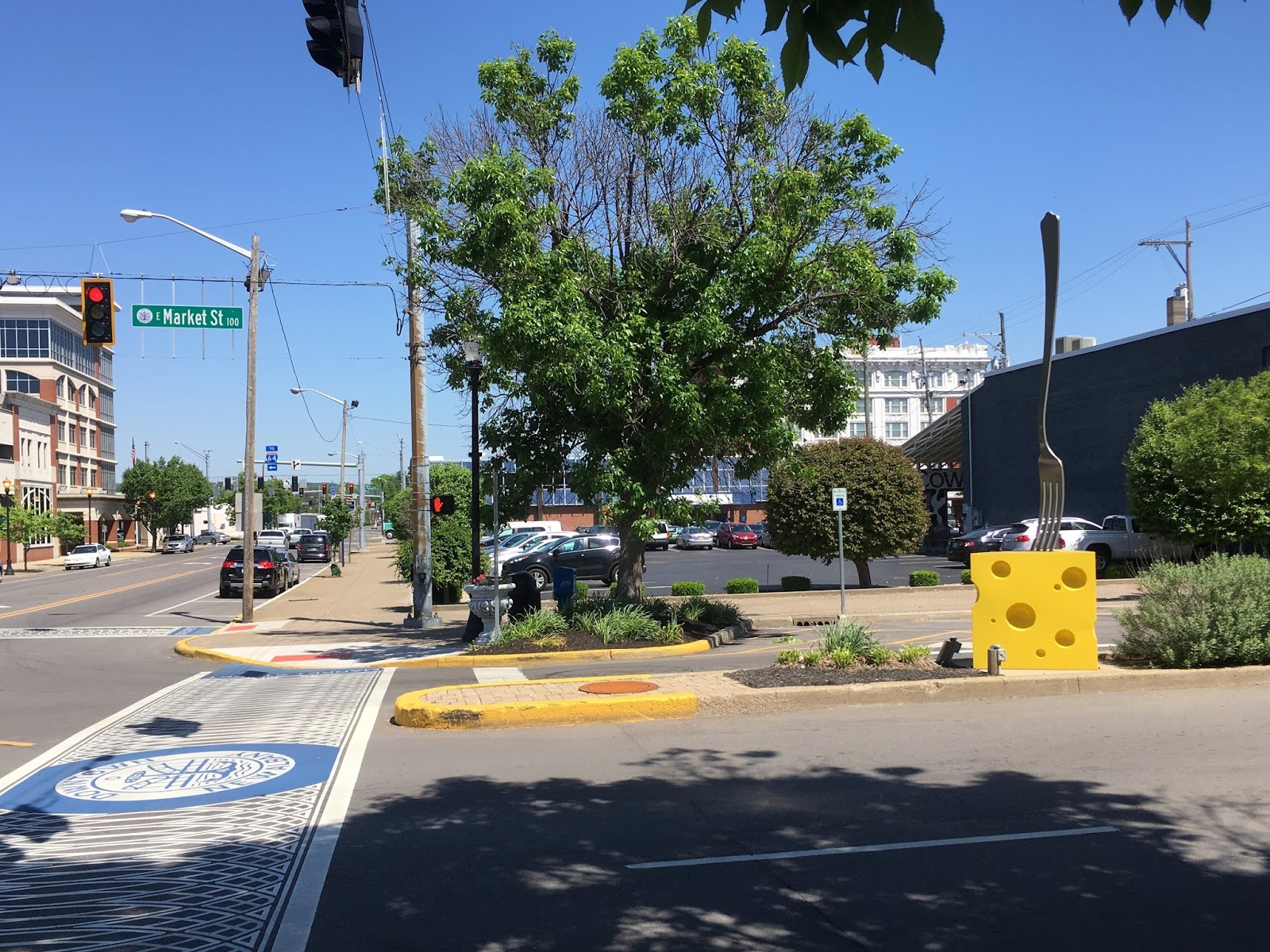
Team Gahan's condiments are aligned and measured, and these trees likely are doomed by yet another non-transparent "beautification" plan.


It's another backroom design contract (HWC?), another campaign finance-loaded bid (Allterrain), and another non-transparent Team Gahan "fix."

Summers announces plan to "Walk the Walk" by enhancing car-centrism via the Market Street medians. We advocate nuking them to outer space.


In an e-mail, I asked David Barksdale a few questions.

He's one of three at-large city councilman who have the job of representing us all, even public housing residents, and he also is a member of the redevelopment commission as council appointee.

Lately he's embraced the role of de facto project manager for Jeff Gahan's sanitized suburban overlay for the historic downtown business district.

Which should remind us that there is a tendency among autocratic personality types to harness design and appearance toward the reinforcement of their personally pervasive patterns of grandiosity -- like the time Frank Burns explained to Hawkeye Pierce why he was having the ketchup and condiments measured.


"Well, if you kneel at the end of the tent and get the tabletop at eye level, you will see that each bottle of ketchup lines up behind the other, unless there's only one bottle of ketchup. Now the same is true of your condiments which, if you will note, are arranged according to height and popularity. There's your ketchup, your mustard, your relish, your mayonnaise, your oil and vinegar, your salt and pepper, and your sweet and sour gherkins all in a row."

In short, just like our anchor-laden crosswalks, beautifully doing absolutely nothing to protect walkers from drivers.

Where was I?

Oh yes, my futile e-mail to CM Barksdale.

It has been announced that there'll be changes made to the block of Market Street between State and Pearl, these coming without any chance for the public to see what's planned, or to provide input. Property owners and business people located on or near this stretch might like to be informed of these changes, don't you think? Are there any plans to accept input, or is it another trademark top-down diktat?

He is to be credited for replying, which is more than his favored comrades at Develop New Albany are capable of doing.

Hello Roger,

This is a NARC project and was discussed at the May 9 & 15 meetings..

Larry Summers is the lead person on it.

Dave

Unfortunately it's a lame, bureaucratically evasive reply, kicking the ball to the non-elected city engineer Summers, who I'd have asked in the first place had Summers not already blocked me on social media. What's more, I can't seem to find the city engineer's e-mail address anywhere on the city's web site, so in a return e-mail, I asked Barksdale if he had an e-mail address for Summers.

Pins drop, crickets chirp. To date, only silence. This closing comment recently was overheard during a curbside discussion of Gahanism in New Albany.

"Why do the folks on 'Mansion Row' get to keep their trees (which sport two lights each and underground watering as well) but the plebiscite have to endure Market Street trees cut down to 'improve the appearance’"?

A damned fine question. Good luck convincing the self-appointed community pillars to answer it, as they're busy confusing their own wants for the city's needs.

Sunday, May 27, 2018

Starting in November, Madrid will make clear that downtown streets are not for drivers.

Photo credit: The Local.

Such nice buildings. One imagines that in Spain, historical preservation advocates surely double as supporters of schemes to get cars off the street and people on them.

Does Madrid have a Tree Board?

Madrid Takes Its Car Ban to the Next Level
, by Feargus O'Sullivan (CityLab)

Starting in November, the city will make clear that downtown streets are not for drivers.

The days when cars could drive unhindered through central Madrid are coming to a close.

Following an announcement this week, the Spanish capital confirmed that, starting in November, all non-resident vehicles will be barred from a zone that covers the entirety of Madrid’s center. The only vehicles that will be allowed in this zone are cars that belong to residents who live there, zero-emissions delivery vehicles, taxis, and public transit. Even on a continent where many cities are scaling back car access, the plan is drastic. While much of central Madrid consists of narrow streets that were never suitable to motor vehicles in the first place, this central zone also includes broad avenues such as Gran Via, and wide squares that have been islands in a sea of surging traffic for decades. The plan is thus not just about making busy central streets more pleasant, but about creating a situation where people simply no longer think of bringing their cars downtown.

This might come as a shock to some drivers, but the wind has been blowing this way for more than a decade. Madrid set up the first of what it calls Residential Priority Zones in 2005, in the historic, densely packed Las Letras neighborhood. Since then, a modest checkerboard of three other similar zones have been installed across central Madrid. The new area will be a sort of all-encompassing zone that abolishes once and for all the role of downtown streets as through-routes across the city.

BEER WITH A SOCIALIST: Vandals strike Asheville brewery: “No more breweries” and “**** Beer City.”

My initial thought upon reading about "anti-brewery vandalism" in Asheville was something on the order of: "Just their luck the Woman's Christian Temperance Union is still alive and kicking."

Indeed, the prohibitionists remain extant, drastically weakened but forever persistent. However, it's doubtful the WCTU is taking the war to Demon Craft Beer at night, clad in dark attire, masked and with spray paint in hand.

Here's the story.

Asheville’s One World Brewing Responds to Anti-Brewery Vandalism, by Jess Baker (Craft Beer Dot Com)

It’s been a frustrating week for One World Brewing, a small and independent craft brewery in Asheville, North Carolina. The brewery, which originally opened four years ago in downtown Asheville, was busy prepping to open its new location in the West Asheville district when vandals hit the brewery as well as surrounding local businesses.

The vandals scrawled messages in black spray paint on the front of the brewery’s white brick building at 520 Haywood Road: “No more breweries” and “**** Beer City.”

The vandals’ anti-brewery messages are stinging words for the Asheville beer community, a city where independent breweries are considered a major driver for tourism.

“We will not be deterred from doing what’s best for our employees and our community,” One World Brewing wrote on its Facebook and Instagram pages Thursday. “We are a homegrown, local, independently owned brewery that does so much more than just brew beer. We use beer as a platform to support so many other aspects of life that we are passionate about.”

The Asheville brewery, like many local breweries, is invested in supporting its employees as well as the community. The brewery used the incident to flip the script and talk about their strong bond with Asheville ...

Beer writer Bryan Roth, who shared the preceding link at Twitter, commented.

"anti-brewery messages" is a new one to me.

Not for Richard Florida, who mentioned the "g" word (gentrification) in a CityLab piece late last year -- or Athena Hobson, from London, two years ago.

During a shameless binge watch of Unbreakable Kimmy Schmidt, I couldn’t help but notice all the references to gentrification (or in simpler terms – places becoming more trendy and modernised, which drives up the costs of living in that area, meaning poorer residents may be forced to relocate).

Hobson expands on her thought.

Don’t Blame The Brewers: Craft Beer And Gentrification, by Athena Hobson (Cultured Vultures)

First-time business owners are taking advantage of run down areas to set up shop and driving up the cost of living for local residents.

Understandably, it is gentrification that is largely responsible for provoking a deep hatred of the craft beer trend, but to what extent can we actually blame the brewers? Had it not been about beer, it may have been bubble tea cafés or ‘soul cycle’ studios. The aforementioned Cereal Killer Café has been under attack of petty vandalism as well as keyboard warriors since word spread of its opening – but would they be so successful if we weren’t so willing to buy into what they’re selling? After all, what is business but seeing a need and providing the product or service?

When you hand over your money to a company, however much or little that may be, you are funding their objectives ...

Regular blog readers residing in New Albany hardly need this reminder, but it's always better to be explicit, so kindly note that Mayor Jeff Gahan's 2017 seizure of public housing, with a stated objective of reducing the number of units by half, is an exercise in socio-economic cleansing -- and this displacement is not being conducted in a conceptual vacuum.

In fact, Gahan's war against the working poor is the logical consequence of our "success" in resuscitating downtown. It's part and parcel of gentrification, and as a "Democrat," the mayor illustrates that callous measures directed against the most vulnerable cannot always be blamed on right-wingers. 

Thanks in large part to food and drink businesses like my own brewery, with which I'm no longer involved, the historic core of the city has experienced a decade of substantive reinvestment.

The result has been an increase in "upscale" thinking, as opposed to those cross-cultural core retail stores operating downtown long ago prior to suburbanization and white flight.

As a corollary, the local political dialogue continues to narrow; either we explore ways to expand the "upscale" developments already in progress, or we do nothing at all. The ensuing shock waves are hitting those community members least able to cope economically, in part because the powers that be in New Albany view gentrification as a social phenomenon of unqualified and unquestioned good.

Few wish to contemplate the consequences, and most are willing to encourage even more of it with measures that gradually have crept beyond those designed somewhat modestly to encourage investment (as with loosened alcoholic beverage licensing in riverfront development areas), to ones like the public housing putsch that actively push social engineering, or the recent proposal (likely inevitable) to spend $8.5 million on local government wants (a new city hall) rather than affordable housing needs for a growing segment of the populace.

Back to the point. Why would someone vandalize a small brewery?

Probably for the same reason that residents of my city greet the news of another new bar or restaurant ...

The former Comfy Cow location will become a bar, but we have no further details.

Downtown NA restaurant and bar scorecard: one new location, two openings and four coming soon.

... with predictable but perfectly plausible questions like these.

Seriously, another bar?

How many downtown restaurants and bars are enough?

Will we be able to afford to eat at these latest and greatest places?

These questions have short-term answers: yes, it's too early to tell, and it's complicated.

Alcohol licensing exists to regulate drinking for the ostensible purpose of societal good, although maximum tax harvesting comes closer to the truth.

Indiana's riverfront development area mechanism is a legal construct expressly designed to "open" a delineated geographical area to licensing with fewer restrictions.

Riverfront permits have the effect of making a demarcated area slightly more free than before, because it provides a framework for licensing outside the customary allocation. It greatly reduces the overall cost of a permit, and opens the market to more participants.

As long as there is available money, and entrepreneurs are eager to spend it, there'll be contestants entering the game. We'll know when there are too many bars and restaurants when more establishments are closing than opening.

As for the pricing, this is a difficult topic somewhat outside the scope of these thoughts. I'll add only that there are fewer disparities in pricing than might appear to be the case among independent and chain/franchise when their menus are comparable, and while I'd never suggest that operators don't look for ways to squeeze a few cents more from any mark-up, it's hard to base a business model on $3 burgers and $6 beers.

There are other questions and answers, but I have no glib conclusions to offer about any of these potential digressions. I've agonized over them for years, and will continue to do so.

At the same time, there is another complementary Pandora's Box to be broached, this being the junction of morals, wages, costs and benefits pertaining to "craft" breweries as workplaces.

I've referenced work by Dave Infante on a couple of past occasions, and he's at peak provocation here.

Infante's piece raised a tremendous din in the usual beer discussion portals. About all I can do is shrug and say two things: Welcome to capitalism ... and I'm happy not to be tormented by these considerations any longer. The economics at a bar stand to be much simpler than those at a brewery.

Craft Beer’s Moral High Ground Doesn't Apply to Its Workers, by Dave Infante (Splinter News)

Scott Timms is taking a break from brewing beer. At 35, he’s been at it for 13 years, most recently having worked at Falling Sky Brewing, a popular brewpub in Eugene, OR, that regularly appears on “best of” lists in the state.

Brewing beer commercially can be hard, thankless work. “It’s a back-breaking job, lifting a hundred 50-pound bags” of ingredients and carrying them up stairs to be added to the mash, Timms says. And it can be dangerous: “You’re dealing with boiling liquids and pretty harsh chemicals that can definitely injury you…It’s not a safe job by any means.” At small breweries, where OSHA visits are unusual and procedures are unstandardized, the “outlook towards safety” can be “laissez-faire” verging on “lackadaisical,” he says.

For his work as a production manager at Falling Sky overseeing a team of brewers and working up to 65 hours a week, Timms made what came out to a little over $40,000 a year. Frustrated, he quit his brewing job in early 2018, convinced that craft brewers were getting shorted across the U.S. beer industry. “There are people making money here,” he says, “but it’s not us.”

In 2017, Lauren Michele Jackson wrote in Eater about the rise of “craft culture,” a food and beverage market that “fetishizes the authentic, the traditionally produced, and the specific [and] loathes the engineered, the mass-produced, and the originless.” Craft beer—made by brewers like Timms at more than 6,000 small, independent breweries across the country—has been a standard-bearer for this progressively infected, anti-commodity eating and drinking movement for more than two decades. Its staggering economic success has spurred an explosion of products in other food and drink categories marketed to like-minded customers. Walk the aisles of your closest Whole Foods and craft culture surrounds you.

But even as sales of craft-culture products steadily rise, the conditions for workers that make and serve those products vary widely. The labor is often physically demanding. Specialized workers are asked to “wear different hats” to make up for understaffing, and gladly answer calls for extra hours because they genuinely care about the products they’re making. Owners, either unwilling or unable to spend on quality executives, take on management responsibilities for which they have no training. The workforces are often small, giving rise to a much-touted familial intimacy that in turn can bring a distinctly familial dysfunction of favoritism and manipulation. Wages and benefits are inconsistent across industries and even within individual companies.

But craft culture is growing, and it’s bringing in a lot of money ...

Reisz, City Hall, and the only truthful argument: As historic preservationists, we must save this building at any cost, and limitless costs are what government is all about -- so we must act now.


The conversion of the (a) dilapidated, (b) neglected, and (c) poorly maintained Reisz Furniture Building into a new City Hall seems to be inevitable. The deals have been cut, and the votes secured.

This "move to protect our history" will come to fruition at a total cost of at least $8.5 million to the city, and it's also highly likely that during one of many backroom deals leading to this juncture, $390,000 was passed by the city to Denton Floyd to buy the structure from Schmitt Furniture -- which City Hall itself admits is responsible for the dilapidation, neglect and poor maintenance.

The city's propagandists used those words, not me.

David Barksdale, a Republican, has carried the ball for this idea, as joined by numerous other pillars of the community, most of whom are Democrats. Because proponents sense that historic preservation alone won't play to the 25% of eligible voters who'll bother turning out in 2019, they've buttressed their case with other arguments.

The argument from civic patriotism

If we're to believe Mayor Jeff Gahan, the city of New Albany (read: the Democratic Party) is engaged in a Great Civil War with Floyd County government (or,the GOP), making it imperative for the municipality to one-up future mayoral opponent Mark Seabrook's team at every opportunity. As such, how can we allow city officials to labor in a veritable shambles on the third floor of a county-owned building?

It's worse than the Bulldogs being beaten by Floyd Central, and it has to stop.

Rebuttal: Seriously? Are we still in high school?

The argument from efficiency

Last year, when a project designed non-transparently and completely out of public view was announced, we were told the savings would be tremendous; instead of a quarter-million annually to occupy the City-County Building, we'd pay just a bit over $300,000 per year to occupy the Reisz on a rent-to-own basis.

This estimate has risen steadily to $570,000 per year; we're pledging TIF bonds and engaging in even more backroom chicanery to make even these inflated numbers work.

Meanwhile, no other options have been explored, no other buildings considered, and as yet, it has not been explained exactly why local government must quadruple its work space in the age of the microchip.

As rebuttal, it cannot be efficient to consider only one choice, then bend reality to suit this single outcome -- and just imagine how $570,000 each year might address a genuine need, like affordable housing for people, as opposed to luxury work spaces for government.

The argument for "putting skin in the game"

According to Barksdale, entrepreneurs and private investors have poured somewhere around $60 million into downtown during the past decade, an estimate he views as low, probably rightly.

Barksdale uses this number as the basis for his contention that by investing $8.5 million over 15 years into the rehabilitation of a single downtown building in need, so as to relocate an existing entity a full four blocks from one site to another, while at the same time taking the Reisz building off the tax rolls and deploying economic development resources to facilitate the needs of government, all of it taken together proves conclusively that City Hall is putting "skin in the game" (his quote).

Simply stated, this is sheer hokum.

To repeat, no other options have been considered. Councilman Scott Blair has sensibly suggested that "putting skin in the game" would be more sensible and effective if considered differently: working together, mayor and council might prioritize the Reisz building's rehabilitation, devote economic development funds and subsidies to enticing the private sector, keep the building on tax rolls and do, in effect, what already was done to incentivize the Breakwater, among others.

Yes, we've debated the efficacy of subsidies in the past, but clearly Blair is correct. A few hundred thousand to leverage the Reisz's salvation is far less than $8.5 million, freeing funding to be used for numerous other projects, not just one, or establishing grassroots programs for small business.

AND THIS IS THE POINT, FOLKS.

The Reisz City Hall project is based on a demonstrably false overall plea, this being an argument from the urgency of a single possibility -- a want rather than a need:

The only way municipal government can "help" downtown is by means of this single historic preservation project -- and time is running out, so if we don't agree immediately, there'll be no other chance, ever again.

This is bullshit, plain and simple, as demonstrated here today.

Unfortunately, one after the other, downtown stakeholders have marched to the lectern to repeat the falsehood.

(Note that there has been no wave of advocacy whatever from the city's neighborhoods and business districts outside the center; perhaps the single best alternative voiced thus far is the Bookseller's idea to move City Hall to the moribund Colonial Manor shopping center on Charlestown Road.) 

Even worse, many of those in alignment with Barksdale and Gahan have been independent business operators, and to them I say:

Small biz peeps, I've experienced the pain, and I know exactly how you feel, but you need to look more closely.

If local government can help at all, it cannot help by devoting money with a myriad of potential uses to a single expensive initiative that primarily benefits local government itself.

If the Reisz building disappeared tomorrow (as I'm sure Gahan has threatened to facilitate if he doesn't get his way), then your daily issues would remain, as they were, unchanged -- and this also will be the outcome if the City Hall move actually occurs. It's never this one big thing; it's many smaller things.

The fact that community pillars aren't speaking of other options is a cynical and unforgivable diversion. There are many, except the fix is in -- and this fix has NOTHING to do with your betterment.

However, there is one solitary non-contradictory truthful argument in favor of spending $8.5 million to restore the Reisz building and move City Hall to it.

As historic preservationists, we must save this building at any cost, and limitless costs are what government is all about -- so we must act now.

In the end, this is all they have.

I don't know about you, but it's not enough for me.

Saturday, May 26, 2018

Downtown NA restaurant and bar scorecard: one new location, two openings and four coming soon.


Today an orange ATC sign appeared on the front door of the former Comfy Cow (109 E. Market), meaning soon the building will enjoy a different life as a bar (I'm pulling for designer frozen Brandy Alexanders). The ATC hearing is on July 3, so the opening will be some time after that.

In back-dated news: Just recently, Floyd County Brewing Company expanded with a new seating area situated just down the hill from the main building. The Grain Haus is separated from the original structure by the Biergarten, and it's up and rolling.

The Grain Haus (129 W. Main Street) "is a dual purpose building used for storing brewing grains for Floyd County Brewing Company, including a tap room with 25 draught taps and 12+ cans & bottle options."

There have been reports of Eh Cumpari mobile pizza sightings, and so my assumption is that food from the FCBC kitchen is not being served at The Grain Haus. Corrections are greatly appreciated (Sunday afternoon update: Brian Hampton explains all):

Currently, The Grain Haus offers a limited bar bites menu from Floyd County Brewing, food trucks such as on Sundays and anyone can bring in food from local restaurants as well.

It's been known for a while that Dragon King's Daughter is moving from the corner of Elm and Bank to 129 W. Market. The time appears to be nearing.

Dragon King's Daughter: "Contemporary Asian fusion restaurant."

From DKD's social media.

Following are the bar and restaurant "coming soons," either with ATC license hearings completed (Longboard's) or applications on the docket June 5 (Double Barrel and Pints&union).

Double Barrel
Bourbon bar and lounge at 147 E. Main (formerly Match Cigar Bar)

Longboard's Taco & Tiki
"Born of a passion for endless summers, delicious food, and exotic drinks, Longboard's (302 Pearl Street Suite C) is our love letter to coastal taco and tiki shacks around the world."

Pints&union
Progressively old world Public House, classic cocktails, small plates, comfort beers, counter service only (114 E. Market).

There's a new barbecue purveyor at 822 State Street: The Wright House Bar B Q, where Shawn's used to be.

Thank you New Albany for making me cook more pulled pork! Staying longer just to make sure I don't run out!
I smoke for the people!- The Boss
Wow a sold out day!

Got to smoke more!
Make us work New Albany!

The Wright House BBQ and Eatery!
822 State Street New Albany IN, 47150
Call in your order at 502.656.0941

Finally, no solid news yet on the Main Street space adjacent to The Exchange, formerly occupied by Feast BBQ.

The former Comfy Cow location will become a bar, but we have no further details.


Revive Property Management LLC is the building owner -- that's Lincoln Ogden, whose Compass Project Management had/has an office upstairs at the former Comfy Cow, which closed earlier this year.

If the Green Mouse's research is correct, NA Main Street LLC is a company formed to operate a bar in this space. We're told Ogden is purchasing this license for use by the future tenants: "some guys from Louisville."

If nothing else, the new operators should be flush with refrigeration equipment in an ex-ice cream shop. Their local board hearing is Tuesday, July 3.

If they decide to call it a speakeasy, there'll be tantrums aplenty. Apart from this, welcome to New Albany -- whoever you are.

Thanks for the tip, T.

Meet the Pee Bed: "In an effort to clean up popular sites of outdoor urination, researchers studied the mind of the man who pees in public."

Kindly allow a "stream" of consciousness before delving into the article.

The album.


The song.


Anchor City's mobile pee bed.

All of this to introduce an academic study as part of seeking solutions for public urination.


Are ‘Pee Beds’ a Fix for Public Urination?
by Feargus O'Sullivan (CityLab)

You may not like it, but stale urine is one of the defining urban smells across the world. Hang out around most sports events or festivals, or in any alley near a bar, and pretty soon your nostrils will be assaulted by the ammonia-tinged stench left by men—it’s almost always men—that couldn’t make it to the nearest bathroom.

Understandably, many people hate this. Police officers are mobilized to prevent it, businesses try to deter it with extra lighting or protective surfaces, and fines are levied. All of these measures still fail to halt the ever-rising tide.

But an interesting new proposal being researched at Munich’s University of Applied Science, focusing specifically on the peeing problem at stadiums, might finally show a way out. It could even create a new model urinal that could clean up popular sites of mass urination. There’s no point simply legislating against the rogue urinator, the research suggests: You have to understand his psychology.

That’s because there’s more to what Germans call “wild peeing” (“wildpinkeln”) than convenience alone, as the University of Applied Science’s Natalie Essig and her team have discovered. Conducting interviews with sports fans at Munich’s main soccer stadium, Essig found that location was indeed a factor in the choice of pee sites—drunken fans had a longish, toilet-free walk between the stadium’s facilities and the metro station. But, she says, “there are other factors.” People find the toilets dirty or smelly, and when they use the parkland around the stadium they can think “I’m ecological.”

Among drunken men, communal peeing had a social bonding factor and even, Essig suggests, works as a kind of territorial marking. The most common wild peeing sites men chose, meanwhile, were against an obstacle—a tree or wall—possibly to provide some cover, but also, believe it or not, because men that chose these sites liked the sound peeing against a barrier produced ...

Friday, May 25, 2018

These useless crosswalk gadgets are Team Gahan's most wasteful expenditure ever -- at least BEFORE the prioritization of a luxury city hall.


If we disguise them as trees, perhaps David Barksdale will have the Tree Board commence another orgy of removal.

These useless "enhanced" (or "high visibility" -- but please, select your own code words for "this dog won't hunt") crosswalks are such an obvious and profound failure that even 3rd district councilman Greg Phipps grasps it, but because the error was cemented into place by the ruling clique to which Phipps is beholden, there cannot logically be a solution involving the councilman.

This would mean challenging Big Daddy G, and that's a good way to have the AdamBot kneecap your next campaign.

Maybe DNA can hang member advertising placards on them.

Crosswalk safety: Phipps goes on TeeVee; Summers gulps the Kool Aid. Jeff Speck had the street grid answers, but Jeff Gahan urinated on them. Unwalkable New Albany -- what a thrill!

 ... Focusing on the topic at hand, maybe Phipps is beginning to see that without Jeff Speck's principled approach to comprehensive street grid reform, two-way automotive friction alone cannot magically produce walkability -- and the majority of bicycle-friendly design components never made it past Gahan's ingrained cowardice.

Can you explain, Jeff Gillenwater?

"Greg Phipps and Larry Summers are both very aware that much more could have been done via this significant expenditure to protect against and start reversing auto-centric culture. It’s too bad both of them chose silence as a means of protecting their vaunted personal positions while a solid plan to do just that was being butchered by their boss. As lots of us have mentioned, two-way conversion as implemented is a bare bones step. Now we’ll have to spend years more and lots of additional money working toward eventually getting it right."

Read the Tweetscript of yesterday's city council committee meeting about Deaf's luxury city hall project.


The Bookseller attended yesterday's city council committee meeting.

GREEN MOUSE SAYS: The $8.5 million city hall fix is still in, unless David Barksdale is kidnapped by his own presumed political party.


Here's the Tweetscript from Randy Smith @NewAlbanist, from beginning to end, with each sentence a separate tweet.

---

City Council thread for committee meeting re: new city hall

Timeline discussion. 25 questions submitted so far, but numerous testimonies lined up for 1 hour public comment

CM Blair speaks of financial responsibility, good value. Too big, too expensive for city hall. 23,000 s.f. and $8.35 million.

Blair says we can build new with twice space we have for $3 million

Using EDIT robs from necessities

Blair still: objects to no-bid lack of competition

Blair supports rehab of Reisz. Just not this way.

"Keep bldg on tax rolls."

Now Steve Burks, GOP politician. Says prop is unwise, non-transparent, no-bid, uncertainty on costs, unaffordable strain on resources/taxes.

Laments lack of options

Salvage facade?

Now Mrs. Kraft, local business. Says city numbers are bogus. Fishy." "Something stinks." People deserve honesty.

CM Dan Coffey now. Why TIF to fund? This started as "rent won't change." But expenses destined to grow.

Cost overruns already. Property too valuable in private market. NAPD will have to remain in place.

EDIT too valuable to lock in for this use for 15 years. Coffey again, process has been flawed, local proven developers bypassed.

Coffey ... Removing bldg from tax rolls bad.

Never seen a project proposed with so little information.

Now G Sekula, Landmarks. Endorses delay, praises Barksdale for holding up on 3rd reading. Supports rehab, unconditionally.

More ... Other options have been considered for city hall over years.

More ... Other cities have much more square footage than NA. MUCH MORE

Sekula endorses a stand-alone city edifice. For intangible city presence

Praises creativity of Gahan

Bldg is not being destroyed if not city hall, is it?

C Kubley, business next to Reisz. Objects to closed bid, but not surprised at lack of transparency. Wants CURRENT maintenance. Bldg falling down/unstable.

Andy Carter, developer. Love to see neighboring development. What is plan B?

Done

Collapse: "As matters now stand, the only arguably defensible reason to vote for Democrats is to vote against Republicans."


Jared Diamond had it right. Following are three articles that should not be read without booze at the ready -- if you're progressively inclined, that is.

The Coming Collapse, by Chris Hedges (Common Dreams)

It is impossible for any doomed population to grasp how fragile the decayed financial, social and political system is on the eve of implosion.

The Trump administration did not rise, prima facie, like Venus on a half shell from the sea. Donald Trump is the result of a long process of political, cultural and social decay. He is a product of our failed democracy. The longer we perpetuate the fiction that we live in a functioning democracy, that Trump and the political mutations around him are somehow an aberrant deviation that can be vanquished in the next election, the more we will hurtle toward tyranny. The problem is not Trump. It is a political system, dominated by corporate power and the mandarins of the two major political parties, in which we don’t count. We will wrest back political control by dismantling the corporate state, and this means massive and sustained civil disobedience, like that demonstrated by teachers around the country this year. If we do not stand up we will enter a new dark age.

The Democratic Party, which helped build our system of inverted totalitarianism, is once again held up by many on the left as the savior. Yet the party steadfastly refuses to address the social inequality that led to the election of Trump and the insurgency by Bernie Sanders. It is deaf, dumb and blind to the very real economic suffering that plagues over half the country. It will not fight to pay workers a living wage. It will not defy the pharmaceutical and insurance industries to provide Medicare for all. It will not curb the voracious appetite of the military that is disemboweling the country and promoting the prosecution of futile and costly foreign wars. It will not restore our lost civil liberties, including the right to privacy, freedom from government surveillance, and due process. It will not get corporate and dark money out of politics. It will not demilitarize our police and reform a prison system that has 25 percent of the world’s prisoners although the United States has only 5 percent of the world’s population. It plays to the margins, especially in election seasons, refusing to address substantive political and social problems and instead focusing on narrow cultural issues like gay rights, abortion and gun control in our peculiar species of anti-politics.

snip

And so, to quote Vladimir Lenin, what must be done?

We must invest our energy in building parallel, popular institutions to protect ourselves and to pit power against power. These parallel institutions, including unions, community development organizations, local currencies, alternative political parties and food cooperatives, will have to be constructed town by town. The elites in a time of distress will retreat to their gated compounds and leave us to fend for ourselves. Basic services, from garbage collection to public transportation, food distribution and health care, will collapse. Massive unemployment and underemployment, triggering social unrest, will be dealt with not through government job creation but the brutality of militarized police and a complete suspension of civil liberties. Critics of the system, already pushed to the margins, will be silenced and attacked as enemies of the state. The last vestiges of labor unions will be targeted for abolition, a process that will soon be accelerated given the expected ruling in a case before the Supreme Court that will cripple the ability of public-sector unions to represent workers. The dollar will stop being the world’s reserve currency, causing a steep devaluation. Banks will close. Global warming will extract heavier and heavier costs, especially on the coastal populations, farming and the infrastructure, costs that the depleted state will be unable to address. The corporate press, like the ruling elites, will go from burlesque to absurdism, its rhetoric so patently fictitious it will, as in all totalitarian states, be unmoored from reality. The media outlets will all sound as fatuous as Trump. And, to quote W.H. Auden, “the little children will die in the streets.”

Here is part one of the author's diary chronicling the "oddest" House race in America (New York 19).

The Battle of Woodstock, by Matt Taibbi (Rolling Stone)

What does it mean when the biggest threat to upstart Democrats is the national Democratic Party?

Before he knew it, pulling the veil back on Iraq was a memory. Beals) was now witnessing something just as strange that he felt the world needed to hear about: the machinations of congressional campaigning.

Major-party politics in America, he insists, is little more than a giant protection racket. As he describes it, the party bureaucracies use local elections as forums to gobble up cash by the multi-millions, with ideology or even winning being, at best, ancillary considerations.

The need to continually raise more and more money to support party bureaucracies becomes so intense that the notion of choosing candidates based on ideas or principles becomes a far-away dream.

"It's like The Godfather," says Beals. "You know how Michael says, 'In five years, the Corleone family will be completely legitimate'? It's just one day. One day. Like, we're not there."

snip

"This is where things get dark, but I think there are a lot of people who want you to think we can't win those votes," he says. "They want us to just get back to focusing on the fundraising, and keep the cash cow going."

Beals belongs to the camp that believes that part of what's turned off voters in both parties is the co-mingling of corporate money and politics, and that the only way to win people back is to eschew that money. For this reason, he makes sure to work in a line about how "I don't accept corporate PAC donations" at every door knock.

Since 2016, only a few high-profile Democrats have dared to edge within shouting distance of this point of view ...

Depressed yet? Just one more.

November’s “Revolution” Will Not Be Televised, by Andrew Levine (CounterPunch)

If, as is widely predicted, Democrats trounce Republicans in the 2018 mid-term elections, the political scene in the United States could become a tad less awful. That is the good news.

The bad news isn’t news at all; it is that Democrats worth supporting for reasons other than Donald Trump, Mike Pence, and the odiousness of House and Senate Republicans, Republican governors, and Republicans at all levels of state and local government, are few and far between.

As candidates emerge from this spring’s and the coming summer’s primaries, the situation may become less bleak, but it will still not be good. The reason is plain: Democrats are odious too, and even if that wretched party is ultimately salvageable, this is not going to happen over the next few months.

It would be a step in the right direction, though, were some fresh progressive faces to come on the scene – women (the emphasis this year is on them) and men of evident dedication and integrity who would give voters reasons to vote for Democrats beyond the ones that are so painfully obvious.

As matters now stand, the only arguably defensible reason to vote for Democrats is to vote against Republicans. If the party leaders can be kept from sabotaging the efforts of genuine progressives, and if there are enough of them and their spiels turn out to be more honest than, say, Obama’s was ten years ago, then, perhaps that could change for the better.

Transforming the Democratic Party is a Herculean task. But it is a lot more doable than overturning the duopoly party system that Democrats and Republicans have concocted over the years ...

Thursday, May 24, 2018

GREEN MOUSE SAYS: The $8.5 million city hall fix is still in, unless David Barksdale is kidnapped by his own presumed political party.


According to the Green Mouse, our ever vigilant Mayor Jeff Gahan (DemoDisneyDixiecrat) has learned that there is an insidious plot among David Barksdale's fellow Republicans to kidnap the $8.5 million councilman and subject him to GOP re-education.

Barksdale is the swing vote in the Reisz luxury city hall measure up for a final vote in July. The Green Mouse's source suggests that Gahan's Gray Ops (no need to insult NFL owners with the word "black") logistics team will provide Barksdale with a temporary identity as "George F. Babbitt," to be sequestered in a Bob Caesar-approved Airbnb until the threat has passed.

In other news, Gahan has vowed that if anything happens to cause the city council vote to go against him, the Reisz building will look like this roughly 12 hours later.


Are we a banana republic yet?

Public offers input on future of Reisz building space, by Aprile Rickert (Tom May Journal & Constitution)

NEW ALBANY — Around 20 people turned out Thursday for an informal public input session on the next phase of the downtown New Albany Reisz Furniture building ...


 ... The first to speak at the public forum was Councilman Scott Blair, who said the estimated $8.3 million project is too expensive, and the roughly 24,000 square feet at the Reisz building too spacious. City hall now occupies around 6,500 square feet.

“This project, in my opinion, is way too big, way too expensive for the city,” he said. “If you're a family of four, you don't go out and buy a seven-bedroom house.”

Blair suggested the city rent office space in another building, and perhaps offer subsidies to help rehabilitate the Reisz building and get private development in there, which would provide property taxes to the city that would go unrealized if it were used for government offices.

Councilman Dan Coffey said there has been very little finite information offered on the project, and he thinks the 15-year commitment is too big and risky. He added that this could be better as a TIF district than to use EDIT funds for the project, and said he had qualms about Denton-Floyd being the sole group with bidding power.

“This has not been a fair process from day 1,” he said.

LIVE TO EAT: Food & Dining Magazine is throwing a party, and YOU are invited.


As noted elsewhere, I've been contributing beer columns to Food & Dining Magazine almost from the beginning, starting around 2005 if memory serves. Lately I've been writing features and profiles, and it's been quite the education at my advanced age.

One key to understanding the impact of this publication is something not always apparent to metro residents, who might see the current issue at eateries and bookstores, but don't notice its placement in hotel rooms.

Obviously, if you live here, chances are you're not staying in a hotel. 

Louisville metro's food and drink scene is excellent by any standard, and we punch above our weight in terms of population. How many visitors these past 15 years have been guided to our abundant and acclaimed eateries and watering holes by this magazine in their hotel rooms? 

We're looking forward to something different.

May 30: Food & Dining 15 Year Anniversary & Summer Issue Release Party

It's free, but you must register. Read all about it, and I hope to see you next Wednesday.

---

We're Throwing a Party...You're invited.

Our Summer issue, Volume 60, is now out on stands, marking 15 amazing years of high quality culinary coverage in Louisville, and we've got a few other reasons to celebrate. So, we're throwing our first ever issue release party just for our faithful followers. Read on for more information, and reserve your free tickets today!
  • It's our 15 year anniversary (60 issues!)
  • We have a new editor-in-chief
  • It’s our first ever issue release party!


 With all of that in mind, we'd like to invite you to our free anniversary celebration and issue release party at Sarino in Germantown! (1030 Goss Avenue) on May 30 from 6 to 9 p.m.

Get Your Tickets Here.
 

  • Free Food (Neapolitan pizza slices and appetizers).
  • Discounted Drinks ($2 off Tito’s Vodka and Four Roses Bourbon, half price bottles of select wines and $1 off beer).
  • Free swag (Hundreds of dollars in restaurant gift card giveaways and other promotional items).
  • Meet the Food & Dining Magazine writers we hope you have enjoyed reading over the years and the staff behind the magazine. 
  • Book signings of five different books penned by our writers, with books available at special pricing

Free tickets are limited and invitation only. You can invite your friends by selecting the number of tickets on the link. You don't need to print them, just give your name at the door (or show emailed tickets on your phone).

Fun Fact:

Our city now has over 1,400 restaurants — 37 new since our last issue. Our guide details them all!


In This Issue:


And we have a new humor column now online:
The Clueless Ginger: Eggs and Water? Wizardry!!

ON THE AVENUES: Long live Keg Liquors Fest of Ale, an indisputable annual beer institution.


ON THE AVENUES: Long live Keg Liquors Fest of Ale, an indisputable annual beer institution.

A weekly column by Roger A. Baylor.

---

Fest of Ale home page

Fest of Ale ticket information here.

---

Lucky thirteen.

Superstition is bunk, and 13 was my varsity baseball uniform number, inherited from an upperclassman named Kevin who was one of my sporting idols of the time.

I asked for 13 in basketball, too, and was compelled to settle for 31. It was deemed impractical to reverse and reattach the digits, and this has annoyed me to the present day. My headband was banned, too, being deemed far too exhibitionistic and ABA-like to suit the Bob Knight fans in the Knobs.

My contrarianism has honest roots, and now to the point.

The 13th edition of Keg Liquors Fest of Ale will take place at New Albany’s Riverfront Amphitheater on Saturday, June 2. Up to 2,500 area beer fans will be in attendance, which might sound like a crush of humanity, but it isn’t. The major regional stops on the beer festival tour host as many as 8,000 guests, with Port-A-Lets extending around the entire perimeter like Donald Trump’s walled-in America.

However, festival founder and package store owner Todd Antz has grown Fest of Ale slowly and organically, from the parking lot adjacent to his original Clarksville store to St. Anthony’s lawn, and now the banks of the Ohio. It’s an urban area, and yet still presents a pastoral scene of greenery, passing barges and the rising sun architectural imagery of the amphitheater itself.

We pause now for a misty-eyed flashback.

---

During the halcyon days of my youth in Southern Indiana, when men were men, beer was beer and craft was a mail order do-it-yourself birdhouse, summer invariably inspired a profusion of outdoor beer festivals.

As did fall, winter and spring.

At 17 years of age, looking more like 12, living at home, ducking prying eyes and requiring divine intervention to get served at rarely obliging package stores like the one Todd’s father ran, natural settings constantly beckoned.

Priority was placed on those patches of isolated farmland belonging to folks who didn’t know or care that we’d found someone older to procure the cheapest swill possible, borrow a steel tub otherwise used to hydrate future beefsteak, buy ice, and await the grapevine-laden onslaught of teenagers who’d learned there was a field party abruptly in progress.

When it rained, we got soaked; not the worst conceivable outcome in hot weather, especially if any girls bothered to come -- which was seldom.

Every now and then, a measure of transcendence was achieved, and an enterprising reader might insert one of Bob Seger’s nostalgic AM radio hits to accompany this narrative, although I never liked his music very much after “Katmandu,” which I heard for the first time – where else? – at a summertime outdoor beer festival in the Knobs, with any style of beer you wanted for thoughtful sampling so long as it was Falls Sh(expletive)y, and with tunes like Seger’s blaring from the crackly sub-par radio of a car stuck axle-deep in a muddy field littered with cigarette butts and spent plastic cups.

Decades have passed, and nowadays, lying about one’s age generally implies a downward revision of chronological information on Facebook. Falls City, our illicitly old-fashioned lunch pail lager, went away – and then reappeared with a craft nouveau makeover.

It's not an expletive any longer, thank heavens.

Outdoor beer festivals have evolved considerably, too, bearing little resemblance to the midsummer’s night screams we staged during the presidency of Jimmy Carter – who, after all, legalized homebrewing, but probably never experienced the welcoming nuzzle of a well-turned beer bong in the steamy July drizzle.

---

As befits the era of “craft” beer’s ascendancy, today’s outdoor beer festivals take place in summer – and increasingly, also in fall, winter and spring. They’re devoted to the exaltation of contemporary brewing, and follow a common template.

Ideally, breweries and wholesalers provide a diverse selection of beers, and when possible, brewers and beer sales representatives will be on hand to answer questions and provide insights. A festival entry fee covers numerous, if not always truly unlimited, wee tastes of these many beers.

Local purveyors vend food, and musical entertainment typically deriving from the rock, pop, blues and bluegrass spectrum is offered, although just once I’d love to hear a string quartet performing modern chamber compositions, or a rollicking Klezmer band covering the Ramones.

As billed, “craft” beer festivals enhance the genre’s visibility through heightened consciousness and increased recognition. They also give back to the community by supporting chosen charities – and if they don’t, suspicion is fully warranted.

Reduced entry prices for designated drivers and the encouragement of moderation illustrate that beer consciousness and social conscience go together like espresso beans and imperial stout.

The template might be common, but the execution separates the pros from the amateurs. In Louisville, the collegiate scrum known as Brew at the Zoo probably remains the largest outdoor “craft” beer festival, although perhaps it has been eclipsed by Tailspin Ale Fest, held mostly indoors and partly outside in a Bowman Field aircraft hangar.

In terms of organization, there is no comparison. Unlike the zoo free-for-all, Tailspin is a class act conceived and organized by Tisha Gainey, Todd’s cousin; as you can see, good taste and attention to detail runs in the family. Tailspin is tops in Louisville, and Fest of Ale has no competition in Southern Indiana.

(Speaking personally, my favorite festive rite of summertime beer held in an outdoor setting takes place each year on the second Saturday in August: It’s the Great Taste of the Midwest, in Madison, Wisconsin. If you’re a beer nut, you owe it to yourself to install the Great Taste in one of your bucket list slots.)

Let’s close with a flashback to Saturday, June 2, 2007. It was the second Fest of Ale, held behind the store on Highway 131 -- had it yet been renamed Lewis & Clark Parkway? – and what I’ll never forget is what happened when a brief thunderstorm slammed the fest site.

Instead of running for cover, everyone grabbed the tent framework’s steel rods with one arm to keep it from blowing to Oz.

The other arm?

Priorities, my friend, because there's no "here, hold my beer" for the truly pure of heart.

---

“Yesterday was the second annual Fest of Ales at Keg Liquors in Clarksville, and store owner and beer enthusiast Todd Antz surely must be happy with the results.

“After last year’s inaugural event, Todd did some necessary tweaking. He moved the date back six weeks, brought in even more breweries and wholesalers, and relentlessly advertised. I’d guess that attendance was triple that of 2006, and in spite of an hour of stormy gusts and hard rain (given the steaminess of the day, this may have helped entertain the crowd rather than hurt), those present seemed to be having a wonderful time throughout.

“The Curmudgeon’s picks of the litter?

“Upland Brewing’s Eileen Martin brought a 750 ml bottle of experimental strawberry lambic; sorry there wasn’t enough for everyone. I’m trying to score some for sampling at the annual Lambic by the Glass on June 30 at NABC.

“World Class Beverage had New Holland’s Existential on hand. It is another creative excursion into crossover territory, with the gravity and heft of a barley wine, but with an overt hoppiness that derives from ten hop additions. It has a clear, well defined balance between the malt and the hops. Who says one can’t enjoy gravity beers like this and Ol’ Shag, a barley wine from Browning’s Brewery, on a hot, sultry day? Not the Curmudgeon, for he did enjoy them.

“Another surprise for me was the complex and tasty Shmaltz He’Brew Origin Pomegranate Ale, brewed with (duh) pomegranate juice. It’s handled in Indiana by Cavalier.

“Louisville-area breweries were well represented, too, and all the styles I tasted were quite good, and to conclude, who doesn’t like fresh-fried, Elector-battered grouper from Bistro New Albany’s Dave Clancy?

“Fest of Ale is sure to grow next year. Try not to miss it.”

Mighty prescient of me, wasn’t it?

Fest of Ale has grown tremendously during the past decade, and one way to look at it is by calculating the number of beers available for sampling (an estimated 250 from 100 breweries in 2018), although an even better indication of the fest’s success is Todd’s justifiable pride at having topped the $100,000 mark in donations to the Crusade for Children.

That’s doing it the right way.

---

Previously:

THE BEER BEAT: Fest of Ale returns on June 2, so please allow me to revive an idea for pre-fest fun next year.

---

Recent columns:

May 17: ON THE AVENUES: Ghosts within these stones, defiance in these bones.

May 10: ON THE AVENUES: Seeing is believing.

May 3: ON THE AVENUES: Sadly, the Kentucky Derby no longer is decadent and depraved. It’s just another vacuous capitalist bait ‘n’ switch.

April 26: ON THE AVENUES: The wonder years.

A 2015 flashback to the former Boomtown, when the mayor's money machine went big-time.


According to the data miners at Facebook, this photograph was taken three years ago today, featuring my campaign's top volunteer.

Little did we know at the time, when Mayor Jeff Gahan swiped the term "Boomtown" from Houndouth (or was it Mike Moore?) for its inaugural 2014 event -- since ingloriously discontinued -- that it would become synonymous with Exalted Leader's campaign finance treasure chest.

Verily, New Albany as "Boomtown" has been a Boon-town for the mayor, his family and closest sycophants. Surely their combined salaries, in addition to benefits and donations to the ruling clique, have topped a cool million since 2012, or more likely since the moment this photo was committed to posterity in 2015.

Gahan's personality cult works quite well for Gahan, his kinfolk and their bootlickers. It's how our local DemoDisneyDixiecrats always gamed the small pond local patronage system, and it's what they'll be clinging to with kamikaze-like fury in the coming months.

If not, it's back to the private sector, and actual work.

For the rest of us, there's #FireGahan2019.

Wednesday, May 23, 2018

SHANE'S EXCELLENT NEW WORDS: Moon's brandy and Lennon's Brandy Alexander, with other less interesting milkshakes and frappes.

Full Moon is a book written by Dougal Butler, who served with distinction as legendary rock drummer Keith Moon's personal assistant and de facto handler. It was published in 1981. Moon's maniacal dissipation had caught up with him three years earlier, when he died at the age of 32 -- but what a life it was.

Moon remains my favorite drummer, if not the all-time best. It's probably Neil Peart of Rush, now retired from music.

The Who was on hiatus after the release of Quadrophenia in 1973, not to record again until The Who By Numbers in 1975.  During this time Moon the Loon rented a house in Malibu, and Butler was dispatched to watch over him.

This tenure of Moon's in SoCal (he adored surfing music) coincided with John Lennon's 18-month separation from Yoko Ono, occurring between 1973 and 1975, which has become known in music lore as the lost weekend.

Lennon went to Los Angeles at various times during this period, inevitably disappearing into rabbit holes with the likes of Moon and Harry Nilsson -- professional drinkers who sometimes paused to work briefly as musicians. The partying was hearty, to say the least, but Lennon eventually caught himself and reconciled with his wife.

However, no such luck for Moon, and the lost weekend was a breaking point for Butler, who famously phoned The Who's manager to say that unless Moon was brought back to England, one of them was going to die -- and it wouldn't be Butler. They were prophetic words, although Moon was staying in London at the time of his death.

I've had more than one lost weekend, with perhaps the first coming just after completing college. Of course, it may have included college. I worked meaningless jobs and drank a lot, often in the company of my friend Bob, with the result that our act achieved immortality as The Bob and Rog Show -- and it was a spectacle at its peak.

We both devoured Butler's book about Moon, in the process being introduced to two entirely novel drinking concepts entirely alien to corn-fed Southern Indiana boys. One was the simple mix of brandy and ginger ale, and the second a cocktail known as the Brandy Alexander -- not to be confused with the porn star who later used this as a stage name.

And don't ask me how I know that.

"Brandy and ginger" was the preferred stuff of Moon's daily sustenance; eventually, he took to consuming two bottles of brandy and two more of champagne each day. This is alcoholism writ large, and the drummer's actual cause of death was an accidental overdose of a drug being administered to help him get sober.

Brandy Alexanders were Lennon's preference.

INGREDIENTS IN THE BRANDY ALEXANDER COCKTAIL

2 oz Cognac or other fine aged brandy
1 oz Dark crème de cacao
1 oz Cream

Garnish: 1 Freshly grated nutmeg

HOW TO MAKE THE BRANDY ALEXANDER COCKTAIL

Add all the ingredients to a cocktail shaker and fill with ice. Shake, and strain into a chilled cocktail glass. Garnish with freshly grated nutmeg.

It should suffice to say that The Bob and Rog Show's budget was not sufficient to justify using (read: wasting) cognac in such a creation. Rather, dirt cheap, grappa-like E & J was just fine.

This column's namesake has plenty enough money to buy the good stuff, but I digress.

Our true innovation, which we may or may not have have purloined from the book, was combining quadrupled or quintupled Brandy Alexander ingredients in a blender with vanilla ice cream, yielding an alcoholic milkshake with more calories than the 57-year-old "me" even dares to contemplate.

Ah, those were the days. We drained them seemingly by the gallon.

Today's new words were to have been "milkshake" and "frappe," or the continuation of a discussion Diana and I were having in late February following our return from Portugal. She's from Maine, and there's a difference, as explored in the following post.

Exactly where these long-suppressed memories of Brandy Alexander milkshakes and/or frappes derive, I couldn't tell you. Age plays tricks with one's memory. I'll say this: while the recipe for a Brandy Alexander remains lodged firmly in my cranium, I likely won't be able to recall the New England milkshake vs. frappe breakdown.

This can only mean it's time for a beer -- and hold the ice cream.

The Difference Between a Milkshake and a Frappe
, by Aimee Tucker (New England Today)

Do you know the difference between a milkshake and a frappe? How about a cabinet? Read on to learn the New England frappe drink definition.

When is a milkshake not a milkshake? In New England, of course, when it’s a frappe (or a cabinet). Confused? Let’s break down the delicious difference between a milkshake, frappe, and cabinet.

According to the American Heritage College Dictionary, a milkshake is a “a beverage that is made of milk, ice cream, and often flavoring and is blended or whipped until foamy.” Unless you live in New England, where a milkshake would never include ice cream. Adding ice cream makes it a “frappe” drink.

Asa teenager, I worked for a popular ice cream stand, Kimball Farm, in my hometown of Westford, Massachusetts, and like most jobs dealing with food and/or “visiting” customers, I spent a decent amount of time explaining things on the menu. Some questions relating to New England ice cream flavors were normal (What’s in Frozen Pudding ice cream? You don’t want to know) but others were uniquely regional – the kinds of things a local might know (What are jimmies?), but had others feeling puzzled.

The number one “from away” question? “What’s a frappe?”

Sometimes it got very “Who’s on first” kinds of confusing. Here’s a typical re-creation:

Customer: “I’d like a chocolate milkshake, please.”
Me: “Do you mean a milkshake or a frappe?”
Customer: “I mean a milkshake – with ice cream.”
Me: “If you want ice cream, you want a frappe. A milkshake just has milk and syrup.”
Customer: “Uhm…I’d like whatever has the ice cream.”

Today I’ve made a classic chocolate frappe with 3 scoops of chocolate ice cream, a generous splash of milk, and thick drizzle of chocolate syrup. I put all of my frappe ingredients into a tall glass fridge jug with an opening that perfectly fits my immersion blender (or “stick” blender), and then pulsed away until I had a thick and rich concoction – namely, a chocolate frappe.

I don’t know why we call the delicious mix of ice cream, milk, syrup, and sometimes malt powder a frappe (pronounced “frap”) here in New England, but when you really think about it, a milkshake shouldn’t be anything other than shaken (NOT stirred) milk and syrup. And a frappe, which sounds funny and looks elegant with those double p’s, must (of course) be the fancier of the two, meaning the one with the ice cream. It makes perfect sense.

Now for those who wonder if a chocolate milkshake in New England is basically just a glass of chocolate milk, the answer is a resounding NO. Chocolate milk is the casual stirring of chocolate syrup into a glass of milk. A chocolate milkshake is the vigorous shaking (or blending) of the two until the consistency is perfectly creamy and a frothy head is formed. I used the same stick blender is a tall glass pitcher to make this drink as well.

Finally, to make matters even more confusing, if you’re from certain parts of Rhode Island and southeastern Massachusetts, you order a cabinet.

What is a cabinet? Basically it’s the same thing as a frappe (usually coffee-flavored and made with Autocrat Coffee Syrup), but it got its name because that’s where the blender was kept. We like to keep milkshake-loving tourists on their toes here in New England!

So, readers…which name do you prefer? Milkshake, frappe, or cabinet? And which flavor is best?