Showing posts with label elections 2018. Show all posts

Wednesday, January 23, 2019

By the numbers: In 2018, Applegate performed better than Charbonneau in the 6th council district.


On Tuesday the Green Mouse reported that Sam Charbonneau might be seeking a city council seat in the 6th district. Speaking for myself, he was in attendance at the last council meeting; given the masochism of such daring decisions, few disinterested citizens bother with the peanut gallery unless they're contemplating involvement ... or resistance.

Charbonneau's only previous campaign came last year. Here are the votes for Indiana House in 2018 from the 6th council district.

Precinct  Ed Clere (R)      Sam Charbonneau (D)

27:            198                               261
41:            336                               276
42:            271                               221
43:            163                               189
44:            323                               300
                                                                    
Total:      1,291                             1,247

We see that even while losing the 6th, Charbonneau did quite well, especially for a first-time candidate. Overall, Clere won re-election in 2918 with around 55% of the vote, but in the 6th, the tally was just shy of 51%.

Yesterday Jason Applegate (D) announced his bid for an at-large city council seat in 2019, having lost a commissioner's race last fall to Shawn Carruthers (R) by a razor-thin margin.

Jason Applegate files for NA city council at-large. Does this mean fellow Democrat Sam Charbonneau will challenge Scott Blair in the 6th?


Both Applegate and Charbonneau reside in the 6th district, so it might be instructive to compare the totals in the 6th for the Carruthers-Applegate contest in 2018.

Precinct       Shawn Carruthers    Jason Applegate

27:                          171                           276
41:                          310                           294
42:                          228                           252
43:                          145                           201
44:                          282                           320
                                                                               
Total:                    1,136                         1,343

Applegate won four of five precincts in the 6th and rolled up a 54%-46% advantage over Carruthers. This seems to suggest that Charbonneau opting for at-large and Applegate in the 6th would be more advantageous to Democrats than the other way around -- although we still don't know for sure whether Charbonneau will be running at all.

Yet again, the big voter turnout in 2018 (around half the registered voters in Floyd County, roughly double the norm) makes it difficult to compare apples with apples.

Here are the results from the last 6th district city council race in 2015.

CITY OF NEW ALBANY COUNCIL MEMBER DIST 6
Total votes: 1,345
LARRY BELCHER (REP)       358      26.62%
CLIFF STATEN (DEM)          404      30.04%
SCOTT A. BLAIR (IND)        583      43.35%

For the past two election cycles, Blair's status as an Independent has muddied traditional norms in the 6th district. He's certainly more R than D in terms of appeal, but in 2019, the Republicans have Scott Evans, a candidate with more potential upside than Belcher, and if Charbonneau goes for it, the Democrats will boast a hard worker who lost in the 6th by a very slim margin to the presumably unassailable Clere.

This one's going to be fascinating.

Wednesday, January 02, 2019

Except for one small point, AssessorGate is a tempest in Squire Adam's chamber pot.

The Democratic brain trust convened a meeting.

AssessorGate has been a very confusing way to begin the New Year.

Floyd County Assessor-elect can take oath, but not office, by Brooke McAfee (Be Fruitful and Multiply the Tom May Content, Hallelujah!)

FLOYD COUNTY — Floyd County Assessor-elect James Sinks will soon be sworn in, according to Floyd County Republican Party Chair Shawn Carruthers. However, he will not be able to take office until he receives the proper certification.

The assessor-elect still needs to obtain a Level II Assessor-Appraiser certification before taking office, according to a letter from the Indiana Department of Local Government Finance. The letter was sent Dec. 20 to Floyd County Clerk Christy Eurton.

He failed to pass a Level II exam this month, and he will not be able to retake the test until January, since he is out of state through Dec. 30. Trish Badger-Byrd, who has served as Floyd County Assessor since 2010, will remain in office until Sinks receives his Level II certification, according to the DLGF letter.

This isn't quite as clear as it might seem, but viewing the code helps.

An Indiana code passed in 2015 requires those elected to the position of assessor to be Level II certified before taking office, according to the letter. This is the first election cycle with the provision in effect.

Here is the code.


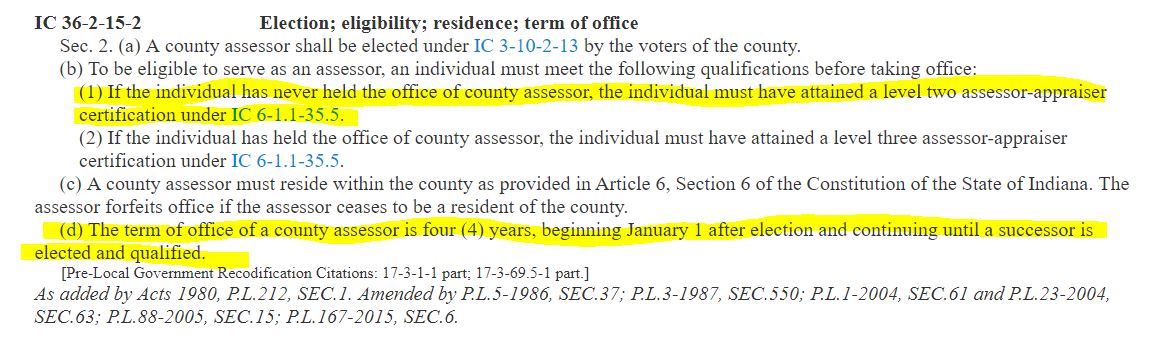
IC 36-2-15-2 Election; eligibility; residence; term of office
Sec. 2. (a) A county assessor shall be elected under IC 3-10-2-13 by the voters of the county.

(b) To be eligible to serve as an assessor, an individual must meet the following qualifications before taking office:

(1) If the individual has never held the office of county assessor, the individual must have attained a level two assessor-appraiser certification under IC 6-1.1-35.5.

(2) If the individual has held the office of county assessor, the individual must have attained a level three assessor-appraiser certification under IC 6-1.1-35.5.

(c) A county assessor must reside within the county as provided in Article 6, Section 6 of the Constitution of the State of Indiana. The assessor forfeits office if the assessor ceases to be a resident of the county.

(d) The term of office of a county assessor is four (4) years, beginning January 1 after election and continuing until a successor is elected and qualified.

[Pre-Local Government Recodification Citations: 17-3-1-1 part; 17-3-69.5-1 part.]

As added by Acts 1980, P.L.212, SEC.1. Amended by P.L.5-1986, SEC.37; P.L.3-1987, SEC.550; P.L.1-2004, SEC.61 and P.L.23-2004, SEC.63; P.L.88-2005, SEC.15; P.L.167-2015, SEC.6.

This passage doesn't say Sinks couldn't run for the assessor's office. Rather, it specifies what he must attain in terms of certifications before taking office (emphasis mine).

(d) The term of office of a county assessor is four (4) years, beginning January 1 after election and continuing until a successor is elected and qualified.

This clause reads almost as though the legislature foresaw the possibility that with new standards, confusion might arise.

Back to McAfee:

Even though he cannot yet take office, Sinks can take his oath of office at any point until Jan. 31, according to Brad King, co-director of the Indiana Election Division of the Secretary of State's Office.

He said Sinks will only be considered an office holder once he completes both parts of the qualification process for assessors, which includes both the oath of office and the Level II certification.

"As a result, until the individual completes both parts, the incumbent holds over until the individual completes qualification. There is no limit on how long that could be. He could qualify at any point in a four-year term."

Sinks will not be paid as an office holder until he passes his Level II certification test, King said.

Mountain, meet molehill.

Having searched far and wide, I nevertheless cannot find a bone to pick with Badger-Byrd. I've no way of knowing, but she might be the best qualified county assessor in the state.

However, contrary to the faux anguish and agitated blathering of local Democratic functionaries, who've smiled and grinned in the past while promoting candidates who were either barely literate or scarcely alive -- and sometimes both -- a fair election is a fair election, and one must wonder whether any of them bothered to read the relevant code before soiling their diapers.

Perhaps party chairman Adam Dickey has participated in so few fair elections that he can't even recognize one when it occurs.

As it stands, logic is taking another hammering as Dickey pontificates and caterwauls, complaining that straight ticket voting by Republicans is pure evil, with the best antidote being straight ticket voting by Democrats, and until then, advocating fair election results be overturned because of something the law does not appear to prohibit.

Ultimately, the Democratic Party's crocodile tears, while understandable in the context of its recent string of electoral failures, is little more than a tempest in Dickey's chamber pot, as Republican chairman Shawn Carruthers can see perfectly clearly.

"They know if we take the city they have nothing at all. We are coming for the mayor's office."

That's the real issue, but in closing, make no mistake: there are remnants of egg on Republican faces, too, primarily because of this:


Really?

Sinks failed an open book test?

Dude!

Saturday, November 24, 2018

Among Democrats elsewhere, progressive economics are ascendant. Here, it's all about a Baked Sale.


The problem for local Democratic cadres as they approach the rapids (municipal elections in 2019) is that 2018 midterm results gave them nothing (ahem) worth dropping anchor.

Consider for a moment the devotion inspired by epic loser Joe "Slavishly Licking Donald Trump's Loafers" Donnelly among the older Democrats; meanwhile, big losses suffered by somewhat left-of-center female candidates Anna Murray and Liz Watson seemed to suggest the task ahead is hopeless.

After Jeff Gahan and four mediocre council "Democrats," the deluge. How will they compete in 2019?

To the left? They don't know how.

To the right? But as Donnelly proved conclusively, if a pretend-Democrat veers too far Falangist, voters will opt for an unalloyed GOP candidate and not the substitute.

Gahan's assets are a cult of personality and lots of money. Will any of it trickle down to the Democratic council candidates?

The obvious answer: Democratic Bake Sale!


My suggestion is to stockpile Rice Krispies Treats and enjoy the show.

Progressive Economics Are Ascendant—Among Democrats, and at the Ballot Box, by Chris Hughes (The Nation)

It’s good politics and good policy, and should be a winning formula in 2020.

With the results of the November midterm elections, we have officially witnessed the end of Rubinomics. Former Treasury secretary Bob Rubin was the ringleader of an incremental, neoliberal economics ascendant in the Democratic Party in the 1990s and through the Obama years. The Rubin school oversaw the deregulation of banking and finance, free-trade agreements with insufficient worker and environmental protections, and the dismantling of core parts of the safety net with Bill Clinton’s “welfare reform” of 1996. These economists, taking a page from Ronald Reagan, argued that markets self-regulate if we just leave them alone.

History has proven them wrong, and this month’s elections signaled the start of a fresh approach. A decade out from the Great Recession, wages are still stagnant, and the cost of living is spiraling out of control. Even though typical economic indicators, like the low unemployment rate, suggest we live in a strong economy, exit polls show that only a third of voters say their own financial situation has improved in the past two years.

A new cohort of candidates this year chose to run on a clear, unapologetic economic progressivism as good politics and good policy. A new analysis found that two-thirds of the incoming Democratic freshman class in Congress campaigned on some form of Medicare for All or the expansion of Social Security. Nearly 80 percent campaigned on tax credits that benefit working families or on rolling back Trump’s tax cuts for the wealthy ...

Thursday, November 15, 2018

Shawn and Ann Carruthers "foster unity and cohesiveness in Southern Indiana."


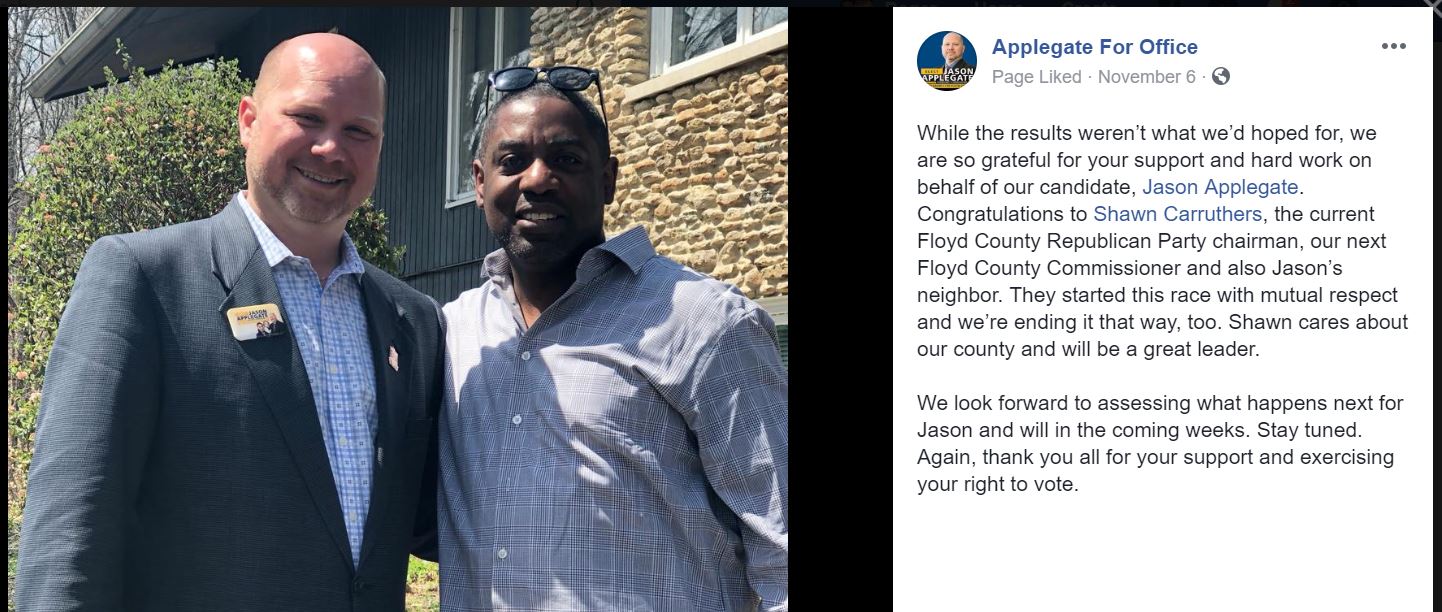
The photo above was borrowed from Shawn's Facebook page. The one below testifies to the ability of our two most recent candidates for commissioner to run clean, respectful campaigns.


We get too few feel-good stories amid the local political scene. This is one of them.

Shawn, Ann Carruthers excel through service, by Melissa Goforth (Tom May's Lair)

 ... Ann and Shawn both say they tackle their respective work with the same desire to foster unity and cohesiveness in Southern Indiana.

Shawn says he is focused on leading his county’s Republican party and working to find common ground across the board as a county commissioner to benefit every resident.

“I don’t have any big plans for the next political position. I’m focused on the here and now, making sure I do the best job as a commissioner to help people,” Shawn said

“I understand that I am on a three-member board, which is a small board that represents a lot of people. So, I want to take every one of those concerns very seriously and just be the best commissioner I can be today and make sure that Floyd County moves forward, and it is the best county in this area.”

For Ann, her passion is centered around helping those in need, especially when it comes to her work as the president of the local non-profit organization Prevent Child Abuse and, in her desire to empower those struggling with mental health issues.

As a New Albany township trustee, she hopes to utilize that platform in expanding her mission to improve and influence the lives of local youth and families.

“We’re team players, and that’s kind of the core of how we make things happen,” Ann said.

While it’s easy to see how the couple has risen to the top, they didn’t begin there — or even aspire to be in such high-profile roles.

Their journey together began more than two decades ago when they met at a church function for youth ...

Sunday, November 11, 2018

Amid Adam's wreckage, the case for optimism: "The advances made by liberals last week render Trump’s talk of all-out victory absurd."

It's true that we've been holding straight to the fire the tender feet of local progressives who consistently apply their progressive beliefs to state and national issues alone, and ignore the daily violation of precisely these same principles by their conniving party chieftains right here in New Albany and Floyd County. here's a sampling:

Pretty in Pink Slips: "The Indiana Democratic Party is badly broken, and party leaders must let go of what worked in the not too distant past."

Embarrassment as "the Donnelly campaign demonstrates the futility of seeking to surmount these obstacles by trying to out-Republican the Republicans."

No blue wave, but white flags aplenty as the GOP dominates Floyd County in mid-term elections. Time yet for heads to roll?

Anna Murray's amazing post-election statement.

So immutable is the chairman that he need not speak twice, seeing as he said nothing the first time.

By the way, has the local chairman tendered his resignation yet? As a friend so eloquently stated reality:

When will local Democrats hold the county party accountable for the losses encountered in the last three cycles? Let's remember - not just the losses of Eurton & Badger-Byrd this round, but Chuck Freiberger in 2016 and the loss of the City Council control in 2015 when Baird and Gonder lost. We've watched the FCDP leadership execute the same plan of action year after year despite continual losses. Does anyone believe the FCDP exists for anything other than protecting the leadership's self interest and protecting the Mayor and his clique?

In short, if you're giving Jeff Gahan a pass on matters like campaign finance payola, public housing demolitions and the mayor's eternally duplicitous "Bumbling Mister Rogers Meets Pure Megalomania" fix-is-in persona, you may think of yourself as a progressive, but you're missing a great many obvious points about the nature of hypocrisy.

However, as the future of progressive political thinking pertains to other faraway places and not the confines of the gilded executive washroom in our emerging Reisz Mahal, let's examine the case for optimism.

Wouldn't it be interesting for all of us to talk about how these progressive trends apply here, in this place, without submitting yet again to the local Democratic leadership imperative wherein any discussion about progressive ideals must first pass through the tentacles of Gahan's Money Machine -- to be scrubbed of all their fundamental meaning?

The message from the midterms: a new, progressive US is slowly taking shape, by Will Hutton (The Guardian)

The advances made by liberals last week render Trump’s talk of all-out victory absurd

It has been a dark two years in Britain and the US. The future had seemed to be captured by the worst of the Anglo-American right, a populist, anti-foreigner, anti-EU, ultra-libertarian, anti-common decency alliance that extended from Donald Trump via Nigel Farage to Jacob Rees-Mogg. They were the masters now. If you believed in anything progressive, forget it.

Tuesday’s midterm elections in the US did not lift the pall, or so it seemed at first glance. Trump insisting on “a near-complete victory” in the hours after the polls had closed when the Republicans had lost control of the House of Representatives was vainglorious overclaiming, but it was not wholly stupid. The immediate consensus was that the hoped-for Democrat wave had turned out to be little more than a ripple. They had not won as many seats in the House of Representatives as they hoped, while the Republicans seemed to have consolidated their grip on the Senate. Where Trump had campaigned hard, the Republicans had won. The odds of him being re-elected in 2020 had shortened. Progressive politics was dying.

But look again a few days later and the story is very different. More Americans turned out to vote in 2018 than in any midterm election since 1966 – and more than 10 million more of them voted Democrat than Republican. As the late counts come in, the Democrat tally of gains in the House will top the targeted 30, including what seemed like improbable wins in Republican strongholds in well-heeled suburbs. This is the strongest rebound in recent decades and in an election year when the economy is booming.

The picture in the Senate is also much more mixed than it seemed on Wednesday morning. The Democrats held Montana when it seemed lost, they took Nevada and at the time of writing are ahead in Arizona. In Florida, the race is so tight both for the governorship and Senate that there will be a manual recount. Sherrod Brown won Ohio, a state that went for Trump in 2016, by a stunning 10% margin. The three states that handed Trump the presidency – Wisconsin, Pennsylvania and Michigan – now all have Democrat governors. Texas, one of the most conservative states, was only narrowly held with Beto O’Rourke falling just short against the Republican incumbent. For Trump to call this a near complete victory is fatuous.

O’Rourke’s campaign was particularly illuminating about what is happening in the US. He’s an across-the-board progressive with openly liberal commitments: universal healthcare; an assault on misogyny; pro-immigration (it makes the US strong); for accountable capitalism and gun control; and in favour of ending the federal prohibition on marijuana. He was even against the militarism of US foreign policy.

His cause seemed hopeless. He spoke in favour of black American NFL football players who had taken the knee when the national anthem was played (“There is nothing more American than to peacefully stand up, or take a knee, for your rights”), courage of a high order in Texas.

But from an unpromising start – a couple of friends and a rented car – his candidacy caught fire. He campaigned in every one of Texas’s 254 counties and through his website portal ActBlue raised a stunning $70m. By the end, he had recruited 25,000 volunteers; 71% of 18- to 29-year-olds voted for him, along with 39% of “Anglo women” – the most conservative in the US. He made liberalism popular in Texas of all places and came within a whisker of winning.

It is a pattern reflected across the US. Symbolically, Richmond, Virginia, the capital of the confederacy and the ultra-conservative city, fell to the Democrats. Almost every city and large town in the US is now controlled by Democrats; 60% of women voted Democrat. The rightwing view is to mock as liberal fads “political correctness”, the #MeToo movement, greens, climate change, the young’s embrace of the view that gender is a continuum, respect for other cultures, the growing trend for vegetarianism. Instead, let’s hang ’em, shoot ’em and fuck ’em – vote for Trump in the US (and Brexit in Britain).

But the message of the midterms is that this is not what the vast majority of Americans believe in or want. The majority culture so far has been denied its full expression by the US electoral system. Rural conservative states such as Wyoming and North Dakota, with fewer than a million voters, return the same number of senators as urbanised California with 40 million people.

Add the gerrymander of creating artificial districts with Republican majorities and suppressing the votes of blacks and ex-prisoners and the pro-conservative bias is near complete.

Yet the nearest the US has to a national election where those preferences can be expressed is in the House of Representatives. It now looks more like the US than ever – emphatically controlled by O’Rourke-style liberals with a record number of women, of whom two are Muslim. California and New York are now fiercely Democrat, as are the young, African Americans and Latinos. They enlist social media, not in centralised hothouses and data farms, but in myriad individual networks. They are the future, rejecting wholesale Trump’s rhetoric and values. They and O’Rourke’s charisma could carry the country, making inroads into the rural and smalltown US that its political system so privileges.

As in the US, so in Britain. This is where our culture is settling too, masked by our overwhelming rightwing media. Brexit, contrary to Jeremy Corbyn’s defeatism, can be stopped. A “people’s vote” would capitalise on the same trends and save Britain. All we need is the Labour party to wake up – and back it.

Saturday, November 10, 2018

Embarrassment as "the Donnelly campaign demonstrates the futility of seeking to surmount these obstacles by trying to out-Republican the Republicans."


This guy who wrote this piece teaches at Indiana University, the same place where Romeo is playing basketball.

The Guardian is big-time, so please pay attention.

Are there any questions?

The Democrats shouldn't move right to win Trump voters. Here's why, by Jeffrey C Isaac (The Guardian)

The midterms showed that pandering to Trumpism is a recipe not just for defeat but for demoralization. Even losing progressive campaigns brought hope

 ... How should the Democrats move forward with an eye toward 2020 and beyond? There are no easy answers, and in the weeks and months to come many answers will be debated. Democrats scored most of their victories in more or less liberal suburban and urban areas where Hillary Clinton won in 2016, and experienced defeat in much of Republican “red state” America, and especially the rural areas, where Trump won in 2016. Do the Democrats need to do better in these conservative, “red” areas? Certainly. Should Democrats attempt this by running candidates who play to the right and appeal to elements of Trump’s base? Many pundits are already stepping forward to urge this. I disagree. And the case of my home state of Indiana is instructive.

Is it ever.

One of the most striking Democratic losses on Tuesday was the resounding defeat of the incumbent Senator Joe Donnelly by conservative Republican Mike Braun. 

The word "loss" simply doesn't convey the odiousness.

The worst features of Trumpism dominated the Indiana Senate race. How did Donnelly respond? By emphasizing his closeness to Trump and the fact that he voted with Trump over 60% of the time, and by campaigning not against his rightwing attackers but against the left of his own party, running his own anti-immigrant, anti-liberal, and red-baiting ads.

It was a destructive and cynical calculation that severely compromised Donnelly’s integrity. More importantly, it was an abysmal political failure. Indiana voters drawn to Trumpism demonstrated on Tuesday that they strongly preferred a real, unadulterated Trumpist to a Democratic facsimile. And so Donnelly lost. First his soul, and then the election. A significant Democratic defeat.

Let's repeat that: "They strongly preferred a real, unadulterated Trumpist to a Democratic facsimile." And yet, how many self-styled local "progressives" voted for Donnelly and Liz Watson?

Area chiropractors should be having a field day.

Democrats lost big in Indiana. But some electoral losses can be seen as ethical and even political victories. And so I turn to Indiana’s ninth congressional district, and to the effort of Democrat Liz Watson to unseat one-term incumbent Republican Trey Hollingsworth.

As we already know, Watson also lost big.

In a way, the electoral margin underestimates the power of (her) loss. For while Watson campaigned tirelessly for months, holding town halls in every county in the district, Hollingsworth did virtually nothing. He held no town hall meetings, and he refused to debate Watson even once. One of the richest men in Congress and a beneficiary of all of the Trumpist support thrown to Republicans in the state, Hollingsworth demonstrated a cynical contempt for the competitive elections and public accountability that are the hallmarks of constitutional democracy. And he won.

Hollingsworth’s victory is a devastating blow for Indiana liberal Democrats, and it underscores just how stacked is the deck against Democrats in the state, who confront a trifecta of serious obstacles: gerrymandered districts profoundly favoring Republicans; garden-variety Republican voter suppression; and a general electorate demographically inclined towards and seriously mobilized by the right.

At the same time, while the Donnelly campaign demonstrates the futility of seeking to surmount these obstacles by trying to out-Republican the Republicans, the Watson campaign demonstrates the potential for something better ... Unlike Donnelly, she refused to turn on her own base. Instead, she tried hard to expand that base. Watson lost, indeed by roughly the same margin that Donnelly lost. But while Donnelly inspired widespread disillusionment among liberal Democrats, Watson inspired hope, in the promise of citizen activism, and in the possibility of a better Democratic party.

The author goes on to make the point that Watson's loss can be rationalized according to future-oriented strategy, while that might possibly be gained from Donnelly's dopey foolishness is a desire to take as many showers as possible in a futile effort to out-distance the taint.

Friday, November 09, 2018

Anna Murray's amazing post-election statement.


Trying to decide what to do next? Municipal election cycles are underway for 2019. Not all of Anna Murray's issues and principles pertain to mayors and city council persons, but a good number of them do, and these are the grassroots where change must begin if it is to occur.

I find her statement fascinating on multiple levels. Maybe mayor of Jeffersonville?

---

I suppose it's about time for me to make a statement about the election. I've actually been fairly busy taking down signs, getting back to some cases, and so forth, but also needed a little time to process my emotions.

Honestly, it's a bit of a relief that I didn't win because going up to Indianapolis all the time was going to be a huge hassle and take a lot more time away from my family. Now I will have many fewer worries and obligations than I would have if I won. On top of all that, I knew that I wouldn't realistically be able to accomplish much in Indianapolis, especially since we only won one other seat in the Senate. I may have had a slight impact, but there is still an overwhelming Republican super majority, so all of the additional effort for me to be in Indianapolis would ultimately not create much real change. So there is definitely a silver lining to losing. Freedom.

I am very happy with the race that I ran. I am so thankful to everyone who helped me along the way. It has been a great experience meeting so many new friends, and I have definitely learned a lot about myself, about politics, and about people.

On the flip side, I am bitter about Ron's win because I do not believe he ran a better race. He spent a lot of money spreading outrageous lies about alleged plans which I not only did not have, but could not possibly have had, since Medicare is handled federally and I was running for a state position. So I do not respect his approach of lying and fear mongering to try and defeat me. And honestly, I don't think he won this race through his efforts. Republicans, generally, won this race. He won because of the party that he is affiliated with. Ron did not conduct himself as a gentleman, at one point knocking my materials off of a table onto the floor. But his "nice guy" image remained solid in everyone's minds. In reality, he's just a part of the good ol' boy network which has dominated politics forever and needs to be changed. I learned other things about him during this campaign which I will not share. But I'm not going to pretend like there are no hard feelings. I am an honest person and a human being, and that's just how I feel.

I am frustrated because I do not believe Ron will make the effort to bring the change that this state and this district needs, and I highly doubt he will have plans to run for a 4th term as he nears 80, so I do not believe there will be anything to make him feel accountable to his constituents. He will pander to his friends and leave those with food insecurity and who are homeless to fend for themselves.

I do hope that the strength of this progressive campaign sends a message to all Republicans throughout this state. That you cannot continue making it a crime to use medicine that helps you. That more poor-paying jobs are not going to fix poverty, nor are good-paying jobs that are inaccessible to people with limitations of many types. Poverty leads to poor education, child abuse and neglect, homelessness, untreated mental and physical illnesses. Stop maintaining a poverty class and allow everyone to live in dignity with a decent standard of living. That substance use disorder is a medical condition that needs to be treated medically. We don't throw people with medical conditions in jail. If they commit a crime like theft or DUI, sure. Make sure our insurance companies have to cover treatment, and if you need to bill somebody, send it to big pharma. They made a killing- figuratively and literally- on opioids and were a major contributor to our problem. If you need even more money for education or treatment, just fully legalize cannabis. We'll make millions in tax revenue and stop spending so much on jailing people for something that is safer than alcohol. Then we could fix our roads, too.

Beyond Ron, I am frustrated with our country as a whole. As we sit here being divided and fear mongering about poor people or people of color or people who aren't born here, or people with a different religion, we are letting the true risks- of climate change, pollinator endangerment, exposure to hazardous chemicals, and plain old hate; and the true villians- those wealthy beneficiaries of the status quo who continue to perpetuate these problems for profit, which those in power are ignoring or even covering up, and we don't have time to keep twiddling our thumbs and complaining about fake news. We are on the precipice of a planetary disaster. Our economy is on the verge of a rapid and dramatic change as a result of automation. Our healthcare system causes people to go bankrupt and become homeless or go without treatment and die while the insurance companies pay their CEOs tens of millions of dollars a year and spend hundreds of millions of dollars lobbying legislators to keep it that way. And yet so many people think that the reason they are struggling financially is because poor people are lazy. God forbid we tax those billionaires a little more to help our Veterans, seniors, disabled or hungry children. Stop taxing the wealthy and cut the benefits of those slackers instead! The wealthy need more boats and bigger houses so that we can have jobs cleaning them for less than a living wage! Don't regulate those big companies just to protect your drinking water or keep your children from getting asthma- it will tank corporate profits!

I am not giving up because these problems are not going away. These problems affect us all. It is time for us to find our common humanity and stop separating ourselves into different groups which we can then dehumanize, denigrate and ignore. It is time for us to listen to science- you know, that thing that lets you fly through the air and go up an elevator into a skyscraper. Remember science? It's quite reliable and we trust our lives with it all the time. Well it's telling us that it's time for change or the consequences may be quite dramatic for our and every other species. If you only respond to fear, then start paying attention to what the world's climate scientists are telling you. Start looking at the harm that OUR policies are causing our own people. Start looking inside of yourself. Are you making this world better for everyone, or are you full of hate and fear and allowing that to blind you to your humanity? Or are you just so well off that you don't feel inclined to pay attention? Very common, and an understandable position to take, but the epitome of privilege.

People are actively suppressing their ability to feel compassion- making fun of it by calling us snowflakes. Responding to expressions of genuine concern with hateful name-calling. Well what some perceive as our greatest weakness is actually our greatest strength. It's that thing that makes us human and differentiates us from machines. The ability to care and love and spread joy and to be able to acknowledge the suffering of others is what makes life worth living. We are more than consumers and there is more to life than just hoarding your wealth and buying new things. We are people and it's time for us to start living with respect for each other and respect for the planet.

I am still trying to decide what I want to do next. I don't know if I have the patience for any more of this politics business, nor if we have the time. I have to say my current mood is somewhat more on the revolutionary side of things. That's all for now..

Thursday, November 08, 2018

Straight-party ballots in Floyd County were way up on Tuesday. Will this development factor into municipal races in 2019?


I'm currently jet-lagged. In fact, I cannot recall being THIS jet-lagged. There were two transatlantic flights, a European time change at the start, and an American one at the end. I was ready to go back to bed just after breakfast today — I mean, tomorrow.

Consequently, those readers with a better fundamental grasp of mathematics, and who are NOT jet-lagged, are invited to compare the information below to the overview of the most recent municipal election cycle in 2015. I believe the numbers from 2015 suggest that as straight-ticket voting pertains to precincts inside the city limits, it favors the Democrats.

At the same time, only 33% of the votes cast in 2015 were straight-ticket -- and, of course, municipal election cycles are isolated, with no nationwide shadings or implications.

Kudos to the assistant newspaper editor's eyes for roving beyond the bare minimum typically deployed by the Nawbany bureau chief.

Straight-party ballots the difference maker on Election Day in Southern Indiana, by Jason Thomas (Tom May Content Compiler)

SOUTHERN INDIANA — Straight-party ballots were at the top of observers' minds Wednesday after an historic midterm that saw voters turn out in shocking numbers for an off-year election.

What happened locally Tuesday night was a reflection of the tone nationally, with more Southern Indiana voters embracing a conservative Republican agenda than those who sought to sweep a so-called "blue wave" of Democrats into office.

A whopping 52 percent of the more than 32,000 ballots cast in Floyd County were straight-party tickets, while 38 percent of the nearly 44,000 ballots cast in Clark County went for a straight ticket.

Statewide voter turnout numbers weren't available Wednesday, but an official with the Secretary of State's Office said it could be the highest midterm election turnout of the 21st century in Indiana.

Wednesday, November 07, 2018

No blue wave, but white flags aplenty as the GOP dominates Floyd County in mid-term elections. Time yet for heads to roll?


Mr. and Mrs. Confidential returned from Gdansk on Tuesday evening just in time to listen to local election returns on WNAS.

It's one thing to mentally process a week overseas, especially in a locale with as much history (and such a vibrant present) as Gdansk. It's another to sort through the aftermath of a mid-term.

In addition, I'm delighted to be returning to actual work for the first time in a while, and two magazine articles for Food & Dining are scheduled to be written yesterday. The eight ball looms.

This is my way of a saying that it may take a while to catch up, so let's start with a few off-the-cuff observations about the local political scene.

  • As for yesterday's local mid-term results, even if I seldom gloat: I TOLD YOU SO. There wasn't going to be a "blue wave" hereabouts. The Democratic Party has too much to do to rectify its internal contradictions, and the GOP is playing a hot hand right now.
  • The 2019 municipal election cycle began at midnight. This is going to be fun.
  • Floyd County Democrats are in their worst position in the city of New Albany in a generation -- maybe a lifetime. However, there's a new generation of useful local Democrats, if only they might be deployed properly. 
  • They're not, so Adam Dickey immediately should offer his resignation as Floyd County Democratic Party Chairman.
  • Dickey has presided over an escalating series of electoral disasters, and no human should be automatically gifted with ongoing tenure based on failure. Undoubtedly Dickey's resignation would be refused, because the party seems to believe it possesses no other subalterns capable of stepping into his shoes. However, we all might be surprised. They're actually there, just overshadowed by Dickey's staggering ineptitude.
  • Jeff Gahan now is ascendant, and stands as the single greatest future hope for local Democratic relevance. He's also extremely vulnerable, but only if all his opponents, left and right, can manage to work together to defeat him. 
  • EMPHATICALLY: This remains to be seen. 
  • Congratulations to David Brewer, hitherto one of the least objectionable and most functional of Team Gahan's appointees. David needs to clarify one point immediately: Does he intend to remain in a salaried position as Building Commissioner and draw the township trustee's pay? 
  • Bigger kudos to Shawn Carruthers, the county's first African-American commissioner and the highest-ranking African-American elected official locally since city councilman Bob Mitchell's departure in 1988.
  • Carruthers defeated Jason Applegate. Both are quality individuals, and I was troubled not by Applegate's belated candidacy itself, but by the way Dickey crassly manipulated it as part of a (predictably failed) master strategy, first kneecapping LaMicra Martin's primary bid, then attaching Jason to the same old Gahan Money Machine donors who are this city's biggest problem, not our ultimate solution. 
  • I'm also concerned about Extol Magazine's ambiguous role in all these maneuverings, which I consider a tad ill-conceived if not unethical; more on this another day.
  • Jason is smart and sincere. He has a viable future in local politics if he wants it. My recommendation, worth almost nothing: Stay away from the local party's petty big-fish/little pond games and those troublesome big-bucks donors; rather, be independent in style, if not in party affiliation. Go to the grassroots, contest a council seat or some such, and do some good in the community.  

There are numerous omissions to the preceding. My brain's still back at the Baltic seaside.

Congratulations to all the candidates who put their names forward and ran for office -- and the ones who are about to. The next six months are going to be a wild ride, folks.

Friday, October 26, 2018

Grooms versus Murray for State Senate.


For my scant money, this race is one of two genuinely compelling ones during the current election cycle (the other is Liz Watson and the filthy rich Tennessean for Congress).

In Depompei's preview, Grooms isn't shy about the notion of car-centrism as an inevitable pillar of regional economic development. Conversely, while referencing her opponent's traditionalism in the final paragraph, Murray has nothing to say about alternative, multi-modal transportation options.

As such, both candidates are conceding the daily absenteeism of One Southern Indiana as it pertains to taking for granted a future of single-occupant cars fighting for space on ever-widening roads, and encouraging the ensuing mayhem.

By not talking about cars, we continue to miss the boat. 

Opposites vie for Indiana Senate District 46, by Elizabeth Depompei (Chronicle of Tom May)

 ... To Grooms, the biggest difference between himself and Murray comes down to one word: experience.

"Experience and understanding and knowing the community. No comparison," he said.

He points to his involvement in issues like the opioid crisis (he authored the state's first pill mill bill) and education (increasing tuition support across schools in his district). It also helps, he said, to be a part of the supermajority held by his fellow Republicans in the Senate, "... which allows me to serve the constituents of my district much better, because I can get a bill heard in committee. I can be on the forefront of discussion," he said.

Murray said her experience as a lawyer has prepared her to work across the aisle.

"I'm used to negotiations and I know how negotiations work," she said.

She embraces her inexperience in political office, saying she offers a new perspective.

"He [Grooms] is still embracing policies that have been around for quite some time and in my opinion policies that have gotten us to the place we're at in terms of our statistics and our quality of life and our health and our general wellbeing of our population," she said. "We are failing."

Monday, October 22, 2018

From WNAS, it's the 2018 general election candidate profile videos for your viewing pleasure.


There are no 18-minute epics (that's an inside joke from 2015), but here's the lineup of candidate profile videos from WNAS -- county and township offices first, then state and national offices (sheriff bundled with the latter).

---


This is a profile show of the candidates that appear on the ballot in Floyd County for the 2018 general election. Election Day will be Tuesday, November 6th. This video highlights the races at the city and county level.

Intro 0:00
Clerk of the Circuit Court 0:12
County Auditor 6:01
County Commissioner - District 1 16:37
County Council - District 1 31:15
County Council - District 2 35:37
County Council - District 3 41:29
County Council - District 4 48:24
Georgetown Township Trustee 51:25
New Albany Township Trustee 54:43
New Albany Township Board 1:04:42
School Board - District 1 1:12:30
School Board - District 2 1:20:17
School Board - At Large 1:30:40

---


This is a profile show of the candidates that appear on the ballot in Floyd County for the 2018 general election. Election Day will be Tuesday, November 6th. This video highlights the races at the state and national level as well as for Floyd County Sheriff.

Intro 0:00
Indiana Secretary of State 0:12
U.S. House of Representatives - 9th District 4:05
State Senator - District 46 9:20
State Representative - District 70 16:55
State Representative - District 72 19:22
Floyd County Sheriff 30:36

Friday, October 19, 2018

On the topic of the forthcoming Floyd County election.


On social media, my close friend Mark Cassidy had this to say:

"I’m voting for Steve Burks. Who is with me?"

Burks is the Republican incumbent as New Albany Township Trustee, and when another reader asked why, Mark clearly explained.

Steve has proven to me that he can be even-handed. I need to take lessons in respectful discourse from him. Yes, he and I will not agree on many national issues, but that does enter into Trustee duties. Honesty, respect, and civility mean a lot to me on the local level, qualities sadly lacking in the local Democratic Party and most of their candidates. That’s why I’m voting straight Republican in city/county elections until the leadership of Floyd County Democrats is changed. I encourage you to do the same. I know it hurts some “good ‘uns” but those people need to stand up and be counted. I see little sign of that. If they want my vote, and hopefully many others, they'd better start.

For a very long time I've been debating what a marooned Euro-zone Social Democrat like me, still hugging left amid a flood of pathetic Joe Donnelly climb-downs, might contribute to this dialogue.

With the exception of previously stating a tactical expression of support for Carrie Klaus, the Democratic candidate for New Albany Township Advisory Board -- which I've undertaken because of the hope, forlorn or otherwise, that she'll soon cross over to the correct side of "street grid is social justice" history -- I've been unwilling to say much for the record.

However, I replied to Mark at Facebook, and will repeat my response here, in slightly augmented form.

Where there is a Libertarian alternative in state races, I'll vote Libertarian. This spares me the pure nausea of contemplating Indiana's U.S. Senate race, already the impetus for a vast increase in air sickness bag sales. As for Tennessee Trey, well, no.

Liz Watson there. 'Nuff said.

I'm pretty much in line with Mark at the local level apart from a contrarian's unwillingness to vote straight-party-anything.

As such, the prime exceptions for me are the aforementioned Klaus (but has she taken a position on the public housing putsch? It might be a deal-breaker) and Anna Murray, who is challenging Ron Grooms for our State Senate seat.

To me, as with Mark, the prime objective of the mid-term election in 2018 is acting in whatever way that hastens the dissolution of the Dickey/Gahan/Nash "numb-o-cratic" clique, plain and simple.

Another election cycle of DemoDisneyDixiecratic losses and the way should be cleared for the clique's final breakdown in 2019.

This means I'll be casting votes for Republicans. There was a time when this might have been a breathtaking revelation, but now, in addition to the imperative of dismembering Dickeyism, I can honestly say that having come to know local Republicans a bit better over the years, I've found vast tracts of common ground at the grassroots level of local governance.

I can't be a Republican, ever. I'm a left-winger. They're not. But using Mark's words as a guide-- honesty, respect and civility -- my conscience is clean and serene.

Yes, this means refraining from voting for a few quality Democrats, ones I know to be competent; in some of these races, both candidates are quite worthy. It pains me, and rest assured it actually isn't "personal" in any of these races, but as Mark so presciently notes, their cognitive dissonance has grown tiresome.

It's long past time for the ones who actually "get it" to stand up, step forward, and challenge the local Democratic Party's catastrophically narrow orthodoxy.

If the rotten patronage structure can be torn down now, maybe it can be rebuilt into something genuinely useful, consistently ethical and worthy of a leftist's support for the future.

That's all I have to say about it. The Confidentials will vote next week at the clerk's office, then leave town for a trip to Gdansk, Poland and a visit to the home of the Solidarity trade union movement. I'll be visiting the European Solidarity Center in Gdansk for a few lessons in history and democracy of the sort seldom encountered at 312 Bank Street.

In closing, having been a candidate for office twice before, allow me to commend everyone locally who has chosen to run -- even if I disagree with you. The community needs lots more contestants next spring in the primary for municipal positions, but we can't make sense of 2019 until the evening of Tuesday, November 6.

Thanks for reading.

Tuesday, October 16, 2018

Local chain newspaper commences anodyne election coverage with Floyd County Commissioners District 1 contest.


"Anodyne" doesn't merit a "Shane's Excellent New Words" tag, but here's the definition.

an·o·dyne
ˈanəˌdīn
adjective
1. not likely to provoke dissent or offense; inoffensive, often deliberately so.

Shawn and Jason are competing for the seat held by Mark Seabrook, who'll seek the office of mayor in 2019. Articles like this one are about as substantive as the chain newspaper will get between now and election day.

I'd recommend contacting either of the candidates if you want more information. Both are friendly and accessible. I have my preference, although as noted previously, there'll probably be no formal endorsements at the blog this cycle.

I'm hiding in plain sight, you know.

New face to join Floyd County Commissioners, by Chris Morris (Maybune)

Applegate, Carruthers both want smart growth

NEW ALBANY — Jason Applegate believes in smart growth. He said Floyd County has a comprehensive plan, and that plan should be followed moving forward.

Shawn Carruthers would like to see high tech companies come to the county, and thinks the proposed innovation park in Georgetown is the perfect location for those types of businesses to flourish.

Saturday, October 13, 2018

I'm supporting Carrie Klaus for New Albany Township Advisory Board because I believe she'll come to agree with us about social justice and the street grid.

Expensive and useless. We can do better.

I've been sitting on this for almost two months, thinking about it and trying to come up with the best way to be constructive in my critique of a letter that appeared in the local chain newspaper on August 19.

If the writer weren't a Democratic candidate for New Albany Township Advisory Board, I probably wouldn't even have noticed the letter. Because Carrie Klaus is running (as an aside, she is a founder of Soindivisible), it strikes me as important, if for no other reason than my preference in voting for those who are informed and aware of contemporary trends in street grid thinking.

And, by extension, we take these trends very seriously at NA Confidential. Keep reading, and I'll explain why I support Carrie's candidacy even though we seem to disagree on this particular issue ... so far, at least.

Let's begin with the letter itself, reprinted here in full.

4-way stop on busy street bad idea

In response to Wednesday's article "New Albany to monitor road......" * and Ron Howard's suggestion to consider a 4-way stop at Fourth and Spring due to parked cars blocking the view at the intersection. As a downtown resident and business owner who travels these roads often, I think a 4-way stop on a major thoroughfare is a terrible idea, and one that will just shift the problem the residents of Spring Street are experiencing to neighboring streets, such as Market Street, where I live and work, as people try to avoid the congestion created by a 4-way stop.

A better solution to the problem of not being able to see around parked cars would be not allowing cars to park all the way to the street corner. In some locations downtown there is such a small buffer between the last parking spot on a block and the corner that it is nearly impossible to see oncoming traffic without literally being in the driving lane. Take the corner of Holy Trinity Way and Market Street for instance, and go see for yourself.

As a pedestrian and biker in downtown, I agree that something needs to be done about the speed of cars traveling on our streets, but shifting the problem off on other downtown residents doesn't seem the solution. On Market Street we already struggle with vehicles traveling at high rates of speed, including law enforcement that are not out on runs. Creating congestion with a 4-way stop will only make that problem worse for us. And quite frankly, as a motorist, I don't want a downtown filled with 4-way stops. If we start making motorists stop at every intersection, it won't be long before they decide to avoid our downtown altogether.

— Carrie Klaus, New Albany

In effect, Carrie is saying that while speed may be a problem on Spring Street, anything the city does to reduce it would have the effect of sending traffic to other streets, like hers, and this would be improper because that's what Spring Street is for -- to carry a high volume of high traffic speedily from one side of town to the other, come what may for those trying to develop safe and healthy neighborhoods along the way.

The easiest way to counter Carrie's argument is to become familiar with Jeff Speck and read his New Albany Indiana Downtown Street Network Proposal.

New Albany's Downtown Grid Modernization Project in 2017, which conceptually owes its existence to Speck's opening proposal, was not fully implemented. In fact, it was barely implemented at all, owing to the local Democratic Party's stubborn unwillingness to challenge rampaging car-centrism, but still the stated intent of the project was to spread local traffic among four two-way streets, rather bottleneck it on two.

Four thoroughfares are better than one -- IF they're designed to reduce speed. Unfortunately, the latter was ignored by Team Gahan.

Actually, the problems we've had since implementation in terms of persistent speed and recklessness on Spring probably can be attributed to there being too little congestion, not too much. The same applies to Market, and Elm, and even Main.

Traffic always is slower during peak commutes; the speeds (and danger) increase when there are fewer cars during the other 22 hours in a day, hence Speck's original intent of bicycle lanes on Market and Elm as well as Spring, and the current need to replace the feeble yellow-light pedestrian crossings with bolder and safer four-way stops.

Yes, we need at least two of them on Spring between 15th and 7th, and maybe a third between 7th and Bank. Pass-through drivers need to be using I-265, not Spring Street.

A very useful article to supplement Speck's thoughts can be found here. I'm including what seems to be a relevant concluding excerpt.

The Causes of Traffic and Congestion, by Andrew Price (Strong Towns)

 ... At the end of the day, we should not worry too much about congestion or traffic. Congestion is part of the solution, not the problem. Congestion is feedback that we have built a place people want to be. The response to congestion should be to allow that Mexican restaurant to open up 3 blocks away rather than 2 miles away. To create bus lines and bike lanes that give people alternative ways to get around. The incorrect response to congestion is to build faster and wider streets, because that just reinforces car dependency and all of the negative consequences that come with it.

To summarize:

  • Development can add traffic. However, development that brings amenities and people closer together and reduces the need to travel so far can actually reduce traffic. With a mixture of uses, you can achieve a high population density with very little motor traffic.
  • A highly-connected street network (either a street grid or organic) with many redundancies better distributes the load of traffic and is more resilient to disruptions.
  • Designated thoroughfares and bypasses create an illusion of traffic because they funnel the traffic through a single point (and with this comes the fragility of a single point of failure that can bring down the system).
  • Attempting to address congestion with solutions that make it easier to drive can make the problem worse by continuing to make the car the preferred way to get around.
  • We should not worry too much about congestion, because it creates demand for other modes of transportation and for amenities to be closer.

In summary, New Albany's more densely populated districts -- generally, inside the beltway, and most of all downtown -- need to function as a city, not as a suburb. The conversion of Speck's recommendations into a two-way paving project cost us the chance to make more progress toward urbanizing the street grid in a shorter amount of time. We've no choice at present apart from applying Band-Aids (for instance, the four-way stops) until another opportunity for advancement comes around.

I use the word "progress" in the preceding purposefully. Speaking for myself, I have a strong desire to identify with progressive policies, but they must be comprehensive and inter-related. To speak of social justice needs without applying these precepts to the way people move around is to neglect a very large piece of the puzzle.

I'll be voting for Carrie Klaus when we make it down to the clerk's office in the coming days. I know she's strong on the more commonly discussed social justice issues, and although we haven't met, it's clear to me that she's perfectly capable of seeing that the safest possible street grid for all users is a vital component of the larger social justice picture.

I'll stop there. Let the discussion begin.

---

* the original newspaper article to which Carrie's letter referred:

New Albany to take road, speed counts on downtown grid, by Chris Morris (Tom May Sussudio)

NEW ALBANY — Several residents, including a city councilman, asked the New Albany Board of Public Works & Safety last week to do something to slow traffic along sections of Spring Street after a man was hit and killed at Spring and E. Ninth streets on Aug. 6.

Officials heard their pleas and steps will begin soon to get a better grasp of traffic and speed on the downtown grid.

City engineer Larry Summers told the board Tuesday that traffic volume and speed will start being monitored immediately on all the streets that were converted to two-way last year, which includes Spring, Elm, Market, Bank and Pearl with "intense focus" on Spring.

"We want to get a better understanding of the traffic counts and speed so we can get an appropriate plan in place," Summers said.

Radar enforcement, similar to that on McDonald Lane, is a possibility.

Ron Howard asked the board to also consider a four-way stop at Fourth and Spring streets. He said cars parked along Spring make it difficult to see oncoming traffic.

Jackie Green on the ghettoization of independent candidates for Louisville mayor: "A form of media censorship — not censorship OF, but censorship BY the media.”


Before stealing a glance at the exclusion of independent candidates from the final Louisville mayoral debate, I'm turning to Jeff Gillenwater to articulate the crux of it.

I’ve spent decades now watching more thoughtful, compassionate people attempt to run for office under the Democratic banner in local, state, and national races. Over and over and over quite consistently, party officials at all levels have intervened, using the full force of their financial and political clout to defeat those candidates, to weaken those voices, and to make sure that their discourse and concerns, no matter how well documented and supported by evidence, do not become the center of policy debate, do not become a legitimate choice that voters can make. The idea that the Democratic Party in this country is an eager and effective agent or vehicle of significant social change simply isn’t true. When you donate to the party, you’re supporting the silencing and defeat of more thoughtful, compassionate voices. There’s no way around that so, if you’re going to do it, you need to own it and call it what it is.

It needed to be said. Now, let's look at yet another way media reinforces the two-party duopoly.

Independent candidates won’t share stage with Fischer, Leet in final mayoral debate, by Joe Sonka (Insider Louisville)

Independent mayoral candidates Jackie Green and Chris Thieneman say they were surprised and disappointed to learn last week that they will not be allowed to participate in the final televised mayoral debate next week, as only Mayor Greg Fischer and Councilwoman Angela Leet have been invited to participate in the live broadcast.

Pat Murrell, the president of the League of Women Voters of Louisville, told Insider Louisville last week that while all nine candidates for mayor were invited to its candidate forum to be broadcast on WAVE3-TV on Oct. 16, organizers recently decided to split the forum into two: one aired live on television and WFPL at 7 p.m., with the second one at 8:15 p.m., which will only be livestreamed on wave3.com and archived online on wave3.com and wfpl.org.

Only Fischer and Leet will participate in the forum that is broadcast live, while the independent candidates will participate in the second forum.

Wednesday, September 26, 2018

According to FiveThirtyEight, Trey Hollingsworth (R) is likely to defeat Liz Watson (D) in November.


FiveThirtyEight offers three House forecasts, none of which bode well for Liz Watson (D), who is challenging incumbent Trey Hollingsworth (R) in the 9th district congressional race.

How do you like your House forecast?

Lite: Keep it simple, please — give me the best forecast you can based on what local and national polls say

Classic: I’ll take the polls, plus all the “fundamentals”: fundraising, past voting in the district, historical trends and more

Deluxe: Gimme the works — the Classic forecasts plus experts’ ratings

It's a grim prognosis.

Lite forecast: 98.2% chance the Republican (Hollingsworth) wins 61.8% - 38.2%

Classic forecast: 78.3 chance the Republican (Hollingsworth) wins 53% - 47%

Deluxe forecast: 90% chance the Republican (Hollingsworth) wins 55% - 45%

From a national perspective, FiveThirtyEight provides a bit of relief for Democrats.


Considering the source? I read something at FiveThirtyEight almost every day.

FiveThirtyEight. | Nate Silver's FiveThirtyEight uses statistical analysis — hard numbers — to tell compelling stories about politics, sports, science, economics and culture.

Sunday, September 23, 2018

CONSTRUCTIVE COMMENTARY: Yes, Mills and Loop should debate, but can we leave the Illuminati accusations out of it?


Ah, the memories.

I can't help recalling the time in 2015 when the incumbent mayor had the opportunity to participate in Leadership SI's mayoral debate at New Albany High School, thus ensuring there'd be at least one session with all three candidates (yours truly and Kevin Zurschmiede) present, facing each other before the public.

I can remember all the prominent Democrats encouraging the mayor to do so, because the community could only benefit from such a gathering, and ...

Wait -- no, actually I don't remember.

That's because none of them did any such thing. Democrats were stone dead silent, and in the end, the two of us, Independent and Republican, had a conversation about issues, allowing the mayor's empty chair to speak for itself.

The point of this recollection is while I agree that the former sheriff Darrell Mills and current sheriff Frank Loop should debate, I'm unmoved by staged crocodile tears from undemocratic Democrats, who were perfectly willing to manipulate the debate schedule in 2015 to ensure the mayor would not be burdened with having to think on his feet.

What's more, for Mills to simultaneously reference his Leadership SI program participation while at the same time criticizing the organization with an unsupported inference that a relative of Loop's somehow is influencing Leadership SI's debate stance strongly suggests Mills wasn't paying close attention to the lessons being taught during his class days.   

In short, this strange press release linked below indicates a willingness on the part of Team Mills to (a) offer conspiracy theories about dark forces arrayed against it, and (b) throw both Leadership SI and IU Southeast under the bus in the process.

I find this attitude worrisome, but of course it's just my 'pinion. If NA Confidential had the resources, I'd offer to sponsor the debate, although only as governed by my own impeccable set of rules.

I've got nothing whatever against either candidate, both of whom are experienced. For the community's enrichment, Loop and Mills do need to debate, but for Mills to attack organizations and institutions for not undertaking the responsibility seems a rather petulant way to approach the ultimate goal.

Perhaps he needs to rethink this tactic. Let's hope the candidates come together and have that chat.

Mills' opponent continues to dodge debate ...

The lengthy process of trying to secure a debate for the benefit of the voters in Floyd County now continues. Mills was originally disappointed when he learned that Leadership Southern Indiana (LSI) was not going to sponsor a Sheriff debate this election cycle, as has been the case in previous elections. This was especially disappointing since both candidates for Floyd County Sheriff are graduates of the LSI program.

The Mills campaign was also concerned when it learned that a relative of the current Sheriff is a member of the LSI Advisory Board where they also serve on the organization’s community relations committee. This committee has been previously charged with running the logistics of LSI debates. The LSI Board of Directors issued a statement in late August stating that the organization will not host debates this year. Conversations between LSI and the Mills campaign reveal that the organization will likely continue to host debates again in the future, but for “capacity reasons” they are just taking a break from debates during this election cycle.

Based on his comments to the News and Tribune on August 28th, Sheriff Loop seemed open to a debate, but only with the two community groups who had already stated they were not interested in hosting a Sheriff debate this year. Loop said he would "absolutely" debate Mills. "I would be glad to entertain the possibility," Loop said. "I think somebody like a 1si (One Southern Indiana) or LSI (Leadership Southern Indiana) ought to put it together to make sure it is fair, but I would be glad to participate."

Friday, September 14, 2018

Here and there, "dislodging those corporate Democrats ... is a critical front in the effort to actually make America great again."


Writing at The Nation, John Nichols, finds reasons to celebrate New York's 2018 state primary results.

Big Wins by Down-Ballot Progressives Are Going to Transform New York Politics

... The change in Albany will be dramatic as a new generation of insurgents and reformers arrives. (Governor Andrew) Cuomo is likely to return with a more progressive bent—having been pushed left by the (Cynthia) Nixon challenge. The Democratic nominee for attorney general, Tish James, has served for many years in New York City posts as a labor-aligned progressive. And the legislature will be populated by a state senators like Alessandra Biaggi, who claimed her victory as a signal that New Yorkers would no longer “tolerate Democrats who would be empowering Republicans.”

If the local Democratic Party is to be purged in like fashion, candidates who aren't afraid to describe unclothed passers-by need to step forward and take "down-ballot" into places like the 2nd, 3rd, 4th and 5th council districts.

First, the bigger picture.

Yes, let's wipe out Trump. But take neoliberal Democrats with him, too, by David Sirota (The Guardian)

After a scorching summer of discontent, Donald Trump’s endless tweets and scandals have given Democrats their best chance to retake Congress since George W Bush’s second term. And yet, insurgent progressives are not limiting themselves to dethroning Republicans: they are taking aim at corporate-friendly Democrats within their own party, too.

Amid an upsurge of populist energy that has alarmed the Democratic establishment, a new wave of left-leaning insurgents have been using Democratic primaries to wage a fierce war on the party’s corporate wing. And, as in past presidential primary battles, many Democratic consultants, politicians and pundits have insisted that the party must prioritize unity and resist grassroots pressure to support a more forceful progressive agenda.

Not surprisingly, much of that analysis comes from those with career stakes in the status quo. Their crude attempts to stamp out any dissent or intraparty discord negates a stark truth: liberal America’s pattern of electing corporate Democrats – rather than progressives – has been a big part of the problem that led to Trump and that continues to make America’s economic and political system a neo-feudal dystopia.

Dislodging those corporate Democrats, then, is not some counterproductive distraction – it is a critical front in the effort to actually make America great again.

Sirota surveys a long train of abuses and usurpations.

Recounting this sordid record is not to dispute Democrats’ occasional successes. Some blue locales continue to periodically pass progressive initiatives, most recently on climate change, net neutrality and minimum wages. These are undoubtedly important, but they have for the most part been incremental at a time when the economic and ecological crises we face demand far more radical action.

The current iteration of the Democratic party has proven time and again that it is not merely uninterested in that kind of radicalism, but actively opposed to it. Party powerbrokers and multimillion-dollar MSNBC pundits would prefer an election focused exclusively on the palace dramas surrounding Trump’s boorish outbursts and outrageous personal behavior. They don’t want an election focused on the bipartisan neoliberalism that has wrought the desperation and mayhem unfolding outside the palace walls.

Out here, though, economic reality has proven the scripted red-versus-blue theater to be a bread-and-circuses distraction from the fact that both parties are culpable for this moment of crisis. America is now in backlash mode, producing candidates in Democratic states who are boldly challenging the party’s decrepit establishment.

After briefly reviewing a list of these candidates, Sirota brings it home.

These progressive challengers and others like them have each run unique campaigns, but all have embodied the core belief that anti-Trump rhetoric alone is not an adequate response to the emergencies at hand. Democrats’ record in liberal states and liberal cities over the last decade makes a strong case that they are correct – and so now the revolution is on.

That may bewilder the Democrats’ permanent political class that has gotten used to steamrolling the public, losing elections and still remaining in charge of the party – but, really, the only confusing thing about this uprising is that it took this long to finally ignite.

As noted previously, local prospects for Democratic Party reform are slim, although much will depend on the next 52 days.

Analysis: Election results this November will offer clues as to the progress (or regress) of the 2019 municipal election cycle in New Albany.

If the "blue wave" doesn't materialize in Floyd County, it's likely the party's current municipal power brokers will go to any length to remain ensconced. They're entrenched and waiting better times outside the city limits, but still capable of wetting beaks in the city.

Do we even have enough progressive voters to support candidates who might seek office? I'll leave that one for another time, along with a analysis of local issues which define "progressive."

Hint: the street grid is a perfectly applicable social justice issue.