Showing posts with label craft beer values. Show all posts

Sunday, December 29, 2019

BEER WITH A SOCIALIST: "First It Was Exploding Cans, Now 450 North Shrugs Off Miscalculated ABVs."


The tweeter's spot-on prelude, which I wish I'd written first:

"I love this story (below) so much. It's everything wrong with craft "beer" these days: Absolute shit product, exploding cans, Branding for kids, Zero QC, Zero integrity, (apparently) Zero accountability, Zero fucks given... and consumers still buying."

This is why I'm happily ensconced in the Realm of the Retro. To paraphrase General Grant, I'll fight it out on these principles if it takes the rest of my life.

Let the uninformed buyer beware?

To an extent, yes, but kaleidoscopes, tilt-a-whirls and rotating roulette wheels aren't my personal idea of fun, and this article is required reading for anyone who still cares about beer -- the actual liquid in the glass, not the institutionalized attention deficit disorder which seems to have gripped the land.

By the way, it's an Indiana brewery in the process of grabbing attention for all the wrong reasons. As an old friend once observed, "for shit's sake."

¯\_(ツ)_/¯ — First It Was Exploding Cans, Now 450 North Shrugs Off Miscalculated ABVs, by Kate Bernot (Good Beer Hunting)

THE GIST

"Holy shiiiiit."

So began the text in a provocative screenshot that was circulating on Twitter in mid-December. The image, whose origins and authorship are unknown, claimed to show laboratory test results of a beer from Columbus, Indiana’s 450 North Brewing Company.

The beer in question was Slushy XL Elephant Ears, a “smoothie-style” Berliner Weisse flavored with raspberry, blackberry, graham cracker, cinnamon, and vanilla, and which could be visually mistaken for a grape Slurpee. The release was part of the brewery’s Slushy XL line, a hype-darling series of kettle-soured beers packaged in 16oz cans and flavored heavily with fruit purees after fermentation. The test results showed the beer’s ABV was 2.65%, significantly lower than the 8% ABV listed on the can.

"If they sent this away to another lab the results would be exactly the same," the screenshot read. "Shocking."

Not only had the brewery apparently been wildly incorrect in its ABV calculations, but it was charging customers IPA-level prices—roughly $15-$19 per four-pack—that some might be reluctant to pay for such a low-strength beer.

450 North responded via a statement on Instagram posted Dec. 24. Signed by owners David and Brenda Simmons, the post breezily acknowledged the disparity, apologized, and stated the brewery would remove the ABV from its Slushy line until early 2020. It also said the brewery has since adjusted its ABV calculation process to “include any additional adjuncts added post-fermentation.”

"The findings were unexpected," they wrote. "The independent testing of multiple Slushys has determined that our calculation process was critically flawed."

According to Instagram, the brewery has released seven Slushy beers since then, but did not disclose any of their ABVs, or assumed ABVs. The Simmons haven’t addressed the issue since their lone response on Christmas Eve.

WHY IT MATTERS

This isn’t 450 North’s first quality control stumble related to its super-fruited beers. In August 2018, its brewers acknowledged some of its fruited, kettle-soured beer cans might explode if not refrigerated immediately after purchase, because yeast present in the cans could continue to ferment thanks to the the hummingbird-nectar levels of sugar added post-fermentation. Can conditioning isn’t new, but it is a delicate process that takes nuanced attention to allow a beer to finish gracefully—let alone safely. 450 North, however, opted to add levels of fruit that could have been a can’s kryptonite.

“If you want something super fruity, that’s the risk you’ve got to take, it seems like,” 450 North’s assistant brewer Brian Pine told the ABV Chicago podcast at the time. The brewery charges roughly $15-$19 for 16oz four-packs of these beers, noting on Instagram that “the amount of fruit added to our Slushys has always dictated the price.” It’s unclear if that’s specific to actual fruit puree, or fruit juice, which caused the latest problem for the brewery.

But these ABV errors, which the brewery’s Instagram post calls “critically flawed,” raise additional red flags and beg even more questions. Namely, how did the brewery miscalculate its ABVs so drastically? Did it really not know its beers would be less alcoholic following significant additions of fruit? Did it just not care? Do its customers care?

The controversy also raises questions around the Simmons' two other beverage alcohol companies: Simmons Winery and Gnarly Grove Hard Cider. The couple clearly has an understanding of fermentation when it comes to a variety of alcohol categories, so what happened with 450 North?

Those questions can’t be answered here, however, as 450 North did not return messages left with taproom staff, or direct messages on social media.The email address listed on 450 North’s Instagram account is invalid. Additional follow-up calls to the brewery went unanswered; the brewery’s voicemail was also full ...

Saturday, November 23, 2019

BEER WITH A SOCIALIST: Have some Yuengling Hershey's Chocolate Porter. Or don't. It's okay, either way.


On Thursday we tapped a keg of Yuengling Hershey's Chocolate Porter at Pints&union. To be honest, I didn't think we'd have the opportunity to score a keg, but one materialized and it sounded like fun to me.

What's more, in spite of a few negative on-line reviews, Yuengling Hershey's Chocolate Porter tastes pretty good. One reviewer slagged a thin body, but it's no lighter than Fuller's London Porter, perhaps because -- huge revelation here -- Yuengling's way of making porter for the last 190 years has not been "robust" in the current parlance.

I'd call it an English-style brown porter, and in this instance syrup and cocoa nibs are added. The chocolate character is sweet but balanced. It isn't cloying, as I read one reviewer describe it. The usual problem remains the skill set of the reviewers, not the product itself.

But I digress.

Reaction has been good, but it occurred to me that some might disapprove of Yuengling owing to politics. There may have been a time when I was among these conscientious objectors, and naturally I respect the point of view of anyone who has a principled reason to not drink, eat or consume anything.

As an example, I've managed to avoid Chick-fil-A for decades, primarily because the name and concept strike me as tacky. I also try to avoid chains whenever possible, and stay away from "fast food" as a rule save for weenie wagons, Cincy chili and the occasional White Castle run. I'm told there are extensive reasons to refrain from Chick-fil-A on grounds of socio-political distinctions, and that's fine, too. However, it isn't necessary. It's tacky fast food, and that's enough for me.

I seem to have digressed again.

As it pertains to Yuengling as a company, and to Hershey's Chocolate Porter as a beer ... and as these pertain to Old Man Yuengling donating to Donald Trump's campaign and entertaining Trump's son at the brewery ... it might be noted that the brewery sent beer to the detested socialist Franklin Delano Roosevelt to celebrate the end of Prohibition. Another horrid "left-winger," Barack Obama, apparently pronounced Yuengling his favorite beer of all (source).

It also bears a quick reminder that the American brewing business at all levels, whether macro or craft, is diverse socially and politically, and not a monolithic entity. You may believe "craft" beer is left/liberal/progressive, but you might well be mistaken. It's not that easy.

Dick Yuengling is the fifth generation to run the family's brewery, and his four daughters are the sixth. The latter are largely in control now, meaning that not only is Yuengling one of the oldest independent family-run breweries in the United States, but it's also one of the oldest businesses of any sort -- and it's a female-run company to boot, something I thought we've all agreed is desirable.

Here's a headline from September.

Yuengling Partners with Pink Boots Society to Launch Yuengling Women in Brewing Scholarship

America’s Oldest Brewery donates $50,000 to support brewing education

Thursday, September 5, 2019 — Pottsville, PA – D.G. Yuengling & Son, Inc., America’s Oldest Brewery®, announced today a $50,000 donation to the Pink Boots Society, a nonprofit focused on assisting, inspiring and encouraging women beer professionals. With this donation, Pink Boots will partner with Yuengling to launch the Yuengling Women in Brewing Scholarship to further advance education for women in the brewing industry.

This doesn't seem fascistic to me.

As a company, Yuengling has survived the American Civil War (Bobby Lee's troops got to Gettysburg, within one hundred miles of the brewery), raw material restrictions borne of two world wars, and Prohibition. Amid boycott calls, the elder Yuengling has shrugged. I'm sure he and I would disagree about certain aspects of politics. I'm also fairly certain we could find a way to have both beers and conversations.

To repeat, I'm one hundred percent in favor of principles, and equally strident in defense of your right to exercise them. I've done plenty of it myself. The problem I've come to see with boycotts of just about anything -- Yuengling because Trump, Founders because racism and Chick-fil-A because homophobia -- is they don't come anywhere close to addressing the root cause of society's ills.

We're getting ready to go out of town, and the Yuengling Hershey's Chocolate Porter will be gone by the time we return. Go drink one at Pints if it suits you, or something else if not.

If it were possible to get a keg of Lord Chesterfield, Yuengling's golden ale, I'd buy it -- and it surprises me that none of the establishments in downtown New Albany have chosen to sell Yuengling Golden Pilsner on draft regularly.

As a final thought, Yuengling aside, just wait until Christmas. I have a surprise beer coming.

Thursday, August 15, 2019

BEER WITH A SOCIALIST: "With the propagation of 'creative' craft, what role, if any, do classic beer styles play?"


Craig and Whitney are the new "Beer Me!" columnists at LEO, and they've done an impeccable job of selecting sources (Scott Hand, Cory Buenning and a burned-out former brewery owner) as well as weaving them into a clear narrative.

Good stuff. With Insider Louisville's demise, LEO has a chance to notch up its beer coverage. This is a fine beginning.

Come For The Crazy Craft Beer But Please Stay For The Classics, by Craig and Whitney Martin (LEO Weekly)

“May I try that Northeast Lactose Milkshake Hazy Bourbon-Barrel Aged Avocado IPA, please?” New beer styles are trending faster than tweets about Trump. Hey, we’re not knocking it. We had a spicy pickle gose at Urban Artifact in Cincy a few weeks ago that was legit. But, with the propagation of “creative” craft, what role, if any, do classic beer styles play?

What is a “classic” beer style?

Avery Brewing Co. brews an Egyptian beer from a recipe dating to around 1800 BCE as part of its “Ancient Ale” series. Does ancient qualify as classic? The 2019 Zymurgy Best Beers in America survey refers to winners Bell’s Two Hearted Ale and Sierra Nevada Pale Ale as “old school.” Is old school equivalent to classic? I mean, does playing Nirvana on the classic rock station make them classic? We don’t think so, but that’s probably because we’re old school.

Through extensive research, we’ve deduced that the technical definition of a classic beer is “anything that falls between ancient and old school.” Think pilsners, lagers, porters and stouts that were being produced circa 1900 or earlier. To continue the music metaphor, “Hotel California” or “Won’t Get Fooled Again” are considered classics due to “the inescapable element of time and perspective” said Roger Baylor (of New Albanian Brewing Co. fame, now beer director for Pints&union in New Albany). It’s not just about when they were created but also how — the quality.

Classic beers stand the test of time ...

Sunday, March 31, 2019

BEER WITH A SOCIALIST: Pokemonification? The beer market is plenty big enough for legacy brewers to benefit from segmentation.


I wrote these words three years ago.

---

Food and drink lend themselves to constant reinvention, and yet it cannot be denied that there are eternal “classics” amid the bedlam. Clichés become such precisely because they contain an element of truth, and certain aspects of the human experience stand the test of time, whether an umbrella, mouse trap or De Koninck.

If I were to start over, conveniently ignoring pesky realities like rent, logistics and aching knees for the mere sake of conjecture, my plan of operation would be just this sort of time-tested, sustainable, “Classic Beer” programming, the fermentable equivalent of Stairway to Heaven, twice daily.

At my former business, we eventually incorporated our own brewery, guest taps, and hundreds of bottles into a bloated beer program that eventually had to be aggressively pruned to avoid capsizing itself.

I’ve no such grandiose ambitions in my dotage, and I don’t care to run a brewery, ever again.

Rather, my contrarian instincts tell me that the beer climate is ripe for a modest, thoughtful return to basics, emblemized by a relatively small list of classics on draft, and in bottles and cans, to be accompanied by some good, old-fashioned beer education, which seems to have been tossed aside in the era of mile-wide, inch-deep “craft” fandom.

Interpreting songs written by others may be the best singing I ever did, or might yet do.

---

The following essay got some measure of play on social media, perhaps owing to the clever title use of Pokemon, a phenomenon that means almost as little to me as mowing the lawn or visiting Disney World.

Kendall Jones is a well-established beer writer and appears to be an old guy, which I appreciate. This said, I'm finding his argument urging legacy brewers to embrace the logic of the kaleidoscope a tad fallacious, in the sense that Jones seems to accept his conclusion as a foundational premise -- short attention spans are the only conceivable beer market -- then argues his way back to supporting the premise as conclusion.

But is this really true? I think the premise bears examination.

The flagships may be down, but they're hardly out. Numerous beer lovers in America as yet snag a six-pack of Sierra Nevada or Anchor Steam from a supermarket shelf while doing the weekday shopping. Legacy brewers are making beer for a mindset and a generation that has decided it doesn't need bells, whistles and season tickets to the tilt-a-whirl in order to find enjoyment. 

We're eight months into Pints&union, and while there are numerous tweaks still to be addressed, my basic beer program strategy of emphasizing classics and saving the Purple IPAs for periodic seasoning seems to be working.

And for this I am grateful.

THE LEGACY BREWERY BLUES AND THE POKEMONIFICATION OF CRAFT BEER, by Kendall Jones (Washington Beer Blog)

The independent craft breweries that deserve so much credit for starting and fueling the craft beer revolution of the past 30-plus years are facing a challenge these days. I call it the legacy brewery blues. If I had to draw a line, I’d say that any brewery nearing the 20-year milestone, or older, qualifies as a legacy brewery. Some would draw that line to include 10-year-old breweries, but that seems a bit unreasonable to me.

Some legacy breweries, like Deschutes Brewery, for example, are refusing to go down without a fight. They aren’t alone. Most legacy breweries are working hard to remain relevant as the craft beer industry that they created and nurtured charges headlong into the future. The breweries that are not at least trying to keep up will inevitably fall behind the ever-growing herd and face extinction ...

Wednesday, January 30, 2019

BEER WITH A SOCIALIST: Citizen journalist Michael Moeller uncovers a craft beer con man named Stephen Foster.


Local beer scribe Michael Moeller smashed a home run earlier this week with this piece about an infamous namesake.

The (Other) Stephen Foster Story: Kentucky’s Craft Beer Con Man, by Michael Moeller (Kentucky Sports Radio)

This is the story of a craft beer con man who traveled across the United States and abroad – a man who knew how to exploit the shared weakness of most small businesses – talk a big enough game and a background check won’t be required. Talk an even bigger game and even fool business partners and investors.

In the beginning there were exploding bottles, infected batches, and angry customers from across the Commonwealth of Kentucky. The longer the brewery stayed open, the more rumors and complaints piled up within the beer community.

Despite the many issues, St. Arnulf Alery, a new brewery in Cadiz, Kentucky, announced on social media that a beer garden was under construction in late September 2018.

And then nothing.

Without explanation or warning, the beer stopped flowing. Distribution stopped. Contact ceased.

With somewhere around 7,000 breweries in America, apparently there are numerous opportunities to fleece unsuspecting sheep. It's an incredible tale.

Based on conversations with former colleagues of Foster’s, in addition to what Foster told others, here’s a timeline:

  • Pre- 2007: Foster is allegedly receiving brewing education in Germany and later employed in beverage jobs in Puerto Rico and the Dominican Republic
  • 2007- 2008: Bowling Green Brewing Co. (KY)
  • Pre-2011: Boston Breweries + Unnamed brewery (Cape Town, South Africa)
  • 2011: Nimbus Brewing (AZ)
  • 2011 – 2013: Four Horsemen Brewing Co. (IN)
  • 2014 – 2015: Knoxville Saw Works / South College (TN)
  • 2015: Sevier Ale House project (Gatlinburg, TN)
  • 2015: Wyndridge Farm (PA)
  • 2016: 81Bay Brewing (FL)
  • 2017-2018: St. Arnulf Alery

Since researching this story, I have learned that Foster occasionally goes by his first name of ‘Scott’ and sometimes takes the last name of ‘Sala.’ As of January 2019, colleagues of Foster believe he is residing with his family in Illinois.

The takeaway for small business owners, of breweries or otherwise – take the time to interview and check references. Know who you’re allowing to become an ambassador for your brand and your name, and especially those who you might be entrusting with investment dollars.

Paste's Jim Vorel picked up Moeller's story and did some musing of his own. How has Foster avoided fraud or embezzlement charges, and "why would a guy like this travel the country, uprooting his family once a year on average, in order to attempt to pass himself off as an experienced brewmaster?"

Perhaps it's because in the overall scheme of things amid corporate America's daily shakedowns and shysterings, Foster's cons are small beer, and mostly off the media radar. He's defrauding family-owned indie businesses, which (a) suffer a degree of self-effacing embarrassment after being ripped off, and (b) figure they don't have the resources to mount a pursuit.

Then again ... can Foster actually be charged with anything substantive?

How many handshakes were involved, as opposed to formal contracts? It's not any less scandalous, but it isn't clear to me whether Foster has done anything explicitly illegal. The lawyers can weigh in on this, and I'm sure they will.

As a supporter of citizen journalism, lots of kudos to Moeller for writing. It seems to me this is something the Brewers Association would pick up -- that is, whenever the BA is finished canonizing Charlie Papazian.

The Unbelievable Story of Stephen Foster, Craft Beer Con Man, by Jim Vorel (Paste)

I’ve heard some strange stories about brewery employees over the years, but it’s 100 percent accurate to say that I’ve never heard a story like this one before. Dogfish Head’s Sam Calagione once described the craft beer industry as 99 percent asshole-free, but if the years since have taught us anything, it’s that he was being very generous in his estimation. Especially in a world where the likes of Stephen Foster continue to exist, trailing brewery closures in their wake.

We should note: Information regarding this story is still pretty scarce. Most of what we know comes from a Kentucky Sports Radio story first published yesterday, wherein the tale of Stephen Foster is brought to light, but there are some supporting anecdotes to be found around the web. Some of this stuff may have to be taken with a grain of salt, but there are enough corroborating breweries to say this with some degree of certainty: A man named Stephen Foster has been conning American craft breweries for more than a decade, at the very least. It’s like the beer world’s equivalent of Frank Abagnale in Catch Me If You Can, except much less sophisticated.

Credit where credit is due: Writer Michael Moeller did a bang-up job of diving into the seedy history of this craft beer bogeyman in his KSR story, and you should really go read it in its entirety.

Tuesday, November 27, 2018

BEER WITH A SOCIALIST: Chasing grandiose white whales is far less interesting to me than nurturing my scruffy little herd of goats.

We returned three weeks ago from Gdansk, Poland. I'm still processing the journey, and so until the words come to me, meet Żywiec IPA.

It's a newer-age beer style brewed by an old-line Polish brewery that's been owned the past two decades by Heineken. The ABV is 5%, making it a Session IPA in my world. It was tasty, and available in bottles throughout the old town in Gdansk.

Now to a larger point. It may seem counter-intuitive, but the deeper I dive into beer programming at Pints&union, the less I've had to say about beer in a more abstract sense.

I'm very interested in what we're trying to do at the pub, less so pertaining to those beers landing outside the newly established perimeter.

Apart from the day-in, day-out tasks at the pub, much of my time has been spent catching up with my past. I've done some reading at the bedrock Beer 101 level, which is to say actively avoiding immersion in this week's beer phenom of the moment.

What's new, different, and the latest, greatest beer to grace Louisville area store shelves and draft spouts?

I've no idea. Frankly, trendsetters, I don't give a damn.

Chasing grandiose white whales is far less interesting to me than nurturing my scruffy little herd of goats. The thrill of the chase isn't entirely tumescent these days, and my preference is to refrain from the heated rush, settling into a nice space at a clean, well-lighted place, and sipping on a bona fide classic.

Yes, craft beer exuberance always will remain a part of my better beer soul. I'm happy we're winning the beer wars, and I'll support the culture while traveling, sneaking a habanero-infused sour pastry Kolsch on scattered occasions just for the hell of it. I'm delighted that so many of the bars and restaurants in downtown New Albany offer these dizzying choices within a minute or three's walk of Pints&union.

However, my contention remains: If beer is "special" every day, all the time, then it really isn't "special" any longer. That bountiful Thanksgiving meal you enjoyed last week materializes rarely, and rarity contributes to the experience. 

From a beer buyer's perspective, it simply astounds me to see kegs of untested craft beer twice the price of a Paulaner Oktoberfest or Bell's Porter. Even if every last one of these beers was spectacular -- and with dozens of them on offer, how could one solitary palate ever really know? -- it wouldn't be feasible to have them all on tap at the same time.

This is why I appreciate limitations, because they have a tendency to restrain urges for overkill. At Pints&union, we have ten draft handles and space for around 50 bottles and cans. That's it. Yes, we might decide to pour beer from sixth barrels only, and add another ten draft lines, except that in terms of everyday pour costs, this would be self-defeating. At the same time, the current configuration allows for two rotating taps.

I think that's enough. There's a daily undertow, and there's some spice. Contrasts are what make the game interesting.

I'll continue to express the wish that our downtown New Albany dining and drinking scene would embrace a bit more of the fixed in beer, and slightly less the kaleidoscope; for instance, that the Exchange would put Firestone Walker Pivo Pils on tap permanently, or there'd always be Sierra Nevada Pale Ale at Cox's Hot Chicken (the former Big Four Burgers).

I'd go to these places more regularly if I knew there'd be everyday pints I liked, and I strongly suspect many others would, too.

Contrarianism; swimming against the tide. It's a tough way to be, but someone's got to do it. See you next time.

Monday, August 27, 2018

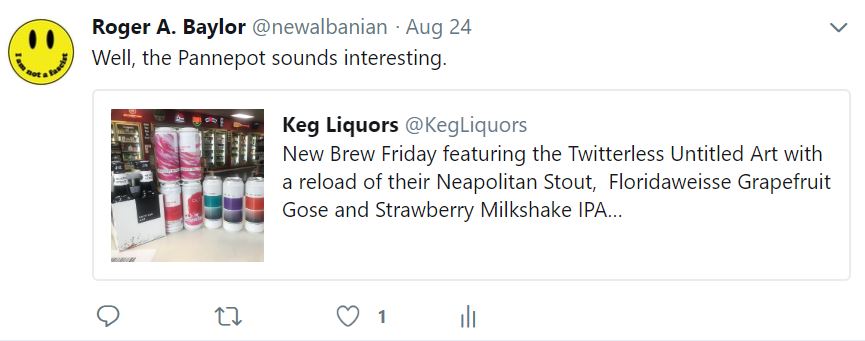
BEER WITH A SOCIALIST Exploding beer cans? If I want to risk injury, I'll try to make it across a New Albany street on foot.

Absolutely no disrespect to my bar-none favorite liquor store, just puzzlement at the decadence of the peak craft beer marketplace.


I'll have one of the gimmick-suppression beers on the right. Urbain Coutteau is a fine guy, indeed.


The irony in all this is that a few days before the advent of Neopolitan Grapefruit Milkshake, I'd dropped by The Keg to purchase a few German-brewed Oktoberfest bottles for a vital personal sampling, and was told a case of 450 North had just detonated in the storeroom.

Lest there be any misunderstanding, allow me to paraphrase an old saw: I may be entirely befuddled by what you're brewing, but I'll fight to the point of unconsciousness in support of your right to brew it.

At the same time, count me among those who can't come to grips with the notion of craft beer as potential can bombs. In response to this cognitive dissonance, I ducked into the wayback machine, armed with my tasty Hacker Pschorr, Paulaner and Hofbrau seasonal lagers, comparing their malty nuances and calculating which among them is best suited to induce the quaffing of another mug without recourse to check-ins, on-line ratings and narcissistic selfies.

In short, my own snug, tasty, dependable counter-revolution -- sans flying debris. The wonderful Bryan Roth takes it from here.


It’s Lit — The Unfortunate Trend of Exploding Cans in Craft Beer
, by Bryan Roth (Good Beer Hunting)

Think the process to go from grain to glass with an ingredient-laden Pastry Stout or lacto-fruit milkshake IPA is strenuous? For some breweries, adding a phone call to their lawyer may be a new, necessary step, too. At least, that's the advice from one attorney regarding a controversial new trend in beer.

“I’d say you definitely need to seek basic legal counsel just to verify what verbiage should be put on a can,” says Candace Moon, a partner and member of the Corporate Department at Dinsmore & Shohl LLP. “Even just to share how things are communicated, because a second set of eyes could be meaningful.”

Such is the awkward reality—and surprising conundrum—of who should be responsible for an exploding can of beer. For all the challenges in today’s beer industry, it’s a rather strange and new one, spurred by discussions not around the quality of a product, but its ability to harm the consumer ...

Sunday, July 22, 2018

BEER WITH A SOCIALIST: When Old Mister Lew tells a story, you're advised to listen closely.


It's an American "craft" (microbrew?) history lesson from Professor Bryson, but don't panic. Think corrections, not catastrophe. The scene may seem to be in upheaval, but as Lew entertainingly points out, we've all been here before -- in the late 1990s.

As an aside, which may or may not be relevant to Lew's thoughts, I've finally started reading a book previously only skimmed: Michael Jackson's Great Beers of Belgium, first published around 1992.

My copy is the revised hardback edition from 2006, which was given to me as a gift. Jackson updated the text one last time in 2007, just before his death, and it came out in paperback form the following year. The book is wonderful, and Jackson's prose styling remains elegant and informative.

I miss his writing tremendously.

Whether good, bad or indifferent, the past few years for me have been a period of reckoning. Chronology afflicts me; so many deaths, so much change. Outside the walls of our house, where Diana and I constantly remind each other of how fortunate we are to be together and to live rich, loving lives, the chaos seems unceasing.

I'm a realist, and while circumstances differ, it's all happened before. When I look back on periods of my life that seem wonderful in retrospect, most of them were just as chaotic and uncertain as now. Perhaps one aspect was fantastic, and that's the part I've chosen to remember, and the way to keep the dissonance at bay.

There isn't one answer to a multiplicity of life's questions, but we can do as Lew advises -- and in his own unique voice, Jackson surely would have seconded -- by filling a glass, breathing deeply and embracing the narrative. Put down your phones, and have a conversation. Tell stories. Teach and be taught.

In a universal context, time's always running out for each one of us. The trick is to address those diminishing sands in the hourglass by slowing down, not speeding up. 

THERE ARE REASONS FOR CONCERN, BUT THE SKY ISN’T FALLING, by Lew Bryson (All About Beer Magazine)

 ... The sky is falling!

Breathe, brothers and sisters. Grab a can, fill a glass, take a seat at the bar … and breathe, while Old Mister Lew tells a story.

Monday, July 16, 2018

BEER WITH A SOCIALIST: Flint Michigan Tap Water? “Walt Disney knew what he was doing and I plan on making Lakeville the Walt Disney of beers.”

Conversation starters. Uh huh.

On the topic of buffoonery, excrement and world class douchebaggery, there's this. It may be the first time in my life that I feel sorry for Walt Disney.

Will beer names bring the right kind of attention to new Lakeville brewery?, by Mary Shown (South Bend Tribune)

LAKEVILLE -- Owners of a new brewery opening in Lakeville want their beer to do the talking for itself, but they also don’t mind starting deeper conversations through the names of their craft beers.

With titles including “Flint Michigan Tap Water,” “Black Beer Matters,” “White Guilt” and “Mass Graves,” Jon Duncan and Rodney Chlebek acknowledge the names are likely to create a reaction from people. But, according to Duncan, at least people will be talking about current issues.

“The way I look at it — with the “Flint Michigan Tap Water” — if you’re going to get mad about that beer name, you should focus your anger more toward the people that are letting that happen to Flint,” he said. “If I can bring some attention to that, whether it be negative attention toward me, it still brings attention to that issue ...”

Sunday, May 27, 2018

BEER WITH A SOCIALIST: Vandals strike Asheville brewery: “No more breweries” and “**** Beer City.”

My initial thought upon reading about "anti-brewery vandalism" in Asheville was something on the order of: "Just their luck the Woman's Christian Temperance Union is still alive and kicking."

Indeed, the prohibitionists remain extant, drastically weakened but forever persistent. However, it's doubtful the WCTU is taking the war to Demon Craft Beer at night, clad in dark attire, masked and with spray paint in hand.

Here's the story.

Asheville’s One World Brewing Responds to Anti-Brewery Vandalism, by Jess Baker (Craft Beer Dot Com)

It’s been a frustrating week for One World Brewing, a small and independent craft brewery in Asheville, North Carolina. The brewery, which originally opened four years ago in downtown Asheville, was busy prepping to open its new location in the West Asheville district when vandals hit the brewery as well as surrounding local businesses.

The vandals scrawled messages in black spray paint on the front of the brewery’s white brick building at 520 Haywood Road: “No more breweries” and “**** Beer City.”

The vandals’ anti-brewery messages are stinging words for the Asheville beer community, a city where independent breweries are considered a major driver for tourism.

“We will not be deterred from doing what’s best for our employees and our community,” One World Brewing wrote on its Facebook and Instagram pages Thursday. “We are a homegrown, local, independently owned brewery that does so much more than just brew beer. We use beer as a platform to support so many other aspects of life that we are passionate about.”

The Asheville brewery, like many local breweries, is invested in supporting its employees as well as the community. The brewery used the incident to flip the script and talk about their strong bond with Asheville ...

Beer writer Bryan Roth, who shared the preceding link at Twitter, commented.

"anti-brewery messages" is a new one to me.

Not for Richard Florida, who mentioned the "g" word (gentrification) in a CityLab piece late last year -- or Athena Hobson, from London, two years ago.

During a shameless binge watch of Unbreakable Kimmy Schmidt, I couldn’t help but notice all the references to gentrification (or in simpler terms – places becoming more trendy and modernised, which drives up the costs of living in that area, meaning poorer residents may be forced to relocate).

Hobson expands on her thought.

Don’t Blame The Brewers: Craft Beer And Gentrification, by Athena Hobson (Cultured Vultures)

First-time business owners are taking advantage of run down areas to set up shop and driving up the cost of living for local residents.

Understandably, it is gentrification that is largely responsible for provoking a deep hatred of the craft beer trend, but to what extent can we actually blame the brewers? Had it not been about beer, it may have been bubble tea cafés or ‘soul cycle’ studios. The aforementioned Cereal Killer Café has been under attack of petty vandalism as well as keyboard warriors since word spread of its opening – but would they be so successful if we weren’t so willing to buy into what they’re selling? After all, what is business but seeing a need and providing the product or service?

When you hand over your money to a company, however much or little that may be, you are funding their objectives ...

Regular blog readers residing in New Albany hardly need this reminder, but it's always better to be explicit, so kindly note that Mayor Jeff Gahan's 2017 seizure of public housing, with a stated objective of reducing the number of units by half, is an exercise in socio-economic cleansing -- and this displacement is not being conducted in a conceptual vacuum.

In fact, Gahan's war against the working poor is the logical consequence of our "success" in resuscitating downtown. It's part and parcel of gentrification, and as a "Democrat," the mayor illustrates that callous measures directed against the most vulnerable cannot always be blamed on right-wingers. 

Thanks in large part to food and drink businesses like my own brewery, with which I'm no longer involved, the historic core of the city has experienced a decade of substantive reinvestment.

The result has been an increase in "upscale" thinking, as opposed to those cross-cultural core retail stores operating downtown long ago prior to suburbanization and white flight.

As a corollary, the local political dialogue continues to narrow; either we explore ways to expand the "upscale" developments already in progress, or we do nothing at all. The ensuing shock waves are hitting those community members least able to cope economically, in part because the powers that be in New Albany view gentrification as a social phenomenon of unqualified and unquestioned good.

Few wish to contemplate the consequences, and most are willing to encourage even more of it with measures that gradually have crept beyond those designed somewhat modestly to encourage investment (as with loosened alcoholic beverage licensing in riverfront development areas), to ones like the public housing putsch that actively push social engineering, or the recent proposal (likely inevitable) to spend $8.5 million on local government wants (a new city hall) rather than affordable housing needs for a growing segment of the populace.

Back to the point. Why would someone vandalize a small brewery?

Probably for the same reason that residents of my city greet the news of another new bar or restaurant ...

The former Comfy Cow location will become a bar, but we have no further details.

Downtown NA restaurant and bar scorecard: one new location, two openings and four coming soon.

... with predictable but perfectly plausible questions like these.

Seriously, another bar?

How many downtown restaurants and bars are enough?

Will we be able to afford to eat at these latest and greatest places?

These questions have short-term answers: yes, it's too early to tell, and it's complicated.

Alcohol licensing exists to regulate drinking for the ostensible purpose of societal good, although maximum tax harvesting comes closer to the truth.

Indiana's riverfront development area mechanism is a legal construct expressly designed to "open" a delineated geographical area to licensing with fewer restrictions.

Riverfront permits have the effect of making a demarcated area slightly more free than before, because it provides a framework for licensing outside the customary allocation. It greatly reduces the overall cost of a permit, and opens the market to more participants.

As long as there is available money, and entrepreneurs are eager to spend it, there'll be contestants entering the game. We'll know when there are too many bars and restaurants when more establishments are closing than opening.

As for the pricing, this is a difficult topic somewhat outside the scope of these thoughts. I'll add only that there are fewer disparities in pricing than might appear to be the case among independent and chain/franchise when their menus are comparable, and while I'd never suggest that operators don't look for ways to squeeze a few cents more from any mark-up, it's hard to base a business model on $3 burgers and $6 beers.

There are other questions and answers, but I have no glib conclusions to offer about any of these potential digressions. I've agonized over them for years, and will continue to do so.

At the same time, there is another complementary Pandora's Box to be broached, this being the junction of morals, wages, costs and benefits pertaining to "craft" breweries as workplaces.

I've referenced work by Dave Infante on a couple of past occasions, and he's at peak provocation here.

Infante's piece raised a tremendous din in the usual beer discussion portals. About all I can do is shrug and say two things: Welcome to capitalism ... and I'm happy not to be tormented by these considerations any longer. The economics at a bar stand to be much simpler than those at a brewery.

Craft Beer’s Moral High Ground Doesn't Apply to Its Workers, by Dave Infante (Splinter News)

Scott Timms is taking a break from brewing beer. At 35, he’s been at it for 13 years, most recently having worked at Falling Sky Brewing, a popular brewpub in Eugene, OR, that regularly appears on “best of” lists in the state.

Brewing beer commercially can be hard, thankless work. “It’s a back-breaking job, lifting a hundred 50-pound bags” of ingredients and carrying them up stairs to be added to the mash, Timms says. And it can be dangerous: “You’re dealing with boiling liquids and pretty harsh chemicals that can definitely injury you…It’s not a safe job by any means.” At small breweries, where OSHA visits are unusual and procedures are unstandardized, the “outlook towards safety” can be “laissez-faire” verging on “lackadaisical,” he says.

For his work as a production manager at Falling Sky overseeing a team of brewers and working up to 65 hours a week, Timms made what came out to a little over $40,000 a year. Frustrated, he quit his brewing job in early 2018, convinced that craft brewers were getting shorted across the U.S. beer industry. “There are people making money here,” he says, “but it’s not us.”

In 2017, Lauren Michele Jackson wrote in Eater about the rise of “craft culture,” a food and beverage market that “fetishizes the authentic, the traditionally produced, and the specific [and] loathes the engineered, the mass-produced, and the originless.” Craft beer—made by brewers like Timms at more than 6,000 small, independent breweries across the country—has been a standard-bearer for this progressively infected, anti-commodity eating and drinking movement for more than two decades. Its staggering economic success has spurred an explosion of products in other food and drink categories marketed to like-minded customers. Walk the aisles of your closest Whole Foods and craft culture surrounds you.

But even as sales of craft-culture products steadily rise, the conditions for workers that make and serve those products vary widely. The labor is often physically demanding. Specialized workers are asked to “wear different hats” to make up for understaffing, and gladly answer calls for extra hours because they genuinely care about the products they’re making. Owners, either unwilling or unable to spend on quality executives, take on management responsibilities for which they have no training. The workforces are often small, giving rise to a much-touted familial intimacy that in turn can bring a distinctly familial dysfunction of favoritism and manipulation. Wages and benefits are inconsistent across industries and even within individual companies.

But craft culture is growing, and it’s bringing in a lot of money ...

Thursday, May 24, 2018

ON THE AVENUES: Long live Keg Liquors Fest of Ale, an indisputable annual beer institution.


ON THE AVENUES: Long live Keg Liquors Fest of Ale, an indisputable annual beer institution.

A weekly column by Roger A. Baylor.

---

Fest of Ale home page

Fest of Ale ticket information here.

---

Lucky thirteen.

Superstition is bunk, and 13 was my varsity baseball uniform number, inherited from an upperclassman named Kevin who was one of my sporting idols of the time.

I asked for 13 in basketball, too, and was compelled to settle for 31. It was deemed impractical to reverse and reattach the digits, and this has annoyed me to the present day. My headband was banned, too, being deemed far too exhibitionistic and ABA-like to suit the Bob Knight fans in the Knobs.

My contrarianism has honest roots, and now to the point.

The 13th edition of Keg Liquors Fest of Ale will take place at New Albany’s Riverfront Amphitheater on Saturday, June 2. Up to 2,500 area beer fans will be in attendance, which might sound like a crush of humanity, but it isn’t. The major regional stops on the beer festival tour host as many as 8,000 guests, with Port-A-Lets extending around the entire perimeter like Donald Trump’s walled-in America.

However, festival founder and package store owner Todd Antz has grown Fest of Ale slowly and organically, from the parking lot adjacent to his original Clarksville store to St. Anthony’s lawn, and now the banks of the Ohio. It’s an urban area, and yet still presents a pastoral scene of greenery, passing barges and the rising sun architectural imagery of the amphitheater itself.

We pause now for a misty-eyed flashback.

---

During the halcyon days of my youth in Southern Indiana, when men were men, beer was beer and craft was a mail order do-it-yourself birdhouse, summer invariably inspired a profusion of outdoor beer festivals.

As did fall, winter and spring.

At 17 years of age, looking more like 12, living at home, ducking prying eyes and requiring divine intervention to get served at rarely obliging package stores like the one Todd’s father ran, natural settings constantly beckoned.

Priority was placed on those patches of isolated farmland belonging to folks who didn’t know or care that we’d found someone older to procure the cheapest swill possible, borrow a steel tub otherwise used to hydrate future beefsteak, buy ice, and await the grapevine-laden onslaught of teenagers who’d learned there was a field party abruptly in progress.

When it rained, we got soaked; not the worst conceivable outcome in hot weather, especially if any girls bothered to come -- which was seldom.

Every now and then, a measure of transcendence was achieved, and an enterprising reader might insert one of Bob Seger’s nostalgic AM radio hits to accompany this narrative, although I never liked his music very much after “Katmandu,” which I heard for the first time – where else? – at a summertime outdoor beer festival in the Knobs, with any style of beer you wanted for thoughtful sampling so long as it was Falls Sh(expletive)y, and with tunes like Seger’s blaring from the crackly sub-par radio of a car stuck axle-deep in a muddy field littered with cigarette butts and spent plastic cups.

Decades have passed, and nowadays, lying about one’s age generally implies a downward revision of chronological information on Facebook. Falls City, our illicitly old-fashioned lunch pail lager, went away – and then reappeared with a craft nouveau makeover.

It's not an expletive any longer, thank heavens.

Outdoor beer festivals have evolved considerably, too, bearing little resemblance to the midsummer’s night screams we staged during the presidency of Jimmy Carter – who, after all, legalized homebrewing, but probably never experienced the welcoming nuzzle of a well-turned beer bong in the steamy July drizzle.

---

As befits the era of “craft” beer’s ascendancy, today’s outdoor beer festivals take place in summer – and increasingly, also in fall, winter and spring. They’re devoted to the exaltation of contemporary brewing, and follow a common template.

Ideally, breweries and wholesalers provide a diverse selection of beers, and when possible, brewers and beer sales representatives will be on hand to answer questions and provide insights. A festival entry fee covers numerous, if not always truly unlimited, wee tastes of these many beers.

Local purveyors vend food, and musical entertainment typically deriving from the rock, pop, blues and bluegrass spectrum is offered, although just once I’d love to hear a string quartet performing modern chamber compositions, or a rollicking Klezmer band covering the Ramones.

As billed, “craft” beer festivals enhance the genre’s visibility through heightened consciousness and increased recognition. They also give back to the community by supporting chosen charities – and if they don’t, suspicion is fully warranted.

Reduced entry prices for designated drivers and the encouragement of moderation illustrate that beer consciousness and social conscience go together like espresso beans and imperial stout.

The template might be common, but the execution separates the pros from the amateurs. In Louisville, the collegiate scrum known as Brew at the Zoo probably remains the largest outdoor “craft” beer festival, although perhaps it has been eclipsed by Tailspin Ale Fest, held mostly indoors and partly outside in a Bowman Field aircraft hangar.

In terms of organization, there is no comparison. Unlike the zoo free-for-all, Tailspin is a class act conceived and organized by Tisha Gainey, Todd’s cousin; as you can see, good taste and attention to detail runs in the family. Tailspin is tops in Louisville, and Fest of Ale has no competition in Southern Indiana.

(Speaking personally, my favorite festive rite of summertime beer held in an outdoor setting takes place each year on the second Saturday in August: It’s the Great Taste of the Midwest, in Madison, Wisconsin. If you’re a beer nut, you owe it to yourself to install the Great Taste in one of your bucket list slots.)

Let’s close with a flashback to Saturday, June 2, 2007. It was the second Fest of Ale, held behind the store on Highway 131 -- had it yet been renamed Lewis & Clark Parkway? – and what I’ll never forget is what happened when a brief thunderstorm slammed the fest site.

Instead of running for cover, everyone grabbed the tent framework’s steel rods with one arm to keep it from blowing to Oz.

The other arm?

Priorities, my friend, because there's no "here, hold my beer" for the truly pure of heart.

---

“Yesterday was the second annual Fest of Ales at Keg Liquors in Clarksville, and store owner and beer enthusiast Todd Antz surely must be happy with the results.

“After last year’s inaugural event, Todd did some necessary tweaking. He moved the date back six weeks, brought in even more breweries and wholesalers, and relentlessly advertised. I’d guess that attendance was triple that of 2006, and in spite of an hour of stormy gusts and hard rain (given the steaminess of the day, this may have helped entertain the crowd rather than hurt), those present seemed to be having a wonderful time throughout.

“The Curmudgeon’s picks of the litter?

“Upland Brewing’s Eileen Martin brought a 750 ml bottle of experimental strawberry lambic; sorry there wasn’t enough for everyone. I’m trying to score some for sampling at the annual Lambic by the Glass on June 30 at NABC.

“World Class Beverage had New Holland’s Existential on hand. It is another creative excursion into crossover territory, with the gravity and heft of a barley wine, but with an overt hoppiness that derives from ten hop additions. It has a clear, well defined balance between the malt and the hops. Who says one can’t enjoy gravity beers like this and Ol’ Shag, a barley wine from Browning’s Brewery, on a hot, sultry day? Not the Curmudgeon, for he did enjoy them.

“Another surprise for me was the complex and tasty Shmaltz He’Brew Origin Pomegranate Ale, brewed with (duh) pomegranate juice. It’s handled in Indiana by Cavalier.

“Louisville-area breweries were well represented, too, and all the styles I tasted were quite good, and to conclude, who doesn’t like fresh-fried, Elector-battered grouper from Bistro New Albany’s Dave Clancy?

“Fest of Ale is sure to grow next year. Try not to miss it.”

Mighty prescient of me, wasn’t it?

Fest of Ale has grown tremendously during the past decade, and one way to look at it is by calculating the number of beers available for sampling (an estimated 250 from 100 breweries in 2018), although an even better indication of the fest’s success is Todd’s justifiable pride at having topped the $100,000 mark in donations to the Crusade for Children.

That’s doing it the right way.

---

Previously:

THE BEER BEAT: Fest of Ale returns on June 2, so please allow me to revive an idea for pre-fest fun next year.

---

Recent columns:

May 17: ON THE AVENUES: Ghosts within these stones, defiance in these bones.

May 10: ON THE AVENUES: Seeing is believing.

May 3: ON THE AVENUES: Sadly, the Kentucky Derby no longer is decadent and depraved. It’s just another vacuous capitalist bait ‘n’ switch.

April 26: ON THE AVENUES: The wonder years.

Saturday, December 23, 2017

THE BEER BEAT: The Bechdel Test, and what 1980s lesbians can teach us about beer.

Source material: Alison Bechdel, "The Rule."

It's best just to read what Emma Inch has to say about what 1980s lesbians can teach us about beer, with a minimum of commentary on my part, but a brief diversion to signpost the Bechdel Test.

The Bechdel Test, sometimes called the Mo Movie Measure or Bechdel Rule is a simple test which names the following three criteria: (1) it has to have at least two women in it, who (2) who talk to each other, about (3) something besides a man. The test was popularized by Alison Bechdel's comic Dykes to Watch Out For, in a 1985 strip called The Rule. For a nice video introduction to the subject please check out The Bechdel Test for Women in Movies on feministfrequency.com.

I'd already bookmarked Inch's essay for the column when this popped up in my feed.

The Next Bechdel Test, by Walt Hickey, Ella Koeze, Rachael Dottle and Gus Wezerek (FiveThirtyEight)

We pitted 50 movies against 12 new ways of measuring Hollywood’s gender imbalance.

... 30 years on, we’re not exactly sitting on a superior answer for measuring the movie industry’s gender imbalance. What does the next Bechdel Test look like? The time is ripe for a successor. Is there a short, punchy test we can apply? One that, if movies start passing it, would indicate that the industry is actually becoming better for both the women who make movies and the people who watch them? Is there a new test that could pull the modern film business in the right direction? And if there is, where on earth do we find it?

If FiveThirtyEight circles back to consider the implications for beer, that's peachy.

Until then, I turn it over to Emma.

online.com/2017/12/15/do-you-pass-the-test-or-what-can-1980s-lesbians-teach-us-about-beer/">Do You Pass the Test? Or: what can 1980s lesbians teach us about beer?

 ... The contemporary beer scene is not alone in sometimes struggling with the representation of women, and there are many examples of great work in this area. But every time women are invisible in areas of influence, every time a beer is marketed solely at men, every time a ‘beer for women’ is produced, every time we have to remind people that women were the first brewers, every time a disagreement on Twitter degenerates into macho posturing, every time craft beer lovers are portrayed as people with beards, every time a woman has to justify why she likes beer, or why offensive beer names are unacceptable, every time sexist ‘banter’ is excused, every time beer fans are greeted on social media as ‘lads’, every time the ‘women don’t drink beer’ myth is perpetuated, every time the consumption of alcohol is accepted as an excuse for sexist, racist or homophobic behaviour, we all lose out.

Friday, May 12, 2017

THE BEER BEAT: Wicked, Weed -- Whatever. Localism is the salve for your cognitive dissonance.


It's been roughly a week since Wicked Weed Brewery sold out to AB InBev, qualifying the story as ancient news in an era of attention spans measured by the length of a gnat's middle finger.

I've used the occasion to play a set of best-loved ditties (below), but today, a new song.

Or, you might choose to return to your swapping, ratings, selfies and narcissism; however, if anyone is interested in learning something, let the Pour Fool provide a brief lecture, prefaced by a few comments of my own.

THE BEER BEAT: The Pour Fool nails it yet again, as "Budweiser Finds Another Sell-Out" -- this time, Wicked Weed.

Like others before it, Wicked Weed Brewing has died. That's unfortunate, indeed, but from the moment the ownership of Wicked Weed passed to AB InBev, this previously independent brewery was transformed into something else. Now it's Wicked Trojan Zombie Afterlife Weed. We'll always have our memories. Speaking only for myself, I wouldn't drink a WTZAW beer with Donald Trump's lips. There are hundreds of other choices, and no commensurate need to deposit money in the coffers of the enemy. It was nice while it lasted, but it's all over now.

At Indiana On Tap, Mark Lasbury makes a laudable effort to grope forward and explain the cognitive dissonance, which might be defined as the nagging fear that something's not quite right.


How To Kill The Wicked Weed Growing In The Garden Of Craft Beer, by Mark E. Lasbury (Indiana On Tap)

AB-InBev is acquiring Wicked Weed. That bit of information almost broke the craft beer channels of the internet Wednesday, but the trend started long before then and will continue long into the future, unless there is a concerted effort on the part of craft beer brewers and drinkers. I don’t know much about business, but here is an opinion, a fact, and a question that keeps hurting my brain.

Beer isn't the only topic to suffer from historical amnesia. Given current events, it is by no means the most important topic we might be discussing in this context, and yet it remains (in the words of the philosopher) that those who cannot remember the past are condemned to repeat it.

Whatever else might be said about AB InBev and the multinationals, we can be sure they remember the past -- and are determined to repeat it.

The "craft" brewing revolution broke out because it was necessary to fight on behalf of change, both within and against prevailing capitalist and regulatory orthodoxies. Still, the revolution did not seek to abandon capitalism, or to deny the veracity of regulation. Rather, it sought necessary modifications, and in the main, these have been achieved.

But there is no action without an opposite and equal reaction, and that's why the AB InBev empire strikes back against threats to its hegemony, and in the only way it can: with lots and lots of money ... and scorched earth. Monolithic corporations attain their clout with cash and brass knuckles -- now, always, forever.

There are plenty of laws that might be enacted to put AB InBev in its place, but these are unlikely to be written, because who benefits the most from robber baron multinationals if not the politicians accepting their campaign contributions?

Accordingly, if vile politicians give money to AB InBev with the aim of preserving monopolies and suppressing choice, why would you even consider doing the same -- even if it's your precious Bourbon County Stout?

As I write these words, there are thousands of local breweries in America pursuing a business model of brewing solid local beer for local consumption. They're selling beer by the pint, growler, cans and bottles. Most of what they sell goes out the door in their own buildings. Their beer won't be on a package store shelf two thousand miles away.

Accordingly, I can think of three very effective ways to reinvigorate the beer and brewing revolution. Dispense with the self-absorbed narcissism that diverts attention from the obvious, and think about concepts like ...

Personal value systems
Individual consciousness
Acts of conscience

In various other areas of the human experience, progress is about every day, not every now and then. It's about the fundamental undertow that prefaces civilization, a bedrock foundation from which creative expression arises. Evolution is to be encouraged, but change for the sake of change is the ideology of a hamster on his wheel.

Speaking for myself, it's all about thinking globally and drinking beer locally. It's about interacting with local breweries, giving them honest feedback, and watching them move forward. It's about this bar, that room, and the patio over there -- or the front porch of my house with a growler and a cigar.

It's also about shift. The way we spend our money plays a large role in determining the sort of world in which we live. There's no evading this fact, although there isn't always an effective way to avoid playing the robber baron capitalist game.

That's why the concept of "shifting" spending is so crucial. Whenever possible, I try to spend locally, within the community. It's not all or nothing. It's a conscientious individual act of consciousness reflecting a personal value system that needn't be broadcast to a wider world in order to retain its validity.

Beer is communal to me. It's not narcissism at all, and it isn't hoarding via black markets. It isn't necessary to calculate my purchases based on what I want you to see me drinking. Rather, it's the intensely mystical nature of the liquid in the glass, a quality that is enhanced when I'm around good people, at good places, in the act of conversing, eating and enjoying life.

I was managing quite nicely to do without Wicked Weed. Now Wicked Weed has died, and it's even easier for me not to care. But I do care about the locals in Asheville who believed in Wicked Weed.

They're the ones who have the best reason to mourn. I'm sorry for their loss. May they feel peace, and start patronizing other breweries that live right.

You?

Numerous other choices await. You're invited to join me in making the revolution as locally based as is humanly possible.

And by the way: Fuck off, AB InBev.

---

Earlier this week:

Thursday: THE BEER BEAT: Wicked, Weed -- Whatever: "Localism + Beer" (2012).

Wednesday: THE BEER BEAT: Wicked, Weed -- Whatever: "Let's explore anti-local craft beer unconsciousness" (2013).

Tuesday: THE BEER BEAT: Wicked, Weed -- Whatever: "This week in solipsistic beer narcissism" (2014).

Monday: THE BEER BEAT: Wicked, Weed -- Whatever: "Tastes of paradise can shatter mirrors" (2014).

Also: Watch the Hands, Not the Cards — The Magic of Megabrew

Thursday, May 11, 2017

THE BEER BEAT: Wicked, Weed -- Whatever: "Localism + Beer" (2012).


It makes no sense to labor over writing a fresh new essay when we've all been here before, and whether or not the "keep politics out of my narcissism" caste
realizes it, we've been here ever since Goose Island died.

My excruciatingly personalized essays from five whole years ago continue today, but first, a reminder of why you should consider the nature of the threat AB InBev poses to our nice little panacea of highly rated white whales.

Watch the Hands, Not the Cards — The Magic of Megabrew

Previously this week:

Wednesday: THE BEER BEAT: Wicked, Weed -- Whatever: "Let's explore anti-local craft beer unconsciousness" (2013).

Tuesday: THE BEER BEAT: Wicked, Weed -- Whatever: "This week in solipsistic beer narcissism" (2014).

Monday: THE BEER BEAT: Wicked, Weed -- Whatever: "Tastes of paradise can shatter mirrors" (2014).

Yesterday afternoon I joined friends on the patio of Buckhead's in Jeffersonville. The bar was pouring Falls City's Calliope Pils. I drank it from a plastic cup while enjoying fellowship and a fine view of the Louisville skyline. You see, the revolutionary idea in the beginning was to build local beer and brewing culture. Let's nurture them, and leave those obsessive white whales to Captain Ahab.

The following first appeared here on November 9, 2012. First the 2012 preface, then the main text.

---

HIP HOPS: LOCALISM + BEER

If you have built castles in the air, your work need not be lost; that is where they should be. Now put the foundations under them.
--
Henry David Thoreau

It always has been my aim to accurately describe various aspects of my beer-infused everyday world, but even as I’ve done so, my everyday world persists in evolving. Apart from necessarily using the word “beer,” I’m increasingly unsure how to view any of the rest of it.

Long ago, good beer was about imports exclusively, because there wasn’t very much good beer in America. Several thousand domestic brewery start-ups later, there’s plenty of good beer here, and these days, we refer to it collectively as “craft” beer. This term is fine by me, except that the definition of craft beer starts on a tiny end with the scant barrels produced by a nano-brewery, and ends voluminously with the nationwide airport lounge availability of Samuel Adams.

Semantics aside, the real point of this digression is to acknowledge that I’m changing, too. Back in 1982, St. Pauli Girl probably was the best beer we had during my first-ever gig as a liquor store clerk. Thirty years later, there are dozens – nay, hundreds – of far better beers available hereabouts, and while I’m entirely comfortable in making a “good, better, best” value judgment, it isn’t as simple as it used to be.

Amid the giddy, exploding exuberance, which I’ve long professed and will continue to advocate, it seems that something important is lost. There exists an understandable zeal to embrace the unprecedented availability of international craft beer, but I find myself thinking back to points of origin, and what has made so many of my beer travels memorable: Localism.

It’s drinking great beer at or near its birthplace, primarily because it never tastes fresher than by doing so, but also because the place itself matters. Beer and community reflect each other, and although we must continue to think globally, I’m sensing a new imperative to drink locally.

Home, Not Away

My professional reputation as a beer purveyor was established owing to a stubborn determination to stock the best legally obtainable (well, most of the time) beer, as brewed in locales across the planet. Nowadays, I’m far less inclined to look past my own geographical proximity. The Louisville metropolitan area has its own great beer, with plenty more quality beer being produced within a hundred mile radius.

I’ll never entirely dismiss Belgian Lambics, German Maibocks and Irish Stouts. There’ll forever be a spot for India Pale Ales from San Diego and New York-brewed Saisons, and yet they’re no longer essential to me; rather, they’re for special sampling occasions, as they were years ago when availability was limited. Inexorably, my beer drinking is shifting to local and regional sources, and for the best of all reasons: Drinking local makes me happy.

Places, Not Prizes

Shift happens. It is perhaps the single, fundamental tenet of emerging economic localism, and when it comes time to have a beer, the concept of shift means putting this principle into liquid practice.

Having acknowledged the efficacy of buying local, as measured by factual indices consistently recognizing that localism keeps more money in one’s community, my household is incrementally shifting toward local sources of goods and services, whenever practical. Shift is a process, not an all-or-nothing crusade. If my shift to locally brewed beer implied being compelled to drink an inferior product, obviously I would think differently. Fortunately, it does not.

Another contemporary societal trend to consider is the notion of placemaking, generally described as “a multi-faceted approach to the planning, design and management of public spaces.” Placemaking is a grassroots, community-based phenomenon, in which those ordinary people using a public space help to determine how that space is used. Placemaking may help in part to explain my re-emerging interest in community-based beer consumption -- keeping the beer drinking venues local, listening to the local beer drinkers, and knowing who supplies the beer.

Eyes and Palates, Wide Open

Not so long ago, Goose Island Brewing Company was a proud independent, but now it is 100% owned by the multinational monolith called AB-Inbev, meaning that in cold, hard fact, Goose Island is no more independent than an Ignatius J. Reilly-themed weenie wagon on the streets of Pyongyang, North Korea. Honkers Ale remains certifiably better than Budweiser, but to me, it really matters where the money goes … and dollars paid for Honkers ultimately travel to corporate headquarters in Leuven, Belgium, not Chicago, Illinois.

Sorry, but Goose Island sold out. Craft beer drinkers need to examine their consciences lest they sell out, too.

Session, Not Sledgehammer

I’m in my sixth decade, and my body reacts differently these days to the excesses of my profession. American craft brewing has excelled in the creation of highly alcoholic genre classics, including Imperial India Pale Ale, Barley Wine and Quadrupel, and while I still adore these styles, increasingly my palate turns to an evening’s reasonable sustainability, in the form of session beers.

The Pennsylvania-based beer writer Lew Bryson is the founder of the Session Beer Project, and he provides these helpful parameters.

Session beers are:

► under 4.5% alcohol by volume
► flavorful enough to be interesting -- no light beers, please
► balanced enough for multiple pints
► conducive to conversation
► reasonably priced

In brief, low-alcohol, but not low-taste. It's deliberately vague. The great thing about session beers, especially the ones that come in under 3.5%, is that you can enjoy several beers, and still have a BAC of under 0.04.

Craft Beer Is A Journey

Maybe some day I’ll come full circle, and find myself craving bottles of Bud Light iced in a pickle bucket. Doubtful, but entirely possible, because beer is less a destination than a journey, and you make the road signs yourself. All I’m asking is that craft beer drinkers resolve to be unafraid of where thinking can lead drinking, especially when thoughts turn to local options.

Wednesday, May 10, 2017

THE BEER BEAT: Wicked, Weed -- Whatever: "Let's explore anti-local craft beer unconsciousness" (2013).


This week I'm reprising excruciatingly personalized variations on a theme of "Who Cares About Wicked Weed and All the Other Zombie Trojan Non-Craft Casualties of AB InBev and Its Brethren."

Of course, not that you shouldn't care about the nature of the threat AB InBev poses. This article goes deep in explaining why.

Watch the Hands, Not the Cards — The Magic of Megabrew

It's just that there is an unmistakable element of individual value systems in all these discussions. As Uriah Heep advised so many years ago, take a look at yourself.

Tuesday: THE BEER BEAT: Wicked, Weed -- Whatever: "This week in solipsistic beer narcissism" (2014).

Monday: THE BEER BEAT: Wicked, Weed -- Whatever: "Tastes of paradise can shatter mirrors" (2014).

We don't need Bourbon County Stout when other versions of wood-aged stouts (and other styles) produced by genuine indies are in the same league.

We don't need whatever sour specialty used to be brewed by Wicked Weed before its untimely demise.

Instead, we need to log off Untappd, hide the phone, find a local brewery and enjoy a fresh beer with living, breathing humans.

There are at least four Louisville area breweries I've yet to visit. Numerous other regional breweries beckon, too. You see, the revolutionary idea in the beginning was to build local beer and brewing culture. Let's nurture it, and leave the white whales to Captain Ahab.

---

The PC: Anti-local craft beer unconsciousness, revisited.

“Art can never take the place of social action … but its task remains forever the same: to change consciousness.”
-- Amos Vogel, from “Film as a Subversive Art”

When will craft beer finally change the consciousness of the American beer-drinking mainstream?”

I’m tempted to answer one question with another: Should mainstream consciousness ever be the desired outcome for craft beer?

But let’s play it straight. Some might say that craft beer consciousness already has arrived. Craft beer’s availability is wider than ever before, and statistically, most Americans live within close proximity to a craft brewer, even if the average measurement is skewed by Michigan as compared to the Deep South.

Slowly, even this imbalance is changing, and craft beer consciousness is penetrating all geographical areas of the country.

More tellingly, America’s copycat megabrewers are quite conscious of craft’s escalating impact. Through imitation and outright, unrepentant piracy – the only recourses for corporate regimes cruelly deprived of the creative gene – mass-market mockrobrews, from Blue Moon and Shock Top to zombie craft beers like those from the late, lamented Goose Island, now are routinely positioned to distract truth seekers. As always, bucket loads of marketing cash are wielded to pull soothing layers of mistruth and gloss over the eyes of the undiscerning.

Overall, my personal view about craft beer’s consciousness is that for all our obvious gains, we’re not quite “there,” at least yet.

Rather, when sociologists and psychologists at last begin studying craft beer drinkers close up and personal, we’ll know that mainstream consciousness has drawn to within a whisker, because there is no more reliable indicator of mass-market impact than the urgent need to understand the behavior of those consumers inhabiting segments poised for profit. That’s how the real money gets made.

While the analysts and shrinks are cogitating, perhaps they can help me with persistent examples of what might be termed cognitive dissonance in craft consciousness.

A prime example includes the inability (read: unwillingness) on the part of credentialed craft beer enthusiasts to tell the difference between craft and crafty as they avert their eyes from the Goose Gambit’s shelf-space-seeking drones, which are intended primarily to shift money to faraway corporate shareholders. It’s the most patently obvious bait-and-switch tactic since door-to-door driveway resealing, and yet it is ignored by many who plainly know better.

---

While we’re at it, these battered and blotted Rorschach findings also may help explain the most disquieting aspect of craft beer consumer behavior, at least to me: Anti-local craft beer unconsciousness.

It is my aim to re-situate the burgeoning craft beer movement within a context of economic localization, to revert the revolution to its point of origin, and to describe how the very consciousness of buying local is important both in non-beer terms, and in the specific way it impacts the craft beer ethos. Recently I wrote:

Shift happens. It is perhaps the single, fundamental tenet of emerging economic localism, and when it comes time to have a beer, the concept of shift means putting this principle into liquid practice.

Having acknowledged the efficacy of buying local, as measured by factual indices consistently recognizing that localism keeps more money in one’s community, my household is incrementally shifting toward local sources of goods and services, whenever practical.

Shift is a process, not an all-or-nothing crusade. If my shift to locally brewed beer implied being compelled to drink an inferior product, obviously I would think differently. Fortunately, it does not.

And yet for some otherwise knowledgeable practitioners of the craft beer ethos, “local” and “inferior” remain synonymous terms.

Why?

It is interesting to consider the contrasting reaction to “buying local” that exists, quite apart from the merits of local beer, when we speak of the retail sector: Hardware, groceries, clothing, floral arrangements and the like. I hear it often:

"But wait: You cannot compel me to spend more money than I wish to spend."

The perception is that buying local always entails higher expense to the consumer. Actually, numerous studies have addressed this perception, and the price differences therein typically are not as profound as imagined, if they even exist at all. Probably what doubters mean to say is that they cannot be compelled to surrender the big box, exurban shopping ease of finding all consumables under one roof – and that’s a different topic, one falling outside my parameters today.

But when it comes to craft beer, independent small brewers seldom hear objections about price, because craft beer enthusiasts understand that handcrafted products using higher quality ingredients within smaller economies of scale cost more than mass produced ones do. Consequently, a different and less readily explicable form of pushback occurs in the context of local beer and brewing.

How about some locally brewed beer, guys?

“No, because you cannot compel me to drink poorer quality beer. Only the best for me, you know."

This reply never fails to utterly befuddle me.

I’m a trained BJCP beer judge, and after thirty years in the beer business, obviously I’ve been around the block a few times – just ask my liver.

When I attend beer festivals these days, my samples invariably are drawn from “everyday” beers as made by small, local breweries, if only to remind me that seldom are these beers in any way unsuitable. On those rare occasion when there’s a quality problem, I’m constructively honest in identifying it, and if I can do so, in proposing a solution. Without dialogue, there cannot be a community. Without community, very little about craft beer interests me, anyway. Craft beer consciousness isn’t me against the world.

It’s us against the world.

Unfortunately, there exists a minority of self-identified craft beer opinion shapers for whom it’s never quite enough for local beer to be good, solid or sessionable.

What’s more, for them, local beer by definition simply cannot ever be “sexy” enough to justify a variant of beer enthusiasm sated only through insularity, exclusivity and narcissism, and before readers take me to task for erecting a straw man, permit me to add that I’m well aware of what such snobbery entails, because I’ve spent years now slowly recovering from its debilitating influence.

You’re damned right I’ve sinned, but consciousness is subject to evolution, and so is conscience. When I look back at my career in beer, I’m not always happy with my modes of expression, but know this: Narcissism’s not my gig, and never was. Expertise isn’t about keeping; with me, it’s all about teaching, and my record should speak for itself in that regard.

In my opinion, the breezy and frankly disdainful attitude that local beer cannot be good is a form of misplaced elitism and condescending snobbery ultimately injurious to craft beer’s larger interests. Attack mass-market swill at will; it deserves censure, but craft beer cannibalism is another matter entirely.

Beer as we know and love it does not exist in a societal, historical or ethical vacuum. Rather, craft beer consciousness exists within a community, and if we wish our community to grow sustainably, we must share our expertise broadly, not narrowly.

Consequently, I challenge the shadowy sect of narcissistic beer enthusiasts to help spread wisdom, not hoard it; to enhance local brewing and not detract from it; and in summary, to be part of the solution, not a collection of snarky Wonkas in the making. We have enough of that, already.

---

Nevertheless, at the end of the day, I remain a realist. Nothing I write or say in this column can substantively change attitudes that derive from a wide variety of wants, needs and experiences. Life’s too complicated for simplicity and we’re all different as people, but what I can make absolutely clear is this:

I’ve got the backs of local, independent brewers in this region, and when the smack starts getting talked, I’ll be there to answer it. It’s a matter of deeply held principle.

Consider joining me by waving potential craft beer converts into the tent, not erecting barriers to their enlightenment. In such a fashion, consciousness changes – and grows.