Showing posts with label solipsistic beer narcissism. Show all posts

Monday, August 27, 2018

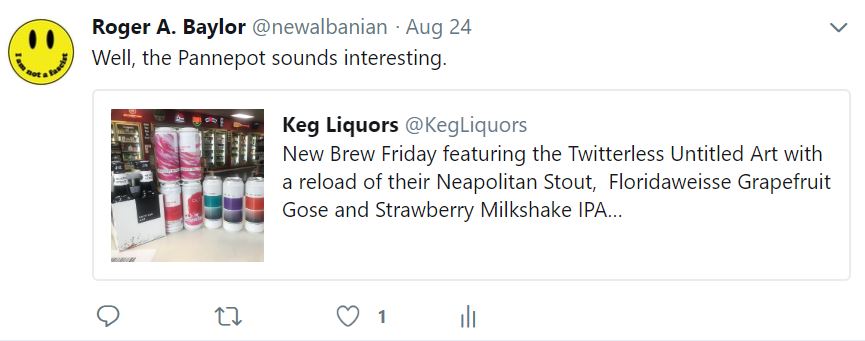
BEER WITH A SOCIALIST Exploding beer cans? If I want to risk injury, I'll try to make it across a New Albany street on foot.

Absolutely no disrespect to my bar-none favorite liquor store, just puzzlement at the decadence of the peak craft beer marketplace.


I'll have one of the gimmick-suppression beers on the right. Urbain Coutteau is a fine guy, indeed.


The irony in all this is that a few days before the advent of Neopolitan Grapefruit Milkshake, I'd dropped by The Keg to purchase a few German-brewed Oktoberfest bottles for a vital personal sampling, and was told a case of 450 North had just detonated in the storeroom.

Lest there be any misunderstanding, allow me to paraphrase an old saw: I may be entirely befuddled by what you're brewing, but I'll fight to the point of unconsciousness in support of your right to brew it.

At the same time, count me among those who can't come to grips with the notion of craft beer as potential can bombs. In response to this cognitive dissonance, I ducked into the wayback machine, armed with my tasty Hacker Pschorr, Paulaner and Hofbrau seasonal lagers, comparing their malty nuances and calculating which among them is best suited to induce the quaffing of another mug without recourse to check-ins, on-line ratings and narcissistic selfies.

In short, my own snug, tasty, dependable counter-revolution -- sans flying debris. The wonderful Bryan Roth takes it from here.


It’s Lit — The Unfortunate Trend of Exploding Cans in Craft Beer
, by Bryan Roth (Good Beer Hunting)

Think the process to go from grain to glass with an ingredient-laden Pastry Stout or lacto-fruit milkshake IPA is strenuous? For some breweries, adding a phone call to their lawyer may be a new, necessary step, too. At least, that's the advice from one attorney regarding a controversial new trend in beer.

“I’d say you definitely need to seek basic legal counsel just to verify what verbiage should be put on a can,” says Candace Moon, a partner and member of the Corporate Department at Dinsmore & Shohl LLP. “Even just to share how things are communicated, because a second set of eyes could be meaningful.”

Such is the awkward reality—and surprising conundrum—of who should be responsible for an exploding can of beer. For all the challenges in today’s beer industry, it’s a rather strange and new one, spurred by discussions not around the quality of a product, but its ability to harm the consumer ...

Friday, May 12, 2017

THE BEER BEAT: Wicked, Weed -- Whatever. Localism is the salve for your cognitive dissonance.


It's been roughly a week since Wicked Weed Brewery sold out to AB InBev, qualifying the story as ancient news in an era of attention spans measured by the length of a gnat's middle finger.

I've used the occasion to play a set of best-loved ditties (below), but today, a new song.

Or, you might choose to return to your swapping, ratings, selfies and narcissism; however, if anyone is interested in learning something, let the Pour Fool provide a brief lecture, prefaced by a few comments of my own.

THE BEER BEAT: The Pour Fool nails it yet again, as "Budweiser Finds Another Sell-Out" -- this time, Wicked Weed.

Like others before it, Wicked Weed Brewing has died. That's unfortunate, indeed, but from the moment the ownership of Wicked Weed passed to AB InBev, this previously independent brewery was transformed into something else. Now it's Wicked Trojan Zombie Afterlife Weed. We'll always have our memories. Speaking only for myself, I wouldn't drink a WTZAW beer with Donald Trump's lips. There are hundreds of other choices, and no commensurate need to deposit money in the coffers of the enemy. It was nice while it lasted, but it's all over now.

At Indiana On Tap, Mark Lasbury makes a laudable effort to grope forward and explain the cognitive dissonance, which might be defined as the nagging fear that something's not quite right.


How To Kill The Wicked Weed Growing In The Garden Of Craft Beer, by Mark E. Lasbury (Indiana On Tap)

AB-InBev is acquiring Wicked Weed. That bit of information almost broke the craft beer channels of the internet Wednesday, but the trend started long before then and will continue long into the future, unless there is a concerted effort on the part of craft beer brewers and drinkers. I don’t know much about business, but here is an opinion, a fact, and a question that keeps hurting my brain.

Beer isn't the only topic to suffer from historical amnesia. Given current events, it is by no means the most important topic we might be discussing in this context, and yet it remains (in the words of the philosopher) that those who cannot remember the past are condemned to repeat it.

Whatever else might be said about AB InBev and the multinationals, we can be sure they remember the past -- and are determined to repeat it.

The "craft" brewing revolution broke out because it was necessary to fight on behalf of change, both within and against prevailing capitalist and regulatory orthodoxies. Still, the revolution did not seek to abandon capitalism, or to deny the veracity of regulation. Rather, it sought necessary modifications, and in the main, these have been achieved.

But there is no action without an opposite and equal reaction, and that's why the AB InBev empire strikes back against threats to its hegemony, and in the only way it can: with lots and lots of money ... and scorched earth. Monolithic corporations attain their clout with cash and brass knuckles -- now, always, forever.

There are plenty of laws that might be enacted to put AB InBev in its place, but these are unlikely to be written, because who benefits the most from robber baron multinationals if not the politicians accepting their campaign contributions?

Accordingly, if vile politicians give money to AB InBev with the aim of preserving monopolies and suppressing choice, why would you even consider doing the same -- even if it's your precious Bourbon County Stout?

As I write these words, there are thousands of local breweries in America pursuing a business model of brewing solid local beer for local consumption. They're selling beer by the pint, growler, cans and bottles. Most of what they sell goes out the door in their own buildings. Their beer won't be on a package store shelf two thousand miles away.

Accordingly, I can think of three very effective ways to reinvigorate the beer and brewing revolution. Dispense with the self-absorbed narcissism that diverts attention from the obvious, and think about concepts like ...

Personal value systems
Individual consciousness
Acts of conscience

In various other areas of the human experience, progress is about every day, not every now and then. It's about the fundamental undertow that prefaces civilization, a bedrock foundation from which creative expression arises. Evolution is to be encouraged, but change for the sake of change is the ideology of a hamster on his wheel.

Speaking for myself, it's all about thinking globally and drinking beer locally. It's about interacting with local breweries, giving them honest feedback, and watching them move forward. It's about this bar, that room, and the patio over there -- or the front porch of my house with a growler and a cigar.

It's also about shift. The way we spend our money plays a large role in determining the sort of world in which we live. There's no evading this fact, although there isn't always an effective way to avoid playing the robber baron capitalist game.

That's why the concept of "shifting" spending is so crucial. Whenever possible, I try to spend locally, within the community. It's not all or nothing. It's a conscientious individual act of consciousness reflecting a personal value system that needn't be broadcast to a wider world in order to retain its validity.

Beer is communal to me. It's not narcissism at all, and it isn't hoarding via black markets. It isn't necessary to calculate my purchases based on what I want you to see me drinking. Rather, it's the intensely mystical nature of the liquid in the glass, a quality that is enhanced when I'm around good people, at good places, in the act of conversing, eating and enjoying life.

I was managing quite nicely to do without Wicked Weed. Now Wicked Weed has died, and it's even easier for me not to care. But I do care about the locals in Asheville who believed in Wicked Weed.

They're the ones who have the best reason to mourn. I'm sorry for their loss. May they feel peace, and start patronizing other breweries that live right.

You?

Numerous other choices await. You're invited to join me in making the revolution as locally based as is humanly possible.

And by the way: Fuck off, AB InBev.

---

Earlier this week:

Thursday: THE BEER BEAT: Wicked, Weed -- Whatever: "Localism + Beer" (2012).

Wednesday: THE BEER BEAT: Wicked, Weed -- Whatever: "Let's explore anti-local craft beer unconsciousness" (2013).

Tuesday: THE BEER BEAT: Wicked, Weed -- Whatever: "This week in solipsistic beer narcissism" (2014).

Monday: THE BEER BEAT: Wicked, Weed -- Whatever: "Tastes of paradise can shatter mirrors" (2014).

Also: Watch the Hands, Not the Cards — The Magic of Megabrew

Friday, January 27, 2017

THE BEER BEAT: No selfies necessary, because localism is why I believe the impending Falls City expansion is good news.

I'd like to applaud a news item pertaining to Falls City Brewing Company, but first, a wee bit of background.

Anyone seen my soapbox?

At some point in the distant past, I joined two or three Facebook sites devoted to "craft" beer, primarily (naively?) seeking information and discussion.

It soon became apparent that I have little in common with an entire generation of "craft" beer fans, especially when exploring the topic of localism in brewing. In retrospect, some of the chats I had on "social" media should have prepared me for the bottomless venom of Clinton v. Trump.

I'd suggest that local beer and brewing were good, and to be desired, and within minutes you'd think I'd bayoneted a baby.

Once upon a time there were many local American breweries. A conflagration (Prohibition) leveled most of them, and of those remaining, only the ones most adept at capital accumulation (ah, glorious capitalism) were able to meet the reemerging beer market's needs, less in terms of price point than packaging to sell beer in areas which might have been out of range formerly – i.e., those very same locales where brewing ceased or diminished owing to Prohibition. The habitat changed, and the strong survived.

Capital accumulation leads to greater size, which leads in turn to wider powers, which leads finally to the ability of an Anheuser-Busch to come into a marketplace (say, Louisville, 1950s and 60s) and knock out whatever remained of brewing competition (say, Fehr’s, Oertel’s and eventually Falls City) by under-selling.

Voila! Now Budweiser from St. Louis could become "Louisville’s beer," and to this very day it says so right there on that humongous sign in right field at Slugger Feel This, bringing with it all the abuses of economic power that compelled us to stage a beer revolt in the first place.

But localism as an economic doctrine provides another way of looking at the world – capitalism with a more human face, complementary to a good beer ethos, and also a different collection of information that permits tying a singular love of mine (beer) to another (the community in which I live, and how to make it better). It offers sense and sensibility out of relative scale, and suggests differing standards of value and achievement.

It isn’t infallible, but it’s a place to start.

I’m coming to understand why Dave Zirin is my favorite American sportswriter, He refers to his column as the place where sports and politics collide, and that’s the same way I feel about beer.

Granted, my former career in beer had its share of missteps, and I didn't always “get it" when I should have, but looking back, there is considerable relief, and a measure of vindication, that I got it right more often than not.

For the most part, I tried to connect dots even before I knew what they meant. Beer is inseparable from community, and it is not consumed in a vacuum. If good beer cannot touch adjoining areas of the human experience, to modify them and be modified by them, then it no longer interests me.

Now, back to the Facebook portals, where the vast majority of activity (then as now) involves participants posting loving photos of the beers they have acquired, or are presently drinking, or will soon hide away in a space formerly reserved for the delusions of post-nuclear attack “survivors.”

Seldom are there substantive efforts to explain exactly why we should be in awe of the treasure troves depicted within; only visual beer porn, because as members of the insider's club, we’re expected to know – or to hurriedly search on-line beer ratings aggregators lest we appear dumb:

“Ah, look; dude got him an equatorial, triple-soured, dry-Chrysanthemummed Brett bomb aged in caskets formerly used to bury Scottish road kill constructed with Islay-tempered wood. Lucky fucker. Maybe he’ll trade me for a …”

To me, this attitude is little more than a circle jerk: “Look what I have, and see how important I am.”

I'd suggest that narcissism of this caliber goes far to explain the nation's current ideological gridlock, and I'll be damned it I'll allow it to intrude upon the serenity of my beeriness -- explaining why I seldom return to the sites in question.

Taking it a step further, with hundreds more breweries capitalized and predicated on an "export" model of packaging, dedicated to shipping elsewhere as opposed to increasing the local "craft" beer base and growing organically, the logic implies attitudinal assumptions with the real potential to negate local brewing's fundamental raison d'etre.

If one follows the export doctrine to its logical conclusion, each brewery will be shipping its beer somewhere else, at least until they’re winnowed out by force of capital accumulation, at which point a brewery in Georgia will erect a billboard somewhere by the Ohio River toll bridges: “We’re the only beer Louisville really needs,” and in the dark of night, their trucks on the interstate highway to Louisville will pass the ones from Louisville breweries, headed toward Atlanta.

Then we’re right back where we started, aren’t we, and in need of (yet another) revolution?

Let's see ... I promised something about Falls City, and here it is. To me, this is great news. It brings the brand back home, and the expansion ties into what John Neace and Neace Ventures are doing with Louisville City FC, and in my mind, enhances prospects for the soccer stadium to be in the west end.

All I need is for the K & I Bridge to be reopened to foot and bicycle traffic, making my commute to all this easier without a car.

This iconic Louisville beer brand is considering a major expansion, by David Mann (Louisville Business First)

Falls City Brewing Co. is planning a major Louisville expansion and it's teaming up with Heine Brothers' Coffee to do so.

Neace Ventures, Fall City's parent, has signed a letter of intent to acquire ownership in the building that houses the Heine Brothers’ Coffee headquarters, according to a news release. The building would be co-owned by the companies. And the move would bring 100 percent of Falls City’s brewing operations to Louisville.

Sunday, January 22, 2017

THE BEER BEAT: In which we talk beer on the "Flies on the Wall" podcast at Crescent Hill Radio.


Flies on the Wall is a weekly podcast on Crescent Hill Radio.


Last week I had the great pleasure of sitting in on the podcast with Kevin Gibson and Butch Bays. We talked about beer and listened to tunes by Roz Tate and Jericho Woods. If you have an hour to kill, listen to it on Soundcloud -- and no, I'm not going to give you a preview.

But I had a blast, and we might do it again.

Thursday, November 13, 2014

ON THE AVENUES: Pardon me as I hoist this middle finger in the general direction of anti-local “craft” beer unconsciousness.

ON THE AVENUES: Pardon me as I hoist this middle finger in the general direction of anti-local “craft” beer unconsciousness.

A weekly web column by Roger A. Baylor.

After a dozen years of stasis, the Southern Indiana brewing community is rapidly expanding.

In Jeffersonville, Red Yeti’s fermenters are being filled, and Flat12’s taproom on the riverfront is coming soon, with the Indianapolis-based company’s on-site brewery to follow in 2015.

New Albany’s Donum Dei near NABC on Grant Line Road should be open any minute, and the Wrecker project on Market Street is somewhere on the horizon. NABC’s two breweries are separately licensed by the state of Indiana, and so Floyd and Clark counties (population 190,000 combined) might soon have six breweries, which is fairly significant on a per capita basis.

This welcomed growth spurt revives an old question: Has “craft” (or “better”) beer actually changed the consciousness of America’s beer-drinking mainstream?” Note that it isn’t clear whether mainstream consciousness ever should be the desired outcome in any such consideration, much less one involving beer.

Overall, certain aspects of elevated better beer consciousness can be easily verified. Availability is wider than ever before, and most Americans live in close proximity to a post-1980s generation brewer, even if the average measurement is skewed by bountiful Michigan as compared to threadbare Mississippi.

Tellingly, America’s copycat multinational brewers are quite conscious of “craft” beer’s escalating popularity. By means of imitation and outright, unrepentant piracy – these being the only recourse for corporate regimes cruelly deprived of any semblance of a creative gene – mass-market mockrobrews (Blue Moon, Shock Top) and zombie craft beers absorptions like Goose Island, Blue Point and 10 Barrel now are routinely positioned to distract and obfuscate.

Obviously, there is much work left to be done in fostering better beer consciousness, particularly given the persistent examples of cognitive dissonance in the “craft” beer consciousness we have now.

A prime example of this incongruity is the unwillingness of so many self-credentialed craft beer enthusiasts to differentiate between "craft and crafty." The emerging cult of solipsistic beer narcissism cravenly averts its eyes from Trojan Goose’s shelf-space-seeking zombie drone strategy even though it ranks as the most patently obvious bait-and-switch maneuver since door-to-door driveway resealing, and exists only to shift money from the delusional to faraway corporate shareholders.

The solution is localized better beer consciousness, which is nearer than Leuven to home.

---

To me, the most disquieting aspect of consumer behavior as it pertains to better beer, and the phenomenon that Southern Indiana’s newcomers soon will face, is what I like to call anti-local “craft” beer unconsciousness.

Spitefulness of this magnitude is doubly annoying given my core daily interest in situating the better beer movement as a component of economic localization, thereby reorienting the beer revolution to its genuine founding point of origin.

Better beer hardly exists in a vacuum. An understanding of localism in non-beer terms comes first, and is the foundation upon which the local “craft” beer ethos rests. Perhaps counter-intuitively, this principled bedrock foundation is one of constant movement, because shift happens.

Shift is perhaps the single, fundamental tenet of emerging local economies. In my own household, having acknowledged the efficacy of buying local as factually measured by indices proving that localism keeps more money in one’s community, we practice an ongoing, incremental shift toward local sources of goods and services, whenever it is practical.

Shift is a process, not an all-or-nothing religious crusade, and when it comes time to have a beer, the concept of shift means putting this principle into liquid practice by patronizing local and regional breweries as often as possible. And yet, for some consumers, “local” and “inferior” remain synonymous terms. Why is this the case?

Interestingly, quite apart from local beer, there is a contrasting reaction to “buying local” when we speak of the retail sector: Hardware, groceries, clothing, floral arrangements and the like. I hear it often:

"But wait: You cannot compel me to spend more money than I wish to spend."

Sorry, but this dog won’t hunt. Numerous studies have addressed the perception that buying local entails higher expense to the consumer. Price variances typically are not as profound as imagined, if they exist at all. What doubters probably mean to say is that they cannot be compelled to surrender the big box, exurban shopping ease of finding all consumables under one roof – and that’s a far different topic, one falling outside my parameters.

However, when it comes to beer, independent small brewers seldom hear objections about price. “Craft” beer enthusiasts of all stripes usually grasp the fiscal implications of high quality ingredients, smaller economies of scale, and artisanal methods. Rather, a different and far less readily explicable form of pushback occurs in the context of local beer and brewing.

How about some locally brewed beer, guys?

“No, because you cannot compel me to drink poor quality beer. Only the best for me, you know."

This reply never fails to befuddle me. I’m a trained BJCP beer judge, and after thirty years in the beer business, I’ve been around the block a few times – just ask my liver.

My beers of choice these days invariably are drawn from “everyday” beers as made by small, local breweries, and I’m invariably reminded of their tasty suitability. On those rare occasions when there is a quality problem, I’m constructively honest in identifying it, and if possible, proposing a solution. Without dialogue, there cannot be a community.

Without community, very little about “craft” beer interests me, because better beer consciousness isn’t me against the world.

It’s us against the world.

Unfortunately, the quality of local beer is never quite enough for the cult of solipsistic beer narcissism. Localism by definition cannot ever be “sexy” enough to justify a variant of devotion sated only through insularity, exclusivity and the next greatest adrenalin rush. Local beer is attacked on the basis of poor quality, but in reality, it is being damned for being a provincial affront to a faux cosmopolitan, masturbatory values system.

No straw men are being erected here.

Beer snobbery is a self-inflicted malady and a debilitating influence, from which I continue to recover, every single day. I used to be just as bad as them. Happily, consciousness is subject to evolution, and so is conscience. When I look back at my career in beer, I see periodic epochs of the same self-indulgence I’m freely skewering here, but narcissism never was my gig, and beer expertise isn’t about hoarding.

Rather, it’s about sharing, teaching and community-building.

The glib and disdainful attitude that local beer cannot ever be good enough represents both misplaced elitism and condescending snobbery. Beer as we know it does not exist outside societal, historical or ethical contexts. Better beer consciousness exists within a place and a community, and if we wish our community – any community -- to prosper, we must begin by acknowledging its locality.

Southern Indiana’s growing brewing community makes us different, but it also helps us to define ourselves. They’re not competition; they’re brethren, and I’ve got their backs. When the solipsistic narcissists talk their inevitable smack, I’ll be right here to answer it.

That's because deeply-held principles are punk-proof.