Monday, June 11, 2018
From Food & Dining (Spring 2018, Vol. 59): My interview with Bert Beveridge, founder of Tito's Handmade Vodka.
When the current issue of Food & Dining Magazine comes out, it is my habit to glance back at the previous quarterly edition and reprise my contributions.
In this instance, it's Spring 2018 (Vol. 59; Feb-Mar-Apr), and my profile of the Chef Space kitchen incubator, and interview with Bert "Tito" Beveridge.
First up, the vodka maker. The Chef Space profile will appear in a separate post.
---
THE MULE’S FROM MOSCOW, BUT THE VODKA’S STRICTLY LONE STAR.
Tito’s Handmade Vodka became the top-selling spirits brand in America by keeping it simple and fostering an enthusiastic fan base.
Vodka remains huge in the United States, and yet the libation’s perceived essence as a colorless, odorless spirit tends to deprive it of the adulation inspired by whiskeys, gins and cognacs.
To me, the 20th-century history of vodka in America makes perfect sense in a geopolitical, Boris and Natasha, ex-Cold War sort of way, seeing as vodka was barely known here until after World War II, when a brand called Smirnoff occupied a leading position in the liquor trade.
Ironically, Russian imagery propelled a popular cocktail known as the Moscow Mule -- the Volga Boatman never really caught on -- and Smirnoff inspired countless Slavic knock-offs spanning the gamut from Popov to Kamchatka to Dark Eyes (a famous Russian folk song).
What better tactic to one-up the Soviets than boldly appropriate their national beverage for capitalism’s greater good, whether as partner to an ocean of tonic water or a willing enabler for countless restorative Bloody Marys?
In recent years vodka has exploded past all former limitations of national origin and price point to become as diverse and specialized as any other type of tipple, but aside from waffle-flavored vodkas distilled according to ancient Druid techniques, exactly how did a regular guy from Texas create a craft vodka that recently toppled the perennial powerhouse Smirnoff as America’s number one spirits brand, hurdling other famous names like Bacardi, Jack Daniels and Jose Cuervo, and in the process completely reordering the American vodka hierarchy?
I’m speaking of Bert “Tito” Beveridge and his creation, Tito’s Handmade Vodka, which dates to humble beginnings two decades ago in Austin, Texas.
Tito’s Handmade Vodka’s success is even more unique given that it is the sole product of an independent distilling company, without the corporate reach or pocketbook of companies like Brown-Forman or Diageo.
Consumers love the Tito’s Handmade Vodka back story, and the enthusiasm extends to bartenders, retail managers and wholesale liquor professionals like Scott Clark of Southern Glazer’s.
“Tito’s is now the standard, with undeniable deals in marketing, point of sale and product support,” said Clark. “In the decade I’ve been selling wine and spirits in Southern Indiana, I’ve never seen this massive a scale of growth in any product, especially in the vodka category.
“It’s family-owned, handmade and gluten-free – but most importantly, Tito’s has become the preferred flavor profile when my customers think about drinking vodka.”
Beveridge was raised in San Antonio and graduated from the University of Texas. He worked in the oil, gas and mortgage businesses before concluding that his hobby of infusing vodkas with flavorings (given as gifts to friends) might actually form the basis of a career.
For Beveridge, “handmade” meant hands-on. He famously grappled with government bureaucrats who hadn’t read their own overstuffed rulebooks, maxed numerous credit cards, cobbled together a still worthy of the surgeons on M*A*S*H, and got to work fashioning vodka from corn.
Sales of Tito’s Handmade Vodka have risen from 12,000 bottles in 1997 to 44 million in 2016, helping to explain Beveridge’s 2017 debut on the Forbes 400 list or richest Americans; with an estimated net worth of $2.5 billion, he ranks 324th.
Earlier this year, I had the chance to ask Beveridge a few questions by e-mail.
---
F & D: When you were young, before you got into the spirits business, what did vodka mean to you – or what did you think it meant at the time? Have you expanded on this notion, or reinvented it?
Tito: In the early 1990s, I lived in Austin and worked in the mortgage business when I started making flavored vodka for my friends as Christmas presents. I was at a party one time and a stranger came up to me and said, ‘Hey you’re the vodka guy’ and I was like ‘No, I am the mortgage guy.’ That’s when I kinda started thinking that this guy’s telling me I need to go sell my flavored vodkas, and this was the first time I really started thinking seriously about it. Today vodka is my means to make the world a better place.
F & D: Napoleon supposedly said “Geography is destiny.” How important is the heritage of Texas, your birthplace, in the brand identity of Tito’s Handmade Vodka?
Tito: Texas is home. I was born and raised here, I established the first legal distillery here and it’s my friends and family here in Texas who all helped me get to where I am today.
F & D: What’s the advantage of a pot still versus a column still?
Tito: Our process, the pot still process, is similar to those used to make fine single malt scotches and high-end French cognacs. It requires more skill and effort than other processes, but it's well worth it.
F & D: To my taste buds Tito’s Handmade Vodka is remarkably smooth with a slightly sweet edge that I’d attribute to corn. Does corn make a difference in the flavor profile?
Tito: Since our vodka is distilled from corn, it is naturally gluten free and has a smooth, slightly sweet mouth feel. Some producers add a little bit of mash back into the spirit after distillation, which would add gluten content into an otherwise gluten-free distillate (if using wheat as the base), but I don’t do that, regardless. We’ve found that this flavor profile complements both cocktails and neat drinks just the same.
F & D: I don’t recall seeing a television ad for Tito’s Handmade Vodka, but years ago I was intrigued by seeing ads in the New York Times. Your chosen style of “guerrilla” marketing as a way of competing with the bigger bankrolls is intriguing. Has word of mouth been a big part of the vodka’s success?
Tito: You’re correct. We’ve never done a TV ad and aren’t planning on any in the future. We attribute a large part of our success to our fans. Back in the day, my family and friends used to come to the distillery and help me bottle the vodka. At the end of the day I’d send them home with a case and ask them to pass it along to their friends. Then they’d pass a bottle to their friends and so on. Eventually people started asking for us at their local bars and they didn’t stop asking until we were behind the bar. Now with social media, we have a direct line to our customers 24 hours a day. It’s allowed us to connect with our fans all over the world. We like to think of it as word of mouth on a much larger scale.
F & D: Is there any part of the ascent that you’d do differently if given a second chance?
Tito: I’m a firm believer that everything happens for a reason, so I wouldn’t change a thing. You know, there are small challenges every day, especially thinking back to those initial days of building the distillery. A lot of people told me it couldn’t be done, but I knew what I wanted to do. I used my previous failures as my strength and didn’t stop, and twenty years later, here we are.
F & D: Have you thought about legacies? Where do you see the company ten years from now, and is there a strategy for staying on top -- or is just being near the top enough?
Tito: For me, I hope the “legacy” goes beyond the vodka. Back when I started this, I also started supporting charity events around Austin one bottle at a time, and gave away a ridiculous amount of vodka. We’ve grown a lot since then and in every new place we were able to reciprocate by pouring that love back into the people and organizations that nurture, support and empower their local communities and causes. Last year we were able to use this medium to give to local, national and global charities supporting disaster relief, the environment, military and veterans, health care and medical research, food and beverage industry workers, arts and culture organizations, the LGBTQ community and the truest form of love on the planet: our pets.
F & D: Speaking of pets, your love for dogs is obvious and touching. Can you explain “Vodka for Dog People”?
Tito: Our passion for animals goes back to the first days at the distillery. At the time, my only companion at the distillery was my German Shepherd mix, DogJo. DogJo's food became a hit with the neighborhood strays, and I began to feed the dogs who would come and go. Eventually I started getting the strays spayed and neutered at the nearby Emancipet, an organization that offers low-cost spay, neuter and vaccination services to dogs and cats. Today, we still work with Emancipet and still have our dogs with us at the distillery and in the office. We can’t really imagine it any other way. Two years ago, we made our passion official with the Vodka for Dog People program. This vision is to unite with our friends, fans and partners to better the lives of pets and their families far and wide.
---
So, how has Beveridge done it?
Tito’s Handmade Vodka’s success owes to quality distilling, hard work, and maybe even a little luck, but it’s community-building and shared values among the brand’s friends and fans that bring them back for the next round.
Tito’s Handmade Vodka
Tito’s at Facebook
Tito’s at Instagram
Vodka for Dog People
There's a nice profile of Deaf Gahan in Anxiety magazine.
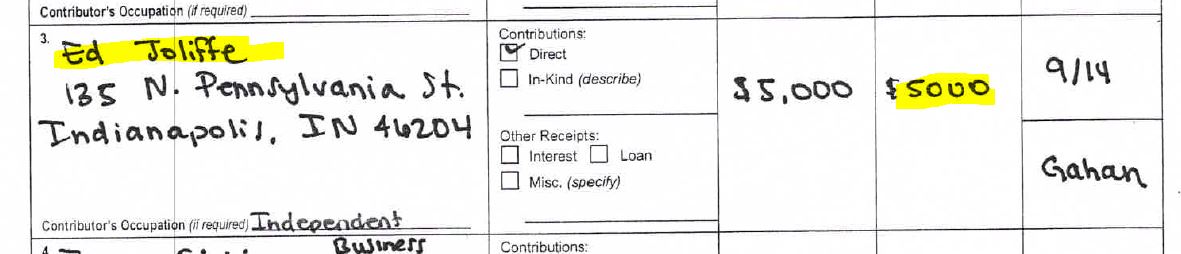
Cash-stuffed envelopes won't ever be the same once HWC completes the design for the Jeff M. Gahan Campaign Finance Modernization Act of 2018.
Kinky retro pneumatic tubes are fast, easy, and donors needn't buy flower arrangements.
---
The Psychology of Dictators: Power, Fear, and Anxiety, by Seth Davin Norrholm, Ph.D. and Samuel Hunley, Ph.D. (Anxiety)
… Not only do dictators commonly show a "pervasive pattern of grandiosity," they also tend to behave with a vindictiveness often observed in narcissistic personality disorder ...
... An additional explanation of their behavioral patterns might be rooted in their individual personalities. Colloquially speaking, people often use "personality" as a synonym of how interesting a person appears to be in the eyes of onlookers, both within and from outside their respective sphere of influence. For instance, we might say that a loud comedian has "a lot of personality," whereas we might describe someone we view as boring and quiet as "lacking personality."
In the psychological literature, though, personality is defined as the "enduring patterns of thinking and behavior that define the person and distinguish him or her from other people." In other words, your personality is what makes you distinct from those around you. In studying personality, psychologists can examine common traits across people and note how these traits may interact to predict behavior. In so doing, researchers can develop a better understanding of why people behave the way they do over the course of many years.
Narcissism Is A Consistent Trait
With regard to dictators, one particular trait that consistently stands out as relevant is narcissism. Narcissistic individuals have a "greatly exaggerated sense of their own importance" and are "preoccupied with their own achievements and abilities." They see themselves as "very special" people, deserving of admiration and, consequently, have difficulty empathizing with the feelings and needs of others.
When narcissism becomes extreme to the point that it:
- interferes with daily life
- appears to be unusual as compared to others within a society, or
- permeates multiple areas of an individual's life …
… that individual may be diagnosed with narcissistic personality disorder, which is defined by a:
- "pervasive pattern of grandiosity"
- "need for admiration" and
- "lack of empathy"
These individuals are "preoccupied with fantasies of unlimited success" and "power." They believe they are unique and can only be associated with others of equally high status. Furthermore, they require excessive admiration to remain happy, possess an extreme sense of entitlement, exploit others, and are often envious of others.
Vindictiveness Is Common
Descriptions of narcissistic personality disorder seem reminiscent of what we know of dictators. Not only do dictators commonly show a "pervasive pattern of grandiosity," they also tend to behave with a vindictiveness often observed in narcissistic personality disorder.
For instance, in now famous psychological experiments, researchers found that highly narcissistic individuals were more likely to try to punish those individuals who negatively evaluated their work, even when the narcissistic person believed they were administering painful electric shocks.
More recent work shows that, after a negative evaluation, narcissistic people will demonstrate greater aggression even to individuals unrelated to the feedback. Such experiments can help us understand the aggressive behavior of dictators, who are known to lash out against negative evaluations.
Surprisingly, narcissism could also help explain the anxious behavior displayed by dictators. Researchers have identified two forms of narcissism: grandiose narcissism and vulnerable narcissism. Though grandiose narcissism is associated with all that you might expect from a narcissist (e.g., grandiosity and aggression), vulnerable narcissism is associated with an "insecure grandiosity," which seems to produce intense defensiveness and feelings of inadequacy. Such individuals are often described as being "worrying, emotional, defensive, anxious, bitter, tense, and complaining".
These components can be so extreme that narcissistic personality disorder can be misdiagnosed as borderline personality disorder, which is associated with high levels of anxiety. The intensity of the emotional experiences produced by narcissism in combination with actual dangers could produce remarkable levels of anxiety, worry, and uncertainty – to the point that one might actually consider moving their entire capital to the middle of a jungle based on the advice of an astrologer ...
Sunday, June 10, 2018
Calendar check: New Albany Blues, Brews, & BBQ Festival at Bicentennial Park on Sat., Sept. 29.
Jimmy Gaetano reminded us to remind you of this fest at Bicentennial Park on September 29.
New Albany Blues, Brews, & BBQ Festival
Our mission is to bring people together to share and experience Americas original music; blues, jazz, and rhythm and blues and Southern Indiana businesses. By showcasing national and local acts, experienced in these styles of music, pair this with local vendors and small businesses, we will highlight Southern Indiana and its many varied talents and attributes. We want to stress the importance that this will be a homegrown, grass roots event, locally owned and operated, where everyone is welcomed to volunteer and attend.
Also at Facebook
Neither City Hall nor HWC Engineering sees a problem with this mishap-plagued intersection. Maybe we should appeal to Floyd County government for help.
![]() |
| Photo by AGB. |
Insightful observer AGB photographed the scene on Sunday afternoon after a driver deposited his car in the yard of the home on the southwest corner of Elm and 13th.
Yet another wreck at Elm and 13th. This time the cars hit and one went into the yard and hit the house. But those flashing pedestrian walkway lights that nobody pays attention to were a much better choice than 4 way stops ... there is only a 2-way stop here and you can't see around the cars parked. So there's often wrecks/near wrecks at this intersection.
Ironically, it was precisely this intersection that I mentioned last week to Jim Rice of HWC Engineering, the mayor’s preferred contractor for street design, as worthy of added study owing to sight lines and the completely ineffective solar-powered "high visibility" pedestrian crossings.
Rice quickly brushed me off, asking how I knew for a fact these crosswalks don't work. I replied that as a frequent walker, a couple hundred hours of direct experience is something not to be ignored; he answered by denigrating real-life observation as opposed to the sheer brilliance of that segment of the populace which has chosen to become engineers.
Sorry, Jim. If the choice is believing you or my own two eyes, you can hurriedly beat a retreat back to suburban Indianapolis (by car, of course) while as a walker, I'll continue crossing in the middle of the block -- because this is safer than the prevailing reality following your de-Specked abortion of a two-way street grid plan, which your presumably flawless firm of flunkies conjured between amassing campaign donations to a failed mayor who ordered the car-centric butchery in the first place.
As an aside, the idiocy of these "high irrelevancy" pedestrian crossing lights is so blatantly obvious that even 3rd district councilman Greg Phipps noticed it, and made at least one appeal to the somnolent Bored of Works, maybe two.
To no one's surprise, BOW has been completely unresponsive -- and as fatigued city engineer Larry Summers informed council just a few weeks ago, he's so busy coordinating campaign donations from paving companies that there's no time for the consideration of other matters.
Unfortunately, Phipps has a history of stopping short of useful action that might offend Dear Leader, so here we are. Perhaps it's time for residents of the 3rd district to learn from the instructive experience of Vulcan, West Virginia in the late 1980s. There's a crucial and delightful twist, seeing as the USSR and the GDR no longer exist.
Let's ask the Floyd County commissioners for help with this intersection, seeing as we're getting none from the Anchor Regime.
Feeling forsaken by their own government, after repeated pleas to have a new bridge constructed, the people of this West Virginia community made an unprecedented move which soon garnered international headlines. At the height of the Cold War, residents of Vulcan wrote to the Soviet Embassy in Washington, as well as to communist officials in East Germany, detailing their plight and requesting foreign aid from the nations.
Sensing an opportunity to shame the American government, the Kremlin immediately dispatched journalists to the United States.
Interviewing the residents of Vulcan and broadcasting their troubles to the rest of the world, the government in Moscow did what the residents of Vulcan had been attempting to do for years, bring attention to their transportation nightmare.
By mid-December 1977, newspaper headlines around the country were announcing, “Small Town Seeks Russ Foreign Aid” (Spokane Daily Chronicle).
The Spokane Daily Chronicle wrote, “Soviet officials were amused today by reports that the small town of Vulcan, W.Va. has appealed to the Kremlin for foreign aid… The town, with a population of 200, asked the Soviet government for financial help to build a bridge after the town was turned down by the U.S. and West Virginia governments.”
Embarrassed by the attention their lack of assistance was receiving, state officials wasted no time in committing $1.3 million and built a bridge for the tiny community.
The two most recent Manic Street Preachers albums, ending one era and beginning another.
A new Manic Street Preachers album has been released. It's called Resistance is Futile, and I love it. There'll be more to say about the album at another time; for the moment, here's a glorious song (above) and an excerpt from the review at NME:
A Franz von Stillfried-Ratenicz photograph called ‘Samurai Warrior 1881’ adorns the sleeve of the Manics’ 13th album, ‘Resistance Is Futile’. It’s a snapshot of one of the very last warriors of his kind. Much like the record’s title itself, is this a call to arms in the face of the changing tide, or an acceptance of defeat?
“People get tired, people get old – people get forgotten, people get sold,” pines James Dean Bradfield on opener ‘People Give In’, but rather than collapsing under the weight of the sorrow at how “there is no theory of everything”, the band gloriously rise from the ashes – driven by their hardened will just to exist and grow stronger.
This morning over coffee, my thoughts turned to the band's previous 2014 release, Futurology, and I started thinking about the way certain aspects of your life make perfect sense in an instant, while others take a while. It's especially relevant to me now, with Pints&union just around the corner (cross your fingers for early July).
In 2014, I turned 54, perhaps a bit late for grand epiphanies, but those were exactly what I received, one after the other, all year long.
We closed the original kitchen at Bank Street Brewhouse. My mother sold the house where I was raised, and she moved to Silvercrest. After four years of continental absence, Diana and I returned to Bamberg and Poperinge, two of my favorite European cities, and we also visited Berlin together for the first time.
The album Futurology by Manic Street Preachers was released in July, 2014. It quickly became my preferred soundtrack for the latter portion of the year, and now, when I listen to a track like "Between the Clock and the Bed," it reminds me of how hopeful I felt at the time. All the changes coming down weren't easy, but even then, there was a dawning awareness that they were necessary.
In retrospect, it's clear to me that the year 2014 was about addressing exhaustion, plotting escape and seeking redemption. Numerous challenges were ahead, and I was gathering the strength needed to take a big leap into the unknown, which is exactly what happened in 2015 and the years since.
If Futurology was the soundtrack to the end of an era, Resistance is Futile is poised to serve the same purpose for the start of a new one. This is the effect music has on my brain, and I wouldn't trade it for anything.
As an aside, thanks to everyone with whom I chatted last week at the Fest of Ale. It's humbling and flattering that you're interested in the forthcoming pub, and I hope to have a more coherent update about all of it very soon. Stay tuned, and thanks again.
Saturday, June 09, 2018
Experts say golf is dying, and if so, expect the redevelopment vultures to circle New Albany Springs.
For as long as I can remember, during unguarded moments, certain of our city officials have been musing about the potential value and redevelopment potential of the area occupied by the New Albany Housing Authority's property on Bono Road.
They no longer speak with me, but I'm assuming this moistening of lips to have escalated since Jeff Gahan seized control of NAHA early in 2017.
Looking at the map, it's easy to see the military reasoning of these C-minus students, graded on the curve. NAHA is the high ground (topographically, though not morally in terms of Gahan's putsch), from which command of the battlefield is assured.
Just to the south, there's the expanse of Padgett. Some day, and I'm guessing sooner rather than later, someone at Padgett finally will do the math, begin negotiating with state agencies, score incentives and treasure chests, and move those cranes out of the city, into industrial space near an interstate, or River Ridge, probably both.
That's because Padgett is landlocked and can't grow where it is now, and the redevelopment potential (read: money) of its downtown property will become too great to ignore.
At this point, all we'll need to complete the scene is for the current New Albany Springs golf course property to become worth more as housing (alas, probably not as affordable as we'd like to see) than recreation, and the dominoes will fall.
Baptismal Hospital to "cleansed" NAHA land, down the hill to Binford Park and the golf course, continuing through the Padgett redevelopment bonanza, and all of it anchored by a cemetery that might as well be another park. It's the closest thing we're likely to have to the Clarksville South and future JeffBoat makeovers, and it's why the sycophants salivate.
And right there, in the middle of it, completely unchanged, with precisely the same long-necks and Democratic Party Walt Disney Film Nights, there'll be the Roadhouse, like a working museum.
Remember, the Green Mouse told you so.
Dead Golf Courses Are the New NIMBY Battlefield, by Nolan Gray (CityLab)
As the sport’s popularity wanes, vast amounts of underutilized land will open up. Can it be developed?
Golf is dying, many experts say. According to one study by the golf industry group Pellucid Corp., the number of regular golfers fell from 30 to 20.9 million between 2002 and 2016. Ratings are down, equipment sales are lagging, and the number of rounds played annually has fallen.
Part of the bust can be blamed on the fallen fortunes of a single person: Tiger Woods. Golf boomed in the 1990s and early 2000s as the charismatic superstar raked in titles. Then, beginning in 2009, it faced a one-two punch of recession and bad press when its star golfer’s chronic infidelity came to light.
But the bigger story involves the sport’s aging demographics and the athletic tastes of Millennials, who just aren’t that into an expensive, poky sport that provides few health benefits. Unless the golf industry can change its ways, the decline will mean a lot of empty greens across the country. How that land is used—or isn’t—could reshape America’s suburbs for decades to come.
Golf courses and country clubs currently consume massive amounts of relatively underutilized land in cities and suburbs. Across the country, as courses and clubs begin shutting down, hundreds of thousands of acres of land could soon start opening up for infill redevelopment. While not so great for golfers, this could be a boon for cities, especially those facing a housing crunch ...
"Meanwhile capitalism does what it does — mostly unabated — and inequality once again becomes the scourge of our times."
The book is Radicals in America: The US Left Since the Second World War, by Howard Brick and Christopher Phelps. I have not read the book, although maybe there'll be time to do so soon, but the point of mentioning it, and excerpting the final section of Hartman's assessment, is to draw a line in the anchor crosswalks.
Hartman's essay is comprehensible to me. In short, I know what he's talking about, and referring to. If you're running for local office as a Democrat, and ask me for my vote, I'll be asking you to display a working knowledge of the history recounted by Hartman. It's as simple as that.
If you can't, then off my porch you'll be going.
It's not about expressing lockstep agreement; it's about being familiar with the material. If you're identifying as a Democrat, then I need to know where you stand in the context of what's being discussed in books like this.
As a Democratic candidate for office, if you can't comment sensibly about matters like this, you're wasting my time.
Got it?
Hartman's essay is comprehensible to me. In short, I know what he's talking about, and referring to. If you're running for local office as a Democrat, and ask me for my vote, I'll be asking you to display a working knowledge of the history recounted by Hartman. It's as simple as that.
If you can't, then off my porch you'll be going.
It's not about expressing lockstep agreement; it's about being familiar with the material. If you're identifying as a Democrat, then I need to know where you stand in the context of what's being discussed in books like this.
As a Democratic candidate for office, if you can't comment sensibly about matters like this, you're wasting my time.
Got it?
Beyond the Whack-a-Mole Left, by Andrew Hartman (Jacobin)
Though often condemned to the fringes of American political life, the radical left has changed the course of US history.
... Brick and Phelps are not entirely without hope. They point to “green shoots,” including the millennial embrace of socialism, which since their book was published has gained political force through the Sanders campaign.
But grizzled historians that they are, Brick and Phelps remain skeptical that a movement capable of a mainstream left-wing revival is visible:
If new layers of youth had come to see capitalism as unstable, destructive, and inequitable, how to connect that observation to imaginative political practice, how to challenge the established order and offer plausible visions of a better future that popular movements can bring into being — in other words, how to move from margin to mainstream — remained opaque.
In spite of their pessimism, Radicals in America highlights some left-wing successes — with the qualification that “radicalism becomes invisible, paradoxically, in its victories.” One such invisible victory — the 1990 Americans with Disabilities Act (ADA), which protects the rights of a previously excluded group of Americans — occurred due to radical organizing and protest.
But one of the reasons left-wing successes like the ADA feel so fleeting is because their effects seem far removed from the labor question that informed a more cohesive American left before 1945.
When it comes to the question of labor — or, more accurately, when it comes to class struggle — the Right is winning. The Left’s invisible victories need to be understood alongside this perplexing fact. As Brick and Phelps write in their shrewd conclusion:
Following the high point of the cascading radicalizations that ran from the 1950s through the 1970s, American political history shows two seemingly antithetical trends: one conservative, toward growing inequality, weakened unions, and an emphasis on private, market relations as a way of life; the other liberalizing, toward greater participation by women and people of color in most aspects of social, economic, and political leadership and a dramatic easing of sexual proscription to make gay and lesbian identities more legitimate.
There is an enormous difference between “liberalizing social relations,” which radicals can chalk up as a victory, and “democratizing and equalizing social relations,” which the Left has failed miserably at achieving. As Brick and Phelps rhetorically ask:
What does it mean that anyone of color can sit in the front of the bus, for example, or that it contains a wheelchair lift, if buses, heavily used by the working poor and elderly, now come with much less frequency and at greater cost to riders because of privatizations and cuts to public transit budgets?
Radicals in America offers a powerful history of how the Left has both succeeded and failed to bring its views into the center of American political life. The fight for gay marriage is a prime example of how once-radical ideas can become widely accepted.
But to make victories like these more substantive and widely shared, we need a broad socialist movement in the United States. Our task is to bring that marginalized idea into the mainstream.
Friday, June 08, 2018
Goodbye to the Fork in the Road, hello to "Mayor Jeff Gahan presents, "A Fork Amid the Sidewalk" -- and fork YOU if you don't obey.
| Photo by David Modica. |
Ah, those blissful days of pre-Gahanista innocence.
More forks in the road. (November 29, 2011)
At this morning's Merchant Mixer meeting, Dave Thrasher explains what may lie beyond the stenciled fork in the road as Curt Peters holds a drawing of the 16-ft tall sculpture soon to occupy space on the west side of the traffic island at State and Market Streets. Bravo!
The new (and putrid) beautification plan looks like this.
We can't blame baseball hall of famer Jim "HWC" Rice for this one; it comes straight from Esteemed Leader, and nowhere else.
Peak inner city suburban Gahanism via faux "input," pre-determined outcomes, clear-cutting, IKEA chairs and raging HWC paranoia. Welcome to your "improved" Market Street.
There's nothing new in any of this. We already knew that Team Gahan views the notion of open, honest transparency with the same reverence as a vampire views garlic -- and speaking of Transylvania, it's also understood that just as comrade Ceausescu sought to remake Bucharest in his own Mussolini-filtered image, Jeff Gahan is striving to render downtown's physical appearance into a tableau worthy of a veneer salesman's insipidity, with all the tasteful flair of an exurban outlet mall by the interstate.
Jeeebus, the clique is engorged. Anyone for lancing the boil in 2019?
Peak inner city suburban Gahanism as HWC recommends buying IKEA when two local furniture dealers are yards away from the redesign atrocity.
ArtSeed, tonight: "Wood and Clay Art Exhibition Opening Reception."
There's an ArtSeed opening tonight, but first, let's review.
ART SEED
ArtSeed is owned and operated by local artists. Exhibits will feature the work of local, regional and international professional artists, and student artists.
The mission of ArtSeed is to support artists, provide a venue for them to live, work, and collaborate with organizations and businesses in our community in a mutually beneficial relationship.
As part of the ArtSeed citywide exhibit program, we are collaborating with multiple galleries to create Friday night gallery openings. The series of exhibits will feature renowned local artists and students artists.
Thank you to our sponsor Tabitha and Jim Sprigler owners of Halo Dash and Conflux Wellness. Exhibit, receptions and lectures are free and open to the public.
For more information, please contact Julie Schweitzer. Check out our website for more information about membership, events and services.
Tonight's opening at 1931 East Spring Street (5:30 p.m. to 7:30 p.m.) features four artists, some of whom exhibited at the late and lamented Gallery on Pearl.
Wood and Clay Art Exhibition Opening Reception
Please join us for WOOD and CLAY. Meet our new artists and enjoy the different approaches and mediums. This is the perfect show to pick up a wonderful Father’s Day and/or graduation gift. The participating artists include:
Alan Mason is a box crafter, retired English teacher, and native of Floyd County, Indiana. Mason says, “I find myself listening to what the wood wants to become, and letting what I hear guide me in making boxes….Sometimes I tell the wood what it wants to be, and sometimes the wood tells me… So far, both the wood and I are happy with the process.” Mason, with a nod to his literature background, includes notes and stories with each box inspired by his vision the wood and/or current events. For Mason, “the creative impulse is as natural as breathing, and just as necessary. It will always find a way to express itself in art, literature, music, or even boxes.”
Kimara Wilhite is a second generation, self-taught, New Albany-based photographer. She loves to travel and finds great joy in capturing nature and dramatic light. She is always inspired by dramatic light and loves to capture that in scenes of nature. She has a lifelong love of horses; the horses and solitary trees of the beaches have become a favorite subject.
Carl Degraaf is a Floyd County clay artist and retired Indiana University Psychology Professor. He credits his Dutch heritage for the practicality and functionality of his work. However, he says, “Beyond being utilitarian, less than an extravagance, hand crafted pottery is a modest indulgence to be enjoyed as a luxury on a daily basis”. His work is created on his ninety-six-acre farm, and the beautiful boxes and vessels are clearly influenced by his love of nature.
Floyd Cornet is a Jeffersonville, Indiana native and self-taught sculptor. His influence ranges from whimsical to abstract. He creates oversized functional pocketknives, carved barrel tops, and large totem poles- whatever strikes his fancy. They are all crafted with precision and character.
The reception is free and open to the public.
Thanks to Jim for the reminder -- and here's the bonus: "We're unveiling the Little Free Library down at the office that we built out of the reclaimed lumber from the old carriage house. It's been up most of the week and we've needed to top it off a few times already which is pretty awesome."
Peak inner city suburban Gahanism as HWC recommends buying IKEA when two local furniture dealers are yards away from the redesign atrocity.
Yesterday at a very private "public input" meeting, the braying luminaries informed us that we'd be needing tables and chairs for the soon-to-be unshaded northern expanse of Market Street between Pearl and State.
Of course, professional planning functionaries who spend most of their days indoors planning Disney vacations, then go to the air-conditioned gym for exercise, have no reason to consider shade in the context of walkability ... but we digress.
According to HWC Engineering, the company that gets so many assignments from Dear Leader that it established an office right across the street from his, there'll need to be an all-expenses-paid road trip to Indianapolis or Cincinnati, because ... I mean ... shouldn't it be obvious ... any city in the process of demolishing public housing units needs IKEA for street furniture downtown where the cool people with money hang out.
So much for localism.
Seriously, how many donations to Jeff Gahan's re-election campaign have to be deposited before local merchants like Schmitt and Classic get to put in bids?
Ah, but who are we as proletarian laymen to question the highly remunerated expertise of HWC's suburban design engineers?
Peak inner city suburban Gahanism via faux "input," pre-determined outcomes, clear-cutting, IKEA chairs and raging HWC paranoia. Welcome to your "improved" Market Street.
First, the renderings, then some of our trademark "hurtful" commentary.
"Surprise, surprise, surprise," said redevelopment commission appointee Gomer Pyle when gazing upon favored city contractor (and frequent Jeff Gahan campaign donor) HWC Engineering's antiseptic and robotic pastel mock-ups of the latest in a series of shameless aesthetic abortions of urban design, this one pre-determined, pre-authorized and pre-monetized to grace Market Street between Pearl and State, but only the north side of the street.
Why only the north side?
Probably because whenever a New Albany city official pontificates about walkability, we've know what he or she really means is car-centric imperatives camouflaged by lofty rhetorical nonsense, and so recalling that city engineer Larry Summers originally referred to this beautification project's wonderful benefits for pedestrians, you'll see that the north sidewalk is halved and the unnecessary median (which should be dynamited) truncated to permit a westbound turn lane for drivers.
In turn, this means that once again -- have we reached 50 times yet, or 75? -- David "I'm Beaming About Buildings" Barksdale of the largely fictitious Treeless Board is merrily presiding over the felling of at least seven healthy trees, proving yet again that irony in New Albany is stone effing dead -- and moreover, with Barksdale the council swing voter of the moment, he's buffed to a high sheen by the City Hall patronage machine and encouraged time and again to lube the chain saw as a means of glorifying objects, as opposed to people.
Sadly, David Thrasher's Fork in the Road sculpture will not survive the signed, sealed and delivered Disneyfication of the block. There being no way for Gahan to take credit for a previous mayor's decision, he instead must intervene somehow, perhaps skulking masked at 3 a.m. to the installation and etching an anchor tattoo into the cheese.
The Gahan Monetary Arts Council proposes moving Fork in the Road to the northwest corner of the intersection at Market and Pearl, rendering it into a Fork in the Sidewalk, and revealing once more that the artistic sensibility of Team Gahan ranks right up there with field mice blind drunk on spontaneously fermented persimmon juice.
Below: (8) marks the spot of the Fork in the Rectum relocation.
That's right: IKEA furniture ... with shadeless tables next to parking spaces by a street adding a traffic lane, all in the service of walkability. They're literally too stupid to be embarrassed by this farrago of power-play suburban white bread foolishness.
---
On Thursday morning at 11:30 a.m., I learned that the Redevelopment Commission had scheduled a public "input" session about the Market Street median enfluffment and beautification project, to be held at 1:30 p.m. at appointed commission member Terry Middleton's gym on the north side of Market, between Pearl and State.
I sincerely thank my informant, without whom I'd not have known the meeting was taking place. As it was revealed later, the full extent of "official" public notification about this meeting, as ostensibly aimed at gathering public "input" toward a foregone conclusion, was limited to those unfortunates in attendance at Develop New Albany's self-congratulatory midday luncheon at The Grand.
Did the intellectual property pilferage seminar go well?
There's nothing new in any of this. We already knew that Team Gahan views the notion of open, honest transparency with the same reverence as a vampire views garlic -- and speaking of Transylvania, it's also understood that just as comrade Ceausescu sought to remake Bucharest in his own Mussolini-filtered image, Jeff Gahan is striving to render downtown's physical appearance into a tableau worthy of a veneer salesman's insipidity, with all the tasteful flair of an exurban outlet mall by the interstate.
As an aside, it should be noted that just last Thursday, at the conclusion of the city council meeting, I exercised my council speaking time to agree (!) with 3rd district councilman Greg Phipps, who earlier in the meeting had expressed interest in viewing the Market Street beautification proposals prior to their implementation.
Congratulating my councilman for this utterly atypical attention to detail, I added that there should be some way for the public to consider the hitherto guarded plan.
Councilman David Barksdale and redevelopment commission director Josh Staten were present and presumed awake, and heard me say this. Naturally, neither of them bothered to tell me about yesterday's meeting.
Perhaps they were in on the joke -- that the "input" meeting would come without any way of recording input aside from transmitting viewpoints orally to an HWC employee who didn't record them, but it matters little, given that as many as two, maybe even three members of the "public" were in attendance at a meeting few knew was occurring, otherwise lost amid the massed presence of City Hall's nepotistic, sycophantic governing clique, abetted by two of DNA's semi-professional grovelers and the duo of HWC operatives.
One of HWC's purveyors of drive-through expertise was in rare holier-than-thou form, but we'll return to baseball hall-of-famer Jim Rice's finger-wagging testimony -- which might be summarized as "engineers always rank higher on the food chain than nasty hurtful plebes" -- at another time.
As a postscript, the ever insightful Jeff Gillenwater inspires me to conduct a thorough analysis of spray paint options.
"Surprise, surprise, surprise," said redevelopment commission appointee Gomer Pyle when gazing upon favored city contractor (and frequent Jeff Gahan campaign donor) HWC Engineering's antiseptic and robotic pastel mock-ups of the latest in a series of shameless aesthetic abortions of urban design, this one pre-determined, pre-authorized and pre-monetized to grace Market Street between Pearl and State, but only the north side of the street.
Why only the north side?
Probably because whenever a New Albany city official pontificates about walkability, we've know what he or she really means is car-centric imperatives camouflaged by lofty rhetorical nonsense, and so recalling that city engineer Larry Summers originally referred to this beautification project's wonderful benefits for pedestrians, you'll see that the north sidewalk is halved and the unnecessary median (which should be dynamited) truncated to permit a westbound turn lane for drivers.
In turn, this means that once again -- have we reached 50 times yet, or 75? -- David "I'm Beaming About Buildings" Barksdale of the largely fictitious Treeless Board is merrily presiding over the felling of at least seven healthy trees, proving yet again that irony in New Albany is stone effing dead -- and moreover, with Barksdale the council swing voter of the moment, he's buffed to a high sheen by the City Hall patronage machine and encouraged time and again to lube the chain saw as a means of glorifying objects, as opposed to people.
Sadly, David Thrasher's Fork in the Road sculpture will not survive the signed, sealed and delivered Disneyfication of the block. There being no way for Gahan to take credit for a previous mayor's decision, he instead must intervene somehow, perhaps skulking masked at 3 a.m. to the installation and etching an anchor tattoo into the cheese.
The Gahan Monetary Arts Council proposes moving Fork in the Road to the northwest corner of the intersection at Market and Pearl, rendering it into a Fork in the Sidewalk, and revealing once more that the artistic sensibility of Team Gahan ranks right up there with field mice blind drunk on spontaneously fermented persimmon juice.
Following are some details. The sole debatable topic on the agenda yesterday was: "Which ironwork design for the fattened mid-block median is your preference?" Note that 1813 refers to the official (and incorrect) date of the city's founding, while 1817 is a nod to the inception of the city market, which used to stand in the middle of the street.
Below: (8) marks the spot of the Fork in the Rectum relocation.
That's right: IKEA furniture ... with shadeless tables next to parking spaces by a street adding a traffic lane, all in the service of walkability. They're literally too stupid to be embarrassed by this farrago of power-play suburban white bread foolishness.
---
On Thursday morning at 11:30 a.m., I learned that the Redevelopment Commission had scheduled a public "input" session about the Market Street median enfluffment and beautification project, to be held at 1:30 p.m. at appointed commission member Terry Middleton's gym on the north side of Market, between Pearl and State.
I sincerely thank my informant, without whom I'd not have known the meeting was taking place. As it was revealed later, the full extent of "official" public notification about this meeting, as ostensibly aimed at gathering public "input" toward a foregone conclusion, was limited to those unfortunates in attendance at Develop New Albany's self-congratulatory midday luncheon at The Grand.
Did the intellectual property pilferage seminar go well?
There's nothing new in any of this. We already knew that Team Gahan views the notion of open, honest transparency with the same reverence as a vampire views garlic -- and speaking of Transylvania, it's also understood that just as comrade Ceausescu sought to remake Bucharest in his own Mussolini-filtered image, Jeff Gahan is striving to render downtown's physical appearance into a tableau worthy of a veneer salesman's insipidity, with all the tasteful flair of an exurban outlet mall by the interstate.
As an aside, it should be noted that just last Thursday, at the conclusion of the city council meeting, I exercised my council speaking time to agree (!) with 3rd district councilman Greg Phipps, who earlier in the meeting had expressed interest in viewing the Market Street beautification proposals prior to their implementation.
Congratulating my councilman for this utterly atypical attention to detail, I added that there should be some way for the public to consider the hitherto guarded plan.
Councilman David Barksdale and redevelopment commission director Josh Staten were present and presumed awake, and heard me say this. Naturally, neither of them bothered to tell me about yesterday's meeting.
Perhaps they were in on the joke -- that the "input" meeting would come without any way of recording input aside from transmitting viewpoints orally to an HWC employee who didn't record them, but it matters little, given that as many as two, maybe even three members of the "public" were in attendance at a meeting few knew was occurring, otherwise lost amid the massed presence of City Hall's nepotistic, sycophantic governing clique, abetted by two of DNA's semi-professional grovelers and the duo of HWC operatives.
One of HWC's purveyors of drive-through expertise was in rare holier-than-thou form, but we'll return to baseball hall-of-famer Jim Rice's finger-wagging testimony -- which might be summarized as "engineers always rank higher on the food chain than nasty hurtful plebes" -- at another time.
As a postscript, the ever insightful Jeff Gillenwater inspires me to conduct a thorough analysis of spray paint options.
One day, someone much smarter than Gahan and his minions is going to tear down and paint over much of what they’ve done. I’m going to volunteer to help.
Thursday, June 07, 2018
ON THE AVENUES: Taco Bell has as much to do with "local business" as Jeff Gahan does with "quality urban design principles."
ON THE AVENUES: Taco Bell has as much to do with "local" business as Jeff Gahan does with "quality urban design principles."
A weekly column by Roger A. Baylor.
Serendipity is the chief motivating factor behind all of human existence, and this fact might explain how I happened upon a film clip from a television series I never once watched.
Last week on Facebook, the proud owner of the newly plasticized Taco Bell perched precariously in a bulldozed flat spot halfway up a hillside that used to be delightfully wooded – just below the barren strip mine tableau up on top, which might yet boast a Rio-sized statue of Dear Leader grinning vacantly and C-student-like, hovering over us all – praised loyal New Albanians for supporting his “local business.”
Jeeebus, here we go again. Does anyone around here read? If you’re baffled by the onslaught of “fake news,” then look no further than the bathroom mirror, which reveals a human being desperately seeking self-delusion.
When the Gordita-bearer was lightly questioned, predictably vapid bilge came spilling out: it’s not a chain at all, because it’s a franchise, and the franchise is locally owned because it’s not a chain, and therefore, this Taco Bell is no different from Aladdin or Lady Tron’s.
By the same token, the Ford Fusion that I inherited from my mother, manufactured in Sonora, Mexico, magically becomes a “local” New Albanian automobile because I drive and operate it locally.
Uh huh.
Right.
It’s all so very tiring. You substitute money for creativity, buying a fully developed restaurant built and programmed by others. You cannot change the menu on whim by substituting Frito Bandito Hot Browns for Roadkill Chalupas, but you’re quite happy to reap the benefits from national advertising and sponsorship campaigns of the sort almost never available to indie innovators.
Yes, it’s true that you must have enough money to buy the franchise and sufficient moxie to run it, but I’m guessing that bankers are far more cooperative with franchise financing than start-ups from scratch, and of course the entire point of franchising is to adjust the risk factor inherent to start-ups by applying the sheer weight of huge pervasiveness.
It's ever harder to discuss matters like this without unleashing f-bombs. Franchisees like the strip mine Taco Bell mogul are almost as objectionable as those wealthy kids born on third base, convinced they hit a triple. It’s more like paying the umpire for a base on balls, trotting to first, and claiming to have been hit in the face by a pitch.
Note: Genuine independent local small business owners know exactly what being hit in the face by a pitch feels like; it's how we learn, daily, without a safety net from a multinational, making it doubly ironic that one redevelopment commission appointee loudly cheering this cookie cutter Taco Bell is the legitimate long-term owner of a local independent business.
Such is the busyness of sycophancy.
---
There’s another big difference between franchise accumulators and indie entrepreneurs, in that neither Aladdin nor Lady Tron’s have been selected as winners in City Hall’s subsidized strip mine development lottery, unlike the operator of the sleek and utterly non-unique “local” Taco Bell.
Taco Bell’s winning ticket casually rides piggyback, wearing flip-flops, on the backs of the stubborn property development coagulators Pat and Pam Kelley, who have relentlessly pursued a lifelong goal of paving every last square inch of their holdings, whether knob or valley, with the closest distance between these two points invariably measured by enhanced storm water runoff, even when their kinky desire to build a shiny profit-makingcity shitty on a hill was contested by the Dear Leader – and it was, at least for a while.
Then Scott Wood got waterboarded and the city collapsed into a puddle of cowardly avarice when the unmistakable odor of opportunism became too alluring to ignore, with Jeff “Dollar Sign” Gahan dispatching David “Bag Man” Duggins to broker a deal, and overnight, as though New Albany were standing in for Orwell’s decrepit Oceania, City Hall no longer sought to enforce rationality in development, but instead grandiosely announced its “partnership” in purposeful irrationality.
From that moment, when taxpayers footed the bill for a spanking new mountain-engineered road to reach the very Summit of the Kelleys’ insatiable greed, the Kelley/Gahan Loot-A-Thon became an indirect subsidy for multi-national hotel and fast food chains.
In turn, this helping hand from the mayoral picker of winners has emboldened the Taco Bell owner to proclaim he’s a local independent businessman, which is propaganda so shameless in its deception that neither Paul Joseph Goebbels nor Sarah Huckabee Sanders have shown any interest in furthering it.
At least Goebbels has the good taste to be dead. Shall we discuss the many high-wage jobs being generated by the subsidies granted to Summit Springs?
No? I thought as mush – make that “much,” but not “munch,” at least at a Taco Bell … ever. Local, my ass.
---
Near the end of the Irish ballad Carrickfergus, the singer comes to an epiphany: “But I'll sing no more now til I get a drink.”
That's what I'm saying, and I’ll write just a bit more before shuffling off to the liquor cabinet. At Governing, there’s a cautionary tale about the convergence of excessive economic development subsidies and worsening inequality.
In New Albany, greater levels of economic inequality have become a favored, risk-free platform for Democratic candidates, and accordingly, the city’s heavily sapped tax increment financing (TIF) areas are displaying an increasingly sickly pallor.
And, speaking of shambles, subsidies and the impending Reisz City Hall historic preservation project, Paul Cooper (at BBC) offers a fascinating explanation of how dictators exploit ruins: “(Saddam Hussein) followed Mussolini’s lead in appropriating ancient ruins to tell a flattering story about his own authoritarian regime.”
Our own tin pot Disney despot duly follows in these narcissistic footsteps. From Taco Bell on the bald knob to a promiscuous proliferation of anchors, spiced by incessant attacks on the poor, not to exclude gentrified alleys, full contact karaoke and the only municipal water park in the world with an offshore safe deposit box to keep the financials from prying eyes … a million bucks to desecrate a Native American site with a dog park, and coming soon, quadruple the functionary space for city hall so as to facilitate seceding from Floyd County and actually becoming the Veneer Salesman’s Republic of New Gahania --- and, of course, the inevitable dogs playing poker.
Let’s celebrate government by the worst, least qualified and most unscrupulous citizens with a Burrito Kakistocratio (no, not castrato) from the plummeting depths of Taco Hell’s commanding vantage point around the corner from the butt ugly bison, below the strip mine, where the storm water roams and the campaign finance report is not cloudy all day.
I’ll have mine with a side of Incensed (Jim) Rice -- light on the MSG, the HWC and the complete BS, please.
---
Recent columns:
There was no column on May 31.
May 24: ON THE AVENUES: Long live Keg Liquors Fest of Ale, an indisputable annual beer institution.
May 17: ON THE AVENUES: Ghosts within these stones, defiance in these bones.
May 10: ON THE AVENUES: Seeing is believing.
May 3: ON THE AVENUES: Sadly, the Kentucky Derby no longer is decadent and depraved. It’s just another vacuous capitalist bait ‘n’ switch.
A weekly column by Roger A. Baylor.
Serendipity is the chief motivating factor behind all of human existence, and this fact might explain how I happened upon a film clip from a television series I never once watched.
Last week on Facebook, the proud owner of the newly plasticized Taco Bell perched precariously in a bulldozed flat spot halfway up a hillside that used to be delightfully wooded – just below the barren strip mine tableau up on top, which might yet boast a Rio-sized statue of Dear Leader grinning vacantly and C-student-like, hovering over us all – praised loyal New Albanians for supporting his “local business.”
Jeeebus, here we go again. Does anyone around here read? If you’re baffled by the onslaught of “fake news,” then look no further than the bathroom mirror, which reveals a human being desperately seeking self-delusion.
When the Gordita-bearer was lightly questioned, predictably vapid bilge came spilling out: it’s not a chain at all, because it’s a franchise, and the franchise is locally owned because it’s not a chain, and therefore, this Taco Bell is no different from Aladdin or Lady Tron’s.
By the same token, the Ford Fusion that I inherited from my mother, manufactured in Sonora, Mexico, magically becomes a “local” New Albanian automobile because I drive and operate it locally.
Uh huh.
Right.
It’s all so very tiring. You substitute money for creativity, buying a fully developed restaurant built and programmed by others. You cannot change the menu on whim by substituting Frito Bandito Hot Browns for Roadkill Chalupas, but you’re quite happy to reap the benefits from national advertising and sponsorship campaigns of the sort almost never available to indie innovators.
Yes, it’s true that you must have enough money to buy the franchise and sufficient moxie to run it, but I’m guessing that bankers are far more cooperative with franchise financing than start-ups from scratch, and of course the entire point of franchising is to adjust the risk factor inherent to start-ups by applying the sheer weight of huge pervasiveness.
It's ever harder to discuss matters like this without unleashing f-bombs. Franchisees like the strip mine Taco Bell mogul are almost as objectionable as those wealthy kids born on third base, convinced they hit a triple. It’s more like paying the umpire for a base on balls, trotting to first, and claiming to have been hit in the face by a pitch.
Note: Genuine independent local small business owners know exactly what being hit in the face by a pitch feels like; it's how we learn, daily, without a safety net from a multinational, making it doubly ironic that one redevelopment commission appointee loudly cheering this cookie cutter Taco Bell is the legitimate long-term owner of a local independent business.
Such is the busyness of sycophancy.
---
There’s another big difference between franchise accumulators and indie entrepreneurs, in that neither Aladdin nor Lady Tron’s have been selected as winners in City Hall’s subsidized strip mine development lottery, unlike the operator of the sleek and utterly non-unique “local” Taco Bell.
Taco Bell’s winning ticket casually rides piggyback, wearing flip-flops, on the backs of the stubborn property development coagulators Pat and Pam Kelley, who have relentlessly pursued a lifelong goal of paving every last square inch of their holdings, whether knob or valley, with the closest distance between these two points invariably measured by enhanced storm water runoff, even when their kinky desire to build a shiny profit-making
Then Scott Wood got waterboarded and the city collapsed into a puddle of cowardly avarice when the unmistakable odor of opportunism became too alluring to ignore, with Jeff “Dollar Sign” Gahan dispatching David “Bag Man” Duggins to broker a deal, and overnight, as though New Albany were standing in for Orwell’s decrepit Oceania, City Hall no longer sought to enforce rationality in development, but instead grandiosely announced its “partnership” in purposeful irrationality.
From that moment, when taxpayers footed the bill for a spanking new mountain-engineered road to reach the very Summit of the Kelleys’ insatiable greed, the Kelley/Gahan Loot-A-Thon became an indirect subsidy for multi-national hotel and fast food chains.
In turn, this helping hand from the mayoral picker of winners has emboldened the Taco Bell owner to proclaim he’s a local independent businessman, which is propaganda so shameless in its deception that neither Paul Joseph Goebbels nor Sarah Huckabee Sanders have shown any interest in furthering it.
At least Goebbels has the good taste to be dead. Shall we discuss the many high-wage jobs being generated by the subsidies granted to Summit Springs?
No? I thought as mush – make that “much,” but not “munch,” at least at a Taco Bell … ever. Local, my ass.
---
Near the end of the Irish ballad Carrickfergus, the singer comes to an epiphany: “But I'll sing no more now til I get a drink.”
That's what I'm saying, and I’ll write just a bit more before shuffling off to the liquor cabinet. At Governing, there’s a cautionary tale about the convergence of excessive economic development subsidies and worsening inequality.
Early this year, construction began on a $130 million luxury high-rise apartment building in St. Louis’ burgeoning Central West End neighborhood. The development will dramatically alter the area’s skyline, but the city won’t be reaping much tax revenue from it anytime soon. Local officials approved a 95 percent property tax abatement that will be in place for a decade, as well as an exemption from sales taxes on the construction costs of the project.
These tax breaks coincide with steep spending reductions St. Louis made last year to bridge a budget shortfall. They are contributing to concerns that many neighborhoods and lower-income residents in the city aren’t benefiting from the tax breaks enacted to encourage projects like the luxury apartment complex.
Many other localities aren’t all that different from St. Louis. Early evidence from newly released financial data suggests that local governments most heavily reliant on tax incentives tend to be those with greater levels of economic inequality.
In New Albany, greater levels of economic inequality have become a favored, risk-free platform for Democratic candidates, and accordingly, the city’s heavily sapped tax increment financing (TIF) areas are displaying an increasingly sickly pallor.
And, speaking of shambles, subsidies and the impending Reisz City Hall historic preservation project, Paul Cooper (at BBC) offers a fascinating explanation of how dictators exploit ruins: “(Saddam Hussein) followed Mussolini’s lead in appropriating ancient ruins to tell a flattering story about his own authoritarian regime.”
For Saddam, the ruined city of Babylon had always held a special fascination. He ordered an ambitious reconstruction of the city’s walls, costing millions of dollars at the height of the Iran-Iraq War. And he raised the walls to a historically-improbable 11.5m (38ft) high, drawing criticism from the international archaeological community, who accused him of turning Babylon into ‘Disney for a despot’. As a finishing touch, Saddam built an anachronistic Roman-style theatre in the ruins. When archaeologists told him that ancient kings like Nebuchadnezzar had stamped their names on Babylon’s bricks, Saddam insisted that his own name be stamped on the modern bricks used in the reconstruction. These efforts were later described by Provisional Coalition Leader Paul Bremer, who was the envoy to the new Iraqi government following Saddam’s fall in 2003, as “a travesty… ersatz monstrosities”.
Our own tin pot Disney despot duly follows in these narcissistic footsteps. From Taco Bell on the bald knob to a promiscuous proliferation of anchors, spiced by incessant attacks on the poor, not to exclude gentrified alleys, full contact karaoke and the only municipal water park in the world with an offshore safe deposit box to keep the financials from prying eyes … a million bucks to desecrate a Native American site with a dog park, and coming soon, quadruple the functionary space for city hall so as to facilitate seceding from Floyd County and actually becoming the Veneer Salesman’s Republic of New Gahania --- and, of course, the inevitable dogs playing poker.
Let’s celebrate government by the worst, least qualified and most unscrupulous citizens with a Burrito Kakistocratio (no, not castrato) from the plummeting depths of Taco Hell’s commanding vantage point around the corner from the butt ugly bison, below the strip mine, where the storm water roams and the campaign finance report is not cloudy all day.
I’ll have mine with a side of Incensed (Jim) Rice -- light on the MSG, the HWC and the complete BS, please.
---
Recent columns:
There was no column on May 31.
May 24: ON THE AVENUES: Long live Keg Liquors Fest of Ale, an indisputable annual beer institution.
May 17: ON THE AVENUES: Ghosts within these stones, defiance in these bones.
May 10: ON THE AVENUES: Seeing is believing.
May 3: ON THE AVENUES: Sadly, the Kentucky Derby no longer is decadent and depraved. It’s just another vacuous capitalist bait ‘n’ switch.
Apartments above, vacant storefronts below. Why do commercial spaces in mixed use developments remain empty?
| Now ... and forever? |
Obviously, we have less of a problem with vacant commercial spaces in new developments because there are fewer of these sort of extravaganzas in New Albany than in larger cities.
Our civic tastes run to free-standing strip mine sites on formerly forested hilltops.
The perpetually vacant (though reasonably sized) corner commercial space located within the Break Wind Lofts at Duggins Flats was discussed here in January of 2017.
Two months ago, a local restaurateur told the Green Mouse that the unfinished potential eatery space in the former showroom actually is priced fairly -- for being unfinished.
Flaherty and Collins apparently is offering to lease this space at the low bargain rate and provide something like $50,000 in cash for the build-out (the Green Mouse was told by the restaurateur that it wasn't enough of an enticement to interest him), but the dollars-per-square-foot price fairly skyrockets if the building's owner must finish the space.
Always be aware that as City Hall touts the many restaurants and bars downtown, as though it had anything whatever to do with their founding and operation -- and you can ask virtually any eatery owner to explain where the bulk of the start-up capital originates, this being with them, and not a magical bunkerside ATM -- the fact that the city subsidized the entirety of the Break Wind development means that the city also is subsidizing the eatery or bar that eventually comes to rest in the rough unfinished space. The city might as well be the one writing the check for $50K, right?
I'm not making this point owing to my antipathy for the current occupant, which is real, but rather because it's absolutely true. With Break Wind, the city's been picking winners with your money -- and is picking winners with your money the sort of thing you want Jeff Gahan doing?
Rachel Quednau breaks it down in the article linked below.
The reason these (often) mandated retail spaces remain empty is because they're priced too high and sized too large for indies; cookie cutter developers with little interest in the real world apart from grabbing municipal abatements and incentives don't bother very much to consider what might actually work in these commercial spaces, and they're willing to sit on emptiness rather than put in the effort to learn.
Or: the polar opposite of the patience and pure acumen that our local developers (Resch, Chalfant, the Carters) have displayed over years of grassroots transformation.
And who gets the money? Faraway folks like Flaherty and Collins from Indianapolis -- then it comes back around to the mayor, which was the point from the very start.
It isn't rocket science after all.
What’s up with all those empty commercial storefronts in new mixed-use developments? by Rachel Quednau (Strong Towns)
Milwaukee, Wisconsin, where I live, is going through a massive building phase, with new construction popping up on every corner in and around our downtown and other popular neighborhoods. If you live in any number of mid-sized cities, this is probably a familiar story. And because recent trends in urban planning have encouraged a return to mixed-use developments, those sorts of buildings dominate the new construction landscape. It has resulted in some lovely new ground-level restaurants and shops emerging in areas that previously lacked much street life.
But here’s the more common picture: a cookie-cutter five story apartment building over a vacant commercial space. This image is probably also familiar to you if you live in one of those cities experiencing an urban growth spurt. One might expect this set-up to last a few months, perhaps, while the apartment units are in the process of being filled and the building manager seeks a commercial tenant. But in fact, in my city, it’s not unusual to see a commercial space sitting empty for months and sometimes years. There are buildings like this near my home and, while they may be a shade better than the derelict one-story structures or vacant lots that used to occupy the area, an empty space is an empty space. At the end of the day, a vacant storefront makes the whole street feel neglected and undesirable, and it isn’t fulfilling its purpose.
At first, the whole scene just didn’t make sense to me. What business owner wouldn’t want to move into a brand new space with freshly painted walls, new windows and a blank canvas to lay out in whatever way suited the needs of the business? Why were these storefronts sitting empty?
First Taco Walk, now 1 Night Stand. It's not derogatory to suggest that no idea is safe from being hijacked by Develop New Albany.
The reason why I don't write fiction is that real life is endlessly bizarre, so let's take a look at the next purloined event from the foot-shot specialists. It's called 1 Night Stand, and if this term sounds weirdly familiar to you, keep reading.
The 1 Night Stand originated in 2009 as an idea minted by Jala Miller, a civic-minded private citizen. She proceeded to organize a sequel, or maybe two, before the notion ran its course.
Now DNA is bringing back an event that wasn't ever their intellectual property to begin with, though as we've seen so depressingly with the Taco Walk (are various walks and crawls the only thing these people can think to do?), no one at DNA seems bothered much by the blatant pilferage, and elected officials merely shrug.
Details
We’re excited to be bringing back the 1 Night Stand! This is an event that was held in Downtown years ago and we’re looking forward to reviving it. This will be a Downtown New Albany Pub Crawl. Participants will pre-purchase a wristband with drink tickets along with a t-shirt and on the day of the event, will choose where to spend their drink tickets at participating locations. We anticipate this being a big draw to Downtown during the summer and a fun event showcasing our local bar/restaurants. Any questions please email developnainfo@gmail.com or message us on Facebook. Any derogatory comments will be deleted.
Boy oh boy, those last lines: "Any questions please email developnainfo@gmail.com or message us on Facebook. Any derogatory comments will be deleted."
Our vanguard of Gahanesque party planning expertise is getting a bit touchy, don't you think? And yet, I persist, safe in the knowledge that my question wasn't derogatory, and if I asked it via e-mail, it would be ignored like all the previous ones have been.
Did the founder give explicit permission for the name to be used, or was it another instance of intellectual property appropriation? DNA has a past, folks.
A week has passed, and guess what?
No answer.
The Green Mouse tells me another local event organizer was planning on staging precisely such a pub crawl reprise later this summer, and actually asked and received permission from Jala, the founder, only to be usurped by the mayor's preferred monopolists.
My advice to all and sundry: if you have a great idea for a community event, keep it a secret. The very walls have ears -- and grubby, grasping fingers.
Here's the story of the original 1 Night Stand from NA Confidential on August 5, 2009.
---
"NA 1 Night Stand," a pub crawl, coming to downtown New Albany on August 29.
When first we heard from Jala Miller, she was moving into her new apartment in the building that houses Studio's Grille & Pub in downtown New Albany. Shortly thereafter, we were introduced, and I heard her idea for a downtown pub crawl, something that would being attention to the many new establishments coming to downtown New Albany.
Most important to me is her view of the demographics involved (her words):
To make this event a success – it is important that everyone “looks at the big picture”. The goal of this beer walk is to get the younger generation to want to visit New Albany “as a whole” – to make it a destination similar to that of Bardstown Road. In order for this to happen, the bars participating will need to be excited about it!
Jala has the plan together, and here are preliminary details. I concede that the date coinciding with Brew at the (Louisville) Zoo is inconvenient, but to be truthful, summer weekends tend to be booked from May through October in recent years. NABC will be participating in "NA 1 Night Stand" in a yet-to-be-determined fashion, hopefully with an outdoor party to serve as the trial run for similar events coming in September and October.
Event: The NA 1 Night Stand -- "Check 'em all before you fall"
What: Festival
Start Time: Saturday, August 29 at 3:00 p.m.
End Time: Sunday, August 30 at 12:00 a.m.
Where: Downtown New Albany
Description:
"The 'NA 1 Night Stand' is a one day welcome or reintroduction to downtown NA and all of the redevelopment that has been taking place. Join us on August 29th for a 'Beer Walk' different than anything NA has ever seen. Beer Olympics sign in begins at 3:00pm at Steinert's.
"Participating establishments will be featuring drink specials, food specials, and other attractions such as live music throughout the entire event day. Raffle prizes will be awarded throughout the day thanks to many local sponsors!"
Subscribe to:
Posts (Atom)