Thursday, February 11, 2016

Thursday Must Read Part 1: Upsides and downsides in a national independent business survey.


A survey of 3,200 independent businesses reveals both good and bad news.

Independent Businesses Report Growing Sales and Hiring, but Policies Tilted in Favor of Large Companies Hold Them Back, by Olivia LaVecchia (Institute for Local Self-Reliance)

A large national survey has found that public support for independent businesses led to brisk sales and a sharp increase in hiring in 2015, but biased policies and other obstacles are limiting their success.

Here's the pivot.

Local First initiatives are part of what’s strengthening independent businesses, the survey found. Two-thirds of respondents in cities with an active Local First, or “buy local,” campaign said that the initiative is having a noticeable positive impact on their business, citing benefits such as new customers and increased loyalty among existing customers.

About one-third of businesses in Local First cities also said that the initiative had led them to become more engaged in advocating on public policy issues, and 44 percent said that the campaign had made elected officials more aware and supportive of independent businesses.

That’s significant because the survey also found that independent businesses are facing a number of challenges, many related to public policy.

Public policy challenges, eh?

In New Albany, one virulent 800-lb public policy gorilla is downtown's one-way street grid, which study after study has proven to be harmful to the interests of small, local, independently-owned businesses.

And yet, more than a few business owners in New Albany either don't wish to "rock" the boat, or worse, to take the time to understand the issues involved.

Think about it: If one-way streets hurt businesses like yours, then they do so 24 hours a day, every day of the year. Conversely, reversion to two-way would help your business -- 24 hours a day, every day of the year. You're fighting a battle with one arm tied behind your back -- by the city itself. The fact that the likes of Bob Caesar lobbies against reform should be the clearest possible indication that reform is both correct and necessary.

Here's another public policy issue.

On the policy side of these challenges, majorities of the businesses surveyed said they would support legislation to cap the dollar value of the economic development tax breaks that companies are eligible to receive, and that they think regulators should more vigorously enforce antitrust laws against dominant companies.

Or, what happens when one type of business (for example, Flaherty and Collins) receives preferential benefits and tax breaks unavailable to others.

Hard time: Otherwise known as the era of Louisville's (and New Albany's) suburban errors.


Two articles, different eras, each providing a unique angle of observation.

First, the here and now, with a reaffirmation of urban timelessness. The scene is Charlotte, North Carolina, but as you're reading, ponder the Ohio River Bridges Project and the way this financially onerous slice of "mobility" wrongheadedness represents a veritable coup d'état on behalf of suburban power elites in Indyucky.

Developers look to urban areas, not suburbs, for growth, by Elly Portillo (Charlotte Observer)

 ... Behind the shift are changing demographics and consumer preferences, said Chris Leinberger, a developer and real estate consultant who has worked on projects in Charlotte with well-known developers such as the late Henry Faison.

“We used to think walkable urban use was a niche market,” said Leinberger, who is also a professor at George Washington University. “Now, it is the market.”

Broken Sidewalk thoughtfully provides a companion piece, illustrating Louisville's decision-making "blunders" in the 1960s and 1970s. The important point in this for me is that Southern Indiana's leaders at the time cut their tactics from the same sad cloth. In New Albany, hallowed personages like Garnet Inman, Warren Nash and a whole crop of bankers and civic leaders leveled buildings, paved parking lots, ran interstate-intensity one-way streets through the city, and always sought to keep the undesirables warehoused in controllable areas, apart from the respectable folks.

Why do we venerate and honor these people? Shouldn't they be arraigned and subjected to show trials? After all, today their ilk are the ones we must battle every unresponsive step of the way, seeking to pry slight measures of progress from their cold, clueless, unresponsive hands.

When they pretend to be "democrats" -- well, that's even worse.

Worst: Louisville went crazy with the wrecking ball in the name of “Urban Renewal”

We're still paying the price of poor urban vision from the 1960s and '70s.

[Editor’s Note: Louisville has made some pretty amazing achievements in its first 238 years—but it’s made a few blunders along the way, too. This week, we’re launching a new contributed mini-series documenting eight of the best and eight of the worst decisions, ideas, or projects that have profoundly affected the city. This list is by no means complete—and you may have strong opinions of your own about what should be on the best or worst lists. Share your thoughts in the comments section below. Or check out the complete Best/Worst list here.]

A policy that was intended to improve the quality of life for city-dwellers actually resulted in expediting the social and cultural deterioration of urban Louisville. We’re talking about, of course, the now-infamous urban renewal programs of the mid-20th century.

Large swaths of Louisville’s Downtown were essentially “scrubbed clean” of any existing structures and replaced by acres of asphalt surface parking lots and generic, bland buildings.

The poor were relocated to barracks-style housing west of Ninth Street that lacked any neighborhood appeal and shunned the variety of uses that made cities tick. In case after case, in city after city, these policies of relocation have failed the public good.

Wednesday, February 10, 2016

Sale of two ti ... I mean, mass transit options, in Indianapolis and Louisville.


Speaking of ZZ Top ...

Something was missing when the Austin chef recreated the gate-fold meal from ZZ Top's Tres Hombres.


For those of you interested in mass transit options, two recent news items contrast Indianapolis and Louisville.

Indianapolis has an idea for rapid transit by bus, and it isn't without controversy.

The Red Line: What you need to know, by John Tuohy (Indy Star)

The Red Line would be the first leg of a long-awaited and ambitious plan to bring some type of modern mass transit system to Indianapolis. Here are eight things you need to know:

1. What is the Red Line?
It’s a planned, all-electric bus rapid transit system to run 37 miles from Westfield through Indianapolis to Greenwood. The first phase is 13.6 miles from 66th Street in Broad Ripple to the University of Indianapolis on the Southside. It would cost an estimated $96.3 million. Construction of the first leg would be paid with a $75 million federal grant and $21.3 million in local matching funds from the Department of Public Works, an IndyGo reserve fund and the Downtown tax increment financing (TIF) district fund. The entire route would rely heavily on federal funds.

(click through to read the rest)

The Louisville, international headquarters of the ORBP Cult, the headline is predictable.

Activists bemoan lack of public transit plans in Louisville’s ‘Smart Cities Challenge’ application, by Caitlin Bowling (Insider Louisville)

... Jackie Greene, who formerly led CART, and Louisville Metro Council candidate Bryan Burns already have penned their own letter to U.S. DOT Secretary Anthony Foxx criticizing the lack of citizen input and listing instances when Mayor Greg Fischer’s administration “undermined the community” to encourage non-urban development in the urban core and exurban development.

Examples provided include the controversial west Louisville Walmart, the development of the Veterans Administration Hospital in a suburban location, and the construction of infrastructure that promotes suburban sprawl.

“Louisville’s full potential will not be realized until we address the serious land use and transportation missteps of over six decades,” the letter states. “Please do not encourage the perpetuation of our mistakes by selecting Louisville as a finalist in Smart Cities Challenge.”

In New Albany ... nah, never mind.

But would they ride the bus together?

Collateral damage: Sadly, the era of "One Night with the Publican" guided tasting certificates for charity has ended, at least for now.

I can't remember when the tradition started of my donation of certificates for private beer tastings to worthy non-profit organizations for their use in fund-raising, typically at silent auctions. If pressed to guess, perhaps ten years. Some of these organizations have been repeat customers, year after year. The total number of certificate redemptions over this span of time probably has been somewhere between 75 and 100.

It's been a wonderful ride, and a great way of leveraging value for positive results. I'm proud of it. The certificates cost NABC only a few ounces of beer per attendee, breadsticks and my time, anywhere between one hour and three, depending on the interest of the particular group. These tastings kept me sharp and on my toes. There was the occasional dud, but my memories are uniformly excellent.

It's February, the usual calls and e-mails are coming through, and I'm obliged to be the bearer of bad tidings. Owing to my estrangement from NABC -- I remain a shareholder, albeit one stripped of corporate offices and with no say or day to day presence -- this charitable component has come to an end. I hate to say no; alas, I cannot say yes.

Maybe as time passes, I'll come up with something similar. Maybe something similar might work with another local establishment, whether brewer, bar or restaurant. Maybe next year. For the time being, I see little choice except to wait until another method of operation presents itself.

This makes me feel awful, but there's not much I can do. Sorry.

SHANE's Excellent New Words: Cupidity, with an aside by Ambrose Bierce.

Welcome to another installment of "SHANE's Excellent New Words," a regular Wednesday feature at NA Confidential.

But why new words?

It's because a healthy vocabulary isn't about trying to show you're smarter than the rest of them. To the contrary, it's about selecting the right word and using it correctly, whatever one's pay grade or station in life.

Even municipal corporate attorneys and board of works gatekeepers are eligible for this enlightening expansion of personal horizons, and really, for those of us compelled to witness the inexorable decline in our property values owing to the fallacy of the one-way downtown pass-through interstate, all we have is time on our hands -- moments enough to learn something.

This week, Shane's new word is cupidity. Cupidity's seemingly most obvious connection is with Valentine's Day, realm of Cupid, and accordingly, you'll sometimes see "cupidity" used in the context of love and romance.

However, cupidity more generally implies a zealous desire to possess money or material wealth.

cupidity
[kyoo-pid-i-tee]

noun

1. eager or excessive desire, especially to possess something; greed; avarice.

Origin of cupidity 

1400-50; late Middle English cupidite (< Middle French) < Latin cupiditās, equivalent to cupid (us) eager, desirous ( cup (ere) to desire + -idus -id) + -itās -ity

Note the use of "cupidity" near the end of this wonderful dictionary and illustrative poem.

COMMONWEALTH, n. An administrative entity operated by an incalculable multitude of political parasites, logically active but fortuitously efficient.

This commonwealth's capitol's corridors view,
So thronged with a hungry and indolent crew
Of clerks, pages, porters and all attaches
Whom rascals appoint and the populace pays
That a cat cannot slip through the thicket of shins
Nor hear its own shriek for the noise of their chins.
On clerks and on pages, and porters, and all,
Misfortune attend and disaster befall!
May life be to them a succession of hurts;
May fleas by the bushel inhabit their shirts;
May aches and diseases encamp in their bones,
Their lungs full of tubercles, bladders of stones;
May microbes, bacilli, their tissues infest,
And tapeworms securely their bowels digest;
May corn-cobs be snared without hope in their hair,
And frequent impalement their pleasure impair.
Disturbed be their dreams by the awful discourse
Of audible sofas sepulchrally hoarse,
By chairs acrobatic and wavering floors --
The mattress that kicks and the pillow that snores!
Sons of cupidity, cradled in sin!
Your criminal ranks may the death angel thin,
Avenging the friend whom I couldn't work in.

-- as quoted by Ambrose Bierce in "The Devil's Dictionary"

A sneak peek of Brooklyn and the Butcher during a pre-preview Tuesday night.


There was a "sneak peek" on Tuesday night at Brooklyn and the Butcher (148 E. Market in downtown New Albany).

Brooklyn what? If you haven't heard, here are sources of knowledge.

A TWO-FOR-ONE DEAL: Brooklyn and the Butcher restaurant set to open on Valentine's Day in New Albany, by Braden Lammers (N and T)

New steakhouse plans Valentine's Day opening, by David A. Mann (Business First)

Steak news: Brooklyn and The Butcher status update (NAC)

The photographs above (cocktail menu and butcher's board) appeared on The Exchange's twitter feed. Below are some of my quick snaps, revealing a radical change from the ones published here in December.

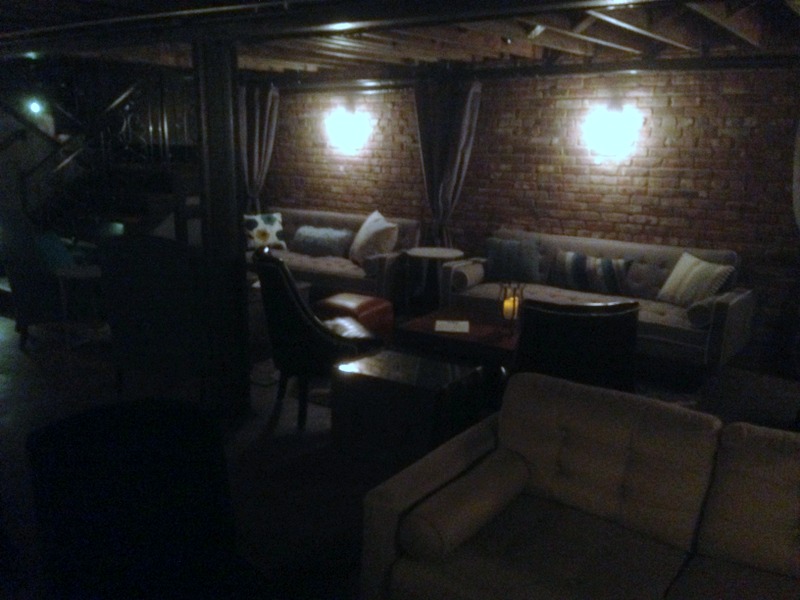
First, views of the subterranean lounge beneath the bar.


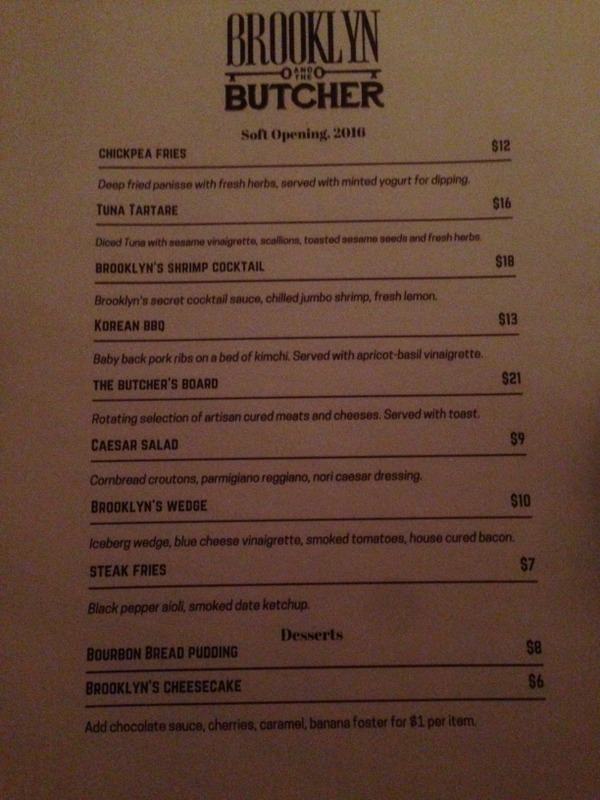
Last night's "soft opening" preview menu, and our Korean BBQ (pork ribs, kimchee and apricot-basil dipping sauce).


The bar.


In interesting juxtaposition: Way back when New Albany Inn signage, and the updated version.


Front dining area facing the corner of Market and Bank.


Rear dining area by the kitchen.


Last but first: As you enter the establishment from Market Street.


Valentine's Day is the official opening, and it is booked solid. Next week, regular hours begin. Get the lowdown at Brooklyn and the Butcher's Fb page.

Tuesday, February 09, 2016

K & I: It's like a litmus test for prejudice ... and it's got hazmat, too.

It remains difficult to for me to fathom the disgruntlement in some quarters expressed at renewed calls for the K & I to be converted into a shared use path.

Broken Sidewalk properly reiterates: "It’s time to open the K&I Bridge to pedestrians and cyclists."


A future K & I shared-use path? It's "not a priority for One Southern Indiana" unless Norfolk Southern can move the bridge to River Ridge.


Or this one from 2013.

A report on the history of the K & I Bridge.

... (Steven R.) Greseth's extensive legal research (he readily concedes it is neither legal advice nor legal opinion) succeeds in asking a whole different set of questions, which might be boiled down to this: How many, if any, of a century's worth of legal obligations is the present-day owner of the K & I now obliged to uphold?

Huckabee-voting Louisville East End suburbanites bash the notion of potential expenditures to assist mobility and interconnected neighborhoods, preferring to reserve transportation subsidies for their own auto-centric sprawl.

New Albanians are terrified that ISIS-colored refugees are in Portland, just waiting for a footpath to launch attacks on Dewey Heights.

Portlanders exactly say the same, only in reverse.

All of it remains purely theoretical, and yet already social media experts are debating policing levels, surveillance against chicanery, and all the other details barely mentioned when the Big Four's conversion was lauded as a victory for modernity.

Then there's the entity that should be on the nationalization chopping block, Norfolk Southern. Frequent blog reader A was struck by this passage in Marcus Green's WDRB article.

"Norfolk Southern's K & I Bridge exists today for a single purpose -- to provide safe transport for freight trains over the Ohio River,” (spokesman Dave) Pidgeon said in a statement. “NS generally does not support recreational trails next to active rail lines because of serious safety concerns, and we remain focused on providing safe, efficient and reliable freight transportation to our customers in Louisville and southern Indiana."

The railroad acknowledges that some want the span open to the public, but “ultimately the K&I Bridge is privately owned and operated for the single purpose of safely moving freight trains which carry ... both hazmat and non-hazmat cargo,” Pidgeon said. “We not only have safety concerns about public access along active right-of-way but also serious, prohibitive concerns about security and liability.”

Our reader brings the hammer down:

Perhaps someone could remind Norfolk Southern spokesperson Dave Pidgeon that the “both hazmat and non-hazmat cargo” already passes through both New Albany and Portland and Crescent Hill and St. Matthews and Anchorage ... That's a piss-poor reason to suggest folks can't walk the bridge. The railroad"s "hazmat and non-hazmat cargo” already passes within a very few feet of homes and children's bedrooms along the rail right-of-way.

It would be almost as interesting to know the contents of Norfolk Southern's hazmat cargo as it would the lead content of Indiana American's water supplies.

Let's keep the spotlight on the civil rights FAIL perpetuated by Mike Pence and Indiana's Republicans.


But that's life in a one-party state.

EDITORIAL: Legislature, governor fail test of courage, at the Evansville Courier & Press

... With five weeks remaining in the short, non-budgetary session, the 2016 Legislature, without great leadership from the governor's office, has accomplished little. We acknowledge that, usually, there is a great rush of bills through Indianapolis in the final week, but beginning with civil rights legislation, it's disheartening what Gov. Mike Pence and the Legislature chose to not push through.

Once again, the simple act of assuring equal rights for all escaped our elected leaders and became a debate that reached the national stage — though, thanks goodness, not as much as last year's Religious Freedom Restoration Act. In an effort to appease both those who support civil rights and those who fear their religious beliefs would be infringed upon, nothing moved forward — which you sense, in this election year, is exactly what Gov. Pence had hoped.

Why food trucks are there, or they aren't.

Beginning in May of 2014, after food service was discontinued, I thought it would be a fine idea to shift Bank Street Brewhouse to a destination tap room mode by working with food trucks. It quickly became evident that New Albany had none. Two years later, this hasn't changed.

This article provides several potential reasons why, but the gist of it to me is that if a food truck exists to go where the consumers are, we have too few places where the consumers are. We don't have a large urban employer. Downtown already is served by bricks and mortar ... and we're not the most technologically proficient metro neighborhood.

It's not a bad/good equation. It simply isn't, yet.


Why Food Trucks Locate Where They Do: Five big takeaways from a unique new study, by Richard Florida and Aria Bendix (City Lab)

But what do food trucks actually mean for urban economies? What impact do they have on local restaurants, food industries, and our choices as consumers?

Here are the bullet points.

  • 1. Twitter is a big factor in food truck location.
  • 2. The connection between food trucks and digital technology is greater in big, dense cities.
  • 3. When it comes to location, variety matters a lot.
  • 4. Food truck location is spiky.
  • 5. Food trucks cause households to spend more money on eating out.

Monday, February 08, 2016

Broken Sidewalk properly reiterates: "It’s time to open the K&I Bridge to pedestrians and cyclists."

Their pearls of wisdom never cease.

Broken Sidewalk echoes the WDRB piece by Marcus Green, referenced at NAC on February 1. While linking to Green's excellent work last week, I couldn't resist exposing One Southern Indiana's non-stance, with our presumed vanguard asleep at the wheel unless Southern Indiana's auto-centric oligarchy is directly involved.

I suppose we must give some credit to Wendy Dant Chesser some credit for knowing whence her meal ticket originates. It's just a shame so many small and genuinely local independent businesses are duped along the way to help underwrite the propaganda.

But I seem to have digressed.

Back to the uniformly excellent Branden Klayko.

It’s time to open the K&I Bridge to pedestrians and cyclists; Railroad company has stymied efforts to date, but leaders continue conversion push.

... There’s an opportunity to create a shared-use path for cyclists and pedestrians along the Kentucky & Indiana (K&I) Bridge linking Louisville’s Portland neighborhood with the flourishing New Albany. A group of dedicated leaders from Kentucky and Indiana has been steadily pushing to open a former automobile lane closed in the ’70s on the bridge to create a 13-mile waterfront loop between the K&I and its Big Four counterpart.

Interestingly, when this topic was raised on Facebook, it took a turn I wasn't expecting.

Yes! Lets make a connection to the highest violent crime area in Louisville. Great!

To which I replied:

You might be interested to know that Portland residents express qualms for precisely the same reason.

Thus ensued a lengthy back 'n' forth, and for once, I found myself dumbfounded. How could it be that given New Albany's (shall we say) eternally transitional nature, there are people here worried about criminals crossing a pedestrian bridge from Portland?

As for the neglected area around the bridge approach on the New Albany side, surely we're the culpable ones. The city of New Albany has not invested in this area for 40 years, since the automotive lane was shut; when vehicular access was removed, the Vincennes corridor and surrounding neighborhood began dying, and successive City Hall regimes did and said nothing.

A useful K & I would be instrumental in rectifying this, whether via private or public investment, and probably both.

A friend provides the appropriate conclusion.

Maybe we should be build a wall.....REALLY? I don't see a pedestrian bridge drastically increasing crime. I don't see a criminal taking a hike across a pedestrian bridge to break into a downtown New Albany home or establishment. It's not like we are Manhattan over here. There is a bridge, the Sherman Minton, that already gives criminals easy access. I think we need to embrace each other's redevelopment efforts.

Unless, of course, such an embrace is prohibited by ordinance -- or One Southern Indiana.

ON THE AVENUES EXTRA: "No, John Rosenbarger, congestion is our friend. Help us achieve it, or get out of the way."

ON THE AVENUES EXTRA: "No, John Rosenbarger, congestion is our friend. Help us achieve it, or get out of the way."

A weekly web column by Roger A. Baylor.

As City Hall dithers, Year Zero draws nearer: Bridge tolls, social injustice, NA's street grid ... and the silence of the culpable.


The column originally was published on February 6, 2014. Two years later, it strikes me as one of my better summaries on the topic of New Albany's enslaved street grid. In fairness, I was wrong about one thing: Our economic development director is not capable of understanding what I wrote. As for the rest, I absolutely nailed it.

---

For months – nay, years – we’ve remorselessly documented the fear, confusion and sheer intellectual laziness of local officialdom when it comes to grasping the basic tenets of street grid reform in New Albany.

It’s true that some of them are further along the path of righteousness than others, but virtually all are afflicted to some degree with a myopic inability, or maybe a plain unwillingness, to think clearly about the topic -- much less to do so openly and for attribution.

Festering at the heart of this ongoing disconnect is a fundamentally flawed understanding of the revitalization New Albany has managed somehow to achieve, against all institutional odds, in recent years: Who has propelled it, why it has occurred, and the incalculable extent to which such progress might be aided and abetted by immediate year-round infrastructure changes guaranteed to be far less costly than a part-time aquatics center.

Precisely because city officials don’t have a clear grasp of cause and effect, they are too easily afflicted with paralyzing dread of the unknown, which merely compounds the dead weight of a civic inferiority complex they simply can’t seem to shake.

---

Conventional ruling wisdom is this: If we as a city do anything that might be remotely construed as discouraging the unrivaled hegemony of the automobile, or if we fail to resolutely mimic the residential and commercial logic of the suburb, these are signs of electoral weakness, and suddenly, no one will like us any longer – both as politicians seeking votes, and also as a municipal entity begging for attention in a crowded marketplace.

It’s inane drivel, but bizarrely resonates among the defeatists. It’s almost as though city officials are conceding that to them, the very idea of an independent business-led downtown revival always was doubtful, at best, especially when most folks (read: “city officials”) still prefer those nice dependable plasticized multinational chains crowding the former pastureland out along Veterans Parkway.

Sadly, this rampant manure fertilizes pervasive wrongheadedness.

In football terms, the governing deletes harbor an attitude similar to the infamous “prevent” defense, which typically stifles vigor and initiative, except that in football, coaches don’t start misusing the prevent until they’re ahead. Here, we’re doing it from behind.

In Junior High School terms, it’s like suffering from rampant adolescent insecurities and low self-esteem, and trying to dress and act like everyone else, just to fit in, only then belatedly realizing that not being yourself is no way to find yourself.

In economic development terms, it’s just plain unimaginative, derivative, non-creative insanity.

---

As it pertains to the street grid, and as befitting those ordinary citizens of a similar age and demographic background who have traveled but paid depressingly scant attention to what they were seeing in a wider world, certain of our city officials evidently believe that the logic of the suburb applies equally and inexorably to the city center itself – that success can be achieved only by maximizing access via automobiles, whether it’s a doctrine applied to arterial streets that handily desecrate entire transitional neighborhoods, or surface parking that both mars the historic streetscape and prevents infill.

It is a self-defeating fallacy for an urban area, but it is the inextricable root fallacy of our detached leadership cadre, many of whom seem proud to know absolutely nothing about the contemporary ideas advanced by Jeff Speck (among others) in the year 2014, as opposed to 1964, and even though we’ve been talking and writing about these matters here at this blog since 2004.

That’s because when challenged to think, they fall back on their native “common” sense, gleaned from confounded, compounded incomprehension, and therefore not very sensible at all. I don’t mean to be harsh, but really, sometimes one must step away from the pasty white Cracker Barrel banquet table, break open an actual book, and learn something.

---

In some respects, I do take city officials at their word. I believe they genuinely grasp that as the Ohio River Bridges Project advances from construction displacement through invasive tolling regime, New Albany stands to be badly harmed by hordes of pass-through cars and drivers, and by the congestive havoc they’ll cause.

However, I don’t see them grasping one iota of the curative logic, albeit counter-intuitive and requiring deeper thinking than suffices for watching network television, which explains the single best counter-active strategy available to us, as prefaced by Jeff Speck:

“Were it not for traffic congestion, we would drive enough additional miles to make congestion."

In short, to reduce congestion, induce congestion, although characteristically, city officials appear to be frozen in the approaching Hummer’s headlights as they grapple with their reigning congestive vision failure.

There’ll be congestion caused by the pass-throughs … but geez, how do we cope with congestion by reducing and slowing vehicular access … shouldn’t we be adding lanes and increasing speeds … hell, those neighborhood people gripe all the time, and they knew their quality of life downtown wouldn’t be half what it is on Rainbow Drive … can’t we just sit here and do nothing, because maybe a few of those cars will stop and eat, and then we can call it economic development, declare victory, and get re-elected and shit.

No. No. No.

NO.

To reduce congestion, induce congestion.

We must actively and unapologetically move to intentionally “congest” our current one-way arterials by making them two-way streets again; reducing lane sizes; lowering speeds; crowding them with walkers and bikers; or even adding a few of John Rosenbarger’s trademark totemic, fetishistic bump-outs of the sort be believes alone can transform paradigms over endless decades of gradual implementation.

But why fight congestion with congestion?

Because if we don’t, people in outlying areas will see downtown New Albany’s streets in precisely the same way they will view the Sherman Minton Bridge: A cost-free route for immediate passage.

Therefore, we must add user costs so as to discourage them, and seeing as we’ll not be tolling city streets during peak usage like London does, purposefully congesting the streets is the only way to impose a cost in extra time for the prospective pass-throughs, encouraging them to self-divert to avoid the cost in time, with the additional practical effects of (a) curbing bad congestion by using good congestion as a tool; (b) enhancing neighborhood quality of life; and (c) helping small, independent business to remain the driving force of downtown redevelopment.

---

Now, here’s where the inferiority complex comes in.

But, omigod, Roger … if we do these things, then they’ll stop coming here, and everything we’ve tried to do …

Wait.

Everything YOU’VE tried to do?

Please.

It seems to me that if the indie business community has the confidence to grasp that street grid reform will deter unwanted pass-throughs while creating urban conditions all the more favorable for the great customers we already have – accepting the obvious fact that we’ve invested far more in money and time toward downtown revitalization than local government has ever dreamed of expending – why not take our word for it?

The people who are spending money downtown right now are not doing so because it has the same vibe as Veterans Parkway, or because we’re a convenient destination. New Albany’s always been out of the way, hasn’t it?

They’re doing it because downtown is different. Street grid reform stands to make downtown even more different, and better for the change; this can only increase consumer loyalty, not defeat it.

As an added bonus, lifting the quality of life in neighborhoods by ending the tyranny of one-way arterials stands to bring more of the neighborhood back to downtown, in effect adding the housing we currently lack in the epicenter. Why? Because they’ll be able to walk and bike and use the grid between their homes and downtown as human beings, not merely driving cars.

What stands in the way?

Essentially, an outdated mantra worthy of Warren Nash: “But it’s the way we’ve always done it.”

---

Boy, haven't we. And see where it's gotten us?

Even it public works über-honcho John Rosenbarger “gets” all this, I’m finished defending him against his detractors, because it has occurred to me that never in my experience advocating for two-way traffic, when John’s somewhere within earshot, has he unequivocally endorsed the idea. Not once.

Rather, each time, he has uttered a disclaimer: Well, if not two-way streets, then traffic calming, and yes, this might make sense if he had a record of actively spearheading traffic calming and complete streets, but while he’s always talked a wonderful game about them, it has taken three decades for us to boast even those minuscule, scattered and pathetically unconnected examples we have now.

Sorry, but it’s time to say it publicly: For reasons unknown, John’s fatally biased against two-way street reform, perhaps because of his preference for the lifelong bureaucrat’s creeping bump-out incrementalism, which we no longer have time to indulge. He’s not helping us; he’s pushing back against us. In fact, I’ve come to believe that John is a major force against the changes we need right now, whether intentionally or otherwise. That’s too bad, and I wish I knew why. He’s not helping us. He’s hurting us.

Concurrently, I believe that economic development director David Duggins is fully capable of understanding the points I’m making here, but chooses not to do so, probably because there are no one way streets in the industrial park.

Moreover, perhaps as few as two, maybe three council persons see the merit of street grid modernism. And, honestly, I have no clue what Mayor Jeff Gahan sincerely believes about this topic, or for that matter, what he believes about anything at all. He remains a sphinx, forever guarded.

The fact is this: We’ve utterly wasted ten years on slipshod photo-op chicanery best symbolized by two bike lanes on each side of a one-way street, attached to nothing, and sheltered not one jot from unregulated vehicular traffic that negates the effort of painting the stripes, and if people like John Rosenbarger want to boast about this as though it were some semblance of a professional legacy, that’s exceedingly odd, because it isn’t, unless professional legacies typically embrace perpetually parsing fifty shades of stalled congestive anxiety, then waiting another few years before refraining from doing anything yet again.

Those municipal officials seeking a substantive legacy might consider leading change rather than road-blocking it. Otherwise, getting the hell out of the way would be a nice alternative, or at least not sabotaging the effort of those who’ve actually put money where their mouths are.

I’m ready to start painting yellow lines.

Aren’t you?

---

Recent columns:

February 4: ON THE AVENUES: Hello, I must be going.

January 28: ON THE AVENUES: They're surely not ROLL models.

January 21: ON THE AVENUES: When I grow up, I'd like to be alive.

January 14: ON THE AVENUES: Should the Queen fail to rescue us, there's always H. L. Mencken.

January 7: ON THE AVENUES: You know, that time when Roger interviewed himself.

Sharrows in New Albany: "A low-cost way for cities to say they’re doing something about safety and street design without really doing much at all."

Days of future past.

Nothing better symbolizes the comprehensive failure of New Albany's Main Street "Improvement" Project than the street's transformation from bicycle-friendly to bicycle-prohibitive.

Yes: Those magical, transformative sharrows.

October 18, 2014
Basically, sharrows suck, so naturally New Albany plans more of them, so we can be "bike friendly" on the cheap.

November 10, 2014
"Sharrows are popular because they are politically easy," and so in NA, they'll multiply like rabbits.

January 4, 2015
Gahan AWOL as cyclist assays new Main Street sharrows: "Someone is going to get seriously hurt or worse."

May 21, 2015
This bicyclist seems mistrustful of the Main Street sharrows.

A Fb conversation ensured. A few random comments:

Jeff Gillenwater 
As many have pointed out, Main Street is indeed more dangerous for bikes now than it was before the "improvement" project.

Roger A. Baylor
Now, Spring Street between Silver and Beharrel will have no bicycle infrastructure of any sort. Rather, our planners will connect bicycles to Spring via Silver, where infrastructure is largely non-existent, and where there is no stated plan to remedy this. When I pointed this out to Larry Summers, Rosenbarger having already fled the room, Larry replied that it's the best that can be done, and there's no choice except gradually implementing inadequate remedies over a long period of time. Thus, we get what we deserve -- good and hard.

RiBr
Main St. in New Albany is a joke and median makes it worse. There is barely enough room for a car to pass a bike, and when they do, if someone was to open a door on a parked car, you are toast.

Roger A. Baylor
And folks like Greg Phipps knew this from the start. But as we've learned so often before, in NA, one doesn't fuck with the in-fix. Apart from Matt Nash, I'm trying to think of an elected official past or present who actually has tried to ride a bike locally. Surely I'm forgetting someone? Maybe John Gonder, ousted by the Floyd County Democratic Party for being an A student.
.
RR
I ride thousands of miles a year and on all sorts of roads, but I will no longer ride on Main street.

KP
My daughter came into town the other day and took me out for supper via Main Street. She was horrified at how small and dangerous it felt to drive that street. "So many blind spots." Yep.

Then there are those pesky researchers. How dare they contradict Team Gahan.

Some Bike Infrastructure Is Worse Than None at All, by Eric Jaffe (City Lab)

It’s time to put the sharrow to rest.

Denver gave rise to the sharrow in the early 1990s, and now two researchers there offer a compelling case to put the lowly form of bike infrastructure to rest.

You’ve seen a sharrow painted on city streets: it’s that image of a cyclist below two arrows in the middle of a lane that—you guessed it—is meant to be shared by bikes and cars. The Federal Highway Administration gave sharrows its official blessing in 2009, and the symbol is now ubiquitous across urban America. It’s also arguably the least-loved nod to cycling, a low-cost way for cities to say they’re doing something about safety and street design without really doing much at all.

SNIP

 ... What is clear in the Vision Zero era is that truly prioritizing bike safety means building separated bike lanes. The results should be confirmed in other cities for good measure, but they certainly seem to suggest that sharrows are poor substitutes for bike lanes at best and “more dangerous than doing nothing” at worst, write Ferenchak and Marshall.

They conclude, in a working paper recently presented at TRB 2016, with some harsh words:

As sharrows do not provide designated space for bicyclists and do not enhance the overall bicycle network, all cities should (as many already have) begin to consider sharrows simply as signage as opposed to actual infrastructure. It is time that sharrows are exposed for what they really are, a cheap alternative that not only fails to solve a pressing safety issue, but actually makes the issue worse through a sense of false security.

Sunday, February 07, 2016

Dear Jeff: "When Drivers Hit Pedestrians, Where Do We Lay the Moral Blame?"


So why do so many people blame the pedestrian?

Earlier today, I was walking on Spring Street, the world’s longest interstate entrance ramp, as recently certified by the Guinness Book of World Records.

City officials giddy as New Albany finally makes Guinness Book of World Records (REPOST).


At one point, three of four vehicles coming past -- probably all of them traveling between 35 and 40 mph -- shared a single feature in common.

Their drivers, two men and a woman, were staring at mobile phones.

When Drivers Hit Pedestrians, Where Do We Lay the Moral Blame?, by Peter Simek (Front Burner blog at Dallas Magazine)

... When your city is constructed in such way that it values efficiency and speed for vehicular traffic above all else, taking every opportunity to create a thoughtless, unobstructed environment for drivers, that design teaches the people who live in the city that the public realm values the car over the pedestrian. When a pedestrian interrupts the vehicular environment, he or she demonized for stepping out of line. They are judged to be thoughtless, reckless, or irresponsible because they have invaded a space that the city has instructed us belongs to cars.

"Gov. Mike Pence and the General Assembly have failed Indiana and its residents, not just those from the LGBT community, but all of us."


When I was a wee lad, being Republican was all about obeying the every desire of high-powered economic interests.

Now it's groveling to the prejudices of our Christian Taliban. It's hard to decide which aspect of the One Party State is worse.

Editorial: A legislative letdown over LGBT rights (Indy Star)

The General Assembly and Gov. Mike Pence’s refusal to extend the state’s civil rights law to include sexual orientation and gender identity continues to tarnish Indiana’s image and jeopardize long-term economic prosperity.

Last spring, after a firestorm from passage of the Religious Freedom Restoration Act blew up in their faces, lawmakers pledged to address legal protections for LGBT citizens in the next legislative session.

But after meeting privately Tuesday, Senate Republican leaders decided to kill legislation that would have protected gay Hoosiers from discrimination. In doing so, they not only failed lesbian, gay, bisexual and transgender Hoosiers but also their families, friends, coworkers and anyone else in our state who values equality ...

Newspaper editorial board votes 4 - 1 in favor of New Albany's downtown "revival," local businesses and two-way streets.


Granted, all the dots don't connect in terms of editorial logic.

OUR OPINION: City's 'Main Street' revival fuels region (editorial board at the News and Tribune)

 ... Long the local standard-bearer for reimagining “Main Street,” downtown New Albany is experiencing a new business microburst. From unique restaurant concepts to trendy décor shops to niche boutiques, the fork-in-the-cheese city is showing its teeth.

Let's consider a few examples.

As a frequent reader notes, "Not so sure the apartments (Breakwater) are a capstone. They may be a millstone."

The culinary team preparing Gospel Bird for opening is surprised to learn about menu options even they didn't know existed: "I had no idea that Gospel Bird is now a Nashville hot chicken place and that we are offering 'games' in the bar area."

(Seeing as NA Confidential has not mentioned games and Nashville hot chicken in a Gospel Bird context, it appears these notions came from elsewhere on the Internet. The newspaper still is down a reporter, after all, and most boots are on the ground in Clark County)

Then there's this: "Can someone forward me info about the accredited Main Street program? Thinking we might be missing out on something."

Straight face: It's Develop New Albany, and it probably is not recommended that Nawbany partisans make too many comparisons between DNA and Jeffersonville Main Street; the latter has a far longer record of adhering to the National Main Street program, although DNA lately has been showing signs of a renewed pulse.

Still, while difficult, let's not be entirely churlish.

The newspaper properly recognizes the entrepreneurs, humorously excludes the politicians forever eager to claim credit, and makes one hugely excellent point:

"Imagine the possibilities if New Albany shifts its downtown street grid to two-way, which would benefit business and pedestrian traffic. We’re counting on hearing positive news to that end this year."

Of course, it's funny how everyone counts on forever elusive "positive news" about the street grid, even as the folks in City Hall charged with making it happen adhere to the down low, drag their feet to the detriment of these same entrepreneurs, and pause only to award lucrative engineering consultancy contracts from sheer nepotism, once removed (something also eluding the newspaper's grasp) ... but I digress.

Of course, there's a humorous side, too: Chris Morris is one component of an editorial board now finally hinting at a solid position in favor of two way streets, on grounds of business and walker safety, as Morris chafes and suppresses a scream: But what's to become of our poor oppressed pass-through truckers? Ah, the humanity ... the lost horsepower ... what, don't these people walking around have cars?

Now, about that reporter ...

Saturday, February 06, 2016

My Euro '85 travel writing reboot is meandering toward a conclusion.

Weenies in Copenhagen.
It used to be a stock comedic gag that returning vacationers would force friends to view photos of their holiday, prattling for hours while the unfortunate victims plotted their escape routes.

This joke probably hasn't survived the advent of social media and ubiquity in communications, seeing as all our photos are available, all the time, for immediate viewing. Now we look to the exclusion of reading.

Upon returning stateside from my first European jaunt in 1985, I couldn't view my visual souvenirs right away. I'd taken slides, and had to get back to work first to amass the money necessary to develop them. Having done so, I staged numerous viewings with projector and screen. Beer was necessary in order to keep the audience fixed in their seats.

In a few months it will have been 31 years, and these reminders remain trapped; I've never gotten around to digitally transferring them, and the 40-year-old projection apparatus doesn't function properly. Your suggestions to inexpensively rectify my sloth are welcome.

In April of 2015 it occurred to me to pick up a ball I'd dropped in 2005, and to reboot the 1985 travel narrative. It had flared up briefly in 2009 during my tenure as newspaper guest columnist, then fizzled again.

Through all the weird changes of past months, I've kept chipping away at the travelogue. To date, 28 installments have been written (I guessed it would require 25), and three or four probably remain. Having written about the trip in other places and contexts over the years, this effort has represented the opportunity to weave it all together in one place.

The purpose isn't high art. It's really about me, and remembering a summer that permanently changed my life. Yes, it was only a three-month pleasure trip to Europe, and fairly inconsequential in the larger scheme of life. However, from ouzo to train travel and from urbanism to pickled herring, I've never been quite the same. My post-traumatic stress derives from where I continue to choose to live, not where I visited.

The chapters are being posted on or around Mondays at my Potable Curmudgeon blog. Part 29 might be ready the day after tomorrow, though I doubt it.

Here are the links to date.

The PC: Euro ’85, Part 28 … A Finnish detour to Tampere for beer and sausages.

The PC: Euro ’85, Part 27 … Stockholm's blonde ambition, with or without mead-balls.

The PC: Euro ’85, Part 26 … The Hansa brewery tour, and a farewell to Norway.

The PC: Euro ’85, Part 25 … Frantic pickled Norway.

The PC: Euro ’85, Part 24 … An aspiring “beer hunter” amid Carlsberg’s considerable charms.

The PC: Euro ’85, Part 23 … A fleeting first glimpse of Copenhagen.

The PC: Euro ’85, Part 22 … It's how the tulips were relegated.

The PC: Euro ’85, Part 21 … A long day in Normandy, though not "The Longest Day."

The PC: Euro ’85, Part 20 … War stories, from neutral Ireland to Omaha Beach.

The PC: Euro ’85, Part 19 … Sligo, Knocknarea, Guinness and Freddie.

The PC: Euro ’85, Part 18 … Irish history with a musical chaser.

The PC: Euro '85, Part 17 ... A first glimpse of Ireland.

The PC: Euro ’85, Part 16 … Lizard King in the City of Light.

The PC: Euro ’85, Part 15 … The traveler at 55, and a strange interlude.

The PC: We pause Euro '85 to remember the Mathäser Bierstadt in Munich.

The PC: Euro ’85, Part 14 … Beers and breakfast in Munich.

The PC: Euro ’85, Part 13 … Tears of overdue joy at Salzburg's Augustiner.

The PC: Euro ’85, Part 12 … Stefan Zweig and his world of yesterday.

The PC: Euro ’85, Part 11: My Franz Ferdinand obsession takes root.

The PC: Euro ’85, Part 10: Habsburgs, history and sausages in Vienna.

The PC: Euro ’85, Part 9 … Milan, Venice and a farewell to Northern Italy.

The PC: Euro ’85, Part 8 … Pecetto idyll, with a Parisian chaser.

The PC: Euro ’85, Part 7 … An eventful detour to Pecetto.

The PC: Euro ’85, Part 6 … When in Rome, critical mass.

The PC: Euro ’85, Part 5 … From Istanbul to Rome, with Greece in between.

The PC: Euro ’85, Part 4 … With Hassan in Pithion.

The PC: Euro ’85, Part 3 … Growing up in Greece.

The PC: Euro '85, Part 2 ... Hitting the ground crawling in Luxembourg.

The PC: Euro ’85, Part 1 … Where it all began.

"Sanders’s suggested policies are better for the struggling people of this country, particularly women."

There simply isn't much to add.

My Kind of Misogyny: I Don’t Care If They Call a Warhawk “Cankles”, by Amber A'Lee Frost (The Baffler)

... I’d obviously be pleased to see a politically decent woman president, and if Hillary gets the nomination, I’ll happily cast my protest ballot for Jill Stein from the safety of my blue state. (Truth be told, as a Cold War social democrat, Bernie’s already my “compromise” candidate anyway.) Obama’s presidency has not yielded much in the way of material gains for black people in America, and it’s hard to imagine what a symbolic feminist victory like a female president would guarantee for all but the most privileged of women. As it stands, I’d no more vote for Hillary than I would for a Margaret Thatcher or a Sarah Palin.

And isn’t that the simpler explanation of left dissent from Team Clinton? It’s not that critics of Hillary are largely misogynist or even that they’re obsessed with political purity. It’s that she’s a proven neoliberal warhawk, a Wall Street sycophant, and a consistent enemy of the poor.

CIDEways Tap Room + Cidery coming soon. Also, an Elks Lodge 270 facade improvement.

Photo credit: 502 Brews. 

I'm shamelessly cribbing this one from Develop New Albany's e-newsletter.

As a "CIDE" note, in addition to Matt's visible work toward refurbishing his Market & Pearl corner property, Elks Lodge 270 immediately adjacent soon will begin a facade enhancement project, replacing the current white "decorative" front (even lodge members routinely refer to it as ugly; see photo above) with bricks in a much better arrangement. It will be more in keeping with the original lodge, which was vastly reconfigured after a catastrophic fire in the early 1960s.

In short, the perimeter expands. Got that wine license yet, Matt?

---

CIDEways Tap Room + Cidery Coming this Summer

The Horseshoe Foundation Revolving Loan Fund announced recently that restaurateur Matt McMahan is the first recipient of a revolving loan for 2016. McMahan will open the CIDEways Tap Room + Cidery, a casual dining restaurant located at the corner of Pearl and East Elm Streets next to the New Albany Elks Lodge in New Albany.

The $50,000 loan awarded to McMahan will be used to build a full kitchen in the building (hood, fryers, stoves, etc.), as well as equipment to make cider. Renovations on the new location will continue, including the addition of outdoor street seating. This is the second Horseshoe Foundation revolving loan received by McMahan; the first being used to open the Big Four Burgers + Beer in New Albany.

CIDEways will be quite different from Big Four Burgers + Beer, CIDEways will offer a wide variety of beers and wines as well as the specialty hard cider. McMahan estimates the new location will have 18 beers on tap, with an additional 60 brands of bottled beer.

CIDEways is scheduled to open by the summer of 2016 and be available to diners seven days a week from 11:00 a.m. to midnight.

Friday, February 05, 2016

Rosenbarger's "Break Wind Plan" for traffic calming on Spring Street.


But ma, they keep handing me material -- and you taught me to be thrifty and use the whole pig. Problem is, I keep running out of lipstick.

Four years later, and City Hall still can't explain this sign. Feeling good about New Albany's "plan" to cope with tolls?


If heavy trucks are not supposed to be using Spring Street, why does it happen? Did something change? Is there a law, or not? If there is a law, why isn't it being enforced?

We've been asking these questions for years, without answers. Now there are many more questions, and still little sign of a pulse.

Bridge tolls, social injustice, NA's street grid ... and the silence of the culpable.


Meanwhile, this article appeared on July 17, 2013.

That's two and a half years ago.

Feeling confident yet?

New Albany concerned drivers trying to avoid new toll bridges may cause gridlock, by Lawrence Smith

NEW ALBANY, Ind. (WDRB) -- The new bridges are expected to ease traffic congestion across the Ohio River, but at least one community is worried the bridges may actually cause more traffic headaches ...

... But officials here are concerned about too much of a good thing.

According to the Kentuckiana Regional Planning and Development Agency, KIPDA, some 90,000 cars cross this bridge everyday.

Depending on the amount of the toll, that could jump to 120,000 a day when the new bridges are finished.

City planners say that could cause gridlock in downtown New Albany.

"Adding that traffic volume to our urban street grid is an issue for us because we don't have the additional right-of-way to add additional laneage and we wouldn't want to do that anyway," said Scott Wood, director of New Albany's Plan Commission.

The city is planning to install counters to get a better gauge on traffic patterns.

Officials may ask for federal funds to study possible solutions, including turning New Albany's one way streets into two-way.

"And we're flexible. We're willing to adjust things on the fly as we need to as we see an issue arising," said Wood.

David Scott believes the city will find answers.

"Personally, I would like to see more two-way streets. It makes for more stop-and-go where people don't try to fly through," said Scott.

No one will truly know the impact of the tolls until the bridges are finished in 2016. But officials here say they need to get ready now, before it's too late.

Thanks, JP.


Arts and Cultural District: Team Gahan lapped again by Jeffersonville.


Sadly, among the artists set to populate Jeffersonville's cultural district is Michael Wimmer, formerly doing good work in New Albany.

Last summer, his departure was explained.


Gahan now open to covert art discussions, but still no public comment on two-way streets.


This was around the same time that Warren Naps was fighting to keep pianos off New Albany's pristine, monster-truck-ridden streets, at least until the piano's backers politely recalled that there is a proper order for art installations in New Gahania: One pitches the idea of campaign donations first, and only then speaks to the actual project itself.

Think of it as the gentle art of the kickback. That's real Nawbany culture, son.

Yep. One headline, multiple uses: Team Gahan, lapped again. 

A CULTURED CORRIDOR: Jeffersonville to create arts and cultural district downtown, by Elizabeth Beilman (Jeffersonville Evening News)

JEFFERSONVILLE — There's not much on Michigan Avenue. The two-and-a-half blocks in downtown Jeffersonville are mostly home to concrete and empty buildings.

" ... Right now, we have people that come off the [Big Four] bridge and they go around Spring Street and they make a loop to the river and they come back, and they don’t go much further," Jeffersonville Public Arts Administrator Dawn Spyker said.

City officials are trying to change that.

The goal is to transform the corridor into an arts and cultural district, a walkable connection between booming Spring Street and the soon-to-be-developed Gateway property at 10th Street.

Bridge tolls, social injustice, NA's street grid ... and the silence of the culpable.

Yesterday the grisly details of bridge tolling began making the rounds of Louisville media outlets. Einstein's theory of relativity is more readily accessible than RiverLube's byzantine explanations, although one point is crystal clear:

You should drive more in order to save money!

What's the use in overbuilding auto-centric infrastructure if we don't become even more dependent on cars?

RiverLink tolls: How much it is really going to cost to cross Ohio River

LOUISVILLE, KY (WAVE) - In just a few short months, tolls across WAVE Country will be a reality. The price will range from $1 to $4 per way for everyday drivers, but getting that discounted rate may be harder than you think ...

... what if you miss one day of work? Or only work a three to four day work week? You could be racking up $76 in tolls for that month. That's why RiverLink officials encourage you to keep an eye on your account and if you're under, get in your car.

"It's absolutely going to benefit you to go ahead and have dinner across the river, go and see a show, or do something because you are saving money at that point and you are saving quite a bit of money to hit that 40 mark."

A few short months, indeed. Remember these words, waaaay back in 2010?

It's deja vu all over again: "While Finn did not directly answer the question ... "

"With tolls, I for one believe if it’s any more than a dollar a toll then we are in serious trouble ... Our hope is that it will be significantly less than that. I know $3 tolls would be devastating to this community.” (Jerry) Finn added that he would never vote for imposing a $3 toll for each trip.

Fast forward to yesterday, and this comment from a Southern Indiana resident.

I will change my commute to the Sherman Minton simply because I can't afford tolls. Doesn't matter how much longer that commute will take, I have no choice ... I just can't comprehend the thought of making them so costly. Just no regard for the common man/woman -- really a shame.

Perhaps Jerry would like to explain.

Perhaps Ron Grooms, Ed Clere and Kerry Stemler can chime in.

Meanwhile, here in Nawbany, does anyone care to predict how long it would take for Dan Coffey, Bob Caesar or someone like them to step forward and demand (not induced demand) that not only should there be no consideration of two-way street reversions, but that the third Spring Street lane should be put back into place to handle the traffic of all those nice folks wanting to shop New Albany during their pass-around excursions to and from work?

Come to think of it: As of this moment, we still do not know what City Hall intends to do about this. Are our streets to remain as they are? To change? The mayor is silent. We are told to trust this silence. Do you?

The following post is from 10 November, 2015. 

---

AAUGH: Gahan, Speck, gridlock, bridge tolls and timetables. 


File under idle curiosity on a day when I clocked a few cars going 50 mph down Spring Street.

If one of the publicly stated purposes of the Speck downtown street network study was to prepare NA for tolling-induced gridlock ...

(it says so here)

 ... and if tolling is to begin by the end of 2016 ...

(as noted here)

 ... and if the need for monetization-friendly engineering studies from Indy-based consultants pushes back any conceivable progress toward street grid reform implementation a full 18 months from April, 2015, to somewhere around October of 2016 ...

(quoted right here)

 ... and if INDOT's published "letting" date for two-way street changes on Market and Spring from Vincennes to State does not occur until January, 2017 ...

(as originally revealed here, but let's have a nice pictorial, too)


Then tell us, exactly how is Team Gahan going to "prepare" New Albany for tolling by the time tolling actually starts?

Or, are we “prepared to take steps to avoid gridlock in our downtown,” only “where feasible"?

As we await an answer from the bunker where transparency goes to die, it may be a good idea not to hold our breaths.