Showing posts with label municipal dysfunction. Show all posts

Tuesday, February 26, 2019

ON THE AVENUES: Pretty in pink slips, aren’t they? Those who mutilated Speck need to be cashiered.


Yes, it's true that I've been indulging in reruns, but hear me out.

For the past two weeks I've been using all my spare moments to go swimming in the rank, toxic, soul-crushing sewer otherwise known as Mayor Jeff Gahan's CFA-4 campaign finance reports.

Y'all know I'm a hardcore cynic -- and the pay-to-play is worse than even I thought.

The Jeff Gahan Money Machine, Part 5: In 2019, Gahan will pass the half million dollar mark in campaign fundraising since 2011.


There's another reason for dipping into the archive.

Many readers weren't with us back when a column like today's was first published (January 8, 2015). At the time, consultant Jeff Speck's draft report about the two-way future of the street grid had only just appeared.

It took another two years for Gahan to commission the ever servile HWC Engineering to butcher Speck's overall perspective, stuff the remnants into sausage casings, spread the largess among the usual suspects, and declare victory.

In short, Gahan gleefully botched the street grid modernization as trucking special interests applauded and the mayor's sticky sycophants sagely nodded -- among them the East Spring Street Neighborhood Association, the brain trust of which concluded with all due terror that "modernization" was far too dangerous a concept to risk in New Albany.

ESNA was catastrophically wrong, and its timidity was both short-sighted and unforgivable. Now Greg Phipps wants four more years as councilman because he's not finished yet -- doing the mayor's daily bidding, that is. We need a principled, independent choice in the third district, don't we?

As for Gahan's trashing of Speck, you can't say I didn't predict it. Read on, and don't forget to vote these under-achievers out of office as soon as you have the chance.

---

ON THE AVENUES: Pretty in pink slips, aren’t they?

A weekly web column by Roger A. Baylor.

On Tuesday, the very morning when City Hall at long last hazarded a first halting, wheezing, asthmatic step toward taking proper possession of Jeff Speck’s seminal street study, it was disturbingly sunny outside.

Now, I’m so old I can remember when Speck was Jeff Gahan’s Big Idea, prompting his very own commissioned mayoral study, at least right up until that fateful moment when the Tiger Trucking semi rig’s headlights froze Hizzoner dead in his tracks, at river’s edge, like a bedraggled, matted raccoon without a paddle, stuck in the middle of an arterial one-way Highway to Birdseye.

Where was I?

Oh, yes: It was sunny outside.

I muttered a choice epithet and spat as I walked downtown, past the doomed urban corner where a quarter million is about to be squandered to permanently anchor a temporary seasonal farmers market on one of the city’s hottest future infill parcels.

Damn. It really needed to be cloudy outside on this, our auspicious Speck Study Day.

After all, if Mayor Gahan (or more likely, the hardest working hologram in Indiana municipal governance) were to surface from Das Subterranean Command Bunker on Speck Study Day, only to see the sun actually shining, we’d be condemned to eight more years of foot-dragging, feeble excuses and DemoDisneyDixecrat appeasement, with little hope of street grid reformatting taking place in our lifetimes.

However, and we can only hope fortuitously, agoraphobia is the cruelest of mistresses. Mayor Gahan sent the city engineer, Larry Summers, to the Bored of Works in his stead, and poor Larry was far too nervous performing his assigned task of explaining how something and nothing can occur simultaneously to notice the prevailing atmospheric conditions.

Tinkerbell Dickey was there, too, but the Democratic major domo was preoccupied with feverishly emitting ear-lobe-tugging, nose-scratching procedural signals to the BOW chairman Nash, who gazed in bewilderment at the Power Point slides:

“Wow, Larry, you mean a road diet isn’t a Disney theme park ride?

"Why, this is the space age!

"Next thing you know, they’ll have color TVs playing at the Waffle House.”

---

Unsurprisingly, those of us most thrilled by the comprehensive efficiency and vigorous optimism of Jeff Speck’s Downtown Street Network Proposal are just as dour and pessimistic about the chances of it ever being carried out hereabouts in any substantive fashion.

That’s because in Come to City, we’ve never really come to, and what’s Groundhog Day, anyway? In New Albany, it’s just another word for tomorrow, and the day after that, and …

---

In 1989, several previous fallen dominoes (Solidarity’s election victory in Poland and the partial opening of the Austro-Hungarian border, to name just two) culminated with the collapse of the Berlin Wall. The USSR stood aside, and the Warsaw Pact was no more.

The subsequent experiences of these East Bloc nations varied, but to some extent in all of them, surely more so in Romania and Bulgaria, the period of post-Communism possessed a decided aura of déjà vu, because there, in the seats of power, occupying elected as well as appointed offices, sat the very same functionaries as before.

Rather like a species of rapidly evolving insect (remember, Franz Kafka was Czech), they either chose the proper moment to switch sides just prior to the outbreak of revolution, or merely shifted into a dormant stage of Down-Low to wait out the post-crash euphoria, reasoning that in the cold light of day, their bureaucratic skills would be deemed essential, and their previous careers worthy of selective forgetfulness.

In this context of adaptability, formerly Communist officials in newly democratic Eastern Europe drew upon an irrefutable pedigree, because after all, denazification in Germany following World War II proved to be schnauzer that simply wouldn’t hunt. Apart from a low percentage of high-profile examples, numerous adherents of the “Heil Hitler” persuasion made a seamless transition from discredited losers to irreplaceable stalwarts of the new/old system now harnessed to a different master, whether West or East.

Why mention Europe’s 20th-century totalitarian hangovers?

It’s because Speck’s street study is more revolutionary than all the (Groucho) Marxists and (John) Lennonists combined, meaning the chances of its implementation in the Land of C and D Students is embarrassingly slight.

But what if a miracle occurs?

What if Speck Happens?

Maybe Tricky Dickey was right all along, and all it takes is faith, and a little bit of pixie dust, and BOOM – Speck in our time!

The good guys win, the city’s future brightens … prosperous times are around the corner, with Tippecanoe and Walkability Too … get out those bikes, people, and skates, and … hold on.

Just wait. It couldn’t be, could it?

Those guys with the clipboards, managing the Five Year Speck Conversion Plan, working for the New Boss … OMG, say it ain’t so.

Not him.

Anyone but him.

---

That’s right. You guessed it. Even in the very rosiest of street scenarios, which most of us reckon might – just might – yield a Speck Study Quotient conversion rate of 15%, quite likely we’ll be asked to accept a state of affairs wherein the same street-disfigurement criminals wreaking havoc all along are magically transformed into courageous reformers.

We’ll be asked to believe that zebras can shed their stripes, as they set out at the usual bloated pay scale to dismantle the very same dysfunctional one-way, auto-centric edifice they spent the previous three decades perfecting, the sheer idiocy of which comprised the fundamental cause for the revolution in the first place.

Specifically, if John Rosenbarger has anything to do with the implementation of the Speck plan, which clearly calls for ridding the landscape of previous masterworks undertaken at Rosenbarger’s dull instigation, like the rock-strewn bump-outs on State Street, then we’ll have final, irrefutable proof of New Albany as default Groundhog Day, every day, forever.

Wonderful. Rosenbarger and his compatriots, some departed, and others still secured within the Third Floor woodwork like termite larva, built a street grid that Speck’s study relentlessly, mercilessly eviscerates – block by block, and lane width by asphalt expanse. Now, he’ll fix it.

Not only is it bullshit, but it’s also unconscionable, absurd and intolerable. In New Albany, these four words are considered synonyms for “bound to happen” – again, and again, and again.

Good grief, people.

Just during the brief period of the Speck study’s gestation in 2014, Rosenbarger merrily shepherded our Main Street equivalent of Nicolae Ceaușescu’s destructive pre-1989 boulevards and palaces chaos in Bucharest, placing a colossal raspberry of damp flatulence on the street grid he has had such a prominent hand in pillaging over 30 long, wasted, impotent years.

Imagining him at the triumphant Speck photo op, equipped with kiddie hardhat and requisite rubber shovel, those glow-in-the-dark reddened eyes leering, makes me reach for my garlic cloves and nice, sharp, wooden stakes. Ceaușescu wasn’t the only vampire on his Romanian bloc, you know.

Yet, in the end, there is very good news … and also very bad news.

The good news is that Rosenbarger probably will have no part whatever in implementing the Speck study in New Albany.

The bad news?

There’ll probably be no implementation of street modernity in New Albany.

Once upon a time, Speck was to have been Gahan’s Big Idea, but now the odds makers are unanimous, and persuasive: All we get is this lousy Potemkin Village – Hooterville and Caesartown, and again tomorrow, and the day after that, and …

Wouldn’t it be nice, just for once, to escape the recurring cycle of stupid?

---

Recent columns:

February 22: ON THE AVENUES SPECIAL: Take your cult of personality and shove it, Dear Leader.

February 19: ON THE AVENUES: I'd stop drinking, but I'm no quitter (the 2019 Gravity Head remix).

February 12: ON THE AVENUES: If it's about learning and knowledge, then by definition it's a Gahan Free Zone. You're welcome.

February 5: ON THE AVENUES: Our mayor hates non-elected boards -- except when they're his own, which is why "hypocrisy" is spelled G-A-H-A-N.

January 29: ON THE AVENUES: How has the 3rd district councilman fared since this question from 2015: "Et tu, Greg Phipps?"

Wednesday, August 10, 2016

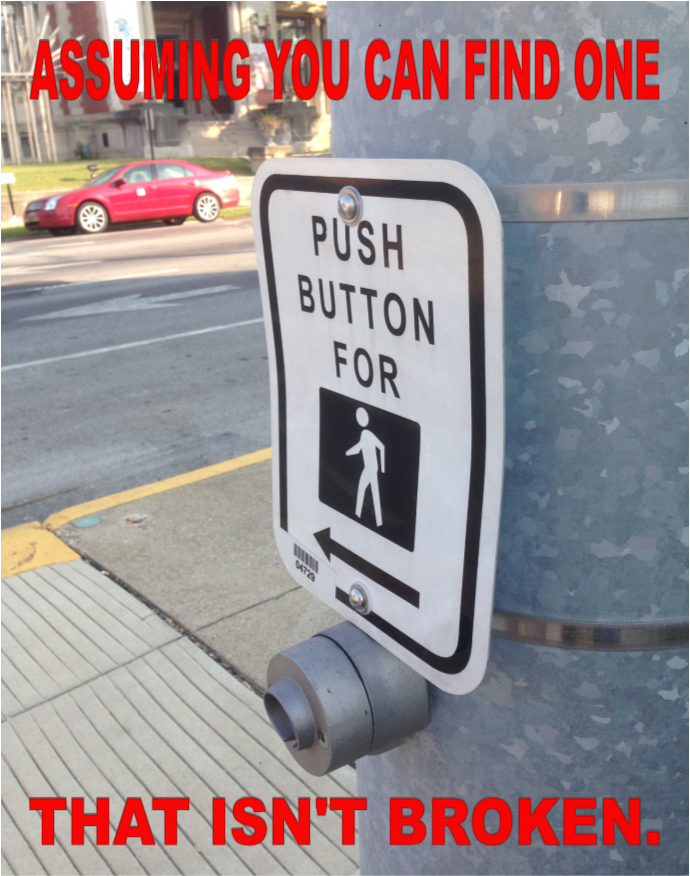
#GahanSafe: All the push-button "walk" signals for crossing Spring at Pearl are defective, and have been for five months to a year.


Way back in March, I pointed out that one "beg button" (push-button crossing signal) on each post at each corner of the intersection of Spring and Pearl was not functional.

Why does Team Gahan always pee on pedestrians?


In New Albany, push button crosswalk signals are not placebos. Walkers actually must push the "beg button" to receive a safe (often a facetious term) signal to cross. If the button malfunctions, there'll be no signal -- ever.

Even in March, it had been this way for a while, with at least two of them broken as far back as September, 2015. Now we've gone through almost an entire summer-season Bicentennial Park concert series cycle with nothing done to correct the problem.

We cannot know if the push-button crosswalk buttons work when so many of them are broken.


It is almost always the cities with push-button crossings that need the most help ... push-buttons almost always mean that the automobile dominates, as they are typically installed in conjunction with a new signal timing in which crossing times are shorter and less frequent.

Specifically, the push-buttons for crossing Spring both north and south on both sides of Pearl Street do not work. This morning I took the time to test each one and to watch. It is physically impossible for a pedestrian to get a "walk" signal crossing Spring Street at this intersection. It has been impossible for at least five months, and probably far longer.

Pictured are the push-buttons that are defective.


To repeat what I wrote in March:

If Jeff Gahan isn't going to do anything substantive to make New Albany a walkable city, can't he just say so aloud, for attribution, and free us from the pain of watching him prevaricate?

Any suggestion he makes to the contrary is being disproved every single day on real city streets, where nothing is being done to indicate any serious intent to improve walkability, and plenty is being done to discourage it. There's only one honest way to conclude these thoughts:

Mr. Mayor, as it pertains to walkability, just shit or get off the pot.

You're embarrassing the city by making private promises constantly contradicted by public indifference -- by your bizarre insistence that you're making omelettes without breaking eggs. Even your own people know it's a shell game.

Join me for an actual walk some day, and I'll show you exactly how urban walking works in real life, as opposed to the fantasyland bunker you prefer inhabiting. The same offer goes for your minions.

Do any of you walk downtown, ever?

Monday, March 28, 2016

Why does Team Gahan always pee on pedestrians?


It began in September, 2015, with this observation: We cannot know if the push-button crosswalk buttons work when so many of them are broken.

Jeff Speck, who once authored a walkability study for New Albany -- a document now being depleted, one precious page at a time, as toilet paper in Jeff Gahan's executive washroom -- is quoted here on the topic of push-button crosswalk signals: How Push-to-Walk reduces the quality of walkable neighborhoods.

It is almost always the cities with push-button crossings that need the most help ... push-buttons almost always mean that the automobile dominates, as they are typically installed in conjunction with a new signal timing in which crossing times are shorter and less frequent. Far from empowering walkers, the push button turns them into second-class citizens; pedestrians should never have to ask for a light.

And boy, does the auto dominate in New Albany.

In New Albany, push button crosswalk signals are not placebos. Walkers actually must push the "beg button" to receive a safe (often a facetious term) signal to cross. If the button malfunctions, there'll be no signal -- ever.

Not only do push buttons turn pedestrians into second-class citizens; broken push buttons surely deter the notion of a pleasant walk just as effectively as sidewalk parking, and other defaults wherein the sidewalk always is blocked first, not a parking space or a street lane.

"I've devoted my life as a social worker to people with developmental disabilities, and can't even walk with them in NA if they are in a wheelchair or have gait issues."


Below are photos taken on Monday morning, March 28, at the intersection of one-way Pearl Street and one-way Spring Street. It's the epicenter of downtown, quite close to where Bob Caesar never imagined a person walking from the Elks Club to his jewelry store to buy a diamond.

There are a total of eight push button signals, two on each corner. The ones pictured below are broken. In fact, one is broken on each corner. At least two of these have been broken for months. They're not the only ones downtown which are disabled, but at no other corner equipped with push buttons is traffic so constantly hazardous owing to drivers increasing speed to run beat red lights.

Note that the issue of malfunctioning push buttons doesn't address the situation at intersections like W 1st and Main, or Bank and Main, where nothing -- zero, zilch, nada -- is in place to slow traffic such that walkers can cross the street safely.

You'll note that throughout the period since the release of the Speck walkability study, Team Gahan has been careful to couch its public pronouncements about the future of street grid reform, of which there have been almost none, as being entirely devoted to making traffic safer.

Reams of evidence from across America and the world point to the flaws of this mode of "thinking," and provide abundant proof that had walkability been pursued first, before the other expensive projects pursued by the current administration, it would have been like a dose of steroids, enhancing investment and not devaluing it.

As it stands, there's a toxic stew under preparation.


  • An auto-centric street grid
  • Rebirth of downtown small business
  • Poor lighting
  • Inconsistent sidewalk maintenance
  • Refusal to enforce ordinances (should there be sidewalk parking, ever?)
  • Antediluvian municipal gatekeepers


Quite literally, multiple accidents are waiting to happen, as we prioritize one bright shiny object after another.

If Jeff Gahan isn't going to do anything substantive to make New Albany a walkable city, can't he just say so aloud, for attribution, and free us from the pain of watching him prevaricate?

Any suggestion he makes to the contrary is being disproved every single day on real city streets, where nothing is being done to indicate any serious intent to improve walkability, and plenty is being done to discourage it. There's only one honest way to conclude these thoughts:

Mr. Mayor, as it pertains to walkability, just shit or get off the pot. 

You're embarrassing the city by making private promises constantly contradicted by public indifference -- by your bizarre insistence that you're making omelettes without breaking eggs. Even your own people know it's a shell game.

Join me for an actual walk some day, and I'll show you exactly how urban walking works in real life, as opposed to the fantasyland bunker you prefer inhabiting. The same offer goes for your minions.

Do any of you walk downtown, ever?


Team Gahan's walkability gap (4 of many): "We’re all apparently okay with dead pedestrians as collateral damage for ensuring cars can travel quickly."


Team Gahan's walkability gap (3 of 3): "A Playbook on the Politics of Better Streets." WE NEED IT.


Monday, February 08, 2016

ON THE AVENUES EXTRA: "No, John Rosenbarger, congestion is our friend. Help us achieve it, or get out of the way."

ON THE AVENUES EXTRA: "No, John Rosenbarger, congestion is our friend. Help us achieve it, or get out of the way."

A weekly web column by Roger A. Baylor.

As City Hall dithers, Year Zero draws nearer: Bridge tolls, social injustice, NA's street grid ... and the silence of the culpable.


The column originally was published on February 6, 2014. Two years later, it strikes me as one of my better summaries on the topic of New Albany's enslaved street grid. In fairness, I was wrong about one thing: Our economic development director is not capable of understanding what I wrote. As for the rest, I absolutely nailed it.

---

For months – nay, years – we’ve remorselessly documented the fear, confusion and sheer intellectual laziness of local officialdom when it comes to grasping the basic tenets of street grid reform in New Albany.

It’s true that some of them are further along the path of righteousness than others, but virtually all are afflicted to some degree with a myopic inability, or maybe a plain unwillingness, to think clearly about the topic -- much less to do so openly and for attribution.

Festering at the heart of this ongoing disconnect is a fundamentally flawed understanding of the revitalization New Albany has managed somehow to achieve, against all institutional odds, in recent years: Who has propelled it, why it has occurred, and the incalculable extent to which such progress might be aided and abetted by immediate year-round infrastructure changes guaranteed to be far less costly than a part-time aquatics center.

Precisely because city officials don’t have a clear grasp of cause and effect, they are too easily afflicted with paralyzing dread of the unknown, which merely compounds the dead weight of a civic inferiority complex they simply can’t seem to shake.

---

Conventional ruling wisdom is this: If we as a city do anything that might be remotely construed as discouraging the unrivaled hegemony of the automobile, or if we fail to resolutely mimic the residential and commercial logic of the suburb, these are signs of electoral weakness, and suddenly, no one will like us any longer – both as politicians seeking votes, and also as a municipal entity begging for attention in a crowded marketplace.

It’s inane drivel, but bizarrely resonates among the defeatists. It’s almost as though city officials are conceding that to them, the very idea of an independent business-led downtown revival always was doubtful, at best, especially when most folks (read: “city officials”) still prefer those nice dependable plasticized multinational chains crowding the former pastureland out along Veterans Parkway.

Sadly, this rampant manure fertilizes pervasive wrongheadedness.

In football terms, the governing deletes harbor an attitude similar to the infamous “prevent” defense, which typically stifles vigor and initiative, except that in football, coaches don’t start misusing the prevent until they’re ahead. Here, we’re doing it from behind.

In Junior High School terms, it’s like suffering from rampant adolescent insecurities and low self-esteem, and trying to dress and act like everyone else, just to fit in, only then belatedly realizing that not being yourself is no way to find yourself.

In economic development terms, it’s just plain unimaginative, derivative, non-creative insanity.

---

As it pertains to the street grid, and as befitting those ordinary citizens of a similar age and demographic background who have traveled but paid depressingly scant attention to what they were seeing in a wider world, certain of our city officials evidently believe that the logic of the suburb applies equally and inexorably to the city center itself – that success can be achieved only by maximizing access via automobiles, whether it’s a doctrine applied to arterial streets that handily desecrate entire transitional neighborhoods, or surface parking that both mars the historic streetscape and prevents infill.

It is a self-defeating fallacy for an urban area, but it is the inextricable root fallacy of our detached leadership cadre, many of whom seem proud to know absolutely nothing about the contemporary ideas advanced by Jeff Speck (among others) in the year 2014, as opposed to 1964, and even though we’ve been talking and writing about these matters here at this blog since 2004.

That’s because when challenged to think, they fall back on their native “common” sense, gleaned from confounded, compounded incomprehension, and therefore not very sensible at all. I don’t mean to be harsh, but really, sometimes one must step away from the pasty white Cracker Barrel banquet table, break open an actual book, and learn something.

---

In some respects, I do take city officials at their word. I believe they genuinely grasp that as the Ohio River Bridges Project advances from construction displacement through invasive tolling regime, New Albany stands to be badly harmed by hordes of pass-through cars and drivers, and by the congestive havoc they’ll cause.

However, I don’t see them grasping one iota of the curative logic, albeit counter-intuitive and requiring deeper thinking than suffices for watching network television, which explains the single best counter-active strategy available to us, as prefaced by Jeff Speck:

“Were it not for traffic congestion, we would drive enough additional miles to make congestion."

In short, to reduce congestion, induce congestion, although characteristically, city officials appear to be frozen in the approaching Hummer’s headlights as they grapple with their reigning congestive vision failure.

There’ll be congestion caused by the pass-throughs … but geez, how do we cope with congestion by reducing and slowing vehicular access … shouldn’t we be adding lanes and increasing speeds … hell, those neighborhood people gripe all the time, and they knew their quality of life downtown wouldn’t be half what it is on Rainbow Drive … can’t we just sit here and do nothing, because maybe a few of those cars will stop and eat, and then we can call it economic development, declare victory, and get re-elected and shit.

No. No. No.

NO.

To reduce congestion, induce congestion.

We must actively and unapologetically move to intentionally “congest” our current one-way arterials by making them two-way streets again; reducing lane sizes; lowering speeds; crowding them with walkers and bikers; or even adding a few of John Rosenbarger’s trademark totemic, fetishistic bump-outs of the sort be believes alone can transform paradigms over endless decades of gradual implementation.

But why fight congestion with congestion?

Because if we don’t, people in outlying areas will see downtown New Albany’s streets in precisely the same way they will view the Sherman Minton Bridge: A cost-free route for immediate passage.

Therefore, we must add user costs so as to discourage them, and seeing as we’ll not be tolling city streets during peak usage like London does, purposefully congesting the streets is the only way to impose a cost in extra time for the prospective pass-throughs, encouraging them to self-divert to avoid the cost in time, with the additional practical effects of (a) curbing bad congestion by using good congestion as a tool; (b) enhancing neighborhood quality of life; and (c) helping small, independent business to remain the driving force of downtown redevelopment.

---

Now, here’s where the inferiority complex comes in.

But, omigod, Roger … if we do these things, then they’ll stop coming here, and everything we’ve tried to do …

Wait.

Everything YOU’VE tried to do?

Please.

It seems to me that if the indie business community has the confidence to grasp that street grid reform will deter unwanted pass-throughs while creating urban conditions all the more favorable for the great customers we already have – accepting the obvious fact that we’ve invested far more in money and time toward downtown revitalization than local government has ever dreamed of expending – why not take our word for it?

The people who are spending money downtown right now are not doing so because it has the same vibe as Veterans Parkway, or because we’re a convenient destination. New Albany’s always been out of the way, hasn’t it?

They’re doing it because downtown is different. Street grid reform stands to make downtown even more different, and better for the change; this can only increase consumer loyalty, not defeat it.

As an added bonus, lifting the quality of life in neighborhoods by ending the tyranny of one-way arterials stands to bring more of the neighborhood back to downtown, in effect adding the housing we currently lack in the epicenter. Why? Because they’ll be able to walk and bike and use the grid between their homes and downtown as human beings, not merely driving cars.

What stands in the way?

Essentially, an outdated mantra worthy of Warren Nash: “But it’s the way we’ve always done it.”

---

Boy, haven't we. And see where it's gotten us?

Even it public works über-honcho John Rosenbarger “gets” all this, I’m finished defending him against his detractors, because it has occurred to me that never in my experience advocating for two-way traffic, when John’s somewhere within earshot, has he unequivocally endorsed the idea. Not once.

Rather, each time, he has uttered a disclaimer: Well, if not two-way streets, then traffic calming, and yes, this might make sense if he had a record of actively spearheading traffic calming and complete streets, but while he’s always talked a wonderful game about them, it has taken three decades for us to boast even those minuscule, scattered and pathetically unconnected examples we have now.

Sorry, but it’s time to say it publicly: For reasons unknown, John’s fatally biased against two-way street reform, perhaps because of his preference for the lifelong bureaucrat’s creeping bump-out incrementalism, which we no longer have time to indulge. He’s not helping us; he’s pushing back against us. In fact, I’ve come to believe that John is a major force against the changes we need right now, whether intentionally or otherwise. That’s too bad, and I wish I knew why. He’s not helping us. He’s hurting us.

Concurrently, I believe that economic development director David Duggins is fully capable of understanding the points I’m making here, but chooses not to do so, probably because there are no one way streets in the industrial park.

Moreover, perhaps as few as two, maybe three council persons see the merit of street grid modernism. And, honestly, I have no clue what Mayor Jeff Gahan sincerely believes about this topic, or for that matter, what he believes about anything at all. He remains a sphinx, forever guarded.

The fact is this: We’ve utterly wasted ten years on slipshod photo-op chicanery best symbolized by two bike lanes on each side of a one-way street, attached to nothing, and sheltered not one jot from unregulated vehicular traffic that negates the effort of painting the stripes, and if people like John Rosenbarger want to boast about this as though it were some semblance of a professional legacy, that’s exceedingly odd, because it isn’t, unless professional legacies typically embrace perpetually parsing fifty shades of stalled congestive anxiety, then waiting another few years before refraining from doing anything yet again.

Those municipal officials seeking a substantive legacy might consider leading change rather than road-blocking it. Otherwise, getting the hell out of the way would be a nice alternative, or at least not sabotaging the effort of those who’ve actually put money where their mouths are.

I’m ready to start painting yellow lines.

Aren’t you?

---

Recent columns:

February 4: ON THE AVENUES: Hello, I must be going.

January 28: ON THE AVENUES: They're surely not ROLL models.

January 21: ON THE AVENUES: When I grow up, I'd like to be alive.

January 14: ON THE AVENUES: Should the Queen fail to rescue us, there's always H. L. Mencken.

January 7: ON THE AVENUES: You know, that time when Roger interviewed himself.

Thursday, September 24, 2015

ON THE AVENUES: Almost two years later, Mr. Gahan has yet to plug in this clock, and so it's time for him to clock out.

Tonight there'll be a softball toss masquerading as a debate, in a Taj Mahal that shouldn't exist, as organized with bored partiality by local Democrats, for whom job security comes before any substantive commitment to substance or ideals of impartiality, and really -- should any of this come as a surprise?

It's what happens in a top-down, one-party state.

At least all three mayoral candidates will be in attendance tonight, although if Kevin Zurschmiede had not opted to purchase a round-trip ticket from his son's destination wedding, Jeff Gahan would have achieved his ideal of not having to face both opponents at once. Whether undertaken from conniving or cowardice, Gahan's "debate" planning should be offensive to every voter in this city.

This column was written on New Year's Eve, 2013. That's almost two years ago, and obviously, much has happened since then. The outside vendor still has the communications contract, but Gahan's minions write the script, so it isn't ProMedia's fault that during 2015, social media and municipal outreach have been devoted almost exclusively to Gahan re-election bromides -- at taxpayer expense, of course.

Downtown decision-making continues to be made according to prevailing Eastridge Drive Neighborhood Association standards of suburban-think, as opposed to urban logic. Bob Caesar gave up the wrong vocational ghost, retiring from jewelry sales, which he was good at doing, and retaining his political seat (not so much). The backroom antics continue, with no-bid contracts and the ritualistic Hooters visits by the economic dishevelment department.

We await the first pangs of John Rosenbarger's shame at not only signing off on millions to plant flowers in front of his Main Street home, but watching as the preferred non-union pavers have gotten his pet project wrong so very often that they're now being confused with the management of the Oakland Raiders. I'm not holding my breath on this one.

Sadly, overall -- 21 months later -- I stand by this paragraph:

More urbanism, not less. More transparency, not less. More localism, not less. More public information and participation, not less. More thinking and doing outside the stunted, Democratic Party-smothered obstruction zone, not less.

I hope to see some of you later today at Silver Street Park. The session begins at 6:00 p.m.

---

ON THE AVENUES: Mr. Gahan -- plug in this clock.

A special New Year's Eve column by Roger A. Baylor.

Perception.

Reality.

They’re how I’ll remember the year 2013, and so appropriately, two New Year’s Eve tweets tell the whole story, and nothing but the story.

From City of New Albany Government: It's New Year's Eve and the City of New Albany wishes everyone a happy and safe night. It was a great year here in New Albany and the future of 2014 looks bright for our city!

From Jeff Speck: "It is difficult to get a man to understand something when his salary depends on his not understanding it." -- Upton Sinclair

(By the way, the city’s utterance today might be the last authored by ProMedia, which cannot be blamed for municipal government’s notoriously non-responsive social media effort. The Green Mouse is told that these communications are to be taken back in-house. Shall we speculate how this decision will impact exclamation mark futures?)

Meanwhile, aside from musical memories coming on Thursday in this space, there’ll be no year in review.

That’s because it was another in a series of mediocre, underachieving years, in which New Albany largely reaffirmed its half-century commitment to repeating the same reactive actions over and over, while hoping the outcome might be different this time.

The Bicentennial was utterly wasted with same-old-suspect buffoonery. There was no plan for economic development downtown, and there are no plans to have a plan. Selected property owners were fluffed, while others were relegated to the iron rule of the slumlord. We’ll have a wonderfully expensive parks system, and use our cars to drive back and forth between them on streets designed for high-speed, reckless driving, while ignoring success stories in other cities, where the city itself has become a recreational area simply by taking back its street grid. The Democratic Party substitutes words for action, and the Republican Party is so moribund and devoid of an intellectual pulse that it doesn’t even have its own Tea Party insurgency.

Even the tea partiers understand the meaning of wasted effort, and concentrate their attention elsewhere.

---

I’m always exhausted at year’s end. This year, as my business approached the end of what amounted to a five-year plan, it has taken much more effort than usual to plan for the next phase. Curiously, as both the city of New Albany and America’s craft beer segment have declared victory, there’s a nasty bubble waiting to pop, although willfully blinded eyes are averted.

Craft beer’s headed for an adjustment, borne of over-capacity among breweries dependent on production-level distribution. There will be casualties. In like fashion, downtown revitalization in New Albany faces the very real likelihood of a slowdown. We’ve gone as far as we can go with smoke and mirrors. Now more than ever, we need the city to put some skin into the game.

Louisville, Jeffersonville and even Clarksville have development plans and strategies to garner entrepreneurs and their dollars. In New Albany, we have enough eateries and bars, and we may well have too many. There needs to be a next phase; and yet current indie business operators are hard-placed to find the time to cooperate. Non-profits are inconsequential. There are no downtown housing initiatives. Ideas that can help right now – a street grid that supports, not defeats, the sort of indie ethos we’ve painstakingly built with our own money – are marginalized by city leaders bizarrely ignorant of urbanism and forever afraid of their own political shadows.

And the newspaper’s top stories of 2013?

Two murder trials, River Ridge, the Floyd County auditor’s incompetence, the city’s new unconnected parks department … and the Ohio River Bridges Project.

Shall I state the obvious?

The ORBP is the undisputed 800-lb gorilla casting a shadow over every single thing mentioned here. We might be doing something about it now; for instance, a commission composed (please God, just for once) of more than just the same tired old usual suspects, to brainstorm coping strategies now, and to engage the public, rather than await the results of useless studies conducted by even more tired old usual consulting suspects, and try yet again to bluff our way through at the very last moment, lest we offend a Democratic Party grandee or dispute Bob Caesar’s self-interested conviction that toll bridges connected to one-way streets will bring an unprecedented number of diamond shoppers downtown.

---

More urbanism, not less. More transparency, not less. More localism, not less. More public information and participation, not less. More thinking and doing outside the stunted, Democratic Party-smothered obstruction zone, not less.

Watch them read the preceding paragraph. See their body language. Realize how futile such efforts are doomed to be.

Quite frankly, I’d dearly love to say “fuck it” and disengage; cash out, punt, pack Uncle Jed’s jalopy and finally spend some quality time in places that are not perpetual fixer-uppers, but turnkey habitations: Like Bamberg -- not Birdseye on the Ohio.

But see, the thing is this: Reduced options have a remarkable way of narrowing one’s focus. At home or at work, we’ve bet the whole pile on this recalcitrant, woebegone, thick-headed old and dirty river town, and I was a stubborn bastard even before it became clear that it was a dubious wager I must have placed in a state of intoxication much more elevated than my normal level of degradation.

I may be tired, but I am not defeated.

I so wish there could be togetherness. There isn’t, so I will push. They will push back. Maybe, for once, we’ll get lucky. Even a stopped clock is right twice a day.

Wouldn’t it be nice if just once, we could hack our way through the oblivious mire, push the plug into the wall socket, and see what happens when the clock actually runs?

After all, we haven't tried it before.

---

Recent columns:

September 17: ON THE AVENUES: Dear Neighbor: If you’re tired of the same old story, turn some pages.

September 10: ON THE AVENUES: Lanesville Heritage Weekend comes around again.

September 3: ON THE AVENUES: When even Mitt Romney can run to the left of New Albany’s Democrats, it's a very big problem.

August 27: ON THE AVENUES: Whips, chains and economic development (2010).

August 20: ON THE AVENUES: In the groove.

August 13: ON THE AVENUES: It’s time to purge two-party politics and tie the community together.

August 10: ON THE AVENUES SPECIAL EDITION: When it comes to the RCI, can the RDA opt out of the RFRA?

Monday, June 15, 2015

NAC Reader Comments 2: "Why does the city turn a blind eye to the negligence on Spring Street?"


Regular blog reader BM recently shared a past Facebook review, posted to the city's Fb site but as yet unacknowledged, and noted that since city officials routinely deny reading what appears at NA Confidential even as they rush to respond to it, perhaps his point would gain wider circulation if published here.

It surely can't come any more slowly than 334-odd days later, so let's give it a go.

From June 10, 2015:

Shared this post because it's been 11 months and nothing has been done on Spring Street yet John Rosenbarger's street has been improved to slow traffic. No answers to my post from the Mayor or his constituents. Still waiting Mr. HAMBURGLER.

From July 11, 2014 -- posted as a review to the city's outsourced Fb page, without reply:

Maybe the city can get some funding to build a pet cemetery instead of a dog park. May I suggest somewhere on Spring Street between Vincennes and 8th Street. This way all the semis can pay their proper respects to the beloved animals that are killed by them. Lost our family cat this morning to a truck doing at least 45 miles an hour!! Why does the city turn a blind eye to the negligence on Spring Street? Maybe if it were the Mayors cat, something might be done??

Thursday, May 21, 2015

ON THE AVENUES REWOUND: “I Just Want to Know, Can I Park Here Somewhere?”

ON THE AVENUES REWOUND: “I Just Want to Know, Can I Park Here Somewhere?”

A weekly web column by Roger A. Baylor.

There are at least two dated references in this column, which originally was published as "Can’t stuff ‘em in a burlap sack, either" on March 29, 2012.

In a rare admission of failure as it pertains to inside jokes, I've changed the title, primarily because after three years, I can't recall the nature of the inside joke being referenced at the time.

Specifically: The Riverview housing and parking garage giveaway died deservedly and ingloriously, and gasoline prices have fallen a tad in three years. Now, are we ready for that overdue discussion of parking meters?


---

My forthcoming documentary is going to be called, “I Just Want to Know, Can I Park Here Somewhere?”

It will be filmed on location in downtown New Albany, with a large cast to include prominent living and deceased examples of: Ducking-and-covering elected officials, their overburdened economic development appointees, shrugging policemen, knowledgeable but bureaucratic planners, thinly stretched street department workers, officious board of works members, eternally fractious business and property owners, neighborhood busybodies and thoroughly confused out-of-town visitors.

At the end of this three-hour movie, there’ll emerge no single instance of agreement among any two of the respective parties mentioned above, and nothing even distantly approximating a quantifiable answer to the question asked in the title, but just to give the ending a nice, down-home New Albanian zeitgeist type of feel, I’ll have Develop New Albany on hand to claim complete credit for an outcome that doesn’t even exist.

In fact, they can call it Drive By City if they like.

For those who are struggling to keep score, please open your “Principles of Banana Republic Management” textbooks to page 105 … or just load the app on your smart phone. It’s called “Is It Even Possible To Do a Worse Job of This?”

---

Once upon a time, in the golden age lasting approximately 25 minutes following curtain calls at the conclusion of World War II, New Albany made vague gestures at enforcing its own traffic ordinances by using policemen to issue tickets. However, because the cops were needed to control rampant episodes of social disarray stemming from the city’s refusal to enforce its buildings and housing codes (see: The Slumlord Empowerment Act), ticketing went somewhat out of fashion.

At any rate, monies collected mostly reverted to the state of Indiana, where they were used to finance measures aimed at thwarting home rule while allowing the simultaneously disingenuous promulgation of the opposite, and when it came to parking tickets downtown, no one bothered to collect the fines incurred.

When city officials did try, certain prominent local citizens – often those veritable doyens of tottering local political party structures – refused to pay, promptly threatened to sue anyone within pellet scattering range, and as a sign of genuine civic solidarity, doused themselves with lighter fluid with Bics close at hand.

After all, there was hardly any activity downtown, so what did it matter to anyone?

---

Then, something completely nutzoid occurred. During the Garner Administration, the city council unanimously approved the creation of a riverfront development area. This was the pretext for a delineated zone in which modified three-way alcoholic beverage permits could be issued apart from the state’s self-defeating quota, and this single, elegant and inexpensive act immediately leveraged numerous independent small business investments in food and drink establishments within the historic downtown commercial district. The first stirrings of a revival began, and overnight, utter chaos descended.

As it turns out, there was nothing whatever – statutory, administrative or experiential – that foresaw the possibility of progress, as opposed to regress. All the rules and practices, and most of the people in charge of them, were jigged only to manage decay, and decay alone.

At this critical moment in the city’s history, Develop New Albany’s invisible cadres rushed in to take complete credit for the progress gained by entrepreneurial investments that had little if anything to do with DNA, and to contribute nothing to the resolution of problems stemming from improvements … rather like State Farm, but without the money to pay claims, which is where the Urban Enterprise Association comes in … but I digress.

---

During the epochal third England Administration, which ingloriously perished when the Democratic executive’s hand-picked Republican successor was crushed prior to his suffering a humiliating council race loss to a comparative non-entity, the mayor took precious time away from his lifelong hobby of dispensing politically-motivated favors with other people’s money to heroically sidestep any involvement with downtown parking issues.

Hizzonner simply decreed that downtown parking rules would not be enforced, so that revenue from fines in that particular locality of the city would be lost, but not in other localities, with there being no clear explanation to this very day of where one might park illegally and expect a ticket, or park illegally and not be ticketed, and if cited, whether there’d be any effort on the city’s part to collect the fine, other than a frayed, adapted Wheel of Fortune board game and a case-by-case heave-ho.

For a number of downtown merchants and their employees, non-enforcement has proven to be the best policy of all, seeing as it is their aim to park their vehicles as closely as possible to their own front doors. Other building owners zealously guard their surface parking lots lest someone dare make an offer to pay or use of the spaces. Still more surface lots are owned by the city, which spins the wheel yet another time so as to determine whether these spaces are to be free of charge or paid, and if paid, to guess aloud if the checks received will ever be endorsed.

And then there’s the proposed Riverview development, and a rare, once-in-a-lifetime chance for the city to pay $15 million for a parking garage and then give it away to private interests which may or may not let anyone else use it.

---

It doesn’t stop there. As I write my documentary prospectus for publishing over at Kickstarter, the price of gasoline has climbed above $4 per gallon, which means more of the city’s least thoughtful citizens will be riding their bicycles in all directions through streets and on sidewalks, without the slightest effort at internal control, or any degree of external regulation.

Automobile drivers impaired by their cell phones weave in and around these oblivious cyclists, as well as roaming packs of skateboarders, at ridiculous rates of speed, regarding all non-automotive presences as targets (if they ever see them in the first place).

Meanwhile, the sensible, oft-cited benefits of traffic calming, two-way street conversions, enforcement of bicycling rules, opportunities for pedestrians to walk safely and an overall elevation of a human-scaled city to primacy even if it means sacrificing a full two minutes of time traveled by car – well, these are routinely derided by those congenital obstructionists for whom New Albany remains a collection of distracting impediments to speeding through and exiting as quickly as possible out the other side.

And, no matter where one looks, the only clear presence on the local scene when it comes to resolving these many issues is a great big hole – not where the giveaway parking garage might go, but the obscure place where leadership is supposed to be, but never is.

Of course, if there was any such thing as public transportation in the Open Air Museum … no, never mind.

Hey, you – can I borrow your lighter? It’ll only take a minute.

---

Recent columns:

May 14: ON THE AVENUES: Take this cult of personality and shove it.

May 7: ON THE AVENUES: In Havel I trust.

April 30: ON THE AVENUES: Until philosophers become kings.

April 27: ON THE AVENUES MONDAY SPECIAL: Et tu, Greg Phipps? Or: Anger and the electoral variability of transparency.

April 23: ON THE AVENUES REWOUND: Anachronisms and intellectuals, here and there.

April 16: ON THE AVENUES: Say a prayer for NA Confidentialas it conducts this exclusive interview with Councilman Cappuccino.

Thursday, January 08, 2015

ON THE AVENUES: Pretty in pink slips, aren’t they?

ON THE AVENUES: Pretty in pink slips, aren’t they?

A weekly web column by Roger A. Baylor.

(Here is the link to a .pdf of the Speck draft report)

On Tuesday, the very morning when City Hall at long last hazarded a first halting, wheezing, asthmatic step toward taking proper possession of Jeff Speck’s seminal street study, it was disturbingly sunny outside.

Now, I’m so old I can remember when Speck was Jeff Gahan’s Big Idea, prompting his very own commissioned mayoral study, at least right up until that fateful moment when the Tiger Trucking semi rig’s headlights froze Hizzoner dead in his tracks, at river’s edge, like a bedraggled, matted raccoon without a paddle, stuck in the middle of an arterial one-way Highway to Birdseye.

Where was I?

Oh, yes: It was sunny outside.

I muttered a choice epithet and spat as I walked downtown, past the doomed urban corner where a quarter million is about to be squandered to permanently anchor a temporary seasonal farmers market on one of the city’s hottest future infill parcels.

Damn. It really needed to be cloudy outside on this, our auspicious Speck Study Day.

After all, if Mayor Gahan (or more likely, the hardest working hologram in Indiana municipal governance) were to surface from Das Subterranean Command Bunker on Speck Study Day, only to see the sun actually shining, we’d be condemned to eight more years of foot-dragging, feeble excuses and Dixecrat appeasement, with little hope of street grid reformatting taking place in our lifetimes.

However, and we can only hope fortuitously, agoraphobia is the cruelest of mistresses. Mayor Gahan sent the city engineer, Larry Summers, to the Bored of Works in his stead, and poor Larry was far too nervous performing his assigned task of explaining how something and nothing can occur simultaneously to notice the prevailing atmospheric conditions.

Tinkerbell was there, too, but the Democratic major domo was preoccupied with feverishly emitting ear-lobe-tugging, nose-scratching procedural signals to the BOW chairman Nash, who gazed in bewilderment at the Power Point slides: “Wow, Larry, you mean a road diet isn’t a Disney theme park ride? Why, this is the space age. Next thing you know, they’ll have color TVs playing at the Waffle House.”

---

Unsurprisingly, those of us most thrilled by the comprehensive efficiency and vigorous optimism of Jeff Speck’s Downtown Street Network Proposal are just as dour and pessimistic about the chances of it ever being carried out hereabouts in any substantive fashion.

That’s because in Come to City, we’ve never really come to, and what’s Groundhog Day, anyway? In New Albany, it’s just another word for tomorrow, and the day after that, and …

---

In 1989, several previous fallen dominoes (Solidarity’s election victory in Poland and the partial opening of the Austro-Hungarian border, to name just two) culminated with the collapse of the Berlin Wall. The USSR stood aside, and the Warsaw Pact was no more.

The subsequent experiences of these East Bloc nations varied, but to some extent in all of them, surely more so in Romania and Bulgaria, the period of post-Communism possessed a decided aura of déjà vu, because there, in the seats of power, occupying elected as well as appointed offices, sat the very same functionaries as before.

Rather like a species of rapidly evolving insect (remember, Franz Kafka was Czech), they either chose the proper moment to switch sides just prior to the outbreak of revolution, or merely shifted into a dormant stage of Down-Low to wait out the post-crash euphoria, reasoning that in the cold light of day, their bureaucratic skills would be deemed essential, and their previous careers worthy of selective forgetfulness.

In this context of adaptability, formerly Communist officials in newly democratic Eastern Europe drew upon an irrefutable pedigree, because after all, denazification in Germany following World War II proved to be schnauzer that simply wouldn’t hunt. Apart from a low percentage of high-profile examples, numerous adherents of the “Heil Hitler” persuasion made a seamless transition from discredited losers to irreplaceable stalwarts of the new/old system now harnessed to a different master, whether West or East.

Why mention Europe’s 20th-century totalitarian hangovers?

It’s because Speck’s street study is more revolutionary than all the (Groucho) Marxists and (John) Lennonists combined, meaning the chances of its implementation in the Land of C and D Students is embarrassingly slight.

But what if a miracle occurs?

What if Speck Happens?

Maybe Tricky Dickey was right all along, and all it takes is faith, and a little bit of pixie dust, and BOOM – Speck in our time!

The good guys win, the city’s future brightens … prosperous times are around the corner, with Tippecanoe and Walkability Too … get out those bikes, people, and skates, and … hold on.

Just wait. It couldn’t be, could it?

Those guys with the clipboards, managing the Five Year Speck Conversion Plan, working for the New Boss … OMG, say it ain’t so.

Not him.

Anyone but him.

---

That’s right. You guessed it. Even in the very rosiest of street scenarios, which most of us reckon might – just might – yield a Speck Study Quotient conversion rate of 15%, quite likely we’ll be asked to accept a state of affairs wherein the same street-disfigurement criminals wreaking havoc all along are magically transformed into courageous reformers.

We’ll be asked to believe that zebras can shed their stripes, as they set out at the usual bloated pay scale to dismantle the very same dysfunctional one-way, auto-centric edifice they spent the previous three decades perfecting, the sheer idiocy of which comprised the fundamental cause for the revolution in the first place.

Specifically, if John Rosenbarger has anything to do with the implementation of the Speck plan, which clearly calls for ridding the landscape of previous masterworks undertaken at Rosenbarger’s dull instigation, like the rock-strewn bump-outs on State Street, then we’ll have final, irrefutable proof of New Albany as default Groundhog Day, every day, forever.

Wonderful. Rosenbarger and his compatriots, some departed, and others still secured within the Third Floor woodwork like termite larva, built a street grid that Speck’s study relentlessly, mercilessly eviscerates – block by block, and lane width by asphalt expanse. Now, he’ll fix it.

Not only is it bullshit, but it’s also unconscionable, absurd and intolerable. In New Albany, these four words are considered synonyms for “bound to happen” – again, and again, and again.

Good grief, people.

Just during the brief period of the Speck study’s gestation in 2014, Rosenbarger merrily shepherded our Main Street equivalent of Nicolae Ceaușescu’s destructive pre-1989 boulevards and palaces chaos in Bucharest, placing a colossal raspberry of damp flatulence on the street grid he has had such a prominent hand in pillaging over 30 long, wasted, impotent years.

Imagining him at the triumphant Speck photo op, equipped with kiddie hardhat and requisite rubber shovel, those glow-in-the-dark reddened eyes leering, makes me reach for my garlic cloves and nice, sharp, wooden stakes. Ceaușescu wasn’t the only vampire on his Romanian bloc, you know.

Yet, in the end, there is very good news … and also very bad news.

The good news is that Rosenbarger probably will have no part whatever in implementing the Speck study in New Albany.

The bad news?

There’ll probably be no implementation of street modernity in New Albany.

Once upon a time, Speck was to have been Gahan’s Big Idea, but now the odds makers are unanimous, and persuasive: All we get is this lousy Potemkin Village – Hooterville and Caesartown, and again tomorrow, and the day after that, and …

Wouldn’t it be nice, just for once, to escape the recurring cycle of stupid?

Monday, November 24, 2014

He only plays a psychiatrist during redevelopment meetings.


Last week, there was a meeting.

ON THE AVENUES: Really, the word “progressive” embarrasses you? That’s okay, because political cowardice disgusts me.

 ... Of course, right now, as it stands, the city’s interminable, fear-driven delay of street grid reform is quite effectively achieving the very same result, by leaving in place a one-way arterial street grid that nullifies every penny-ante ribbon cutting and “stay open late” promotion tossed into the air by increasingly desperate indie shop owners in the absence of a downtown economic development plan, because while street grid reform could be so very helpful, and constitute an economic development plan in itself, it would fatally embarrass a Democratic mayor to be seen openly advocating it.

It's exactly as if Jeff Gahan were to say it's okay to be gay, just as long as you don't kiss in public.

When the meeting was finished, and David Duggins, the city’s selective economic development director, had dispensed with strong-arming those in attendance as to what they were and were not interested in hearing -- according to Mr. Duggins -- he and I began a private discussion.

Soon the topic arose of the city’s persistent lies and fabrications pertaining to heavy truck traffic as diverted from Main to Spring, Market and Elm. Mr. Duggins brushed off my comments.

I replied that it’s easy for him to ignore something he never directly experiences, both by virtue of living in a less dense area of Clark County, and being neither a walker nor a biker. In short, I told him that when you’re not the one suffering from post-traumatic stress syndrome caused by the window-rattling din of trucks that were not there before, you’ve no idea how it detracts from your “quality of life.”

He greeted this with a massive, dismissive and scornful scoff, chortling, “That’s what Hawkins on Main Street always said, too, and that guy’s just plain crazy.”

Now, I never knew that working as a selective economic development director came imbued with psychiatric diagnosis credentials, but if the Hawkins fellow in question indeed is "crazy" as characterized by Mr. Duggins, then he’s crazy like a fox.

Because: Guess where the trucks are NOT, any longer.

---

Interested in helping formulate a platform incorporating principle, rather than poppycock?

Drinking Progressively: Let's make it Tuesday evenings, beginning on November 25.

Thursday, October 23, 2014

10th and Elm: Another failure-by-design for walkability.

E. 10th Street crosses Elm one block away from S. Ellen Jones Elementary School. The satellite view tells the inexplicable tale: There are no crosswalks drawn across Elm, a one-way arterial street with lanes drawn for 18-wheelers, slicing like an interstate through a residential neighborhood. .


However, there is a lone, wide and profoundly weird line drawn across Elm on the west side. One simply has to ask: What were they thinking?


Answer: They weren't. Anyone who has spent five minutes observing this intersection knows that this line tends NOT to bring automotive traffic to anything approximating a complete stop -- a truth that eluded the NAPD under Chief Knight when the department spent all of an hour or two disproving the notion advanced by residents that cars move very fast on Elm.


Let's go over this again: Wide street, a school nearby, unenforced traffic, a residential area ... and nothing whatsoever to assist walkers crossing the street.


In a nutshell, this is the biggest extant red flag in the run-up to the Jeff Speck report. The record of this city toward walkers and bikers is one of blithe neglect (at best) and institutionalized hostility (at its worst). The current administration continues to insist that once it receives its report, it finally will begin to remedy this situation.

But if you know something needs fixing, why do you wait for the report? Why don't you exercise pro-activity in advance?

After all, the information's out there, and it has been for years.

The problem? You have to read it first.


Wednesday, October 22, 2014

Which downtown New Albany intersections are the very worst for walkers?

By which I mean to imply downtown/midtown and uptown.

Arguably the worst place for walkers in the entire city is Grant Line Road from Beechwood to Wal-mart, where recently I saw a man, woman and baby carriage walking with traffic (not against it) in the stretch where 45 m.p.h. automotive speeds are not uncommon.

Back to the historic core, where I nominate two. Please tell us yours.

First, the intersection of East Spring and Vincennes. There are two streets with big automotive traffic volumes and very little speed enforcement (we simply don't do that in New Albany), three corner businesses generating traffic and walkers (Walgreen's, White Castle and Rally's), a high school just down the way ... and a place where the signals aren't usually trustworthy alone for a safe crossing.


Second, the enduringly thought-provoking spot where West 1st crosses E. Spring to become Hauss (there is no) Square (there). Traffic barrels unimpeded toward the interstate from the Spring-State intersection, usually increasing speeds to make the light at Scribner Drive, past a spot where a dozen legal offices and the public library lie across the street from both local and federal government buildings. There is not even the pretense of a crosswalk, and some of the most amusing (as well as harrowing) spectacles I've ever seen are government employees -- up to and including city council members -- balancing their Big Gulps as they dodge flying cars and trucks to try to cross to the City County Building.


You can't help thinking: They see the problem, they experience the problem, years go past ... and absolutely nothing is done. Then, as we talk about walkability, the topic is greeted with blank faces.

If not for dysfunction, we'd have no function at all.

Two rapidly developing trouble spots are nearby, on Main Street. I've already hectored the somnolent Rosenbargerite "planning" cadres about the intersection of W. 1st and Main, by The Exchange, Seeds and Greens and the YMCA.

The next accident waiting to happen is the intersection of Bank and Main, where quite soon the new commercial buildings on the southwest side will be filled with tenants, while facing them across Main are Primo's and Bread & Breakfast, among others.

Throughout 2014, the mantra has been consistent: We cannot address what we see with our own eyes each and every day until the Speck study is completed. To me, this ongoing failure of vision is the best reason to doubt whether the Speck study will cure the willful blindness.

Which hazardous crossings for walkers are we leaving out?


Monday, October 20, 2014

Dear Mayor Gahan: Would you agree that these steps to slow traffic, deter distraction and promote walkability are all about PUBLIC SAFETY?


If so, then why are we undertaking to implement so few of these steps, and so reluctantly?

“These pedestrian improvements also improve motorists’ and bicyclists’ safety. It’s a win-win-win. Everyone’s safer.”

That word again ... safety.

You invoked it repeatedly to justify demolishing a historic structure, even after you'd received a legitimate and workable rehab offer from a contractor (I'll have the information about that soon enough ... ans what happened to the "salvaged" contents, anyway?)

Why does City Hall continue to ignore safety as it pertains to the streets?

Why must public safety as promoted on the city's own streets and sidewalks wait until Jeff Speck tells us what's already published here, and what has been known for many years?

Or should I be asking Adam Dickey these questions?

How to Restore Walking as a Way of Life, by Jay Walljasper (Project for Public Spaces)

The gravest danger to walkers as well as bicyclists and motorists is other motorists who drive dangerously. According to data collected by the New York City Department of Transportation from 2008-2012, “dangerous driver choices” contributes to pedestrian deaths in 70 percent of cases. “Dangerous pedestrian choices” is responsible in 30 percent of cases and joint responsibility in 17 percent of cases.

As the old saying goes, speed kills ...

... Many experts think it’s not as simple as changing the speed limits. Charlie Zegeer, project manager at the University of North Carolina’s authoritative Pedestrian and Bicycle Information Center (PBIC) says, “Research shows that lowering a speed limit doesn’t work to slow traffic– it’s the roadway design that affects the speed.”

(list follows)

Wednesday, August 06, 2014

Friday, June 20, 2014

It's all about "public safety first" -- unless it's a one-way street, of course!

And then we're utterly powerless and chock full of cowardice.

It's the first time in months that Mayor Gahan has shown any interest in downtown ... and it's a demolition. That speaks volumes, even if he doesn't.

When the city announces this latest redevelopment triumph, will there be the requisite exclamation mark?

Old New Albany tavern to be torn down; Indiana Landmarks wanted Culbertson Avenue building, by Daniel Suddeath (N and T)

... “We want to be respectful of the structures we have, but at the same time, we have to put public safety first,” (David Brewer) said.

Wednesday, April 16, 2014

New Albany's streets: Screwed by design. Why?


The YMCA is on the south side of Main Street, with parking on the building's west side. Feast BBQ and The Exchange (sorry, but the Hour/Tower/Shower of Power doesn't count) are on the north side of Main. Soon, across W. 1st Street on the north side of Main, there'll be the Seeds and Greens Natural Market and Deli, and of course the antique store already operates on the corner.

A half-block to the north are the municipal parking lots where the farmers market probably should be, if we were in the habit of thinking and acting in the interest of multiple usage.

The are multiple traffic lanes at W. 1st and Main in the approach to the stop light at State, and people crossing the street from the western parking areas more often than ever before. All that's missing is a crosswalk, as can be seen in the photo. I'd just bounded across after being cursed by a driver who'd be forced to wait an entire 10 seconds for my passage.

As it pertains to rationalizing the city's street grid, there are two 800-lb gorillas perched downtown. One is Padgett, which uses East 4th and Spring as its private driveway for maneuvering block-long heavy equipment from its site, which quite simply is increasingly obsolete in a revitalizing urban context.

The second is QRS (formerly Riverside) Recycling. Heavy trucks formerly bound for QRS from the east now divert from Main Street and barrel down Spring, unimpeded by the city's non-enforcement regime; meanwhile, those approaching from the interstate thunder past downtown businesses on State before turning onto Main at a point just to the left of the view in the photo. Of course, Main also serves as the conduit to the casino.

Naturally, when called upon to address the section of Main most in need of a refrofit, the city is devoting its time and resources to the residential stretch of the street in front of John Rosenbarger's house, picking winners in one neighborhood, and shifting pressing issues elsewhere (monster trucks on Spring), thus dully ensuring that the counter-productive situation with unregulated heavy truck traffic downtown will be downplayed for another decade or three.

Of course, we are perpetually assured that somewhere behind closed doors sans public input, this problem is being carefully studied -- but let's leave Democratic Party central committee bowling events out of it.

In the meantime, any number of calming and enforcement measures might be deployed to improve street scenes like the one depicted above. But in New Albany, we've only gotten one design issue right: Our streets are designed for chaos, and chaos is what they produce, on a daily basis.

Does it have to be this way?