Showing posts with label sidewalks. Show all posts

Saturday, February 08, 2020

Glasser don't care: "As a general rule of thumb, it’s not a good idea to encourage bicycling on sidewalks."


Yesterday we were walking westbound on an almost deserted Market Street, when Diana asked me why a grown man and a woman on bicycles were approaching us, riding on the sidewalk.

"Because they're fucking idiots," I said, "and because the city allows them to be fucking idiots."

But then they saw us, moved to unoccupied parking spaces on Market, and commenced riding against traffic.

Of course, I was being flippant up to a point. Granted, they shouldn't be on the sidewalk, and while ignorance is part of it, the bigger reason is an understandable discomfort (read: fear) of riding on the street alongside the cars, when neither the drivers of these cars NOR CITY HALL itself cares to acknowledge them, to calm traffic, or do anything useful to make their passage safer.

That's why when a useful dupe like Louisville's Chris Glasser crows about Jeff Gahan's excellence in street grid reform, he's actually looking at a Potemkin facade erected by congenital liars, and not the real state of affairs experienced by people who actually live here.

Speck's unfulfilled plan: Intellectually lazy carpetbagging shortcuts from clueless Louisvillians don't make New Albany's streets any safer.


Meanwhile, enjoy this digression.


BICYCLING ON SIDEWALKS
 (The Cornell University Bicycle and Pedestrian Web Site)

There is momentum throughout the country to make our communities more walking and bicycling-friendly, thereby making them more livable. In trying to accomplish this goal, citizens are challenged by limited physical space, high volumes of vehicular traffic, and overall congestion. The question of whether to permit bicycling on sidewalks is often discussed in the planning process.

As a general rule of thumb, it’s not a good idea to encourage bicycling on sidewalks ...

Wednesday, August 28, 2019

Pedestrians and bicyclists in Amsterdam -- and Deaf Gahan's Nawbany.


On Monday I was walking down the sidewalk on the south side of Market when I saw a bicyclist riding down the sidewalk toward me. At this time of the morning there were no cars whatever on Market, and yet there she was, so I politely asked if she would stop for just a moment and entertain a question or three in the interest of science, and she was amenable.

From a former to a current bicycle rider, do you always ride on the sidewalk?

"Yes, almost always," she said.

But shouldn't bikes be on the street?

"It isn't safe out there -- there's no bike lane."

There's a bike lane on Spring Street.

"Sort of. The traffic still moves too fast, and anyway the bike lane ends and I'm back on the sidewalk again."

What do you think of sharrows?

"You used to ride a bike? Then you know sharrows aren't safe."

---

I thanked her and kept walking, confident that this brief conversation of two or three minutes was two or three minutes linger than any chat ever held between Jeff Gahan's inept minions, his corrupt contractors and a real human being on an actual bicycle.

By the way, there are problems in Amsterdam, too.

Can Amsterdam’s Cyclists and Pedestrians Learn to Get Along? by Sophie Knight (CityLab)

As Amsterdammers jostle for space, the city government is trying to ease conflicts between those on bikes and on foot.

Urbanists around the world swoon over Amsterdam’s cycling culture: residents trundling around cobbled streets with a child balanced on their handlebars or a friend on the back, everyone blissfully free from the road rage that infects car-heavy cities such as London and New York. What’s not to like?

Well, a few things, if you’re a pedestrian. An oncoming cyclist may barrel through a red light or crosswalk or suddenly swerve onto the sidewalk. Cyclists in Amsterdam often park their bikes haphazardly, cluttering street corners and blocking the passage of strollers, wheelchairs, and suitcase-bearing tourists.

And woe betide those who accidentally step onto a bike path. “This is Amsterdam!” is one of the kinder reactions.

“Cyclists are even more antisocial than drivers,” complains Jennifer Brouwer, 37, who is registered blind and who moved to the city’s quieter outskirts from its busy West district because she was tired of conflicts with cyclists. “They’re more likely to think, ‘Oh, I can get away with that,’ like cutting people up, cycling a hair’s breadth away from you… There is just no enforcement.”

Efforts to educate cyclists or tame two-wheelers are met with opprobrium in anti-authoritarian Amsterdam, according to “street coaches” hired by the city to do so. Nevertheless, the local government is trying to balance the needs of cyclists and pedestrians. Aware of pressure on public space as the city’s population swells, the municipality said in 2017 it would prioritize both groups, not just cyclists, in its five-year Bicycle Plan starting that year ...

Monday, April 08, 2019

In which Deaf Gahan encourages public housing residents to be "thrilled" about the indoor grass at the sportsplex he built with their money.


On April 2 a "handful" of Mark Elrod Tower residents (the mayor's words, not ours) witnessed a full-throttle City Hall team in glorious campaign mode. Mayor Gahan, Gauleiter Duggins and BOWhisperer Nash each spoke. In this excerpt, Gahan deftly shifts from a question about sidewalks to "cool stuff."

---

Question: Are they putting sidewalks down Grant Line?

Jeff Gahan: “Beechwood all the way down to McDonald Lane. Do you guys think that’s a good idea?”

(some say yes, others no)

“I do, too. We also (audio muddled) down Mt Tabor Road, sidewalks on both sides (audio muddled) like it, but that’s the thing you run into. To me it makes sense to have sidewalks on both sides, but not there. Anyway, so yes, we have five roads plugged up right now, and Warren did that (giggles), and, uh, we’ve got paving on top of it, so there’s a lot of construction in the city, lots of cool stuff going on in downtown New Albany, we have, we are having a resurgence now, a lot of folks are finding interest in New Albany, it lost interest for a while, now they’re kind of coming back. Got some new housing in New Albany, attracting some people, got housing – older housing – redone so it’s attracting as well, so, uh, investing heavily in the parks, yeah, got a lot of folks that are using the parks. If you guys aren’t, you should be, we’ve got a great swimming pool. Love to see you in the pool, love to see you in the parks, uh, we have a sportsplex with a grass surface so you can walk in there year-round, love to see you in there. Make sure you use those facilities, but anyway, we’re thrilled, thrilled that you’re here, thrilled to be here, uh, you got any questions for me?"

---

For obvious reasons and maximum humor, these transcriptions will be kept brief.

Saturday, March 02, 2019

Reacting to Mt. Tabor Road council sidewalk resolution, Deaf Gahan declares Monday as "High School Weight Room TIF-cake Day."


The Green Mouse received this from the citizen activists on Mt. Tabor Road.  

---

Mt. Tabor Rd. Residents (and all other concerned neighbors),

Please mark your calendar for this Monday, March 4th at 7 pm as the City Council will be discussing the Mt. Tabor Rd. project. Al Knable has drafted a resolution requesting the proposed sidewalks on the northern side of Mt. Tabor Rd. be removed from the plans. IN DNR told the City and its engineers to not build on the northern side of the road and residents have stated they don’t want the sidewalk. Since the administration has ignored all involved, the City Council is stepping in and making its request known.

If this resolution is passed it will be important to discuss this change with your attorney as the City will no longer need 10’ of land for a grass buffer and sidewalk. See Indiana Codes:

IC 32-24-1-15 Forfeitures; failure to pay damages or take possession
     Sec. 15. (a) If the person seeking to take property under this article fails:
(4) to take possession of the property and adapt the property for the purpose for which it was acquired not later than six (6) years after the payment of the award or judgment for damages, except where a fee simple interest in the property is authorized to be acquired and is acquired; the person seeking to acquire the property forfeits all rights in the property as fully and completely as if the procedure to take the property had not begun.
     (b) An action to declare a forfeiture under this section may be brought by any person having an interest in the property sought to be acquired, or the question of the forfeiture may be raised and determined by direct allegation in any subsequent proceedings, by any other person to acquire the property for a public use. In the subsequent proceedings the person seeking the previous acquisition or the person's proper representatives, successors, or assigns shall be made parties.
[Pre-2002 Recodification Citation: 32-11-1-11.]
As added by P.L.2-2002, SEC.9. Amended by P.L.163-2006, SEC.13.

IC 32-24-2-17 Attorney's fees
     Sec. 17. If applicable, a landowner who incurs attorney's fees through the exercise of eminent domain under this chapter is entitled to reasonable attorney's fees in accordance with IC 32-24-1-14.
As added by P.L.163-2006, SEC.14.

IC 32-24-1-14 Costs of proceedings; litigation expenses

     Sec. 14. (a) Except as provided in subsection (b), the plaintiff shall pay the costs of the proceedings.

Attached are the minutes from the last council meeting as well as the proposed resolution.

Monday, March 4, 2019 At 7:00 P.M.
Regular Council Meeting
Third Floor Assembly Room
City/County Building


Saturday, January 12, 2019

Life imitates art: The dizzying pinnacle of Gahanism came in January of 2016, when the Bicentennial Park Snow Schlong spoke volumes to our municipal predicament.

It's a new tradition: During the first Great White Death Event of the new year, we look back to January, 2016 when nature provided the canvas for stirring and innovative public art.

Bicentennial Park Snow Schlong proves conclusively that public art can be turgid, indeed.

Mayor Jeff Gahan Presents: The Bicentennial Snow Schlong Remix.


Bicentennial Park Snow Schlong: Or, when City Hall stamped out public art (literally).


Apart from the Anchor Regime's hostility to grassroots expression, there's a way to tell if you have good neighbors.

ONE WAY TO TELL IF YOU HAVE GOOD NEIGHBORS, by Rachel Quednau (Strong Towns)

 ... During this snowy season, it is very easy to figure out who your attentive and caring neighbors are: They're the people who shovel. Shoveling clearly shows how present property owners are and how connected they are to their neighborhood. As I walked down the street after that big snowfall, I could immediately tell which apartments were vacant and which landlords lived far away from their properties (my area is mostly commercial and residential rentals).

The surface parking lots were by far the worst. I'd bet their owners only visit these lots a couple times a year. And why would they visit more often? They're just managing a piece of asphalt. So not only are parking lots bad neighbors because they waste precious space in our towns, contribute negligible property taxes, and create space vacuums, they also leave dangerous sidewalks around them.

Winter walking isn't easy. Not only does our Board of Public Works and Safety make no special efforts to make winter walking easier, it also tolerates snow removal (especially from surface parking lots) that often makes the problem worse.

When neighbors are present and connected with one another, the whole community benefits; when they're not, it's a loss for everyone.

Of course, there's another solution to the problem of shoveling: make local governments responsible for plowing sidewalks, just like they're responsible for plowing roads and streets. As I wrote in an article about winter walking last year, "The failure of cities to plow sidewalks is utterly indicative of the way they view pedestrians." If cities wanted to prioritize a more affordable mode of transportation than driving—more affordable for government and more affordable for resident—plowing sidewalks would be a small step to getting more people out walking.

So far, it doesn't look like a schlong-worthy accumulation in 2019. We'll see.

---

As an addendum, NA Confidential has been unable to confirm whether New Albany Mayor Jeff M. Gahan or anyone working in the city's administration is under federal investigation or indictment for corruption, bribery or racketeering. It is standard policy of the U.S. Justice Department to refuse to confirm or deny the existence or non-existence of investigations or subjects of investigations. A similar policy exists at the F.B.I.

Sunday, September 09, 2018

"The real story here is that scooters are actually exposing decades of terrible, dangerous, inflexible, car-centric road design."


This fellow gets it, and the same point applies to bicyclists on the sidewalk.

Why are scooters on sidewalks? Cuz 90% of our public right-of-way goes to car movement and storage. And why not on streets? Cuz we allow cars to travel at speeds that we know are deadly. The issue isn’t scooters. The issue is our obeisance to cars.

The reason why "something must be done, damn it" about lower-impact wheeled conveyances on sidewalks is that it's seldom truly safe for these devices to be on a SHARED street where they obviously should be -- because drivers of automobiles are perhaps the most coddled of privileged classes in America, allowed to dictate the terms of engagement for all of us.

Why is that?

BURYING THE REAL STORY ABOUT SCOOTER CAPS AND PERMITS
 (Have A Go)

Cities have started coming out with micromobility provider rankings, announcing which companies can operate on their streets and setting caps and handing out restrictive permits ...

I concede to having skimmed over most of the headlines cited by the author. Scooters aren't my personal choice of transit, but this is irrelevant. Here's an extended closing excerpt.

Cities have for decades handed over our public streets to big auto and big oil. They have used taxpayer money to pave over all city streets to help millions of automobiles, which kill tens of thousands of people every year, pollute the air, and heat up the planet, monopolize our roads.

Some cities even ignored their own plans for diversifying roadways with bicycle networks.

Then a new micromobility model appears: the dockless bike and scooter, placing few hundred or a few thousand scooters on city streets. Some riders end up riding on the sidewalks for legitimate safety concerns (since riding next to 4000lb cars piloted by distracted drivers isn’t ideal). Some scooters end up blocking the sidewalk because there are no real parking spaces for them.

And cities (and some annoyed residents) start complaining, citing scooters’ “alarming” safety concerns.

If city streets can handle millions of cars, yet can’t accommodate a few thousand scooters, the obvious real question that must be asked is “why not?”

The real story here isn’t scooter problems. Nor is it the “winners and losers” of scooter turf wars.

The real story here is that scooters are actually exposing decades of terrible, dangerous, inflexible, car-centric road design.

And the other real story here is the extreme mobility and safety double standard of cities.

Yes, shared scooters do cause injuries, as do private scooters, bicycles, skateboards, roller blades, etc.

However thousands of people DIE from car crashes, every month.

When thousands dying is considered normal while a few dozen getting bruised up is somehow considered an extreme safety hazard, so much so that cities MUST do something like restrict, cap, and permit, the real safety story should be the stunning levels of automobile deaths on our roads and the utter lack of perspective that city officials and traffic engineers seem to have regarding road safety.

For those readers who've always been puzzled by my hostility to entities like the Board of Works, it's precisely this. Bad streets are a social justice issue, but all too often the same people who are impeccably versed about more obvious social justice issues wax imperialistically when it comes to their cars.

All I'm asking is for a wee little bit of consistency. 

Saturday, September 01, 2018

Yo, progressives -- sidewalks are a social justice issue. But we spend a lot more on paving, don't we?


Don't strain your eyes looking. There were no signs warning of a closed sidewalk throughout the period of work, even though handicapped users could not pass. How much effort can it possibly take to think FIRST about walkers and handicapped users? 

My new work schedule has made it somewhat impractical to attend city council meetings, but I can still read the minutes.

It's budget time, and in the minutes from August 16 there was a casual mention of combining money from two different funds to free as much as $3 million for paving in 2019. Note that this sum addresses paving alone. It does not include various other street expenditures, the bulk of which go toward automotive-enoblement projects.

It would be interesting to arrive at a comparison of car-centric expenditures and those going to improve and enhance non-automotive options. I think it's safe to say that sidewalks (to name just one) receive much less investment on an annual basis. At the risk of error, my guess is that we rely primarily on Community Development Block Grants for the cash for sidewalk improvements. This excerpt is from the 2015 CDBG draft.

Sidewalk Spot Improvements $1,100,000: Funded throughout the Five-Year Plan to provide for improvements where deteriorated sidewalks restrict connections that can benefit pedestrians or to repair spot basis sidewalks where incidental deterioration exists. Sidewalk improvements of approximately 1,795 linear feet are planned each year. Americans with Disabilities Act (ADA) compliant ramps are included.

Um, impressive.


Dear reader, do you think of yourself as a progressive? If so, are you aware that deteriorating or non-existent sidewalks are a social justice problem of escalating dimension?

Read on, if you dare.

Crumbling Sidewalks Become a Legal Battleground, by Adina Solomon (CityLab)

A lawsuit in Atlanta reflects a growing movement that demands accessible, well-maintained sidewalks—and rejects budgetary constraints as an excuse.

I'm shocked -- SHOCKED -- at the possibility of cities not properly budgeting for sidewalks.

For one thing, the ADA became law nearly three decades ago, in 1990. Section 504 of the Rehabilitation Act, which guarantees certain rights to people with disabilities, dates back to 1973.

“At this point, it’s hard to imagine that cities aren’t appropriately accessible,” says James Harrington, an adjunct professor at the University of Texas at Austin and founder of the Texas Civil Rights Project. He has worked on sidewalk-related cases in Texas. “The ultimate defense, of course, is they can’t afford it, but when you’re looking at 30 years of notice, then it’s hard for them to say they can’t afford it had they not structured it into their budget as they were supposed to from the beginning.”

Attorney James Radford, who is representing the plaintiffs in Atlanta, says he spent two to three years on research before filing the lawsuit. He met with people in wheelchairs and looked at sidewalks across the city to gauge whether maintenance was a systemic issue. He also found a 2010 report from Atlanta’s Department of Public Works saying 18 percent of the city’s sidewalk network was categorized as deteriorated.

“If you look at the budgets over time, they just decided not to fix it,” Radford says.

But ... but ... annual paving is the very basis of pay-to-play!

And it’s important to remember that it isn’t just a matter of convenience.

“Cities should invest in sidewalks if they want to increase walkability, often for some of the most vulnerable parts of the population, but [also] for the general population as a whole,” Loukaitou-Sideris says. “Now that we have the back-to-the-city movement, we have more people walking or wanting to walk. As costly as it is, it is not as costly as paving highways.”

Of course, New Albany municipal bureaucrats typically cite their own long-neglected sidewalks as an excuse to mow down street trees accused of buckling walkways, but subsequently they repair only a fraction of the sidewalks thus liberated from the insidious tyranny of shade.

Can old trees and sidewalk repairs co-exist? New Albany's lickspittle clique says no, but surely there's a way, although we probably won't discover a solution for so long as Nanny Barksdale insists on clearcutting anything green (except money).

Seismologists record earthshaking Tree Board orgasms as Schoolmaster Barksdale's chain saw strikes again.


Meanwhile, the newspaper's most recent reporter hire dug a bit and learned that the street tree recently landing atop a car on the south side of the 100 block Market Street -- this being the side of the street slated for zero improvements according to the city's latest sycophant-endorsed plastic Disneyfication plan -- had been reported repeatedly to the city by the business owners nearest it.

Here finally was an obviously rotting tree, one certifiably justifying pre-emptive removal, and of course the city did nothing; however, once the tree fell, all remaining living things on the block were removed and light landscaping followed at a glacial pace, taking something like six days, with parking in front of the salon blocked throughout.

That'll show them for running to the newspaper instead of Big Daddy G. As for Ms. McAfee, she'd best be careful with truth-telling like this. Deaf Gahan might get huffy and cancel his newspaper ads -- and without ads, how can Bill dispatch an editor all the way to Evansville to cover Herr Drumpf?

New Albany business owners frustrated with delays in removing tree, by Brooke McAfee (Tom May[de] in the Shade)

NEW ALBANY—Local business owner Angela Shaughnessy said she wishes the City of New Albany had taken immediate action to remove a hazardous tree before it fell.

On Wednesday, a tree uprooted and fell on top of a car parked downtown on Market Street in New Albany.

The car was damaged, but it was unoccupied at the time. No injuries were reported.

Shaughnessy, co-owner of Downtown Style on Market Street, said she and her business partner have called the City of New Albany multiple times about their concerns with the tree. The tree was located outside of her beauty salon, and she noticed that large portions of the tree's base were visibly hollow.

"I don’t know how it was still standing," she said ...

Friday, May 04, 2018

Bicycles and sidewalks? As always, New Albany's legal stance is as clear as mud -- and City Hall gazes at the ceiling.

Behold, another Rosenbarger bike lane triumph.

We've all been here before, but the fake factoids never cease, so let's have another look at the question of whether it is legal to ride a bicycle on the sidewalk in New Albany. Not unexpectedly in a state with its own contradictory laws, sections of the official code of ordinances in New Albany don't jibe.

§ 73.01 OPERATION OF BICYCLES.
(A) Every person riding a bicycle upon a street shall be granted all of the rights and shall be subject to all of the duties applicable to the driver of a vehicle. Every person riding a bicycle upon a sidewalk shall be granted all of the rights and shall be subject to all of the duties applicable to a pedestrian.

(D) No person 14 years of age or older shall operate a bicycle on the sidewalks located within the geographical incorporated boundary limits of the City of New Albany ("city").

73.01 seems to suggest that since no person 14 years or age or older should be on the sidewalk anywhere within the city limits, everyone else should be riding on the street.

Then it gets weird.

§ 73.03 RIDING ON SIDEWALKS.
(A) Except as provided in division (B) of this section, it shall be legal to operate a bicycle upon a sidewalk when sidewalks are available and are not congested with pedestrian traffic. If the sidewalk is congested with pedestrian traffic, any bicycle operator using the sidewalk shall walk the bicycle.

(B) No person shall ride a bicycle upon a sidewalk in a business district or upon or along which signs have been erected by authority of the Board of Works prohibiting such bicycle riding.

In 73.03, it's legal to ride on the sidewalk with no reference to age, except in a business district, which isn't defined (here or elsewhere in the code), or wherever signs prohibiting bicycling have been erected.

Which is it? Maybe BOW can spin the wheel during its next meeting. In truth, it doesn't matter much because there is no enforcement of any conceivable interpretation.

As for which direction a bicyclist should travel when riding on a street, it should stand to reason that if the code of ordinance explicitly holds bicyclists riding in the street to the same duties of motorists, and it does, then these duties include riding in the same direction as traffic, seeing as a driver wouldn't decide to drive against traffic -- for the very same safety reasons as a bicyclist shouldn't.

You were taught to ride against traffic? Sorry, but you were taught wrong.

DEBUNKING WRONG-WAY RIDING, by Jamie Wine

Lots of us were taught as kids to ride facing traffic ... this sense of safety is tragically false, but that doesn’t stop it from being widely believed – especially if your last lesson in bike safety was when you were seven.

Even closer to the center of the target:

When you see someone riding the wrong way on a bike, the chances are good that they have chosen this as a crummy alternative to an even crummier series of major roads and horrifying intersections.

Yesterday during a conversation at Facebook, some guy living in Harrison County insisted that bicycle licensing is the answer to all these issues: "I believe that it (licensing) should be on the books and enforced. Especially with bike lanes now prevalent like never before."

Bike lanes prevalent? It's hard to believe bicycle lanes in New Albany amount to more than a few single digit percentage points of the street grid's total acreage. Perhaps it seems like more for folks living in mobile homes by a cornfield.

Bizarrely, until recently, the city of New Albany had bicycling laws on the books, dating from the aftermath of the Great Flood.

Rewind: Bicycles, mopeds and the ordinances not governing them.

§ 73.20 LICENSE REQUIRED BEFORE OPERATING BICYCLE.
No person shall ride or propel a bicycle upon any public highway, street, boulevard or other public place in the city, unless the same shall be licensed as herein provided.
('71 Code, §73.28) (Ord. 4120, passed 3-6-39)

In summary, city government's relationship with the street grid is devoted roughly 95% of the time to assuring drivers that car-centrism is king. There are no stated policies v.v. bicycling (or walking), no goals for improving non-automotive access, and no evident will to improve. If you're interested in this changing, then it's time to begin holding feet to the fire -- and next year, when there's a municipal election, you'll have the opportunity.

Rant over.

Tuesday, January 30, 2018

ASK THE BORED: "The sidewalk mistake our cities need to stop making."


It took only six years for Dear Leader's anchor-weighted City Hall to publicize agenda items and ensuing decisions from the Board of Public Works and Safety — and only one week for the feed to be propagandized into meaninglessness.

But this is New Gahania, after all, and now that the sun is out, can we have a conversation about sidewalks -- or is it to be top-down communication only?

Like always?

Meanwhile, the newspaper's coverage of Tuesday's meeting reveals critical information: there'll be a Taco Bell atop the strip mine called Summit Springs.

THE SIDEWALK MISTAKE OUR CITIES NEED TO STOP MAKING, by Rachel Quednau (Strong Towns)

 ... Within a few months of the sidewalk being restored, it was closed off again and, months later, it's still impassable. The situation is not just inconvenient, but dangerous — especially for the children, seniors and wheelchair users in my neighborhood.

Unfortunately, this type of treatment of sidewalks and pedestrians is the norm in my city and countless others. Here are a couple more examples of disregard for needs of people walking that I bet you’ve encountered in your town:

  • NO WARNING
  • PLAYING HOPSCOTCH
  • CAR SPACE OVER PEDESTRIAN SPACE
  • A SIMPLE SOLUTION

The conclusion:

This should be the case in all of our cities, and it’s not hard to achieve, either. Some signage that directs people, temporary wooden ramps where needed and generic barriers that protect pedestrians walking in the street (which most construction companies likely already have at their disposal anyway) are all that you need.

In order to accomplish this, we need our local leaders to step up and make it a legal requirement for construction projects to preserve or provide an alternative for pedestrian space, and we need development companies to take a few simple steps to put this requirement into action. It won’t involve much effort on the part of any of these entities — like I said, we’re talking about a few feet of sidewalk width — but the positive impact for anyone walking (and that includes people walking from their car into a business or residence) will be significant.

Friday, January 12, 2018

The dizzying pinnacle of Gahanism -- or, fond remembrances of the Bicentennial Park Snow Schlong in 2016.

New Albany's sole Great White Death Event of 2017 was little more than a dusting, but maybe this first snowfall of 2018 will echo the one in January, 2016 and produce stirring and innovative public art.

Bicentennial Park Snow Schlong proves conclusively that public art can be turgid, indeed.

Mayor Jeff Gahan Presents: The Bicentennial Snow Schlong Remix.


Bicentennial Park Snow Schlong: Or, when City Hall stamped out public art (literally).


Apart from the Anchor Regime's hostility to grassroots expression, there's a way to tell if you have good neighbors.

ONE WAY TO TELL IF YOU HAVE GOOD NEIGHBORS, by Rachel Quednau (Strong Towns)

 ... During this snowy season, it is very easy to figure out who your attentive and caring neighbors are: They're the people who shovel. Shoveling clearly shows how present property owners are and how connected they are to their neighborhood. As I walked down the street after that big snowfall, I could immediately tell which apartments were vacant and which landlords lived far away from their properties (my area is mostly commercial and residential rentals).

The surface parking lots were by far the worst. I'd bet their owners only visit these lots a couple times a year. And why would they visit more often? They're just managing a piece of asphalt. So not only are parking lots bad neighbors because they waste precious space in our towns, contribute negligible property taxes, and create space vacuums, they also leave dangerous sidewalks around them.

Winter walking isn't easy. Not only does our Board of Public Works and Safety make no special efforts to make winter walking easier, it also tolerates snow removal (especially from surface parking lots) that often makes the problem worse.

When neighbors are present and connected with one another, the whole community benefits; when they're not, it's a loss for everyone.

Of course, there's another solution to the problem of shoveling: make local governments responsible for plowing sidewalks, just like they're responsible for plowing roads and streets. As I wrote in an article about winter walking last year, "The failure of cities to plow sidewalks is utterly indicative of the way they view pedestrians." If cities wanted to prioritize a more affordable mode of transportation than driving—more affordable for government and more affordable for resident—plowing sidewalks would be a small step to getting more people out walking.

So far, it doesn't look like a schlong-worthy accumulation. We'll see.

---

As an addendum, NA Confidential has been unable to confirm whether New Albany Mayor Jeff M. Gahan or anyone working in the city's administration is under federal investigation or indictment for corruption, bribery or racketeering. It is standard policy of the U.S. Justice Department to refuse to confirm or deny the existence or non-existence of investigations or subjects of investigations. A similar policy exists at the F.B.I.

Friday, October 27, 2017

Hey, dumbass! Get those steel beams off the street and put 'em where they belong -- on the sidewalk.

It's okay. Handicapped users can use the sidewalk on the other side ...


... which doesn't exist.


Looks like we're all out on the street, literally and figuratively.

Why does the Board of Public Works and Safety routinely approve things like this? Until municipal government learns what is meant by concepts like walkability and handicapped access, and enforces this understanding not only as it pertains to others, but to municipal government itself, the situation isn't going to improve.

#OurDelightfulDemocrats

Tuesday, September 26, 2017

OMG -- it's a pre-Harvest Homecoming sidewalk trip hazard removal miracle!


The southeast side of 10th & Elm ↑ and northeast ↓ on Tuesday, 26 September 2017.


The same views in June of this year, showing the perennial trip hazards in these two spots.


In June, NAC recalled the countless years of inaction.

Covering and uncovering trip hazards at Elm and 10th without bothering to fix the problem? Why, that's #gahansafe!

It's been almost two years since NAC somewhat belatedly pointed to pedestrian trip hazards on two corners of Elm and 10th, these having gone unaddressed for so many years that even long-term residents couldn't recall the exact duration.

How many years to remove two hunks of trio-hazard metal and fill in the holes?

#HisNA #WhatATrip

Monday, August 07, 2017

Croissants d'BBQ Bologna: Dan Coffey says that restaurants are taking up the sidewalk and his compatriots damn well better do something about it.


There will be a city council meeting tonight. If I can remain sober today, I might attend it.

But first, at the July 20 city council meeting, the king of barbecued bologna -- the Wizard of Westendia, and the Shunner of Tulip Tiptoeing -- indulged his penchant for diversionary innuendo.


Coffey's germ of truth is irrefutable, because disabled users really do face myriad daily challenges attempting to navigate the city of New Albany's sidewalks and streets.

But making this point by attacking the city's food and dining community, which has done more than any other economic sector to make downtown habitable again, misses the larger truth by a Birdseye mile.

As we've pointed out numerous times before, city government itself has no mission statement or internal policy pertaining to prioritization of mobility, and City Hall needs to begin by policing itself in this regard.

The vast majority of abuses occur at the hands of the city's chosen contractors, indifferent utility monopoly slackers, and unfortunately the city's own Street Department. Neither Jeff Gahan nor the Board of Public Works and Safety has made an effort to embrace modernity.

To repeat: it's merely procedural.

The city must develop good habits, and to develop them, the city must acknowledge it has a problem. A good start would be reading the bimonthly council agenda. At the bottom, there is a promise of assistance from the city clerk to disabled council meeting attendees who are in need of it.

Shouldn't the city's own workers, contractors and utility monopolies adhere to the same promise?

It starts with BoW's rote interrogations. Instead of this:

"How will (a proposal) affect parking/traffic/cars?"

The board first should ask this:

"How will (a proposal) affect handicapped users without cars?"

Infrastructure decisions routinely are rendered in the absence of forethought as to their effect on persons with disabilities. These tiny bits of effort will have little if any ultimate effect on the Holy Writ of Autocentrism, as worshipped by City Hall. However, these instances will immeasurably assist the disabled in getting back and forth.

Consequently, it is laughable for Coffey to continue pointing his dull reaper's finger at downtown business violators when there are far larger fish to fry. Furthermore, it's a safe bet that these scattered and inconsequential instances of eatery transgression are occurring not in Coffey's 1st district, but Greg Phipps' 3rd, which embraces the epicenter of downtown east of State Street.

And so we've learned to ask the question: What's Coffey after this time? I guess we'll find out after Adam Dickey hands the envelope du jour to Coffey on a gilded Democratic Party platter.

Tonight's agenda follows. After writing the preceding spiel, that half-full bottle of gin over in the corner is starting to look very much like lunch.


Saturday, August 05, 2017

Not in NA, at least yet: "Man In Wheelchair Struck By Car, Gets Ticket For Not Crossing Road Fast Enough."


Our weekend message to "Mayor Jeff Gahan Presents the Board of Public Works and Safety" (shouldn't it be Board of Works and Public Safety?) simply is this.

Don't be like Denver (below) -- and don't lie to me by saying "it couldn't happen here."

The mayor and his board have made no effort whatever to wrap their institutional arms around modernity. To repeat: it's merely procedural, Jeffrey and Warren. You must develop good habits, and to develop them, you must acknowledge you have a problem.

Instead of this: "How will (a proposal) affect parking/traffic/cars?"

You ask this: "How will (a proposal) affect handicapped users without cars?"

Infrastructure decisions routinely are rendered in the absence of forethought as to their effects on persons with disabilities. These tiny bits of effort will have little if any ultimate effect on the Holy Writ of Autocentrism. However, these instances will immeasurably assist the disabled in getting back and forth.

It's cultural, Jeffrey and Warren. You're in charge. Think you might get to the task of changing the culture?

Or should we ask Adam's DemoDisneyDixiecratic Party for permission?
online.com/2017/08/01/man-in-wheelchair-struck-by-car-gets-ticket-for-not-crossing-road-fast-enough/amp/">
Man In Wheelchair Struck By Car, Gets Ticket For Not Crossing Road Fast Enough (5 News Online)

DENVER -- A man in a wheelchair claims he was ticketed because he couldn't get across the road during the signal's allotted time and now he's fighting the citation, according to KDVR.

Kyle Wolfe said he was passing through 19th and Lawrence streets in downtown Denver. Wolfe said he started to cross the street when the signal indicated it was his turn to cross.

Wolfe said he couldn't make it through the intersection in the 20 seconds allotted at the light. He said he was 5 feet from the curb when an SUV struck him from behind.

Wolfe said the accident left his wheelchair totaled, and left him scraped and bruised. He received a ticket from a Denver police officer for disobeying the traffic signal.

"I was very shocked that a pedestrian that has the right of way got a ticket," Wolfe said.

Monday, June 26, 2017

City Hall unveils new street corner splash pads, with an ingenious example of the "sharing economy."

Last Friday it was revealed that just in time for the return of scorching weather, Jeff Gahan's bracingly futuristic Downtown Grid Modernization Project includes dozens of new splash pad installations.


Gahan's innovative Splash Pad Egress Reuse Program installations are located directly adjacent to ADA accessibility ramps (see photos below).

As a City Hall Source told the Green Mouse, "Why not use the ADA ramps for standing water? It isn't like we have disabled people in New Albany, and even if we do, they can just be shipped out to the tent camps in Greenville along with the public housing residents."

Nevertheless, NA Confidential has learned that Gahan has proposed a characteristically bold solution to safety concerns arising from drowning. Other cities have bike shares, but New Albany will be the first American city with ...


#OurNA ... where hashtags and satire go to be completely overwhelmed by the prevailing politics of insipid.


Uncanny, aren't they?

Saturday, June 24, 2017

Covering and uncovering trip hazards at Elm and 10th without bothering to fix the problem? Why, that's #gahansafe!


It's been almost two years since NAC somewhat belatedly pointed to pedestrian trip hazards on two corners of Elm and 10th, these having gone unaddressed for so many years that even long-term residents couldn't recall the exact duration.

July 30, 2015

Photo essay: Only one of these things is a liability concern for the Board of Public Works and Safety.


You guessed it: The board's big liability concern is a street piano/public art project.

Brought in 2015 to the attention of the Bored of Works and Public Safety, junta coordinator Warren Nash yawned and returned to the task of re-electing a mayor with no aptitude for detail amid grandiose TIF-laden boondoggles.

Then, without warning, someone decided to give a damn.

January 9, 2017


18 months later, lip service for the trip hazards at 10th and Elm.


We might express curiosity at the number of years required to address the trip hazard issue with the least conceivable effort, but at least someone noticed and something was done to warn walkers, if not resolve the problem.

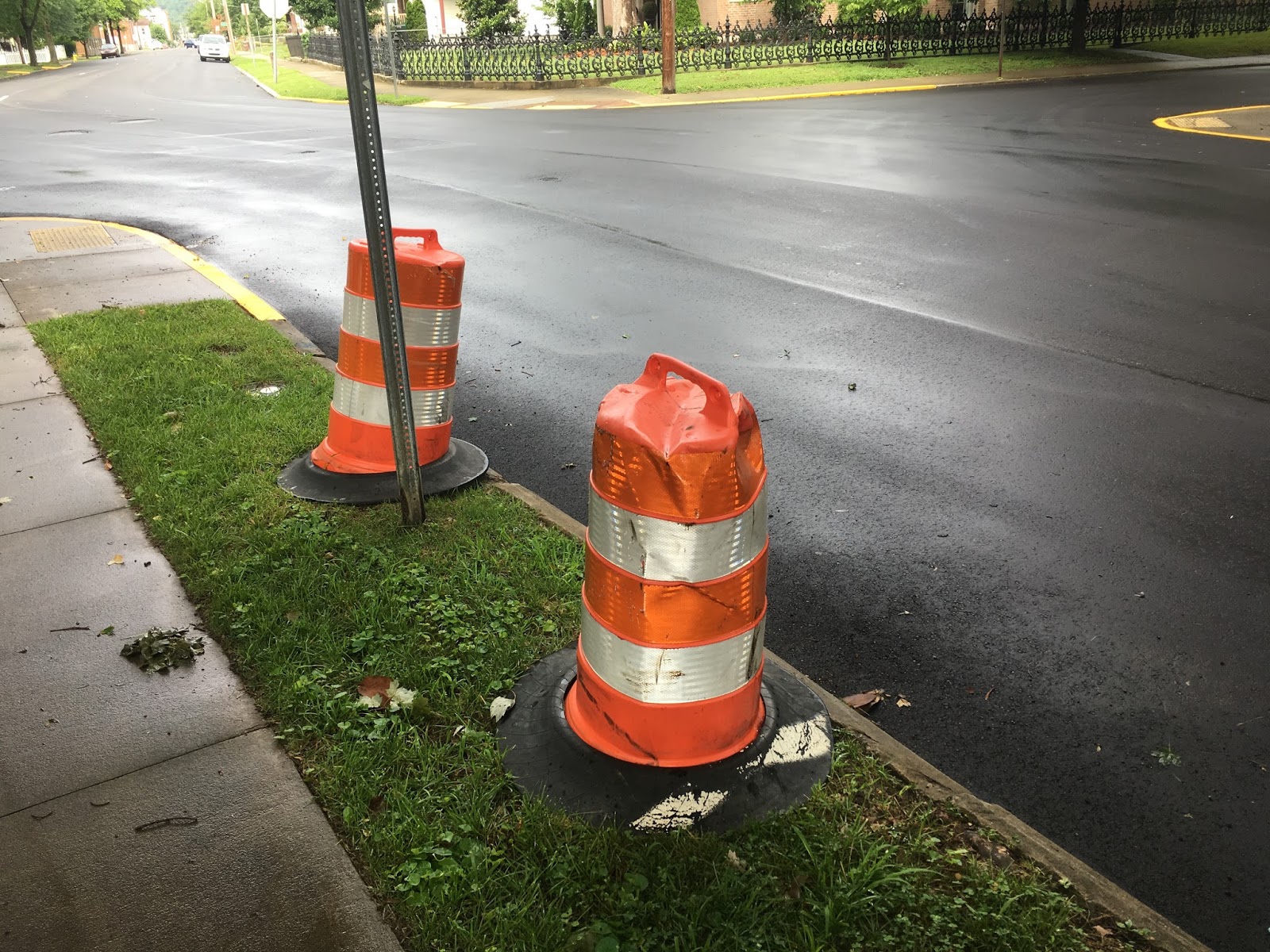
In early June, when Elm Street milling and paving commenced, MAC's crack ... team shrugged and moved the orange traffic pylons out of the way of shaded areas where workers congregate as their machinery operates.

This week on Thursday prior to the onset of rain, I was walking and noticed that after two weeks, the pylons still hadn't been moved back to their positions guarding trip hazards that the city refuses to mitigate over a period of years, and so I replaced them.

To whom should I send my civic mindedness invoice? I'm guessing the addressee isn't Warren Nash, who no doubt will yawn and return to the task of re-electing a mayor with no aptitude for detail amid grandiose TIF-laden boondoggles.

June 22, 2017


Thinking in Nawbany? It's always anchored firmly into place, right there on the mud flats, where the Ohio River meets the end of possibilities.