Showing posts with label liability. Show all posts

Tuesday, September 26, 2017

OMG -- it's a pre-Harvest Homecoming sidewalk trip hazard removal miracle!


The southeast side of 10th & Elm ↑ and northeast ↓ on Tuesday, 26 September 2017.


The same views in June of this year, showing the perennial trip hazards in these two spots.


In June, NAC recalled the countless years of inaction.

Covering and uncovering trip hazards at Elm and 10th without bothering to fix the problem? Why, that's #gahansafe!

It's been almost two years since NAC somewhat belatedly pointed to pedestrian trip hazards on two corners of Elm and 10th, these having gone unaddressed for so many years that even long-term residents couldn't recall the exact duration.

How many years to remove two hunks of trio-hazard metal and fill in the holes?

#HisNA #WhatATrip

Saturday, June 24, 2017

Covering and uncovering trip hazards at Elm and 10th without bothering to fix the problem? Why, that's #gahansafe!


It's been almost two years since NAC somewhat belatedly pointed to pedestrian trip hazards on two corners of Elm and 10th, these having gone unaddressed for so many years that even long-term residents couldn't recall the exact duration.

July 30, 2015

Photo essay: Only one of these things is a liability concern for the Board of Public Works and Safety.


You guessed it: The board's big liability concern is a street piano/public art project.

Brought in 2015 to the attention of the Bored of Works and Public Safety, junta coordinator Warren Nash yawned and returned to the task of re-electing a mayor with no aptitude for detail amid grandiose TIF-laden boondoggles.

Then, without warning, someone decided to give a damn.

January 9, 2017


18 months later, lip service for the trip hazards at 10th and Elm.


We might express curiosity at the number of years required to address the trip hazard issue with the least conceivable effort, but at least someone noticed and something was done to warn walkers, if not resolve the problem.

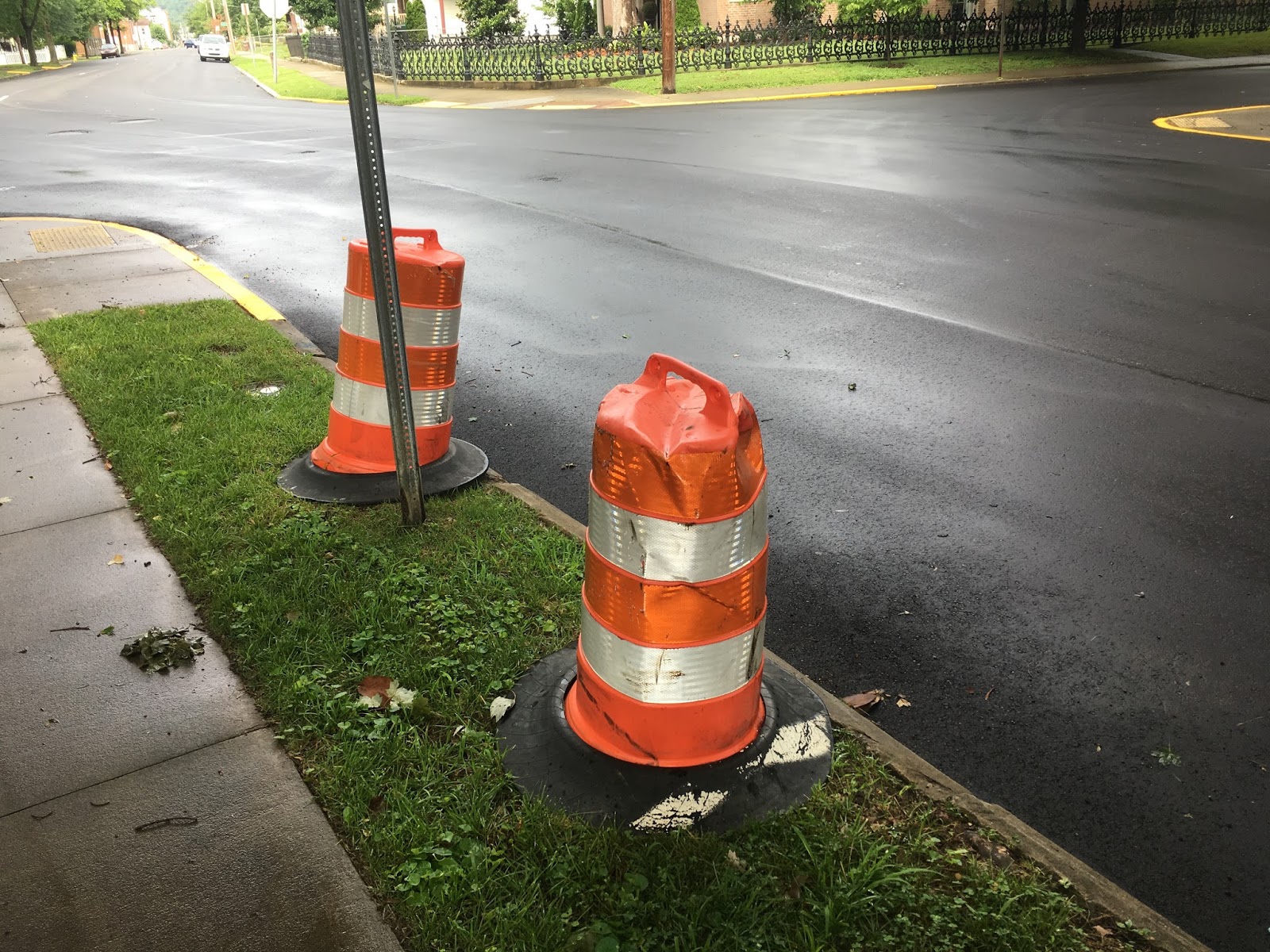
In early June, when Elm Street milling and paving commenced, MAC's crack ... team shrugged and moved the orange traffic pylons out of the way of shaded areas where workers congregate as their machinery operates.

This week on Thursday prior to the onset of rain, I was walking and noticed that after two weeks, the pylons still hadn't been moved back to their positions guarding trip hazards that the city refuses to mitigate over a period of years, and so I replaced them.

To whom should I send my civic mindedness invoice? I'm guessing the addressee isn't Warren Nash, who no doubt will yawn and return to the task of re-electing a mayor with no aptitude for detail amid grandiose TIF-laden boondoggles.

June 22, 2017


Thinking in Nawbany? It's always anchored firmly into place, right there on the mud flats, where the Ohio River meets the end of possibilities.

Monday, January 09, 2017

18 months later, lip service for the trip hazards at 10th and Elm.

This morning I noticed that two over-sized pylons had been placed atop the trip hazards on the NE and SE sidewalks at 10th and Elm -- hazards that have been unaddressed for years. "Before" photos follow, below.


In fact, it was on July 10, 2015, that NAC mentioned this situation for the first time, though it had been this way for a long while. Back then, I mentioned it at the BOW meeting, and (of course) was looked at as though I'd just stepped off a flying saucer. Such is the city's commitment to walkability that it's taken a year and a half for the pylons to be placed.

Wouldn't it be nice to have a councilman to bird-dog these perennial disconnects? If you find one, please let me know.

Psst, Warren: Two more unaddressed trip hazards in Rarely Walkable NA.

Briefly there was an orange pylon on the northeast side of the intersection, which finally had crosswalk stripes painted two weeks ago, after a decade of neglect by the Bored of Works.

Election year crosswalk paint -- on a one-way street.

Now the pylon is gone, and the trip hazards remain unaddressed.

I wonder what this excuse will be?


Then there's the overall issue at 10th and Elm, taking us all the way back to 2014:


10th and Elm: Another failure-by-design for walkability.

Thursday, July 30, 2015

Photo essay: Only one of these things is a liability concern for the Board of Public Works and Safety.

Neither this trip hazard on 10th and Elm ...

... nor this one on the opposite corner.

Not this semi truck invading sidewalk space.

No, not the underbrush obscuring this sign (and intersection).

Faded bike lane markings by an interstate-grade one-way street? Nope.

Cars parking on the sidewalk? Not even close.

You guessed it: The board's big liability concern
is a street piano/public art project. 


(Unfortunately, this is not The Onion, and we're not joking)


Friday, March 02, 2012

"The Dutch philosophy is: Cyclists are not dangerous; cars and car drivers are."

Food for thought, from a place where life is not dysfunctional by design.

---

In the Netherlands cyclists are fairly vulnerable, given the chance of injury per kilometre covered. However, in recent decades, the safety of cyclists has steadily improved. The annual number of road accident victims has halved since 1980, both in terms of cyclists and those in cars.

This decline must also be set against the enormous rise in car and bicycle use. In total, both cars and cyclists covered 32% more distance in 2001 than in 1980. Statistically, the number of potential confrontations between cars and bicycles should thus increase exponentially.

Consequently, the decline in danger is spectacular.

More traffic and a high bicycle use do not therefore automatically mean more traffic danger. Besides making a comparison over time, this can also be demonstrated by comparing countries and even Dutch municipalities.

Figure 8 (page 14) clearly shows that the risks for cyclists are lower in countries with a higher bicycle use. The same pattern is visible when Dutch municipalities are compared. In municipalities with high bicycle use, the risk of a cyclist being injured in a traffic accident is on average 35% lower than in municipalities with fewer cyclists.

The same pattern recurs in various studies: the higher the bicycle use, the safer it is for cyclists.

There are a number of explanations for this, involving the conduct of road users and the attention that policy-makers pay to the bicycle.

Firstly, higher bicycle use leads to modified conduct on the part of all traffic participants, because cyclists are more dominant in the overall road picture and because more traffic participants have cycling experience.

Secondly, higher bicycle use often goes together with lower car use, thus reducing the chance of conflict with car traffic.

Thirdly, almost every car driver is also a bicyclist (60% of the Dutch cycle at least three times a week, 80% at least once a week), which implies that car drivers know how cyclists behave.

Finally the policy explanation: high bicycle use creates more support for bicycle policy, so that more is invested in a safer cycling infrastructure.

Something that should not be overlooked in the safety section: Liability.

In some countries, bicycling is seen as causing danger, which sometimes ends up in an anti-cycling policy. The Dutch philosophy is: Cyclists are not dangerous; cars and car drivers are: so car drivers should take the responsibility for avoiding collisions with cyclists. This implies that car drivers are almost always liable when a collision with a bicycle occurs and should adapt their speed when bicycles share the roads with cyclists.