Showing posts with label push button signals. Show all posts

Monday, September 12, 2016

It's a pre-Harvest Homecoming miracle: Pedestrian crossing buttons at Spring & Pearl repaired after 6 (8?) (10?) months.


Well at least the buttons on the northeast and southeast corners have been replaced. I didn't cross the street to examine the ones on the west side. But a win's a win.

You know, maybe we've been looking at Harvest Homecoming all wrong these many years. After all, just before the festival kicks off each year, there is a crazed flurry of cleaning and repairs. I actually saw a four-man city crew on Market Street today, and only TWO of them were sitting.

If Harvest Homecoming ran all year long, might we actually have functional infrastructure?

Previously at NAC:

August 10, 2016

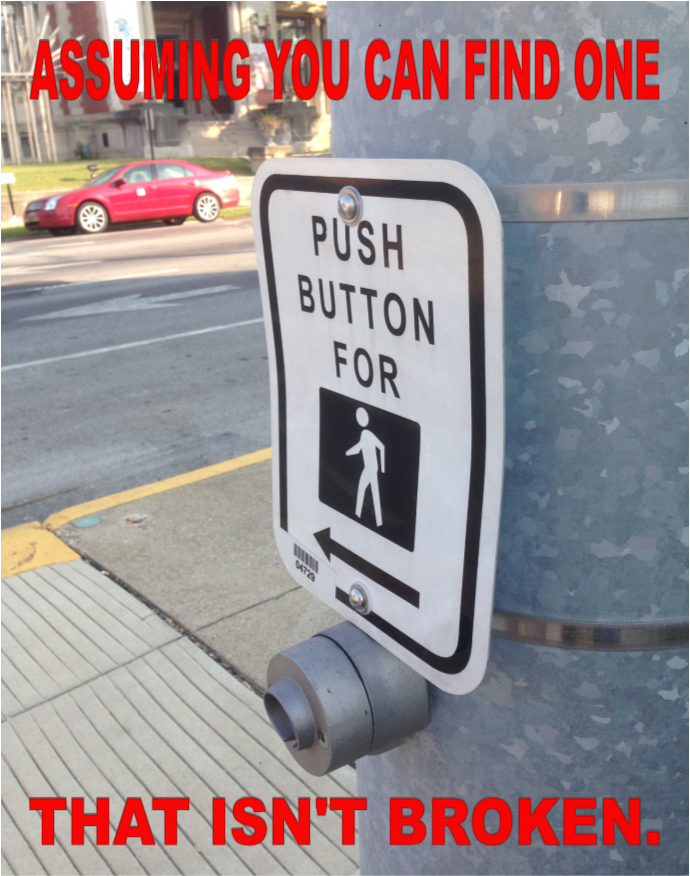
#GahanSafe: All the push-button "walk" signals for crossing Spring at Pearl are defective, and have been for five months to a year.


March 28, 2016

March 12, 2016

March 12, 2016

March 12, 2016

March 12, 2016

February 7, 2016

September 2, 2015

Friday, September 02, 2016

"How can we get the most out of pedestrian crossing signals?"


Or, to summarize:

"Why isn’t it a people-crossing with buttons for drivers to push when they want to cross the people road?"

In all such considerations, of which there are many, it tends to come back to first causes, from design to fundamental intent. I persist in thinking that just as Americans have a Bill of Rights for ready consultation as citizens, that road the street users of all sorts (not only automotive) should have the same.

---

It's easy to look at an intersection where pedestrians frequently cross and think, "What we really need is a crossing signal to make this place safer. The more bright lights and signage the better!" Well, today, our resident engineer team, R. Mosesoffered surprising answers to two questions about getting better pedestrian crossing signals in neighborhoods.

Here's a teaser:

Mid-block crossings, HAWK signals, and other such add-ons are attempts to fix a bad design. The bottom line is the street/stroad was designed wrong and flashing lights are not going to fix it, nor will a plethora of pedestrian crossing signs.

Wednesday, August 10, 2016

#GahanSafe: All the push-button "walk" signals for crossing Spring at Pearl are defective, and have been for five months to a year.


Way back in March, I pointed out that one "beg button" (push-button crossing signal) on each post at each corner of the intersection of Spring and Pearl was not functional.

Why does Team Gahan always pee on pedestrians?


In New Albany, push button crosswalk signals are not placebos. Walkers actually must push the "beg button" to receive a safe (often a facetious term) signal to cross. If the button malfunctions, there'll be no signal -- ever.

Even in March, it had been this way for a while, with at least two of them broken as far back as September, 2015. Now we've gone through almost an entire summer-season Bicentennial Park concert series cycle with nothing done to correct the problem.

We cannot know if the push-button crosswalk buttons work when so many of them are broken.


It is almost always the cities with push-button crossings that need the most help ... push-buttons almost always mean that the automobile dominates, as they are typically installed in conjunction with a new signal timing in which crossing times are shorter and less frequent.

Specifically, the push-buttons for crossing Spring both north and south on both sides of Pearl Street do not work. This morning I took the time to test each one and to watch. It is physically impossible for a pedestrian to get a "walk" signal crossing Spring Street at this intersection. It has been impossible for at least five months, and probably far longer.

Pictured are the push-buttons that are defective.


To repeat what I wrote in March:

If Jeff Gahan isn't going to do anything substantive to make New Albany a walkable city, can't he just say so aloud, for attribution, and free us from the pain of watching him prevaricate?

Any suggestion he makes to the contrary is being disproved every single day on real city streets, where nothing is being done to indicate any serious intent to improve walkability, and plenty is being done to discourage it. There's only one honest way to conclude these thoughts:

Mr. Mayor, as it pertains to walkability, just shit or get off the pot.

You're embarrassing the city by making private promises constantly contradicted by public indifference -- by your bizarre insistence that you're making omelettes without breaking eggs. Even your own people know it's a shell game.

Join me for an actual walk some day, and I'll show you exactly how urban walking works in real life, as opposed to the fantasyland bunker you prefer inhabiting. The same offer goes for your minions.

Do any of you walk downtown, ever?

Monday, March 28, 2016

Why does Team Gahan always pee on pedestrians?


It began in September, 2015, with this observation: We cannot know if the push-button crosswalk buttons work when so many of them are broken.

Jeff Speck, who once authored a walkability study for New Albany -- a document now being depleted, one precious page at a time, as toilet paper in Jeff Gahan's executive washroom -- is quoted here on the topic of push-button crosswalk signals: How Push-to-Walk reduces the quality of walkable neighborhoods.

It is almost always the cities with push-button crossings that need the most help ... push-buttons almost always mean that the automobile dominates, as they are typically installed in conjunction with a new signal timing in which crossing times are shorter and less frequent. Far from empowering walkers, the push button turns them into second-class citizens; pedestrians should never have to ask for a light.

And boy, does the auto dominate in New Albany.

In New Albany, push button crosswalk signals are not placebos. Walkers actually must push the "beg button" to receive a safe (often a facetious term) signal to cross. If the button malfunctions, there'll be no signal -- ever.

Not only do push buttons turn pedestrians into second-class citizens; broken push buttons surely deter the notion of a pleasant walk just as effectively as sidewalk parking, and other defaults wherein the sidewalk always is blocked first, not a parking space or a street lane.

"I've devoted my life as a social worker to people with developmental disabilities, and can't even walk with them in NA if they are in a wheelchair or have gait issues."


Below are photos taken on Monday morning, March 28, at the intersection of one-way Pearl Street and one-way Spring Street. It's the epicenter of downtown, quite close to where Bob Caesar never imagined a person walking from the Elks Club to his jewelry store to buy a diamond.

There are a total of eight push button signals, two on each corner. The ones pictured below are broken. In fact, one is broken on each corner. At least two of these have been broken for months. They're not the only ones downtown which are disabled, but at no other corner equipped with push buttons is traffic so constantly hazardous owing to drivers increasing speed to run beat red lights.

Note that the issue of malfunctioning push buttons doesn't address the situation at intersections like W 1st and Main, or Bank and Main, where nothing -- zero, zilch, nada -- is in place to slow traffic such that walkers can cross the street safely.

You'll note that throughout the period since the release of the Speck walkability study, Team Gahan has been careful to couch its public pronouncements about the future of street grid reform, of which there have been almost none, as being entirely devoted to making traffic safer.

Reams of evidence from across America and the world point to the flaws of this mode of "thinking," and provide abundant proof that had walkability been pursued first, before the other expensive projects pursued by the current administration, it would have been like a dose of steroids, enhancing investment and not devaluing it.

As it stands, there's a toxic stew under preparation.


  • An auto-centric street grid
  • Rebirth of downtown small business
  • Poor lighting
  • Inconsistent sidewalk maintenance
  • Refusal to enforce ordinances (should there be sidewalk parking, ever?)
  • Antediluvian municipal gatekeepers


Quite literally, multiple accidents are waiting to happen, as we prioritize one bright shiny object after another.

If Jeff Gahan isn't going to do anything substantive to make New Albany a walkable city, can't he just say so aloud, for attribution, and free us from the pain of watching him prevaricate?

Any suggestion he makes to the contrary is being disproved every single day on real city streets, where nothing is being done to indicate any serious intent to improve walkability, and plenty is being done to discourage it. There's only one honest way to conclude these thoughts:

Mr. Mayor, as it pertains to walkability, just shit or get off the pot. 

You're embarrassing the city by making private promises constantly contradicted by public indifference -- by your bizarre insistence that you're making omelettes without breaking eggs. Even your own people know it's a shell game.

Join me for an actual walk some day, and I'll show you exactly how urban walking works in real life, as opposed to the fantasyland bunker you prefer inhabiting. The same offer goes for your minions.

Do any of you walk downtown, ever?


Team Gahan's walkability gap (4 of many): "We’re all apparently okay with dead pedestrians as collateral damage for ensuring cars can travel quickly."


Team Gahan's walkability gap (3 of 3): "A Playbook on the Politics of Better Streets." WE NEED IT.


Saturday, March 12, 2016

Team Gahan's walkability gap (2 of 3): "Is your city pedestrian unfriendly"? YEP.


A classic example of the idiocy described below is pictured above.

We have allowed the national chains Rally's, White Castle and Walgreen's to construct a suburban maze in the middle of a densely populated urban area, with multiple curb cuts, each building set back from the street.

But the part that continues to amaze me is that in each instance, if you're crossing either Vincennes or Spring using push button signals that may or may not work -- the terrors of vehicular traffic here is another story entirely, as we seem determined not to calm traffic or place trucks where they should be -- you cannot proceed directly to the business's door using the layout built for your feet.

That's because it was designed for cars, NOT your feet.

Rather, one either must traverse corner landscaping, which works for me only because I'm not in a wheelchair, or use the entry lanes alongside oblivious autos. In short, these three businesses are built and situated adjacent to sidewalks in an area of prime potential walkability, and simultaneously are cut off from use as a walker.

Director of Mayhem John Rosenbarger was on duty when these were approved. Anyone interested in holding his or her breath until he explains why atrocities like this occurred?

I didn't think so, seeing as the human instinct is to live, even if butchers like Rosenbarger and Warren Nash continue to deposit their paychecks for ... what?

IS YOUR CITY PEDESTRIAN-UNFRIENDLY?, by Sarah Kobos (Strong Towns)

As more and more people say they want to live in walkable neighborhoods, it’s fun to watch the old-school, suburban developers squirm. Unwilling to change what they do, they instead attempt to market their car-centric products as “pedestrian friendly.” Generally, this occurs at planning commission meetings, where words like “walkability” and “pedestrian amenities” are tossed around like claims in a presidential debate. It sounds great when they say it, but there’s no substance behind the jargon.

Here are just a few of my favorite pedestrian unfriendly amenities.


  • THE SIDEWALK TO NOWHERE
  • HIGH-SPEED DRIVEWAYS
  • MULTIPLE CURB CUTS
  • DEEP SETBACKS
  • WHERE IN THE WORLD IS CARMEN SAN DIEGO… AND WHERE THE !@#%*#! IS THE FRONT DOOR?
  • ENORMOUS PARKING LOTS
  • TITANIC SCALE
  • BLANK WALLS
  • ELEVATION DROPS
  • WALLS


Then this. I see examples of each of these in New Albany every single day,as noted above. What is Team Gahan and his Bored of Works doing apart from coordinating the political finance largess from paving bids?

BUT WE CAN’T JUST BLAME THE DEVELOPERS

It’s not just old-school developers who design barriers into the pedestrian experience. Every day, people who don’t drive experience discrimination in the form of bad street design, sidewalk obstacles and blithe disregard for their needs.

A few common examples…

WHOOPS! WE FORGOT!
The most common form of pedestrian unfriendliness is the ubiquitous street without a sidewalk.

THE SIDEWALK STORAGE AREA
Many street crews obviously see the sidewalk as a convenient place to store construction materials, park cars, and locate temporary signage, even if it means that a person in a wheelchair has absolutely no way to cross the barrier.

UTILITIES!
Imagine the outrage if utilities were placed in the middle of traffic lanes, forcing cars to bob and weave their way down the street. This casual disregard for the needs of people who use sidewalks is an impressive symbol of how we prioritize auto travel over all other modes.

THE OBLIQUE RAMP
Why pay for two ramps when just one completely unsafe ramp will do?

NO RAMP AT ALL
It’s like CrossFit for disabled people.

LACK OF STREET TREES
If you live in the south, trees make a dramatic difference to people who walk.

I could go on, but you get the idea. We’ve spent the better part of 70 years building our cities for cars, not people, and it shows. It’s time to make walkability a priority, not just a feel-good buzzword.
Awareness is the first step. The more we can help our neighbors and elected officials recognize obstacles to walkability, the sooner we can make our cities better and healthier places for everyone.

Let’s get this conversation started! Share your examples of affronts to walkability on Twitter, Facebook and Instagram using the hashtag #PedestrianUnfriendly.

Team Gahan's walkability gap (1 of 3): "If you want to make a walkable city, you need to do the little things well." WE DON'T.


Previously at NAC:

Dear Jeff: "When Drivers Hit Pedestrians, Where Do We Lay the Moral Blame?"


Team Gahan seems unable (read: unwilling) to do little things well, and consequently, the mayor's minions are failing to lead New Albany toward walkability.

Of course, publicly stated aims and goals would provide a better checklist. Seen any of these lately?

I didn't think so.

Tim Kovach writes here about Cleveland, but many of his comments bear relevance to New Albany's perennial degradation. Shouldn't it be easier in a small city than in a larger one? Not if presumed "leaders' have no moral compass.

If you want to make a walkable city, you need to do the little things well, by Tim Kovach

 ... It’s a scene that haunts me to this day. While the driver was found not to be at fault, this was a visceral reminder of the stark imbalance between drivers and pedestrians. If a teenager makes one bad decision, he may never make another ...

 ... The City Planning Commission seems committed to moving towards form-based zoning, at least in limited areas, in an attempt to make our city more walkable and pedestrian friendly (but) the City seems preoccupied with big, shiny, expensive projects, rather than the types of small changes that can immediately improve peoples’ lives.

If you know me or have read things that I’ve written here in the past, you probably realize that I’m a proponent of incremental progress. It’s great to push for the Big Things that can help shift paradigms, but we shouldn’t ignore the types of small, tangible changes that help people at the margins. It’s just as important to do the little things well.

Kovach goes on to highlight three "small details that can go a long way towards improving pedestrians’ quality of life." I've edited them, and my answers/comments are in red.

1.) Do all intersections include crosswalks and pedestrian signals?

No, not in downtown New Albany. The most egregious examples can be found on Main Street.


On the advent of Underground Station, rank political poseurs and a dangerous street without crosswalks or stop signs.


As Team Gahan snoozes, the intersection of West 1st and Main is an accident waiting to happen.


One of the simplest and most important things a city can do is to ensure that every intersection is equipped with crosswalks and pedestrian signals. This simple addition of some painted lines and signals carves out a small part of the street where pedestrians have a legally enforceable right to space.

And ...

2.) Are all pedestrian signals set to actuate at all times (i.e. not pedestrian actuated)?

Maybe, maybe not, though it's hard to tell when so many of the push buttons are broken so often. One thing is certain: If the button is broken, there'll be no signal. I've witnessed it again and again.

Once again, this seems like a small thing. It makes a pedestrian’s life a lot easier if she knows that regardless of when she gets to the intersection during the cycle, the walk signal is going to trigger when it’s supposed to.

Finally ...

3.) Has the city installed “leading pedestrian interval” signals, which allow pedestrians to start ahead of vehicular traffic?

No, though Louisville just now has introduced a few of these.

 ... Realistically, I just want the City to ensure that every pedestrian signal is synced to the traffic light. That is, the walk sign should activate as soon as the light turns green for cars, and the signal should not switch from flashing don’t walk to sold don’t walk until that traffic light turns yellow. At the very least, pedestrians should be afforded the same legal rights as the cars, right?

His conclusion:

All too often, we spend money on things that look nice or seem nice in theory, even as we overlook the little things that can make a tangible difference. I understand that elected officials don’t get to attend a ribbon-cutting ceremony when you sync a pedestrian signal to the traffic light, but these seemingly small things matter. Until officials commit to tackling these easy-to-fix problems, the focus on the Big projects will seem like little more than PR.

Sunday, February 07, 2016

Dear Jeff: "When Drivers Hit Pedestrians, Where Do We Lay the Moral Blame?"


So why do so many people blame the pedestrian?

Earlier today, I was walking on Spring Street, the world’s longest interstate entrance ramp, as recently certified by the Guinness Book of World Records.

City officials giddy as New Albany finally makes Guinness Book of World Records (REPOST).


At one point, three of four vehicles coming past -- probably all of them traveling between 35 and 40 mph -- shared a single feature in common.

Their drivers, two men and a woman, were staring at mobile phones.

When Drivers Hit Pedestrians, Where Do We Lay the Moral Blame?, by Peter Simek (Front Burner blog at Dallas Magazine)

... When your city is constructed in such way that it values efficiency and speed for vehicular traffic above all else, taking every opportunity to create a thoughtless, unobstructed environment for drivers, that design teaches the people who live in the city that the public realm values the car over the pedestrian. When a pedestrian interrupts the vehicular environment, he or she demonized for stepping out of line. They are judged to be thoughtless, reckless, or irresponsible because they have invaded a space that the city has instructed us belongs to cars.

Wednesday, September 02, 2015

We cannot know if the push-button crosswalk buttons work when so many of them are broken.


That's right, NA:

We're fundamentally better.

Jeff Speck, who once authored a walkability study for New Albany -- a document now being depleted, one precious page at a time, as toilet paper in Jeff Gahan's mayoral washroom -- is quoted here on the topic of push-button crosswalk signals: How Push-to-Walk reduces the quality of walkable neighborhoods.

It is almost always the cities with push-button crossings that need the most help ... push-buttons almost always mean that the automobile dominates, as they are typically installed in conjunction with a new signal timing in which crossing times are shorter and less frequent. Far from empowering walkers, the push button turns them into second-class citizens; pedestrians should never have to ask for a light.

And boy, does the auto dominate in New Albany.

There is reason to believe that quite often, push-button at crosswalks do nothing, and in fact are virtual placebos.

MANY CROSSWALK SIGNAL BUTTONS DON’T DO ANYTHING ANYMORE (Today I Found Out)

Does pressing the pedestrian crossing button actually do anything?, by Tom de Castella (BBC News Magazine)

My sense is that in New Albany, these push-buttons are enabled and actually do something. I base this observation on lengthy waits at crosswalks downtown, where the buttons (as the one pictured above) chronically malfunction.

There are a great many of them.