Showing posts with label Fascism. Show all posts

Sunday, October 04, 2020

About Miklos Gárdos and anti-fascism.


4 October 1942 | Hungarian Jewish boy Miklos Gárdos was born. In July 1944 he was deported to #Auschwitz and murdered in a gas chamber.

I'm always cautious to reference posts like this one, as I'm sure the people at Auschwitz Memorial would remind us that man's inhumanity to man isn't restricted to one "side" or another. 

Still, for me, it's the reason why I always will consider myself anti-fascist, even if I'm not pro-anything else. Fascism has no intellectual or theoretical foundation, period, apart from the accumulation of raw power. And, by extension, Auschwitz is where an unchecked accumulation of raw power leads. 

Kindly spare me your equivocations. If this is something that eludes you, merely adjust your social media settings. Delude yourself if you wish, but I don't need you in my life.

ON THE AVENUES: Dear Holocaust deniers: If you don't like this post, unfriend me now.

Wednesday, September 23, 2020

Democrats? Acting more aggressively? Probably a pipe dream, but worth a post at least.


This is a slightly rosy assessment of policy options, especially in imagining there'll be a transition as we've known it; again tonight Donald Trump trolled the country about not going away peacefully. 

And all my white Republican friends were silent like tombs. I believe categorically that what we're witnessing at the present time is (a) the cancerous decay of late-stage capitalism; (b) the equally malignant pathology of decadent capital accumulation; and (c) a fanatical determination on the part of white America to remain the dominant caste, come what may.

I've no firm idea how I can help those in need, given that the bulk of you insist on identifying with the abysmal, corrupt two-party system.

But I'm open to suggestions.

Republicans will replace RBG but Democrats hold the trump cards – no, really, by David Litt (The Guardian)

Progressives should not worry about what will happen if they mimic McConnell’s constitutional hardball. Their representatives need only act with a little less restraint

... For one thing, America’s political institutions are currently biased – in many cases quite aggressively – in favor of conservatives. Restrictive voting laws make casting a ballot disproportionately difficult for lower-income, non-white and young Americans. Unprecedented gerrymandering gives Republicans a built-in advantage in the race for the House, and according to FiveThirtyEight’s Nate Silver, the Senate’s bias toward rural states makes the chamber about seven points redder than the nation as a whole. Thanks to the electoral college, two of the past five presidential elections have been won by Republicans who lost the popular vote – one reason why even before Justice Ginsburg’s death, 15 of the past 19 supreme court justices were appointed by GOP presidents.

The conservative movement, in other words, already had it pretty good. The average American disagrees with Republican orthodoxy on every major issue: healthcare, climate change, gun violence, immigration, taxes, Covid response. Yet thanks to the biases embedded in the American political process, Republicans have not just remained viable, but secured extraordinary amounts of power. We can’t know for certain who would benefit from upending the status quo that existed at the time of Justice Ginsburg’s passing – but we do know which party has the most to lose.

Thursday, June 04, 2020

Hilter Skilter, Béarnaise, Gwobbles and the origins of propaganda in American-style capitalism.


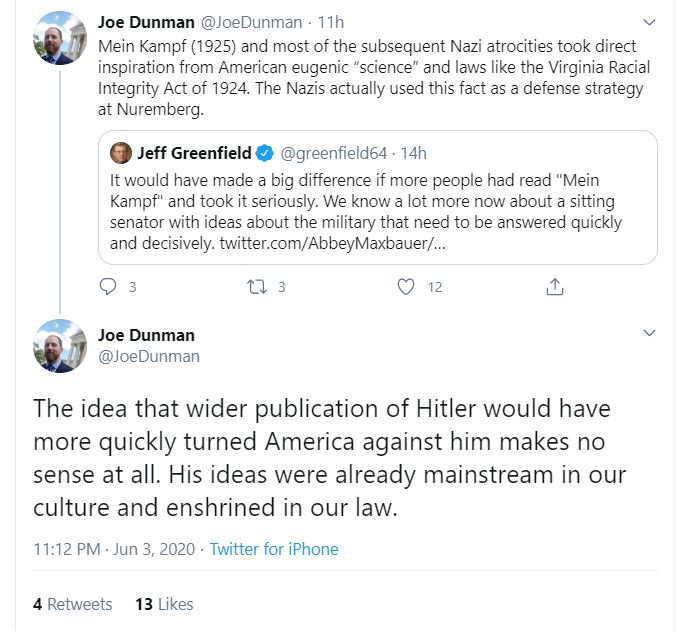
Reading this thread at Joe Dunman's Twitter account led me to a feeling of déjà vu.


As it turns out, almost exactly three years ago in this space, I took to the airwaves to correct an error about the career of Joseph Goebbels.

---

That's right; I was wrong. Goebbels got his ideas for propaganda from American advertising, not the other way around.

June 5, 2017

Recently I posted this on social media.

I'm eternally amazed by chain restaurant envy, which always seemed to me an inevitable result of Goebbels-scale national advertising and perception of price point (the latter is skewed, but real enough in many cases). But is it cultural, too? I don't know the answer, but is it a fair question?

Among the responses was this.

Using the Goebbels example is just histrionic.

I replied:

I don't think so. It's the basis of saturation advertising, in the sense of constant repetition. We're exposed to ads every day, hundreds and maybe thousands of times. I believe numerous studies have been devoted to the ongoing subliminal effects even when we think we're tuning it out. Goebbels preached these very qualities in his propaganda dissemination.

In essence, I was arguing that from the techniques of Goebbels, post-war capitalism derived its operational handbook for mass marketing.

I was mistaken.

In fact, Goebbels found inspiration for his propaganda techniques in pre-war capitalism. Big lies and mass-marketing in the service of profit made Goebbels, and not the other way around.

Meet Edward Bernays. You'll want to click through and read the entire essay.

The manipulation of the American mind: Edward Bernays and the birth of public relations, by Richard Gunderman (The Conversation)

“The most interesting man in the world.” “Reach out and touch someone.” “Finger-lickin’ good.” Such advertising slogans have become fixtures of American culture, and each year millions now tune into the Super Bowl as much for the ads as for the football.

While no single person can claim exclusive credit for the ascendancy of advertising in American life, no one deserves credit more than a man most of us have never heard of: Edward Bernays ... often referred to as “the father of public relations,” Bernays in 1928 published his seminal work, Propaganda, in which he argued that public relations is not a gimmick but a necessity:

The conscious and intelligent manipulation of the organized habits and opinions of the masses is an important element in democratic society. Those who manipulate this unseen mechanism of society constitute an invisible government which is the true ruling power of our country. We are governed, our minds are molded, our tastes formed, and our ideas suggested, largely by men we have never heard of ... It is they who pull the wires that control the public mind.

It turns out that Bernays had an international readership.

Bernays’ ideas sold a lot more than cigarettes and Dixie cups.

Even though Bernays saw the power of propaganda during war and used it to sell products during peacetime, he couldn’t have imagined that his writings on public relations would become a tool of the Third Reich.

In the 1920s, Joseph Goebbels became an avid admirer of Bernays and his writings – despite the fact that Bernays was a Jew. When Goebbels became the minister of propaganda for the Third Reich, he sought to exploit Bernays’ ideas to the fullest extent possible. For example, he created a “Fuhrer cult” around Adolph Hitler.

In 2017, we're exposed to advertising (or marketing, or branding) cues thousands of time each day. Whether overt or subliminal, these messages influence actions we blithely regard as "free."

But are they?

Goebbels may have been less concerned with profits, though the result is largely the same.

Its underlying purpose, in large part, is to make money. By convincing people that they want something they do not need, Bernays sought to turn citizens and neighbors into consumers who use their purchasing power to propel themselves down the road to happiness.

Without a moral compass, however, such a transformation promotes a patronizing and ultimately cynical view of human nature and human possibilities, one as likely to destroy lives as to build them up.

Another Bernays citation is here.

He disseminated propaganda for the Government during World War I and tried to brighten Calvin Coolidge's dour image during the 1924 campaign by importing Al Jolson and 40 other Broadway performers to the White House. A master at concealing base drives behind exalted rhetoric, Bernays in 1928 provided this defense of political work: ''Intelligent men must realize that propaganda is the modern instrument by which they can fight for productive ends and help to bring order out of chaos.'' As if to mock this rosy view, Joseph Goebbels became an attentive student of Bernays's theories five years later.

And another.

It is known that Goebbels studied the way advertising companies worked in America. A great deal of his written work was made up of short sentences – as the above indicate. Everything was kept simple so that there could be no misunderstanding as to its meaning.

Finally, this.

Goebbels “took his cue from the model of commercial advertising”.

For Goebbels, “commercial advertising was overtly cited as the model to follow. Whether it was a matter of simplification, constant repetition of memorable slogans, or concentration of propaganda material in regular campaigns, the principles of mass advertising could easily be applied to political propaganda.”

Strictly speaking, I was mistaken to assert that mass-market, saturation advertising for McDonald's, Budweiser or Ford derived from Goebbels.

Under the circumstances, I'm perfectly happy to concede my error.

Wednesday, June 03, 2020

Trump's biblical photo op? It was American history in a nutshell.


The Economist believes America's chronic anger has led to this violent juncture. That's surely true. But where does the anger come from? It makes sense for the downtrodden to be angry. But why the people who have so much? That's level of fear that's hard to fathom.

'How did we get here?': Trump has normalised mayhem and the US is paying the price, by Julian Borger (The Guardian)

The sheer tumult of the Trump era, the unceasing torrent of events that were unthinkable even hours before, has left a nation constantly off balance, unable to find its bearing and grasp how far it has traveled.

The developments of the past 24 hours were a reminder of how slippery the downward slope has been.

More than a hundred thousand Americans are dead from a pandemic after the government’s botched response; there are armoured cars and troops outside Washington metro stations; men in combat gear carrying sniper rifles were seen perched in the open door of a helicopter flying low over the commercial district. A military chopper buzzed a crowd of demonstrators so close to the ground they were buffeted around by the wind from the rotor, a dispersal technique learned in counter-insurgencies abroad.

On Monday, an entirely peaceful protest was driven out of a city square in front of the White House with teargas, baton charges and mounted police, so Trump could pose in front of a church with a Bible.

A priest and a seminarian, who had been distributing water and hand sanitizer to protesters from the steps of St John’s Episcopal, were driven away by police with helmets and riot shields to create an uncluttered tableau. A Bible was procured for Trump from inside the church for him to hold aloft. Journalists asked if it was his Bible. “It’s a Bible,” he replied.

The rate of fresh affronts has often outpaced the capacity to digest – or even describe – them ...

Sunday, August 25, 2019

Design elements: Is it Market Street beautification or Il Duce's Italy?


Who knew Jeff Gahan was a student of pre-WWII fascist history? It's only a matter of time before Dear Leader channels Il Duce: "We must create a new art, an art of today, a Gahanist-HWC art."

As Bluegill wisely noted:

New Albany’s Market Street project is depressingly familiar - big money, long time, the usual political patronage, generic ugly car-centric result. New Gahania in a nutshell.

This nutshell includes the beautiful people rushing to praise the emperor's nudity as they overlook what he's done to terrorize the less fortunate among us.

Therein lies the biggest part of our city's problem -- that, and street light poles made out to look like Roman plinths for enormous ceremonial statues, which they might yet become during a third Gahan term.


We'll be invading Clarksville before you know it.

#FireGahan2019

Thursday, April 18, 2019

Branding Gahan's "sweet spot," part two: He's selling a whole city in his own image, but personality cults aren't pretty pictures.


Part one here.

There can be no doubt. Jeff Gahan's "sweetest spot" is himself.

In his What is character and why it really does matter, Thomas A. Wright states, "The cult of personality phenomenon refers to the idealized, even god-like, public image of an individual consciously shaped and molded through constant propaganda and media exposure. As a result, one is able to manipulate others based entirely on the influence of public personality...the cult of personality perspective focuses on the often shallow, external images that many public figures cultivate to create an idealized and heroic image."

A few recent examples follow. Cautionary note: these images are not for the faint of heart.


The conclusion is as obvious as it is absurd.

Jeff Gahan has been branding the city in his own image, and using our money to do it, but we need collective thinking, not the shoddy veneer of a personality cult.

Here's one definition of branding.

The process involved in creating a unique name and image for a product in the consumers' mind, mainly through advertising campaigns with a consistent theme. Branding aims to establish a significant and differentiated presence in the market that attracts and retains loyal customers.

Below is an article by the estimable Aaron Renn, in which the author discusses branding, or in this case the marketing efforts undertaken by cities.

You can’t help but notice how few unique things about these cities manage to come through.

What about branding our town? For the past eight years here in New Albany, what passes for a "brain trust" at City Hall (try not to cringe in disgust) surely has undertaken a branding campaign. It may or may not have been explicitly organized as a branding campaign, but the effect has been the same.

In essence, New Albany very much has been branded as New Gahania, which is to say that in terms of promotions, every aspect of the city has been tied to the mayor's cult of personality: New Albany is Jeff Gahan, and vice versa.

Students of history will recognize this device from numerous authoritarian and totalitarian regimes, but let's focus on just one: Italy under Benito Mussolini during the 1920s and 1930s.

Mussolini's Italian "fascism" came along first, and was in many ways a precursor of Adolf Hitler's organizational model for Nazi Germany. In fact, Mussolini's chosen symbol became the word to describe his movement.

Fasces ... a bound bundle of wooden rods, sometimes including an axe with its blade emerging. The fasces had its origin in the Etruscan civilization and was passed on to ancient Rome, where it symbolized a magistrate's power and jurisdiction.

A fasces looks like this.


Gahan's chosen symbol emerged from the back rooms where appointed committees meet, utterly without the input or votes of any elected official, and as selected by then-redevelopment honcho and noted artistic design expert David Duggins because it looked "cute."


Now it has become the anchor that adorns every city-owned object.


In Duggins' own words, the anchor was chosen to be a "branding device" for the city. This points to the importance of knowing the meaning of words, for an anchor is something heavy that is used to keep a boat fixed in place, not moving.


Consequently New Albany's second-most-important act of branding during the past eight years has been to slap the anchor logo on everything, which has the effect of announcing that we'll be moving forward while remaining anchored right where we were.

It may not be the best branding for the world outside, but it actually jibes with Gahan's self-aggrandizing governing philosophy, as when he claimed to radically change the street grid while doing almost nothing to ... radically change the street grid.

But far more so than anchors, our foremost branding effort has been devoted to slapping Gahan's cherubic chihuahua image on every last advertisement purchased with taxpayer dollars. An anchor keeps the boat from moving. Gahan keeps the city from moving, while grandly lubricating his own pockets with pay-to-play dollars from special interests.


Of course, Benito Mussolini already had been there and done that.


Allow me to direct this comment to those merchants and independent business owners who tend to accept what they're told at gatherings without examining any of it too closely: if we work together as a collective bearing the weight of our combined investments, the city's marketing and branding would reflect us.

As it stands, the city has indeed been branding -- as New Gahania, not New Albany. This does much for the incumbent, and almost nothing for the rest of us. Worse still, he's been using our money to pay for his own glorification.

Cities: Don’t Fall in the Branding Trap, by Aaron Renn (CityLab)

From Instagram stunts to Edison bulbs, why do so many cities’ marketing plans try to convince people that they’re exactly like somewhere else?

It’s curious that while every company tries its hardest to convince you of how much different and better it is than every other company in its industry, every city tries its hardest to convince you it’s exactly the same as every other city that’s conventionally considered cool.

Look at any piece of city marketing material, from promo videos to airline magazine ad inserts. It’s amazing how so many of them rely on the same basic ingredients: hipster coffee shops, microbreweries, bike lanes, creative-class members, startups, intimations of a fashion scene, farm-to-table restaurants, new downtown streetcars, etc.

These are all good things, mind you: things cities should be happy to have. Some of them may even be modern necessities. But you can’t help but notice how few unique things about these cities manage to come through ...

Four more years of this?

So off went the Emperor in procession under his splendid canopy. Everyone in the streets and the windows said, "Oh, how fine are the Emperor's new clothes! Don't they fit him to perfection? And see his long train!" Nobody would confess that he couldn't see anything, for that would prove him either unfit for his position, or a fool. No costume the Emperor had worn before was ever such a complete success.

"But he hasn't got anything on," a little child said.

"Did you ever hear such innocent prattle?" said its father. And one person whispered to another what the child had said, "He hasn't anything on. A child says he hasn't anything on."

"But he hasn't got anything on!" the whole town cried out at last.

Yes, the "Tsar of the Shopping Cart" has been branding the city in his own image and using our money to do it.

However, we need collective grassroots thinking, not the shoddy veneer of a personality cult, even if the absurd personality cult veneer is what we keep getting, again and again. Here's a sampling.

December 16, 2018: Cult of personality: Jeff Gahan's face appears on doggie calendars and in newspaper inserts. It's blatant electioneering at the taxpayer's expense.

August 13, 2018: Earache My Eye: Check out Deaf Gahan's full page Anchor Marriage ad in Extol's wedding issue.

August 10, 2018: Shameless self-aggrandizement as Gahan invites 1Si to provide career counseling to local students.

June 13, 2018: Jeff "Look at Me" Gahan's aquatic cult of personality: He brings us health, all by himself.

February 3, 2018: Inflatable Date Night is ultimate proof that Deaf Gahan seeks to emulate Rev. Moon with a hip new campaign finance baby boom.

January 18, 2018: ON THE AVENUES: During our State of the Gahanaissance Address for 2018, feel free to resort to hard liquor. I did, and will.

September 10, 2017: Adam polishes Jeffrey's personality cult, and yet Dickey's Floyd County Democratic Party still hasn't embraced Gahan's public housing putsch.

June 11, 2017: CARTOON: Gahan Mach III ... or, daddy needs a brand new logo.

June 4, 2017: Scraping rock bottom: Jeff Gahan brings his cult of personality to Kroger shopping carts. But who paid for these political ads?

June 4, 2017: Shopping cart blurbs, magazine ads, billboards ... and now the NTSPY Awards. How much of your money is Jeff Gahan spending on all this?

There's a way out of this deaf, dumb and blind alley: #FireGahan2019


---

I'm voting for David White.


Democratic mayoral candidate David White understands that change begins with a whole lotta scrubbing, and NA Confidential advocates just such a deep civic cleansing. 

After eight years on the job, Mayor Jeff Gahan's list of stunning "achievements" is long, indeed: tax increases, budgetary hide 'n' seek, self-deification, daily hypocrisy, public housing takeover, non-transparency, pay-to-play for no-bid contracts, bullying city residents and bullying city employees. Eight years is enough. It's time to drain Gahan's swamp, flush his ruling clique and take this city back from Gahan's Indy-based special interest donors. 


NA Confidential supports David White for Mayor in the Democratic Party primary, with voting now through May 7. 

Wednesday, February 13, 2019

Jeff Gahan has been branding the city in his own image, and using our money to do it, but we need collective thinking, not the shoddy veneer of a personality cult.


Here's one definition of branding.

The process involved in creating a unique name and image for a product in the consumers' mind, mainly through advertising campaigns with a consistent theme. Branding aims to establish a significant and differentiated presence in the market that attracts and retains loyal customers.

Below is an article by the estimable Aaron Renn, in which the author discusses branding, or in this case the marketing efforts undertaken by cities.

You can’t help but notice how few unique things about these cities manage to come through.

What about branding our town?

For the past eight years here in New Albany, what passes for a "brain trust" at City Hall (try not to cringe in disgust) surely has undertaken a branding campaign. It may or may not have been explicitly organized as a branding campaign, but the effect has been the same.

In essence, New Albany very much has been branded as New Gahania, which is to say that in terms of promotions, every aspect of the city has been tied to the mayor's cult of personality: New Albany is Jeff Gahan, and vice versa.

Students of history will recognize this device from numerous totalitarian regimes, but let's focus on just one: Italy under Benito Mussolini during the 1920s and 1930s.

Mussolini's Italian "fascism" came along first, and was in many ways a precursor of Adolf Hitler's organizational model for Nazi Germany. In fact, Mussolini's chosen symbol became the word to describe his movement.

Fasces ... a bound bundle of wooden rods, sometimes including an axe with its blade emerging. The fasces had its origin in the Etruscan civilization and was passed on to ancient Rome, where it symbolized a magistrate's power and jurisdiction.

A fasces looks like this.


Gahan's chosen symbol emerged from the back rooms where appointed committees meet, utterly without the input or votes of any elected official, and as selected by then-redevelopment honcho and noted artistic design expert David Duggins because it looked "cute."

Now it has become the anchor that adorns every city-owned object.


In Duggins' own words, the anchor was chosen to be a "branding device" for the city. This points to the importance of knowing the meaning of words, for an anchor is something heavy that is used to keep a boat fixed in place, not moving.

Consequently New Albany's second-most-important act of branding during the past eight years has been to slap the anchor logo on everything, which has the effect of announcing that we'll be moving forward while remaining anchored right where we were.

It may not be the best branding for the world outside, but it actually jibes with Gahan's self-aggrandizing governing philosophy, as when he claimed to radically change the street grid while doing almost nothing to ... radically change the street grid.

But far more so than anchors, our foremost branding effort has been devoted to slapping Gahan's cherubic chihuahua image on every last advertisement purchased with taxpayer dollars. An anchor keeps the boat from moving. Gahan keeps the city from moving, while grandly lubricating his own pockets with pay-to-play dollars from special interests.


Of course, Benito Mussolini already had been there and done that.


Allow me to direct this comment to those merchants and independent business owners who tend to accept what they're told at gatherings without examining any of it too closely: if we work together as a collective bearing the weight of our combined investments, the city's marketing and branding would reflect us.

As it stands, the city has indeed been branding -- as New Gahania, not New Albany. This does much for the incumbent, and almost nothing for the rest of us. Worse still, he's been using our money to pay for his own glorification.

One way to repair this profound malfunction is #FireGahan2019, and start the process of taking back our civic identity from the charlatan in chief.

Cities: Don’t Fall in the Branding Trap, by Aaron Renn (CityLab)

From Instagram stunts to Edison bulbs, why do so many cities’ marketing plans try to convince people that they’re exactly like somewhere else?

It’s curious that while every company tries its hardest to convince you of how much different and better it is than every other company in its industry, every city tries its hardest to convince you it’s exactly the same as every other city that’s conventionally considered cool.

Look at any piece of city marketing material, from promo videos to airline magazine ad inserts. It’s amazing how so many of them rely on the same basic ingredients: hipster coffee shops, microbreweries, bike lanes, creative-class members, startups, intimations of a fashion scene, farm-to-table restaurants, new downtown streetcars, etc.

These are all good things, mind you: things cities should be happy to have. Some of them may even be modern necessities. But you can’t help but notice how few unique things about these cities manage to come through ...

Saturday, December 01, 2018

Thomas Frank and The Baffler on the betrayal of populism by liberals.


It's No. 42 of The Baffler, on the topic of populism.

What’s to blame for our disgraceful turn toward fascism? “The scourge of populism,” your Ivy-educated tutor answers confidently. But the liberal framing of populism as an uprising of unruly rednecks in MAGA gear, writes founding editor Thomas Frank in his introduction to Issue no. 42, is a betrayal of “the faith in ‘the people’ that built unions and fought World War II.”

Yes, I know: What is ...

The Baffler is America’s leading voice of interesting and unexpected left-wing political criticism, cultural analysis, short stories, poems and art. We publish six print issues annually, as well as online content every day of the cursed workweek.

Founded in 1988 by Thomas Frank as “the journal that blunts the cutting edge,” the magazine is currently edited by Chris Lehmann and headquartered in New York. We publish both new and established voices, and our regular contributors include Barbara Ehrenreich, Susan Faludi, Evgeny Morozov, Rick Perlstein and Astra Taylor. You can subscribe here for as little as $24 a year.

Our regular subjects include Silicon Valley snake-oil, the deadening weight of consumer capitalism, our faithless media, and the redemptive promise of people claiming control of their own lives. Submit your own dyspeptic work for our consideration over here.

The Baffler is owned by the non-profit Baffler Foundation and the majority of our budget comes from tax-deductible donations. We are as charitable as a church, and certainly more fun. Please give us your money. We will beg and/or threaten dogs as necessary.

Frank's introduction is choice. A subscription to The Baffler is likely to be a Saturnalia present to myself. 

---

The People, No, by Thomas Frank (The Baffler)

An introduction from our founding editor


THE BACKLASH AGAINST LIBERALISM was thirty years old when this magazine dedicated a special issue to it in 1999; today it has been running for a full half-century and it is ready for its testimonial dinners and commemorative postage stamps. In its early days, the backlash was startling and strange: it was ordinary people siding with the Chicago police when they brutalized protesters; it was the hardhat as a symbol of reaction; it was a Republican presidential candidate claiming to speak for the “silent majority.”

The common man appeared to be in open rebellion against liberalism, and it was no passing tantrum. Dozens of tax revolts and busing riots and flag battles later, The Baffler tried to gauge the volcanic perversity of the spectacle. Populism, we thought in 1999, had once been a phenomenon of the left; it was a mobilization of the people united in outrage against bankers, industrialists, or just “the establishment.” How had it come to pass that middle-class Americans now poured into the streets to demand that the taxes of the rich be cut or that the coal mines be deregulated? And how could the backlash keep going as it dismantled the middle-class arrangements on which its fantasies were based?

Well, continue it did. Today a spiteful disciple of Richard Nixon’s law-and-order agenda sits in the White House. The shade of segregationist George Wallace stalks the land, and the crypto-racist spirit of the white backlash is playing on TV all day, every day.

In one sense, I guess, we can finally say that Americans understand this. Among the bien pensant theorists of the liberal “Resistance,” everyone talks about “populism” today, and everyone is against it. For the high-born and the well-graduated, the word is perfect—in one drive-by slur, it brings together all that is not-them: the racist and the rural; the uneducated and the left-behind; the clueless billionaire president and his adoring proletarian throngs. Today it is the dread of populism that causes the foundation dollars to flow and the murmurs of agreement to sweep the well-heeled audience at Aspen or Davos or SXSW.

The incandescent perversity of the thing, however, is completely lost to populism’s growing chorus of detractors. In 1999, we thought right-wing populism was a historical mystery that needed to be unraveled and understood; in the minds of its legions of analysts today it’s no mystery at all. For them, the common people’s incomprehension of liberal values is as unremarkable and self-evident as is the superiority of Yale over Southeast Missouri State. Populism, much of our ruling punditburo now believes, is a creature of the ill-informed right by its very nature. Bring aggrieved plebes together in movements and mass rallies and of course they will start chanting the name of Trump. That’s just who ordinary Americans are. In this democracy, it’s the people themselves who are the problem.

This is the reason that so many of the prized manifestos of the left these days resemble nothing so much as ritualized scolding—or, rather, concerned letters from mom gently reminding the lowly of their precarious place in the New Economy hierarchy. Before long, chide the solons of liberalism, they’ll have to retrain and repatriate to one of the coastal warrens of tech monopoly and lifestyle liberalism—places where they don’t look too fondly on MAGA hats.

At the other end of the ideological spectrum, meanwhile, the Tea Party movement of 2009 is now in the midst of a full-on populist makeover. Never has there been a phonier, more transparent bid to mislead an angry public. Supposedly a protest against bank bailouts, it was actually launched from among the futures traders on the floor of the Chicago Mercantile Exchange—and then backed to the hilt by Beltway libertarians looking for a way to distance themselves from the badly damaged Republican brand. The movement’s Number One heroine, Ayn Rand, spent decades dreaming up ways to express her contempt for democracy and its beloved average citizen. The Tea Party movement’s great demand for solving the problem of out-of-control bankers—more bank deregulation—seems to have been developed as a kind of thought experiment to gauge the outer limits of human gullibility.

Yet in the fast-growing field of populism studies, the Tea Party movement is widely understood to be the realest deal there is. This is what populism looks like, the new Trump-addled cohort of populist diagnosticians confidently tells us; indeed, it is an almost perfect example of the species. That anti-bank catechism the founders of American populism preached in Kansas a century ago is the outlier, the mystery. That faith in “the people” that built unions and fought World War II is something completely forgotten. Don’t call those things “populism”; don’t even think of them at all.

The story of how racist right-wing demagoguery came to be the meaning of “populism” rather than a perversion of the populist impulse is a fascinating one, but what’s even more critical now is the implication of the change.

What does it tell us when liberals, faced with epic political corruption, spectacular bank misbehavior, and towering inequality, take that opportunity to declare war on populism? It tells us that they’ve lost any sense of their own movement as an expression of the vast majority. It tells us they have no idea why they believe they should be entrusted with power in the first place. And it reminds us that their particular brand of class-based self-delusion is a luxury that the rest of us can ill afford.

Thursday, March 29, 2018

The Bughouse: "Coming to terms with Ezra Pound’s politics."


Every now and then, Ezra Pound (1885-1972) bobs to the blog's surface, as in these three posts from 2016 and 2017.

"Ezra Pound: The Solitary Volcano," a biography by John Tytell.


Shane's Excellent New Words: Autodidacticism ... and a biography of the poet Ezra Pound.


SHANE'S EXCELLENT NEW WORDS: Effluvium or effluent? Ezra's tree needs to know.


In one of them I wrote: "It is fascinating to contemplate a time when an artist could proclaim that poetry would change the world, and be taken seriously."

According to Evan Kindley at The Nation, such a time hasn't yet passed, and Pound continues to have an influence on the nation's discourse, although this fact owes to Pound's fascist politics more than his poetry -- and at any rate, these factors were intertwined from the very start.

The Insanity Defense

Coming to terms with Ezra Pound’s politics.

In December 1945, Ezra Pound was committed to St. Elizabeths Hospital in Washington, DC. He was then 60 years old, internationally famous, and under indictment for treason against the United States. In an infamous series of broadcasts made on Italian radio between 1941 and 1943, Pound had declared his support for Mussolini’s regime and his contempt for the Allied forces. He parroted fascist talking points but also added a layer of byzantine anti-Semitic conspiracy theory all his own. “You let in the Jew and the Jew rotted your empire, and you yourselves out-Jewed the Jew,” he admonished the British on March 15, 1942. In other broadcasts, Pound spoke of “Jew slime,” warned of the white race “going toward total extinction,” suggested hanging President Roosevelt (“if you can do it by due legal process”), praised Hitler’s Mein Kampf, and urged his listeners to familiarize themselves with The Protocols of the Elders of Zion.

Pound had arrived at this vicious ideological position gradually. His early work, while always concerned with the relations between art and society, had rarely been political per se. Over the years, though, his long poem The Cantos, started in 1915, had drifted from a preoccupation with mythological subjects to an investigation of economics and governance, influenced by heterodox economists like C.H. Douglas and Silvio Gesell. By the time the Second World War began, Pound had come to blame the practice of usury, propagated by a secret network of nefarious Jewish bankers, for all the evils afflicting the world ...

Thursday, September 07, 2017

Antifa and capitalism: "Hate is not an isolated occurrence, detached from the rest of society, but very much a symptom of a system built on exploitation."


This one's going to go down nicely at the Friday night fish fry.

The Anti-Capitalist Politics of Antifa, by Stephanie Basile (CounterPunch)

As antifa has burst into the mainstream in recent weeks, suddenly the efficacy of confronting Nazis in the streets is being debated on the national stage. Antifa is not one particular group, but a term used to describe anti-fascists committed to stamping out fascism before it can rise to power. The debate around antifa tends to stay narrowly focused on the use of physical self-defense in public spaces. What’s received less attention is the anti-capitalist politics of antifa, and how some anti-fascists and are putting these politics into practice through workplace organizing.

Two workplace examples are given.

Phoenix, Tiffany, and Kenny all identify as anti-capitalists and anti-fascists. They see combating fascism, racism, sexism, and capitalism as inextricably linked. “They’re inseparable, they are the pillars of white supremacy,” says Phoenix. “They can’t exist without each other.” Tiffany frames the connection between capitalism and other forms of oppression as being rooted in our material reality. “When I think about the connections between capital and white supremacy, I think- who owns what, and how did they come to own it? Slaves were working the land, producing cotton, or tobacco, or sugar. Where did that money go, and what does that mean?” For Tiffany, using concrete material conditions of workers’ lives as a starting point is the easiest way of making connections between systems of capitalism and white supremacy.

In his new book Antifa: The Anti-Fascist Handbook, Mark Bray places current antifa struggles within a larger political ideology that is explicitly anti-capitalist. He notes that antifa has historically brought together broad segments of the left, including anarchists, communists, and socialists. “Many anti-fascists will argue that you can’t really be an anti-fascist without being an anti-capitalist, because they argue that capitalism breeds the conditions for fascism,” says Bray.

While anti-fascists have differing opinions about how fascism takes roots and grows, “what they agree on is that you can’t take fascism as a blemish on capitalist society, but instead as a key part of it.”

The compelling argument builds from these, which are excerpts only, so go and read the damn article -- and enjoy your "osters."

Monday, June 05, 2017

That's right; I was wrong. Goebbels got his ideas for propaganda from American advertising, not the other way around.


Recently I posted this on social media.

I'm eternally amazed by chain restaurant envy, which always seemed to me an inevitable result of Goebbels-scale national advertising and perception of price point (the latter is skewed, but real enough in many cases). But is it cultural, too? I don't know the answer, but is it a fair question?

Among the responses was this.

Using the Goebbels example is just histrionic.

I replied:

I don't think so. It's the basis of saturation advertising, in the sense of constant repetition. We're exposed to ads every day, hundreds and maybe thousands of times. I believe numerous studies have been devoted to the ongoing subliminal effects even when we think we're tuning it out. Goebbels preached these very qualities in his propaganda dissemination.

In essence, I was arguing that from the techniques of Goebbels, post-war capitalism derived its operational handbook for mass marketing.

I was mistaken.

In fact, Goebbels found inspiration for his propaganda techniques in pre-war capitalism. Big lies and mass-marketing in the service of profit made Goebbels, and not the other way around.

Meet Edward Bernays. You'll want to click through and read the entire essay.

The manipulation of the American mind: Edward Bernays and the birth of public relations, by Richard Gunderman (The Conversation)

“The most interesting man in the world.” “Reach out and touch someone.” “Finger-lickin’ good.” Such advertising slogans have become fixtures of American culture, and each year millions now tune into the Super Bowl as much for the ads as for the football.

While no single person can claim exclusive credit for the ascendancy of advertising in American life, no one deserves credit more than a man most of us have never heard of: Edward Bernays ... often referred to as “the father of public relations,” Bernays in 1928 published his seminal work, Propaganda, in which he argued that public relations is not a gimmick but a necessity:

The conscious and intelligent manipulation of the organized habits and opinions of the masses is an important element in democratic society. Those who manipulate this unseen mechanism of society constitute an invisible government which is the true ruling power of our country. We are governed, our minds are molded, our tastes formed, and our ideas suggested, largely by men we have never heard of ... It is they who pull the wires that control the public mind.

It turns out that Bernays had an international readership.

Bernays’ ideas sold a lot more than cigarettes and Dixie cups.

Even though Bernays saw the power of propaganda during war and used it to sell products during peacetime, he couldn’t have imagined that his writings on public relations would become a tool of the Third Reich.

In the 1920s, Joseph Goebbels became an avid admirer of Bernays and his writings – despite the fact that Bernays was a Jew. When Goebbels became the minister of propaganda for the Third Reich, he sought to exploit Bernays’ ideas to the fullest extent possible. For example, he created a “Fuhrer cult” around Adolph Hitler.

In 2017, we're exposed to advertising (or marketing, or branding) cues thousands of time each day. Whether overt or subliminal, these messages influence actions we blithely regard as "free."

But are they?

Goebbels may have been less concerned with profits, though the result is largely the same.

Its underlying purpose, in large part, is to make money. By convincing people that they want something they do not need, Bernays sought to turn citizens and neighbors into consumers who use their purchasing power to propel themselves down the road to happiness.

Without a moral compass, however, such a transformation promotes a patronizing and ultimately cynical view of human nature and human possibilities, one as likely to destroy lives as to build them up.

Another Bernays citation is here.

He disseminated propaganda for the Government during World War I and tried to brighten Calvin Coolidge's dour image during the 1924 campaign by importing Al Jolson and 40 other Broadway performers to the White House. A master at concealing base drives behind exalted rhetoric, Bernays in 1928 provided this defense of political work: ''Intelligent men must realize that propaganda is the modern instrument by which they can fight for productive ends and help to bring order out of chaos.'' As if to mock this rosy view, Joseph Goebbels became an attentive student of Bernays's theories five years later.

And another.

It is known that Goebbels studied the way advertising companies worked in America. A great deal of his written work was made up of short sentences – as the above indicate. Everything was kept simple so that there could be no misunderstanding as to its meaning.

Finally, this.

Goebbels “took his cue from the model of commercial advertising”.

For Goebbels, “commercial advertising was overtly cited as the model to follow. Whether it was a matter of simplification, constant repetition of memorable slogans, or concentration of propaganda material in regular campaigns, the principles of mass advertising could easily be applied to political propaganda.”

Strictly speaking, I was mistaken to assert that mass-market, saturation advertising for McDonald's, Budweiser or Ford derived from Goebbels.

Under the circumstances, I'm perfectly happy to concede my error.

Saturday, December 03, 2016

Umberto Eco on "Eternal Fascism" and fascism's common features.


Simply stated, the late Umberto Eco is a great favorite of mine. To me, writers, intellectuals and thinkers matter.

They matter a lot.

Umberto Eco: “When men stop believing in God, it isn't that they then believe in nothing: they believe in everything.”

This website aims to present all the aspects of the Writer, Linguist, Philosopher and the Man UMBERTO ECO. Eco was born in Alessandria, Italy on January 5th, 1932 and died at the age of 84 in Milano, Italy on February 19th, 2016.

Umberto Eco is still best known for his novel Il nome della rosa (The Name of the Rose) which was published in 1980. The book is an intellectual mystery combining semiotics in fiction, biblical analysis, medieval studies and literary theory. In 1986 a movie by the same name, directed by Jean-Jacques Annaud and starring Sean Connery was released.

His 1988 novel Foucault's Pendulum could be described as a "thinking man's Da Vinci Code".

Umberto Eco was President of the Scuola Superiore di Studi Umanistici, University of Bologna. Additionally he has written a multitude of academic texts, children’s books and essays.

Eco's 1995 essay Ur-Fascism has exploded back into significance.

Umberto Eco Makes a List of the 14 Common Features of Fascism, by Josh Jones (Open Culture)

One of the key questions facing both journalists and loyal oppositions these days is how do we stay honest as euphemisms and trivializations take over the discourse? Can we use words like “fascism,” for example, with fidelity to the meaning of that word in world history? ...

Let's snip through to the list.

 ... While Eco is firm in claiming “There was only one Nazism,” he says, “the fascist game can be played in many forms, and the name of the game does not change.” Eco reduces the qualities of what he calls “Ur-Fascism, or Eternal Fascism” down to 14 “typical” features. “These features,” writes the novelist and semiotician, “cannot be organized into a system; many of them contradict each other, and are also typical of other kinds of despotism or fanaticism. But it is enough that one of them be present to allow fascism to coagulate around it.”


  1. The cult of tradition. “One has only to look at the syllabus of every fascist movement to find the major traditionalist thinkers. The Nazi gnosis was nourished by traditionalist, syncretistic, occult elements.”
  2. The rejection of modernism. “The Enlightenment, the Age of Reason, is seen as the beginning of modern depravity. In this sense Ur-Fascism can be defined as irrationalism.”
  3. The cult of action for action’s sake. “Action being beautiful in itself, it must be taken before, or without, any previous reflection. Thinking is a form of emasculation.”
  4. Disagreement is treason. “The critical spirit makes distinctions, and to distinguish is a sign of modernism. In modern culture the scientific community praises disagreement as a way to improve knowledge.”
  5. Fear of difference. “The first appeal of a fascist or prematurely fascist movement is an appeal against the intruders. Thus Ur-Fascism is racist by definition.”
  6. Appeal to social frustration. “One of the most typical features of the historical fascism was the appeal to a frustrated middle class, a class suffering from an economic crisis or feelings of political humiliation, and frightened by the pressure of lower social groups.”
  7. The obsession with a plot. “The followers must feel besieged. The easiest way to solve the plot is the appeal to xenophobia.”
  8. The enemy is both strong and weak. “By a continuous shifting of rhetorical focus, the enemies are at the same time too strong and too weak.”
  9. Pacifism is trafficking with the enemy. “For Ur-Fascism there is no struggle for life but, rather, life is lived for struggle.”
  10. Contempt for the weak. “Elitism is a typical aspect of any reactionary ideology.”
  11. Everybody is educated to become a hero. “In Ur-Fascist ideology, heroism is the norm. This cult of heroism is strictly linked with the cult of death.”
  12. Machismo and weaponry. “Machismo implies both disdain for women and intolerance and condemnation of nonstandard sexual habits, from chastity to homosexuality.”
  13. Selective populism. “There is in our future a TV or Internet populism, in which the emotional response of a selected group of citizens can be presented and accepted as the Voice of the People.”
  14. Ur-Fascism speaks Newspeak. “All the Nazi or Fascist schoolbooks made use of an impoverished vocabulary, and an elementary syntax, in order to limit the instruments for complex and critical reasoning.”


This abridged list (available in full at The New York Review of Books) comes to us from Kottke, by way of blogger Paul Bausch, who writes “we have a strong history of opposing authoritarianism. I’d like to believe that opposition is like an immune system response that kicks in.”

Monday, November 28, 2016

Democrats seeking an alternative to Trump: "You won’t have a choice but to try something new."

Trump-ready balconies?

"Whatever the cause, something is different here. One age is dying, and another is rearing its head."

Dan O'Sullivan writes like the love child of Alexander Cockburn and Hunter S. Thompson, and the result may be the single best summary I've yet seen of the recently concluded presidential election, as well as a thoughtful (and delightfully florid) assessment of where we are are, as a nation, right now.

Vengeance Is Mine, at Jacobin

Chaos reigns … fascist stooge finds his balcony … the resistible rise of Donald Trump … bomb crater America finds its Dauphin … Hillary Clinton: 10.0 Richter scale failure … the pinko revolt begins … digging ourselves out of the collapsed gold mine

(SNIP) The results will be radioactive. There is a perverse and hideous gift here. While the madness of a Clinton interregnum would’ve proceeded according to standard operating procedure, a banal yet sickening continuity with that of Obama and Bush, the colossal weirdness of Trump’s movement does represent something of an innovation. Frankly, Trump is too fucked up to ignore, and his core gang of freaks will make this country an extravagantly worse place.

You won’t have a choice but to try something new.

So, what is to be done?

For one thing, face the "alt-right" for what it really is, take a lesson from Bernie Sanders, and promote a genuinely alternative vision.

They may be loud and sinister; they may harass and impugn and assault those weaker than them. They are also cowards, emboldened by their tangerine stalking horse. I know them; they are young losers who crave the attention otherwise denied in life. Their will is as weak as their leader. Stop giving them for free what they dream of all day long.

No more of this narrow view of either wooing or abandoning “the white working class,” either. The zero-sum, emotionally bankrupt thinking on race that has dominated this country — one in which African-Americans see their voting rights stolen, while white Americans are incited against “welfare cheats” and other euphemistic scapegoats while further immiserated themselves — must be smashed. It is time to defend and support the entire working class — the black working class, the Latino working class, indigenous Americans, and the white working class.

There is no need to pick and choose between helping one group to the detriment of another; an alternative vision will answer Trump’s bigotry with an abiding antiracism, a radical compassion capable of freeing all Americans from the indignities of life today in this country.

There can be no dealing with this man. Bernie has lain down a gauntlet Trump cannot meet. Now, every day, and in every way, it is time to say “go fuck yourself” to Trump and his ilk, until the weapons capable of destroying him can be perfected.

Trump is, for all his monstrosity, just a symptom; as daunting as the challenge of frustrating Trump and the GOP’s agenda at every turn will be, of even graver importance will be constructing an alternative vision capable of contending with the crisis of American life.

It is impossible to select meaningful excerpts from an essay of this length, so please click through and read it all. You too, Adam.

Friday, November 04, 2016

No, Adam Dickey didn't send us this link: "Only Socialism Can Defeat Trumpism."

Olbermann, The Closer, Ep. 37: "This Weekend, Let’s Be Angry. But Not Afraid!"

How sweet is is to have the old -isms back for another run.

Americans—especially young adults and minorities—don’t see Sanders as a dinosaur trading on nostalgia or harking back to an irredeemable past. Instead, they see capitalism as a key source of their troubles.

Yep.

Only Socialism Can Defeat Trumpism, by Nicole Aschoff and Bhaskar Sunkara (The Nation)

Millions of ordinary people are ready for an alternative, one pointed to by the success of Bernie Sanders.

 ... The Democratic Party must ponder a tough question: How much of Trump’s support among the white working class can really be chalked up to Republican propaganda and race-baiting, or is a good deal of populist anger rooted in the Democrats’ hypocrisy on economic issues? If the past eight years of Obama recovery haven’t benefited these workers, why would they be enthused to rally beyond his anointed successor?

Sunday, May 08, 2016

A long Sunday must-read: "Trump is an extinction-level event."

In the past, I've agreed and disagreed with Andrew Sullivan. In this essay, there is room for honest debate; however, this isn't my aim at present.

I have friends who are supporting Donald Trump. Obviously, you know who you are. Can you read this, and tell me your thoughts?

What is your rebuttal?

Democracies end when they are too democratic ... and right now, America is a breeding ground for tyranny, by Andrew Sullivan (New Yorker)

... For Trump is not just a wacky politician of the far right, or a riveting television spectacle, or a Twitter phenom and bizarre working-class hero. He is not just another candidate to be parsed and analyzed by TV pundits in the same breath as all the others. In terms of our liberal democracy and constitutional order, Trump is an extinction-level event. It’s long past time we started treating him as such.

Friday, March 11, 2016

Why does America hate roundabouts, when they're the antidote to “fascist, robotic traffic lights"?


As the current Republican presidential primary attests, perhaps it's because we prefer fascistic robots.


Why Does America Hate Roundabouts?,by John Metcalfe (City Lab)

Maps and data visualizations show the U.S. trailing much of the world when it comes to traffic circles.

Some argue the primitive roots of the roundabout actually grew in the U.S. “It’s widely accepted that William Phelps Eno was the bright spark who first devised the idea of a one-way rotary system in 1903, for Columbus Circle, New York City, USA,” asserts the U.K. Roundabout Appreciation Society, an organization rabidly opposed to “fascist, robotic traffic lights.” So why has the country fallen so far behind in deployment, given roundabouts’ elegant simplicity and proven safety benefits?

There are a lot of possible answers, says Lee Rodegerdts, an international roundabout expert (yes, they exist) at the Portland transportation-engineering and planning group Kittelson & Associates.

“My guess is that the possible benefit of roundabouts wasn’t widely known, and we had a long history of using traffic signals,” he says. “It took some bold people—both on the elected-official side and on the transportation-professional side—to get the first ones installed, and they deserve a lot of credit for sticking their necks out there. This boldness had to be repeated a lot around the U.S. during the [first] decade or two, given the skepticism of: ‘Well, that might work there, but it won’t work here.’”

Monday, February 23, 2015

Mussolini, Ethiopia and round vs. square houses.

One thing leads to another. First, a passage that caught my attention in an essay about Mussolini's desire to remake Addis Ababa: "The round houses of the Ethiopians were regarded by Italian architects as irrational and unhygienic."

When Fascists Tried to Remake Ethiopia, by Jonathan Coppage (The American Conservative)

When Mussolini’s army invaded and ultimately occupied Ethiopia, the Italian fascists did more than expand Italy’s African empire; in their eyes, they obtained an opportunity to build a capital from scratch.

As Rixt Woudstra details at Failed Architecture,

The idea of Ethiopia as a tabula rasa—a blank slate—was omnipresent in the writings of architects and urban planners occupied with the designs of the colonial capital between 1936 and 1939, who considered the country devoid of any structures of architectural significance. Contrary to the fascination of Libyan whitewashed courtyard house – their simplicity, colours and volumes perfectly in tune with modern taste – the round houses of the Ethiopians were regarded by Italian architects as irrational and unhygienic.

So what's the issue with round houses? Not a lot. Here's an old but good explanation.

Why Our Ancestors Built Round Houses - and Why it Still Makes Sense to Build Round Structures Today, by Rachel Ross (Inhabit)

The oldest forms of indigenous shelter were often round in shape. (Think the Southwest USA Hogan, Mongolian Yurt, North American Teepee and the Greek Tenemos, among others.) Why did our ancestors choose to build round? Because the ovid shape -- eggs, earth, tree trunks, and stones -- is what they saw reflected in the surrounding natural environment. And, as usual, Mother Nature knows best. There is some nifty natural science that makes round buildings more comfortable, more energy-efficient and safer -- especially if you combine the ancient shape with modern materials!

Sunday, March 30, 2014

But first, a CeeSaw digression: "The Fascist Automobile vs. Bicycle Rebellion."


Councilman Bob "CeeSaw" Caesar has uttered so much white-bread blather over the years that it would require a full-time archivist to annotate the quotes, which we'd then be throwing into the fireplace, anyway, better to save on a long winter's heating bills.

One time just after we first clashed over the one-way street grid, and in CeeSaw's best 1960s-era verbiage, borrowed from a time when he undoubtedly occupied the city's defense ramparts all alone, besuited, starched and buttoned-down, heroically facing the long-haired hippie freaks advancing like drugs-and-free-sex zombies toward his well-ordered foyer, Caesar referred to me as anti-establishment. Or maybe it was counter-cultural, or both.

His scorn was as palpable as my pride.

The point, however, is that my flaming radicalism of the sort that sends cautious jewelry buyers scurrying is as quaint and peaceful as Bob Caesar's "but really, I'm still a Democrat" innate Romneyism when compared elsewhere.

Like here.

The Fascist Automobile vs. Bicycle Rebellion (Rebel Metropolis)

 ... Instead of leveling the playing field by democratizing our common street space the way bikes do, automobiles prompt us to often engage in sociopathic behavior that’s hostile, selfish, dangerous, and downright fascist.