Showing posts with label traffic signals. Show all posts

Tuesday, October 01, 2019

Beleaguered merchants at Underground Station await the Board of Works' next crushing street closure bombardment.


How much more construction closures and special events disruptions can these merchants take and still survive?

Added together, the last-minute Bank and Main signal project (wouldn't a 4-way stop have sufficed as opposed to yet another signature half-million-dollar Gahan campaign finance monetization boondoggle?) and the rear parking lot closure for Harvest Homecoming will total a full month of business pattern interruption, with precious little advance information provided to people who've invested in bricks and mortar and learned the hard way that the utterly non-transparent Team Gahan doesn't understand anything about what it means to be in business, unless "being in business" means grandstanding at ribbon-cuttings.

GREEN MOUSE SAYS: Main and Bank work to begin on Monday the 13th -- or was that Friday the 16th?

GREEN MOUSE SAYS: The shenanigans and ass-hattery of Deaf Gahan's last-minute Main and Bank stop light project have commenced.

"Aladdin's and all the merchants at the Underground Station will be open regular business hours during the complete reconstruction of Bank St. in front of the Underground Station."


Slick Jeffie's $500,000 stop light project at the intersection of Main and Bank, the urgent need for which has been apparent for at least six years, was stupidly delayed until the middle of September because of the mayor's self-glorification imperatives elsewhere. It then was decreed that a two- to three-month project would be completed in 27 days -- because of election year politics.

But everyone forgot about the OTHER 800-lb gorilla: Harvest Homecoming's carnival rides, hence this morning's abrupt notification that much of the parking on the south side of the Underground Station block will be closed until October 17.


Open, but ...


The Reisz Mahal is the only thing moving here.


A business owner sent this update:

"Thank you. A number of businesses here have clients and patients with mobility issues who require ADA compliant accessibility, which was torn up and made completely unusable with no notice to us or our clients."

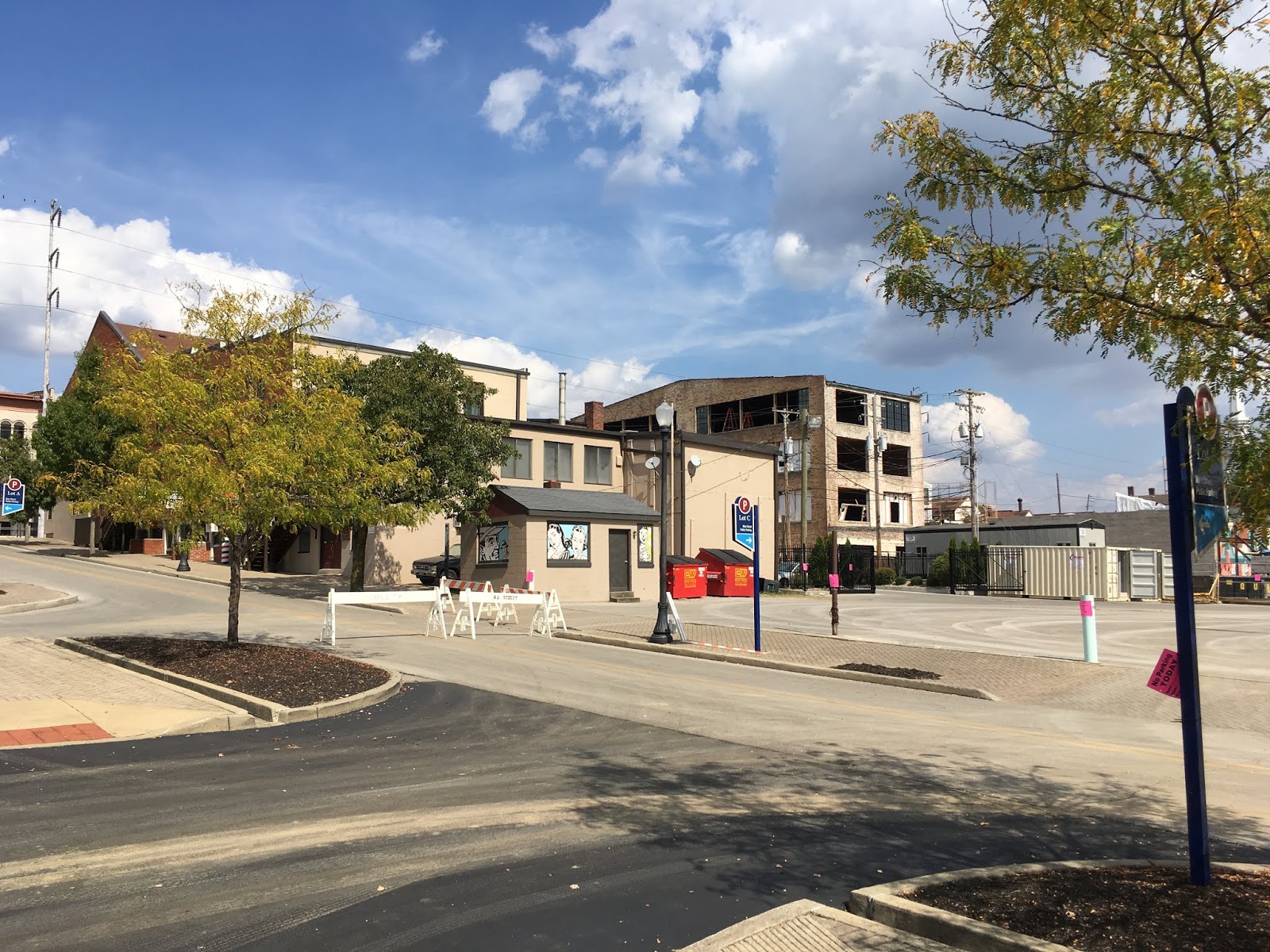

I can hear the whining of Gahan's minions: Can't people just walk? As if a single one of the privileged time-servers grasped what walkability really means amidst their incessant car-centric "improvements."

Or, walk -- like all those people did, past an entire blocked block of Market last weekend, to behold barbecue they couldn't purchase, from a landscape that resembled a KOA campground.

Shouldn't the Board of Works be helping small businesses to remain in business?

Or do we take Gahanism to its logical conclusion and begin tithing donations to Gahan to protect us from Gahan?

I'll be updating this story as merited.

Monday, January 14, 2019

HWC dissolves into laughter: "For a More Walkable City, Replace Signals with All-Way Stops."


Randy at Destinations Booksellers can get you a copy of Jeff Speck's Walkable City Rules. Mine's waiting to be picked up when I get a minute. Gahan administration functionaries are encouraged to read the book and see how their master failed the city with his botched two-way "modernization"; for them, ordering on-line with a plain brown snail-mail wrapper might be the best course. Dear Leader would be very unhappy if he caught them thinking on the job, wouldn't he?

---

For a More Walkable City, Replace Signals with All-Way Stops, by Jeff Speck (Streetsblog USA)

Rule 76: Replace Signals with All-way Stops
In many places, stop signs are the safest solution.

For many years, cities inserted traffic signals at their intersections as a matter of pride, with the sentiment that more signals made a place more modern and cosmopolitan. Recently, that dynamic has begun to change, as concerns about road safety have caused many to question whether signals are the best solution for intersections experiencing moderate traffic.

Research now suggests that all-way stop signs, which ask motorists to approach each intersection as a negotiation, turn out to be much safer than signals.

This greater safety has multiple causes. Unlike with signals, no law-abiding driver ever passes an all-way stop sign at more than a very low speed, and there is considerable eye contact among users. People walking and biking are generally waved through first. And nobody tries to beat the light.

While it would be useful to have more data, the main study on this subject, from Philadelphia, is compelling. It recounts the 1978 removal of 462 traffic signals due to a 1977 state ruling disallowing signals at intersections with limited traffic. In almost all cases, the signals were replaced by all-way stop signs. The overall reduction in crashes was 24 percent. Severe injury crashes were reduced 62.5 percent. Severe pedestrian injury crashes were reduced by 68 percent.

While some pedestrians and drivers prefer signalized intersections, these data are too conclusive to ignore. Until a contradicting study is completed, cities should be compelled to conduct an audit of current signalization regimes to determine which signals may be eliminated.

When converting signals to stop signs, cities face the choice of two-way and all-way stops. Clearly, if one street contains tremendously more traffic than the other, a two-way stop makes more sense. However, there is no doubt that all-way stops should be used wherever they do not pose an undue burden, as they are 50 percent to 80 percent safer than two-ways.

Additionally, two-way stops hurt walkability, as they require people crossing the major street to dodge traffic. For this reason, it seems wise to leave signals in place in locations where an all-way stop is not justified.

One great byproduct of converting signals to stops is money saved: stop signs are much cheaper to install and maintain than signals. This fact is important to keep in mind as one considers the conversion of a downtown’s streets from one-way to two-way. The principal cost of these reversions is signal reorientation. However, while signals are almost always required where multilane one-ways intersect, they are often not required where two-lane two-ways intersect. Moreover, when two-lane two-ways cross at a four-way stop sign, there is often no need or use for left-turn lanes, and that pavement can be used instead for parking or cycling.

A word is also needed about the driver experience that accompanies the replacement of signals with all-way stops. It is true that, compared to a network of signals, a network of stops signs result in a drive that is interrupted by more pauses. But these pauses are all quite brief.

Never does the driver have to sit and wait for a light to turn from red to green. Such waits at signalized intersections are often 30 seconds long or longer, and, across a network, can add up to a lot of time wasted. Surprisingly, more stops can mean a quicker commute.

Finally, some air-quality advocates will argue against new stop signs due to the additional pollution caused by cars stopping and starting. This argument is accurate, but only in isolation, ignoring the smaller carbon footprint of more walkable places. As stop signs make places safer to walk, they can be expected to reduce overall driving, countering this impact.

There is no reason to conduct an expensive study on this subject. For each intersection with traffic that is moderate and fairly balanced, conduct a one-week test of an all-way stop configuration. If problems don’t arise, make it permanent.

Monday, June 20, 2016

A contrarian asks: Should there even be "walk" signals for pedestrians?


Here's another way of looking at how best to walk across the street.

In a four-part opinion piece at GreaterGreaterWashington.org, Ben Ross considers signals and crosswalks, and argues on behalf of the principle that "negotiating the use of shared space makes roads safer."

Utopian or practical? You be the judge. Here are links to the four parts, each with a brief teaser.

---

Part 1. Careful jaywalking saves lives


Pedestrians put themselves in danger if they wait for a walk signal instead of crossing the street whenever and wherever it looks safest. There are no definitive studies, but that is what available evidence strongly suggests ...

... Drivers hit pedestrians when turning more often than when they are driving straight ahead. At a red light, drivers who are about to turn wait alongside pedestrians. The changing signal sends both into the intersection at the same time—maximizing the opportunities for collisions.

---

Part 2. Walk signals are bad for walking


Many pedestrians think the walk-don't walk light helps by letting them know when it's safe to cross the street. But its actual effect is to curtail the right to make that crossing.

---

Part 3. Timing signals to work for pedestrians is impossible


It is possible, as New York and a few other cities have shown, for complex signals to make walking easier. Pedestrians get a few seconds to enter a crosswalk before cars can turn. Or turns are banned while people are crossing. But if you try to orchestrate movement on foot in this way at every streetcorner, the traffic engineers' job becomes entirely unmanageable. They cannot possibly find the time to adjust every walk signal for the proper balance between walking and driving.

---

Part 4. To make streets walkable, empower pedestrians to cross anywhere


As the previous posts in this series have shown, these simpler streets would be far safer. They could operate with only limited changes in the rules of the road. Drivers would follow traffic signals as they do today—pedestrians would have the right of way when they cross on green, but yield to drivers when the light is against them. The rule for crosswalks with no signal would not change at all; those on foot would still have the right of way at all times. Elsewhere, foot crossings would be allowed at any location, but pedestrians would have to yield.

Friday, March 11, 2016

Why does America hate roundabouts, when they're the antidote to “fascist, robotic traffic lights"?


As the current Republican presidential primary attests, perhaps it's because we prefer fascistic robots.


Why Does America Hate Roundabouts?,by John Metcalfe (City Lab)

Maps and data visualizations show the U.S. trailing much of the world when it comes to traffic circles.

Some argue the primitive roots of the roundabout actually grew in the U.S. “It’s widely accepted that William Phelps Eno was the bright spark who first devised the idea of a one-way rotary system in 1903, for Columbus Circle, New York City, USA,” asserts the U.K. Roundabout Appreciation Society, an organization rabidly opposed to “fascist, robotic traffic lights.” So why has the country fallen so far behind in deployment, given roundabouts’ elegant simplicity and proven safety benefits?

There are a lot of possible answers, says Lee Rodegerdts, an international roundabout expert (yes, they exist) at the Portland transportation-engineering and planning group Kittelson & Associates.

“My guess is that the possible benefit of roundabouts wasn’t widely known, and we had a long history of using traffic signals,” he says. “It took some bold people—both on the elected-official side and on the transportation-professional side—to get the first ones installed, and they deserve a lot of credit for sticking their necks out there. This boldness had to be repeated a lot around the U.S. during the [first] decade or two, given the skepticism of: ‘Well, that might work there, but it won’t work here.’”

Wednesday, January 25, 2012

Non-recusals, Wendy's, 2009, The Gary, a roadway and lessons never learned.

Readers with long memories (they are to be pitied, in a way) will recall it starting back in spring of 2009, when The Gary (McCartin) wanted to turn a green space into non-permeable asphalt by moving the Wendy's from a regrettably expanding old-school suburban doughnut hole to a spanking new exurban location on Charlestown Road by the rockin' Interstate, where the Hummers and private autos roam.

The plan snaked its way through the scores and snores of various bureaucratic channels and came to rest in city council packets, where it devolved into an epic, multi-meeting struggle between the adjacent neighborhood and The Gary's Krafty John.

Live blogging 4: Council votes on The Gary's Wendy's fetish.

Jaws drop as Messer, Coffey execute simultaneous 180-degree flip-flops, killing Wendy's ... for now?

Okay, I'll say it: Messer and Coffey unite to promote cynicism in Wendy's flip-flop.

Ah, the humanity ... or lack thereof.

There was a first council reading, and then a second and third, both occurring with the council short one member; afterwards, the then-council attorney Stan Robison dramatically reversed the finality of those 4-4 ties, and so fourth and fifth readings were scheduled and recorded. After the Messer/Coffey flip-flops finally came to rest, The Gary had been ingloriously defeated, and he stormed away in a pique, muttering about never doing anything for this ungrateful community, ever again -- a promise we piously hope he's keeping.

Except that he had the last Wendy's laugh: A few months later, all was moot when McCartin found a convenient zoning-supported spot nearby to make the community even fatter then before from heart-healthy burger grease.

All of this came back to me today when I noticed in the newspaper that the final resting place of Wendy's on Charlestown Road had so altered the traffic dynamic that the Board of Public Works and Safety had been compelled to consider changes to the roadway.

New signal in design for Charlestown Road; Light would be adjacent to new Wendy’s (Suddeath; OSIN)


New Albany City Council President Diane McCartin-Benedetti said Sam’s ownership needed to be alerted of the plan, though the board of works would still have to approve the actual installation of the signal.


That'd be the CeeSaw-coup-mandated council president Benedetti, also a council delegate to Redevelopment, now graciously helping to broker a traffic solution, and the knowledge of this reminded me of something else about that legendary 2009 council clash, as framed by the inimitable Bob Dusch during public comments about the Wendy's move.

Live blogging: City council meeting of March 19, 2009.


Bob Dusch - (It's an) "end run" to develop commercially. Explains that zoning laws exist to protect property owners. Waste of neighborhood and council time. "We will have been sold out for a hamburger joint ... Wendy's isn't even owned locally." Mrs. Benedetti is now singled out. She ran as Diane MCCARTIN Benedetti. How can she vote on bro's project? (Even the) Tribune pointed out the seeming conflict of interest ... "appearance is important."

Benedetti responds: Yes I ran on that basis. I have no capital gain. Voted him down before. I did my research (she gets very hysterical) ... wants to make "solutions not problems." Doesn't have an e-mail address because "I don't want people e-mailing me ... I want them calling me." Now says that brother and the others have actually spoken with Bob. She now gestures to the crowd like Steve Price always does. Now she denigrates downtown New Albany as comparison. She cherishes the exurb. BIG BIG time grandstanding. BIG BIG time grandstanding. No capital gain, no conflict of interest.

New Albany stories typically don't have morals, because for there to be a moral, it is necessary for there to be a lasting lesson. So, I'll stop here.

Thursday, February 11, 2010

City says: "Traffic signal modernization project underway in New Albany."

I was wondering about all the "construction" signs that went up just before Tuesday's snowfall. The city's official press release explains all -- well, almost all. Are the signals for one-way or two-way traffic?

---

Traffic signal modernization project underway in New Albany

A traffic signal modernization project set to improve six downtown signals at little-to-no cost to local taxpayers began this week, Mayor Doug England announced.


The project involves the replacement of existing mast arms, controllers, signal indications for both vehicular and pedestrian traffic and the installation of new vehicle detection at the following intersections:

• E. Market St. at Pearl St.
• E. Market St. at Bank St.
• E. Market St. at E. Seventh St.
• E. Spring St. at Pearl St.
• E. Spring St. at Bank St.
• E. Spring St. and E. Seventh St.

Other notable improvements:

• The detection system will now be wireless, eliminating issues typical to wired loop systems within the pavement.
• Pedestrian signal indications will visibly display the amount of crossing time remaining.
• New controllers and antennae will be installed where State St. intersects E. Market and E. Spring Streets to create a coordinated signal system.
• Signal heads will use LED lights, which are brighter, last longer and are more energy-efficient.

The project was let by the Indiana Department of Transportation on Nov. 18, 2009. Michiana Contracting, Inc. was awarded the project with a bid of $539,904.33.

Construction funding is 100-percent federal-aid through the American Recovery and Reinvestment Act of 2009. Engineering fees were funded locally through tax-increment financing. The job is expected to be complete at the end of June 2010.

A similar project is slated to soon begin at the intersection of E. Elm and Pearl Streets, which will incorporate the intersections of E. Elm and Pearl and State Streets and Scribner Dr. in the coordinated system.