Showing posts with label Joseph Goebbels. Show all posts

Thursday, June 04, 2020

Hilter Skilter, Béarnaise, Gwobbles and the origins of propaganda in American-style capitalism.


Reading this thread at Joe Dunman's Twitter account led me to a feeling of déjà vu.
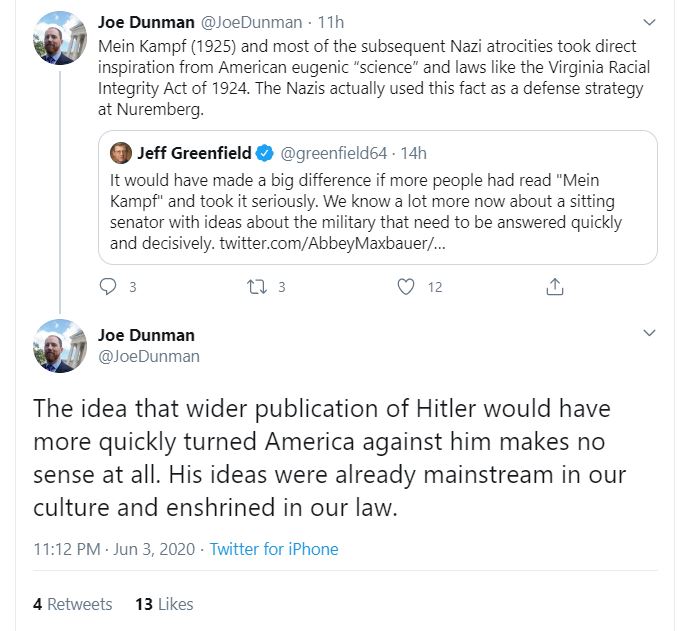

As it turns out, almost exactly three years ago in this space, I took to the airwaves to correct an error about the career of Joseph Goebbels.

---

That's right; I was wrong. Goebbels got his ideas for propaganda from American advertising, not the other way around.

June 5, 2017

Recently I posted this on social media.

I'm eternally amazed by chain restaurant envy, which always seemed to me an inevitable result of Goebbels-scale national advertising and perception of price point (the latter is skewed, but real enough in many cases). But is it cultural, too? I don't know the answer, but is it a fair question?

Among the responses was this.

Using the Goebbels example is just histrionic.

I replied:

I don't think so. It's the basis of saturation advertising, in the sense of constant repetition. We're exposed to ads every day, hundreds and maybe thousands of times. I believe numerous studies have been devoted to the ongoing subliminal effects even when we think we're tuning it out. Goebbels preached these very qualities in his propaganda dissemination.

In essence, I was arguing that from the techniques of Goebbels, post-war capitalism derived its operational handbook for mass marketing.

I was mistaken.

In fact, Goebbels found inspiration for his propaganda techniques in pre-war capitalism. Big lies and mass-marketing in the service of profit made Goebbels, and not the other way around.

Meet Edward Bernays. You'll want to click through and read the entire essay.

The manipulation of the American mind: Edward Bernays and the birth of public relations, by Richard Gunderman (The Conversation)

“The most interesting man in the world.” “Reach out and touch someone.” “Finger-lickin’ good.” Such advertising slogans have become fixtures of American culture, and each year millions now tune into the Super Bowl as much for the ads as for the football.

While no single person can claim exclusive credit for the ascendancy of advertising in American life, no one deserves credit more than a man most of us have never heard of: Edward Bernays ... often referred to as “the father of public relations,” Bernays in 1928 published his seminal work, Propaganda, in which he argued that public relations is not a gimmick but a necessity:

The conscious and intelligent manipulation of the organized habits and opinions of the masses is an important element in democratic society. Those who manipulate this unseen mechanism of society constitute an invisible government which is the true ruling power of our country. We are governed, our minds are molded, our tastes formed, and our ideas suggested, largely by men we have never heard of ... It is they who pull the wires that control the public mind.

It turns out that Bernays had an international readership.

Bernays’ ideas sold a lot more than cigarettes and Dixie cups.

Even though Bernays saw the power of propaganda during war and used it to sell products during peacetime, he couldn’t have imagined that his writings on public relations would become a tool of the Third Reich.

In the 1920s, Joseph Goebbels became an avid admirer of Bernays and his writings – despite the fact that Bernays was a Jew. When Goebbels became the minister of propaganda for the Third Reich, he sought to exploit Bernays’ ideas to the fullest extent possible. For example, he created a “Fuhrer cult” around Adolph Hitler.

In 2017, we're exposed to advertising (or marketing, or branding) cues thousands of time each day. Whether overt or subliminal, these messages influence actions we blithely regard as "free."

But are they?

Goebbels may have been less concerned with profits, though the result is largely the same.

Its underlying purpose, in large part, is to make money. By convincing people that they want something they do not need, Bernays sought to turn citizens and neighbors into consumers who use their purchasing power to propel themselves down the road to happiness.

Without a moral compass, however, such a transformation promotes a patronizing and ultimately cynical view of human nature and human possibilities, one as likely to destroy lives as to build them up.

Another Bernays citation is here.

He disseminated propaganda for the Government during World War I and tried to brighten Calvin Coolidge's dour image during the 1924 campaign by importing Al Jolson and 40 other Broadway performers to the White House. A master at concealing base drives behind exalted rhetoric, Bernays in 1928 provided this defense of political work: ''Intelligent men must realize that propaganda is the modern instrument by which they can fight for productive ends and help to bring order out of chaos.'' As if to mock this rosy view, Joseph Goebbels became an attentive student of Bernays's theories five years later.

And another.

It is known that Goebbels studied the way advertising companies worked in America. A great deal of his written work was made up of short sentences – as the above indicate. Everything was kept simple so that there could be no misunderstanding as to its meaning.

Finally, this.

Goebbels “took his cue from the model of commercial advertising”.

For Goebbels, “commercial advertising was overtly cited as the model to follow. Whether it was a matter of simplification, constant repetition of memorable slogans, or concentration of propaganda material in regular campaigns, the principles of mass advertising could easily be applied to political propaganda.”

Strictly speaking, I was mistaken to assert that mass-market, saturation advertising for McDonald's, Budweiser or Ford derived from Goebbels.

Under the circumstances, I'm perfectly happy to concede my error.

Wednesday, June 26, 2019

Hilter Skilter: Here's the sum total of Facebook's non-explanation for censoring me last week.


It was Gwobbels whodunnit: Greetings from Facebook gaol, where I'm serving a sentence for being historically accurate.


Exactly how did my mention of the propaganda minister's family name violate Facebook's exceedingly vague "community standards"?

Cuz Big Brother Zuckerberg says so. In the absence of human contact, that's the best explanation I can find.

This article from March from Forbes goes further toward explaining why the mere mention of Goebbels merited intervention than anything Facebook has said to me, or intends to say.

Last month, a Los Angeles Times investigation uncovered that "despite promises of greater oversight... Facebook has continued to allow advertisers to target hundreds of thousands of users the social media firm believes are curious about topics such as 'Joseph Goebbels', 'Josef Mengele', 'Heinrich Himmler', the neo-nazi punk band Skrewdriver and Benito Mussolini’s long-defunct National Fascist Party."

Whatever. I'm a socialist, not a fascist, and I'm unrepentant. A big lie's still a big lie, eh? And when Jeff Gahan claims to be a street safety savior and Jeff Speck agrees, then that's a great big lie even by Gwobbles's standards.

Friday, June 21, 2019

It was Gwobbles whodunnit: Greetings from Facebook gaol, where I'm serving a sentence for being historically accurate.


Yes, I understand that Facebook belatedly seeks to cleanse its wretched image after criticism over all manner of contemporary "Nazis" using the social media platform.

Just as obviously the robotic algorithm can't begin to detect creative sarcasm from a socialist like me who wouldn't be deploying an historical reference to the likes of a real-life individual if it weren't valuable as a means of heaping scorn on truth-challenged dullards like the reigning mayor.

It's hard to decide what I enjoy most about the process of Facebook's censorship in this instance. It might be the "guilty until proven innocent" default, or the purported proviso promising the opportunity to explain but provides no way to do so apart from telepathy.

Sans any semblance of due process, I'm also blocked from participation in separate pages where I serve as an administrator. I can imagine instances where such a guilt-by-affiliation ban would interfere with one's ability to perform his or her paying job, all the while without a pathway to communicate with a human at Facebook and come to an understanding about the idiocy.

At least it's a good learning opportunity for my long-lost cousin Regor to lend a helping hand.


Unfortunately, Regor can't post at NA Confidential on Facebook. Bluegill, if you're reading, can I ask a small favor?

As usual, there is plenty of irony herein. After all, Joseph Goebbels developed his "big lie" theory of totalitarian propaganda under the influence of the American advertising industry and its techniques.

It's a fact that cannot be erased, no matter how hard you try, and in today's world we seem intent on scrubbing unpleasantness rather than taking the time to explain to people why Goebbels was an enabler of atrocities against mankind. That's just Disney escapism, isn't it?

---

Monday note, June 24

For the entire 72-hour duration of my imprisonment, which ended at 7:00 p.m. on the 23rd, the "support" box at Fb continued to indicate that the post in question was under "review." Obviously at this point it's irrelevant to be found not guilty given the sentence having already been served.

Interestingly, with no means of communicating with actual humans throughout this annoying period, I did locate a "additional thoughts" comment box last Friday evening and duly added this:

I used the name of Joseph Goebbels, a real-life figure from history, as an ironic reference to the propensity of local politicians in my town to emit "big lies." I did not use Goebbels' name as a glorification of neo-Nazism, which would be impossible given that I'm a Social Democrat. It's idiotic to scrub Goebbels' name in this fashion given that I'm an educated individual perfectly able to explain the former propaganda minister's atrocities against humankind. Your algorithm obviously is resistant to sarcasm, and at this moment you're making it difficult for me to do my job because I can't post on group pages that bear no relevance to my personal page. This is all unnecessary and annoying, and while I realize there will be no apology forthcoming from the robot who controls this process, can you please remove the block sooner rather than later so I can return to my life? Thank you.

When I pressed "send," this was the result, one that summarizes the Facebook malignancy.


Yep. Due process, indeed.

Saturday, July 01, 2017

Goebbels, Baarová and Hitler: "Those who make history do not have the right to a private life."


I'm not sure what suddenly made me think of Josef Goebbels and Lida Baarová, perhaps some sort of free association that afflicts history buffs.

The story of Goebbels' affair with Baarová is well-known, but I'm still fascinated to learn that even in 1938 it was front page news in the Chicago Tribune.

When the Czech actress Lida Baarová, who has died aged 86, first went to Berlin in 1934 and began mixing with leading Nazis, she felt as if she was in heaven. The regrets came later. Six decades on she told me of the offers to go to Hollywood, which she had turned down. If she had got out of the clutches of the Nazis, she observed, she could have been as famous as Marlene Dietrich.

Perhaps. But at the time she basked in the attention she received from Adolf Hitler's followers, particularly his propaganda minister, Josef Goebbels. She will be best remembered for the affair she had with him, which threatened his career, rather than for her acting.

Up to a point, Goebbels' incessant womanizing was of no concern to Hitler, even when involving an "inferior" Slav like Baarová. However, things changed when Goebbels threatened to become a living refutation of Nazi "family values" propaganda. Hitler was compelled to act.

A year later, Goebbels’ infatuation pushed matters to a head. While Magda Goebbels had appeared willing to accept Baarová as a mistress, one of a series of Goebbels’ actress flings, he was now asking for divorce and was apparently willing to give up his top Nazi post and leave Germany to be with his lover. He apparently suggested a post as ambassador to far away Japan.

Goebbels’ bid for a divorce and offer of resignation prompted a furious intervention from Hitler. He rejected both requests and told his minister that those who made history did not have the right to a private life. He forced Goebbels to promise he would never see Baarová again– a promise he kept. In a final telephone call Goebbels told Baarová that he loved her.

Just about everything we know about Hitler as an obsessive crackpot supports the idea that he'd feel exactly this way: "Those who make history do not have the right to a private life."

Of course, many of us would say that the private lives of public officials have nothing at all to do with politics. What did Bill and Monica have to do with the Clinton administration's ruinous tilt toward neoliberalism?

And yet it's entirely likely, as with Hitler's intervention to separate the parties involved in Goebbels' love life, that similar personnel decisions (reshufflings, appointments, terminations) with wider ramifications often are taken for petty reasons pertaining to private lives.

A boss might not be able to fire underlings having a fling, but he or she might reassign the parties to different areas of the company. And, speaking of terminations, not every divorced couple can continue working near each other.

Isn't Fleetwood Mac the exception that proves the rule?

Now we happily return to our regular Goebbels programming, though not before we ask:

What would have happened in WWII if Goebbels would have been with Baarová in Japan?

That's right; I was wrong. Goebbels got his ideas for propaganda from American advertising, not the other way around.


It can't happen here: A timely documentary film about Nazi "propaganda mastermind" Joseph Goebbels.

Monday, June 05, 2017

That's right; I was wrong. Goebbels got his ideas for propaganda from American advertising, not the other way around.


Recently I posted this on social media.

I'm eternally amazed by chain restaurant envy, which always seemed to me an inevitable result of Goebbels-scale national advertising and perception of price point (the latter is skewed, but real enough in many cases). But is it cultural, too? I don't know the answer, but is it a fair question?

Among the responses was this.

Using the Goebbels example is just histrionic.

I replied:

I don't think so. It's the basis of saturation advertising, in the sense of constant repetition. We're exposed to ads every day, hundreds and maybe thousands of times. I believe numerous studies have been devoted to the ongoing subliminal effects even when we think we're tuning it out. Goebbels preached these very qualities in his propaganda dissemination.

In essence, I was arguing that from the techniques of Goebbels, post-war capitalism derived its operational handbook for mass marketing.

I was mistaken.

In fact, Goebbels found inspiration for his propaganda techniques in pre-war capitalism. Big lies and mass-marketing in the service of profit made Goebbels, and not the other way around.

Meet Edward Bernays. You'll want to click through and read the entire essay.

The manipulation of the American mind: Edward Bernays and the birth of public relations, by Richard Gunderman (The Conversation)

“The most interesting man in the world.” “Reach out and touch someone.” “Finger-lickin’ good.” Such advertising slogans have become fixtures of American culture, and each year millions now tune into the Super Bowl as much for the ads as for the football.

While no single person can claim exclusive credit for the ascendancy of advertising in American life, no one deserves credit more than a man most of us have never heard of: Edward Bernays ... often referred to as “the father of public relations,” Bernays in 1928 published his seminal work, Propaganda, in which he argued that public relations is not a gimmick but a necessity:

The conscious and intelligent manipulation of the organized habits and opinions of the masses is an important element in democratic society. Those who manipulate this unseen mechanism of society constitute an invisible government which is the true ruling power of our country. We are governed, our minds are molded, our tastes formed, and our ideas suggested, largely by men we have never heard of ... It is they who pull the wires that control the public mind.

It turns out that Bernays had an international readership.

Bernays’ ideas sold a lot more than cigarettes and Dixie cups.

Even though Bernays saw the power of propaganda during war and used it to sell products during peacetime, he couldn’t have imagined that his writings on public relations would become a tool of the Third Reich.

In the 1920s, Joseph Goebbels became an avid admirer of Bernays and his writings – despite the fact that Bernays was a Jew. When Goebbels became the minister of propaganda for the Third Reich, he sought to exploit Bernays’ ideas to the fullest extent possible. For example, he created a “Fuhrer cult” around Adolph Hitler.

In 2017, we're exposed to advertising (or marketing, or branding) cues thousands of time each day. Whether overt or subliminal, these messages influence actions we blithely regard as "free."

But are they?

Goebbels may have been less concerned with profits, though the result is largely the same.

Its underlying purpose, in large part, is to make money. By convincing people that they want something they do not need, Bernays sought to turn citizens and neighbors into consumers who use their purchasing power to propel themselves down the road to happiness.

Without a moral compass, however, such a transformation promotes a patronizing and ultimately cynical view of human nature and human possibilities, one as likely to destroy lives as to build them up.

Another Bernays citation is here.

He disseminated propaganda for the Government during World War I and tried to brighten Calvin Coolidge's dour image during the 1924 campaign by importing Al Jolson and 40 other Broadway performers to the White House. A master at concealing base drives behind exalted rhetoric, Bernays in 1928 provided this defense of political work: ''Intelligent men must realize that propaganda is the modern instrument by which they can fight for productive ends and help to bring order out of chaos.'' As if to mock this rosy view, Joseph Goebbels became an attentive student of Bernays's theories five years later.

And another.

It is known that Goebbels studied the way advertising companies worked in America. A great deal of his written work was made up of short sentences – as the above indicate. Everything was kept simple so that there could be no misunderstanding as to its meaning.

Finally, this.

Goebbels “took his cue from the model of commercial advertising”.

For Goebbels, “commercial advertising was overtly cited as the model to follow. Whether it was a matter of simplification, constant repetition of memorable slogans, or concentration of propaganda material in regular campaigns, the principles of mass advertising could easily be applied to political propaganda.”

Strictly speaking, I was mistaken to assert that mass-market, saturation advertising for McDonald's, Budweiser or Ford derived from Goebbels.

Under the circumstances, I'm perfectly happy to concede my error.

Sunday, December 18, 2016

It can't happen here: A timely documentary film about Nazi "propaganda mastermind" Joseph Goebbels.


“She was not an avid Nazi. She just didn’t care and looked away. That’s what I think makes her guilty.”
-- Florian Weigensamer, co-director of A German Life (2016), the story of Joseph Goebbels' 105-year-old personal secretary Brunhilde Pomsel, one of the last surviving witnesses to the Nazi regime's Berlin end game in 1945.

---

My father raised me on tales of World War II, during which he found himself in the Pacific Theater for three years. Perhaps because of this experience, his major subsequent interest was with wartime events occurring in Europe, a place he never saw.

My own obsessions were different: Europe and World War I prior to my father's war, and the Cold War after it. I'm not even sure there was such a thing as World War II. To me, an 80-year war began in 1912 in the Balkans and ended (maybe) in the 1990s, when the Yugoslav civil war finally cooled.

Still, on occasion I'm prone to his generation's fascination with Hitler and all things Nazi, and it's strange to have missed The Goebbels Experiment (2005) until now.

This highly recommended documentary's narration is drawn entirely from the diaries of Goebbels, so if you're unfamiliar with his life and career, a refresher might be in order.

From the Revealing Journals of a Propaganda Mastermind, by Jeannette Catsoulis (New York Times)

... At a time when much of our news and entertainment media is controlled by a handful of corporations, "The Goebbels Experiment" is a cautionary reminder that equal access to the machinery of ideas may be society's most critical goal.