Wednesday, September 16, 2015

If the ORBP is bringing "$87 billion into the region over the next 30 years," then why are we paying tolls to use them?

One is compelled to be fair, and so I must recognize this article for capturing some of the most stirring examples of Usual Suspects Boondoggle Speak yet recorded.

I'll merely note that auto-centrism is cancer, and leave it at that.

Ohio River bridges hailed as economic leader in infrastructure projects, by Elizabeth Beilman (News and Tribune)

... United States Deputy Secretary of Transportation Victor Mendez on Tuesday called the Ohio River Bridges Project a "perfect example of what is needed throughout this country."

" ... At the end of the day, we all go home, and we go home to our community," Mendez said at a news conference at Waterfront Park in Louisville. "And that's what this [project] is all about — improving our communities from an economic standpoint and really just from a quality of life standpoint."

Tuesday, September 15, 2015

Feeling the Bern in Lynchburg, and not missing Jerry one bit.

The late Rev. Jerry Falwell, founder of Liberty University, blamed "civil libertarians, feminists, homosexuals, and abortion rights supporters for the terrorist attacks of Tuesday, September 11, 2001."

And, I know that I'll hear from them for this. But, throwing God out successfully with the help of the federal court system, throwing God out of the public square, out of the schools. The abortionists have got to bear some burden for this because God will not be mocked. And when we destroy 40 million little innocent babies, we make God mad. I really believe that the pagans, and the abortionists, and the feminists, and the gays and the lesbians who are actively trying to make that an alternative lifestyle, the ACLU, People for the American Way -- all of them who have tried to secularize America -- I point the finger in their face and say, "You helped this happen."

Yes, and Bernie Sanders went to Lynchburg. Conceding that I'm a pagan and a heretic, still, what is it with evangelicals and their adoration of the 1%?

Bernie in the Lion’s Den: The socialist senator from Vermont wasn’t exactly eaten alive at Jerry Falwell’s Liberty University in Lynchburg, by D.D. Guttenplan (The Nation)

... But if his attacks on corporate greed, inequality, and the excessive power of the 1 percent mostly fell on stony soil—afterward a young woman told me “those people had to work hard to make that money” and that poor people “were part of God’s plan”—Sanders did find some common ground with his audience. When he said that racism was part of America’s past, but that today racism, racial discrimination, and racist attacks on foreigners or immigrants were “completely unacceptable in America,” the audience cheered.

Caption contest: There's just nothing to watch on TV.


Yes, I know.

I didn't declare a winner last time.

Let's give this illustration a brand new caption.


There were plenty of page views, but only two entries. I may have a couple of good ones for the image above, which I photographed earlier today after almost tripping over the TV.

"Man Gets Ticket For Not Riding In Bike Lane, Films Himself Crashing Into Things In Bike Lanes."


An old one, but a good one.

This guy tried to explain to the cops that he had to leave the bike lane for valid reasons but they did not want to listen and issued him with a $50 fine.  He made a little movie about riding his bike in the bike lane and this is the result.
Credits: CaseyNeistat and TrueActivist.com.

Monday, September 14, 2015

Rosenbarger's plaque, Gahan's yard sign, ethical quagmires, and the urgent need for deep cleansing in City Hall.


We're still not exactly sure how much the .8-mile-long Main Street "Improvement" Project cost, but whether $3 million, $4 million or probably more, it was intended (among other aims, most of them far more dubious) to improve the value of property on Main Street, at the request of a handful of residents, and to the exclusion of properties on the remainder of the streets in the city.

John Rosenbarger administered the project.

He lives on Main Street.

He will benefit from it.

He now has a Gahan sign in his yard.


We snicker at corruption in other countries, and throw around terms like "banana republic" and "kleptocracy" ...

Kleptocracy, alternatively cleptocracy or kleptarchy, (from Greek: κλέπτης - kleptēs, "thief" and κράτος - kratos, "power, rule", hence "rule by thieves") is a term applied to a government seen as having a particularly severe and systemic problem with officials or a ruling class (collectively, kleptocrats) taking advantage of corruption to extend their personal wealth and political power. Typically this system involves the embezzlement of state funds at the expense of the wider population, sometimes without even the pretense of honest service.

... but maybe we should refrain -- particularly those in the camp of the mayor who has rendered such notions so very close to home.

After all, given the immediate need for deep cleansing in City Hall, we wouldn't want to insult the world's kleptocrats, would we?

The more you ignore me, the closer I get.


It's stressful, isn't it?

You're a piece of something that's suddenly up for grabs, and while your advantages are many, nothing about the process is assured.

Still, I don't take your boorish behavior personally, because I know that unlike me, you've no idea how to express yourselves, save through transfers of taxpayer-sourced cash.

I'm a writer; you're a racket.

So it goes, but there's one thing about this whole process that you need to remember, because it's really important: It isn't fate, and it's no accident.

You've put yourselves in this position.

Things fall apart owing to hubris -- excessive pride, and a detachment from reality. It's why bunkers aren't the best places to conduct any kind of business.

Moreover, I'm quite content to be painted the pariah. It's a role I've prepared to play for decades, and to be honest, I fairly revel in it.

Your junior high school antics amuse me, and so I'll contentedly work my side of the street and let the proverbial chips fall, right on down, where they will.

We'll all have different jobs soon, and you'll make lots more money in the "private" sector, but here's the thing: You still won't get it, and that's YOUR burden, not mine ... because I do.

Cheers, guys. See you in the funny papers.

(photo credit ... The Telegraph)

Let's try to make "walking American again."

If we designed ourselves into this box, we can redesign ourselves out of it. What must come first is an overt, open state of intent: This WILL be a walkable (and bikeable) city, and here's how we are going to proceed toward the goalposts.

The government is trying to make walking American again, by Emily Badger (Washington Post)

The U.S. Surgeon General on Wednesday proposed a radical idea wrapped in a banal government document, a 72-page "call to action" with 359 tiny-font references: Americans, Vivek Murthy said, should walk more.

We should walk to the grocery store, and to school, and to the bus stop. We should take "walking meetings" at the office and spend more time walking in parks. And, because nearly a third of American adults report living in a neighborhood without a single sidewalk, we should rethink how we design communities so that it's actually possible to walk them.

Maybe this sounds like obvious advice, a health tip right up there with admonitions to eat right and wear sunblock. But for much of the last century, the federal government has backed a different idea — cars running on cheap fuel and fast asphalt should carry us everywhere — that has largely proved incompatible with walking.

Sunday, September 13, 2015

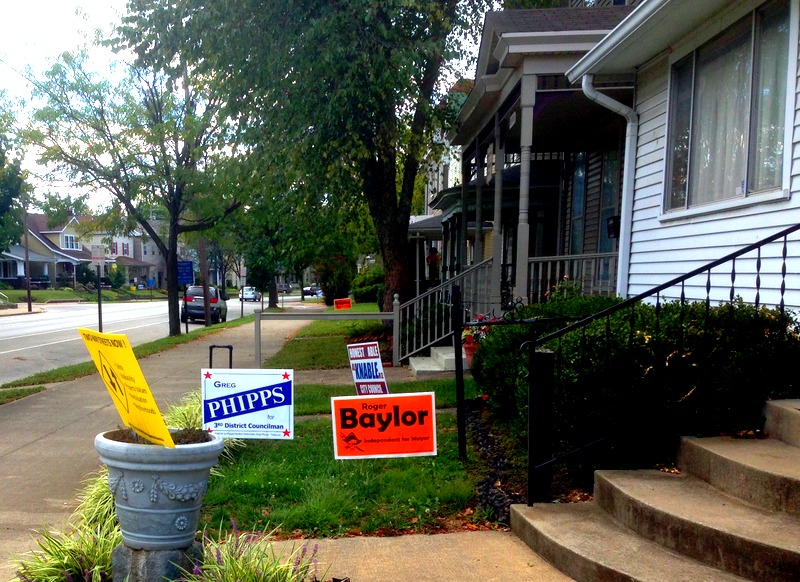
Campaign Diary, Chapter 6: Matching ensembles in the 3rd, psychologically speaking.


First, thanks to the New Albanians who've supported the Baylor for Mayor campaign thus far, whether with grassroots testimony, the wearing of t-shirts, planting signs or kicking a few dollars into the jar. Every little bit helps, and I appreciate it. I've heard from voters in every district who agree that by emphasizing transparency, infrastructure and empowerment, we can TIE the city together.


In this periodic installment of the campaign diary, permit me to narrow the focus to my own neighborhood, and observe that there is a psychology to the political yard sign.

Given that I've publicly disagreed on occasion with my 3rd district councilman Greg Phipps' partisan votes with the current administration, I still believe that on balance, our views with regard to what's fundamentally best for New Albany's neighborhoods are in accordance: Ordinance enforcement, rental property registration, safe and functional two-way streets, human rights, and support for level playing fields and the rule of law.


I've advocated and fought for these (and other) ideas, and so has he. I believe in our own district, neighbors asking for one of my signs, and placing it next to one of Greg's signs, shows that they see the similarities more than the differences -- and grasp the reality of the incumbent mayor's abject failure to govern in the best interest of the neighborhood. Jeff Gahan's instincts are suburban, not urban, and virtually all the areas inside the beltway can benefit from greater urbanism, not less.


I'm restricting the analogy to my own backyard merely to suggest that the odd man out in this instance is the current mayor. Look at the positions, platforms and policies. It's a secret ballot, and we all have the opportunity to vote our consciences.

Thanks.

Trump, Obama and the enduring lure of "populist nationalism."

It's worth it for the Voltaire quote, which I haven't seen for many a moon.

Trump and Obama: A Night to Remember, by Adam Gopnik (The New Yorker)

Once, and only once, in 2011, have I attended the annual White House Correspondents’ Association dinner in Washington, D.C., on the grounds, as I explained then, that Voltaire is said to have cited when he declined a second invitation to an orgy: once a philosopher, twice a pervert. Luckily for the philosopher in me, it turned out to be an auspicious night. Not only, as we did not know then, was President Obama in the midst of the operation that would lead shortly to Osama bin Laden’s killing; it was also the night when, despite that preoccupation, the President took apart Donald Trump, plastic piece by orange part, and then refused to put him back together again.

There's a far deeper side to this. It's the enduring lure of what the author calls "populist nationalism."

Nor is it at all surprising to find a billionaire businessman representing this ideology, because it is not really members of the economic élite who are its villains—it is the educated élite, and the uneducated outsiders, who are. It is, on the historical record, much more a response to the ceaseless anxieties of modern life than to any financial angst of the moment. Probably the best student of this modern ideology is the conservative historian John Lukacs, whose 2005 book “Democracy And Populism: Fear and Hatred” makes clear how different the nationalist formula is from patriotism properly so called: it rests not on a sense of pride in place or background but in an intense sense of victimization. The cry of the genuine patriot is, Leave us alone to be the people we have always been. The populist nationalist cries, We have been cheated of our birthright, and the Leader will give it back.

The ideology is always available; it just changes its agents from time to time.

A simple fact: "Gays, not Christians, are still America’s truly embattled minority."

Whomever chose Survivor's "Eye of the Tiger" to serenade Kim Davis upon her release from prison merely offered the most recent example of American conservatives somehow not being able to grasp the applicability of popular music to photo ops.

Here are two hints: Read the lyrics and ask permission.

Conversely, had Davis chosen to expend her 14th minute of fame to bask in the glow of Ted Nugent's "Wang Dang Sweet Poontang," the planets would have remained in perfect ideological alignment.

But enough flippancy. As The Economist makes clear ...

Some martyr; Gays, not Christians, are still America’s truly embattled minority (The Economist)

 ... Ms Davis is fully entitled to her horror, but it is irrelevant to her duties ... to compare her recalcitrance, as some admirers have, to the refusal of Rosa Parks to give up her seat on a Montgomery bus, or to the 19th-century figures who declined to return runaway slaves, is absurd.

Absurd because, unlike slavery or segregation, gay marriage is almost completely victimless. Therein lies another fallacy of Ms Davis’s martyrdom: she makes it seem that Christians have been persecuted by the Supreme Court’s ruling, directly and en masse, when, in reality, only a few have been inconvenienced (and many more gay Christians stand to benefit) ...

 ... The furore in Kentucky shows the extent to which some Christian Americans feel besieged by what they perceive as a strangulating godlessness. Given the freshness of the gay-marriage ruling, perhaps that paranoia is understandable. The truth, though, is that Americans’ freedom to practise their faiths is robustly defended by both the constitution and federal law (see article). The rights of the godly are actually much more secure than those of gay Americans—who still lack federal protection from prejudice like that granted to other groups by the Civil Rights Act of 1964. In most states of America homophobes can still legally discriminate against homosexuals, married or otherwise. That is a much graver scandal than Ms Davis’s theatrical refusal to do her job.

Of cuisine, great and humble.


This morning I cooked this recipe for West African Vegetarian Peanut Stew, and it's delicious.

I think I’ve just discovered the most satisfying, hearty vegan recipe known to mankind. Imagine what you get when you cross an Indonesian satay with an Indian curry—you end up with a West African peanut stew. This traditional stew (also known as groundnut stew, domoda, or maafe) is usually made with meat and vegetables. My version forgoes the meat but bolsters it with a bounty of sweet potatoes, eggplant and okra. The vegetables are enveloped by a silky sauce of tomatoes, aromatics, a mouth-tingling spice mixture and, the magical ingredient, peanut butter.

Throughout 2015, I've been writing about my first trip to Europe in 1985 (last week's installment at my beer blog was about Ireland), and even when other memories seem lost, I can recall many of the meals.

Perhaps this owes to experiencing so many different varieties of food for the first time, including Leberkäse, curry, Moroccan tagine and couscous, steak tartare, stuffed tomatoes, moussaka and pickled herring. I was able to eat well on a strict budget, and it opened my mind to world cuisine.

Then again, I've missed most of the rest of the planet.
Not all cuisines are created equal, so which country has the worst food?, by Adam Liaw (The Guardian)

We have no problem scoring restaurants, ranking them or handing out awards, but what about an entire cuisine? Can we really say that one country’s food is better than another’s? Personal preference counts for a lot but it can’t obscure the truth that not all cuisines are created equal ...

 ... A country’s cuisine is a part of its cultural identity. It can be a source of pride, a catalyst for tourism and even a vehicle for soft power. As such, criticism of it can be dangerous territory, exposing the critic to claims of ignorance, poor taste or even xenophobia. Yet we needn’t be so thin skinned.

The author seems to lean in the direction of Cuba as chief offender, although those of us fortunate enough to reside in or near Louisville have several fine eateries to choose from, including Havana Rumba and New Albany's own Habana Blues.

I wouldn’t go back to Cuba for the food right now, but give it a decade and I might be on to a winner. In the meantime, if someone could point me in the direction of a decent Gabonese buffet, it’d be much appreciated.

Back in the 1980s, once I'd started traveling abroad, it became evident that if I wanted certain meals back home, they'd have to be DIY productions. Fortunately, the raw materials and directions could be acquired with a bit of  diligence, and this is how I discovered Lotsa Pasta.

Meanwhile, our library had a sizable Russian cookbook written by a food writer who'd left the USSR for the USA. In the introduction, she spoke of her career in the Soviet Union, invariably describing meals made with ingredients seldom found there, at least among city dwellers. She concluded that she'd never be able to write the ultimate Russian cookbook unless she moved to a country where recipes were more than theoretical constructs.

I suspect Cuba's been a lot like that, too.

I'd like to go and eat my way through the possibilities.

Saturday, September 12, 2015

Gahan is far more energetic in ducking debates than keeping campaign promises from 2011.


Shattered 2011 Gahan campaign promises, Part 1: The "good jobs" mayor!


Shattered 2011 Gahan campaign promises, Part 2: The "good education" mayor!


Shattered 2011 Gahan campaign promises, Part 3: The "let's work together" mayor!


Let's review.

In the assumption that Kevin Zurschmiede would be out of town for his son's wedding, Jeff Gahan carefully planned his mayoral debate schedule to avoid any unmanageable situation requiring the three of us to appear together, accepting invitations to events staged by the New Albany Housing Authority (Sept. 22) and the League of Women Voters (24th), and declining to participate in what obviously stood to be the most substantive and challenging, debate, as organized by Leadership Southern Indiana on the 29th.

Gahan already has refused to attend the Southern Indiana Realtors Association question and answer luncheon. Another such mayoral chat, put together by the Builders & Development Association, was cancelled. Had it been held, Gahan would not have been there.

Subsequently, Zurschmiede was able to alter his travel plans, and now he'll be able to come to Silver Street Park (Gahan's de facto "home" field) for the League's debate, which will feature questions provided in advance from LWV organizers like Linda Moeller, who also is Gahan's appointee as controller and openly acknowledges her position as high-ranking Gahan campaign worker.

Thus far, the League has managed to misspell Zurschmiede's name twice (differently each time) on promotional materials, which incorporate an 8-year-old photo of me, when literally dozens of more recent photos can be found merely by Googling my name and clicking on Images.

In short, the only debate at which all three candidates will appear is a softball toss orchestrated by Democrats supporting Gahan, who conveniently wave the League's "impartial" banner. It's a farce, and needs to be recognized as such, but I wouldn't think of missing.

I'd suggest you write to Gahan urging him to sprout a pair and come to the LSI debate on the 29th, but as we know, after four years in office, he doesn't yet have an official, published e-mail address. This in itself begs a question: Has our mayor been emulating Hillary Clinton by using a private e-mail address, one safely removed from public information requests, to conduct city business?

More on that another time. For now ...

Only one full-field debate set in New Albany mayoral race, by Daniel Suddeath (News and Tribune)

NEW ALBANY — New Albany Mayor Jeff Gahan will attend two debates ahead of the November general election.

He won't, however, be taking part in the Leadership Southern Indiana debate at New Albany High School on Sept. 29. As a result, voters will have just one opportunity to see all three candidates — Republican Kevin Zurschmiede, independent Roger Baylor and Gahan — on stage during the same forum.

Barcelona: Why not a radical grassroots activist as mayor? Maybe something can be accomplished.

With roots in the Spanish "indignados" movement, Barcelona's mayor has occupied banks and called for a more feminized democracy. Her bio is here, and curiously, nowhere in it does she mention the need for more water parks as the cure for social ills.

Colau simply could not be a "Democrat" in New Albany, could she? If for no other reason, it appears she once read a book that wasn't written about sports.

The New Mayor of Barcelona Tells Us Her Plans for a Radical City; Once an activist, can Ada Colau make her vision a reality?, by Elia Gran (The Nation)

Ada Colau, the first woman mayor of Barcelona, has just marked her first two months in office. Previously an activist, she’s the founder of the Platform for 
People Affected by Mortgages (PAH). In this interview, Colau talks about the challenges of leading one of Spain’s most celebrated cities during the current democratic revolution.

This interview has been translated from Spanish and edited and condensed.

Jeremy Corbyn: In the UK, Labour "takes a turn to the left."

The analogy isn't perfect by any stretch, but think of Corbyn as a sort of Bernie Sanders with Vindaloo and a nice pint of Bitter.

Labour leadership: Jeremy Corbyn elected with huge mandate; Election of backbench MP and anti-war campaigner means party now has one of the most leftwing, anti-establishment leaders in its history, by Rowena Mason (The Guardian)

Jeremy Corbyn has been elected leader of the British Labour party, in a stunning first-round victory that dwarfed even the mandate for Tony Blair in 1994.

Corbyn won with nearly 59.5% of first-preference votes, beating rivals Andy Burnham, who trailed on 19%, and Yvette Cooper who received 17%. The “Blairite” candidate Liz Kendall came last on 4.5%.

Minutes after his victory, Corbyn said the message is that people are “fed up with the injustice and the inequality” of Britain.

“The media and many of us, simply didn’t understand the views of young people in our country. They were turned off by the way politics was being conducted. We have to and must change that. The fightback gathers speed and gathers pace,” he said.

Previously, at Al Jazeera:

Corbyn prepares to lead UK Labour Party amid socialist surge; A once unthinkable reality materializes in Britain, as left-wing politician rides anti-austerity wave, by James Maxwell (Al Jazeera)

Corbyn’s supporters argue that their candidate will breathe new life into British socialism. They say his air of rumpled authenticity, coupled with his staunch opposition to Tory-imposed spending cuts, chimes with the populist mood sweeping European politics that has seen leftist parties win power and influence in countries like Spain and Greece.

“Jeremy is winning because he offers something different, something Labour members can campaign for and believe in,” said Andrew Smith, a Labour activist and former local council candidate in northern London.

“He represents the idea of power as an instrument of change, rather than power for its own sake … It is telling that he’s the only candidate to inspire people to join the party in large numbers.”

Friday, September 11, 2015

Looking for my policies? They're right there, at BaylorforMayor.com ... you DO know how to use a computer, David?


The reviews are in, and the critics agree: Baylor for Mayor is a hit, because the reviewers are profoundly uncomfortable with the prospect of something different for a change.


  • "It will be a COLD day in HELL before the voters of the Great City of New Albany will EVER elect him. Sorry, Rog. Your just NOT qualified." -- Erika, College Professor of Political Science (Freedom to Screech)
  • "He doesn't have any policies!" -- DDuggins (NA Stormwater & Water Park Gazette)
  • "To be clear I am not affiliated with the lowly steno's at the 'Bama-Owned Keystone Light 1SI Examiner" -- Rogar Bayler (City Employee Parody Picayune)


Read more at the Baylor for Mayor website, including actual qualifications, plenty of policies and pure independence from your father-in-law looking over your shoulder at work.

After all, Shift Happens.

Lenin's head finally is located, and will be displayed in Berlin.

The story of the toppled 60-foot tall statue of Vladimir Ilyich Lenin that formerly stood in East Berlin where the Volkspark Friedrichshain (extant) faced Leninplatz (defunct) is such a central part of my personal travel mythology that I've long since abandoned any effort to be rational about it.

One year ago today, we boarded a plane from Newark bound for Berlin, where there was a pilgrimage to the pedestal: 2014 Euro Reunion Tour, Day 4: To Leninplatz and the Imbiss, 25 years later.

Just before departing last year, the statue's "remains" were the subject of a hot dispute (see the full text below), but now Lenin's head has been found, and will be featured in the exhibition after all.

Giant head from Lenin statue unearthed for exhibition in Berlin; Statue of former Soviet leader was buried after fall of Berlin Wall in 1989. His head will be displayed in the city’s Spandau district (Reuters, via The Guardian)

Twenty-four years after it was buried, the head of a giant statue of Soviet revolutionary leader Vladimir Lenin was dug up from woodland on the outskirts of Berlin on Thursday to be displayed at an exhibition in the German capital.

The monument was unceremoniously torn down two years after the 1989 fall of the Berlin Wall. Its demolition, depicted in the German blockbuster movie Good-bye, Lenin!, became a symbol of the end of East Germany and downfall of Communism in Europe.

Meanwhile, Vladimir Putin still won't answer my calls.

---

August 21, 2014:
The Berliners came to bury Lenin, not exhume his statue. But I remember it well.

As it looked then. 

It was 25 years ago this month that I was in East Berlin, tidying the vicinity of this very decapitated statue in preparation for the celebration of East Germany's 40th birthday, at which Mikhail Gorbachev famously wagged his finger at Erich Honecker.

Berlin's giant Lenin statue may have been lost, say city authorities; Monument torn down in 1991 was buried and cannot be dug up for exhibition, according to officials, by Philip Oltermann (Guardian)

It was the star of Good Bye Lenin, Wolfgang Becker's tragicomedy set around the fall of the Berlin Wall: a statue of Vladimir Ilyich Lenin, suspended from a helicopter, seemingly waving goodbye to the crumbling socialist republic.

But more than two decades after it was torn down, Berlin authorities have admitted the giant monument may be lost in storage.

Curators of an exhibition about the German capital's monuments had proposed including the Russian revolutionary's 1.7-metre (5.6ft) head in their show, scheduled for spring 2015. Between 1970 and 1991, the statue had stood on Lenin Square in Berlin's Friedrichshain district. After its removal, it was cut into 129 pieces and buried in a pit in Köpenick.

My work duties at Leninplatz and the adjacent Friedrichshain public park as a temporary employee of the East Berlin Parks Department, culminating in a beer with Vladimir Putin in Dresden, were documented previously at NAC way back in 2008 (and revised in 2014 for reposting).

Pilsner, Putin and Me (Part One).

Pilsner, Putin and Me (Part Two).

Pilsner, Putin and Me (Part Three).

Pilsner, Putin and Me (Part Four).

I'll be back in Berlin soon for the first time in 15 years, and plan on visiting the empty space.

Ghosts affect me that way.

As Team Gahan snoozes, the intersection of West 1st and Main is an accident waiting to happen.


We've been asking this question for a while, and now that the Floyd County Brewing Company has opened for business, and the first tenant at New Albany Mercantile has been announced (Laurie Haag, owner of The Loft on Spring, will be leasing the entire second floor for wedding- and event-related shops), we'll ask it again.

Given that the intersection of West 1st and Main is becoming ever more heavily traveled by walkers, what is Team Gahan doing to make it safe for crossing, and walkable?

Remember the notion of walkability, Mayor Gahan? You briefly touted it once.

Can you afford to wait for yet another traffic study, when inaction in this  intersection quite likely is resulting in less walker safety in this area, as well as putting the lie to your claims of support for independent local business?

You'd do it for Kroger, wouldn't you?

Or is it only about nice shiny new sidewalks, and walkers can just go another block down to cross?

Oct 17, 2014: Must we wait for a traffic study to slow traffic and put crosswalks at the corner of Main and W. 1st?

June 17, 2015: Walkability might as well begin with the intersection of Main and West 1st, so can it begin now?

NYT on "The Architecture of Segregation."

If you think the perpetual public housing conversation in places like New Albany only involve whether or not to improve the building we already have, where they already are, be advised that the terms of the discussion seem gradually to be changing.

And New Albany is notoriously slow to grasp change.

The Architecture of Segregation, and editorial in the New York Times

Fifty years after the creation of the Department of Housing and Urban Development — and nearly that long after the passage of the Fair Housing Act of 1968 — the fight against the interlinked scourges of housing discrimination and racial segregation in America is far from finished. Economic isolation is actually growing worse across the country, as more and more minority families find themselves trapped in high-poverty neighborhoods without decent housing, schools or jobs, and with few avenues of escape.

This did not happen by accident. It is a direct consequence of federal, state and local housing policies that encourage — indeed, subsidize — racial and economic segregation. Fair housing advocates have recently been encouraged by a Supreme Court decision and new federal rules they see as favorable to their cause. Even so, there will be no fundamental change without the dismantling of policies that isolate the poor and that Paul Jargowsky, a professor of public policy at Rutgers University-Camden, and others call the “architecture of segregation.”

As things stand now, federally subsidized housing for low-income citizens, which seems on its face to be a good thing, is disproportionately built in poor areas offering no work, underperforming schools and limited opportunity. Zoning laws in newer suburbs that rest on and benefit from infrastructure built with public subsidies prevent poor, moderate-income and minority families from moving in. Discriminatory practices exclude even higher income minority citizens from some communities.

Thursday, September 10, 2015

ON THE AVENUES: Lanesville Heritage Weekend comes around again.

ON THE AVENUES: Lanesville Heritage Weekend comes around again.

A weekly web column by Roger A. Baylor ... reworked from a column published in 2012.

On Indiana State Road 62, the main highway through Lanesville, there stands a sturdy red barn with nicely restored Mail Pouch Tobacco advertisements on its east and west sides.

Just down a gentle slope from the barn, and across the shallow Little Indiana Creek, is the property where Lanesville Heritage Weekend takes place each September. This year’s renewal marks the 40th anniversary of the festival, which begins on Friday, September 11.

In 2012, I returned to Heritage Weekend after far too long of an absence. Some of NABC’s friends in the Lanesville Jaycees had petitioned to have a craft beer on tap*, so I drove out on a warm and sunny Friday to observe the Jaycees’ beer garden setup and be sure the Tafel was ready for pouring.

I was strolling through the grounds and saw the Mail Pouch barn, perfectly framed by old trees and vintage farm equipment, the former slightly rustling, the latter purring, grinding and whirring as their operators explained to inquiring passers-by how the threshers, balers and shredders originally had been used.

The sight inspired a photo, but more importantly, it conjured a brief but gripping reverie.

True – regrettably – I hadn’t been to Heritage Weekend for years, and neither grew up in Lanesville nor attended school there, but you might plausibly say I was a semi-residential alien during my early twenties, never quite qualifying for a formal passport, and yet making regular trips from Georgetown across the wooded ridgeline to the next watershed situated south.

Lost in thought, I was startled back to the present by a shadow materializing to my left. It was an acquaintance from this previous transient life of mine, a Lanesville native and former star athlete perhaps six years my junior. Hoisted on his shoulder was a tow-headed, blond-haired little boy, his bright, youthful eyes locked on the nearby steam engines.

“I needed to bring him down here so he’d know what a tractor is,” he said. “Can you imagine that?”

We chatted for a bit, and then they moved on to grab a bite. It was early yet, but my reconnoitering work was finished. Veering toward Heritage Weekend’s vast grassy parking acreage to reclaim my car, I cursed under my breath as I walked, because now I’d have to lie about my puffy red eyes.

Just allergies.

You know how it is out in the country.

---

I entered the 1st grade in 1966, which was the final hurrah for Georgetown High School. Grades 7 through 12 departed for consolidation at Floyd Central High School in 1967. FCHS was seven miles away from my house, but it was only three miles to Lanesville, across the county line from Floyd into Harrison, a place marked by the end of pavement and the beginning of gravel.

The distance was so short that the winos around the corner were able to walk to Lanesville for booze when their car wasn’t running, which was almost never. Later I occasionally did the same, for beer, even when my own car was fully functional.

My father explained it to me: Lanesville was populated by Catholic folks of German ancestry, and if they weren’t Catholic, they were most likely Lutheran, which was somehow different in theological terms, but meant almost the same thing when it came to drinking.

Conversely, Georgetown had “too damned many” (his words) Baptists and Methodists, some of whom were teetotalers. For the ones who didn’t abstain, refuge for discrete tippling could be found in places like Lanesville.

As a teenager, summers were for riding bikes and playing baseball, and we often played games at Lanesville High School’s ball field. On a couple of occasions, I rode my bike to the ballgame.

The fact that Lanesville had a high school at all was testament to stubbornness, pride and grit. Famously, the town had resisted the push to consolidate, and its school remained a community focal point.

Back then I never thought about it much, and yet the older I got, the more Georgetown seemed to fade from view, while Lanesville remained far more interesting to me. I made friends in Lanesville, dated a girl from Lanesville, and learned there were Lanesville taverns ready and willing to serve me long before I was 21 years of age.

Let’s hope the statute of limitations has expired.

There also came a dawning realization that Lanesville’s attraction to me was at least in part because the town seemingly stood for something, and the town stood for something because it retained a sense of place – and Lanesville retained a sense of place in large measure because it still had its school, as well as an annual festival called Heritage Weekend.

---

Lanesville Heritage Weekend always struck me as fundamentally different from New Albany’s older and larger Harvest Homecoming. Not better or worse, just different.

For starters, the very concept of “harvest” bears somewhat less meaning when tied to an urban area dotted with supermarkets and plagued to this very day by mall envy, as opposed to corn fields with cattle grazing nearby.

Verily, the countryside abides.

Furthermore, New Albany’s “special” fest time always was referred to as a “homecoming,” as opposed to “heritage,” and in my reading, this terminology explicitly acknowledged an awkward yet fundamental reality: In a form of decades-long unstanched bleeding, the city’s best and brightest sons and daughters usually are compelled to move elsewhere in the nation to live and work.

They’d return to New Albany during Harvest Homecoming to catch up – spend a few dollars, drink a few beers, notice (or not) what’s changed (or hadn't) about downtown behind the booths – then head back to Boulder, Asheville or San Jose before it becomes too obvious why they’d left town in the first place.

Lanesville’s annual fete not only chose “heritage” as a tag line, but from the start, actually meant it. Heritage Weekend began as a one-off U.S.A. Bicentennial event that morphed into a legitimate trend, genuinely reflecting the town’s heritage by using the past as an educational and demonstrative springboard to the present, and perhaps even the future.

Heritage Weekend invariably reminds me of the triennial hop festival in Poperinge, Belgium, where almost every townsperson is involved with the pageantry. As in Poperinge, the message is inescapable: Lanesville may be small, but its denominator is high.

No, it isn’t where I want to live; not any longer. Europe changed me, and it's doubtful I'll change back. Besides, New Albany’s where I’d rather stay, and hopefully finish what we’ve started here.

But my respect for Lanesville is genuine and sincere.

Rock on, townies … and I’ll try not to be such a stranger.

---

* We were poured again in 2013, but in 2014 ran into equipment problems. This year, I have no idea. Given the growth of brewing in America, let’s hope Lanesville has its own brewery sooner rather than later.

---

Recent columns:

September 3: ON THE AVENUES: When even Mitt Romney can run to the left of New Albany’s Democrats, it's a very big problem.

August 27: ON THE AVENUES: Whips, chains and economic development (2010).

August 20: ON THE AVENUES: In the groove.

August 13: ON THE AVENUES: It’s time to purge two-party politics and tie the community together.

August 10: ON THE AVENUES SPECIAL EDITION: When it comes to the RCI, can the RDA opt out of the RFRA?

August 6: ON THE AVENUES: Money is the ultimate bully.

July 30: ON THE AVENUES: Homegrown New Albany, but not in a good way.

Shattered 2011 Gahan campaign promises, Part 3: The "let's work together" mayor!


Part 1: Jobs!
Part 2: Education!

Back in 2011, this Gahan campaign mailer touted the boilerplate endorsement of Lee Hamilton, and revealed the Gahan campaign's three primary tenets ...


 ... which we were asked to "work together" to achieve.

  • Creating and keeping good-paying jobs
  • Improving our education system
  • Ensuring that government works for all of us

Since January 1, 2012, the city's budget has effectively doubled. Somewhere between $30 and $40 million has been spent on projects like the water park (mentioned by Gahan ever so briefly during the sole 2011 mayoral debate, accompanied by a long forgotten promise to also improve the library), Main Street beautification (filched from state-provided Hwy 111 maintenance monies) and the same old payoffs to cash-rich, big-time property developers (Flaherty Collins from Indianapolis) while local companies do the heavy lifting of grassroots redevelopment on their own.

Untold millions later, here's an overview of reality, in which not even the first truly fundamental improvement has been instigated:


  • Pillsbury's leaving, and the new north side industrial park remains empty. There is no economic development strategy apart from the the usual abatements and subsidies.
  • The school corporation remains aloof, and there has been no Gahan-led discussion about education.
  • By any rational human standard, the Gahan administration has been the least transparent in our city's history.


But there's more. Let's throw in those promises made privately,as in my own discussions with Gahan in 2011, such as a supposed determination to do more to support independent local business, and to bring about two-way streets -- neither of which has been deemed anywhere close to a priority these past four years.

Gahan made plenty of promises in 2011, both publicly and privately. He hasn't followed through on very many of them. In fact, he'd barely settled into his office chair before an entirely new set of priorities became evident,most of them predicated on non-sustainable spending.

If you cast your ballot for Gahan in 2011 based on promises like these, which he didn't keep, I'd suggest you approach this year's self-congratulatory bromides with extreme caution, and consider shifting to an alternative.

Shattered 2011 Gahan campaign promises, Part 2: The "good education" mayor!


Part 1: Jobs!
Part 3: Unity!

I can't seem to recall the discussion about education ever taking place, unless it was held behind closed doors -- and closed doors are the biggest problem of all, aren't they?

To repeat: Can ANYONE offer evidence to substantiate ANY action during the past four years applicable to these forgotten campaign promises?

If so, pass it along.

Shattered 2011 Gahan campaign promises, Part 1: The "good jobs" mayor!


Part 2: Education!
Part 3: Unity!

Yo, Jimmy: Can you hook up an audio feed through those tornado warning sirens so we can have a laugh track playing downtown?

A better question: Can ANYONE offer evidence to substantiate ANY action during the past four years applicable to these long discarded campaign promises?

If so, pass it along. Turns out the water park sucked all of his own air out of the room, didn't it?

Wednesday, September 09, 2015

Never mind, Bill. I'll just fix it myself.


Shrug. I sent the photo from this year, as opposed to the one from 2008. Below, unchanged save for the inclusion of Kevin Zurschmiede; above, with my edit.


A book about Newark's attempt to rebuild its schools.

The reviewer calls it "one of the most important books on education to come along in years. It serves as a kind of corrective to the dominant narrative of school reformers across the country."

I'll ask two serious questions, because I don't know the answers.

When was the last time a City Hall team in New Albany got genuinely involved in matters of public education?

Conversely, when did school administration last take a serious interest in the city's management?

Yes, the mayor's wife is a principal, so I don't doubt there is interest. School administration cultivates an aura of lofty distance, but I'm equally confident that someone probably there cares how the city is run.

However, the public appearance is one of non-cooperation on the part of both "sides."

Is this accurate? Let me know what you think.

‘The Prize,’ by Dale Russakoff, a book review by Alex Kotlowitz (New York Times)

In America, education was long seen as the great equalizer, but that has become mostly myth. So, over the past decade, there has been a vigorous effort to fortify and rebuild our schools, and in this there is a recognition that we have failed our children, especially those living in poverty, those for whom education could — and should — be transformational. From Chicago to New Orleans, school reform has been engineered by the well heeled and well connected — from hedge fund managers to corporate heads to directors of foundations — who believe that with the right kind of teachers and pedagogy, and with a ­business-like administration, schooling can trump the daily burdens and indignities of growing up poor. “No excuses” has become the rallying cry of the reformers.

Along comes Dale Russakoff’s “The Prize,” a brilliantly reported behind-the-scenes account of one city’s attempt to right its failing public schools. When Russakoff began reporting this book in 2010, fewer than 40 percent of the students in the third through eighth grades in Newark, N.J., were reading or doing math at grade level — and nearly half of the system’s students dropped out before graduating. The schools were so broken that the state had taken them over. Something needed to be done. From this rubble emerged an exciting if not unusual partnership between three individuals who couldn’t have been more different from one another. The city’s black Democratic mayor, the charismatic and ambitious Cory Booker, joined hands with the state’s blustery and ambitious white Republican governor, Chris Christie, to reimagine Newark’s schools. Together, they enlisted Facebook’s Mark Zuckerberg, who pledged a whopping $100 million — to be matched by another $100 million, which the city raised, mostly from foundations and private individuals. It was such an extraordinary gift that Zuckerberg, with Booker and Christie by his side, announced it on “The Oprah Winfrey Show.” As Russakoff writes: “Their stated goal was not to repair education in Newark but to develop a model for saving it in all of urban America.” This is what makes “The Prize” essential reading. Newark was to be our compass for school reform.

They're not car "accidents. They're car "crashes."

The gist is changing the way we use language, so as to change the way we view reality.

Families for Safe Streets has launched a campaign to get people to say “crash” instead of “accident.” They want to emphasize that many, if not most, traffic fatalities are preventable—not inevitable occurrences.

It would help. It also would be beneficial for our process of issuing drivers licenses to require prospective drivers to walk a few blocks in this or any other city, just so it can be seen how badly we drive. I don't exclude myself from this assessment; I've had my share of lapses. Perhaps it's of less significance in the countryside, where the odds of causing harm to another are less.

But here in the city, speed and recklessness kill. Can we be honest about it with the language we use? And, shouldn't we harness better design to discourage the likelihood of crashes, accidents, and general auto-borne mayhem?

Why We Say 'Car Accident,' and Why We Need to Stop: The term suggests fatal crashes are inevitable and beyond our control—they're not, by Sarah Goodyear (City Lab)

... Most people in the United States are compelled by the design of the places where they live to drive nearly everywhere. They are locked into a system where the car is a required tool for fully enfranchised citizenship—the only sensible and convenient way to get to work, to the store, to the doctor’s office, to school.

Anyone who has driven more than a few thousand miles in his or her lifetime has had the unnerving experience of a near miss. Get going fast enough, which is precisely what cars enable you to do, and even a momentary lapse of attention can have you drifting onto the shoulder, or making an unsafe turn. Drive hour after hour, day after day, year after year, and the potential for error mounts.

On some level, we all know that driving is a dangerous activity, probably the most dangerous thing that the average person does in a lifetime. We know that every time we turn the key in the ignition, we are powering up a machine that gives us a stupendous and potentially deadly power. But most of us are in no position to choose another mode of transportation. Most of us must accept the responsibility of piloting that machine as the baseline price of admission to America.

Tuesday, September 08, 2015

There are no words, so: "In Flowerpots We Trust."


On one side a sitting DemoDisneyDixiecratic councilman who has said that he'll stake his political career on the implementation of two-way streets, and on the other, a Re-Republican who stands with Bic and lighter fluid in hand, determined to prevent any change that might impede Mr. Padgett's coal trains from trammeling unimpeded through residential neighborhoods.

Does anyone read?

Can anyone explain why Irv Stumler has so many yard signs outside the 2nd District?

Does he even know this corner isn't in his district?

Is it any wonder we drink?

Take it away, guys.

"Small-scale developers around the county ... organizing around their central goals of revitalizing communities, one small lot at a time."

“There is no lack of places in the country where there is opportunity to renew more walkable communities, places that have the bones for this kind of economic success. People have lived in these places a long time, but they haven’t had the benefit of building the wealth for living there a long time.”
-- Jim Kumon (from the article)

As Jeff G pointed out on Fb, New Albany already has the bones, as well as a handful of precisely such developers. In fact, together with local entrepreneurs, they're responsible for a disproportionately high percentage of projects that have combined to create a measure hope for the historic business district.

And yet, the emphasis remains on corporate welfare and the usual smorgasbord of abatements and incentives for big ticket, plaque ready projects. I differ with this attitude. Given that these small-scale developers don't depend on corporate welfare, I think it's the city's job to get the other pieces of the puzzle, primarily infrastructure, into place.

This article is a great example of how little bits of progress add up to tangible and sustainable gains, resulting in the sort of business floor, upon which the large projects can be conceived and implemented organically, without so much need for taxpayer-subsidized fertilizer.

Developers Build Walkable Neighborhoods With Focus on Community Wealth, by Oscar Perry Abello (Next City)

 ... (Monte Anderson is one of a growing group of small-scale developers around the county that is organizing around their central goals of revitalizing communities, one small lot at a time. They typically don’t rely on local tax subsidies or other incentives, and beneficiaries are usually local entrepreneurs and neighborhood residents. They favor walkable, mixed-use, mixed-income, racially diverse communities.

Through the Congress for the New Urbanism, several of them got together and this year began gathering common resources and organizing a small-scale developer program, including small-scale developer boot camps. The first boot camp was in Duncanville, Texas, one of the communities where Anderson works. There are two more scheduled for later this month in Maine and New Hampshire, and one in Atlanta, Georgia, in October ...

Dear Jeff: There is far more to a safe urban walk than random sidewalk repairs.

The lost masterwork.

Dear Jeff,

Remember that street study by the renowned Jeff Speck you commissioned -- you know, back when you'd occasionally pretend (privately, of course, and not for attribution) that you read his book and "got" it?

Hint: It's called the Downtown Street Network Proposal, and it has much to say about the usefulness of two-way streets. Back in 2011, you said you favored two-way streets.

Remember?

(sound of fingers drumming on Formica)

Hey, that's okay. Take a moment. I'm sure it will come back to you.

(crickets try to play the street piano, but are too light to depress the keys)

I know, I know; it's complicated, so let me help refresh your memory.

Once upon a time you were sorta/kinda for it, and the council wouldn't fund the study, then you were angry and probably made a few of your fabled hectoring late night phone calls.

Dan Coffey saw an opening and rode to the rescue, finding the money under a mattress at redevelopment. You quickly lost interest once it became obvious that it wasn't your idea in the first place, and couldn't ever be. Now Coffey's against it, too, since he can't find a way to wet his beak in a bike lane.

But a demolition ... now there's some good eatin'.

Anyway, permit me to call your attention to page 17.


II: WHAT MAKES A SAFE WALK?

The principal way to make a street feel safe is to keep automobiles at reasonable speeds
and to protect pedestrians from them. This is achieved by meeting the following ten
criteria:


  • The proper number of driving lanes;
  • Lanes of proper width;
  • Avoiding one-way streets;
  • Limited use and length of turn lanes;
  • Including bike lanes;
  • Continuous on-street parking;
  • Continuous shade trees;
  • Replacing unwarranted signals with principally all-way stop signs
  • Pedestrian-friendly signals where signals are warranted; and
  • Pedestrian-Friendly details.


These criteria are addressed individually below in terms of how they apply to downtown
New Albany, and are used as an organizational framework for a series of specific
recommendations.

Now Jeff, the reason I bring this up is your ill-chosen words in this numbingly predictable, self-serving press release reported by Daniel Suddeath of the Jeffersonville newspaper.

"We will continue to repair and replace our sidewalk infrastructure in order to allow pedestrians to feel both safe and confident while walking within the city of New Albany," Mayor Jeff Gahan stated in a news release issued after the meeting.

Please go back and review the points made by the consultant you hired, on page 17 of the study you financed.

Remember now?

I didn't think so.

Is it time for recess yet?

New Albany's new slogan: "Truck Through City" ... Part 100: Mister Padgett's coal train has hauled it away.


As in the preceding 99 episodes of this depressing series, we present diesel-powered visuals, the essence of which vividly contradict the original design and best present use of multi-modal streets running through densely populated urban areas -- streets once redesigned to interstate highway specifications, for reasons that were bad then and worse now, and which are in desperate need of reversion to their original aim as routes for people, not fast-moving machines.


All other expenditures and efforts we undertake to "revitalize" neighborhoods are flatly contradicted, and often cruelly usurped, by our arterial, one-way street design -- and yet, the political response in New Albany has been consistent in only one way: Ongoing, unprincipled and sniveling cowardice.


This needs to change.


Every one of  600+ trucks pictured in this series over a period of almost two years WOULD STILL BE ABLE TO USE city streets completed and calmed according to Jeff Speck's plan -- not to be confused with the idiotic Main Street beautification aberration -- and so would everyone else.


We'd all use the streets more slowly, and more safely. Walkability and bicycle use would be enhanced.


The "ripple effect" so often mistakenly cited by dime store time-servers to describe the mythical fallout from bonded capital projects actually would have the chance to occur, in both reality and real neighborhoods, as manifested by greater quality of life and heightened property values; as we've pointed out on numerous occasions, these two-way benefits are being objectively charted and are the subject of steadily amassing fact, not fiction.


Trucking interests and heavy industrial operators belong in an industrial park near the actual interstate, not in downtown areas more suited for human habitation and use, and we have the as yet unused acreage on the north side.


Let's make a deal, because multiple positive outcomes occur when business is being done where it should, and people are living their lives where they should.


Making it happen will require thinking outside matchbook-sized "economic development as usual" boxes, and a fair dollop of political courage.


See any of these qualities in candidates standing for office this November? Then vote for those who have them, and as for those who don't ...


 ... sorry, Jeff. We'll have to let you go, but maybe Mr. Padgett can hire you to run one of his coal trains.

You DO have a CDL, right?

Campaign Diary, Chapter 5: Essential reading about urbanism if you're interested in correctives to Jeff Gahan's suburban dreck.


"The idea that compact, mixed use, pedestrian friendly development is somehow alien to American families or productive capitalism is so strange. It’s exactly this type of building that made America financially and culturally strong from the very beginning. It’s actually all the low grade scattershot construction smeared across the landscape that’s concentrating wealth into fewer and fewer distant hands and impoverishing ordinary towns and families."

Anyone seen Scott Blair?

I hear that his bank stands ready and waiting to ignore the lessons herein -- early and often.

If you're still confused by what we've been saying with regard to urbanism, please read the article linked here. It's about how we build and use cities, and the point comes down to this:

"Form ... dictated by practical considerations based on what worked well on a tight budget."

In short, what Jeff Gahan has spent the past four years NOT doing.

Consequently, you can consider the article a de facto Baylor for Mayor campaign speech. Can either of my opponents touch any of this, either in terms of conceptual grasp or actual performance while occupying various offices over a period of years?

(crickets chirp, pins drop ... somewhere, a Gahan billboard is erected at the headquarters of a downtown neighborhood association, and a tsunami borne of cognitive dissonance threatens our collective existence as rational human beings)

I didn't think so, but go ahead and delude yourselves.

Do exactly what the tone-deaf local Democratic Party wants you to do, but at least have the good grace to remove the "Gahan for Mayor" blinders first -- and seriously, do away with your anti-GOP "chickens vote for Colonel Sanders" bumper sticker, because the closer to New Albany's historic center you live, the more your support for Gahan becomes this fowl analogy.

Cluck it.

I've highlighted just three passages, but you really need to read the entire article. Thanks to JeffG for calling my attention to it.

Middle of the Road Kentucky, by Johnny (Granola Shotgun)

... It also happens to embody all the tenets promoted by the Smart Growth “coastal elite”. Except Bellevue was founded in 1870 by some profoundly conservative market oriented families. Bellevue isn’t New Urbanism. It’s just plain old fashioned regular urbanism like every other town built before World War II. Its form was dictated by practical considerations based on what worked well on a tight budget. From the beginning there was a good balance of taxable private property relative to the public cost of providing quality municipal services ...

... Some people like living in a walkable neighborhood. Other people prefer a driveable suburban living arrangement. It’s a big country so there’s room for everyone to find a place they really love and want to call home. But there are inherent benefits and drawbacks to each kind of development. Notice that everything that makes the old part of Bellevue pleasant for people on foot makes it less conducive to people in cars. The opposite is true in the newer part of town. The more a place is made effortlessly driveable the less it works for pedestrians or cyclists ...

... Most municipalities and states (and the federal government for that matter) are consistently spending more than they collect in revenue. A majority of towns are already deep in debt and servicing that debt is becoming a larger and larger portion of the budget. The usual conversation of, “Teachers are paid way too much” and, “We just need to entice a big employer to our town” or, “If we widened the highway the new Target and Walmart will arrive to provide tax revenue” has entered an era of diminishing returns. This approach isn’t going to fix what’s broken. In fact, this set of policies is what’s slowly destroying our towns.

Monday, September 07, 2015

Scoops aplenty: "LSI to host mayoral debates in coming weeks."

At 7:30 p.m. on September 4, the newspaper "reported" Leadership Southern Indiana's press release.

LSI to host mayoral debates in coming weeks

SELLERSBURG — As an organization that actively engages leaders and develops ethical leadership to impact the region, Leadership Southern Indiana will be hosting mayoral debates in New Albany and Jeffersonville to kick-off election season this fall.

LSI and event sponsor Duke Energy hope to bring together an informed community by hearing viewpoints from each mayoral candidate in both Jeffersonville and New Albany to encourage citizens to make an informed vote ...

 ... New Albany candidates Roger Baylor, Jeff Gahan and Kevin Zurschmiede have been invited to participate at New Albany High School on Tuesday, Sept. 29.

A full day ahead of this, NA Confidential already had provided the substantive juice: In letter, Gahan confirms intent to snub Leadership Southern Indiana and bypass LSI's mayoral debate (includes my return letter).

But I see the array of pop-ups has been enhanced. That's nice.

"Why community policing should focus on helping to resolve personal and domestic disputes, not signs of physical decay."

My hunch is that most of us would agree with the utility of community-oriented policing. While mayor of New York City, Rudy Giuliani famously subscribed to the "broken window" theory, which he extended to include the removal not only of visual signs of physical decay, but also humans he associated with them.

How's this theory holding up?

Private Conflict, Not Broken Windows: Why community policing should focus on helping to resolve personal and domestic disputes, not signs of physical decay, Richard Florida (City Lab)

... The authors’ key findings provide little support for the claim of broken windows theory that visual cues of neighborhood decay precipitate disorder and crime. As O’Brien and Sampson write, “Public denigration had no predictive power, belying the role of literal broken windows; and the link from public social disorder to later public violence was half the magnitude of the reverse pathway from violence to social disorder. Put more simply, both physical and social forms of public disorder were weakly predictive of future violence and disorder, if at all.” This is a big deal because these are the very things on which broken windows policing focuses.

It's ironic: As Florida's essay was being disseminated, Giuliani was back in the news.

Rudolph Giuliani’s Outrage on Homelessness, and Richard Gere’s, by Ginia Bellafante (New York Times)

... In an interview with NBC’s local news channel in New York, former Mayor Rudolph W. Giuliani explained, with both glee and self-regard, that not long ago he had paid a visit to the 19th Precinct station house on the Upper East Side to complain about a homeless man who had taken up residence on his block.

“Do you know when people lived on the streets and didn’t use bathrooms inside?” he said. “It’s called the Dark Ages.”

Needless to say, Mr. Giuliani did not pause and follow up that remark with, “And how disgraceful that so many centuries later we are still not able to house all of our neediest.”

He instead went on to remind us how in the 1990s, his “brain” and Police Commissioner William J. Bratton’s “people” got rid of the homeless, the panhandlers, the nuisances. “You chase ’em and you chase ’em and you chase ’em and you chase ’em, and they either get the treatment that they need or you chase ’em out of the city.”

Frank Zappa on Steve Allen's show, 1963.


It is an exceedingly strange overlapping of cultural eras, and big thanks to DW for pointing to it.

As in so many other cultural spheres, YouTube boasts a treasure trove of material pertaining to Frank Zappa's varied and all too short career in music. I recommend taking time to watch some of the videos available there, especially those dealing with Zappa's eclectic musical influences. There was little room for improvisation in Zappa's output; almost all of it was scripted and written in advance, and as such, he surely must be regarded as one of the great American composers.