Showing posts with label urban areas. Show all posts

Sunday, February 23, 2020

What would it take to make Paris (or anywhere) a ‘15-Minute City’?

Inconvenient facts for Glasser & Speck.

Ultimately, the "15 minute city" (or less) is is the goal.

It's not taking away your car, just lessening (in ways great and small) the necessity of using is as much as you are now, because there are only benefits to this lessening in the sense of health and well-being for everyone.

Right now, where we live on Spring Street, many amenities are within walking distance. With improved public transportation, there'd be more. Grocery shopping remains a challenge, but if I could leave the car parked most of the time, then use it once or twice a week for groceries, that'd be an improvement. We might find it unnecessary to have two cars, and already have discussed selling one of them.

What has to occur first is this: One must be able to imagine another way, unlike car-centric opinionating bloviators like Lindon Dodd and John Gilkey. As for me, I'll continue to try to offer alternatives to the absence of creative thought so sadly lacking in my aging white male brethren. 

What It Would Take to Make Paris a ‘15-Minute City’ (CityLab):

So close, yet so far: Imagine a city where all your essentials are just a short walk or bike ride from your doorstep: the doctor, your local boulangerie, even your office job. That’s the vision behind a 15-minute city, which is at the center of Paris Mayor Anne Hidalgo’s re-election bid. The plan calls for creating a more thoroughly integrated urban fabric, where stores mix with homes, bars with health centers, and schools with office buildings.

It's a bold plan that counters the planning orthodoxy of separating residential areas from retail, manufacturing, and office districts, and would require reversing car-centric, suburban-style zoning, writes Feargus O'Sullivan. But Paris isn't the first city to explore the concept. Cities from Barcelona to Portland, Oregon, are taking steps to curb car dependency and boost hyper-local development. The question is: Can a city like Paris expand neighborhood amenities without leaving people behind?

Saturday, June 15, 2019

Trump, Brexit and Yellow Vests: “To Understand American Political Anger, Look to ‘Peripheral France’ ”


"You segregate yourself but continue to talk about an open society. That’s the paradox."

Speaking for myself, I find the analysis compelling.

To Understand American Political Anger, Look to ‘Peripheral France’, by Ian Klaus (CityLab)

French geographer Christophe Guilluy has a controversial diagnosis of working-class resentment in the age of Trump, Brexit, and the Yellow Vests.

Ever since the twin 2016 ballot-booth surprises of Brexit and the U.S. presidential election, academics, journalists, and policymakers have been looking intently at geographic divides—in particular, the gap between urban and rural communities. The arrival of the Gilets Jaunes—the Yellow Vests—on the streets and squares of French cities in 2018 prompted a similar searching. Led initially by disgruntled motorists protesting government fuel taxes, the Yellow Vests tapped a familiar vein of populist anger against an increasingly out-of-touch urban elite. To understand what the movement wanted, many turned to the work of French geographer Christophe Guilluy.

Before the Yellow Vests emerged, Guilluy laid out a searing indictment of trans-Atlantic capitalism and its urban forms in his books La France Périphérique and Twilight of the Elites, the latter of which has recently been published in English. Focusing on smaller French cities and rural areas, the 54-year-old writer takes aim at liberal articles of faith around openness, cosmopolitanism, protest, and multiculturalism. Provocative in print, congenial in conversation, Guilluy spoke with CityLab on why “urban” is a useless concept, the problem with the “cool bourgeoisie,” and why Notre Dame belongs to more than just Parisians. Our conversation was translated by Dylan Yaeger and has been condensed and edited for clarity.

Let's skip to the conclusion.

Ultimately, I think that what is interesting is to see that the global economic model has produced the same effects in all the Western democracies. We cannot continue to act as if the Yellow Vests or Trump’s electorate or the Brexiteers don’t exist. These people exist. They exist in regions very removed from the globalized city, and we need to come up with an economic model for them. We don’t have a choice. They will be here for around 100 years. So, whatever else, we need to think differently about space.

Saturday, May 04, 2019

Lausanne, Switzerland: "Can you correct the planning blunders of the past and modernize an older city without endangering its soul?"


Contrast this to Deaf Gahan's traditional approach.

This year, Lausanne has been piloting a radically inclusive public consultation into the area’s future. The city is not just offering the public possible options to choose from. By piloting months of information-gathering from local people that culminated in a three-day mass workshop, it is trying to spark an almost existential debate about what the squares mean—or could mean—to the many diverse, overlapping groups that form the public.

You can hear the wailing in the bunker. How can the usual campaign donors wet their beaks from an existential debate about anything apart from cold, hard cash?

In Switzerland, Everyone’s an Urban Planner, by Feargus O'Sullivan (CityLab)

To reimagine its largest public space, the Swiss city of Lausanne organized a citywide consultation and workshop that asked: Just who is the public?

How could anyone mess up a space this impressive?

Lausanne’s Place de la Riponne, a grand square in the heart of Switzerland’s fourth-largest city, is the kind of historically significant, dramatically sited urban set piece that would likely be the tourist-thronged highlight of any North American city. Flanked on one side by the steroidally grandiose neo-Renaissance Palais de Rumine (the building in which Iraq’s borders were drawn up in 1923), the broad plaza stands at the foot of a hill stacked with layers of turrets and steeples, beyond which you can see snow-capped Alpine mountain peaks.

But somehow, the city has managed to mess it up. The square’s ring of late 19th to mid-20th century buildings—which range visually from decent to spectacular—has been somewhat rudely interrupted by a brutalist early 1960s headquarters for the state government that serves to mask the site’s interesting, funnel-shaped topography. By the standards of old Europe, the space has been warped by some ungainly traffic planning, with a strip of the square reimagined as the feeder road to a subterranean parking lot.

This parking lot, meanwhile, has rendered the square above it ill-suited to bearing heavy loads of equipment needed for major public events—events it would otherwise have seemed perfect for. Though it still has charisma, the square and its neighbor, Place du Tunnel, could stand as textbook examples of the problems of late 20th-century urban planning; they’re noisy, unloved, and faintly neglected underneath their thin patina of grime.

Still, if Lausanne shows how bad planning can screw up a magnificent space, the city is now trying hard to make up for it. This year, Lausanne has been piloting a radically inclusive public consultation into the area’s future. The city is not just offering the public possible options to choose from. By piloting months of information-gathering from local people that culminated in a three-day mass workshop, it is trying to spark an almost existential debate about what the squares mean—or could mean—to the many diverse, overlapping groups that form the public. Rather than providing ready-made blueprints, Lausanne is starting a process that the city’s Socialist mayor Grégoire Junod calls “turning a blank page to explore the field of the possible.”

Sunday, January 06, 2019

Your Sunday MUST READ: "My city is unlike any other. My city is not a thru street."


If Deaf Gahan would have paid attention the first time ... thick, ain't he? Our campaign finance aggregator-in-chief will read this sentence and ask, "but isn't pass-through logic why I'm here?"

"We let the idea of high volumes of through traffic become our identity."

In terms of specific circumstances, Lebanon, Ohio is not the same as New Albany, Indiana. But shared universals are another matter entirely. Go to Strong Towns and read the entire essay, excerpted below.

The member who sent us the following essay about their hometown of Lebanon, Ohio, wished to remain anonymous, but is hopeful that it will spark discussion in Lebanon about how the city sees itself and its future. We hope so too. The history of Lebanon related here is familiar: it echoes those of hundreds of other American towns and cities that have mortgaged their futures on unproductive patterns of growth... but that have a history and identity to be proud of, if they can embrace it anew. Is yours one of them?

Are you paying attention, Deaf Gahan?

Are you paying attention, 3rd council district?

My City is Not a Through Street (Strong Towns)

... Lebanon is a strong and beautiful city. We hold an identity wholly apart from either nearby metro. This isn’t the kind of place where you travel between indistinguishable suburbs and forget what city you’re in. This place shows that it is different, from the unique Broadway streetscape to the fast pace of business on Mulberry, and from the vast attendance of the Carriage Parade to the humble but everlasting presence of our farmers' market. Lebanon was once a place, a destination for all kinds of people, and it can be so again.

Lebanon doesn’t need the through traffic. Lebanon doesn’t need the "through" mindset. We don’t need more bedrooms for commuters to spend ten hours of their days. We don’t need to draw tourists from Cincinnati and Dayton. We don’t need huge, silver-bullet developments like Union Village to increase downtown patronage. We already have the bones of a great downtown; we have since our forefathers started building it in 1803. What we need is bottom-up growth; more businesses that are uniquely Lebanon; more reasons to work here and spend our free time (and dollars) here. Fears of the loss of "small town feel" are misguided. Our downtown is an authentic expression of who we are.

We don’t need more endless bedrooms communities and chain retail to steamroll through our beautiful countryside. And we do not need one more development of detached single-family housing.

We need to be a city growing from the center outward, unafraid to grow taller and busier—busy with people going about their lives here, not passing through in their cars to somewhere else. We need more residents who are invested in the community and want to live and work in the heart of Lebanon.

My city is unlike any other. My city is not a thru street.

Wednesday, July 25, 2018

Windmill dunk by Richard Florida: "America devotes far too many of its precious resources to parking."


Outside, it's New Albany, and in this map prepared a few years back by Jeff Gillenwater, parking areas in downtown are colored red. Granted, not all are public auto-friendly spaces, and perhaps pieces of the wasted acreage have since disappeared for infill, as with Breakwater.

The point remains: the red splotches should be vastly reduced -- and as far as Harvest Homecoming's parking needs for one week each year are concerned, just don't go there.

Would you rather generate income 51 weeks each year, or only one?

The article at CityLab is Parking Has Eaten American Cities, and Richard Florida's conclusion is the place to start.

America devotes far too many of its precious resources to parking. This is especially troubling given that driving is in decline. For example, the share of Seattle households with a car has fallen for the first time in at least 40 years, and the percentage of U.S. high school seniors with a driver’s license is at “a record low”—down from 85.3 percent in 1996 to 71.5 percent in 2015. Meanwhile, ride-sharing is up, and cities and real estate developers are striving to reduce parking requirements.

Joni Mitchell famously sang: “They paved paradise and put up a parking lot.” It’s time we reclaim our cities from car storage and use the space for what we need more of, from housing and bike lanes to sidewalk cafes and parks.

As always, Florida offers statistical evidence.

Parking eats up an incredible amount of space and costs America’s cities an extraordinary amount of money. That’s the main takeaway of a new study that looks in detail at parking in five U.S. cities: New York, Philadelphia, Seattle, Des Moines, and Jackson, Wyoming.

The study, by Eric Scharnhorst of the Research Institute for Housing America (which is affiliated with the Mortgage Bankers of America), uses data from satellite images, the U.S. Census, property tax assessment offices, city departments of transportation, parking authorities, and geospatial maps like Google Maps to generate inventories of parking for these five cities. (The inventories include on-street parking spaces, off-street surface parking lots, and off-street parking structures.)

Friday evening is going to be an interesting test case. There'll be two food and drink openings downtown, and maybe a third, and also Schmitt Furniture's birthday concert is at the amphitheater. Friday's always the busiest night of the week for eating out, anyway.

If all this comes down on Friday and the top two levels of the (free) parking garage are still mostly empty ...

Friday, July 28, 2017

Parking terror! "Mexico City just made it easier for real estate developers to avoid building parking."


Only recently, we surveyed alleged radicalism that isn't radical at all.

Chatting on Fb about the street grid in NA: "The push to start reclaiming some of our streets and spaces for users and uses other than cars isn't a radical change."

But really, even car-choked Mexico City can figure it out before Louisville Metro? I've got your toll bridge, chump. Thanks to W for the link.

MEXICO CITY IS KILLING PARKING SPACES. PAY ATTENTION, AMERICA, by Aarian Marshall (Wired)

 ... You might be surprised to learn that Mexico City just made it easier for real estate developers to avoid building parking. Mayor Miguel Ángel Mancera Espinosa this month announced a new policy that limits how many parking spaces builders can build. He hopes to spur development, which sounds counterintuitive. Without parking spaces, where will commuters rest their rides?

But it turns out sprawling parking lots and looming garages can actually create more traffic and make housing less affordable and city streets more difficult to navigate. By limiting the growth of its parking infrastructure, the largest city in North America thinks it can return some balance to its urban ecosystem. Listen up, United States: Your southerly neighbors might be on to something ...

Monday, May 22, 2017

Urban, suburban and UniGov: "Municipal consolidation will only amplify the underlying fragilities inherent in our development pattern."


I'm going to repeat something written two years ago during the pirate's mayoral campaign, but first, the 2011 article that prompts it.


CONSOLIDATION IS THE WRONG RESPONSE
, by Charles Marohn (Strong Towns)

... Consolidation is a response to the notion that our problem is essentially one of efficiency. The idea is that local governments are not efficient enough and therefore we can increase efficiency by combining them into fewer governments. Like the banking sector, fewer players means more efficiency, and like banks, fewer players will amplify fragility.

Take school consolidation as an example ...

LEAP FORWARD

... Our biggest problem as a nation right now is that our places are generally all vulnerable to the same things. That is because we have all used the same cookbook (standard zoning) and the same Mechanisms of Growth (government transfers, transportation spending and debt) to get to where we are now. Fundamentally, our cities are all pretty much the same. When gas prices rise, our cities struggle. When growth slows or stalls, our cities go into decline. When government aid goes away, our places start to implode. This lack of resilience will only be covered up by consolidation, the day of reckoning pushed off and made more difficult as a result.

Instead of consolidation, we should embrace the core strength of our system; an ability to innovate. This means loosening the controls we have placed on our cities and towns thus allowing local officials to try different solutions to the problems they face. The correct response is not to become more parochial, it is to become less ...

Indeed, county government no longer is "starved" of cash since last year's sale of Floyd Memorial Hospital. But the pattern of development remains exactly the same.

---

Urban, suburban and UniGov.

Hoosiers typically refer to combined city-county government as "Unigov," this being the catch phrase that originated 45 years ago when Indianapolis and Marion County undertook a "consolidation" of government pushed by then-mayor Richard Lugar.

What this notion of "combining" governments implies to me is an economy of scale -- but not the one we usually hear mentioned. We're told about the myriad small efficiencies to be derived from reducing or eliminating overlap, and while I don't contest these in every instance, what I see is a different kind of efficiency, or more accurately, inefficiency: Compact urban expenditures versus suburban sprawl subsidies.

It's the 800-lb gorilla in the room, as illustrated and explained here.

Sprawl Costs the Public More Than Twice as Much as Compact Development, by Angie Schmitt (Streetsblog)

How much more does it cost the public to build infrastructure and provide services for sprawling development compared to more compact neighborhoods? A lot more, according to this handy summary from the Canadian environmental think tank Sustainable Prosperity.

To create this graphic, the organization synthesized a study by the Halifax Regional Municipality [PDF] in Nova Scotia, and the research is worth a closer look.

Halifax found the cost of administering services varied directly in proportion to how far apart homes were spaced. On the rural end, each house sat on a 2.5 acre lot. On the very urban end, there were 92 people dwelling on each acre. Between those two extremes were several development patterns of varying density.

It costs more to "service" infrastructure for a few houses five miles off the main road outside Greenville than it does multiple homes located on a city block downtown. Precisely for this reason, Floyd County government is starved for money. Sprawl costs more, and revenues aren't sufficient to cover it. Somewhat surprisingly, the News and Tribune recently editorialized in favor of higher taxes to make up the difference, although the newspaper's editorial board didn't trace the need to the root cause: Sprawl costs more.

Of course there are areas suitable for sharing and cooperation between city and county government. These can and should be explored.

There's also a fundamental difference in settlement patterns between more and less densely populated areas, with ramifications for the cost of services and infrastructure maintenance. The latter represents a serious discussion we have not had.

Shall we begin?

Sunday, March 26, 2017

Snowbelt-to-Sunbelt migration? Not to worry -- we got Break Wind and Amazon.


As of 2015, Louisville metro was growing. According to WFPL, "Most of the growth is happening on the periphery. If you were in, what we call, the city, you’re not seeing any change at all."

The Midwest Is in Trouble, by Laura Bliss (CityLab)

New Census estimates show the Snowbelt-to-Sunbelt migration pattern is deepening.

For all the talk of downtown revitalization in places like Detroit, Pittsburgh, and Baltimore, the numbers don’t lie.

The U.S. Census bureau released population estimates covering counties and metro areas today, and the picture is grim for the post-industrial Midwest and Northeast. For example, the city of St. Louis lost nearly 3,500 residents between July 2015 and 2016, representing a 1.1 percent population drop—the sharpest out of any city in the country, and a much sharper local decline than in recent years. Chicago, too, saw its long-term losses compound, with the largest numeric decline out of any metro area: more than 21,000 people, or 0.4 percent of its population. A similar story unfolded in Baltimore, which saw a rapid acceleration in population loss from 2015 to 2016. Pittsburgh, Cleveland, Syracuse, Hartford, Buffalo, Scranton, and Rochester also lost thousands.

All told, according to Governing magazine, the “146 most densely populated counties lost a total of 539,000 residents to other parts of the country over the 12-month period ending in July, representing the largest decline in recent years.”

Saturday, January 14, 2017

When can we leave? "Vienna Offers Affordable and Luxurious Housing."

From the article: "Karl Marx-Hof, one of Vienna’s most famous government-owned housing developments, was built in the 1920s. It's the longest residential building in the world." (Photos by Heimo Aga)

I remember seeing the blocks-long Karl-Marx-Hof apartment building in 1985, and being utterly fascinated. The article makes clear that the housing policy in Vienna is very much the product of specific circumstances. Still ...

ECONOMIC DEVELOPMENT: Vienna Offers Affordable and Luxurious Housing, by Ryan Holeywell (Governing)

Vienna has figured out how to offer high-quality apartments with low-cost rent and renters' rights that would be unheard of in the United States. Advocates say it's a model worth examining.

 ... A unique system nearly a century in the making has created a situation today in which the city government of Vienna either owns or directly influences almost half the housing stock in the capital city. As a result, residents enjoy high-quality apartments with inexpensive rent, along with renters’ rights that would be unheard of in the U.S. The Viennese have decided that housing is a human right so important that it shouldn’t be left up to the free market. Advocates for the Vienna model say it’s something U.S. policymakers should examine closely ...

And:

 ... The idea that everyday citizens should have access to not just affordable apartments but also attractive ones -- and that it’s the city’s responsibility to provide them -- continues to this day. There’s a mindset that housing is a way to link residents to their communities and the larger city through design. “It was never just about housing,” Blau says. “It was always about the city. It was about not just providing private living space but also public living space to people for whom they were also providing housing” ...

And:

 ... Thus, in Vienna, public space and private space are interwoven. Case in point: The city’s first libraries were part of the housing system. Kindergartens and day care, dental clinics and courtyard parks were all high priorities in the early days of public housing. “It made the division between housing and the city really kind of blurred,” Blau says. That trend continues, with the government emphasizing amenities that encourage interaction among residents. Those amenities also happen to be the same type found in high-end American residences. “These places are incredible,” says William Menking, an architectural historian, of the city’s subsidized housing. “There are swimming pools and saunas and bicycle parking.”

Tuesday, October 18, 2016

"The Future of Retirement Communities: Walkable and Urban."


When all is said and done, it's a great deal more likely that NA's Breakwind Lofts at Duggins Flats apartments will attract empty-nesters rather than millennials.

As this and hundreds of other news items attest, what these age groups have in common is an interest in walkability. In the massive irony for which New Albany is renowned, the foremost opponent of walkable, bikeable two-way streets is Padgett Inc, which sits atop a slam-dunk redevelopment acreage bonanza, one made potentially even more valuable by the very mobility reforms Padgett opposes.

Literally, Padgett might have its cake and eat it, too -- but no. It's in the water, folks, and what comes of the water?

We use it to make Kool-Aid, of course.

The Future of Retirement Communities: Walkable and Urban, by John F. Wasik (New York Times)

FEW people in America walk to work. Most of us drive to the supermarket. But more older people these days are looking for a community where they can enjoy a full life without a car ...

... Enter a new paradigm: the walkable, urban space. It may range from existing neighborhoods in places like Brooklyn or San Francisco to newly built housing within city and suburban cores from coast to coast. Though not primarily for retirees, places like Reston, Va., and Seaside, Fla., were early examples of the new urbanism built from the ground up. Among senior housing projects, examples include Waterstone at Wellesley along the Charles River in the Boston area and The Lofts at McKinley in downtown Phoenix. The theme is simple: Get out and walk to basic services.

Walkability, though, is much more than a hip marketing pitch. It’s linked to better health, social engagement and higher property values.

Saturday, July 02, 2016

ENCORE: As Irv artlessly flatulates about street safety, let's look at actual real-world evidence.

BREAKING: Proposed yard signs for the new "There's Only One Way to NA" anti-Speck group.

Perhaps a nice sedative cocktail would help, or better yet, a high colonic.

ON THE AVENUES: Irv Stumler screams, "We don't deserve two-way streets!"


In the article linked below, the first paragraph tells the whole story, even if we've previously referenced what follows -- again and again.

That's the most depressing thing about reaching back (not "out") into the NAC archives. It's the knowledge that (in this instance) another year has been wasted.

All those males in city hall, and so few cojones ... but water park!

Yes, we'll continue referencing and re-referencing these facts, because one-way arterial streets needlessly tether New Albany to a street grid that actively works against our best collective interests in terms of revitalization.

Period.

Is this just our opinion?

No, it isn't.

Research by John Gilderbloom and William Riggs, coupled with verifiable experience all across the American map, combines to indicate otherwise.

Meanwhile, for those remaining unclear about the nature of opinions, this link is a good one: No, it's not your opinion. You're just wrong. 

Irv, if you're reading ... it's from July 26, 2015, and a long, long way from 1958.

The Many Benefits of Making One-Way Streets Two-Way ... Safer traffic, for one thing, by Eric Jaffe (City Lab)

From a traffic engineering perspective, one-way streets are all about speed. Without the danger of oncoming traffic, one-way streets can feel like an invitation to hit the gas. But swift traffic flow isn’t the only factor by which progressive cities judge their streets, and as safety and livability become more important, a number of metros have found the case for converting one-way streets into two-way streets a compelling one.

Count Louisville among the believers. In 2011, the city converted two one-way streets (Brook and 1st) in the Old Louisville part of town. Though originally designed as two-way streets, Brook and 1st became one-way after World War II, in keeping with the car-first engineering of the time. In championing the change, local official David James cited the need for calmer streets and economic development.

A pair of planning scholars has evaluated just how well the safety and economic claims held up following the street conversions. In a word: very. William Riggs of California Polytechnic State University and John Gilderbloom of the University of Louisville report that compared with nearby, parallel streets that remained one-way (2nd and 3rd), Brook and 1st experienced fewer collisions, less crime, and higher property valuations.

Monday, April 04, 2016

'How Long Before Regionalization Is Rebranded as a Suburban Bailout?"

Last evening following the city council meeting, a friend suggested that one way to minimize the the hospital's effects on city infrastructure, i.e., as a non-profit paying no property taxes and thus not contributing to the cost of city services, would be to have unified city-county government.

This article explains why I disagree with my friend's position.


How Long Before Regionalization Is Rebranded as a Suburban Bailout?


Back in January Strong Towns ran a great piece by Nathaniel Hood called “This isn’t an annexation – it’s a bailout.”  It’s a short story about a town in Minnesota that’s about to annex a small 1960’s subdivision that somehow remained in incorporated territory for many years.

Sunday, September 13, 2015

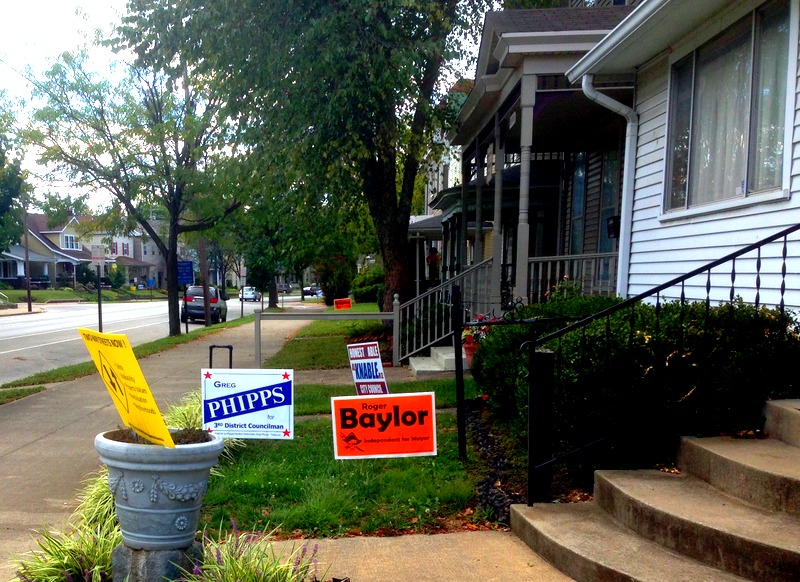
Campaign Diary, Chapter 6: Matching ensembles in the 3rd, psychologically speaking.


First, thanks to the New Albanians who've supported the Baylor for Mayor campaign thus far, whether with grassroots testimony, the wearing of t-shirts, planting signs or kicking a few dollars into the jar. Every little bit helps, and I appreciate it. I've heard from voters in every district who agree that by emphasizing transparency, infrastructure and empowerment, we can TIE the city together.


In this periodic installment of the campaign diary, permit me to narrow the focus to my own neighborhood, and observe that there is a psychology to the political yard sign.

Given that I've publicly disagreed on occasion with my 3rd district councilman Greg Phipps' partisan votes with the current administration, I still believe that on balance, our views with regard to what's fundamentally best for New Albany's neighborhoods are in accordance: Ordinance enforcement, rental property registration, safe and functional two-way streets, human rights, and support for level playing fields and the rule of law.


I've advocated and fought for these (and other) ideas, and so has he. I believe in our own district, neighbors asking for one of my signs, and placing it next to one of Greg's signs, shows that they see the similarities more than the differences -- and grasp the reality of the incumbent mayor's abject failure to govern in the best interest of the neighborhood. Jeff Gahan's instincts are suburban, not urban, and virtually all the areas inside the beltway can benefit from greater urbanism, not less.


I'm restricting the analogy to my own backyard merely to suggest that the odd man out in this instance is the current mayor. Look at the positions, platforms and policies. It's a secret ballot, and we all have the opportunity to vote our consciences.

Thanks.

Friday, September 04, 2015

"When you design a city for cars, it fails everyone."

In a way a water park simply cannot do.

"The new transportation system in Medellín ... is not only a physical solution. It is not only transportation. It is also a social instrument that involves the community, that integrates the community in all the city."

But one must be willing to think outside self-limiting boxes. In New Albany, just the mere act of thinking itself would be a fine first step.

Where Did We Go Wrong? I never realized how dumb our cities are until I saw what a smart one looks like, by Maz Ali (Upworthy)

... A healthy diet and regular physical activity are some of the most important things we can do for our health as individuals, but flawed city design has restricted opportunities for people to make those choices, which has contributed greatly to what are essentially public health epidemics — ones that require public health solutions.

Most cities have been designed for cars, not for people.

Look out your window and see for yourself.

Saturday, August 01, 2015

Baylor for Mayor: Urban, suburban and UniGov.


Hoosiers typically refer to combined city-county government as "Unigov," this being the catch phrase that originated 45 years ago when Indianapolis and Marion County undertook a "consolidation" of government pushed by then-mayor Richard Lugar.

What this notion of "combining" governments implies to me is an economy of scale -- but not the one we usually hear mentioned. We're told about the myriad small efficiencies to be derived from reducing or eliminating overlap, and while I don't contest these in every instance, what I see is a different kind of efficiency, or more accurately, inefficiency: Compact urban expenditures versus suburban sprawl subsidies.

It's the 800-lb gorilla in the room, as illustrated and explained here.

Sprawl Costs the Public More Than Twice as Much as Compact Development, by Angie Schmitt (Streetsblog)

How much more does it cost the public to build infrastructure and provide services for sprawling development compared to more compact neighborhoods? A lot more, according to this handy summary from the Canadian environmental think tank Sustainable Prosperity.

To create this graphic, the organization synthesized a study by the Halifax Regional Municipality [PDF] in Nova Scotia, and the research is worth a closer look.

Halifax found the cost of administering services varied directly in proportion to how far apart homes were spaced. On the rural end, each house sat on a 2.5 acre lot. On the very urban end, there were 92 people dwelling on each acre. Between those two extremes were several development patterns of varying density.

It costs more to "service" infrastructure for a few houses five miles off the main road outside Greenville than it does multiple homes located on a city block downtown. Precisely for this reason, Floyd County government is starved for money. Sprawl costs more, and revenues aren't sufficient to cover it. Somewhat surprisingly, the News and Tribune recently editorialized in favor of higher taxes to make up the difference, although the newspaper's editorial board didn't trace the need to the root cause: Sprawl costs more.

Of course there are areas suitable for sharing and cooperation between city and county government. These can and should be explored.

There's also a fundamental difference in settlement patterns between more and less densely populated areas, with ramifications for the cost of services and infrastructure maintenance. The latter represents a serious discussion we have not had.

Shall we begin?

Sunday, July 26, 2015

"As safety and livability become more important ... the case for converting one-way streets into two-way streets (is) a compelling one."


The first paragraph tells the story, even if we've previously referenced what follows.

I'll continue referencing it, because one-way arterial streets foolishly tether New Albany to a street grid that actively works against our best interests in terms of revitalization.

Period.

Is this an opinion?

No, it isn't. Research by John Gilderbloom and William Riggs, coupled with verifiable experience all across the map, combines to indicate otherwise. For those unclear about the nature of opinions, this link is a good one: No, it's not your opinion. You're just wrong. Irv, if you're reading ...

And, as you may already know, councilman John Gonder has invited Dr. Gilderbloom to come to New Albany and speak.

You are invited to listen as Dr. John Gilderbloom preaches his "gospel of things urban" on Tuesday, August 4, at the library.

Jeff Gahan's abject failure to act on this fundamental infrastructure truth isn't the only reason why he needs to be forcibly returned to selling veneer for a living, but it's significant among them. Still, in spite of all evidence to the contrary, his fawning sycophants insist that he really does "get it" even if he cannot bring himself to say so publicly.

That's not good enough for leadership, is it?

The Many Benefits of Making One-Way Streets Two-Way ... Safer traffic, for one thing, by Eric Jaffe (City Lab)

From a traffic engineering perspective, one-way streets are all about speed. Without the danger of oncoming traffic, one-way streets can feel like an invitation to hit the gas. But swift traffic flow isn’t the only factor by which progressive cities judge their streets, and as safety and livability become more important, a number of metros have found the case for converting one-way streets into two-way streets a compelling one.

Count Louisville among the believers. In 2011, the city converted two one-way streets (Brook and 1st) in the Old Louisville part of town. Though originally designed as two-way streets, Brook and 1st became one-way after World War II, in keeping with the car-first engineering of the time. In championing the change, local official David James cited the need for calmer streets and economic development.

A pair of planning scholars has evaluated just how well the safety and economic claims held up following the street conversions. In a word: very. William Riggs of California Polytechnic State University and John Gilderbloom of the University of Louisville report that compared with nearby, parallel streets that remained one-way (2nd and 3rd), Brook and 1st experienced fewer collisions, less crime, and higher property valuations.

Wednesday, May 27, 2015

"The Link Between Walkable Neighborhoods and Race."

File under: Things no one wants to talk about in New Albany, either.

The Link Between Walkable Neighborhoods and Race, by Richard Florida (City Lab)

African Americans are far more likely to live in the San Francisco Bay Area’s least walkable neighborhoods. Why?

Walkability is not only good for you: It’s a highly desired characteristic of housing and neighborhoods. I’ve written before about the connection between walkable neighborhoods and higher housing values, reduced rates of violent crime, obesity, premature death and long-term memory loss, as well as higher levels of creativity and civic engagement. But a recent study from California Polytechnic State University’s William Riggs reminds us that not all urbanites have the same kind of access to walkable streets and neighborhoods. The study, which focuses on the San Francisco Bay Area, finds a considerable racial divide when it comes to access to walkability, with black residents much less likely to live in the area’s walkable neighborhoods.

Friday, March 06, 2015

"Sprawl Costs the Public More Than Twice as Much as Compact Development."


Just remember this when David White comes knocking to speak with you about NA-FC "unigov."

Sprawl Costs the Public More Than Twice as Much as Compact Development, by Angie Schmitt (Streetsblog)

How much more does it cost the public to build infrastructure and provide services for sprawling development compared to more compact neighborhoods? A lot more, according to this handy summary from the Canadian environmental think tank Sustainable Prosperity.

To create this graphic, the organization synthesized a study by the Halifax Regional Municipality [PDF] in Nova Scotia, and the research is worth a closer look.

Halifax found the cost of administering services varied directly in proportion to how far apart homes were spaced. On the rural end, each house sat on a 2.5 acre lot. On the very urban end, there were 92 people dwelling on each acre. Between those two extremes were several development patterns of varying density.

Tuesday, December 16, 2014

Delightful heresy: Urban values as accommodating automobiles in an environment dominated by people.


To rethink implies having the first thought, and as this pertains to New Albany's traditional ruling class, it's where the problems rend to start.

As you read, consider how the Gahan team already has commenced botching the rethink by refusing to THINK first: What sort of urban area do we want this to be? Here's the crux of it, and a ready-made mission statement for getting down to first principles.

We need to rethink our urban areas. They need to be redesigned around a new set of values, one that doesn’t seek to accommodate bikers and pedestrians within an auto-dominated environment but instead does the opposite: accommodates automobiles in an environment dominated by people. It is people that create value. It is people that build wealth. It is in prioritizing their needs – whether on foot, on a bike or in a wheelchair – that we will begin to change the financial health of our cities and truly make them strong towns.

By all means, read the whole essay.

BEST OF BLOG: FOLLOW THE RULES, BIKERS, by Charles Marohn (Strongtowns)

I spent much of the year working on the sequel to the Curbside Chat that has come to be known as Transportation in the Next American City. Where the Chat explains why our cities are going broke and how embracing an incremental approach to growth can put us on a path towards building productive places once more, Transportation in the Next American City explains why our auto-based approach to transportation is yielding negative returns and how our cities, to be prosperous again, need to be built for people, not cars. It is a radical rethink that I initially struggled with but have found a voice for as I've been forced to explain it to multiple audiences.