Friday, June 21, 2019

It was Gwobbles whodunnit: Greetings from Facebook gaol, where I'm serving a sentence for being historically accurate.


Yes, I understand that Facebook belatedly seeks to cleanse its wretched image after criticism over all manner of contemporary "Nazis" using the social media platform.

Just as obviously the robotic algorithm can't begin to detect creative sarcasm from a socialist like me who wouldn't be deploying an historical reference to the likes of a real-life individual if it weren't valuable as a means of heaping scorn on truth-challenged dullards like the reigning mayor.

It's hard to decide what I enjoy most about the process of Facebook's censorship in this instance. It might be the "guilty until proven innocent" default, or the purported proviso promising the opportunity to explain but provides no way to do so apart from telepathy.

Sans any semblance of due process, I'm also blocked from participation in separate pages where I serve as an administrator. I can imagine instances where such a guilt-by-affiliation ban would interfere with one's ability to perform his or her paying job, all the while without a pathway to communicate with a human at Facebook and come to an understanding about the idiocy.

At least it's a good learning opportunity for my long-lost cousin Regor to lend a helping hand.


Unfortunately, Regor can't post at NA Confidential on Facebook. Bluegill, if you're reading, can I ask a small favor?

As usual, there is plenty of irony herein. After all, Joseph Goebbels developed his "big lie" theory of totalitarian propaganda under the influence of the American advertising industry and its techniques.

It's a fact that cannot be erased, no matter how hard you try, and in today's world we seem intent on scrubbing unpleasantness rather than taking the time to explain to people why Goebbels was an enabler of atrocities against mankind. That's just Disney escapism, isn't it?

---

Monday note, June 24

For the entire 72-hour duration of my imprisonment, which ended at 7:00 p.m. on the 23rd, the "support" box at Fb continued to indicate that the post in question was under "review." Obviously at this point it's irrelevant to be found not guilty given the sentence having already been served.

Interestingly, with no means of communicating with actual humans throughout this annoying period, I did locate a "additional thoughts" comment box last Friday evening and duly added this:

I used the name of Joseph Goebbels, a real-life figure from history, as an ironic reference to the propensity of local politicians in my town to emit "big lies." I did not use Goebbels' name as a glorification of neo-Nazism, which would be impossible given that I'm a Social Democrat. It's idiotic to scrub Goebbels' name in this fashion given that I'm an educated individual perfectly able to explain the former propaganda minister's atrocities against humankind. Your algorithm obviously is resistant to sarcasm, and at this moment you're making it difficult for me to do my job because I can't post on group pages that bear no relevance to my personal page. This is all unnecessary and annoying, and while I realize there will be no apology forthcoming from the robot who controls this process, can you please remove the block sooner rather than later so I can return to my life? Thank you.

When I pressed "send," this was the result, one that summarizes the Facebook malignancy.


Yep. Due process, indeed.

Thursday, June 20, 2019

City council gathers tonight as Irving Joshua reminds all and sundry to keep their grubby hands off Redevelopment's assessed TIF capture.


I'll be tipping a toe back into muddy waters this evening with a city council meeting light on agenda items.

I asked two council persons about the statement above, which prefaced the council packet for tonight. The consensus is that it's legally mandated boilerplate from redevelopment, informing one and all that what the commission TIFs, it keeps.

Will there be "live" tweeting? Probably not. Give me a break, will ya? Psychiatric convalescence is hard, and I'm not as young as I used to be.

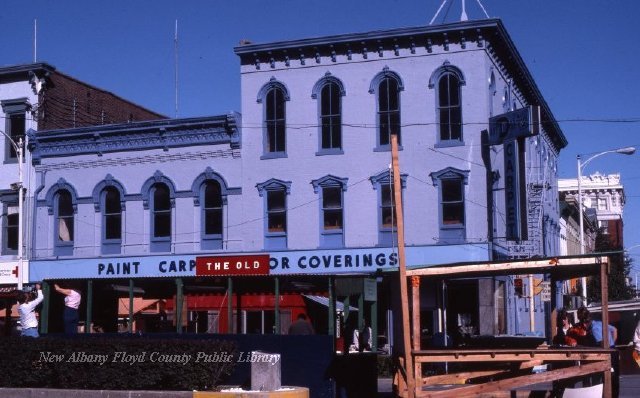
A sign of things to come at Schmitt Furniture, as exterior restoration continues.


Schmitt Furniture's ongoing exterior restoration project took a big turn earlier today. The landmark Schmitt sign isn't going away, just being moved while work is underway.

We are not closing 😉

Every day we get closer to bringing the corner of State and Main back to its original beauty. In order to do that we have to take the sign down to continue with the restoration. This is big. And it’s been a process. This sign has been up for a long, long time. We are so happy to share the amazing transformation with you. This is an exciting time for the Schmitt family. Thank you Rueff Sign Company for handling our sign with great care.

During the course of the work, various bits of history have been revealed.


Schmitt Furniture recently posted these before-and-after shots of progress on the State Street side of the business, which is made up of several older buildings bound together as one. Now their contours are being revealed.


Don't forget Schmitt Furniture’s 83rd Birthday Bash on Saturday, July 13.


Last year was a blast, so let’s do this again. Help us celebrate our 83rd birthday and party the night away with the Juice Box Heroes. This is a free concert! Food, wine and brew will be available for purchase.

Food, beer and wine line up:

Chef Walker - BBQ
Wick’s Pizza
Fistful of Tacos
Wine by Huber’s Winery
Floyd County Brewing
Donum Dei Brewery

More to be added ...

Welcome to Boomtown Kitchen, which opens this evening at 5 p.m.


Boomtown Kitchen is located at 110 Main Street in the space most recently housing Cox's, and before that Big Four Burgers.

We are honored and excited to announce the grand opening of Boomtown Kitchen! We will be introducing ourselves to our community Thursday, June 20th we will open at 5 PM until 11 PM so join us for dinner. Our Americana based menu offers a variety of entrées including salmon, pork chops, chicken, Certified Angus Beef sirloin and ribeye cuts, as well as an array of sandwiches and burgers including our wild game option for the rest of June ... antelope. See you soon friends!

Previously:

It's the business of being in business: Matt McMahan explains the Cox's-to-Boomtown Kitchen story ... then drops the mic.


SHANE'S EXCELLENT NEW WORDS: Boomtown's a kitchen now, but it used to be a made-for-Gahan fest.


The old becomes new: Boomtown Kitchen will replace Cox's -- and a glimpse of Floyd County Brewing's new beer garden.

Reading the Downtown Jeffersonville News and Tribune reminds me of a certain food.


The Downtown Jeffersonville News and Tribune is getting very good at covering news that occurs within walking distance of the newspaper's headquarters ... in downtown Jeffersonsville.

As for the rest of us, there are scraps, sports and the odd bit. Anyone feel like some head cheese?

After all, parts is parts.

What Is Head Cheese And How To Eat It (Melanie Cooks)

“Head cheese” is not a cheese. I don’t know why it’s called cheese, when it is, in fact, meat! Head cheese is a jellied meat made from the meat of the head of a pig or cow. That’s why it’s “head”, but who knows why it’s “cheese.”

Following is an excerpt from an old story of mine about eating and drinking in (soon to become independent) Slovakia when I was teaching in Kosice in 1991.

Why repeat it? Because the only way I can get the bad taste of the News and Tribune's seemingly inexorable decline out of my mouth is to imagine pleasant things like beer and snacks going into it.

Can someone pass the vinegar?

---

Jozef announced his unshakable preference for a dish called t'lachinka: "Do you like our food?" he asked. "T'lachinka is Slovak food of tradition. At this restaurant, it is very good. Okay?" He actually smacked his lips.

"Maybe it isn't so good for you," said Ludmila. "Maybe your stomach is not good for our Slovak food." Vladimir laughed. Jozef looked dismayed. "No, no," he said, "it is best food for beer. We eat t'lachinka and drink beer. Yes?"

Yes.

The beer arrived. One taste confirmed that it was Pilsner Urquell. Three tastes later, it was gone. So was Jozef's. Vladimir, good‑natured and quiet, abandoned his half‑full glass to find the waitress and order another round.

I told Ludmila that Slovak food was fine. The previous evening, I'd gone with another student to the Gazdovska wine cellar, an atmospheric, slightly scruffy restaurant where the specialty is bryndza hluska, which I'd heard much about but not sampled.

Every Slovak I'd spoken to considered it to be incompatible with American tastes, perhaps owing to its topping of melted sheep's cheese. Naturally, the Gazdovska's bryndza hluska was excellent: pea‑sized dumplings in a white gravy, topped with tangy cheese and real bacon bits, and accompanied by a glass of golden Tokaj wine.

Back at the Zlaty Dukat, Ludmila was impressed by my familiarity with Slovak cuisine. Moments later, two platters of t'lachinka arrived.

In the lunchmeat section of the typical American supermarket, you'll find t'lachinka. It's called head cheese.

With obvious relish, Jozef said "watch me, okay?" He shifted a stack of raw, chopped onions onto slices of the compressed, unidentifiable, gelatinous meat. He ladled vinegar from a small tureen, dousing the quivering stack of meat by‑product and onion.

After that, all was flashing forks and lengthy drinks of the world's finest pilsner beer. I didn't hesitate to follow suit, and the t'lachinka was good. Why waste time contemplating internal organs and slaughterhouse scrapings so long as they taste good with beer?

Wednesday, June 19, 2019

Big, big world out there: Isn't one remedy for overtourism to visit neglected places with fewer tourists?


I shall be telling this with a sigh
Somewhere ages and ages hence:
Two roads diverged in a wood, and I—
I took the one less traveled by,
And that has made all the difference

-- Robert Frost

The photo was taken on the Charles Bridge in Prague one afternoon in June of 1989, and of course at the time Czechoslovakia was "behind" the Iron Curtain (from our vantage point, at least), and nowhere close to the level of accessibility the city experiences today.

It's been too long since I've been to Prague, but based on the photos I see today and the testimony of recent visitors, you'd be compelled to visit the bridge by the light of the moon just before dawn to find it as emptied of people as in this photo. Most of the people pictured here were natives, walking back and forth, to and from places important to them in their own lives.

Overtourism is a thing. Maybe it always was, but we seem to have missed it for the most part these past few years. Our destinations have included Tallinn, Estonia; Mechelen and Poperinge, Belgium; Catania (Sicily) and Valletta (Malta); Porto, Portugal and Gdansk, Poland. There have been tourists in these places, though not a ridiculous selfie-ridden scrum, and part of the reason for this might be our habit of off-season travel in addition to choosing secondary locales.

To me, they're just as exciting as the places you're "supposed" to go.

Haarlem, Netherlands is only a few minutes from Amsterdam. To be in Haarlem, which is a large city in its own right, is to enjoy everything wonderful about the Dutch way of life without stumbling over tourists in the fashion of Amsterdam. Yes, there are museums and sights in Amsterdam that cannot be found in Haarlem, but thanks to an amazing public transportation system, they're all within easy reach from outside the larger city.

My next trip to Europe will be my 40th since 1985, so I can't say I'm not a tourist like all the rest. Just the same, the smaller cities and "lesser" attractions have come to captivate me. My advice is to vacate the beaten path and find the place that speaks to you like all the others can't.

These are the cities overtourism could threaten next, by Hannah Sampson (Washington Post)

Amsterdam, Venice, Barcelona, Paris — the poster children for overtourism are well-known. Now, 20 more cities are on alert lest they turn into the future face of the problem, according to a new report from the World Travel & Tourism Council and commercial real estate firm JLL.

The report, called “Destination 2030,” examines the tourism “readiness” of 50 destinations around the world and groups cities into five types. The “emerging performers” category includes destinations where infrastructure and tourism momentum are growing along with the pressures associated with more tourists. Those cities were Bangkok; Cape Town, South Africa; Ho Chi Minh City, Vietnam; Istanbul; Jakarta, Indonesia; Mexico City; and New Delhi.

Another 13 cities — called “mature performers” — were described as having an established tourism infrastructure, strong leisure or business travel, and good positioning to manage current growth levels. “But there is a risk of future strains related to visit volume, infrastructure or activity that is testing readiness for additional growth,” the report said. It listed Auckland, New Zealand; Berlin; Dublin; Las Vegas; Lisbon; London; Los Angeles; Madrid; Miami; New York; Seoul; Seville, Spain; and Sydney in this category.

The study adds a fresh layer to the ongoing conversation over how much tourism is too much, and how both iconic and emerging destinations can cope with the world’s apparently insatiable appetite for travel.

“Over the past few years … several destinations, and cities in particular, have been criticized in the media for the under-management of travel and tourism and the stresses that visitor numbers have put on urban systems and residents,” the report said.

SHANE'S EXCELLENT NEW WORDS: One bluegill, one crappie, one carp.


Last week I posted a serious article, in which a small joke was inserted.

Culture, demographics and territorial pissings: "Gen X Is Having a (Very Gen X) Moment."

Thanks to Bluegill (or as they refer to him in France, Bleugill) for drawing my attention to this essay.

The reference should be familiar to anyone who has surveyed the salad offerings and wondered why English-speakers insist on misspelling the color blue.

You'll be dismayed to hear this, but the phrase “blue cheese” showed up in English a century and a half before the Frenchified “bleu cheese” version. In fact, the phrase “blue cheese” may have appeared in English before fromage bleu made its appearance in French.

NAC's co-editor emeritus long has been known for his nickname derived from the fish, but a regular reader took it a step further.

In France, the bluegill is often called "crapet arlequin”… for the little black spot by the fish’s gills. I think it’s from where we bastardized the name “crappie”.

So it would appear.

Crappie - Wikipedia

Etymology. The genus name Pomoxis derives from the Greek πώμα (cover, plug, operculum) and οξύς (sharp). The common name (also spelled croppie or crappé), derives from the Canadian French crapet, which refers to many different fishes of the sunfish family.

Fishing isn't my bag, and I have eaten neither crappie nor bluegill for many years. Carp is a different story. Not only is carp a fish that makes great, peppery soup when pulled from the depths of Lake Balaton, but it also is a very useful verb in New Gahania.

The verb to carp is synonymous with to complain. However, where complaining is usually understandable, carping about something is complaining to the extent that it annoys others and may make people uncomfortable.

At this juncture I'll let sleeping fishies lie.

Tuesday, June 18, 2019

"Getting people out of cars and rebuilding our main streets is not going to be easy, and cannot be oversimplified."


I appreciate the author's candor in this short but unsparing look at the realities of striving toward walkability. The bullet points in the excerpt ideally would be grasped by all local candidates for office; I wouldn't expect them all to agree, although it would be nice to think they'd at least been exposed to them.

Is there a "fundamental logic of walkability"? by Lloyd Alter (Treehugger)

 ... It is so complex, building a walkable city that works.

  • We need higher average densities to have enough people to actually support small shops.
  • We need a fairer tax structure that doesn't shift so much of property tax burden onto the commercial sector, making Main Street stores so expensive.
  • We need better pedestrian infrastructure so that people in wheelchairs, with buggies and with strollers can actually all get down the street.
  • We need to stop the subsidies on highways and fuel that support the suburban big box economic models.
  • We have to charge car owners the true economic costs of maintaining the roads, police, ambulances and parking because even when the store is less than a mile away, it is still often easier to drive. If the car is there, people are going to use it.

Then there will be some logic to walkability. Right now, for many, it makes more sense to drive.

ON THE AVENUES: Let's lift our voices for another verse of "Talking Seventh Inning Blues."


On the Avenues will move back to Thursdays, beginning next week.

World Cup soccer star Megan Repinoe's principled decision to refrain from singing the "The Star Spangled Banner" prompts one of those questions we ask the friendly 800-lb gorilla in the corner.

In short, why do we play the national anthem before a sporting event, but not prior to opening the doors at a frilly boutique, muffler shop or dive bar?

Imagine the plight of the 24-hour mini-mart, forever unable to to find an opportunity to play the national anthem, and settling instead on an endless loop of Lee Greenwood songs.

The 800-lb gorilla isn't finished.

Why do we insist on patriotic rituals attendant to the airing of the anthem alongside overt displays of nationalism merely to sanction throwing a football and shooting hoops, not to mention taking slap shots?

(As an aside, these questions were of relevance long before Repinoe chose silence and football’s Colin Kaepernick took a knee.)

According to writer Richard C. Crepeau in an essay from the mid-200s, the answer is that rote patriotism featuring "The Star Spangled Banner" became a feature of baseball games during World War II.

In 1940, with the fighting underway in earnest and America becoming more conscious of the possibility of war, there was increased talk of the need to hear the national anthem before all baseball games. This was suggested by The Sporting News in June, while at the same time the president of the International League called for the anthem to be played in U.S. league cities, as was already being done in Canadian cities. By 1941, the practice of playing the anthem before sporting events had achieved nearly universal status. At some games the pledge of allegiance was added, and, by 1941, "I Am an American Day" became a feature at major league parks.

It would be nice to say that all of this was due to pure patriotic expression, but of course much of it was created by PR-conscious owners who wanted to make sure that no one would question the patriotism of athletes who played games during World War II while others went off to serve their country. Four years of war, followed by the Cold War and the emergence of the American Empire, solidified the practice and made it into a national ritual.

Since September 11, 2001, another ritual has come into fashion in baseball. Nowadays the seventh inning stretch often is devoted to a commemorative performance of “God Bless America,” for which I’ll soon be suggesting an alternative with less proselytizing. As a long-ago Internet analyst once wrote:

“‘God Bless America’ rings a false note now, as it did when the song was first written (by Irving Berlin, 1939). Woody Guthrie, wrote the song ‘This Land is Your Land’ in 1940 after hearing Kate Smith sing ‘God Bless America’ one too many times.”

But first, since I’m perfectly willing to be the iconoclast in this particular hometown locker room, another question: Is it really necessary to bring religious devotion into the seventh inning stretch?

Or: Where is the imperative for a deity to “bless” America in the first place, quite apart from sports?

Perhaps a better question is this: If we deploy societal peer pressure to encourage a conditioned response by requiring people to participate in a ritual intended to remind them of a noteworthy event, aren’t we trivializing the event?

Shouldn't folks remember on their own?

To be sure, the events of September 11 are an indelible memory for current generations. Furthermore, and on a far less savory note, the invasive logic of the security state arising in America since 2001 has affected our lives more deeply than we realize.

Still, active memories of 9-11 will fade, just as recollections of human slavery's toll, the efficacy of vaccination and a merits of a living wage have disappeared into the mists of rear-view mirrors.

In my world, instead of mandating participation in sing-alongs during sporting events, a better way of understanding history’s lessons is to take an interest in historical facts. Some sweet day we all may rise as one from the bleachers, precariously cradling ours beers and brats, and listen as local actors and television luminaries read relevant passages from Howard Zinn.

Too few of us can sing well, anyway.

---

At this point the hackles of some readers surely are popping to life: “What -- don’t you love your country?”

Well, this depends on what the meaning of “love” is.

Speaking only for myself, I cannot regard the word “love” as a concept applicable to one among many nation-states into which I was serendipitously deposited by the fickle finger of fate. Rather, during my adult life the extent of my personal attachment to the concept of the United States of America has been conducted in a cerebral way, not in terms of blind allegiance.

(I do love my wife, but each year at tax time my feelings take a back seat to hard mathematics and fluency in bureaucratese; lacking both, I immediately hand the dossier to my accountant to be assured it's done right.)

Somewhat amazingly my teachers succeeded in convincing me that to be an American bears an intimate connection with an intellectual process, not an emotional one. I accept that a philosophy of governance came first, this being a rational undertaking incorporating thoughts, ideals and the historical record, not misty eyes, the fevered thumping of a chest or identification with a piece of cloth.

At the same time, my acknowledgment of this political construct does not imply acceptance of its imperfections. As Tina Turner might have asked, “what’s love got to do with it?” The Constitution as a document is a starting point, and it is to be regarded as a work in progress, not another gilded icon to be revered sans examination with a critical lens.

Because how could the nation's founders have devised perfection when Walt Disney had yet to be born?

All of these considerations matter owing to one’s personal conscience, and the minute we seek to align the conscience of the many individuals into the potential blunt instrument of the one, it’s time to be vigilant.

A brief survey of history reveals that soldiers on all sides have consistently marched off to war in the patriotic belief that God is on their side, and when one considers the catastrophic results of war, it should be obvious that this equation is irreparably skewed, as is any other pertaining to the abstract entity of nationhood -- especially as such abstractions come from hearts and not heads.

My views in this context understandably aren’t mainstream. I think love for other persons can be crazy, blind, binding and inexplicable. Beyond that, brains are there to be used, not lobotomized.

There weren't any weapons of mass destruction in Iraq, were there?

---

Returning to what it means to be a baseball fan, "Take Me Out to the Ballgame" is the only patriotic song we've ever needed. For decades a staple of the seventh-inning stretch at ballparks large and small, from California to the New York island, this music was most delightfully defined by the late Harry Caray’s boisterous press box version.

Baseball possesses its own sort of quasi-religious faith; if not, why would Baltimore Orioles fans buy a single ticket in 2019?

For me the substitution of “God Bless America” for “Take Me Out to the Ballgame” is like inserting an advertisement for organized religion where it doesn't belong, whatever the variety.

Of course I’ve nothing whatever against the old-school songwriter Israel Beilin (Irving Berlin), who died a famous, feted American in 1989 at the age of 101, this wonderful and welcoming country having provided a beacon to his family of immigrants escaping nasty pograms in Tsarist Russia.

Among Berlin’s hit songs I prefer “Cheek to Cheek” or even “Alexander’s Ragtime Band” to “God Bless America,” in which Berlin appealed directly to a simple love of country with groundless theism, prideful chest-thumping and a mawkish sentimentality, neither of which suits my cosmopolitan (read: cynical) internationalism.

---

Conversely, if we simply must have a 7th-inning tune other than the historically correct one, why not sing “This Land Is Your Land,” Woody Guthrie’s far superior response to Berlin?

Why not sing it instead of the national anthem?

“This Land Is Your Land” is sublimely ecumenical, addressing the natural and human wonders of America without resorting to the divisiveness of those many supernatural elements.

I suppose the drawback is that when it comes to the imperative of emotional manipulation required by engorged corporate capitalists, Guthrie’s work isn’t as simplistic as Berlin’s schmaltzy paean to blind obedience.

Better yet, we might all wear “This Machine Kills Fascists” t-shirts whilst happily harmonizing from the third base side. It is through Guthrie’s legacy that this phrase has become immortalized. For many years my former brewing company used “These Machines Kill Fascists” as our motto, alongside a graphic of brewing vessels, and even today, with me being long gone from NABC, I never tire of telling the story of its origin.

Woodrow Wilson Guthrie (1912-1967) was an iconic American folksinger. He was born in Oklahoma and came of age during the twin pre-WWII crises of national economic collapse (the Great Depression) and regional environmental catastrophe (the Dust Bowl).

Musically inclined from childhood, Guthrie followed the westward drift in pursuit of work, eventually landing in California alongside numerous other Okies. In doing so, he played a living, breathing part in novelist John Steinbeck’s “Grapes of Wrath,” and as a direct result of what Guthrie experienced during these troubled times in America, his political views evolved in progressive, leftist directions.

Many of Guthrie’s subsequent songs -- he wrote thousands -- chronicled the hardships of ordinary people, expressing empathy for their lot and support for what he saw as curatives: Worker rights, unionizing, and racial and gender equality.

Guthrie eschewed the feel-good and the flag-waving, both so often deployed to mask deprivation and trivialize injustice. His annoyance with “God Bless America” spoke to this feeling.

For all of Guthrie’s leftist tendencies, he remained a staunch patriot as well as a firm, committed believer in the potential of America, albeit a more idealistic and hopeful vision of the American experiment, one not defined entirely by wealth and privilege. The Second World War put his beliefs to the test, and he responded admirably.

It is instructive to remember that during World War II, the United States (a democracy -- of sorts) aligned with a hereditary monarchy (Great Britain) and the USSR’s Communist gulag against the military aggression of Germany, Italy and Japan. Such was the greater threat posed by fascism.

Guthrie viewed his music as an integral part of the war effort, and so he scrawled “This Machine Kills Fascists” on his acoustic guitar, meaning that music and ideas were as much weapons against fascism as guns and bullets. Guthrie enlisted in the Merchant Marine, and whenever performing, he used his own machine, one that he considered vital in killing fascists.

The same phrase was written on machinery in factories throughout the United States, as those millions of people in America’s industrial work force made a similar point: The person operating the machine that makes the supplies used to defeat fascism are helping to kill fascists, too.

Co-opting religious imagery to further the imperatives of a war machine driven by wealthy elites, or returning to the egg and reminding us that “we the people” might yet resemble universalism and in self-governance?

I appreciate Irving, but I vote for Woody -- now and always.

---

As a postscript, the lyrics.

This land is your land This land is my land
From California to the New York island;
From the red wood forest to the Gulf Stream waters
This land was made for you and Me.

As I was walking that ribbon of highway,
I saw above me that endless skyway:
I saw below me that golden valley:
This land was made for you and me.

I've roamed and rambled and I followed my footsteps
To the sparkling sands of her diamond deserts;
And all around me a voice was sounding:
This land was made for you and me.

When the sun came shining, and I was strolling,
And the wheat fields waving and the dust clouds rolling,
As the fog was lifting a voice was chanting:
This land was made for you and me.

As I went walking I saw a sign there
And on the sign it said "No Trespassing."
But on the other side it didn't say nothing,
That side was made for you and me.

In the shadow of the steeple I saw my people,
By the relief office I seen my people;
As they stood there hungry, I stood there asking
Is this land made for you and me?

Nobody living can ever stop me,
As I go walking that freedom highway;
Nobody living can ever make me turn back
This land was made for you and me.

---

Recent columns:

May 28: ON THE AVENUES: Challenges are forever, but downtown New Albany's food and drink purveyors keep on keeping on.

May 21: ON THE AVENUES: "Pints&union, where the classic beer hits keep right on pouring."

May 14: ON THE AVENUES: Where do we go from here?

May 6: ON THE AVENUES REWOUND: Ghosts within these stones, defiance in these bones (2018).

BEER WITH A SOCIALIST: "Craft is being assimilated by the mainstream, but not entirely on the mainstream’s own terms."


Three pieces to an ongoing puzzle, though still too early to glimpse the larger picture.

All shook up: When craft beer goes mainstream, by Pete Brown (Imbibe)

With craft brewers selling out to multi-nationals and global giants acting like craft brewers, it’s a confusing time in the world of beer. Pete Brown takes a look at how we got here and where we might go next

When looking at the beer market, it might be tempting to see craft beer as a discreet little niche, a bubble that operates differently and separately from the mainstream. But if you’re invested in the beer market, such thinking is dangerously wrong. Craft and mainstream are converging, and stories that look quite separate from each other are starting to intertwine. Let us explain …

Pardon a massive snip, straight to the conclusion.

... In one sense, craft is simply the latest stage in the ongoing, permanent state of evolution in beer, of consumer education and rising expectations. But crucially, unlike any other innovation in recent history, this one happened without the permission of the biggest brewers in the world, and those corporations were powerless to prevent it.

Craft is being assimilated by the mainstream, but not entirely on the mainstream’s own terms. After trying to belittle it, they have been forced to accommodate and accept it, and they’ve had to recognise the seismic difference that craft has made to what drinkers expect from any beer.

Two additional links provide informative reading about the booze and beer scenes. First, the great Lew Bryson. Feeling all shook up? Sometimes it's better stirred, not shaken.

PODCAST EP 118 – STIRRING THINGS UP – WRITER LEW BRYSON, at the Full Pint

We are joined by veteran beer and whiskey writer Lew Bryson. We share stories, laughs and hot takes on covering booze.

Items of discussion include:

– Why Danny loves Lew.
– Our admiration of tech writer John C. Dvorak.
– Lew’s approach to writing about beer and whiskey.
– Dealing with Pennsylvania liquor laws.
– Comparing to the late 2010’s craft beer boom to the 90’s.
– Well made alcohol is well made alcohol.
– Gut reactions to new styles.

And to close this session, a look at how craft pioneer Anchor Brewing is doing under a(nother) new owner.

The unanchoring of Anchor Brewing, by Esther Mobley (SF Chronicle)

Our original craft brewery has changed radically since Fritz Maytag sold it in 2010. So who is it today?

A lot has changed at Anchor Brewing Co. in the last few years, but one thing hasn’t: how it makes steam beer.

On the second floor of the Potrero Hill brewery, built as a coffee roastery in the 1930s, workers still hand-crank the valve on the copper mash cooker, half a century old and shaped like an onion dome. In an adjacent room, steam beer, Anchor’s signature product, still undergoes fermentation in big, open-top steel bins. Almost all the time, the only temperature control is that chilly San Francisco Bay breeze, on which the original Anchor brewers wisely capitalized in 1896. The process is practically anachronistic.

Anachronism has always been part of Anchor Brewing’s appeal. It was the brewery oblivious to the beer zeitgeist, known for old-fashioned styles like barleywine, porter and, quaintest of all, steam. Steam is balanced, clean, refreshing; it’s timeless, and it’s never been cool. When craft beer exploded in the nineties and early aughts with its insatiably hoppy IPAs, Anchor stayed true to its old ways. It felt like home.

Which is why, to those who grew up on the local institution, these can feel like bewildering times. Anchor was Fritz Maytag’s, it was San Francisco’s. Now, as of 2017, California’s oldest brewery is owned by Japanese beer corporation Sapporo. Anchor was always touted as the nation’s first craft brewery. Now the Brewers Association says it can’t be called “craft” at all. In lieu of having a brew pub, Anchor always just offered a free tour, with beer samples. Now it charges for tours, and it has a trendy taproom, Public Taps, complete with a Skee-Ball machine and limited-edition beers like Boys ‘N’ Blood, a fruited kettle sour.

Suddenly it looks as if Anchor has jumped on every possible bandwagon, making beer styles you could never imagine Maytag endorsing. Meyer lemon lager? Blackberry IPA? Brut IPA? In the 45 years that Maytag owned Anchor, the brewery released just 10 beer styles. In the nine years since he sold it, it’s put 30 new styles into distribution — and that’s not counting the 60-plus beers that have shown up on the taproom menu since launching a pilot brewery in 2017.

Has Anchor lost touch with its own identity?

By modernizing, does it risk alienating the people who love it most?

And, in an era when this city worries about these things, what part of San Francisco’s identity hangs in the balance?

Monday, June 17, 2019

Megan Rapinoe and the National Anthem: Because "compulsory expressions of freedom are always the most compelling."

Photo credit.

Bluegill contributed these words back in 2014. They're an antidote to hegemony in all its oppressive varieties.

A short story of passing in the street.

I don't recite the Pledge of Allegiance, stand for the National Anthem, or recognize prayer as sponsored by public institutions. When a funeral procession crosses my path, though - and it happens quite a bit when you live down the street from a funeral home - I stop what I'm doing, take off my hat if I'm wearing one, and stand in silent solidarity until it passes. That's not nationalism, militarism, or theocratic hegemony. That's someone's family, and we all have those.

An essay called "The Sports Song of Patriotism" by Richard C. Crepeau may or may not be accessible on-line, but here's an excerpt that reveals how the national anthem came to be de rigueur at sporting events.

First, it is important to note that there was no official national anthem until the 1930s. During World War I, however, President Wilson declared the "Star Spangled Banner" the unofficial national anthem, and the intense display of public patriotism during this period led to it being played on many public occasions.

It is generally accepted that its first appearance during a sporting event was the 1918 World Series. To demonstrate major league patriotism, baseball teams had the players march in formation during pre-game military drills while carrying bats on their shoulders. During the seventh-inning stretch of game one, when the band spontaneously began to play the "Star Spangled Banner," the Cubs and Red Sox players stood at attention facing the centerfield flag pole. The crowd sang along and applauded when the singing ended.

Given this reaction in Chicago, the "Star Spangled Banner" was played during the seventh-inning stretch for the next two games. When the Series moved to Boston, the great theatrical Red Sox owner Harry Frazee pumped up the show biz: He brought in a band, and the song was played before the start of each game.

When the war ended, the song continued to be played, but only on special occasions when a band was present — such as opening day, special holidays or the World Series. On opening day in Washington, D.C., it was played before the president of the United States, and local politicians in other cities learned to participate in the events.

The "Star Spangled Banner" was finally declared the official national anthem in 1931. Even though by 1934 some ballparks had public address systems, it still was not played at every game. The coming of war in the late 1930s changed all of that. During the 1939-40 National Hockey League season, the Canadian anthem was played at games in Canadian cities as Canada was already at war. Then the practice spread to Madison Square Garden and from there it was transferred from hockey to baseball.

In 1940, with the fighting underway in earnest and America becoming more conscious of the possibility of war, there was increased talk of the need to hear the national anthem before all baseball games. This was suggested by The Sporting News in June, while at the same time the president of the International League called for the anthem to be played in U.S. league cities, as was already being done in Canadian cities. By 1941, the practice of playing the anthem before sporting events had achieved nearly universal status. At some games the pledge of allegiance was added, and, by 1941, "I Am an American Day" became a feature at major league parks.

It would be nice to say that all of this was due to pure patriotic expression, but of course much of it was created by PR-conscious owners who wanted to make sure that no one would question the patriotism of athletes who played games during World War II while others went off to serve their country. Four years of war, followed by the Cold War and the emergence of the American Empire, solidified the practice and made it into a national ritual.

This begins us to an athlete who won't sing the national anthem. Why on earth this matters to anyone is an abiding mystery to me, but here we are. Individual conscience is just that: our own, each of us. The reasons for mandated public displays of private truthfulness elude me, although my best guess is that they're all about power.

Megan Rapinoe Is Right to Not Sing the Anthem, by Dave Zirin (The Nation)

Megan Rapinoe won’t kneel for the anthem any longer. Now the right wants her to sing it as well.

The right is in a lather over US Women’s National Team forward Megan Rapinoe’s standing for the national anthem… but not singing. I wish I were joking. The sputtering anger across certain websites and social media is connected to Rapinoe’s efforts to keep a mild promise. Rapinoe used to kneel during the anthem as a way, in part, to express solidarity with Colin Kaepernick. But that wasn’t the only reason. She said in 2016, “Being a gay American, I know what it means to look at the flag and not have it protect all of your liberties. It was something small that I could do and something that I plan to keep doing in the future and hopefully spark some meaningful conversation around it.”

Then the US Soccer Federation had itself a good old-fashioned hissy fit. First, it issued a statement demanding that everyone on the team must stand for the anthem. Then it took the extraordinary step of codifying a policy requiring players to stand. Yes, compulsory expressions of freedom are always the most compelling.

At the time, Rapinoe begrudgingly agreed to respect the diktat, although she also made a point to call it “cowardly,” saying, “We can actually have a conversation, instead of just telling me that it’s a privilege to pull on the jersey. Like, of course it’s a privilege for me to pull on the jersey. Part of that privilege is representing America, and representing America is representing all of America.”

That includes representing the part of America that America refuses to represent: the America being herded into internment camps and the America being denied basic civil and human rights under this venal administration.

Rapinoe did, however, also promise that while she would stand for the anthem, she would not in fact sing. She told Yahoo Sports, “I’ll probably never put my hand over my heart. I’ll probably never sing the national anthem again” ...

Four decades later, Disco Demolition Night has not aged well.


"This wouldn't have happened if they had country and western night."
-- White Sox pitcher Rich Wortham

To me, the infamous Disco Demolition Night in Chicago forty years ago is an excellent case study for the merits of revising one's point of view when new information arises. Put another way, there really aren't purely musical sentiments in which "disco sucks" can be isolated from cultural contexts, even if it seemed so to us at the time. Back then I was pushing 19 years of age and delighted to see disco taking it on the chin, but in truth I lacked the emotional maturity necessary to understand what Dave Marsh wrote at the time:

White males, eighteen to thirty-four are the most likely to see disco as the product of homosexuals, blacks, and Latins, and therefore they're the most likely to respond to appeals to wipe out such threats to their security. It goes almost without saying that such appeals are racist and sexist, but broadcasting has never been an especially civil-libertarian medium.

Now, I know better. It goes to show that when the facts change, or when a persuasive and factual counter-argument appears, reasonable people can and do change their minds.

Why are the Chicago White Sox commemorating Disco Demolition Night? at The Economist

On July 12th 1979 disco records were destroyed as part of the in-match entertainment. It has come to be seen as an appalling act of prejudice

ON THURSDAY nights the Chicago White Sox give something back to baseball fans, usually T-shirts for the first 10,000 people through the gates of Guaranteed Rate Field. On July 4th the garment is a handsome navy-blue number to mark Independence Day; on July 25th they remember the legendary Sox team of 1983 with a “Miracle on 35th Street” tee. And today, June 13th, when they play the New York Yankees, they are planning to commemorate one of the strangest—and, for many people, most disgraceful—episodes in their history with a T-shirt bearing the legend: “Disco Demolition – the night records were broken.”

Disco Demolition Night took place on July 12th 1979 at the Sox’s old stadium, Comiskey Park. Trying to boost attendance in a season of poor crowds, the Sox invited a local DJ named Steve Dahl to provide some entertainment between the first and second games of a double-header against the Detroit Tigers. Mr Dahl, a rock DJ, had lost his slot at a radio station when it switched formats to disco, and when he got a new job he made much of his unequivocal hatred of the music. This hatred was to be the entertainment for fans. Mr Dahl invited his listeners to bring disco records to the ballpark where he would blow them up, to “end disco once and for all” ...

What Steve Resch has in mind for the Jimmy's Music Center building downtown.

1970

1983.

It's one small step for man, and one giant leap for mankind.

Music venue, office space planned for downtown New Albany, by Brooke McAfee (Hanson's Folly)

NEW ALBANY — A live music venue, a bank and office spaces are some of the new additions coming to Market Street in downtown New Albany through a new redevelopment project.

The Jimmy's Music Center location at the corner of Market Street and Pearl streets is in the process of some major changes. Developer Steve Resch, owner of Resch Construction, purchased the space in November, and he is building offices in the historic building, along with a concert venue and bar in the basement.

Jimmy's Music Center remains open in a smaller space in the same location at 123 E. Market St., and owner James Gaetano is planning to eventually relocate the music shop to another downtown space. A space at the corner of the building's first floor has already been leased to New Washington State Bank, and the other side (where Jimmy's Music Center is now operating) will be a retail space. The second and third floors will be used for office space.

Joe Phillips, owner of Pints & Union, plans to open a live music venue called Misery Loves Company, or the MLC Club, in the downstairs area. The idea of starting a live music venue has been floating around in his head for about five years, he said, and the concept for the upcoming business was inspired by Jimmy Can't Dance, a jazz bar located beneath Another Place Sandwich Shop in Louisville ...

Sunday, June 16, 2019

Depaving makes grassroots sense: "A little less asphalt. A little more greenery."


"I feel like we’ve just gotten so used to looking at these huge spaces are just asphalt and asphalt. Now whenever I got to a new space, I look at how the space is being used and where’s the water going to."

I'm accepting solicitations from those candidates -- ONLY those candidates -- who support ideas like depaving and an accelerated program of planting trees. Advocacy needn't be expressed with promises of kickback loot or campaign finance extractions. Rather, comprehension of the utility of grassroots projects like this one is enough to start the conversation.

Any Democrats out there capable of handling this solo, or will you need to visit Big Daddy G or the AdamBot to ask permission?

Depaving Paradise: Grassroots Portland Group Reclaims Parking Lots by Hand, by Angie Schmitt (Streetsblog)

A little less asphalt. A little more greenery.

That’s the mission of Depave Portland, a volunteer group that is deconstructing parking lots all across the Oregon city, replacing them with water filtration gardens, or playgrounds for children.

Since its founding in 2008, the organization has deconstructed some 75 parking lots across Portland, removing 150,000 square feet of pavement by hand with the help of more than 3,000 volunteers. Its projects have diverted more than 3.5 millions gallons of stormwater runoff from local watersheds.

The movement is spreading; Depave groups modeled on Portland’s are now active in Canada, Cincinnati and Tennessee.

Carlos Nuñez, a member of the board, spoke with Streetsblog to explain the motivation and how it all works. (The below has been lightly edited for length and clarity.)

BEER WITH A SOCIALIST: Don't get around much anymore, but don't take it the wrong way. I like drinking beer in my own joint.


It will come as no surprise to anyone that I'm a natural born contrarian.

When everyone else is on board with something, I'm filled with suspicion. If the conventional wisdom is being espoused, then it seems to me there must be an obtuse angle willfully neglected by the prevailing herd mentality. "Common" sense? It's another way of enforcing uniformity.

These days there's a fashionable default template for selling beer according to the logic of attention deficit's promiscuous kaleidoscope -- embracing an ever-changing, rapid-fire, tilt-a-whirl dizziness.

It's no longer the approach I favor. It doesn't work for me professionally, and the same applies to my own beer drinking. In the here and now, I'd much rather savor two or three servings of one great (and usually lower gravity) beer, and get to know it better.

Before you ask, it doesn't matter at all that once upon a time, I was among the risk-taking pioneers of this disorienting tap shuffle. Seeing as these days most places embrace a scattershot, constantly rotating "system" of pouring whichever draft beer is new, while neglecting the possibilities inherent to an intelligent bottle and can list, you can count me out of the ensuing rat race.

The past is gone, and my head isn't there any longer.

My solution as beer programmer at Pints&union has been to return to school -- the old school. We emphasize comfort beers, teach neglected styles and offer the greatest beer hits of the 1300s through the 1900s, as placed alongside a few contemporary selections destined to become classics. Some of these come and go, but most stay put.

I'm very proud of what we've achieved with beer in less than a year by undertaking to narrow and solidify options, although the wonderful thing about doing business in our ever-evolving downtown New Albany is that if the old school isn't your bag, other establishments nearby offer plenty of new-wave beers. Generally speaking, downtown New Albany's eateries and watering holes are just a few minutes apart from each other.

Your mandate is clear: Walk about and check them out. At any given time, there surely are more than one hundred different beers available for consumption in downtown New Albany. Many of them won't be pouring during your next visit, while most of the ones at Pints&union will.

So be it, and I like it this way. That's because it may have occurred to you that a corollary of my mission at Pints&union, which is to assemble a classic selection of old-school beers, is my personal preference for precisely the same classic selection of old-school beers.

It follows that the bulk of my own beer drinking takes place at the very bar where I work, although I try not to abuse my privileges, and I don't indulge every night of the week. Rather, I pick my spots. I enjoy drinking the same beers I've chosen and stocked. Obviously this home field advantage also provides an opportunity to shoot the breeze with friends and customers, as well as educating visitors and staff alike.

The down side to Pints&union being my favorite place to drink beer is that I drink beer less often than before at other places, especially since my old stomping grounds at Bank Street Brewhouse have gone away. Part of the reason for my scarcity is a high-mileage liver.

Another is a tight household budget, and besides, there are are numerous other licensees in downtown New Albany (and Jeffersonville, and Louisville). While I try my best to support local businesses, acting as an honest broker of information who sincerely wants everyone to succeed, I can't patronize them all. 

None of this should be construed to imply personal disdain toward other establishments and their beer programs. Their choices aren't bad, just different; different beers for different peers. Diversity? It's good.

The ideal outcome in a district like downtown New Albany is for as many food and drink establishments as the free market proves are viable to co-exist with each other, refining their own offerings and being good at what they choose to do -- and with there being as many differing ideas about how to run a bar, cook food and build a beer selection as there are physical pieces of property to set up shop, the specific possibilities are endless.

I'm very fortunate to be able to purpose-build a beer program capable of pleasing customers and me, all at once. Because of this, Pints&union is my favorite place to drink beer, but for those among you with a tad more vim and vigor than I'm feeling lately, get out there and add to your Untappd totals.

You're just as likely to find me at Pints&union, curled up with a Pilsner Urquell or Fuller's London Porter. Nothing against anyone else; it's just that I really enjoy being a regular at the pub on top of working there.

---

A few pub-related links:

What does it mean to be a pub regular, anyway?

In the Age of Seamless, Is the ‘Regular’ a Dying Breed? by Helene Stapinski (New York Times)

For years, they came out night after night. Born of a time before internet and smartphones — or at least before Seamless — the regular is as old as the bar stool, and possibly poised for extinction.

But is the tradition really endangered?

We posed the question to our readers: What makes a regular? And are you one?

More than 500 responded to the callout, and they were as varied a group as you could imagine. The regulars come from every ethnic group and occupation, making certain restaurants and bars their living rooms and dining rooms, where they discover community, nourishment, sometimes even love. They tend to be over 40, though the tradition also seems appealing to millennials.

But no matter the establishment — cafe, trattoria, dive bar, coffeehouse, doughnut shop, pharmacy, even — those who make themselves permanent fixtures almost all say the same thing about what makes a regular. When they walk in, the people behind the counter know who they are.

Regular or not, there used to be a measure of gender discrimination in places like Edinburgh, Scotland.

Bennets Bar (Atlas Obscura)

Edinburgh locals have been drinking at the building that houses Bennets Bar since 1839. Refitted with a new interior in 1906, the bar maintains many of its historic fixtures, including stained glass windows, beautiful tiles depicting cherubs, and a wooden bar. There is even a brass water tap for topping off one’s whisky. Perhaps the most unusual feature, however, is what locals refer to as a “jug” or “snug.”

As a closing bit of serendipity, regulars spent decades drinking in this Wisconsin bar without knowing what was behind a nearby wall.

Huge 19th Century Circus Poster Found in Walls of Wisconsin Bar, by Brigit Katz (Smithsonian)

It advertised an 1885 performance by the Great Anglo-American Circus

Since the 1970s, the family-owned Corral Bar has been serving drinks and hearty meals to diners in the small town of Durand, Wisconsin. But the property has a much longer history: it sits on land that was first surveyed in 1857 and has been home to a succession of stores, barber shops and saloons. As Eric Lindquist reports for the Eau Claire Leader-Telegram that one of the bar’s current owners, Ron Berger, recently revealed a vibrant relic of the Corral’s rich past: a nine-foot-high, 55-foot-long circus poster, long hidden behind the bar’s walls.

Hall of Fame cocktails: "It took a century, but the Negroni cocktail has finally become a sensation in the United States."

Photo credit.

Negroni Week is June 24 - 30, 2019: "For one week every June, bar and restaurants mix classic Negronis and Negroni variations for a great cause."

Learn more about Negroni Week here. It's an idea co-sponsored by Campari, which is one-third of the Negroni.

1 oz Gin
1 oz Campari
1 oz Sweet vermouth

The Campari story begins in the early 1860s, when a bartender-turned-caffe-proprietor named Gaspare Campari started inventing bottled cocktails in the cellar of his new establishment in Milan. He'd mix neutral alcohol with raspberry juice, vanilla, cocoa—whatever struck his fancy—and then sell his homemade libations upstairs. One day, he came up with something he called "Bitter all'Uso d'Holanda"—bitter [meaning a kind of bitter herbal drink] in the style of Holland—based on his notions about legendary Dutch cordials.

The recipe reportedly has not changed since that time: Campari is a blend of equal parts of alcohol, sugar syrup, distilled water, and an infusion flavored with oranges, rhubarb, and—I was told when I visited the main Campari bottling plant in Sesto S. Giovanni, a sterile industrial suburb ten miles north of Milan—ginseng, as well as a mixture of herbs. What herbs? Apparently, only one man in the world knows the answer to that question—the factory director. And he's not telling. So great is the secrecy that some ingredients for Campari are reportedly shipped straight to the director's office in plain brown wrappers.

To conclude, here is essential reading. You'll be tested on June 23.

LA DOLCE VITA: How the Negroni Conquered America, by David Wondrich (Daily Beast)

It took a century, but the Negroni cocktail has finally become a sensation in the United States.

Until the cocktail revolution of the last 20-odd years, the Negroni was Patrick Stewart before Star Trek called.

The Italian-born mix of gin, vermouth and Campari had its fans, enjoyed the critics’ respect, and was well-known in the country of its birth, but it was far from a household name in America or the rest of the world. Now, of course, it is—like Sir Patrick himself—a global icon, and one of the most popular and beloved things in its field.

But the Negroni wouldn’t have been able to climb those last steps to the peak of Cocktail Olympus if it hadn’t been waiting right there at the bottom of the stairs, ready for its call. How it got to that stage is, I think, the most interesting and even illuminating part of its complex story, and it has not been well understood ...

Saturday, June 15, 2019

At The Aggregate: "A Quaint Discussion with New Albany City Councilman Al Knable."


Michael and Nick from The Aggregate sat down with at-large councilman Al Knable for an entertaining and informative chat about all things NA. It's an hour in length.

A Quaint Discussion with New Albany City Councilman Al Knable

I'm having trouble imagining His Highness the incumbent relenting to an unscripted interview in like fashion, although Jeff Gahan's past record suggests that he's always willing to "take the test" just so long as the answers (or in this case, questions) are provided to him in advance.

Trump, Brexit and Yellow Vests: “To Understand American Political Anger, Look to ‘Peripheral France’ ”


"You segregate yourself but continue to talk about an open society. That’s the paradox."

Speaking for myself, I find the analysis compelling.

To Understand American Political Anger, Look to ‘Peripheral France’, by Ian Klaus (CityLab)

French geographer Christophe Guilluy has a controversial diagnosis of working-class resentment in the age of Trump, Brexit, and the Yellow Vests.

Ever since the twin 2016 ballot-booth surprises of Brexit and the U.S. presidential election, academics, journalists, and policymakers have been looking intently at geographic divides—in particular, the gap between urban and rural communities. The arrival of the Gilets Jaunes—the Yellow Vests—on the streets and squares of French cities in 2018 prompted a similar searching. Led initially by disgruntled motorists protesting government fuel taxes, the Yellow Vests tapped a familiar vein of populist anger against an increasingly out-of-touch urban elite. To understand what the movement wanted, many turned to the work of French geographer Christophe Guilluy.

Before the Yellow Vests emerged, Guilluy laid out a searing indictment of trans-Atlantic capitalism and its urban forms in his books La France Périphérique and Twilight of the Elites, the latter of which has recently been published in English. Focusing on smaller French cities and rural areas, the 54-year-old writer takes aim at liberal articles of faith around openness, cosmopolitanism, protest, and multiculturalism. Provocative in print, congenial in conversation, Guilluy spoke with CityLab on why “urban” is a useless concept, the problem with the “cool bourgeoisie,” and why Notre Dame belongs to more than just Parisians. Our conversation was translated by Dylan Yaeger and has been condensed and edited for clarity.

Let's skip to the conclusion.

Ultimately, I think that what is interesting is to see that the global economic model has produced the same effects in all the Western democracies. We cannot continue to act as if the Yellow Vests or Trump’s electorate or the Brexiteers don’t exist. These people exist. They exist in regions very removed from the globalized city, and we need to come up with an economic model for them. We don’t have a choice. They will be here for around 100 years. So, whatever else, we need to think differently about space.

Paging Bill Allen: "Blight is eating American cities. Here’s how Mobile, Alabama, stopped it."


Long article, good article.

Blight is eating American cities. Here’s how Mobile, Alabama, stopped it, by Hana Schank (Fast Company)

The story of blight in Mobile, Alabama, is the story of the rich and poor in America, of unregulated real estate, and of centuries of inequality. But in Mobile, a small team figured out how to change the narrative.

... This is the story of how one city reduced blight, but it is also the story of what happens when cities think differently about how to solve their problems, when politicians are willing to embrace policies that might not line up with the party line, when city workers look beyond band-aid solutions. It is the story of how cities can do good things for their residents, and how people can work across the city to unravel knotty problems that are centuries in the making. While the crafters of the Alabama constitution wrote the document as a giant middle finger to the rest of the nation, to the government, and to any elected official who might ever try to wield power, Mobile’s modern-day residents have discovered that they need government’s help. They perhaps don’t want to be left alone as much as Mobilians did a century ago. They see their perpetual potential ...

Friday, June 14, 2019

BEER WITH A SOCIALIST: Our Lady of Perpetual Hops foresees a mid-summer debut.


It isn't unusual for a year or more to elapse before a brewery comes to fruition. It's a great deal of work.

THE BEER BEAT: "Dives and hives" in Nawbany, a new brewery coming to Floyds Knobs, and other tales of the drinking life.


The idea for Our Lady of Perpetual Hops first came to light in early 2018, and I suppose the only change is the brewing equipment finding a home in the industrial park prior to the establishment of the Paoli Pike location in Floyds Knobs.

OLPH is hoping to be open in July, so we'll return to the topic then. Best of luck to them in the interim. Reporter Boyle does a solid job with this newspaper overview, although somehow the name of Rob Pappas is omitted. I'm told he's still involved, though.

New brewery to bring unique beer experience to New Albany, by John Boyle

Our Lady of Perpetual Hops to open this summer in Grant Line Industrial Park

This summer, a new hangout spot for beer lovers is coming to town.

Unlike other local breweries, however, Our Lady of Perpetual Hops is a bit off the beaten path, located in the Grant Line Industrial Park just past Indiana University Southeast.

Proprietors Tanner Wortham and Kyle Richmer said the idea to start the brewery and taphouse, which they hope to open in July, started as somewhat of a joke before blossoming into a full-blown business ...