Showing posts with label tax increment financing (TIF). Show all posts

Tuesday, June 25, 2019

Engorged with boilerplate, the AdamBot whines: My power would come to a "screeching halt" without TIF.


"(Commission member Scott) Stewart previously said the city could release a portion of the increase in assessed valuation, instead of capturing all the incremental increases, to other taxing units which would free up money for schools and public safety."

But how would that benefit Dickey's DemoDisneyDixiecrats?

New Albany Redevelopment Commission director says TIF districts healthy, by Chris Morris (Hanson's Trolley)

NEW ALBANY — The seven New Albany Tax Increment Financing districts are healthy.

That was Josh Staten's message to the New Albany Redevelopment Commission following a presentation Tuesday. Staten, the redevelopment director, discussed projects planned and financial obligations for each district and projections for 2020-21.

Thursday, June 20, 2019

City council gathers tonight as Irving Joshua reminds all and sundry to keep their grubby hands off Redevelopment's assessed TIF capture.


I'll be tipping a toe back into muddy waters this evening with a city council meeting light on agenda items.

I asked two council persons about the statement above, which prefaced the council packet for tonight. The consensus is that it's legally mandated boilerplate from redevelopment, informing one and all that what the commission TIFs, it keeps.

Will there be "live" tweeting? Probably not. Give me a break, will ya? Psychiatric convalescence is hard, and I'm not as young as I used to be.

Wednesday, April 24, 2019

Let's focus on Jeff Gahan's breathtakingly brazen string of fake facts and outright lies about Colonial Manor.

On Wednesday afternoon just a few hours before the listening event sponsored by Colonial Manor Redevelopment Visioning, City Hall released a propaganda video aimed at (a) exaggerating Jeff Gahan's role in the Colonial Manor redevelopment process, and (b) insulting the grassroots community group that came into existence precisely because Gahan and his crack team of minions hadn't been doing anything about Colonial Manor.

As Bluegill succinctly observed:

In which Mayor Jeff Gahan uses city tax dollars to produce a highly biased, politically charged propaganda piece that distorts the story to make himself look better for re-election.

Amid the din of Kool-Aid slurping, let's take a closer look at the video with the aim of exposing Gahan's shameless whoppers.

1

1. It's true that on April 18, Mayor Jeff Gahan's administration brought plans to city council for the purchase of Colonial Manor. Gahan himself yet again refused to attend to take ownership of his brilliant redevelopment instincts, second only to Robert Moses in scope and coolness. However, no plans for redevelopment were brought to council -- while six "test" designs had been hoisted up the flagpole at the non-input public meeting (see below), redevelopment director Joshua Staten insisted the administration would do some listening of its own after the purchase of the property.

Truth meter #1: Half credit.
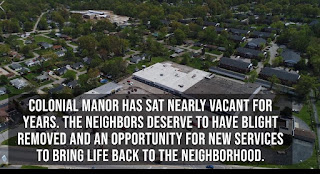
2

2. Colonial Manor has been moribund for so very long that Team Gahan displayed not one jot of interest in its redevelopment for seven whole years until the "deserving neighbors" began organizing themselves, thus holding out the prospect of interfering with Team Gahan's usual top-down, pay-to-play monetization arrangements.

Truth meter #2: Half credit.

3

3. An essentially meaningless claim. The city's new comprehensive plan explains theoretical development goals for the entire city, not any one area.

Truth meter #3: Irrelevant.

4

4. Number four is a doozy. A public meeting was held, but only Team Gahan's operatives were allowed to speak, and requests for public "preferences" were limited to six hastily concocted "options" from one of Gahan's campaign donor engineers. Duh: Of course neighbors "want something done to the property." You could glean as much from Facebook. After all, they'd already assembled a grassroots lobby group to drive the conversation, hence the need for Gahan's non-input meeting: to squelch this conversation and take back control for his Indianapolis corporate campaign donors.

Truth meter #4: Bald-faced, faked-fact lie. 

5

5. In which Gahan refers to $2.6 million in tax increment financing (TIF) bonds as "cash reserves" when in essence they're credit cards, then further asserts that TIF is not a form of borrowing. Among other problems, these "cash reserves" deprive schools of property tax revenue, leading to school corporation referendums like the one responsible for the Slate Run school construction taking place behind Colonial Manor. Do you think Gahan lies like this about his own household finances?

Truth meter #5: Egregious, bald-faced, faked-fact lie. 

6

6. The city did vote 5-4 against something, but whether it was an "effort to bring new life" cannot be known because the vote pertained only to acquiring the property, not to future plans (if any) to redevelop it.

Truth meter #6: Half credit. 

7

7. We saw the first such "exploration" of options at approximately 2:30 p.m. on Wednesday, when the video being dissected here was released. By his choice of timing, Gahan chose quite consciously (and with obvious malice) to undercut the grassroots efforts of the very same "neighbors" he'd already refused to allow to speak at the non-input public meeting he held for his own benefit.

With friends like Jeff Gahan, who needs enemas?

Truth meter #7: Perhaps the only truthful statement of the bunch. 

8

8. Gahan closes with his trademark messy verbiage. He "encourages everyone" (they're no longer "neighbors," are they?) to "encourage" -- that's right, the same verb twice in one sentence, attesting to the sloppiness of writing herein -- city council to "support revitalization efforts for Colonial Manor."

Note the first use of "revitalization" as opposed to "redevelopment," and also consider that Gahan doesn't specify which revitalization efforts "everyone" should support. Is it Gahan's politically motivated boilerplate or the efforts area residents already had started on their own with absolutely no help from the mayor or his flunkies, including their council person Matt Nash, who attended Wednesday's neighborhood meeting but couldn't muster the gumption to address the crowd, identify himself and let them know that he's listening.

Truth meter #8: See how Gahan acts when he can't have his toys?

Summary: Today's City Hall video shambles depicts Gahan at his self-interested, narcissistic and bullying nadir, with a truthfulness tally of roughly 25%, and still no apparent interest in the needs of people as opposed to the fix-is-in, play-to-play patronage boondoggle that local "pretend progressives" tolerate and seem to feel is justified as long as local Democrats mouth platitudes about other issues.

How many lies does Gahan need to tell before Democrats see the handwriting on the wall?

There's a solution. Vote David White for Mayor in the Democratic primary, and let's give the governing clique a purifying flush.

Thursday, April 18, 2019

Council rejects Gahan's, Redevelopment's Colonial Manor tax increment financing lollapalooza by a 5-4 vote. Alterations to come?


It might surprise you to hear me say that overall, tonight's council meeting was one of the most informative in a good while. The pros and cons of Team Gahan's Redevelopment Commission resolution to spend $2.6 million to acquire the Colonial Manor property were presented, and it was rejected 5-4, with the three council Republicans and two Independents against, and the body's four Democrats in favor.

Council president Blair's pre-vote summary of the stakes involved was very good. Interestingly, the Redevelopment Commission's visiting Indy lawyer Zoeller from the firm of Frost Brown and Todd ...


 ... which is a frequent Gahan campaign donor, stated that any amendments attached by council to the resolution would require Redevelopment's approval. However council's lawyer confirmed that no amendments could be attached; it was yes or no only.

Blair aired his frustrations with the Redevelopment Commission's overall autonomy and secretive nature. He suggested Redevelopment take out an option for purchase to allow time to incorporate council's points. Al Knable and others noted that it might be the only chance we get to "do" Colonial Manor right, and so it would be advisable to take our time and resist haste.

In turning down tonight's resolution, council in effect sends it back to Redevelopment with helpful post-it notes for changes sufficient to garner future council approval. For example, a comprehensive Charlestown Road corridor study is urged to be a part of what comes back for consideration. Other caveats include a citizen advisory committee and public input meetings that genuinely seek participation and not the rubber-stamping of pre-determined outcomes.

Given that the Redevelopment Commission is regarded by Jeff Gahan as his personal plaything, and the Colonial Manor purchase with the TIF One Platinum card plainly was intended as a rushed feather in Dear Leader's re-election bonnet, things now get interesting.

Don't forget next week's listening session. There might be more tomorrow, but right now, I'm tired.


Previously:

Researcher says: "In most cases around the country TIF did not fulfill its main goal of boosting economic development."


ON THE AVENUES: Amid Deaf Gahan's "victory" over grassroots activists at Colonial Manor, the toxic paranoia is no less rancid.


City Hall's staged Colonial Manor farce: It was INFORMATIONAL, you see, not COMMENTATIONAL. Deaf Gahan can't help it if voters don't know the lingo.


GREEN MOUSE SAYS: It's the Colonial Manor video Jeff Gahan didn't want you to see last night.

Researcher says: "In most cases around the country TIF did not fulfill its main goal of boosting economic development."


The reason why we're always talking about TIF?

  • TIF benefits are routinely exaggerated
  • TIF abets pay-to-play political patronage
  • TIF abuse shifts funding from schools and services to more speculative "public-private partnerships"
  • TIF expenditures typically are made by appointed boards, and consequently are not transparent

Because of the legal stipulation that TIF expenditures for property purchases above the appraised amount must come with approval by elected officials (as opposed to the usual appointed functionaries), city council will vote this evening on a resolution favoring the use of TIF funds by the Redevelopment Commission to purchase the moribund Colonial Manor shopping center from absentee owners.

Indiana law now makes clear that TIF is intended to fund infrastructure to promote development that would not occur but for the added infrastructure financed by the TIF revenues. Evidence that the development would not happen but for the establishment of the TIF district must be presented before the TIF district is approved. TIF is not meant as a source of revenue for responding to ongoing development, nor as a substitute for other sources of infrastructure funding. TIF districts are required to expire once the infrastructure bond is repaid. TIF is not meant as a permanent source of revenue for the enacting government.

It should be an interesting evening. The Green Mouse has tonight's tally at 4 council persons for, and 4 against, with Nanny Barksdale as the swing vote.

But is he really swinging?

Almost certainly not. Barksdale already has voted "aye" at Redevelopment for the Colonial Manor power play, and while nominally Republican, he's rubber-stamped Jeff Gahan's mega-spending almost as often as Greg Phipps (a Democrat).

This one's a done deal, so read why TIF shouldn't be.

The Trouble With TIF, by Tanvi Misra (CityLab)

Cities love to use Tax Increment Financing to boost development. Should they?

 ... After reviewing available research on the implementation and impacts of TIF, (Professor David) Merriman concludes that the mechanism, while helpful in some ways, leaves a lot to be desired.

“In the end, it can be a valuable mechanism,” he said. “It’s not something I’d like to get rid of—but it deserves a lot of scrutiny because public sector dollars are being re-routed into a different task, away from general purpose funds.”

snip

To understand what he means, let’s first explain how TIF works: When a city designates an area as a TIF district, the property value of all the real estate within its boundaries at that time is designated as the “base value.” This is the amount that, for a set amount of years after the fact, generates revenue through the city’s property tax process. Everything over and above that, through an increase in value of existing real estate and new development in that time frame, goes into a separate fund earmarked for economic development.

The city can then use this second pot of money to lure private investors with loans and subsidies for commercial projects, or to make public projects more attractive.

snip

Critics often charge that (TIF) funnels money out of the taxpayers’ pockets into a special fund that, by and large, works in a pretty opaque manner. While some of that money funds essential public works, much has also gone towards erecting new Whole Foods, renovating glitzy hotels, and building stadiums—the type of projects, one might argue, should not require such incentives. And the evidence Merriman analyzes suggest they may have a point. He shows that, in most cases around the country, the tool did not fulfill its main goal of boosting economic development.

“On average, [TIF] may be moving development from one part of the city to another, and changing the timing of the development, but there’s not more development than would have otherwise been made,” Merriman said.

In addition, this is a tool with several drawbacks. According to Merriman, TIFs might “capture” some tax revenue above the capped “base value” that may have been generated anyway through natural appreciation in property values if the TIF hadn’t been created. This is money that taxpayers might have otherwise paid directly towards an overlapping school district, or for public services. And while TIF is not a direct tax increase, it may lead to higher rates or service cuts elsewhere, if the city plans on bringing in the same general property tax revenue as before TIF.

“If property taxes are higher—if the rates are higher—then the TIF money has come of the taxpayer’s pocket,” Merriman said. “It’s a diversion in that way.”

In other words, TIF doesn’t exist in a vacuum. Like other tax incentive programs, it may have the adverse affect of creating competition between neighboring jurisdictions in a way that is not always beneficial—all for outcomes that are mixed, at best.

Perhaps the biggest concern with TIF, though, is that of transparency, because of the way this mechanism effectively bypasses the public municipal budget process.

“Once a TIF is created, the operation of a TIF receives less scrutiny than other spending,” Merriman said.


---


Democratic mayoral candidate David White understands that change begins with a whole lotta scrubbing, and NA Confidential advocates just such a deep civic cleansing. 

After eight years on the job, Mayor Jeff Gahan's list of stunning "achievements" is long, indeed: tax increasesbudgetary hide 'n' seekself-deificationdaily hypocrisy, public housing takeovernon-transparencypay-to-play for no-bid contracts, bullying city residents and bullying city employees. Eight years is enough. It's time to drain Gahan's swamp, flush his ruling clique and take this city back from Gahan's Indy-based special interest donors. 


NA Confidential supports David White for Mayor in the Democratic Party primary, with voting now through May 7

Tuesday, April 16, 2019

Hello darkness, my old friend: Is David Barksdale yet again the council's swing vote on Gahan's Colonial Manor power play?


"Shades of the Reisz Mahal," said the spider to the fly.

The Green Mouse has been told that occasional Republican councilman David Barksdale, who has voted with City Hall almost as often as council's Rubber Stamp Quartet of Democrats, yet again looks like the swing vote; the Mouse's abacus shows the Democratic foursome in favor, with two Republicans and two Independents opposed.

Of course we're referring to Thursday evening's resolution to approve the Redevelopment Commission's use of the city's TIF One Platinum card to purchase the moribund Colonial Manor shopping center from absentee owners.

ON THE AVENUES: Amid Deaf Gahan's "victory" over grassroots activists at Colonial Manor, the toxic paranoia is no less rancid.


At last week's Redevelopment fix-fest, council president Blair asked for documentation of the city's current TIF zone status. It runs for quite a few pages, and can be viewed here: CCPackets-041819

Here's the resolution. The bracketed passage explains why this measure even appears before council, and isn't just another backroom deal.


And this statement by redevelopment director Staten is meant to allay fears that the crazily rushed Colonial Manor deal isn't, well, just another backroom deal.


Is a construction date of 1965 historic enough for Barksdale's fetish? Will he fall into Dear Leader's bed/web/thrall as before? Or is it time to Make Spines Great Again (MSGA)?

Monday, March 18, 2019

Innovative ways of redeveloping Colonial Manor -- or, things John Gonder was talking about ten years ago.


In 2015 after two city council terms John Gonder ran afoul of the mayor's DemoDisneyDixiecratic patronage machine and lost his re-election bid, moving on to other things in life. John had a blog but didn't use it all that often; when he chose to write, the results invariably were thoughtful and indicative of interests outside our city's self-imposed political boxes.

On Sunday evening John made this comment to yesterday's Colonial Manor post: Colonial Manor redevelopment visioning to be the subject of a public meeting on Wednesday at 5:30 p.m.

This run at revitalizing Colonial Manor caused me to look back at something from ten years ago. It might still be worth considering. The points relevant to the current situation appear in the final three paragraphs. Here's the link.

That's right. Colonial Manor was being discussed ten years ago during Barack Obama's first term -- and Doug England's last. Since John no longer actively blogs, I'm reprinting the entire post from March 22, 2009, but consider clicking through to view the comments.

There seems to be one big question about future prospects for refurbishment at Colonial Manor: Can anything positive happen there without the use of tax increment financing (TIF) money?

---

Back to the Drawingboard. Please.

At the most recent City Council meeting, March 19, a development which could have resulted in the relocation of the Charlestown Road Wendy's to a site farther out Charlestown Road was nixed by the Council.

For those who don't know, the Wendy's project cuts out a portion of a large lot for the restaurant while leaving the current zoning in place for an "L" shaped piece of property surrounding the restaurant on two sides.

In an attempt to extract something meaningful from the proceedings, I would like to offer an idea that could have possibly yielded a different outcome. At least it could have changed my vote. Unfortunately I'm not holding my breath waiting for the missing ingredient, because that missing ingredient is found in such short supply among developers hereabouts. The ingredient? It goes by several names: innovative thought, creative approaches, getting ahead of the curve, anticipatory development in recognition of the changes suggested by new environmental realities.

That is, after three or four years on the New Albany Plan Commission and now starting the second year on the City Council, I have yet to see more than about two developments that might fall outside the unflattering catchall categorization of cookie cutter sameness.

Look at any of the patio home developments. These are offered as a response to a demographic change in our culture. Aging people are downsizing their households yet still want independence and convenience. So far, so good. A curbside assessment of the typical patio home,however, looks like, in Jeopardy fashion, an answer to the question "Where can my car and I go so both of us feel at home?" The street presentation is of struggle for dominance between the garage and the living quarters. From all appearances, the cars are winning out with the most prominent digs.

Are the developers stupid? The buyers? No, I don't think so. On the contrary, the patio homes I've seen from the inside appear well built and comfortable and suited to the needs of the people living there. But it would be difficult to find a current mode of housing design that more glaringly exemplifies the cookie cutter school of thought.

But the Wendy's development, ( if indeed it is a Wendy's, and there's truly no way to know that at this juncture, according to counsel ) is a commercial development, so what's that got to do with cookie cutters and patio homes? Again, it's the lack of a creative or innovative approach to the puzzle of what to do with that parcel of land. Clearly no one who holds an economic interest in the land sees doing nothing, or next to nothing, as a viable option, otherwise they might consider leasing it to an agricultural entrepreneur who could open an "in-town" small scale u-pick farm. Would there be enough customers for such a thing? Surely not in that end of town.

I just erased several paragraphs in which I suggest what the developers could do with the land. The reality is, that just like with the patio homes, the developers failed to offer anything innovative. As if to underscore the fact that they were offering nothing innovative, they weren't even offering a plan to bring in a new hamburger joint, they were simply going to move an existing hamburger joint to a new location; on the same road yet. And for this accommodation of the developers' plans, the existing neighborhood residents were being asked to suck it up in the cause of progress and free markets.

So maybe it shouldn't all be left up to the developer.

One of the best ways this type of situation could be headed off in the future is for the City of New Albany to begin a reorientation away from greenfield development and toward REdevelopment. (As was stated in the Council meeting, fast food restaurants typically use up a building in a pre-ordained period of years and then move to a new location.) Charlestown Road from Eighth Street out to Klerner Lane is showing signs of commercial and residential neglect and deterioration.

A prime example is the Colonial Manor shopping center, across the street from the current Wendy's site, abandoned several years ago by Kroger in favor of a new site across from the proposed Wendy's site. If the city were to acquire the property it could solicit proposals from developers to take that property back to the level of vibrancy needed to make a strong neighborhood. The use of Economic Development Income Tax (EDIT) funds could be used to buy the property thus freeing the developer from the carrying cost of the project during development. Direction by the Plan Commission, through the RFP, could shape the REdevelopment in ways most beneficial for the entire community. The developer would make a profit but only by producing a worthwhile, cohesive project. And when the developer is out of the deal the EDIT funds would be returned.

This would be a better way to steer the development of the community in ways that truly benefit the entire community, not simply the narrow interests of the developers. If Colonial Manor were, in fact, redeveloped it is quite possible that the entire Charlestown Road corridor would be seen as more desirable and unfortunate situations such as the one involving the Wendy's project might be avoided.

Sunday, March 10, 2019

Homeschoolers react with puzzlement as Deaf Gahan reads to them from his masterwork, "TIF Area Erotica."


It was THAT kind of week, as area news agencies fell over themselves to transform Gahan's rails-to-trails pipe dream of a campaign slogan into some semblance of reality.


Meanwhile, we kept right on reporting the facts.


It's New Albany, not New Gahania, and we don't need a Gahan-scaled personality cult.


We don't need an insular clique farming contracts and favors to the same old special interest donors, or taxpayer-funded municipal media feeds that function as campaign tokens. Gahanism has been a colossal bait 'n' switch, with working people and the downtrodden paying the freight for ruinously expensive luxury facades. It's all for show, and when we peel away the glitz, there's nothing underneath except a former veneer salesman's tin-can ambition.

I'll be voting for David White in May, and I encourage you to do the same.

Thursday, February 14, 2019

Ribbon cuttings and back alley slush, or "How Corruption in Public Investment Hurts Growth."


Yesterday we took a look at branding and personality cults.

Jeff Gahan has been branding the city in his own image, and using our money to do it, but we need collective thinking, not the shoddy veneer of a personality cult.


Next, on the general topic of corruption in public investment, here's a two-decade-old analysis that hasn't aged a day.

This paper contends that such corruption increases the number of capital projects undertaken and tends to enlarge their size and complexity. The result is that, paradoxically, some public investment can end up reducing a country’s growth because, even though the share of public investment in gross domestic product (the total of all goods and services produced in a country in a given year) may have risen, the average productivity of that investment has dropped.

Consider the way Strong Towns addresses the issue of scale.

We all know that it makes more sense to work incrementally, to make many small investments to shore up and strengthen our core neighborhoods. How do we do that when every mechanism we use to deliver projects — from funding sources to regulations to the project advocates themselves — pushes us into a few large endeavors we hope will trickle down to something resembling success.

In a place like New Albany, mayors like Jeff Gahan utilize mechanisms like Tax Increment Financing for the funding of large capital projects, seeing as the general fund already is spoken for.

Because most current spending by governments reflects entitlements or previous commitments—such as pensions, interest payments on public debt, salaries, and subsidies—politicians have, in the short run, limited discretion to influence it. 

The amount of money available for large capital projects via TIF runs into the tens of millions, and boards appointed by the mayor to do the his bidding rubber stamping these decisions.

Senior officials may have complete discretion over these decisions, especially when a country’s controlling or auditing institutions are not well developed and institutional controls are weak.

Precisely because the nickels and dimes of these large expenditures are not being overseen by elected officials, there is the very real possibilities that size and scale are inflated. After all, those small and sustainable projects generate too few headlines, and too little beak-wetting.

For a private enterprise, getting a contract to execute a project, especially a large one, can be very profitable. Therefore, managers of these enterprises may be willing to offer a "commission" to politicians who help them win the contract. Conversely, in many cases the act of bribery may not start with the enterprise but with the officials who control the decisions—in some countries it is apparently impossible to win a government contract without first paying a bribe. The payment of such a bribe is illegal in very few countries.

Are campaign contributions merely the cost of doing business? As the authors make clear, chicanery reduces the ultimate value of the investment; it also contributes to under-funding of maintenance and repair costs, another reality seldom discussed at the ribbon cutting.

As noted previously, the clearest way for any local candidate to demonstrate his or her understanding of the possibilities for abuse inherent to promiscuous fundraising is to embrace a higher ethical bar.

With David White as mayor we'll have ethical standards from the get go -- not Jeff Gahan's pay-to-play cesspool on the down low.


Gahan ethics? You might as well try to teach your dog to sing opera. Read the report, reprinted below.

---

Roads to Nowhere: How Corruption in Public Investment Hurts Growth, by Vito Tanzi and Hamid Davoodi (International Monetary Fund; March 1998)

Roads to Nowhere: How Corruption in Public Investment Hurts Growth
Ribbon-cutting ceremonies marking the opening of investment projects—such as roads, dams, irrigation canals, power plants, ports, airports, schools, and hospitals—are every politician’s dream. These occasions present splendid photo opportunities, while the very act of cutting the ribbon seems to identify the shear-wielding politician as a contributor to the future growth of the economy. In some countries, however, corrupt politicians appear to choose investment projects not on the basis of their intrinsic economic worth, but on the opportunity for bribes and kickbacks these projects present.

This paper contends that such corruption increases the number of capital projects undertaken and tends to enlarge their size and complexity. The result is that, paradoxically, some public investment can end up reducing a country’s growth because, even though the share of public investment in gross domestic product (the total of all goods and services produced in a country in a given year) may have risen, the average productivity of that investment has dropped.

This conclusion runs counter to the bias of many economists. The conventional wisdom of the economics profession is that countries need capital to grow and, more important, that a direct relation exists between capital spending and growth. In other words, if a country engages in capital spending, growth is likely to follow. As a consequence of this belief, the economics profession has been strongly biased in favor of capital spending by governments. When economists evaluate the allocation of public money between current spending (for recurring, day-to-day expenses) and capital spending in government budgets, they tend to be critical of countries that allot a large share of government expenditure to current spending, but to applaud countries that refuse to stint on capital spending.

This bias is enshrined in the "golden rule" often advocated by economists. The rule states simply that only current expenditure needs to be balanced by ordinary revenue, but that a country can—within limits—safely run a fiscal deficit (an amount it must borrow from domestic or foreign investors) equal to the capital spending of the government. You should cover the current budget with government revenues, but borrow whatever you can for the capital budget. Thus, it is all right to borrow to finance the building of new roads but not to finance the repair of existing roads, or to borrow for building a new hospital but not for hiring doctors or nurses or for buying medicines. This rule continues to be evoked as a good guide to policy even in the face of much evidence that some current expenditure—such as on operation and maintenance that keeps existing infrastructure in good condition or that contributes to the accumulation of human capital—can promote growth more effectively than capital expenditure.

Politicians have been quick to internalize this bias and have sensibly learned to exploit it. This pro-investment bias bloats the investment budget.

A Wealth of Opportunity and Vice Versa
Because most current spending by governments reflects entitlements or previous commitments—such as pensions, interest payments on public debt, salaries, and subsidies—politicians have, in the short run, limited discretion to influence it. Individual politicians generally lack the power or will to change the salaries or pensions of specific public employees or to alter subsidies to individuals. In contrast, there is nothing routine about the capital (investment) budget and its composition: capital spending is highly discretionary. In formulating the capital budget, senior political figures must make the basic decisions. These decisions determine the size of the total public investment budget, the general composition of that budget (the broad allocation among different categories of capital spending), the choice of specific projects and their geographical location, and even the design of each project. Senior officials may have complete discretion over these decisions, especially when a country’s controlling or auditing institutions are not well developed and institutional controls are weak.

Who Benefits?
Public investment projects tend to be large and, sometimes, very large. Since their execution is generally contracted out to domestic or foreign enterprises, the first step is choosing a firm to undertake the project. For a private enterprise, getting a contract to execute a project, especially a large one, can be very profitable. Therefore, managers of these enterprises may be willing to offer a "commission" to politicians who help them win the contract. Conversely, in many cases the act of bribery may not start with the enterprise but with the officials who control the decisions—in some countries it is apparently impossible to win a government contract without first paying a bribe. The payment of such a bribe is illegal in very few countries. In fact, the laws of certain major industrial countries regard commissions paid by domestic enterprises to foreign politicians as not only legal but also tax deductible, although this is changing, as discussed below.

A commission of even a few percentage points on a project that costs millions or even hundreds of millions of dollars can be a large sum, one large enough to exceed the temptation price for many otherwise reputable individuals. When commissions are calculated as a percentage of project costs, the politicians or public officials who receive payment for helping the enterprise win the bid will have a vested interest in increasing the scope or the size of the project so they can get larger commissions. A commission of 2 percent of the cost of a four-lane road is understandably more tempting than 2 percent of the cost of a two-lane road.

The process of approving an investment project can be an irresistible temptation for the unscrupulous. For example, a civil construction project (a road, building, or port) requires decisions related to specification and design issues, issue of tender (limited to a single firm or open to all), tender scrutiny, tender negotiations, and tender approval and contracting process. The completion of the project will require verification that the work has been done according to the contract. It will also require some arbitration about points of disagreement. The writing of contracts for complex projects is difficult and inevitably many areas of uncertainty and eventual disagreement will need to be resolved through negotiation.

In some of these phases, a strategically placed high-level official can manipulate the process to select a particular project. He can also tailor the specifications of the design to favor a given enterprise by, for example, providing inside information to that enterprise at the time of issuance of tender.

Who Pays?
The enterprise that pays the commission rarely suffers from the payment of the bribe, since it is usually fairly simple to recover that cost. First, if it is assured by corrupt officials of winning the bidding competition, the enterprise can include the cost of the commission in its bid. Second, it can reach an understanding with the influential official that the initial low bid can be adjusted upward along the way, presumably to reflect modifications to the basic design. Third, it can reduce its spending on the project by the amount of the bribe by skimping on the quality of the work performed and the materials used. Fourth, if the contract is stipulated in a cost-plus fashion, the enterprise can recover the cost of the commission by overpricing.

In all these alternatives that require the collaboration of a corrupt politician or official, the taxpayers will end up with either a more costly project—or a bigger or more complex project than necessary—or a project of inferior quality that will require costly upkeep and repair. Experience with public sector projects, especially in developing countries, is replete with stories about roads that are pocked with potholes soon after completion, power plants that experience regular blackouts, and sewer systems that don’t work.

So What?
Why does it matter when this happens? It matters because the productivity of capital spending is reduced, which in turn lowers the growth rate of the country. When corrupt politicians influence the approval of an investment project, the rate of return as calculated by cost-benefit analysis (a method of determining just how much each dollar invested will increase output) ceases to be the criterion for project selection. Corruption distorts decisions about the investment budget. When corruption plays a large role in the selection of projects and contractors, some projects are completed but never used. Others are so poorly built that they will need continuous repair and their output capacity will disappoint. In these circumstances, it is not surprising that capital spending often fails to generate the growth economists expect.

Side Effects
Widespread corruption in the investment budget will not only reduce the rate of return to new investment in a country, but will also affect the rate of return the country gets from its existing infrastructure. To the extent that corruption has been around for some time, the existing infrastructure has also been contaminated because past investments were also misdirected or distorted by corruption. Moreover, higher spending on capital projects will reduce the resources available for other spending. Of the other spending categories, one not protected by entitlements or implicit commitments is operation and maintenance—the current public spending required to keep the existing physical infrastructure in good working order. Too often, new projects are undertaken while the existing infrastructure is left to deteriorate. In cases of extreme corruption, operation and maintenance on the physical infrastructure of a country are intentionally neglected so that some infrastructure will need to be rebuilt, thus allowing corrupt officials the opportunity to extract additional commissions from new investment projects.

A country can squeeze more output out of existing infrastructure by keeping it in good working order. It is easy to think of situations in which the deterioration of infrastructure retards growth more than new capital projects add to growth. In addition, when generalized corruption in a country reduces resources because corrupt tax administrators skim off or fail to turn in tax revenues, operation and maintenance will be reduced far more than public investment because of the intellectual bias that supports borrowing for capital projects but not for current expenditure.

Empirical Analysis
Is the discussion so far merely theoretical or anecdotal? Unhappily, enough information has been gathered on corruption not only to justify the above observations but also to allow the formulation of several hypotheses about a symbiosis between high-level corruption and specific aspects of public spending and revenue collection. A principal source of assessments of the degree of corruption in various countries is Business International and Political Risk Services, Inc., which publishes an annual index, International Country Risk Guide, covering the 1982–95 period for 42 to 128 countries, depending on the year. In this index higher corruption indicates that "high government officials are likely to demand special payments" and "illegal payments are generally expected throughout lower levels of government" in the form of "bribes connected with import and export licenses, exchange controls, tax assessment, police protection, or loans." Data on specific aspects of government spending and revenue collection, meanwhile, may be drawn from the IMF’s Government Financial Statistics.

An examination of the data from these two sources suggests the formulation of several clear hypotheses concerning the relationship between corruption on the one hand and (1) public investment, (2) government revenue, (3) operation and maintenance expenditures, and (4) the quality of infrastructure on the other. The authors test the hypotheses against statistical evidence, analyzing cross-country data through the use of a statistical tool called regression analysis to estimate the strength of the relationship between corruption and these four variables. In guarding against spurious regression results, and depending on the regression, the researchers controlled for other variables, such as real per capita GDP, the ratio of government revenue to GDP, and the ratio of public investment to GDP. Their hypotheses follow.

Corruption and Government Investment
Hypothesis 1. Other things being equal, high corruption is associated with high public investment.

The governments of most countries are honest and responsible, but in some countries the government is not above suspicion of serious corruption. For these latter countries, regression analysis shows that the above hypothesis cannot be rejected. ("Cannot be rejected" is a somewhat off-putting term of art in regression analysis indicating a high correlation between variables: where you have one, you probably have the other.) The data also suggest the unfortunate corollary that corruption reduces private capital investment by more than it increases public capital investment.

Corruption and Government Revenue
Corruption can reduce government revenue if it contributes to tax evasion, improper tax exemptions, or weak tax administration. This leads to a second hypothesis.

Hypothesis 2. Other things being equal, high corruption is associated with low government revenue.

The analysis indicates that this hypothesis cannot be rejected either.

Corruption and Operation and Maintenance Spending
Since corruption and bribery are more effectively related to (that is, it is easier to extract bribes from) new investments (as opposed to infrastructure already in place), corruption may result in lower operation and maintenance expenditure on existing investments. This observation leads to a third hypothesis.

Hypothesis 3. Other things being equal, high corruption is associated with low operation and maintenance expenditures.

Since direct cross-country data on operation and maintenance expenditures are not available, the analysis uses two statistical proxies: (1) IMF Government Financial Statistics "expenditures on other goods and services," which include operation and maintenance expenditures, and (2) wages and salaries expressed as a fraction of current expenditure, because governments tend to cut operation and maintenance expenditures when they award salary increases. Hence, increases in wages and salaries can be interpreted as cuts in operation and maintenance expenses.

The analysis shows that high corruption is indeed associated with low operation and maintenance expenditures. Although the first proxy (expenditure on other goods and services) does not support this correlation, the second shows a positive correlation: countries with high corruption do tend to have a high ratio of wages and salaries to current expenditure. (Note that this result does not mean that the level of salaries of government officials in corrupt countries is higher.)

Corruption and the Quality of Public Investment
It has been known for some time that corruption is most prevalent in infrastructure projects, usually large civil engineering projects. Current evidence, however, has linked corruption only to the quantity of investment and not its quality. It was argued above that high-level corruption induces countries to increase the quantity of infrastructure because of the bribery potential of new infrastructure investment. In addition, the quality of existing infrastructure will tend to deteriorate if corruption leads to cutbacks on operation and maintenance expenditure. These observations lead to a fourth hypothesis.

Hypothesis 4. Other things being equal, high corruption is associated with poor quality of infrastructure.

The data analyzed in this hypothesis (referred to as performance indicators of infrastructure) are measured from the perspective of both infrastructure providers and users. They cover a large number of countries and have many characteristics that make them the responsibility of governments. These data are taken from the International Telecommunications Union and the World Bank’s World Development Indicators database. The analysis shows that this hypothesis cannot be rejected: countries with high corruption do tend to have poor-quality infrastructure. The impact of corruption is statistically strongest on the quality of roads (paved roads in good condition), power outages, and railway diesels in use. An important implication of the results is that the costs of corruption should also be measured in terms of deterioration in the quality of existing infrastructure, since these costs can severely inhibit economic growth.

Reprise
Evidence presented in this paper supports four arguments.

1. Corruption can reduce growth by increasing public investment while reducing its productivity.

2. Corruption can reduce growth by increasing public investment that is not adequately supported by nonwage expenditure on operation and maintenance. Evidence also shows that higher corruption is associated with higher total expenditure on wages and salaries. Wages and salaries are a large component of government consumption, and higher government consumption has been shown to be unambiguously associated with lower growth.

3. Corruption can reduce growth by reducing the quality of the existing infrastructure. A deteriorating infrastructure increases the cost of doing business for both government and the private sector (congestion, power outages, accidents) and thus leads to lower output and growth.

4. Corruption can reduce growth by decreasing the government revenue needed to finance productive spending.

In sum, economists should be more restrained in their praise of high public sector investment spending, especially in countries where high-level corruption is a problem. Although this paper focuses on the problem of corruption and not on its solutions, concern about the issues discussed here appears to be gaining currency. On December 17, 1997, for example, ministers of 34 countries—of which 29 are members of the Organization for Economic Cooperation and Development (OECD)—signed an agreement aimed at eradicating bribery of foreign officials. The agreement encourages its signatory countries to introduce legislation making payments of bribes to foreign officials no longer tax deductible, and criminalizing the payment of bribes to foreign government officials. The agreement is limited, however, as it does not apply to the payment of bribes to foreign political parties or to private individuals. Moreover, it must be ratified by the legislative bodies of each signatory country. The initiative represents, however, an encouraging start in eliminating the corruption of political leaders.

Author Information
Vito Tanzi is Director of the Fiscal Affairs Department of the IMF. He holds a Ph.D. in economics from Harvard University.

Hamid Davoodi is an economist in the Fiscal Affairs Department of the IMF. He graduated from the London School of Economics and Political Science and holds a Ph.D. from the University of Wisconsin, Madison.

Thursday, January 31, 2019

A Tax Increment Financing (TIF) primer, noting TIF's chumminess with insider corruption, and certain grassroots alternatives to big ticket glitz.


Tax Increment Financing (TIF) came up a lot when I ran for mayor in 2015, so much so that the Bookseller created a paper for consultation by our team.

---

A Baylor Paper on Tax Increment Financing

HISTORY: Tax Increment Financing, commonly known as T.I.F., is a method created by the legislature that allows a city to invest borrowed money in the hopes that the investment will increase property values in a specific geographic area. To the extent that property values do increase, the city may use those new tax dollars to retire its debt on that investment.

TIF areas have expiration dates. Other taxing entities are barred from collecting taxes on the increased value, if any, until the expiration of the TIF area.

PREMISE: Cities are severely limited in how rapidly they can grow their revenues, which are based largely on the assessed value of properties within the city limits. Cities have no control over assessments and their revenues are capped by annual growth limits. Thus, tax increment financing is one way to make ambitious, if speculative, investments in the future without waiting for growth.

But TIF-ability is an asset that must be carefully used and its benefits must be calculable. The Gahan administration has been irresponsible in that respect and has used the T.I.F. function more like a piggy bank or a blue-sky wish list. Current officials won’t be around when the bills have to be paid.

PROPOSAL: I’ll conduct an immediate audit of our T.I.F. programs and will publicly report to the citizens of New Albany the whos, whats, whens, whys, and wheres regarding them.

---

I haven't asked Democratic mayoral candidate David White yet, but I strongly suspect his view of TIF programs and the abusive tendencies of their local application corresponds with the preceding. However, I can state with certainty that White fully understands the challenge to future municipal solvency posed by serial TIF misuse. He'd rather face up to it than kick the can further down the high-maintenance-cost road.

As an aside, I cannot recall a time when 3rd district councilman Greg Phipps girded up to disagree with current Anchor Office occupant Jeff Gahan's addiction to TIF areas as de facto credit cards intended to be pumped dry so as to enable bright shiny "piggy bank" and "blue sky" wish lists, while leaving the burden of debt management to be left for our grandchildren.

Yesterday I spoke of the no-gimmicks Strong Towns platform as a "third way" for New Albany.

+ Stop valuing efficiency and start valuing resilience;
+ Stop betting our futures on huge, irreversible projects, and taking small, incremental steps and iterating based on what we learn;
+ Stop fearing change and start embracing a process of continuous adaptation;
+ Stop building our world based on abstract theories, and start building it based on how our places actually work and what our neighbors actually need today;
+ Stop obsessing about future growth and start obsessing about our current finances.

For more about TIF's positives and negatives, read this article from the Strong Towns Knowledge Base. It's also worth contemplating this: How much of Gahan's pay-to-play campaign finance enhancement would be possible without the gravy generated by TIF projects? He may be corrupt, but he's no fool when it comes to undercover math.

Your Questions Answered: Is TIF Always Bad? by Jacob Moses

 ... This week’s question: Is TIF always bad?

Tax increment financing (TIF) is a financing method used by local governments, often to redevelop blighted or disinvested areas where market-rate development is seen as unprofitable without assistance. Under a TIF agreement, a local government incentivizes a developer to work in a designated geographic area (called a TIF district) by subsidizing a portion of the development costs. The subsidy may help pay the up-front cost of either private development or associated public infrastructure. The city raises the money by selling bonds to investors, and the bonds are gradually paid back out of increased property taxes over the next 20 or 30 years.

As redevelopment causes the value of the property to increase, more property taxes can be collected from within the TIF district. Rather than adding these to the city’s general budget, any additional tax revenues above the amount paid at the time the TIF was established are set aside in a special fund. That fund is reserved for gradually paying back the initial TIF bonds. Once the TIF is paid off, local governments can use the future property taxes for anything—road maintenance, schools, etc.

Questions to ask, and alternatives to be considered.

The intention behind TIF is not always bad—but here is a list of questions you can ask yourself or your elected officials to discover if TIF is best for your city’s or town’s financial health.

Have you considered incremental development?
Incremental development means making small bets on many small projects over a broad area over a long period of time. Because local governments don’t have the ability to guarantee the future success of a project, they should consider growing incrementally.

Instead of constructing a rail line, you start with a shuttle bus; instead of building an apartment complex, you start with a duplex.

This same philosophy applies to TIF districts, which are often used to jump-start large scale redevelopment projects, and justified on the basis that no such mega-project would have been viable without TIF. But should the city first consider a smaller investment to develop the area? Could they invest in helping the existing local grocery meet its needs? Could they practice economic gardening and seek to help hardworking, entrepreneurial residents of the area start and grow companies? Could they make sidewalk and traffic-calming improvements that improve street safety and make a business district more walkable and lively?

What would it take to gradually bring up the value of existing properties instead of doing full-scale redevelopment?

We know these alternative solutions aren’t as shiny and new as the proposed, TIF-funded megaproject. However, because they are small bets, local governments can preserve their resilience if they don’t succeed.

Is the public losing anything?
Before local government can approve a project for TIF, they must ensure the project passes the “but for” test: but for the TIF subsidy, the development wouldn’t happen.

If that’s true, then the TIF is jumpstarting development but the public isn’t losing anything, because the money to pay off the initial TIF subsidy is coming from property taxes that otherwise wouldn’t have been collected at all.

The problem, however, is that it’s challenging to actually assess that “but for” test in practice, meaning lots of projects that get TIF money probably don’t pass it. That means TIF can end up starving the local government’s general fund—which pays for most city services—because the property taxes are going to the TIF district instead.

Before approving projects for TIF, it’s essential that local governments—to the best of their ability—ensure that the TIF money is going to truly necessary, value-creating projects that can’t happen any other way, and not to subsidize development that could have been achieved by another means.