A friend uncovered these snippets of the time 65 years ago when an untolled bridge (Clark Memorial) was a godsend for Southern Indiana, and New Albany still had its own Chamber of Commerce.
Strikingly, the availability of public housing was considered an indicator of growth progress, but the units being constructed at the time were segregated ... in Indiana, mind you.
Six and a half decades later, are we making progress?
Thanks, B.
Tuesday, November 07, 2017
Monday, November 06, 2017
City Council Monday: All the mews fit to reject?
Tonight there was a city council meeting, and 3rd district councilman Greg Phipps introduced this PUDD request:
Z-17-03 Ordinance Amending the Code of Ordinances of New Albany, Indiana Title XV Chapter 156 (West Street Mews, Inc. requests a PUDD to permit freehold townhouses in the R-2, Urban Residential district at 1105-1109 West Street)
Amid rumblings of tsunami-intensity storm water chaos from Mt. Coffey, Phipps conceded that he had several issues with the plan to construct townhouses on permeable green space -- though he voted in favor of the proposal when it came came before the Plan Commission because, in his own words, he "didn't want to be the only vote against."
Phipps later reiterated the existence of undisclosed issues but said he'd hate to make the developers incur any further expense.
Meanwhile, Coffey reminded listeners of the incredible miracles of affordable housing and economic recovery achieved in Westendia during his long tenure, and said that townhouse-level density would just plain kill these many advancements.
There finally was a vote, during which Phipps dismissed any of the doubts he hadn't yet explained and voted in favor, but only (or so he stated) because he was the one to bring it to council from the Plan Commission, implying he felt obliged.
He was joined by the three Republicans, leaving council president McLaughlin to cast the deciding vote against the proposal.
THROUGHOUT THE ENTIRE DEBATE, NOT A SINGLE ELECTED REPRESENTATIVE ASKED THE MOST PERTINENT QUESTION OF ALL.
Like this:
Why are newly constructed townhouses in Westendia being called "mews," when to call them "mews" is complete and utter nonsense?
mews
myo͞oz
noun (British)
1. a row or street of houses or apartments that have been converted from stables or built to look like former stables.
2. a group of stables, typically with rooms above, built around a yard or along an alley.
Mews? Not these apartments in Massachusetts.
This is more like it.
The proper course of action this evening was to look the developers square in the eye and say:
"Stop insulting our community with cutesy-pie bullshit. Go away, and come back with a name that makes sense."
Well, a boy can dream. Now, see what the real thing looks like in London.
LONDON’S PRETTIEST MEWS STREETS, by Laura (Sometime Traveller)
Wander around the streets of Kensington, Chelsea or Notting Hill and it won’t be long before you stumble across a mews street. You might not notice them at first – they’re often hidden away behind brick archways or ivy-covered entrance ways – but make the effort and you’ll discover some of the prettiest streets in London.
You’ll mostly find mews streets lying behind a row of grand townhouses. The little cottages along these streets used to be the stables for the townhouses back in the day, but nowadays they’ve been converted into multi-million pound properties that you’ll need a lottery win to afford (unless you’re Keira Knightley in Love Actually*).
Below are six of my favourite mews streets in London. Most of them are nice and close to each other in Kensington (Gloucester Road or Earl’s Court are the nearest tubes), so they make a really nice walk, particularly on a sunny day.
*If you want to see the mews where Keira’s character lived, it’s St Luke’s Mews in Notting Hill.
UPDATE: Redevelopment's proposals for 32 Bank Street and 1629/1637 Market Street.
The grassy expanse at 32 Bank Street is the city-owned space adjacent to the levee recently immortalized by Dan Coffey in "Brother, Can You Spare a Dime to Park During Harvest Homecoming?"
GREEN MOUSE SAYS: Did BOW give Dan Coffey permission to leverage city-owned ground during the Orange Occupation?
The lots in disarray at 1629/1637 Market Street (the Vinod Gupta Vincennes Revitalization Project) are where Tommy Lancaster Restaurant and Market Boy used to stand.
UPDATE: 90 days later, Deaf Gahan's "blight and eyesore" has been superseded by "eyesore and blight" -- and DNA jauntily approves.
Matt Chalfant is the developer behind the proposal at 32 Bank, which presumably will be residential, further complicating the Orange Occupation's plan of operation (and Coffey's pocketbook).
| August 8 Minutes |
---
| August 22 Minutes |
The entity submitting a proposal for 1629/1637 Market is Progressive Land Development LLC, with Paul Barber listed as registered agent. Previous public announcements by disgraced former redevelopment kingpin David Duggins suggest that mixed use (residential and retail) are desired in this location.
Redevelopment minutes for October have not been posted, and these the August record provides no more detail than you can see in these excerpts.
Do you have more detailed information? Let me know. The 3rd floor oddly has become reticent in communicating with the blog.
Shrug.
Sunday, November 05, 2017
Shopping, strolling, beaches, herring, bock and madras. Just a second day's reintroduction to Haarlem.
Previously: Renewing friendships in Haarlem. Being thankful. Promising to be back soon.
Our second day in Haarlem was Thursday, September 21.
Marilyn was in school, so Inge met us at the Grote Markt and we went off on a proper walk in search of a thrift store, passing from the center of the city through through a slice of Haarlem's neighborhoods north of the train station.
But first, there was "second breakfast" herring to eat, as previously documented here: LIVE TO EAT: In Haarlem, the delicious "Hollandse Nieuwe" herring experience.
Originally the "Hollandse Nieuwe" haring being recounted here was intended for consumption on Wednesday, the day of our arrival. However, by the time we finished an opening round of drinks and got organized, the proprietor was depleted for the day.Hollandse nieuwe haring is a delicious memory I'll continue reliving in my mind and taste buds -- until whenever we return to Haarlem.
Hence, the saddest sight in all of the Netherlands.
Inge opted to have hers sliced. It tastes just as good, albeit slightly less theatrical.
Haarlem's town hall was the backdrop.
We'd actually strolled a bit before Inge arrived. Alas, the friet (fries) stand wasn't open yet.
With the herring consumed, we set off for the thrift store. Consider the space it takes to park bicycles as opposed to cars.
However, if even more bicycle parking is needed, there's always the underground, bikes-only garage by the train station.
It was a delightful walk.
The thrift store had an eclectic selection of glassware and music.
At the adjacent supermarket was evidence that in the Netherlands, bock/bok beers are an autumn phenomenon, not late winter/spring as in Germany.
There was a huge display given over to local beers.
Later in the afternoon, Diana and I walked back to the station and hopped a train to the beach resort at Zandvoort, only a six-mile ride through the relatively truncated Haarlem suburbs and the barrier terrain of the National Park Zuid-Kennemerland.
The National Park is composed of young calcerous dunes, wide beaches and lush coastel forests as well as remnants of cultural history like farms/estates, seaside villages and bunkers. Differences in soil, elevation, climate and groundwater levels in dunes provide diverse living conditions for both flora and fauna alike. While the elements, sand, rain and wind only serve to reinforce the biological dynamics of the area.
It was a temperate autumn day by the ocean, and we restricted our activities to observing the scene from the safety of a seaside restaurant.
Back in Haarlem from the beach, Diana took a break and I went to Jopenkerk to meet Dewi and Boris. We subsequently decamped for Lokaal, Rob's signature Dutch beer bar. It is located just a couple minutes by foot from our hotel, and since the closing of Cafe Briljant, it's his sole pub business.
On the topic of food, it was revealed that seeing as Lokaal has no kitchen, we'd be ordering dinner delivery from Taste of India. This afforded a second happy opportunity for madras and curry. Diana joined us for the feast.
That's half a profile of Rob in the rear. Weirdly, it occurred to no one to photograph the reunion, and so having finally made it back to Haarlem after nine years, the faces of Rob, Boris and Dewi were not captured on film.
(exasperation)
Two full days remained.
UPDATE: A Human Rights Commission would come in handy given the public housing putsch, but the same lawyer who wrote the belly-up human rights ordinance now sits on the public housing board. Now that's New Gahania.
![]() |
| Stan Robison's that lawyer, sans pink slip from Glorious Leader. |
It has been almost nine months since New Albany's Human Rights Commission made a feeble blip on the city's radar screen.
---
(January 19, 2017)
Gee, CM Phipps, we're mystified as to why the New Albany Human Rights Commission is moribund.
During the appointments phase of this evening's city council meeting, President Pat McLaughlin (4th District) asked Greg Phipps (3rd District) about the council appointments status of the Human Rights Commission.
According to the ordinance, council and mayor each appoint members to the HRC, and then the four pick the fifth.
Phipps waved him off, briefly indicating that the HRC seems dead, with no meetings for the past 18 months and no apparent interest. McLaughlin was more than happy to move to the next commission, and that's all we know. It isn't much.
I won't go into the lengthy and exceedingly futile history of the HRC's most recent incarnation, though almost exactly five years ago, we thanked Phipps for taking an interest.
Kudos to CM Phipps for making the Human Rights Commission's revival a priority.
Subsequently, perhaps no other single topic better illustrates the doctrine of Civic Gahanism than the history of our reconstituted Human Rights Commission:
Fundamental change is imperative, so long as nothing fundamentally changes.
Here's a short summary from 2015.
It was never Jeff Gahan's idea to enable a human rights commission, but in the grand scheme of political maneuvering, there was sufficient support that he acquiesced, pausing only to be assured that he'd receive credit for the sham he at first opposed, and would extract payback chits from those duly assuaged, redeemable for bonded boondoggles down the road.
Consequently, New Albany was gifted with vintage Gahan intellectual infrastructure: An entity neutered and defanged at birth, suitable primarily for posturing and press releases. The sycophants were delighted, and so little of merit occurred (for once, actually by design) that a whole other entity (Southern Indiana Equality) was privately created.
If you can find anything in this story to suggest a vote to re-elect Jeff Gahan, please let me know. While you're pondering this, consider yet again the "human rights mayor's" abysmal record in matters such as ... well, human rights.
Also from 2015:
Often in these pages, we advocate the notion of progress by design, and since 2012, New Albany has possessed a reconstituted Human Rights Commission. Since it was formed again and duly stocked with appointees, it has had very little to do, not because New Albany is a fundamentally functional utopia of tolerance and good sense, but because City Hall's evident design for the HRC has been that it remain unused -- reserved for show and public relations pronouncements, while kept hermetically sealed and out of controversy's way.
This has disgusted me from day one, and continues to do so. It implies that "quality of life" derives solely from capital intensive building projects, and has nothing to do with fundamental human dignity. It is both cynical and cowardly to first enable a Human Rights Commission, then render it caged and impotent.
My most recent reprinting of the following column on the topic of the Human Rights Commission was on March 21, 2011. The column itself was written in 2009. Ironically, as I read the final paragraphs, there is considerable irony. We certainly did determine that the members of New Albany's political class could vote "for" something.
Unfortunately, they seem to be content with form over content. This needs to change.
The HRC was reformed, then immediately stripped of working parts and left to rest atop blocks in City Hall's dustiest file cabinet. This was fine with the mayor, who never wanted it to be viable, anyway, and was perfectly content to accept the plaudits for a commitment to human rights that he doesn't possess in any discernible way, shape or form.
If Gahan, a self-described Democrat, did in fact possess such a commitment to human rights, chances are he wouldn't be telling people that the best solution to the housing "project" is to demolish it and ship housing authority residents to the county somewhere, perhaps in tent camps, as though he were speaking of toxic waste or cordwood and not human beings.
But in the end, the saddest cut of all is that Phipps, who has danced the limbo to Adam Dickey's increasingly discordant Democratic tune, went along with this shell game from the very start, garnering his own participation trophies and gold stars, and accepting a non-functional Potemkin facade of an institution as quid pro quo for rubber-stamping every one of Gahan's TIF bond and "quality of life" over-expenditures that crossed his desk.
It's a damned shame.
Gahan's done nothing for Phipps. Neither has the Democratic Party. Perhaps independence is the only true way for a New Albanian to preserve even a semblance of integrity amid the chicanery, dullness and corruption taken for granted by the big fish here in this tiny bird feeder of a town.
---
Let's summarize the current situation.
The revised, updated and currently moribund human rights ordinance was the work of the city's non-corporate attorney at the time, Stan Robison, who based it on an existing ordinance in Bloomington.
The commission formed to oversee the ordinance -- to educate and hear cases stemming from complaints about violations -- was emasculated from the start via a handy mechanism for all potential activity being shunted first to one or the other city attorneys.
The HRC was built for show, and in truth, it was unable to achieve even this in spite of the efforts of well-meaning commission members like Brad Bell, who saw the rot almost from the start and jumped a hamstrung ship to try his hand at an autonomous organization called Southern Indiana Equality -- which lasted two years and recently was disbanded.
In 2017 Robison, the architect of the subsequently neutered human rights ordinance, was appointed to the public housing board when Jeff Gahan packed it with bootlickers and sycophants willing and eager to implement the mayor's annexation of public housing properties for future luxury, and the necessary expulsion of hundreds of residents in the absence of a viable plan to shelter them.
When asked about the public housing putsch, Phipps the human rights campaigner has replied (in effect) that is no business of his.
Phipps' purportedly "Democratic" party has watched the human rights commission crash and burn, supports Gahan's public housing incursion, and continues to exist in an Adam Disneyesque netherworld of hypocrisy, wherein it is encouraged to criticize a Republican mayor in Charlestown for doing what a Democratic mayor in New Albany is doing even when the party's two best hopes for 9th district Congress surely know better.
The Putsch Man Cometh: Jeff Gahan waxes delusional about being a public housing "advocate," then cheerfully explains why he should be summarily deposed in 2019.
Welcome to Jeff Gahan's perfect Come to City: Human rights ordinances aren't worth the digital ink it takes to spell the word "deleted," while David Duggins, Stan Robison and Bob Norwood are in control of peoples' lives.
I'll stick with this meme from my 2015 campaign.
UPDATE: Southern Indiana Equality is no more.
![]() |
| R.I.P., S.I.E. |
We received a question from a regular reader.
How do I get in touch with Southern Indiana Equality? Their web site and Facebook page are gone. Do they still exist?
The answer is no.
According to SIE president Brad Bell, "We disbanded right after Jeff Pride. Too many other groups sprouted up doing primarily the same thing, plus we (SIE) never got good traction to get moving in the right direction."
Southern Indiana Equality began in 2015, in part as a response to the city's "built to be docile" Human Rights Commission.
More here:
UPDATE: A Human Rights Commission would come in handy given the public housing putsch, but the same lawyer who wrote the belly-up human rights ordinance now sits on the public housing board. Now that's New Gahania.
Saturday, November 04, 2017
THE BEER BEAT: Martin Luther, gruit, hops, brewer's droop and Industrial Disease.
"Two men say they're Jesus one of them must be wrong."
---
It's one of my favorite songs of 1982, but we'll get back to that in just a moment. You probably saw the NPR story of October 31 on the occasion of the 500th anniversary of Martin Luther's presumed posting of the 95 theses on his church door in Wittenberg.
On this day 500 years ago, an obscure Saxon monk launched a protest movement against the Catholic Church that would transform Europe. Martin Luther's Protestant Reformation changed not just the way Europeans lived, fought, worshipped, worked and created art but also how they ate and drank. For among the things it impacted was a drink beloved throughout the world and especially in Luther's native Germany: beer.
Actually no one knows for sure if Luther's theses were revealed via a door on October 31, 1517, or whether he posted them in such a manner at all, but let's not quibble over details.
As relayed by NPR, among other purely secular motivations of the Protestant Reformation (the "success" of which had far more to do with politics than theology) was the opportunity to hoist a middle finger to the Catholic Church's monopoly on gruit, then the flavoring agent of choice in brewing.
In the 16th century, the Catholic Church had a stranglehold on beer production, since it held the monopoly on gruit — the mixture of herbs and botanicals (sweet gale, mug wort, yarrow, ground ivy, heather, rosemary, juniper berries, ginger, cinnamon) used to flavor and preserve beer. Hops, however, were not taxed.
At the time, hops had a bad reputation.
"The church didn't like hops," says William Bostwick, the beer critic for The Wall Street Journal and author of The Brewer's Tale: A History of the World According to Beer. "One reason was that the 12th century German mystic and abbess Hildegard had pronounced that hops were not very good for you, because they 'make the soul of a man sad and weigh down his inner organs.' So, if you were a Protestant brewer and wanted to thumb your nose at Catholicism, you used hops instead of herbs."
Sidestepping the reliability of Bostwick as a beer historian (it may be best not to mention Bostwick's name to British beer writer Martyn Cornell), I couldn't help thinking about Stephen Harrod Buhner while reading the NPR story.
Think of Buhner as the Garrett Oliver of mystic herbal brewing. One of his books is Sacred and Herbal Healing Beers: The Secrets of Ancient Fermentation (1998), which I dimly recall being recommended to me by one of the (shall we say) more left-leaning of homebrewing club members at the time.
A few years ago, my friend Karen pointed me to Buhner's article about gruit vs. hops. Consider it a more detailed treatment of what Bostwick told NPR.
The Fall of Gruit and the Rise of Brewer's Droop, by Stephen Harrod Buhner (2003)
... To understand why hops replaced gruit it is important keep in mind the properties of gruit ale: it is highly intoxicating and aphrodisiacal when consumed in sufficient quantity. Gruit ale stimulates the mind, creates euphoria and enhances sexual drive. Hopped ale is quite different. Contemporary scientific research has conclusively demonstrated that hops contains large quantities of estrogenic and soporific compounds. In fact hops has been used for many thousands of years in traditional medical practice as a natural estrogen replacement therapy and to help insomniacs sleep. The high level of plant estrogens in hops makes hopped beer an extremely good drink for women in menopause but also makes it a very bad drink for men. Consumption by men of large levels of estrogenic compounds can lead to erection problems later in life. In fact, there is a well-known condition in England called Brewer's Droop which is regularly contracted by bartenders and brewers after years of exposure to hopped beers and ales.
Whether it's Buhner's or Bostwick's research, I've no idea whether any of this is entirely reputable. I always thought it was the alcohol itself that contributes to erectile dysfunction, but strict veracity isn't my point.
Rather, it's the phrase "brewer's droop" itself, and joyfully recalling how it was used by Dire Straits in the song.
Doctor Parkinson declared 'I'm not surprised to see you here
You've got smokers cough from smoking, brewer's droop from drinking beer
I don't know how you came to get the Betty Davis knees
But worst of all young man you've got Industrial Disease
Brewer's droop apparently has a double meaning, as it was the name of a band, too. Why was the name Parkinson used? I'm not sure, but Cecil Parkinson was one of Maggie Thatcher's favorites at the time of the album's incubation.
Downfall of Margaret Thatcher's number one guy Cecil Parkinson; HE WAS the golden boy of the Conservative Party in the early Eighties, by Neil Clark (Express)
A favourite of prime minister Margaret Thatcher, Cecil Parkinson had as Tory chairman masterminded the landslide election victory over Labour in 1983. Handsome, charming and highly ambitious, he was the man who - as newly released private papers suggest - Mrs Thatcher wanted to anoint as her successor.
Unfortunately, Parkinson's mistress turned up pregnant, and his star abruptly fell. No drooper, he -- probably a wine drinker, and not Horace Rumpole's Chateau de Thames Embankment, either.
In closing, let's recall Luther's famous quote about beer and sin ... which he probably never said.
Whatever.
Whoever drinks beer, he is quick to sleep; whoever sleeps long, does not sin; whoever does not sin, enters Heaven! Thus, let us drink beer!
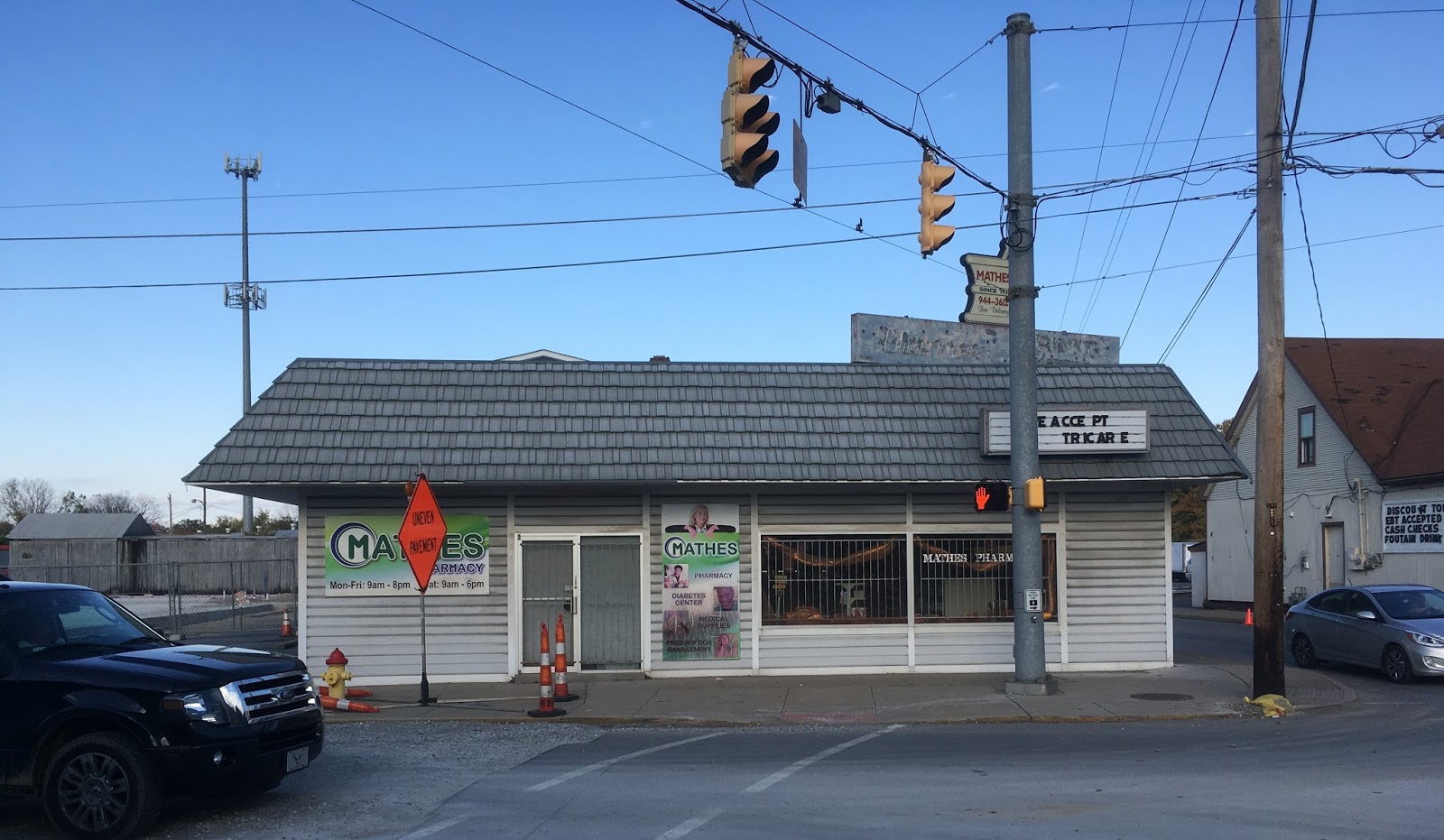
Mathes Pharmacy will expand into a new building. Congrats to a New Albany indie stalwart.
Mathes is my pharmacy.
It's about a 20-minute walk from our house. I'm unrepentant as it pertains to advocating independent small businesses. It's hard to see how Joe could do other than erect a new building and replace the old one with parking. I wish them all the best and look forward to continue doing business.
Disclaimers aside, I'd be lying if I said it's not decidedly bittersweet to see an older corner building be replaced by a parking lot. There's too much of that in New Albany already.
But: Rock on, Mathes. Having an indie pharmacy is very important to the Confidentials, and it should be to you, too.
Mathes Pharmacy tearing down shop, building new one, by Danielle Grady (Hanson Raycom Generator)
NEW ALBANY — When Mathes Pharmacy opened in 1931, there were several independent pharmacies in New Albany.
Today, only a few, including Mathes, remain — thanks in part to embracing of change.
Mathes continues to innovate under the leadership of Joe Dones, who became the sole owner of the business in 2004. His most recent project is tearing down Mathes’ old building of 29 years and doubling its space with an entirely new building in the back.
The project will mean more room for Mathes’ clinical services, including its diabetes center, vaccinations and blood pressure and cholesterol testing. Joe will also be moving Mathes’ medical supplies store, currently located across the street from the main pharmacy, into the new building.
Strong Towns Week: "In an urban neighbourhood it is important ... that everyone has a park within a few minutes walk."
In New Albany, we've opted for the "grand park" approach. Millions in TIF borrowing have produced several mini-Disneys, but not the sort of neighborhood approach being advocated in yet another thoughtful posting at Strong Towns.
GRAND PARKS VS. NEIGHBORHOOD PARKS, by Andrew Price
When we talk about parks in cities, I think it helps if we can classify parks into two types: Grand Parks and Neighbourhood Parks (Like a lot of things, I am making up terminology here, but I feel that it is often relevant to have terms to distinguish between things.) When I am talking about parks, I do not mean greenspace, which is unnecessary filler. You can often tell the difference between a park and greenspace, because somebody loves a park enough, no matter how small it is, to give it a name.
Grand Parks are places like Central Park, Prospect Park, national parks, Chapultepec, etc. They can range from day trip destinations, or sometimes far-flung destinations in other states.
Neighbourhood Parks are sort of places you expect to find up the street - kids can play there after school, people walk their dog there, you can stroll down there with a book ...
One significant problem with New Albany's mini-Disney approach apart from the misuse of TIF is it being predicated on people driving their cars to the parks, while the notion of neighborhood parks supports walking or biking there.
We have relocated to the NYC area, and are now renting a 3 bedroom townhouse in Hoboken, NJ. It's a very nice family-oriented area, but it is highly urban and virtually the entire city of Hoboken consists of either townhouses or mid-rise apartments. People here either just do not have yard, or it is a tiny communal courtyard.
So, if you have children, or you want to read a book, or lay among the trees, or throw a ball with your dog, you need Neighbourhood Parks. Central Park, as beautiful as it is, is useless for this purpose if you live 50 minutes away - you are not walking there with your book after work everyday.
That is why I think in an urban neighbourhood it is important that if you do not have a private yard that everyone has a park within a few minutes walk.
Even if you have a private yard, Neighbourhood Parks can still serve a purpose. They can be the living room of the community. If I am reading a book or doing work, I find it more relaxing to be among the light flutter of activity found in a public park than to be in absolute solitude. This is probably also why I prefer working from my office, even if I have the ability to telecommute on occasion - it is nice just to be in the presence of others.
Subscribe to:
Posts (Atom)


