Showing posts with label Belgium and Netherlands Trip 2017. Show all posts

Tuesday, September 15, 2020

From 2017: "Time for remembrance at Lijssenthoek Military Cemetery outside Poperinge."

I'm moody this week because the pandemic postponed Poperinge's Beer and Hop Festival, and so this week I'll be flooding the blog pages with reruns of past visits. As I've been saying for roughly 23 years, Poperinge is a great base of operations to explore numerous places of interest nearby, most of them accessible by bicycle. 

When the Great War began in 1914, Lijssenthoek was a small village near Poperinge, perched on the rail line to France.


Amid the stupendous carnage of the battles around Ieper (Ypres), which were renewed in various incarnations for four years, Lijssenthoek quickly became a place of great importance.


The rail line was the single most important Allied supply route, and a farm at Lijssenthoek was available for use as a field hospital and evacuation point. Most of the war, this vicinity was out of German artillery range.

For four years, trains arrived from France filled with healthy soldiers and supplies, and returned with wounded, but of course not all of the wounded survived, hence the military cemetery. Needless to say, it filled quickly. Today it is the second-largest Commonwealth cemetery in Belgium.

While most of the burials are British, Canadian and Australians, along with other troops from the British colonies, some Frenchmen and a handful of German troops also are buried at Lijssenthoek, as well as Chinese laborers. There is one American grave.

On Monday, Luc drove me to the cemetery. The village no longer exists, apart from a former pub building where the Englishman working as cemetery caretaker lived for many years.


At some point in the past the railroad tracks were torn out, and the N38 roadway built along the right-of-way. Because the N38 is the most direct route from Poperinge to France, it's the path we chose to bike in the direction of Cassel during those first two beercycling trips in 2000 and 2001.

However, we never stopped for a sag at the cemetery. Dozens of burial grounds dot the landscape around Ieper, and perhaps at some point a visitor no longer notices they're there.

If you ever go to Ieper and environs, take the time to stop and look at the graves. World War I knocked civilization off kilter. I'm not sure we've regained our balance, 100 years later.


This chart marks the daily number of burials in the cemetery. The highest points depicted here occurred almost exactly one hundred years ago at the time of my visit as a result of the Battle of Menin Road Ridge, itself one phase of the idiocy known to us as Passchendaele.

It was a battle that lasted three and a half months, achieved almost nothing, and resulted in 275,000 casualties under British command and 220,000 Germans.


Each day, the video screen in the comprehensive visitor's center focuses on one interment.


These are the faces of some of the 10,784 men (and one woman, a nurse named Nellie Spindler) buried at Lijssenthoek. Only 35 are unnamed. This is because if a soldier could be brought to the rear for medical attention, there was a much better chance of identification. Conversely, such was the horror of the Passchendaele battles that 90,000 bodies could not be identified, and 42,000 were never recovered.


The fence by the road outside is another artistic representation of the volume of burials.


Luc showed me the numeric mapping system enabling individual graves to be located easily. It's still in a book, not an app.


Gaps in the headstones usually indicate a burial moved to a different cemetery after war's end.


I was unaware of the reason for stones being placed atop the graves of Jewish soldiers.

All the explanations have one thing in common — the sense of solidity that stones give. Flowers are a good metaphor for life. Life withers; it fades like a flower. As Isaiah says, “All flesh is grass, and all its beauty like the flower of the field; grass withers and flowers fade” (Isaiah 40:6-7). For that reason, flowers are an apt symbol of passing.

But the memory is supposed to be lasting. While flowers may be a good metaphor for the brevity of life, stones seem better suited to the permanence of memory. Stones do not die.


Ironically, this is the (larger) Stone of Remembrance.


Members of the Chinese Labour Corps.


As for the remainder of the day on Monday, almost every eatery and watering hole in Poperinge was closed, although the shops were open. Diana and I went to the grocery and purchased sandwiches and salads for a day's meals in the apartment.

It was cool and rainy, and the city's workers gradually disassembled the festival infrastructure. The two of us read and rested.

At times, it's what you have to do.

Friday, December 22, 2017

A farewell to wonderful Haarlem on Saturday, September 23.


Previously: Haarlem on a Friday night in September: One church with beer, another without, and a relaxing dinner with friends at The Warehouse.

The last full day in Europe always seems bittersweet, even after three dozen goodbyes. My body returns to the daily grind, but something of my spirit remains behind, to be reclaimed next time.

In 2017, a complicating factor for me was what seemed like a head cold, steadily worsening as the week progressed. I felt fine in Mechelen and Poperinge, but by Wednesday night in Haarlem the crud was creeping into my head, throat and chest.

Upon returning stateside, this malaise was diagnosed as an upper respiratory infection, which dovetailed into the purely awful, lingering allergy conditions in the Ohio Valley, and finally compelled me to consult with GP and allergist to see what might be done about my deteriorating sinuses.

The good news is after two months of annoyance, the diagnosis is comprehensible and the path forward clear.

The bad news: none of it did me any good those last two days in Haarlem, to the extent that during our final afternoon in town, I was drinking mint tea instead of beer. It's sad to have wonderful arrays of beer spread out before you, and be unable to taste them.

The highlight of Saturday was to have been an appearance by "Big" Kim Andersen, who earlier in the year took up residence in Arnhem, Netherlands, just a couple hours from Haarlem by train.

As it happened, Kim was sick, too; he was forced to cancel, and coupled with my own infirmity, this journey of renewal with friends concluded with a decided whimper.

However, it was a gorgeous late summer's day, and we managed a late morning walk to the De Adriaan windmill, a symbol of Haarlem since the last 1700s. One of Jopen's beers is named for the imposing structure.


Next stop was the Amsterdamse Poort, which was built in 1355 and is the last remnant of Haarlem's twelve city defense gates. In front of the gate is a sculpture depicting Kenau Simonsdochter Hasselaer, wood merchant and daughter of a brewer, who became a folk legend for rallying Haarlem's women to fight the invading Spaniards in 1573.


Eventually we circled back to the Grote Markt for the Saturday market day spread. I couldn't last long without a tasty nieuwe haring.


Waffles are a thing, especially when freshly rendered. They're not just for tourists, either -- although we were.


Just off the Grote Markt, a statue of two knights jousting.


Inge and Marilyn came by Spaarne 66 for goodbyes. The weather was beautiful, and most of Haarlem was out in the street making merry.


Boris and Dewi were waiting at Cafe Briljant for a final round during the establishment's last days of operation, but first we stopped for some carryout döner kebab and brought it to the cafe.

On Sunday morning, the fast and efficient bus to Schiphol, and the return flights.


The narrative ends here. All things considered, I was exhausted. There were many times in the past when the pace of partying dictated physical infirmity, though not this time. Age, maybe.

Mentally, it had been an exceedingly challenging year before the trip commenced; there'd been too many deaths and too many elegies, hence a need to reconnect with folks we hadn't seen for such a long time.

Of course, this also meant bidding adieu to Bill England, which was slightly easier to do upon meeting his and Inge's daughter. Marilyn simply rocks. Boris and Dewi were non-judgmental about the long absence, and I'm thankful. It was like no years had passed at all.

Be well. It won't be as long until next time. We'll see you all soon. 

Saturday, December 09, 2017

Haarlem on a Friday night in September: One church with beer, another without, and a relaxing dinner with friends at The Warehouse.


Previously: Shopping, strolling, beaches, herring, bock and madras. Just a second day's reintroduction to Haarlem.

I've lagged badly in concluding the September travel narrative. Bear in mind that while millions of readers aren't hanging on every word, the story is important to me, if for no other reason than the excellent odds of my forgetting much of it. A drinking life may or may not be responsible for these memory lapses, and so we carry on regardless.

By the time Friday 22 September rolled around, the weather had cooled and rain arrived. I was in the throes of what I thought was a cold (later to become an upper respiratory infection, accompanied by allergies and affiliated muck).

Since returning home, this most recent breakdown of my sinuses has occasioned a long-delayed appointment with an allergist, who tells me that while I'm not allergic to beer or food, just about everything else is a problem.

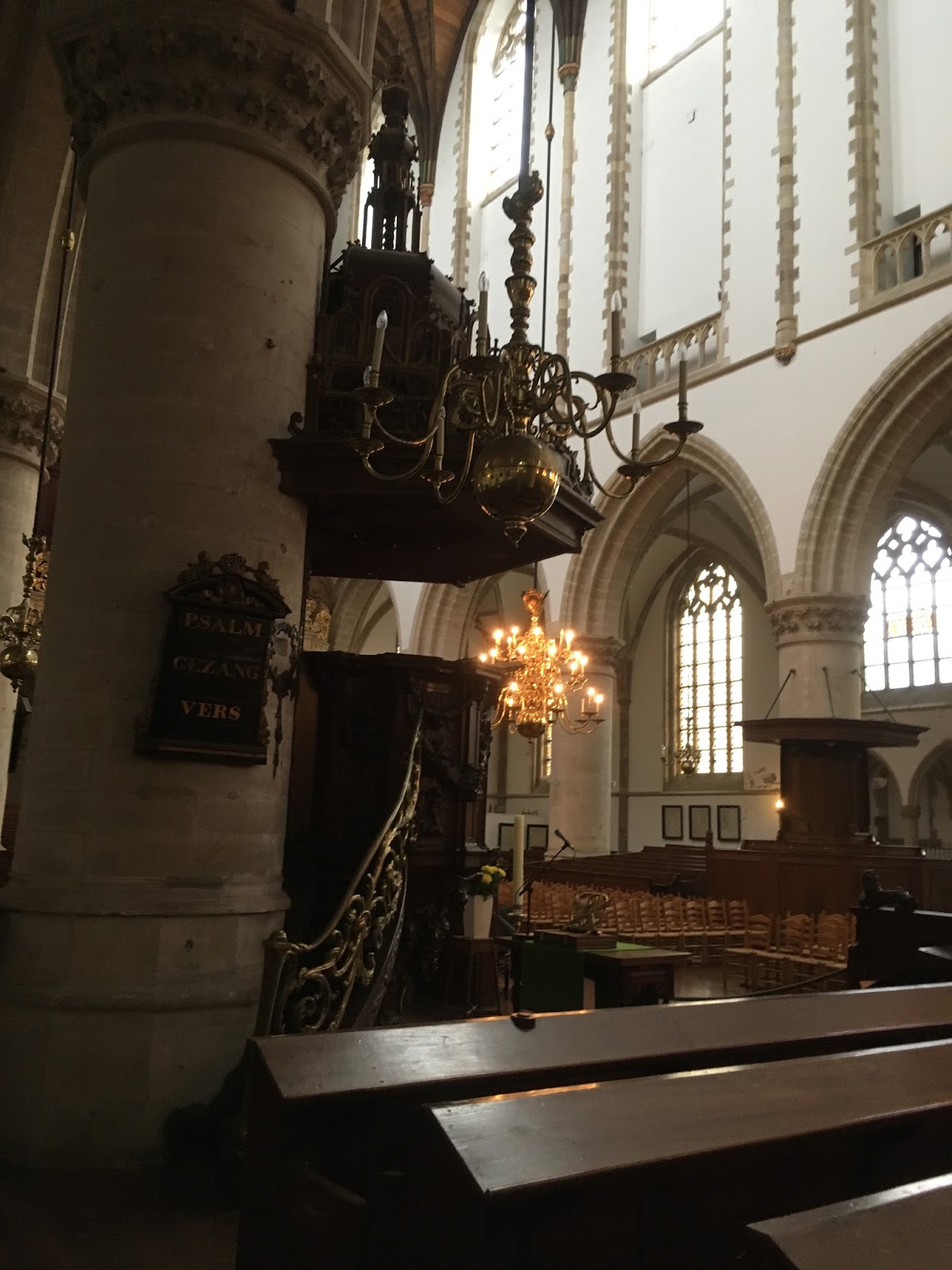
The Hotel Amadeus offers an ample breakfast, and so the day began with a short waddle of a stroll, followed by a look inside De Grote of St.-Bavokerk. However, first there were monkeys to light the way.


Following are photos of the church taken by both of us, in no particular order. It's an imposing but not overly ornate edifice, and a good place to avoid the drizzle outside.


By lunchtime the rain was abating, and street life proceeded as usual, with herring accenting the market stalls.


We navigated toward Jopenkerk for snacks, local ales and a scheduled midday chat with Erwin Klijn, the brewery's sales manager. It was quite informative. The former church building's transformation is stunning, and as noted previously during this travelogue, crowds seemed to be on hand at all hours of the business day. I like everything about Jopen, and look forward to our next visit.


With a social evening of drinks and dining still ahead, we retired to the hotel for a nap.


By the time we emerged to meet Inge, the skies had cleared and it was a stunning afternoon for coffee at Spaarne 66, which is known as "the living room of Haarlem." It was here that we sat by the river, perhaps 50 feet away from the cafe's door, with servers crossing a traffic lane, biking lanes and two sidewalks to get to us, without an accident. Try imagining this in downtown New Albany, and you'll realize why I drink -- and travel to places like Haarlem.


The five of us (including Boris and Dewi) had booked a table at Het Pakhuis, or "The Warehouse," located a short walk along the river. It was a fine multi-course meal, indeed, though I still found myself mourning the passing of De Ark, the restaurant we'd visited most often during previous stays in Haarlem.

The Ark closed earlier in 2017 after a long run of more than two decades. I found it noteworthy for the secluded location off any of Haarlem's main routes; very much of the neighborhood, though right around the corner from the popular Frans Hals Museum, with heaping platters of meat and potatoes, plenty of lagers and ales, and multiple wood-paneled rooms displaying traditional "bruin cafe" (brown cafe) ambiance.

No matter; our evening at The Warehouse was sublime, filled with easy laughs and serious conversation. Judging from the expectation that Big Kim would be coming to Haarlem on Saturday for a final session at Cafe Briljant, there was every appearance we'd be limping home on Sunday.

Like oft times before ...