Showing posts with label World War I. Show all posts

Tuesday, September 15, 2020

From 2017: "Time for remembrance at Lijssenthoek Military Cemetery outside Poperinge."

I'm moody this week because the pandemic postponed Poperinge's Beer and Hop Festival, and so this week I'll be flooding the blog pages with reruns of past visits. As I've been saying for roughly 23 years, Poperinge is a great base of operations to explore numerous places of interest nearby, most of them accessible by bicycle. 

When the Great War began in 1914, Lijssenthoek was a small village near Poperinge, perched on the rail line to France.


Amid the stupendous carnage of the battles around Ieper (Ypres), which were renewed in various incarnations for four years, Lijssenthoek quickly became a place of great importance.


The rail line was the single most important Allied supply route, and a farm at Lijssenthoek was available for use as a field hospital and evacuation point. Most of the war, this vicinity was out of German artillery range.

For four years, trains arrived from France filled with healthy soldiers and supplies, and returned with wounded, but of course not all of the wounded survived, hence the military cemetery. Needless to say, it filled quickly. Today it is the second-largest Commonwealth cemetery in Belgium.

While most of the burials are British, Canadian and Australians, along with other troops from the British colonies, some Frenchmen and a handful of German troops also are buried at Lijssenthoek, as well as Chinese laborers. There is one American grave.

On Monday, Luc drove me to the cemetery. The village no longer exists, apart from a former pub building where the Englishman working as cemetery caretaker lived for many years.


At some point in the past the railroad tracks were torn out, and the N38 roadway built along the right-of-way. Because the N38 is the most direct route from Poperinge to France, it's the path we chose to bike in the direction of Cassel during those first two beercycling trips in 2000 and 2001.

However, we never stopped for a sag at the cemetery. Dozens of burial grounds dot the landscape around Ieper, and perhaps at some point a visitor no longer notices they're there.

If you ever go to Ieper and environs, take the time to stop and look at the graves. World War I knocked civilization off kilter. I'm not sure we've regained our balance, 100 years later.


This chart marks the daily number of burials in the cemetery. The highest points depicted here occurred almost exactly one hundred years ago at the time of my visit as a result of the Battle of Menin Road Ridge, itself one phase of the idiocy known to us as Passchendaele.

It was a battle that lasted three and a half months, achieved almost nothing, and resulted in 275,000 casualties under British command and 220,000 Germans.


Each day, the video screen in the comprehensive visitor's center focuses on one interment.


These are the faces of some of the 10,784 men (and one woman, a nurse named Nellie Spindler) buried at Lijssenthoek. Only 35 are unnamed. This is because if a soldier could be brought to the rear for medical attention, there was a much better chance of identification. Conversely, such was the horror of the Passchendaele battles that 90,000 bodies could not be identified, and 42,000 were never recovered.


The fence by the road outside is another artistic representation of the volume of burials.


Luc showed me the numeric mapping system enabling individual graves to be located easily. It's still in a book, not an app.


Gaps in the headstones usually indicate a burial moved to a different cemetery after war's end.


I was unaware of the reason for stones being placed atop the graves of Jewish soldiers.

All the explanations have one thing in common — the sense of solidity that stones give. Flowers are a good metaphor for life. Life withers; it fades like a flower. As Isaiah says, “All flesh is grass, and all its beauty like the flower of the field; grass withers and flowers fade” (Isaiah 40:6-7). For that reason, flowers are an apt symbol of passing.

But the memory is supposed to be lasting. While flowers may be a good metaphor for the brevity of life, stones seem better suited to the permanence of memory. Stones do not die.


Ironically, this is the (larger) Stone of Remembrance.


Members of the Chinese Labour Corps.


As for the remainder of the day on Monday, almost every eatery and watering hole in Poperinge was closed, although the shops were open. Diana and I went to the grocery and purchased sandwiches and salads for a day's meals in the apartment.

It was cool and rainy, and the city's workers gradually disassembled the festival infrastructure. The two of us read and rested.

At times, it's what you have to do.

Monday, September 14, 2020

From 2017: "TRAVEL PRELUDES: Ieper ... Ypres ... Wipers; the Great War and a passing of generations."


The Cloth Hall in Ieper (Ypres), with St. Martin's Cathedral behind it. Everything you see here was a hole in the ground in 1918. 

I'm being petulant because the pandemic postponed Poperinge's Beer and Hop Festival, and so this week I'll be flooding the blog pages with reruns of past visits. 

TRAVEL PRELUDES: Ieper ... Ypres ... Wipers; the Great War and a passing of generations.


The three segments of this decade-old documentary -- Geert Mak's In Europa ... "1915 Ieper" -- last only 40 minutes, but it's an invaluable introduction to the lasting impact of World War I. 

---

I'm trying not to read very much into this breathtakingly trite observation, but time has a way of passing.

Between 1998 and 2008, I traveled to Poperinge nine times, five of them with a bicycle as integral component of the itinerary. However, 2017 will mark only the second time back since 2008, and in the interim, much has changed in Pops and environs.

Well, duh -- and yet it's always amazing the way a human mind can remain stuck in self-enforced sepia, visualizing a milieu as it was, as though life itself wasn't dynamic and ever shifting.

Westhoek means "west corner" in Dutch, and as a region, Westhoek includes the areas around Poperinge, Ieper, Watou and Diksmuide. More so than the Middle Ages or Napoleon -- far more so than World War II -- these locales were profoundly impacted by almost four years of constant combat during the Great War.

In the year 2000 on the Monday of our first-ever bicycling adventure using Poperinge as a base, we rode to Ieper (ee-per). That's the Flemish version; it's Ypres in French and 'Wipers" to British soldiers during World War I. Barely a stone was left standing in Ieper at war's end. The whole city was rebuilt from the cellars up, and to this very day, tons of unexploded ordinance surface yearly.

On that first day in 2000, as we headed east from Poperinge, the French hills known as Trois Monts almost always could be seen rising on the horizon to the south, and although they aren’t particularly big, the flatness of Flanders magnifies their significance and one can readily understand their strategic importance in wartime.

The hills are why the Germans attacked in this direction. The Allies answered, and the result was years of devastating trench warfare stalemate. Just to the north, the Allied flank was secured only by a desperate expedient: the dikes near Diksmuide were breached and thousands of acres of farmland flooded to create a wall of water.

Our cycling journey took us past numerous Great War monuments and cemeteries of the British Commonwealth forces, whose final resting places attested to the global scale of the First World War: Irish, Australian, Canadian and Indian soldiers, buried alongside lads from Manchester and Newcastle. The resting places of Belgian, French and German soldiers also were seen.

Monday’s midday sag brought us to the center of the city, and a tale I've never forgotten. When the second world conflagration swept through Belgium, one young Ieper native resolved to escape. He made it somehow to the then-colony of Belgian Congo, and later to South Africa, where he enlisted in the British armed forces and fought against his country's German occupiers until 1945.

Afterward he returned to Ieper and founded a restaurant and pub, sold it, then opened another, called Ter Posterie for its location opposite the post office.

Ter Posterie was another classic Belgian cafe, with many dozens of bottled ales, a few more on draft, savory food and a comfortable outdoor terrace, where we sat and discussed our first half-day’s ride.

I never knew this man’s name, but nonetheless met him on three different occasions while enjoying the beer, food and hospitality at Ter Posterie. By 2000, active control of the business had long since passed to his daughter, although the old man still frequented the establishment.

Whenever he heard English being spoken, he'd amble over and spin his life story for the visitor in a narrative honed over thousands of ale-side retellings. Apparently we met him as he was descending into Alzheimer’s disease. During one visit on a quiet afternoon, perhaps in 2005, he could be heard howling somewhere to the rear, with harried family members rushing back and forth to care both for him and the cafe's guests.

At some point prior to 2009, he died, and later Ter Posterie closed.

In circuitous fashion, we return to the inevitability of change. I'm writing these words in advance of our actual visit to Poperinge and Haarlem (Netherlands), which I suspect will be a tad more elegiac than those stays in previous years.

In Poperinge, the triennial hop fest rolls merrily on. Luc is retired from the tourist office, and it's been almost ten years since Guy and Beatrice ran the Hotel Palace. It remains a viable business, just not the same for me as before.

In Watou, Chef Stefaan Couttenye's wife Sabine died a few years ago. She ran the front of the house at 't Hommelhof, and I worked with her twice when making arrangements for feeding my motorcoach groups.

I'd visited Poperinge prior to my period of obsession with bicycling, and for this reason my friends joined me in biking there for the first time in 2000, but there'd have been no biking without the encouragement and tutelage of the late Kevin Richards, who'll be very much on my mind as the parade unwinds in 2017. Glasses will be raised, repeatedly.

As you're watching the video prefacing these thoughts, remember that 100 years ago, there seemed to be no future for Westhoek. The people there persevered, and they built it back.

For me, returning to Poperinge will be like visiting old friends, albeit missing a few of them. All I can do is promise to remember them, and keep moving forward.

Monday, November 11, 2019

An annual reminder (2019): Forgotten fields in Flanders on Armistice (Veterans) Day.


In 2018 the annual renewal of Veterans Day was auspicious because it marked the 100th anniversary of the Great War's end. Since the conflict's centenary in 2014, there have been 100-year memories of battles and events, from the Masurian Lakes through Meuse-Argonne.

Why is this important?

Among other reasons, Americans remember 11/11/11 each year in the form of a holiday that has come to embrace the service of all veterans, not only those from the now wholly passed World War I generation.

Veterans Day is an official United States holiday honoring armed service veterans. It is a federal holiday that is observed on November 11th. It coincides with other holidays such as Armistice Day or Remembrance Day, which are celebrated in other parts of the world and also mark the anniversary of the signing of the Armistice that ended World War I. (Major hostilities of World War I were formally ended at the 11th hour of the 11th day of the 11th month of 1918 with the German signing of the Armistice.)

November 9 was the 30th anniversary of the day the Berlin Wall began falling. As I'm fond of arguing, the armistice in 1918 didn't end the first war at all. The demise of the Wall did -- well, maybe so. I believe future historians will refer to the period of 1912-1989 as the "77 Years' War," or perhaps tack on another decade and pronounce the 87 Years' War as concluding with the bombardment of Belgrade by NATO.

Speaking for myself, America's Civil War has been a fascination since childhood, and had I hazarded a guess back in 2010 or so, it would have been that the Civil War's sesquicentennial (observed during the years 2011 - 2015) would have gripped me.

To an extent it did, but I should have known better. Europe has been an obsession for thirty-five years of my adult life.

What's more, there's an immediacy. My grandfather was drafted into the Army circa 1918, but fortunately never left the continental United States before WWI ended. His son, who was my father, volunteered and joined the Marines in 1942, spending three years in the Pacific theater of operations.

I didn't do anything, apart from studying their experiences and visiting the European locales neither of them ever saw.

Lessons from history 100 years after the Armistice (The Economist)

The guns fell silent a century ago

 ... National chauvinisms live on despite the Somme. Anti-Semitism lives on despite the Holocaust. Societies’ capacity to imagine collapse and barbarism in visceral terms fades with time. All Europeans can do is be vigilant and humble before these forces, dip their oars into the waves of history when possible, hold tight to their humanity and be grateful that their continent’s past and present are now broadly in harmony, the former educating and civilising the latter, for now at least. Like train lines running together in a wood.

Having visited Gdansk in Poland in 2018, these reflections seem particularly relevant.

For millions of Europeans, the war did not end in 1918, by Natalie Nougayrède (The Guardian)

Our narrative of the armistice is not the only one. In the east conflict continued, fuelled by the crumbling of empires

 ... For one thing, 1918 as the date of the end of the conflict only holds true for the western front. In the east of Europe, the crumbling of empires, the Russian revolution, civil war and the struggle to establish the borders of newly established states all meant that armed violence continued, leaving deep scars.

Here is a guest column originally published in the pre-merger Tribune on November 5, 2009. I repeat it annually.

---

Forgotten fields in Flanders.

Lately I keep hearing this tune.

Keep the home fires burning,
While your hearts are yearning,
Though your lads are far away
They dream of home.

These dreaming lads were soldiers, in route across the English Channel to fight for the United Kingdom, and several hundred thousand of them failed to return home to nostalgically remember a popular song written to inspire the home front in their absence.

By now it should be clear that war is horrible, and I’m not sure that it serves any purpose to discuss which wars are “just.” Justice in this context inevitably owes to situational morality as the combatants pray to their respective deities and make theological mockery of whatever religious interpretation devolves from these biased, selective judgments.

By all such standards, the Great War was especially horrible. The specific horror of this conflict, which eventually came to be known as World War I out of a contextual necessity to keep our historical accountings of human suffering clearly ordered, surely represents societal innocence shattered on an unfathomably massive scale.

An entire generation that had known no war outside of mock duels and parlor games willingly marched off to slaughter while gaily singing songs about honor and glory, and consequently, it’s a safe bet that World War I was the last disastrous conflict to feature a soundtrack entirely devoid of irony. Western societies would have to wait decades and refine techniques of amplification until the onset of thrash metal’s inherent violence finally provided music capable of approximating the grim reality of institutionalized murder.

Earlier this year, the last British veteran of the war died. Perhaps one American soldier of the era remains alive – and, in the time it has taken for me to write this essay, perhaps he’s gone, too. The war began in 1914, and it has long since faded into the black and white images of crude newsreel footage that only hint at the carnage of trench warfare and the doltish, outmoded “leadership” on the part of uniformed war criminals.

Providentially, my own grandfather was drafted too late for combat duty. He managed the not inconsiderable task of avoiding the flu pandemic that killed more American soldiers than enemy fire. My father then followed suit by serving in the Marines during World War II, which was “his” war, and a subject of fascination for him the remainder of his life.

I, too, went overseas, although not in uniform. In 1987, I found myself in Sopron, Hungary, choosing a beautiful early summer’s day to go for a hike in the hills. I came upon a large, older cemetery, and decided to walk through it, ascending a gentle, wooded slope past contemporary gravestones of the still-extant Communist era.

Like rings on a tree stump, history’s reverse chronology rotated as I continued uphill. Nearing the top, rows of Great War graves finally commenced. These were the soldiers who fought and died for the ruling family of the Austro-Hungarian Empire – the losers, as it were, who died as readily as the “winners” on the other side.

The first death dates were more recent: 1918, and then somewhat more from 1917, and as I scanned their names, the majority Hungarian, but also some Germanic and Slavic owing to the mutli-ethnic, polyglot nature of the Habsburg domain – as I contemplated how ridiculously, stupidly youthful so many of them were – I reached the lip of the hill, rather puzzled that there seemed to be no graves from earlier war years.

The answer to my befuddlement was just on the other side. Dipping into a valley studded with older, larger hardwoods, row after row of markers told the lethal tale: Died in 1916, 1915 and 1914.

I always think about the cemetery in Sopron on Veterans Day, formerly Armistice Day, which originally fell on November 11th because that's when the fighting stopped in 1918, ending the First Great World War and enabling a “peace” conference in Versailles that did so much to ensure a second.

Previous generations knew about the 11th hour of the 11th day of the 11th month, but all the other mass bloodlettings since required a consolidation of observance, and a holiday more intrinsically American. So be it, and I’m not here to disagree, even if we forget the first causes that brought it about.

However, we’re left with those many innocent, misplaced songs. Now that living memory has passed, they speak even more eloquently about life, death and our capacity, sometimes successful, and often not, to make sense out of the insensible.

A CBS television documentary, World War One, ran from 1964-65, comprising 26 half-hour episodes, and later airing on cable. My friend Barrie videotaped them. The series is now available on DVD (you can see excerpts on YouTube), and I’m weighing a Christmas purchase, because one of the episodes, “Tipperary and All That Jazz,” has haunted me since the first time he and I watched it around the time of my Sopron sojourn.

Ancient film, much of it depicting camp life behind the lines, forms a backdrop for song snippets. They are melancholy, sentimental and elegiac. It is heartbreaking … and very real.

There's a long, long trail a-winding
Into the land of my dreams,
Where the nightingales are singing,
And a white moon beams.
There's a long, long night of waiting
Until my dreams all come true,
Till the day when I'll be going
Down that long, long trail with you.

Monday, February 04, 2019

Peter Jackson's They Shall Not Grow Old is a visceral, deeply moving reminder of things that mustn't be forgotten.


They shall grow not old, as we that are left grow old:
Age shall not weary them, nor the years condemn.
At the going down of the sun and in the morning
We will remember them.
-- Laurence Binyon

Yesterday we made the trek to one of those garish shopping meccas amid the sprawl of Louisville's eastern suburbs (as they're all equally depressing, I'm never able to remember the exact name of the particular atrocity) to view They Shall Not Grow Old, Peter Jackson's incredible World War I documentary film.

I managed to avoid shedding a tear until the very last bit of the closing credits, where it was written "Filmed on location on the Western Front, 1914-1918." I'm not sure why this simple phrase made me cry, but it did. It may have been the cumulative effect of the voices and visuals; it was so long ago, and they're all ghosts now.

Perhaps Jackson's greatest achievement with this innovative documentary film is to let the restored images and voice-overs tell the story, uncluttered by maps and grand strategies. For instance, have you ever wondered how latrines worked on the front lines? It was elegantly simple, in fact.

To me, the film humanizes the experience of soldiers who we've come to view with some justification as little more than cannon fodder.

It covers the four years in one story arc with the voice-over anecdotes telling of the initial excitement of signing up, the harsh realities of training, shipping out, then finding yourself in a muddy hole combating lice, rats, gas, dysentery, trench-foot, trench-fever, frostbite, the stench of death and, occasionally, the enemy a rifle shot away. The film doesn’t flinch from showing the carnage.

At the end, an added segment finds Jackson explaining how his team managed to do what they did, and for many reviewers, the wizardry involved must be examined; colorization is only a small part of this critique, which I feel is completely justified. You can follow the links below to indulge in it.

However, the historian in me sees They Shall Not Grow Old as an invaluable teaching tool, full stop. A century later, the imperative is people understanding how the far-off Great War continues to impact our lives. As one small example, consider the way boundary lines in the Middle East were drawn at war's end.

By all means, let's revel in the arguments of authenticity implicit in Jackson's directorial decision-making. But let's not take our eyes off the prize.

‘They Shall Not Grow Old’ Review: World War I, in Living Color, by Ben Kenigsberg (NYT)

Peter Jackson's WWI film is a portal into the past, by Russell Baillie (New Zealand Listener)

A Few Thoughts on the Authenticity of Peter Jackson’s “They Shall Not Grow Old” by Adam Gopnik (The New Yorker)

They Shall Not Grow Old review – Peter Jackson's electrifying journey into the first world war trenches, by Peter Bradshaw (The Guardian)

Previously:

Peter Jackson's They Shall Not Grow Old: "A visually staggering thought experiment; an immersive deep-dive into what it was like for ordinary British soldiers on the western front."

Apocalypse: Never-Ending War: "A film about the years of fragile peace that followed the Fist World War, the collapse of empires, and the fateful rise of totalitarianism."

Thursday, November 22, 2018

Apocalypse: Never-Ending War: "A film about the years of fragile peace that followed the Fist World War, the collapse of empires, and the fateful rise of totalitarianism."


It comes as no surprise when two more documentaries about the Great War come through the YouTube pipeline and fascinate me.


The films are excellent, and the production is a joint venture between Canadian and French filmmakers (here's the link for the Canadian series home page), as broadcast and posted at YouTube by Deutsche Welle.

There have been two of these series about World War I, both using colorized archival footage.

Apocalypse World War I
1914-1918 (5 x 52’)

Apocalypse Never-Ending War
1918-1929 (2 x 45’)

I need to catch up on the first series. Meanwhile, here's the synopsis of the second, via Deutsche Welle.

Apocalypse - Never-Ending War 1918 - 1929

"Apocalypse: Never-Ending War" tells the story of the years of fragile peace that followed the Fist World War, the collapse of empires, and the fateful rise of totalitarianism. Years that foretell the coming of another disastrous war. For four years, from 1914-1918, the world seemed hellbent on total self-annihilation. The First World War was an apocalyptic war that claimed over 50 million lives, civilian and military. Those who survive come to realize the world of the past century has now disappeared into an abyss of suffering. Millions of soldiers, the shell-shocked, the amputees, the disabled, will spend the rest of their lives trying to make sense of their years in hell. Parents are in despair at the loss of their children, families destroyed, millions of widows and orphans left to survive any way they can. In 1919 at Versailles and Saint-Germain-en-Laye, and in 1920 at Trianon, the victors forge peace treaties that they claim will restore balance. But those who have pinned their hopes on a transition from war to universal peace are to be deeply disappointed. Hatred, fear, and resentment re-emerge from the depths of societies traumatized by war and the tumultuous transformation that results from the world’s map being re-drawn. The vanquished, facing terrible reparations, look for promises of hope, stability and order, even at the cost of personal freedom. The climate is ripe for the emergence of authoritarian forces, exacerbating ethnic nationalism, and opening doors to the worst of human nature. Extreme ideologies take root in Germany and Italy, and spread from there.

I've already mentioned the latest sensation for documentary enthusiasts like me.

Peter Jackson's They Shall Not Grow Old: "A visually staggering thought experiment; an immersive deep-dive into what it was like for ordinary British soldiers on the western front."


The Economist uses precisely the right word: immediacy.

“They Shall Not Grow Old” brings archive footage to stirring life, by Prospero (The Economist)

The film applies modern production techniques to old film to achieve something poppies and pageantry cannot: immediacy

 ... The attention to detail was painstaking, and almost five years in the making. Mr Jackson trawled through hundreds of hours of video and audio footage, most of it collected by the BBC for their documentary “The Great War” (1964). Once these were stitched together into a storyline, each frame was colourised and digitally restored. Computer programs helped to move the video from the ten to 18 frames per second (fps) at which it was shot to the modern rate of 24 fps, doing away with the “Charlie Chaplin effect” (the jerky, disjointed movement that characterises old film). Forensic lip-readers were hired to work out what soldiers might be saying, and their words were voiced by actors.

Sunday, November 11, 2018

An annual reminder: Forgotten fields in Flanders on Armistice (Veterans) Day.


In 2018, the annual renewal of Veterans Day is auspicious because it's the 100th anniversary of the Great War's end. Since the conflict's centenary in 2014, there have been 100-year memories of battles and events, from the Masurian Lakes through Meuse-Argonne.

Why is this important?

Among other reasons, Americans remember 11/11/11 each year in the form of a holiday that has come to embrace the service of all veterans, not only those from the now wholly passed World War I generation.

Veterans Day is an official United States holiday honoring armed service veterans. It is a federal holiday that is observed on November 11th. It coincides with other holidays such as Armistice Day or Remembrance Day, which are celebrated in other parts of the world and also mark the anniversary of the signing of the Armistice that ended World War I. (Major hostilities of World War I were formally ended at the 11th hour of the 11th day of the 11th month of 1918 with the German signing of the Armistice.)

November 9 was the 29th anniversary of the day the Berlin Wall fell. As I'm fond of arguing, the armistice in 1918 didn't end the first war at all. The demise of the Wall did -- well, maybe.

I believe future historians will refer to the period of 1912-1989 as the "77 Years' War," or perhaps tack on another decade and pronounce the 87 Years' War as concluding with the bombardment of Belgrade by NATO.

Speaking for myself, America's Civil War has been a fascination since childhood, and had I hazarded a guess back in 2010 or so, it would have been that the Civil War's sesquicentennial (observed during the years 2011 - 2015) would have gripped me.

To an extent it did, but I should have known better. Europe has been an obsession for thirty-five years of my adult life.

What's more, there's an immediacy. My grandfather was drafted into the Army circa 1918, but fortunately never left the continental United States before WWI ended. His son, who was my father, volunteered and joined the Marines in 1942, spending three years in the Pacific theater of operations.

I didn't do anything, apart from studying their experiences and visiting the European locales neither of them ever saw.

Lessons from history 100 years after the Armistice (The Economist)

The guns fell silent a century ago

 ... National chauvinisms live on despite the Somme. Anti-Semitism lives on despite the Holocaust. Societies’ capacity to imagine collapse and barbarism in visceral terms fades with time. All Europeans can do is be vigilant and humble before these forces, dip their oars into the waves of history when possible, hold tight to their humanity and be grateful that their continent’s past and present are now broadly in harmony, the former educating and civilising the latter, for now at least. Like train lines running together in a wood.

Having just returned from a visit to Gdansk in Poland, these reflections seem particularly relevant.

For millions of Europeans, the war did not end in 1918, by Natalie Nougayrède (The Guardian)

Our narrative of the armistice is not the only one. In the east conflict continued, fuelled by the crumbling of empires

 ... For one thing, 1918 as the date of the end of the conflict only holds true for the western front. In the east of Europe, the crumbling of empires, the Russian revolution, civil war and the struggle to establish the borders of newly established states all meant that armed violence continued, leaving deep scars.

Here is a guest column originally published in the pre-merger Tribune on November 5, 2009. I repeat it annually.

---

Forgotten fields in Flanders.

Lately I keep hearing this tune.

Keep the home fires burning,
While your hearts are yearning,
Though your lads are far away
They dream of home.

These dreaming lads were soldiers, in route across the English Channel to fight for the United Kingdom, and several hundred thousand of them failed to return home to nostalgically remember a popular song written to inspire the home front in their absence.

By now it should be clear that war is horrible, and I’m not sure that it serves any purpose to discuss which wars are “just.” Justice in this context inevitably owes to situational morality as the combatants pray to their respective deities and make theological mockery of whatever religious interpretation devolves from these biased, selective judgments.

By all such standards, the Great War was especially horrible. The specific horror of this conflict, which eventually came to be known as World War I out of a contextual necessity to keep our historical accountings of human suffering clearly ordered, surely represents societal innocence shattered on an unfathomably massive scale.

An entire generation that had known no war outside of mock duels and parlor games willingly marched off to slaughter while gaily singing songs about honor and glory, and consequently, it’s a safe bet that World War I was the last disastrous conflict to feature a soundtrack entirely devoid of irony. Western societies would have to wait decades and refine techniques of amplification until the onset of thrash metal’s inherent violence finally provided music capable of approximating the grim reality of institutionalized murder.

Earlier this year, the last British veteran of the war died. Perhaps one American soldier of the era remains alive – and, in the time it has taken for me to write this essay, perhaps he’s gone, too. The war began in 1914, and it has long since faded into the black and white images of crude newsreel footage that only hint at the carnage of trench warfare and the doltish, outmoded “leadership” on the part of uniformed war criminals.

Providentially, my own grandfather was drafted too late for combat duty. He managed the not inconsiderable task of avoiding the flu pandemic that killed more American soldiers than enemy fire. My father then followed suit by serving in the Marines during World War II, which was “his” war, and a subject of fascination for him the remainder of his life.

I, too, went overseas, although not in uniform. In 1987, I found myself in Sopron, Hungary, choosing a beautiful early summer’s day to go for a hike in the hills. I came upon a large, older cemetery, and decided to walk through it, ascending a gentle, wooded slope past contemporary gravestones of the still-extant Communist era.

Like rings on a tree stump, history’s reverse chronology rotated as I continued uphill. Nearing the top, rows of Great War graves finally commenced. These were the soldiers who fought and died for the ruling family of the Austro-Hungarian Empire – the losers, as it were, who died as readily as the “winners” on the other side.

The first death dates were more recent: 1918, and then somewhat more from 1917, and as I scanned their names, the majority Hungarian, but also some Germanic and Slavic owing to the mutli-ethnic, polyglot nature of the Habsburg domain – as I contemplated how ridiculously, stupidly youthful so many of them were – I reached the lip of the hill, rather puzzled that there seemed to be no graves from earlier war years.

The answer to my befuddlement was just on the other side. Dipping into a valley studded with older, larger hardwoods, row after row of markers told the lethal tale: Died in 1916, 1915 and 1914.

I always think about the cemetery in Sopron on Veterans Day, formerly Armistice Day, which originally fell on November 11th because that's when the fighting stopped in 1918, ending the First Great World War and enabling a “peace” conference in Versailles that did so much to ensure a second.

Previous generations knew about the 11th hour of the 11th day of the 11th month, but all the other mass bloodlettings since required a consolidation of observance, and a holiday more intrinsically American. So be it, and I’m not here to disagree, even if we forget the first causes that brought it about.

However, we’re left with those many innocent, misplaced songs. Now that living memory has passed, they speak even more eloquently about life, death and our capacity, sometimes successful, and often not, to make sense out of the insensible.

A CBS television documentary, World War One, ran from 1964-65, comprising 26 half-hour episodes, and later airing on cable. My friend Barrie videotaped them. The series is now available on DVD (you can see excerpts on YouTube), and I’m weighing a Christmas purchase, because one of the episodes, “Tipperary and All That Jazz,” has haunted me since the first time he and I watched it around the time of my Sopron sojourn.

Ancient film, much of it depicting camp life behind the lines, forms a backdrop for song snippets. They are melancholy, sentimental and elegiac. It is heartbreaking … and very real.

There's a long, long trail a-winding
Into the land of my dreams,
Where the nightingales are singing,
And a white moon beams.
There's a long, long night of waiting
Until my dreams all come true,
Till the day when I'll be going
Down that long, long trail with you.

Wednesday, October 17, 2018

Peter Jackson's They Shall Not Grow Old: "A visually staggering thought experiment; an immersive deep-dive into what it was like for ordinary British soldiers on the western front."


I find this utterly fascinating. There have been images of the period captured in rare, early color film, and there has been colorization of film.

However, this is a whole new level.

They Shall Not Grow Old review – Peter Jackson's electrifying journey into the first world war trenches, by Peter Bradshaw (The Guardian)

Jackson has restored, colourised and added voices to footage of the western front, bringing the soldiers unforgettably back to life

To mark the centenary of the first world war’s end, Peter Jackson has created a visually staggering thought experiment; an immersive deep-dive into what it was like for ordinary British soldiers on the western front. This he has done using state-of-the-art digital technology to restore flickery old black-and-white archive footage of the servicemen’s life in training and in the trenches. He has colourised it, sharpened it, put it in 3D and, as well as using diaries and letters for narrative voiceover, he has used lip-readers to help dub in what the men are actually saying.

The effect is electrifying. The soldiers are returned to an eerie, hyperreal kind of life in front of our eyes, like ghosts or figures summoned up in a seance. The faces are unforgettable.

Watching this, I understood how the world wars of the 20th century are said to have inspired surrealism. Thirty or so years ago, there was a debate in film circles about the sacrilege of colourising classic black-and-white movies. This is different. The colourisation effect is artificial, as is 3D (as is monochrome, too, of course), and the painterly approximation of reality presents a challenge to what you consider “real” on film. After a few minutes, I realised that force of cultural habit was causing me to doubt what I was seeing, because colour means modern. The colourisation, and everything else, is a kind of alienation shock tactic as well as a means of enfolding you in the experience. It is an indirect way of reminding you that this really did happen to people like you and me ...

Wednesday, March 21, 2018

SHANE'S EXCELLENT NEW WORDS: The genuine meaning of ersatz, with a bonus Mencken digression.

Counterfeit, phony, bogus ... ersatz.

I used to be fond of saying that Miller Lite was ersatz beer, although strictly speaking, this isn't true.

Flavorless, boring and a insult to the palate? Yes, very much so (less so?), but not ersatz.

ersatz

[er-zahts, -sahts, er-zahts, -sahts]

adjective

1. serving as a substitute; synthetic; artificial: an ersatz coffee made from grain.

noun

2. an artificial substance or article used to replace something natural or genuine; a substitute.

Origin of ersatz

1870-75; < German Ersatz a substitute (derivative of ersetzen to replace)

Ersatz is a German word, one unlikely to have migrated into English if not for Germany's homefront experience during two world wars.

FAKING IT, by Christian Ford (Hogsalt)

Pity poor ersatz. In its native German, ersatz started out as a harmless word, connoting a simple substitute or replacement — a new part for something worn out. But two world wars and a whole lot of not-enough-food changed that forever, particularly on the lips of returning POWs who brought the word into English.

In a roundabout way, Ford's well-considered (not ersatz at all) thoughts lead to corn, American style. Click through to see how.

It takes a certain way of thinking to break open a spiffy packet labeled “ersatz pepper” and filled with a teaspoon of ash — and scatter it over your meal, however ersatz it may already be. Food, that most corporeal foundation of society, was becoming notional, the site of sustenance moving from the belly to the mind.

Not that this came without some cost. There was ersatzkrankheit, “substitute sickness,” which came from eating too many foods that weren’t really what they should have been or weren’t even food at all. But there was another, more telling, neologism that emerged. This was ersatzmenchen — “substitute people,” a uncomfortably sinister term that reflected the front line’s endless appetite for its own kind of substitutes.

Ersatzkrankheit seems tailor-made to describe the result of ingesting too much fake (ersatz) news.

Tying together "ersatz" and the Great War, and adding the opportunity to make mention of my hero H.L. Mencken, I conclude with a quote from Gather at the River: Notes from the Post-Millennial South, by Hal Crowther

... It made Mencken a contrarian, a libertarian, and a political lone wolf. Do you have any idea how much courage – how much arrogance – it took for a 35-year-old newspaperman to sit in Baltimore and cheer for Germany in World War I, a minority of one flying in the teeth of one of the most poisonous spasms of jingoism America ever produced? It’s a true miracle he wasn’t lynched.

Risk life, limb and livelihood for a principle, for a prejudice? It’s impossible to place Mencken in a context the twenty-first century can understand, in our cultural cul-de-sac where the eloquent knights-errant of the editorial pages have been replaced by TV “news” shows geared to the depth and dignity of professional wrestling—tag teams of predictable hacks and eunuchs squealing in ersatz fury and quacking partisan platitudes. Seating Mencken on Crossfire would be like releasing a wolverine among neutered cats.

Wednesday, March 14, 2018

From the British documentary archive, two examinations of shell shock during the world wars of the 20th century.


I stumbled by accident on the first of two Shell Shock documentaries (above), which was linked to the second part, below. Background is hard to find, although they seem to have been produced in 1998.


War itself is awful, and the notion of using damaged soldiers as guinea pigs for experimental therapies is horrible, too, especially when one considers the objective of rushing them back to the meat grinder as soon as possible.

The archival footage is black and white, and there is little that might be termed gratuitous blood and gore. But it's still very, very disturbing.

Sunday, December 24, 2017

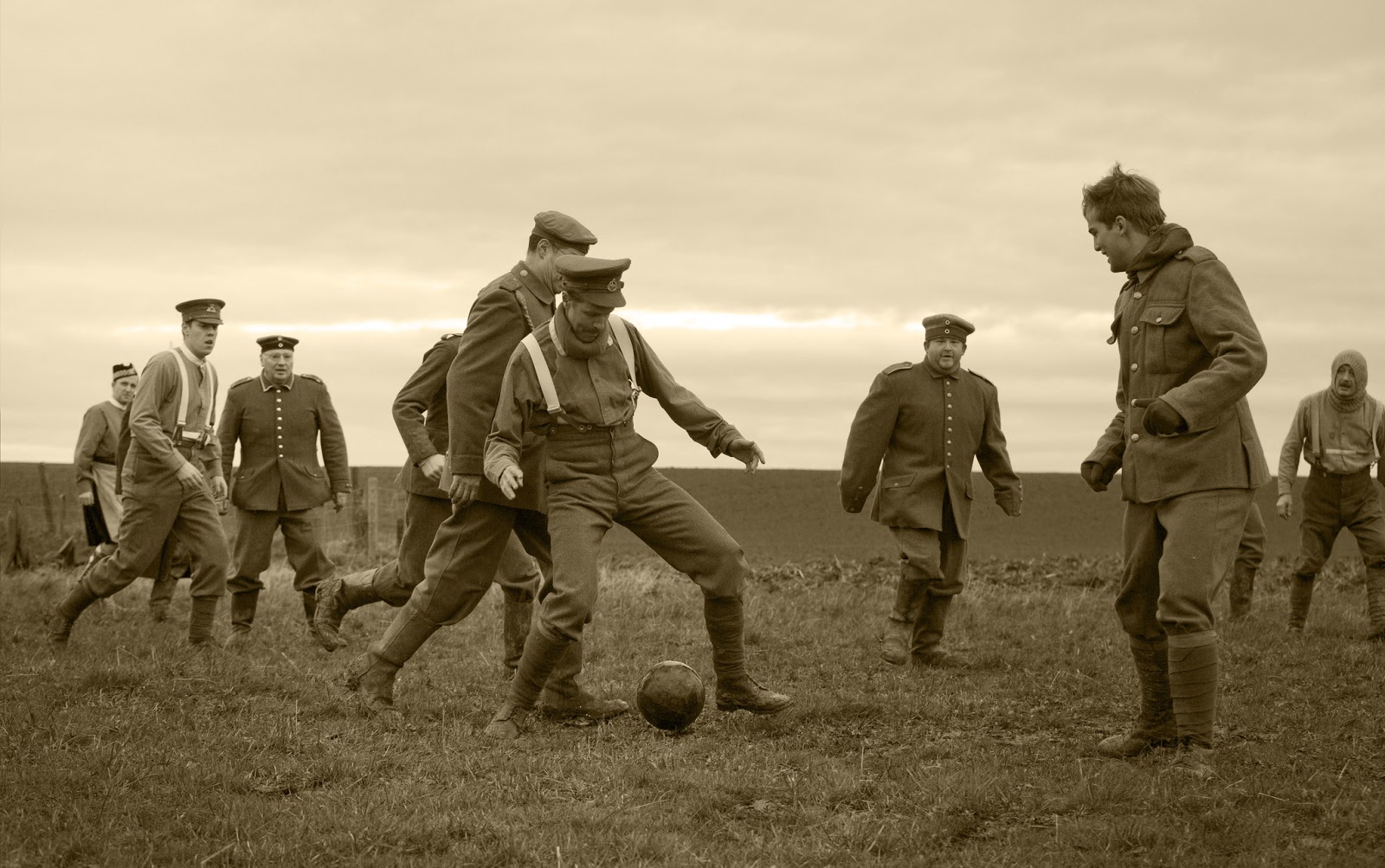
THE BEER BEAT: Beer and the Christmas Truce, France, 1914.

Photo credit and more.

"The two barrels of beer were drunk, and the German officer was right: if it was possible for a man to have drunk the two barrels himself he would have bursted before he had got drunk. French beer was rotten stuff."

The Christmas Truce of 1914 is the stuff of Great War myth and legend, but it really happened.

What style of beer was in those barrels, anyway?


Beer Makes the Armistice, by Eileen L. Wittig (Foundation for Economic Education)

By now we’ve all heard of the Christmas Truce of 1914, whether because we are cultured and learned citizens, or because we saw Sainsbury’s Christmas commercial a couple years ago. And because we are all cultured and enjoy edifying ourselves, we know the general events that started and continued the truce. (In case you partied so thoroughly you forgot, the reason was that both sides wanted to celebrate Christmas, and they were sick of the trenches. Solid reasons.) But no one talks about the best part of the truce – the beer.

Here's a Christmas toast for the ages.

After all, the enemy who agrees that my beer enemy is bad at making beer is my friend.

Saturday, November 11, 2017

An annual reminder: Forgotten fields in Flanders on Armistice (Veterans) Day.


The annual renewal of Veterans Day reminds us that 2017 is the 99th anniversary of the Great War's end. The conflict's centenary was in 2014, and throughout 2017 there have been 100-year memories of horrific battles like Passchendaele and the Caporetto.

Why is this important? Among other reasons, Americans remember 11/11/11 each year in the form of a holiday that has come to embrace the service of all veterans, not just the World War I generation.

Veterans Day is an official United States holiday honoring armed service veterans. It is a federal holiday that is observed on November 11th. It coincides with other holidays such as Armistice Day or Remembrance Day, which are celebrated in other parts of the world and also mark the anniversary of the signing of the Armistice that ended World War I. (Major hostilities of World War I were formally ended at the 11th hour of the 11th day of the 11th month of 1918 with the German signing of the Armistice.)

November 9 was the 28th anniversary of the day the Berlin Wall fell. As I'm fond of arguing, the armistice in 1918 didn't end the first war at all. The demise of the Wall did -- well, maybe. There's the Yugoslav civil war of the 1990s to consider, and now that the religious division of Ireland is back in the news as a result of Brexit ...

Thus, future historians might refer to the period of 1912-1989 as the "77 Years' War," or perhaps tack on another decade and pronounce the 87 Years' War as concluding with the bombardment of Belgrade by NATO. Most of us will be gone by then, anyway.

Here is a guest column originally published in the pre-merger Tribune on November 5, 2009.

---

Forgotten fields in Flanders.

Lately I keep hearing this tune.

Keep the home fires burning,
While your hearts are yearning,
Though your lads are far away
They dream of home.

These dreaming lads were soldiers, in route across the English Channel to fight for the United Kingdom, and several hundred thousand of them failed to return home to nostalgically remember a popular song written to inspire the home front in their absence.

By now it should be clear that war is horrible, and I’m not sure that it serves any purpose to discuss which wars are “just.” Justice in this context inevitably owes to situational morality as the combatants pray to their respective deities and make theological mockery of whatever religious interpretation devolves from these biased, selective judgments.

By all such standards, the Great War was especially horrible. The specific horror of this conflict, which eventually came to be known as World War I out of a contextual necessity to keep our historical accountings of human suffering clearly ordered, surely represents societal innocence shattered on an unfathomably massive scale.

An entire generation that had known no war outside of mock duels and parlor games willingly marched off to slaughter while gaily singing songs about honor and glory, and consequently, it’s a safe bet that World War I was the last disastrous conflict to feature a soundtrack entirely devoid of irony. Western societies would have to wait decades and refine techniques of amplification until the onset of thrash metal’s inherent violence finally provided music capable of approximating the grim reality of institutionalized murder.

Earlier this year, the last British veteran of the war died. Perhaps one American soldier of the era remains alive – and, in the time it has taken for me to write this essay, perhaps he’s gone, too. The war began in 1914, and it has long since faded into the black and white images of crude newsreel footage that only hint at the carnage of trench warfare and the doltish, outmoded “leadership” on the part of uniformed war criminals.

Providentially, my own grandfather was drafted too late for combat duty. He managed the not inconsiderable task of avoiding the flu pandemic that killed more American soldiers than enemy fire. My father then followed suit by serving in the Marines during World War II, which was “his” war, and a subject of fascination for him the remainder of his life.

I, too, went overseas, although not in uniform. In 1987, I found myself in Sopron, Hungary, choosing a beautiful early summer’s day to go for a hike in the hills. I came upon a large, older cemetery, and decided to walk through it, ascending a gentle, wooded slope past contemporary gravestones of the still-extant Communist era.

Like rings on a tree stump, history’s reverse chronology rotated as I continued uphill. Nearing the top, rows of Great War graves finally commenced. These were the soldiers who fought and died for the ruling family of the Austro-Hungarian Empire – the losers, as it were, who died as readily as the “winners” on the other side.

The first death dates were more recent: 1918, and then somewhat more from 1917, and as I scanned their names, the majority Hungarian, but also some Germanic and Slavic owing to the mutli-ethnic, polyglot nature of the Habsburg domain – as I contemplated how ridiculously, stupidly youthful so many of them were – I reached the lip of the hill, rather puzzled that there seemed to be no graves from earlier war years.

The answer to my befuddlement was just on the other side. Dipping into a valley studded with older, larger hardwoods, row after row of markers told the lethal tale: Died in 1916, 1915 and 1914.

I always think about the cemetery in Sopron on Veterans Day, formerly Armistice Day, which originally fell on November 11th because that's when the fighting stopped in 1918, ending the First Great World War and enabling a “peace” conference in Versailles that did so much to ensure a second.

Previous generations knew about the 11th hour of the 11th day of the 11th month, but all the other mass bloodlettings since required a consolidation of observance, and a holiday more intrinsically American. So be it, and I’m not here to disagree, even if we forget the first causes that brought it about.

However, we’re left with those many innocent, misplaced songs. Now that living memory has passed, they speak even more eloquently about life, death and our capacity, sometimes successful, and often not, to make sense out of the insensible.

A CBS television documentary, World War One, ran from 1964-65, comprising 26 half-hour episodes, and later airing on cable. My friend Barrie videotaped them. The series is now available on DVD (you can see excerpts on YouTube), and I’m weighing a Christmas purchase, because one of the episodes, “Tipperary and All That Jazz,” has haunted me since the first time he and I watched it around the time of my Sopron sojourn.

Ancient film, much of it depicting camp life behind the lines, forms a backdrop for song snippets. They are melancholy, sentimental and elegiac. It is heartbreaking … and very real.

There's a long, long trail a-winding
Into the land of my dreams,
Where the nightingales are singing,
And a white moon beams.
There's a long, long night of waiting
Until my dreams all come true,
Till the day when I'll be going
Down that long, long trail with you.

Sunday, October 22, 2017

THE BEER BEAT: "One hundred years ago, Britain nationalized hundreds of its pubs — and invented a better drinking culture."

Photo credit.

Simply stated, speaking as one who is fascinated by World War I and British pub culture and the notion of prohibition, this is a worthy digression to which I'll be returning.

In the interim, it's a pleasure to be introduced to the writing of Phil Mellows, and for more on the topic: The Carlisle Experiment – limiting alcohol in wartime, by Roger Kershaw (The National Archives UK)

Absolutely compelling stuff, this.

Nationalize the Pubs, by Phil Mellows (Jacobin)

A hundred years ago, at the height of World War I, the British government faced a dilemma. As the slaughter on the Somme reached its climax, a vast munitions factory had been built on the border between England and Scotland, on an area covering more than fourteen square miles. Some 12,000 workers, plus thousands more builders and a military guard, were drafted into the area.

Most were billeted in townships near Gretna on the Scottish side of the border, but only a short train journey from Carlisle, a city in northern England. With little else to amuse themselves, Carlisle’s pubs became a home for the workers and their unusually generous pay packets, every evening swelling a native population of just 50,000. At Boustead’s, a watering hole near Carlisle station, they would line up 500 whiskies along the bar, ready for the first after-work customers off the train.

By the summer of 1916, convictions for drunkenness in the town had soared six-fold. But, of course, it wasn’t disorder that primarily concerned the authorities. When future prime minister David Lloyd George, then munitions minister, declared that “We are fighting Germany, Austria and drink, and as far as I can see, the greatest of these three deadly foes is drink,” he was referencing the widespread view that the effects of alcohol were threatening production.

Outright prohibition was on the agenda for a time, something which was to come to pass in America only four years later with a constitutional ban on the production, importation, transportation, and sale of alcohol. But by the outbreak of the First World War the temperance movement in Britain had passed its high-water mark. In 1908, the House of Lords threw out a licensing bill which had proposed closing 30,000 of the 96,000 pubs in England and Wales.

But war had sharpened the drink question once more — and something had to be done. Against this backdrop, the Carlisle Experiment, as it became known, was born ...

Wednesday, October 04, 2017

Time for remembrance at Lijssenthoek Military Cemetery outside Poperinge.

When the Great War began in 1914, Lijssenthoek was a small village near Poperinge, perched on the rail line to France.


Amid the stupendous carnage of the battles around Ieper (Ypres), which were renewed in various incarnations for four years, Lijssenthoek quickly became a place of great importance.


The rail line was the single most important Allied supply route, and a farm at Lijssenthoek was available for use as a field hospital and evacuation point. Most of the war, this vicinity was out of German artillery range.

For four years, trains arrived from France filled with healthy soldiers and supplies, and returned with wounded, but of course not all of the wounded survived, hence the military cemetery. Needless to say, it filled quickly. Today it is the second-largest Commonwealth cemetery in Belgium.

While most of the burials are British, Canadian and Australians, along with other troops from the British colonies, some Frenchmen and a handful of German troops also are buried at Lijssenthoek, as well as Chinese laborers. There is one American grave.

On Monday, Luc drove me to the cemetery. The village no longer exists, apart from a former pub building where the Englishman working as cemetery caretaker lived for many years.


At some point in the past the railroad tracks were torn out, and the N38 roadway built along the right-of-way. Because the N38 is the most direct route from Poperinge to France, it's the path we chose to bike in the direction of Cassel during those first two beercycling trips in 2000 and 2001.

However, we never stopped for a sag at the cemetery. Dozens of burial grounds dot the landscape around Ieper, and perhaps at some point a visitor no longer notices they're there.

If you ever go to Ieper and environs, take the time to stop and look at the graves. World War I knocked civilization off kilter. I'm not sure we've regained our balance, 100 years later.


This chart marks the daily number of burials in the cemetery. The highest points depicted here occurred almost exactly one hundred years ago at the time of my visit as a result of the Battle of Menin Road Ridge, itself one phase of the idiocy known to us as Passchendaele.

It was a battle that lasted three and a half months, achieved almost nothing, and resulted in 275,000 casualties under British command and 220,000 Germans.


Each day, the video screen in the comprehensive visitor's center focuses on one interment.


These are the faces of some of the 10,784 men (and one woman, a nurse named Nellie Spindler) buried at Lijssenthoek. Only 35 are unnamed. This is because if a soldier could be brought to the rear for medical attention, there was a much better chance of identification. Conversely, such was the horror of the Passchendaele battles that 90,000 bodies could not be identified, and 42,000 were never recovered.


The fence by the road outside is another artistic representation of the volume of burials.


Luc showed me the numeric mapping system enabling individual graves to be located easily. It's still in a book, not an app.


Gaps in the headstones usually indicate a burial moved to a different cemetery after war's end.


I was unaware of the reason for stones being placed atop the graves of Jewish soldiers.

All the explanations have one thing in common — the sense of solidity that stones give. Flowers are a good metaphor for life. Life withers; it fades like a flower. As Isaiah says, “All flesh is grass, and all its beauty like the flower of the field; grass withers and flowers fade” (Isaiah 40:6-7). For that reason, flowers are an apt symbol of passing.

But the memory is supposed to be lasting. While flowers may be a good metaphor for the brevity of life, stones seem better suited to the permanence of memory. Stones do not die.


Ironically, this is the (larger) Stone of Remembrance.


Members of the Chinese Labour Corps.


As for the remainder of the day on Monday, almost every eatery and watering hole in Poperinge was closed, although the shops were open. Diana and I went to the grocery and purchased sandwiches and salads for a day's meals in the apartment.

It was cool and rainy, and the city's workers gradually disassembled the festival infrastructure. The two of us read and rested. At times, it's what you have to do.

---

Previously:

The 2017 Poperinge Hop Parade, Part Two: The procession itself, and where to dine afterward.


TRAVEL PRELUDES: Ieper ... Ypres ... Wipers; the Great War and a passing of generations.