Showing posts with label open air museum. Show all posts

Wednesday, October 07, 2020

From 2009: "Hot Hofstadter, cold Cappuccino," or a treatise on Nawbanian anti-intellectualism.


This was one of my guest columns for the pre-merger Tribune, appearing there on December 12, 2009. 

Many of the columns didn't appear at the blog in their entirety until later, if at all, seeing as the Tribune's understandable directive at the time was that I could link to them and drive traffic to the newspaper's web site (which NAC did consistently for 16 years, and I'm still awaiting a thank you card, ingrates), but not publish the columns myself. 

When the merger rendered me redundant, I assumed all previous agreements went out the window. If not, I'm sure current management is as oblivious as ever.

Consequently, as an introduction to this column's blog link in 2009, I wrote this.

Code enforcement alert: Today's column knowingly and indiscriminately violates the city of New Albany's ban on words of four syllables or more. I'm at home this morning and available to be cited and/or arrested.

No one ever knocked. If there is any consistent pattern to governance in Nawbany, it's that our betters don't read. Especially since 2012.

---

BEER MONEY: Hot Hofstadter, cold Cappuccino.

On Monday evening, I overheard a New Albany city councilman explaining to a bystander how much more he knows about drainage issues than any number of trained experts in the field, and that our problems with stormwater primarily result from virulent conspiracies between city planners and a veritable mafia of builders.

I reached for my steaming wand, and thought immediately of Bayard R. Hall.

"(We) always preferred an ignorant bad man to a talented one, and hence attempts were usually made to ruin the moral character of a smart candidate; since unhappily, smartness and wickedness were supposed to be generally coupled, and incompetence and goodness."

Even though Hall might have written it yesterday, speaking perhaps as a resident of New Albany’s 3rd council district, or as a bemused observer of contemporary America’s penchant for creationist museums, masturbatory tea-party circles and Palin for Dogcatcher campaigns, all competing for the attention of a benumbed populace forever mistaking spasm for thought, his words actually date all the way back to 1843.

Hall penned them in reference to the political scene in frontier Indiana, thereby illustrating that anti-intellectualism was a cankerous sore on the American body politic long before George W. Bush took office.

“Anti-intellectualism is a term that in one sense describes a hostility towards, or mistrust of, those who call themselves intellectuals, and intellectual pursuits. This may be expressed in various ways, such as an attack on the merits of science, education or literature.”
--Wikipedia

From Hall, my thoughts raced to Richard Hofstadter. Those voters who have somehow managed to progress beyond the literary realm of “Left Behind” and the attractions of “Dancing with the Stars” might eventually come into contact with the work of the historian Hofstadter, whose 1964 book, “Anti-Intellectualism in American Life,” charted the American cultural habit of loudly detesting the quality that separates humans from other mammals.

“The common strain that binds together the attitudes and ideas which I call anti-intellectual is a resentment and suspicion of the life of the mind and of those who are considered to represent it; and a disposition constantly to farm-near-me/">minimize the value of that life.”

Hofstadter devoted his all too brief career to advancing the primacy of ideas, and exploring the ways that behavior (primarily in the political sense, but also in related pursuits) is related to the way people use, or refuse, their minds.

Ariel Dorfman, a writer, paraphrases Hofstadter’s findings:

“Anti-intellectualism had its origins … in American traits that anteceded the nation's founding: the mistrust of secular modernization, the preference for practical and commercial solutions to problems and, above all, to the devastating influence of Protestant evangelism in everyday lives.”

Like the councilman spouting in the corridor, New Albany’s most renowned practitioners of the anti-intellectual craft tend somewhat bizarrely to be registered as Democrats, although it is difficult to imagine any of them voting for their party’s standard bearer, Barack Obama, in 2008. As such, they’re little more than political poseurs, and with each passing day, we find better ways to sidestep their obstructionist defaults.

Does their destructive anti-intellectualism really matter?

It does, because it emits a catastrophic message to the community, mimicking Pink Floyd: “We don’t need no education – only ward heeling.”

It cynically condemns our children to the very same poisoned atmosphere of unaccountability and low common denominators that shaped New Albany’s malignant past and brought us to a state of apathetic degradation.

It furthers an atmosphere of congenital political underachievement. How many elected community “leaders” can you identify with support for the proposition that life’s difficulties are best confronted “with an intelligence of which no human should ever be ashamed,” as Dorfman phrases it.

Not many.

Rather, they persistently demand that we be ashamed, frightened and uncooperative. They denounce a pantheon of imaginary enemies, of shifty, phantom withholders of vital information, of smarty-pants book-learning engineers, of those who read, of those who write … of anyone who can “do” as they haven’t ever done, and cannot ever do.

Hence the purely imaginary cabal of zoning officials and contractors, plotting by candlelight to pump sewage into area basements.

In the same year as Hofstadter’s treatise on anti-intellectualism, his essay entitled “The Paranoid Style in American Politics” was published in Harper’s Magazine. It is a compendium of American political paranoia, as directed against a cornucopia of enemies – free masonry, the international gold ring, the Illuminati, Catholics and Communists, among others.

Hofstadter offers that “American politics has often been an arena for angry minds,” behind which is a “paranoid style” of thought.

“I call it the paranoid style simply because no other word adequately evokes the sense of heated exaggeration, suspiciousness, and conspiratorial fantasy that I have in mind.”

Hofstadter died many years ago, and yet his words chillingly describe the prevailing New Albanian political “culture.”

Consider the incessant talk of malicious City Hall plots directed against selfless public servants on the council. Survey the chronic knee-jerking when these same public servants are asked for corroborating evidence to support their nonsensical conspiratorial claims. Chuckle at the recurring expressions of anti-intellectual rage when they’re presented with alternative, contemporary visions of the world and asked if they’ve heard of life outside the Open Air Museum.

Looking for the best place to begin rejecting the politics of anti-intellectualism and paranoia on the council, and for isolating their practitioners? It’s the council president’s chair – and the time for change is mercifully close at hand.

Roger believes that there are no big or little words, just the right ones. For daily commentary, visit the NA Confidential blog: www.cityofnewalbany.blogspot.com

Wednesday, September 30, 2020

The farewell tour continues: "Ilmatyynyalukseni on täynnä ankeriaita," from March 20, 2010.

As NA Confidential prepares to ride off into the sunset, I'll be reposting selected bits from the past. This one's from the spring of 2010. Already I was starting to "know" better, but my daddy raised me stubborn. Too bad for me.  

---

Ilmatyynyalukseni on täynnä ankeriaita.

Excuse the title. I've been looking for an excuse to use obscure linguistics in a title. Basque was my first choice ... but ...

I can appreciate where you’re coming from. Both of you.

You’ve landed here only recently, and in the course of surveying the landscape, there have been judgments based on first impressions. Some of these will survive scrutiny, others not. That’s the classic, enduring beauty of the learning curve.

I’ve lived here in Floyd County my whole life, and have always had a mailing address within ten or so miles of City-County Building, but because my residency in the city of New Albany only began in 1993, I’m considered an outsider by many (mostly older, mostly bitter) New Albanians. Consequently, I know what it’s like to arrive here and be childishly derided for not being FROM here.

The ones who never accomplished anything will always resent you for your talent, your skill, and most of all, your mobility. If they perceive you being of temporary assistance to them in their goals of universal doltery and egalitarian misery, they’ll lionize you until you think for yourself. Then it will be over, and you’ll feel predictably dirty the next morning.

It’s frustrating, but ultimately, it’s their loss. They can do nothing to improve the planet. You can. The question is: Who wins?

Doers … or delusionals?

My involvement with the eternal morass of New Albanian politics dates back about six years. Before that, I was busy with the original pub and brewery on the north side. When I remarried, we bought a house on Spring Street, and began absorbing contemporary ways of thinking and planning as they pertain to historic urban cores. All I could see was an underutilized, savaged doughnut hole. I had to learn why it had happened, and how best to rectify it.

In the beginning, I looked around and thought I understood the lay of the land. I spoke out accordingly. As I met people who were outside my comfort zone of the Grant Line pub, and who had put much more thought into matters like this than I had, it began to occur to me that my initial snap judgments were utterly and embarrassingly mistaken. Much had been misread on my part, which is understandable given my inexperience.

Too bad I spouted before I grokked, but so it goes. You live, and you learn.

In New Albany, for better or worse, the more one learns, the murkier it gets, and the more affairs become resistant to glib, simple answers of the sort that satisfy the populist in all of us. We want these sort of answers, and badly. It’s easier to believe them and to range outside self-imposed cultural boxes. Unfortunately, they’re seldom true.

Obfuscation, self-destructiveness and perhaps plain ol’ simple insanity are parts of everyday life here, maybe more so than most suspect. So it is that sometimes, you get off on the wrong foot and miss things. It’s difficult to see what’s progressive, and what isn’t. Some times, one must shrug and accept the daily torrential abuse for what it is: Fear, and loathing, and on occasion, chemical imbalance.

In the end, it comes down to this: If you’re smart enough to know better, you’re obliged to ... know better. 

To know. 

That’s the key word. In a city that by and large hates knowledge, hates achievement, and hates itself, knowing is the only conceivable coping mechanism.

The dark side in NA? It’s not the place to be. Trust me. The capable mustn't be divided by pettiness and intemperance, because there are too damned few of us.

Tuesday, February 18, 2020

BEER WITH A SOCIALIST: Who's Gonna Drive You Home? Gravity Head's 22nd bacchanal begins on February 28.

Gravity Head XXII (okay, right on; not the Super Bowl, so "the 22nd running") returns to the NABC Pizzeria & Public House on Friday, February 28.

As far as I know it's the usual 7:00 a.m. kickoff with breakfast and I'm weighing if I should go. After all, Bobby Knight returned to Assembly Hall.

The last Gravity Head with which I had any active participation was 2015, and yes, it's strange to think it's been five whole years. I've gone over a time or two on opening weekend Saturday, and my favorite moment was when Eric Gray saw me coming and immediately poured a Pilsner Urquell.

The following was published last year as "I'd stop drinking, but I'm no quitter (the 2019 Gravity Head remix)." It's a stream-of-consciousness collage, and I'll buff and polish a wee bit for 2020.

One part will be retained, but with this explanation: While I've resolved to cease attending meetings apart from cases of extreme emergency, if compelled, only martinis might possibly serve as preparation. 

---

Before the drinking starts, let’s consider a ship leaving the dock and making for open water. We experienced this first-hand in 2016 aboard a big Baltic ferry, leaving Tallinn for Helsinki in the morning and returning at dusk the same day.

In darkness of night the specific sensation might be described as lights fading, but by daylight it is the gradual disappearance of land as the ship moves away from shore. Depending on the weather and the strength of one’s eyesight, there comes a split second when land no longer is visible. It’s a melancholy feeling, like the place itself has ceased to exist apart from a lingering imagination of it.

From this point forward, until the next port of call begins slowly to materialize past the bow, the journey becomes synonymous with the undulating rhythm of the sea.

Similarly, most aspects of business ownership consuming my daily existence for a quarter-century -- the good, the bad, the drunk and the sublime -- have dissolved entirely into those distant invisible headlands. Now it’s just the rocking of the waves, and pondering what it all meant.

These days it seems like another person's life.

---

Col. Sherman T. Potter: I gather you drink.
Captain“Hawkeye” Pierce: Only to excess.

In the Western cultural tradition, there are numerous examples of the seasoned drinker as a sodden protagonist, at times an inspiring and compelling figure -- perhaps even a heroic one, as with Norm Peterson on Cheers -- although bar owner Sam Malone was a reformed alcoholic, as was the real-life Nicholas Colosanto, who played the bartender Coach on the popular show.

Sometimes you want to go where everybody knows your name, although it occurs to me some of you might not want to go here, finding this topic distasteful. At the same time, it would be pointless of me to deny or to disavow a career in beverage alcohol, or to suggest that it was only a job.

Trust me; my work wasn't left atop a desk at the office.

I drink very differently now than before, and far less overall, but drinking's still a conscious lifestyle choice. So it goes. I don't drive while intoxicated, and command all drinkers to be responsible.

Back to these fictional drinkers, who in my view reflect an existential aspect of the human condition. To be succinct, what else remains to be said, done or alibied when life’s fundamentally surreal futility strikes you as inescapable, and is best addressed and assuaged by peering through the bottom of a lifted glass, one deftly drained only seconds ago?

The cultural milieu of alcoholic beverages in places like India, Bolivia or Ghana remains a mystery to me, although it is clear that the pursuit of intoxicants is a universal human condition throughout the world. Certain European and American archetypes endure to entertain and enlighten, from Falstaff in olden times to Bukowski in ours, as buttressed by diverse personalities such as W.C. Fields, Dean Martin and Dudley Moore’s Arthur.

I've always been a reader of books. In the American literary oeuvre, one must push past cautionary tales of prohibitionist finger-wagging during the lamentably fevered Carrie Nation period of our national existence, straight to the dawn of the modern period occurring just after the Great War. Inhibitions fell prey to an all-encompassing, collective thirst enabled by the villainous Volstead Act, and brutal realism finally forced its way out of societal straitjackets.

Imbibing in print became great again.

It may have been Ernest Hemingway who first incorporated the drinker’s lifestyle as integral backdrop, seen most strikingly in his groundbreaking novel, The Sun Also Rises. Youthful, disaffected, expatriated Americans find solace in adult beverages at all hours of the day, even when they should be diligently working to appease the Puritanical prerequisites of capitalism and families back home.

The acerbic commentator Dorothy Parker emerged from this period, Scotch in hand. Equilibrium came with Repeal, and America scarcely skipped a beat, quickly eschewing Scott and Zelda for Reefer Madness and later, Timothy Leary. However, this is beyond the scope of today's examination.

Malcolm Lowry was an Englishman heavily influenced by the New World, and he captured the bibulous essence in the person of Geoffrey Firmin, otherwise known as the Consul, in Under the Volcano. Firmin is a defeated man on the Day of the Dead, utterly adrift during his final hours on earth, navigating the streets of a dusty Mexican provincial town in search of celestial meaning and settling instead for bottles of mezcal hidden in the shrubbery, as well as an infamous midday jolt of aftershave.

When seeking literary inspiration across the pond, a personal favorite is J.P. Donleavy’s The Ginger Man, chronicling the antics of supposed student Sebastian Dangerfield, a profligate American carousing, drinking, roaring and whoring in Ireland. For more of the same, Anglo-style, consult Kingsley Amis’s Lucky Jim, and know that in his prime, the very real Amis fully imitated his art.

On the continent, Czech playwright-turned-statesman Vaclav Havel’s two-person play, Audience, posits an artistic, city-dwelling enemy of the totalitarian state abruptly sent as punishment to the hinterlands and a term as manual laborer in a brewery. He must endure the ramblings of his boss, who cannot refrain from sampling the fermented wares and hilariously sinks into inebriation while haplessly pretending to interrogate the urban exile.

The doctor in László Krasznahorkai’s novel Satantango desperately tries to ration his enabling pálinka (and fails) as he observes the disintegration of the dysfunctional collective farm, and in the first-person narrative of The Drinker, by Hans Fallada, the hapless Herr Sommer will swallow just about anything as he abruptly transitions from sobriety to alcoholism, and eventually to insanity -- but schnapps is the preferred lubricant of his alarmingly precipitous decline.

For something approximating a philosophical rationale for the drinker’s lifestyle choice, we must turn to Jerzy Pilch’s A Thousand Peaceful Cities and the bombastic figure of Mr. Traba, a retired Lutheran pastor in heavily Catholic (and Communist) Poland.

Mr. Traba’s daily doses of vodka are the pretext for a fateful decision. It is 1963, and he has decided to erase his life’s numerous frustrations by committing a final, exclamatory act: Assassinating Comrade Gomulka, the unimaginative and degraded Communist tyrant. As the tragicomic final moment draws near, the perpetually intoxicated Mr. Traba addresses his companions:

Of course, there were moments in my wasted life when I got the audacious idea in my head to gain mastery of some earthly skill other than drinking, but upon reflection I rejected all these ideas. I drank all my life, and drinking was my work and my rest, my love and my hobby. Drinking was my art, my concert, and my artfully written sonnet. Drinking was my cognition, my description, my synthesis, and my analysis.

Only amateurs, laymen and graphomaniacs assert that you drink in order to soften the monstrosity of the world and to dull unbearable sensitivity. On the contrary, you drink in order to deepen pain and to heighten sensitivity. Especially in a case like mine: when there is nothing but drinking, it is necessary to make an art of drinking, it is necessary to reach the heart of the matter through drinking, and the heart of the matter is death.

When I first read the testimony of Pilch’s extraordinary character, I finally understood the contemporary reality of which all New Albanians boasting consciousness and a pulse must eventually grapple.

Even today, it is virtually impossible to attend a public meeting in this town without recourse to strong drink.

---

Meanwhile, an ancestral imperative creeps into the narrative.

When Gravity Head launches at NABC's Pizzeria & Public House, as it will again on Friday, February 28, the familiar space and time continuum is briefly altered. Normal routines appear Byzantine by comparison. Life’s infinite horizons narrow. One reverts to existence by the hour, or minute by minute. Passing through the looking glass is perfectly boring by comparison.

As for the fest’s actual commencement, once the opening bell sounds there is a collective observance of Dr. Sidney Freedman’s immortal dictum:

“Ladies and gentlemen, take my advice - pull down your pants and slide on the ice.”

Why do I continue to mention Gravity Head even after my final, much belated exit in 2018 from the company I helped found?

It's simple, because once upon a time Gravity Head was my idea. The 2020 edition will be the 22nd such gathering, and I'm unrepentantly proud of my creation. Of course Gravity Head no longer is about me, assuming it ever really was. It always took the entire workplace village to pull it off, and I imagine this remains true.

Besides, gravity’s the law. It’s bigger than you and me.

Gravity Head’s opening day has become somewhat of a chaotic scrum, and a singular tradition all its own. Folks seem content with the interior logic occurring at the fest’s beginning, but this isn’t what every celebrant looks forward to experiencing each year.

Rather, there’ll inevitably be a quiet Tuesday night on the second or third week, with a handful of friends, and leisurely, contemplative sipping of one or two quality libations, spiced with conversation. These are the precious moments that lead to feelings of timelessness.

And without timelessness, beer is far less interesting to me. Will I attend this year? Not sure, and it doesn't matter. Have fun if you do, and be responsible.

---

These days I'm working in the beer trade at Pints&union in downtown New Albany. It's been 14 years since our presumed civic revitalization began with the establishment of Bistro New Albany -- a pivotal if short-lived eatery and watering hole. It operated where Brooklyn & The Butcher is located today.

Amid the prevailing Gahanian personality cult of the present, the pendulum has swung all the way back to alcohol as the best available means to deepen pain and heighten sensitivity. Dissipation may be a masochistic coping mechanism to counter the Disney-fried dictatorship, but it has the benefit of reminding us of how little the base culture of obliviousness has changed in all this time.

My favorite way of defining dissipation is this: “Unrestrained indulgence in physical pleasures, especially alcohol.”

Perhaps that’s why I’ve always been an aficionado of dissipation, albeit in the manner of a willful, controlled narrative. In the hands of lesser mortals, dissipation can be harmful, but there are times when it proceeds from conscious calculation in the face of savage, visceral, conditioned responses, as when a glance at the calendar confirms that it’s a first Monday or third Thursday, and the occasion for another New Albany common council meeting.

(Given that attendance at fix-forever-in Redevelopment Commission meetings would require sedation by an anesthesiologist, let’s not even go there ... literally as well as figuratively.)

Considering the implications of meeting attendance, you find yourself thinking about how those impossibly brief final hours should be spent before history rudely repeats itself as tragedy, farce or vaudeville’s worst ventriloquist routines. Will you smoke a cigarette, have a last supper, and leave a testament for posterity?

Better to have a stiff drink, relax and enjoy the inevitable. Dissipation suddenly ceases to be a pejorative term thrown your way by the kill-joys and health fascists, and comes to more closely resemble what Hemingway, a true giant of the dissipative genre, once described as a “means of sovereign action.”

Papa was talking about a bottle of liquor, which could be consumed, used to crack skulls or rendered into a Molotov cocktail, sometimes all at once. Until recently, I stuck to a regimen of Progressive Pints somewhere downtown before ambling down to the City-County Building and taking in the floor show.

But times change, and medicine's effectiveness changes with them. Lately the prescription has come full circle, all the way back to the improvised still in the Swamp at the 4077th.

It may or may not have been gin, but there can be no doubt that it was the right stuff.

Hawkeye Pierce: Let’s make a pact about drinking.
Trapper John McIntyre: All right.
Hawkeye Pierce: Let’s never stop.

Saturday, February 15, 2020

On being an exile in one's own community (thanks, Jan Morris).

Not Mussolini.
It has been only a few months since I wrote about Trieste and the Meaning of Nowhere, "a meditation on the crossroads city of Trieste" (in Italy) by the Welsh journalist and writer Jan Morris, who was born in 1926 and remains with us.

We visited Trieste just after Thanksgiving, and I became enamored of this amazing place, although it must be said that my geographic promiscuity is legendary in this regard. Trieste is one of several hundred European cities, towns and goat crossings in which I'd live happily ever after if afforded the chance -- or rather, if I could afford it, having dedicated my life to pro bono pay scales in pursuit of various windmills.

La Mancha? I'd live there, too.

Back to Trieste. Morris's book is history, travelogue and social commentary all at once, canvassing Illyrians, Austrians, Italians, Slovenes and Jews; long-term expatriate resident James Joyce's fondness for whorehouses and ill-fated Emperor Maximilian's unfortunate career choice in Mexico; Karst limestone topography, native Bora winds, the Glagolitic (old Slavic) alphabet and young Sigmund Freud's failure to determine how eels copulate; mediocre opera, excellent coffee and various movable landmarks; and not to exclude robust viewpoints about racism and nationalism (unsurprisingly she's decidedly against them).

She offers this summary, incorporating a few words about exile.

“There are people everywhere who form a Fourth World, or a diaspora of their own. They are the lordly ones. They come in all colours. They can be Christians or Hindus or Muslims or Jews or pagans or atheists. They can be young or old, men or women, soldiers or pacifists, rich or poor. They may be patriots, but are never chauvinists. They share with each other, across all the nations, common values of humour and understanding. When you are among them you will not be mocked or resented, because they will not care about your race, your faith, your sex or your nationality, and they suffer fools if not gladly, at least sympathetically. They laugh easily. They are easily grateful. They are never mean. They are not inhibited by fashion, public opinion or political correctness. They are exiles in their own communities, because they are always in a minority, but they form a mighty nation, if they only knew it. It is the nation of nowhere, and I have come to believe that its natural capital is Trieste.”

A noted last year, while Morris has not visited New Albany, she knows exactly what it feels like to exist here amid the reign of the mediocre charlatans. Internal exile, New Gahania-style, means being confined to quarters because it's too dumb to go outside.

The first mention at NA Confidential of Nawbany's congenital anti-intellectualism came in October of 2005, courtesy of long-forgotten 19th-century Hoosier writer and pedagogue, Bayard R. Hall:

In 1843, Hall wrote of frontier Indiana that "(w)e always preferred an ignorant bad man to a talented one, and hence attempts were usually made to ruin the moral character of a smart candidate; since unhappily, smartness and wickedness were supposed to be generally coupled, and incompetence and goodness."

Remarkably, Hall foresaw the 2000s, prompting the query: Why am I still here, continuing to live in New Albany, when I might be residing in another part of the state, country or world?

(Reader’s note: The axiom known as Thrasher’s Razor fully applies to this rumination, because now more than ever, we’re all here because we’re not all there.)

As the missus reminds me on widely scattered occasions -- basically, every morning at breakfast -- I’ve never been much in sync with the sort of polite poseur’s society values craved by the underachieving likes of Bob Caesar. They're far too banal an ordeal for me.

What's more, I’ve never been able to swim a lick unless it’s against the metaphorical tide. Contrarianism fits me like a well-tailored suit, which of course I’d subsequently refuse to wear, because you can’t trust anyone who does. Suits are little more than costumes to facilitate hiding behind.

Wouldn’t I be happier elsewhere, in a place with a cultural climate more in keeping with my personal value system, as opposed to one that prompts severe allergic (read: aesthetic) reactions? Haven’t “they” always told me to leave town if I didn’t like “their” toxic farrago of ignorance?

To which I’ve always succinctly replied: “You first, my dear Gaston.”

All this being said, for the first time since the 1980s, the notion of living elsewhere is being tossed around my dusty cranium. The forthcoming "60" seems a nice, round age to begin contemplating future options. If I'm lucky, two quality decades remain, with maybe some pocket change before eternity.

Is an open air museum where the life of the mind is shunned like a displaced coronavirus sufferer really the final stop for me -- for us? I don't know. All I know is it's worth thinking about.   

Sunday, October 27, 2019

GREEN MOUSE SAYS: An October opioid settlement surprise -- and howzabout Dan Coffey as drug czar? Well, we're all on SOMETHING.


The Green Mouse has a crazed and wacky composite rumor to report, and at first glance it appears nutzoid, but then again we inhabit The Veneer Peddler's Republic of New Gahania, otherwise known as the Open Air Museum of Ignorance, Superstition and Backwardness.

As background, recall that Slick Jeffie Gahan couldn't ever bring himself to say the word "opioid" aloud for attribution until late August, when a typically self-serving press release trumpeted the city's participation in a class action lawsuit against opioid distributors, giving the Gahanite propaganda secretariat a nice pre-election trial balloon to loft in the general direction of those sub-human Republicans in Floyd County government: Mayor Gahan Shares Information About Opioid Crisis.

Note the header: Gee thanks, Dear Leader, as though the rest of humanity hadn't previously known about opioids, reminding us that campaign finance accumulation is why Team Gahan is here, not good writing. 

Here is the main passage, in which Gahan uses a revealing vocab word he'd just been taught by the band Fairmont Break Room (in the key of G, of course).

This is a county crisis and a national epidemic, brought on by reckless distribution of opioids which possess properties that bring addiction to some of our most vulnerable family members and friends. To help bring attention to this issue, our Board of Works has approved 2 awareness walks - one in September, and one in November.

That's right: vulnerable, like the residents of public housing Gahan has been targeting with eviction ever since 2017. Funny, he never made the connection between vulnerability and public housing. It must be a DemoDisneyDemocratic thing.

Thus, Rumor Mill Part One: the city's cut from this opioid class action lawsuit settlement will be Gahan's "October surprise" announcement later this week, to be followed by the revelation that 1/3 of the money paid to the city as a result of the settlement actually will be used for opioid treatment.

The other 2/3? It will be shifted into another honey pot to buy whatever other votes are necessary for the re-enthronement. 

As a corollary of the first rumor, Gahan would set out to appoint a symbolic drug czar to posture at press conferences and seek faith-based solutions to addiction.

The identity of this drug czar is Rumor Mill Number Two.

Gahan's choice for drug czar will be none other than Dan Coffey, who will suspend his mayoral campaign and ask his supporters to shift their allegiance to the Genius of the Flood Plain. 

Whoa, boy. This surely is the best composite rumor in recent memory, but is there any chance of it being true?

Granted, not much time remains in the fall campaign, and yet as an indicator that Gahan is flush with money and 100% paranoid, he's still lobbing half-pints of Kessler at Fairview Cemetery voters. Consider also that his groveling sycophants haven't stopped erecting billboard-sized yard signs in the heart of Kool Aid Country (i.e., the East Spring Street Neighborhood Association, which following the election is to be renamed the Rice Krispies Treats Neighborhood Association).

Would Coffey do such a thing?

In all seriousness, I don't think so.

I might be the only person in town who believes Coffey is being sincere in his run for mayor. At the same time, during 15 years of stunned observance, we've seen Coffey on every side of every issue at least once. He's the ultimate survivor, and the most adept player of political angles in the city's modern history.

I'd rate this rumor as highly unlikely -- and just as sadly possible. Such are the depths to which we've plunged with Deaf Gahan as mayor.

Oops, almost forgot the Indy lawyer's bizarre donation to Coffey's account. Who know how we can link $2,500 to the conspiracy theory?

Mayoral aspirant Dan Coffey says, "Hey, I can get $2,500 from an out-of-town lawyer, too."

Chronicles of New Gahania: Endeavour Morse, Joseph Brodsky and coping with the darkness of the Open Air Museum of Ignorance, Superstition and Backwardness.

Recently I made a reference to New Albany as the Open Air Museum of Ignorance, Superstition and Backwardness. Here's the explanation.

---

February 7, 2017


It took a few days for me to see it, but last night's council meeting provided the necessary epiphany.

Why have I reacted so strongly against the scrubbed and polished fantasy land depicted in New Albany's new Comprehensive Plan?

Because it's delusional lipstick on an unreconstructed pig. We're still the Open Air Museum of Ignorance, Superstition and Backwardness.

As last night's meeting amply attested, the same perennial prejudices, assumptions, idiocies and clannishness held by the same perennial ruling caste haven't gone anywhere at all in spite of the ballyhooed makeovers. Dan Coffey mouthed the mantra of the New Albanian dark ages, and a room filled with people who earnestly believe they're more intelligent than Coffey said and did nothing. From somewhere deep within his bunker, Jeff Gahan beamed proudly.

DC Endeavour Morse: How do you do it? Leave it at the front door?

DI Fred Thursday: 'Cause I have to. Case like this will tear a heart right out of a man. Find something worth defending.

DC Endeavour Morse: I thought I had! Found something.

DI Fred Thursday: Music? I suppose music is as good as anything. Go home. Put your best record on. Loud as it'll play. And with every note, you remember: That's something the darkness couldn't take from you.

[Thursday walks away, Morse emotionally looks at the view of Oxford and then leaves the rooftop]

The poet Joseph Brodsky (1940-1996) is a far cry from a defeated Scott Wood's imaginary magnum opus or the Inspector Morse prequel, but the unifying theme is darkness -- and dissent.

From Brodsky's obituary in the New York Times.

However, he was something of a spiritual dissenter, even as a boy. "I began to despise Lenin, even when I was in the first grade, not so much because of his political philosophy or practice . . . but because of his omnipresent images," he recalled.

That's my life young Brodsky is referring to, and I accept it, though some days are harder than others. It wasn't aimed at you, Chief. It was aimed at all of us, me included. Thanks to my friend Jon for inadvertently salvaging my morning with this poem.

---

I Sit By The Window

By Joseph Brodsky

I said fate plays a game without a score,
and who needs fish if you've got caviar?
The triumph of the Gothic style would come to pass
and turn you on--no need for coke, or grass.
I sit by the window. Outside, an aspen.
When I loved, I loved deeply. It wasn't often.

I said the forest's only part of a tree.
Who needs the whole girl if you've got her knee?
Sick of the dust raised by the modern era,
the Russian eye would rest on an Estonian spire.
I sit by the window. The dishes are done.
I was happy here. But I won't be again.

I wrote: The bulb looks at the flower in fear,
and love, as an act, lacks a verb; the zer-
o Euclid thought the vanishing point became
wasn't math--it was the nothingness of Time.
I sit by the window. And while I sit
my youth comes back. Sometimes I'd smile. Or spit.

I said that the leaf may destroy the bud;
what's fertile falls in fallow soil--a dud;
that on the flat field, the unshadowed plain
nature spills the seeds of trees in vain.
I sit by the window. Hands lock my knees.
My heavy shadow's my squat company.

My song was out of tune, my voice was cracked,
but at least no chorus can ever sing it back.
That talk like this reaps no reward bewilders
no one--no one's legs rest on my shoulders.
I sit by the window in the dark. Like an express,
the waves behind the wavelike curtain crash.

A loyal subject of these second-rate years,
I proudly admit that my finest ideas
are second-rate, and may the future take them
as trophies of my struggle against suffocation.
I sit in the dark. And it would be hard to figure out
which is worse; the dark inside, or the darkness out.

Sunday, August 18, 2019

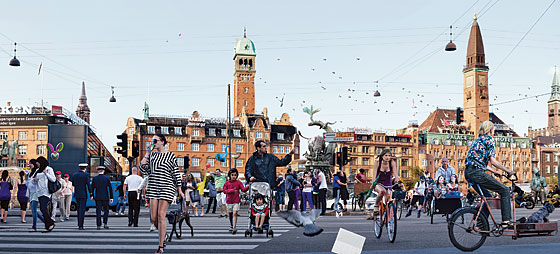
Copenhagen's bike lane success is about more than bike lanes.


"Public policies that ask car owners to take greater responsibility for the cost of roads and emissions, and the conscious decision to build housing at much higher densities, make cycling in Copenhagen more attractive and feasible than car travel for many trips."

All of which reinforces a point to be made about New Albany's shambolic and purposefully short-sighted "commitment" to bicycles and similar alternative means of transport.

A bike path or lane cannot be a success when it isn't connected to anything. As with Cortright's comments below, the objective should be creating systems.

In Nawbany, the Democratic ruling elite simply isn't bright enough for THAT.

Copenhagen: More Than Bike Lanes, by Joe Cortright (Strong Towns)

Strong Towns member Joe Cortright runs the think tank and blog City Observatory. This post is republished from City Observatory with permission.

 ... For those who have made the pilgrimage to Copenhagen, and come away with a romantic vision of re-making their auto-dominated city into a more bike-friendly place, there’s a lot than can be learned. While leadership and infrastructure are certainly keys to building a bike-friendly city, too many re-tellings of Copenhagen’s success leave out some of the most important ingredients.

Aside from a reference to parking violations costing as much as $80, the LA Times article spells out none of the details about how car travel is priced in Denmark. A close look at the specific policies for taxing and pricing of cars and fuel, and promoting dense urban development, are key to understanding why Copenhagen has been so successful.

And ...

There’s a lot we can learn from the design and operation of bike lanes in Copenhagen, and the lessons about leadership and the need to make investment are real. But that’s only part of the story. Public policies that ask car owners to take greater responsibility for the cost of roads and emissions, and the conscious decision to build housing at much higher densities, make cycling more attractive and feasible than car travel for many trips. As we always stress at City Observatory, the dysfunction in our transportation system stems fundamentally from charging the wrong price for roads. Stories, like this one from the LA Times, extolling the Copenhagen cycling success story shouldn’t leave out the essential role of correctly pricing cars and fuel and building dense housing.

Thursday, August 01, 2019

Gahan commits violence against our most vulnerable because our most beautiful can't get enough of "sanitary conditions."


It was another morning among many, walking back home from work, entertaining myself by watching as drivers of automobiles routinely violated the traffic rules, all the while ready to turn into road-raging beasts if a solitary bicyclist were to do the same by rolling through a stop sign, when from the shadows emerged a gargantuan 300-pound male pedaling frantically atop a terribly creaky ten-year-old’s bike.

This is the sort of contemporary phenomenon that eludes comprehension, these full-grown adults on kiddie bikes, and yes, I’ve certainly heard the litany of their vagrancy, drug abuse and petty thievery. Some of it may even be true, and deprivation in one of its numerous sanctioned forms surely plays a part, although I insist on thinking it goes deeper.

I believe they're the dispossessed protesting against the current reign of the fashionistas, or as I've termed them previously, the "beautiful" people.

SHANE'S EXCELLENT NEW WORDS: Is there a -cracy word for government by the beautiful people?

... To me the term "beautiful people" is decidedly pejorative.

It's inevitably the people who fancy themselves as beautiful, not necessarily in some accepted sense of outwardly physical beauty, but those possessing the right ideas, the right look, the right connections and the right way of viewing their privileged place in the world.

Obviously I reserve the right to heatedly differ with "right" in these contexts, extolling a alternative definition in the process.

As an awkward and ungainly ugly duckling of a book reader, I've learned the hard way that trying to fit in with the beautiful people is a fool's errand. Whenever I've tried it, the story has ended badly.

I'm not sure whether these experiences made me into a defiant jaded contrarian or the other way around, but there we are. I've become fairly contemptuous of the self-centered milieu of the beautiful people, who know far less about the world than they profess, and who tend to dismiss the "little people" -- and this may be one reason why Donald Trump is president, among other things.

There are beautiful people and homeless people, and almost axiomatically, never the twain shall meet. In fact the beautiful people tend to view the homeless people as blotches to be removed, lest property values plunge and visitors come to believe we weren't taught about deodorant.

To close this post, give it up for this blog's co-editor, who has a knack for finding the center of the target.

---

We were out of town when Mayor Gahan lied to and then destroyed a community of homeless people here in New Albany. His personal actions and the usual lack of substantive response from other Democratic officials are deplorable but not at all surprising given their consistent track records of subsidizing the wealthy while seeking to limit or penalize nearly everyone else. 

What’s mostly gone unremarked, though, owing to them being wholly unremarkable in this country, are the other lessons again made clear: 

1. It’s not just possible but highly probable for working people to be unable to afford a decent place to live. 

2. Medical situations to which we are all susceptible make and help keep people homeless every day.

I’m sure, via occasional donations, thoughts and prayers, etc., some of you think you’re offering support for the homeless. The fact is, though, there isn’t a single good and justifiable reason why the factors above need to be true. When we continue to respect and re-elect a leadership class that doesn’t support a living wage and universal health care, we are choosing to make people’s lives look and function like the photos and videos we’ve all seen too much of lately. We are choosing, in the wealthiest empire to ever exist, to set the humanitarian baseline so low that “unsafe, unsanitary” housing camps are accepted as a “natural” consequence of our systemic beliefs and actions. 

Year after year, a bulk of the American voting public, regardless of party and desperately clung-to delusional self-images, actively chooses and reinforces numerous forms of poverty and violence. It’s what we electorally say we want and it’s precisely what we get.

Tuesday, February 19, 2019

ON THE AVENUES: I'd stop drinking, but I'm no quitter (the 2019 Gravity Head remix).


ON THE AVENUES: I'd stop drinking, but I'm no quitter (the 2019 Gravity Head remix).

A weekly column by Roger A. Baylor.

---

Today's column artfully combines excerpts from previous ramblings.

---

Before the drinking starts, let’s consider a ship leaving the dock and making for open water. We experienced this first-hand in 2016 aboard a big Baltic ferry, leaving Tallinn for Helsinki in the morning and returning at dusk the same day.

In darkness of night the specific sensation might be described as lights fading, but by daylight it is the gradual disappearance of land as the ship moves away from shore. Depending on the weather and the strength of one’s eyesight, there comes a split second when land no longer is visible. It’s a melancholy feeling, like the place itself has ceased to exist apart from a lingering imagination of it.

From this point forward, until the next port of call begins slowly to materialize past the bow, the journey becomes synonymous with the undulating rhythm of the sea.

Similarly, most aspects of business ownership consuming my daily existence for a quarter-century -- the good, the bad, the drunk and the sublime -- have dissolved entirely into those distant invisible headlands. Now it’s just the rocking of the waves, and pondering what it all meant.

These days it seems like another person's life.

---

Col. Sherman T. Potter: I gather you drink.
Captain“Hawkeye” Pierce: Only to excess.

In the Western cultural tradition, there are numerous examples of the seasoned drinker as a sodden protagonist, at times an inspiring and compelling figure -- perhaps even a heroic one, as with Norm Peterson on Cheers -- although bar owner Sam Malone was a reformed alcoholic, as was the real-life Nicholas Colosanto, who played the bartender Coach on the popular show.

Sometimes you want to go where everybody knows your name, although it occurs to me some of you might not want to go here, finding this topic distasteful. At the same time, it would be pointless of me to deny or to disavow a career in beverage alcohol, or to suggest that it was only a job.

Trust me; my work wasn't left atop a desk at the office.

I drink very differently now than before, and far less overall, but drinking's still a conscious lifestyle choice. So it goes. I don't drive while intoxicated, and command all drinkers to be responsible.

Back to these fictional drinkers, who in my view reflect an existential aspect of the human condition. To be succinct, what else remains to be said, done or alibied when life’s fundamentally surreal futility strikes you as inescapable, and is best addressed and assuaged by peering through the bottom of a lifted glass, one deftly drained only seconds ago?

The cultural milieu of alcoholic beverages in places like India, Bolivia or Ghana remains a mystery to me, although it is clear that the pursuit of intoxicants is a universal human condition throughout the world. Certain European and American archetypes endure to entertain and enlighten, from Falstaff in olden times to Bukowski in ours, as buttressed by diverse personalities such as W.C. Fields, Dean Martin and Dudley Moore’s Arthur.

I've always been a reader of books. In the American literary oeuvre, one must push past cautionary tales of prohibitionist finger-wagging during the lamentably fevered Carrie Nation period of our national existence, straight to the dawn of the modern period occurring just after the Great War. Inhibitions fell prey to an all-encompassing, collective thirst enabled by the villainous Volstead Act, and brutal realism finally forced its way out of societal straitjackets.

Imbibing in print became great again.

It may have been Ernest Hemingway who first incorporated the drinker’s lifestyle as integral backdrop, seen most strikingly in his groundbreaking novel, The Sun Also Rises. Youthful, disaffected, expatriated Americans find solace in adult beverages at all hours of the day, even when they should be diligently working to appease the Puritanical prerequisites of capitalism and families back home.

The acerbic commentator Dorothy Parker emerged from this period, Scotch in hand. Equilibrium came with Repeal, and America scarcely skipped a beat, quickly eschewing Scott and Zelda for Reefer Madness and later, Timothy Leary. However, this is beyond the scope of today's examination.

Malcolm Lowry was an Englishman heavily influenced by the New World, and he captured the bibulous essence in the person of Geoffrey Firmin, otherwise known as the Consul, in Under the Volcano. Firmin is a defeated man on the Day of the Dead, utterly adrift during his final hours on earth, navigating the streets of a dusty Mexican provincial town in search of celestial meaning and settling instead for bottles of mezcal hidden in the shrubbery, as well as an infamous midday jolt of aftershave.

When seeking literary inspiration across the pond, a personal favorite is J.P. Donleavy’s The Ginger Man, chronicling the antics of supposed student Sebastian Dangerfield, a profligate American carousing, drinking, roaring and whoring in Ireland. For more of the same, Anglo-style, consult Kingsley Amis’s Lucky Jim, and know that in his prime, the very real Amis fully imitated his art.

On the continent, Czech playwright-turned-statesman Vaclav Havel’s two-person play, Audience, posits an artistic, city-dwelling enemy of the totalitarian state abruptly sent as punishment to the hinterlands and a term as manual laborer in a brewery. He must endure the ramblings of his boss, who cannot refrain from sampling the fermented wares and hilariously sinks into inebriation while haplessly pretending to interrogate the urban exile.

The doctor in László Krasznahorkai’s novel Satantango desperately tries to ration his enabling pálinka (and fails) as he observes the disintegration of the dysfunctional collective farm, and in the first-person narrative of The Drinker, by Hans Fallada, the hapless Herr Sommer will swallow just about anything as he abruptly transitions from sobriety to alcoholism, and eventually to insanity -- but schnapps is the preferred lubricant of his alarmingly precipitous decline.

For something approximating a philosophical rationale for the drinker’s lifestyle choice, we must turn to Jerzy Pilch’s A Thousand Peaceful Cities and the bombastic figure of Mr. Traba, a retired Lutheran pastor in heavily Catholic (and Communist) Poland.

Mr. Traba’s daily doses of vodka are the pretext for a fateful decision. It is 1963, and he has decided to erase his life’s numerous frustrations by committing a final, exclamatory act: Assassinating Comrade Gomulka, the unimaginative and degraded Communist tyrant. As the tragicomic final moment draws near, the perpetually intoxicated Mr. Traba addresses his companions:

Of course, there were moments in my wasted life when I got the audacious idea in my head to gain mastery of some earthly skill other than drinking, but upon reflection I rejected all these ideas. I drank all my life, and drinking was my work and my rest, my love and my hobby. Drinking was my art, my concert, and my artfully written sonnet. Drinking was my cognition, my description, my synthesis, and my analysis.

Only amateurs, laymen and graphomaniacs assert that you drink in order to soften the monstrosity of the world and to dull unbearable sensitivity. On the contrary, you drink in order to deepen pain and to heighten sensitivity. Especially in a case like mine: when there is nothing but drinking, it is necessary to make an art of drinking, it is necessary to reach the heart of the matter through drinking, and the heart of the matter is death.

When I first read the testimony of Pilch’s extraordinary character, I finally understood the contemporary reality of which all New Albanians boasting consciousness and a pulse must eventually grapple.

Even today, it is virtually impossible to attend a public meeting in this town without recourse to strong drink.

---

Meanwhile, an ancestral imperative creeps into the narrative.

When Gravity Head launches at NABC's Pizzeria & Public House, as it will again this Friday, February 22, the familiar space and time continuum is briefly altered. Normal routines appear Byzantine by comparison. Life’s infinite horizons narrow. One reverts to existence by the hour, or minute by minute. Passing through the looking glass is perfectly boring by comparison.

As for the fest’s actual commencement, once the opening bell sounds there is a collective observance of Dr. Sidney Freedman’s immortal dictum:

“Ladies and gentlemen, take my advice - pull down your pants and slide on the ice.”

Why do I continue to mention Gravity Head even after my final, much belated exit in 2018 from the company I helped found?

It's simple, because once upon a time Gravity Head was my idea. The 2019 edition will be the 21st such gathering, and I'm proud of my creation. Of course Gravity Head no longer is about me, assuming it ever really was. It always took the entire workplace village to pull it off, and I imagine this remains true.

Besides, gravity’s the law. It’s bigger than you and me.

Gravity Head’s opening day has become somewhat of a chaotic scrum, and a singular tradition all its own. Folks seem content with the interior logic occurring at the fest’s beginning, but this isn’t what every celebrant looks forward to experiencing each year.

Rather, there’ll inevitably be a quiet Tuesday night on the second or third week, with a handful of friends, and leisurely, contemplative sipping of one or two quality libations, spiced with conversation. These are the precious moments that lead to feelings of timelessness.

And without timelessness, beer is far less interesting to me. Will I attend this year? Not sure, and it doesn't matter. Have fun if you do, and be responsible.

---

These days I'm working in the beer trade at Pints&union in downtown New Albany. It's been 13 years since our presumed civic revitalization began with the establishment of Bistro New Albany -- a pivotal if short-lived eatery and watering hole. It operated where Brooklyn & The Butcher is located today.

Amid the prevailing Gahanian personality cult of the present, the pendulum has swung all the way back to alcohol as the best available means to deepen pain and heighten sensitivity. Dissipation may be a masochistic coping mechanism to counter the Disney-fried dictatorship, but it has the benefit of reminding us of how little the base culture of obliviousness has changed in all this time.

My favorite way of defining dissipation is this: “Unrestrained indulgence in physical pleasures, especially alcohol.”

Perhaps that’s why I’ve always been an aficionado of dissipation, albeit in the manner of a willful, controlled narrative. In the hands of lesser mortals, dissipation can be harmful, but there are times when it proceeds from conscious calculation in the face of savage, visceral, conditioned responses, as when a glance at the calendar confirms that it’s a first Monday or third Thursday, and the occasion for another New Albany common council meeting.

(Given that attendance at fix-forever-in Redevelopment Commission meetings would require sedation by an anesthesiologist, let’s not even go there ... literally as well as figuratively.)

Considering the implications of meeting attendance, you find yourself thinking about how those impossibly brief final hours should be spent before history rudely repeats itself as tragedy, farce or vaudeville’s worst ventriloquist routines. Will you smoke a cigarette, have a last supper, and leave a testament for posterity?

Better to have a stiff drink, relax and enjoy the inevitable. Dissipation suddenly ceases to be a pejorative term thrown your way by the kill-joys and health fascists, and comes to more closely resemble what Hemingway, a true giant of the dissipative genre, once described as a “means of sovereign action.”

Papa was talking about a bottle of liquor, which could be consumed, used to crack skulls or rendered into a Molotov cocktail, sometimes all at once. Until recently, I stuck to a regimen of Progressive Pints somewhere downtown before ambling down to the City-County Building and taking in the floor show.

But times change, and medicine's effectiveness changes with them. Lately the prescription has come full circle, all the way back to the improvised still in the Swamp at the 4077th.

It may or may not have been gin, but there can be no doubt that it was the right stuff.

Hawkeye Pierce: Let’s make a pact about drinking.
Trapper John McIntyre: All right.
Hawkeye Pierce: Let’s never stop.

---

Recent columns:

February 12: ON THE AVENUES: If it's about learning and knowledge, then by definition it's a Gahan Free Zone. You're welcome.

February 5: ON THE AVENUES: Our mayor hates non-elected boards -- except when they're his own, which is why "hypocrisy" is spelled G-A-H-A-N.

January 29: ON THE AVENUES: How has the 3rd district councilman fared since this question from 2015: "Et tu, Greg Phipps?"

January 22: ON THE AVENUES: Democrats should judge city council incumbents in districts 2, 3, 4 and 5 by their regressive deeds, not their progressive words.

Friday, December 14, 2018

A joyful noise? The six most-read ON THE AVENUES columns of 2018.

A joyful noise? The six most-read ON THE AVENUES columns of 2018.

A weekly column by Roger A. Baylor.

"If Potter gets hold of this Building and Loan, there’ll never be another decent house built in this town. He’s already got charge of the bank. He’s got the bus line. He got the department stores. And now he’s after us!"

Poor George Bailey gets a vision of awful, grasping Potter getting everything and naming everything after himself: Pottersville, a hideous ego-plutocrat takeover. And if he had a hotel chain, it would be called something alliterative, no doubt, like … Potter Palace?

Summit Springs?

The Jeff M. Gahan Family Fun City Hall?

We can't fault The Guardian piece's writer, who knows all about It's a Wonderful Life but hasn't witnessed the Potter-like proclivities of our own dull mayoral eminence.

And so our scene opens with a panoramic shot of the city filmed by drone, gradually zooming to street level. Stuffed to the turducken with campaign cash, Dear Leader is seen waddling toward Bunker Hatch #4.

He seems to be humming a tune: "You wish me a Merry Christmas -- or else."

Naturally the captive local news media dares not take him to task. The Genius of the Flood Plain’s wretched anchor tattoo adorns every street sign and trash can. Sewer lift stations and Rice Krispies coeds titter when he is ushered into the photo-op by a team of drooling glad-handers.

Discarded envelopes flutter to the floor beneath the Pedestal of the Fruit Baskets, accumulating like snow (sic) drifts atop David Duggins’ desk at NAHA.

But hey: That’s why he’s here.

Those 37,000-plus city residents who currently do not enjoy the perks and privileges of inner circle membership somehow have managed to stumble to the conclusion of New Gahania Year Seven, known as "2018" to the wider world existing outside the confines of the Open Air Museum of Ignorance, Superstition and Backwardness.

Well, come what may, my job at NA Confidential is to provide the other side of the story. Truth actually mattered when I was growing up. You can count me out of the ring kissing. I don’t do idol worship, and I won’t pretend to honor the credentials of a middling mediocrity of a veneer salesman who hasn’t read a book since Ray-Gun was president, although I’d be remiss without offering a helpful suggestion: Babbitt, by Sinclair Lewis.

On second thought, never mind. It would be pearls before bovine.

---

Let’s have a glance at the six most-read ON THE AVENUES columns of 2018, with a necessary caveat.

As recently explained, the “scoring” system at Blogger underwent a manner of bizarre and largely unexplained alteration in October, and statistics for the past three months don’t correlate with those of the year’s first nine.

I regret my blog being situated at this perennially inept platform, and if 13,400 posts hadn’t already adorned the tote board since 2004, I’d do something about it. As such, we begin with one honorable mention, based not on Google hiccups, but an informal tally of Facebook engagements.

---

This November 29 column looks to be tops for the months of October, November and December.

ON THE AVENUES: "That's why I voted no," explains Scott Stewart, pausing to duck rocks feebly lobbed by Team Gahan's propaganda pygmies.

City council president Al Knable’s inspired 2018 appointment of Scott Stewart to the cloistered confines of the Redevelopment Commission was a signal for New Albany’s suburban-minded, self-congratulatory ruling caste to move with characteristic pre-election haste to make the city safe for all the people just like them.

Accordingly, when Wile E Gahan pointed his ego toward someone else’s idea about a recreational rails-to-trails, and headed down to the Quality of Life Pawn Shop for the cash to pay approximately 3% of a long-term project located almost entirely outside city limits, Stewart asked a series of excellent, pointed questions.

These concerns were batted away by redevelopment’s the-fix-stays-in sycophants, who quickly reaffirmed their pre-determined vote prior to sliming Stewart in subsequent social media Trump-o-grams, which almost certainly were written by Adam Dickey, lifetime redevelopment wheel-greaser, who also serves as Democratic Party chairman.

Nepotism much?

---

Number Six appeared on January 4, previewing the coming year’s renewed non-transparency.

ON THE AVENUES: Opposition? It is defined as resistance or dissent, expressed in action or argument, and in New Gahania, now's the time for it.

Tome May’s News & Maroon kicked off 2018 with another triumph of unalloyed stenography, providing Jeff Gahan with excessive column inches to belch his exaggerated feats of Kool-Aid consumption. Our forever posturing mayor heartily congratulated himself with the “shucks, just can’t help it if I’m perfect” plea familiar to cloistered autocrats (or Greg Fischer) since time immemorial.

I dissented, reminding readers that just because the local chain good-news-paper won’t tackle the hard issues, it doesn’t mean they’re not there: a flawed and unsafe street grid realization, luxury parks deficit funding, clearcutting of the urban canopy, the public housing putsch, criminal neglect of civic assets like the doomed Moser Tannery, and worst of all, Gahan’s pay-to-play lovefest with special interests.

There also was advice for Republicans: If Gahan won’t give a State of the City with real people in the room, interacting, then a Republican needs to give one instead. The marketplace of ideas is preferred by many, though abhorred by the likes of Gahan. I urged the GOP to full-court press him, because I’m getting damned tired of doing it all alone.

Not as though they ever began -- or I ever stopped. Such are the burdens of commitment.

---

Number Five took a look back, and was as relevant on February 15 as it had been three years earlier.

ON THE AVENUES REWOUND: No more fear, Jeff (2015).

From the moment Gahan settled into the anchor’s seat in 2012, he began drinking deeply of the ego-driven power potion, as preferred the world over by big fish swimming in small ponds. The bullying and intimidation has only escalated in the following years, and transparency has become as rare as mountain oysters on downtown vegetarian restaurant menus.

Free speech seems a particular irritant to Gahan and the Floyd County Democratic Party, especially as it pertains to social media. In the marketplace of ideas, they’re a one-party dictatorship, albeit without any verifiable dogma to protect from scrutiny apart from daily compounded monetization of municipal contracts. It is telling that Chairman Dickey rivals Kentucky Governor Matt Bevin in his eagerness to block dissenters.

I’ve actually been to places where fear was a daily consideration, but New Albany isn’t East Germany, and we can do better than this.

---

On September 30 there was reason for hope. It's Number Four.

ON THE AVENUES SPECIAL EDITION: As David White's mayoral campaign begins, let's briefly survey the electoral landscape.

On November 6, the Floyd County Democratic Party’s ramshackle jalopy bottomed out on a speed bump in a snail’s path.

In the aftermath of a certifiable Red Wave, the Alamo Scenario materialized: Gahan, his party chairman and a scant four remaining city council Democrats placed in a last-ditch, us-against-them scenario, tattered and bedraggled but with no choice except defending the lucrative system of political patronage that Gahan has adeptly exploited these past seven years.

David White already had declared his intention to challenge Gahan in the 2019 Democratic primary, and Gahan's steadily multiplying negatives make a strong case for White, given the centrist (at best) and right-leaning (bingo!) tendencies of those older local Democrats who actually bother voting.

White is a fiscal conservative, and while no flaming radical, his concern for the community’s most vulnerable citizens, coupled with libertarian attitudes toward social issues, is a welcome change for those of a more youthful and progressive bent, given they'd no longer have to clench their teeth and tolerate Gahan's reactionary worldview in an ongoing Faustian bargain to preserve the party's declining prospects for ward heeling.

---

Coming in at Number Three, there was a nostalgic remembrance of employment, which was published on March 1.

ON THE AVENUES: Scoreboard daze of old.

Three decades ago, my introduction to the Open Air Museum was a gig at Scoreboard Liquors, located across the street from the Federal Building in an oppressively ugly structure long since demolished -- for once, rightfully.

Package stores of Scoreboard’s socioeconomic ilk remain an ongoing psychological experiment. During my tenure, insights into the human condition were plentiful, and sometimes fairly hard to stomach.

It was my introduction to good beer, and we did a fairly good trade in imports, given their obscurity and the fact that whenever I wasn’t on site to explain what they were, consumer requests generally were greeted with a sneer by Duck, the manager.

“Huh? I don’t drink that shit.”

---

The year's runner-up at Number Two came on January 25. Truth-telling isn't always easy; it took far too much effort on my part to interest the newspaper in this story, so most of what we know was disseminated right here. 

ON THE AVENUES: David Duggins’ violent “jokes” will continue until the New Albany Housing Authority’s morale improves – or Duggins is fired. We advocate the latter.

In early 2017, Gahan seized control of New Albany Public Housing, firing NAHA’s longtime director and packing its board with a collection of shameless, kowtowing lickspittles unparalleled in venality even by New Albany’s subterranean standards.

Gahan appointed his flagrantly unqualified campaign fund bag man David Duggins to one of the city’s top-paying positions as NAHA disheveler-in-chief, and Duggins missed very few opportunities to remind us what a dreadful idea his appointment was in the first place, as when he emerged from a board meeting in January of 2018 and threatened a NAHA resident with an impromptu disciplinary tasering.

The ruling caste predictably laughed it off -- Davey, well, he's OUR boy -- but of course had the same NAHA resident “joked” about shooting or tasing Duggins, he likely wouldn't have emerged from the meeting room uninjured.

Our city hall C-students -- almost all of them white, male and insular graduates of New Albany High School --- seem unable to grasp that only with disproportionate power comes the “right” to say it was all a joke, and make no mistake: Duggins’ threats were about power. So was Gahan's hostile takeover of public housing.

People? They're just in the way.

Jeff Gahan owned this predicament when it occurred, and he still does. Duggins has been empowered for far too long, and after he made a fool of himself and exposed the intellectual vacancy of Gahanism in the process, his power actually increased.

This made me sick then, it makes me sick now, and it should make readers sick, too. Duggins should have been fired on the spot, and still should be -- before someone gets hurt.

---

It should come as no surprise that my commentary about a new luxury city hall for "inhumanely" treated city workers was Number One, and the most-read ON THE AVENUES of 2018 (June 12).

ON THE AVENUES: Histrionic preservation? $8.5 million to gift Jeff Gahan with a luxury city hall "want" is simply obscene in a time of societal need.

Whenever Gahan, a presumed Democrat, pontificates about the Reisz Mahal project being “a move to protect our history," I sadly recall the fate of Haughey’s Place and so many other remnants of the city’s past, buildings that might have been adaptively re-used, but didn’t meet the threshold of narcissistic grandiloquence demanded by the mayor’s ethics-free selective reasoning and laughably elevated self-image.

In a city more allergic to irony than pollen or ragweed, Gahan’s newfound tender concern for the historical imperatives of the Reisz building is profoundly ironic, too. Do you recall those two words, “dilapidated” and “neglect”?

They’re not mine.

Rather, they come straight from Dear Leader’s mouth, via the medium of Mike Hall, the Shadow Mayor & Big Word Interpreter & Imperial Court Food Taster, and they serve as the convenient excuse for Gahan to don his Halloween leftover Superman outfit and rescue this pathetically abused historic building from the scandalous clutches of its shirker owner, who after all, has allowed it to deteriorate to the current juncture of high urgency.

Except the neglectful "villain" in this instance has been remunerated far above market value for his stubbornness. The redevelopment commission surreptitiously gifted the Reisz’s purchase price of $390,000 to the city’s preferred contractor Denton Floyd -- by sheer coincidence a firm frequently contributing to Gahan’s campaign war chest -- which duly passed the money to the Reisz building’s owner, who as Gahan himself concedes, rendered it dilapidated in the first place.

In consequence-free Nawbany, the words “miraculous government-enabled windfall bailout” spring immediately to mind.

Eagerly abetting Gahan’s desire to erect a lasting memorial to his shimmering and saintly benevolence is councilman David “Tunnel Vision” Barksdale, a thoroughly camouflaged Republican and prominent historic preservationist, who has let it be known that the Reisz building is so very important to the city that no cost is too great to “save” it.

To summarize, for at least thirty years the structure has rotted, but only now, with a crucial municipal election coming in 2019, does time suddenly become of the essence. The decision about Reisz must be made right away, with as little transparent public debate as possible, or else the city’s forward progress will be halted dead in its tracks.

And people still wonder why I’m cynical.

---

Recent columns:

December 6: ON THE AVENUES: Straight tickets, unsociable media and whether Democrats should rally around Gahan's gallows pole.

November 29: ON THE AVENUES: "That's why I voted no," explains Scott Stewart, pausing to duck rocks feebly lobbed by Team Gahan's propaganda pygmies.

November 22: ON THE AVENUES: A few thanks to give before we return to our regular anti-anchor resistance programming.

November 15: ON THE AVENUES: Notes on Solidarity after a visit to the European Solidarity Centre in Gdansk.

Monday, September 03, 2018

"Lithuania's barking-mad Soviet-era theme park has barking dogs and barking ex-KGB," but ironically, no place to walk your dog.


Tanned, rested and ready, my masterpiece development plan is ready to be TIFFed: The Open Air Museum of Ignorance, Superstition and Backwardness.

LITHUANIA’S BARKING-MAD SOVIET-ERA THEME PARK HAS BARKING DOGS AND BARKING EX-KGB, by Colton (Ripley's)

If you’ve ever wanted to trudge around in the cold while being shouted at in Russian, the could be the perfect vacation spot.

Set in a Soviet-era bunker, 1984: Survival Experience visitors are treated as though they were Lithuanian citizens under the control of the communist Russian military. The dramatization starts with putting on heavy, damp jackets. A German shepherd and ex-KGB officer bark orders as you enter your new Soviet paradise. Yes, ex-KGB. Believe it or not, all of the attractions actors were in the Soviet army. Some even interrogators trained in psychological tactics.

It gets real ...

Friday, August 25, 2017

On the errant notion of downtown two-way gridlock: The "I'll huff and puff and boycott a place I rarely go anyway, except to pass through" approach.


Just imagine if City Hall and captive non-profits like Develop New Albany had devoted just a bit of time educating the populace. Well, parties are more fun, I guess.

On the topic of impending two-way streets, our neighbor Jessica hits the center of the target and drops the mic:

"I'm sorry that this is going to slow down your commute and not allow you to speed down my neighborhood street. I'm sorry that two-way streets are going to make it safer for pedestrians. I'm sorry that this is going to cause less accidents to occur. I'm sorry this is going to make our city a walkable city. I'm sorry that this transition is going to continue to help our local businesses thrive. I'm sorry that this is going to make it safer for my family and all of the families with children that have begun to move to this area. Imagine if your subdivision/neighborhood streets were a speedway and think about how you would feel? Now think about downtown New Albany." 

Her hashtag: #sorrynotsorry

Right on, neighbor. Right on. Yesterday the social media-sphere was filled with the threats of flat-earthers to boycott downtown New Albany because the exact same number of traffic lanes will exist after the two-way reversion, just as they did before, but because the configuration is different, OMIGOD HOW WILL WE EVER MANAGE IT.

Maybe by paying attention?

There is a word that can't be repeated often enough to those who threaten to boycott downtown because two-way streets will require them to drive a tad more slowly and (heaven forbid) pay attention to the community outside their car windows:

Promise?

Even before the mayor has mounted his first self-congratulatory plaque, indignant pass-through drivers are screaming about gridlock, and as usual, Jeff Gillenwater provides the most devastating refutation of these spasms:

If people have to wait for more than a traffic light or two in downtown New Albany after having already sped through the neighborhood, traffic is "backed up" and that's usually just because too many drivers aren't smart enough to take alternate routes all of two blocks in either direction from Spring. It often takes me longer to exit the interstate via the 9th Street ramp in Louisville than it does to navigate the "traffic" in downtown New Albany. It's a lot like parking perception: There are typically so few problems with automobile congestion in Downtown New Albany, any seems like a lot. Those frustrated drivers, though, like to take it out on everybody else once they hit the ramps, driving 70-75 mph and weaving in and out of lanes because everybody knows that it's well worth risking multiple lives to keep them from being five minutes late to wherever they're going. I mean, they might not have time for a second cup of coffee at their destination before they have to get started with their work. If everybody driving a car was 1/3 as important as a lot of them seem to think they are, I could roll down my windows and chat with Nobel Prize winners every morning.

Perhaps my favorite of all was the man who said he'd be taking his business to all the wonderful restaurants on Veterans Parkway.

Dude: don't make promises that you can't keep.