Showing posts with label branding. Show all posts

Thursday, June 04, 2020

Hilter Skilter, Béarnaise, Gwobbles and the origins of propaganda in American-style capitalism.


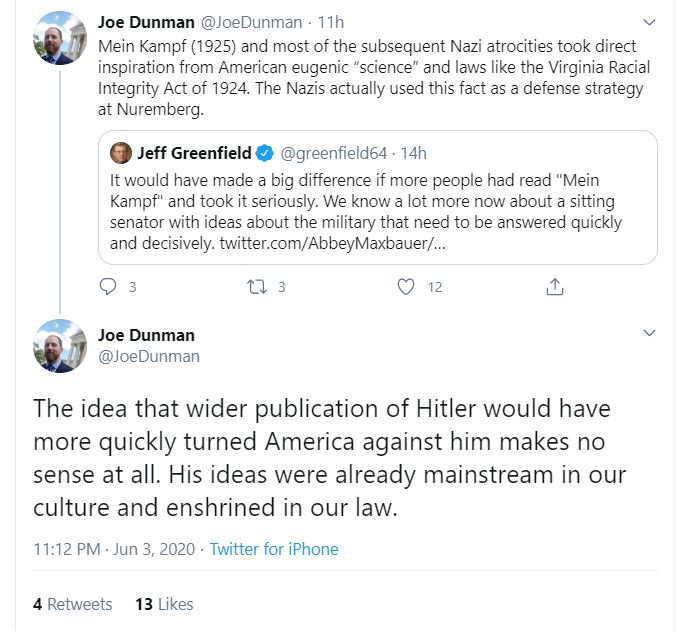
Reading this thread at Joe Dunman's Twitter account led me to a feeling of déjà vu.


As it turns out, almost exactly three years ago in this space, I took to the airwaves to correct an error about the career of Joseph Goebbels.

---

That's right; I was wrong. Goebbels got his ideas for propaganda from American advertising, not the other way around.

June 5, 2017

Recently I posted this on social media.

I'm eternally amazed by chain restaurant envy, which always seemed to me an inevitable result of Goebbels-scale national advertising and perception of price point (the latter is skewed, but real enough in many cases). But is it cultural, too? I don't know the answer, but is it a fair question?

Among the responses was this.

Using the Goebbels example is just histrionic.

I replied:

I don't think so. It's the basis of saturation advertising, in the sense of constant repetition. We're exposed to ads every day, hundreds and maybe thousands of times. I believe numerous studies have been devoted to the ongoing subliminal effects even when we think we're tuning it out. Goebbels preached these very qualities in his propaganda dissemination.

In essence, I was arguing that from the techniques of Goebbels, post-war capitalism derived its operational handbook for mass marketing.

I was mistaken.

In fact, Goebbels found inspiration for his propaganda techniques in pre-war capitalism. Big lies and mass-marketing in the service of profit made Goebbels, and not the other way around.

Meet Edward Bernays. You'll want to click through and read the entire essay.

The manipulation of the American mind: Edward Bernays and the birth of public relations, by Richard Gunderman (The Conversation)

“The most interesting man in the world.” “Reach out and touch someone.” “Finger-lickin’ good.” Such advertising slogans have become fixtures of American culture, and each year millions now tune into the Super Bowl as much for the ads as for the football.

While no single person can claim exclusive credit for the ascendancy of advertising in American life, no one deserves credit more than a man most of us have never heard of: Edward Bernays ... often referred to as “the father of public relations,” Bernays in 1928 published his seminal work, Propaganda, in which he argued that public relations is not a gimmick but a necessity:

The conscious and intelligent manipulation of the organized habits and opinions of the masses is an important element in democratic society. Those who manipulate this unseen mechanism of society constitute an invisible government which is the true ruling power of our country. We are governed, our minds are molded, our tastes formed, and our ideas suggested, largely by men we have never heard of ... It is they who pull the wires that control the public mind.

It turns out that Bernays had an international readership.

Bernays’ ideas sold a lot more than cigarettes and Dixie cups.

Even though Bernays saw the power of propaganda during war and used it to sell products during peacetime, he couldn’t have imagined that his writings on public relations would become a tool of the Third Reich.

In the 1920s, Joseph Goebbels became an avid admirer of Bernays and his writings – despite the fact that Bernays was a Jew. When Goebbels became the minister of propaganda for the Third Reich, he sought to exploit Bernays’ ideas to the fullest extent possible. For example, he created a “Fuhrer cult” around Adolph Hitler.

In 2017, we're exposed to advertising (or marketing, or branding) cues thousands of time each day. Whether overt or subliminal, these messages influence actions we blithely regard as "free."

But are they?

Goebbels may have been less concerned with profits, though the result is largely the same.

Its underlying purpose, in large part, is to make money. By convincing people that they want something they do not need, Bernays sought to turn citizens and neighbors into consumers who use their purchasing power to propel themselves down the road to happiness.

Without a moral compass, however, such a transformation promotes a patronizing and ultimately cynical view of human nature and human possibilities, one as likely to destroy lives as to build them up.

Another Bernays citation is here.

He disseminated propaganda for the Government during World War I and tried to brighten Calvin Coolidge's dour image during the 1924 campaign by importing Al Jolson and 40 other Broadway performers to the White House. A master at concealing base drives behind exalted rhetoric, Bernays in 1928 provided this defense of political work: ''Intelligent men must realize that propaganda is the modern instrument by which they can fight for productive ends and help to bring order out of chaos.'' As if to mock this rosy view, Joseph Goebbels became an attentive student of Bernays's theories five years later.

And another.

It is known that Goebbels studied the way advertising companies worked in America. A great deal of his written work was made up of short sentences – as the above indicate. Everything was kept simple so that there could be no misunderstanding as to its meaning.

Finally, this.

Goebbels “took his cue from the model of commercial advertising”.

For Goebbels, “commercial advertising was overtly cited as the model to follow. Whether it was a matter of simplification, constant repetition of memorable slogans, or concentration of propaganda material in regular campaigns, the principles of mass advertising could easily be applied to political propaganda.”

Strictly speaking, I was mistaken to assert that mass-market, saturation advertising for McDonald's, Budweiser or Ford derived from Goebbels.

Under the circumstances, I'm perfectly happy to concede my error.

Wednesday, April 29, 2020

It's godawful and tacky BUT let's look at the bright side, because it might be FAR worse.


I knew it was too good to be true.

Say what? Look, it's a pandemic parking garage painting innovation.


How many of these "branding" mechanisms do we need before the whole world understands New Albany is "anchored" to the floodplain?

Then again, it could be much worse, and Gahan might have emulated Il Duce -- again.


yes yes yes

NO NO NO

Monday, February 24, 2020

ROGER'S DIARY OF THE END TIMES: Branding your royals, having your food delivered and waiting for the final moments.


There was a time when hereditary monarchies enforced the head of the family's whims by means a tad stronger than appearances with their attorneys in trademark court. Consider Henry VIII's six marriages. Of course no reason whatever remains for there to be any such thing as a hereditary monarchy (precedents exist for this sort of cleansing, too).

This brings us to the End Times Branding Department.

Harry and Meghan show anger at palace over loss of royal branding, by Jamie Doward (The Guardian)

Sussexes say monarchy has no jurisdiction over use of word ‘royal’ overseas

The couple’s Instagram account uses the name SussexRoyal, as does a website they set up following their shock decision to stop carrying out official royal duties in favour of financial freedom. Both will have to be rebranded.

Maybe they need to consider guerrilla marketing.

In other news from the apocalypse's cusp, I posted a brief piece at Food & Dining Magazine about problems with food delivery services, which might be summarized thusly: The more you seek to make things easy for yourself, the harder things get for everyone else.

Edibles & Potables: About food deliveries, domains, tipping and reconciliation

“Life is really simple, but we insist on making it complicated.”
― Confucius

Where I live the options for food delivery used to be simple. Many pizza parlors did it, and maybe a few Chinese restaurants. These were the alternatives to going to the eatery itself to pick up your order, or if it got to be too late in the evening and driving wasn’t an option, tearing into your stash of emergency past-date sardines and stale Saltines.

(They pair well with beer, but I digress.)

These days amid the post-apocalyptic, neoliberally electronic, service-oriented economy, food delivery services have become ubiquitous, and so have issues arising from them. The evolution of these discussions can be confusing, to say the least ...

Thursday, April 18, 2019

Branding Gahan's "sweet spot," part two: He's selling a whole city in his own image, but personality cults aren't pretty pictures.


Part one here.

There can be no doubt. Jeff Gahan's "sweetest spot" is himself.

In his What is character and why it really does matter, Thomas A. Wright states, "The cult of personality phenomenon refers to the idealized, even god-like, public image of an individual consciously shaped and molded through constant propaganda and media exposure. As a result, one is able to manipulate others based entirely on the influence of public personality...the cult of personality perspective focuses on the often shallow, external images that many public figures cultivate to create an idealized and heroic image."

A few recent examples follow. Cautionary note: these images are not for the faint of heart.


The conclusion is as obvious as it is absurd.

Jeff Gahan has been branding the city in his own image, and using our money to do it, but we need collective thinking, not the shoddy veneer of a personality cult.

Here's one definition of branding.

The process involved in creating a unique name and image for a product in the consumers' mind, mainly through advertising campaigns with a consistent theme. Branding aims to establish a significant and differentiated presence in the market that attracts and retains loyal customers.

Below is an article by the estimable Aaron Renn, in which the author discusses branding, or in this case the marketing efforts undertaken by cities.

You can’t help but notice how few unique things about these cities manage to come through.

What about branding our town? For the past eight years here in New Albany, what passes for a "brain trust" at City Hall (try not to cringe in disgust) surely has undertaken a branding campaign. It may or may not have been explicitly organized as a branding campaign, but the effect has been the same.

In essence, New Albany very much has been branded as New Gahania, which is to say that in terms of promotions, every aspect of the city has been tied to the mayor's cult of personality: New Albany is Jeff Gahan, and vice versa.

Students of history will recognize this device from numerous authoritarian and totalitarian regimes, but let's focus on just one: Italy under Benito Mussolini during the 1920s and 1930s.

Mussolini's Italian "fascism" came along first, and was in many ways a precursor of Adolf Hitler's organizational model for Nazi Germany. In fact, Mussolini's chosen symbol became the word to describe his movement.

Fasces ... a bound bundle of wooden rods, sometimes including an axe with its blade emerging. The fasces had its origin in the Etruscan civilization and was passed on to ancient Rome, where it symbolized a magistrate's power and jurisdiction.

A fasces looks like this.


Gahan's chosen symbol emerged from the back rooms where appointed committees meet, utterly without the input or votes of any elected official, and as selected by then-redevelopment honcho and noted artistic design expert David Duggins because it looked "cute."


Now it has become the anchor that adorns every city-owned object.


In Duggins' own words, the anchor was chosen to be a "branding device" for the city. This points to the importance of knowing the meaning of words, for an anchor is something heavy that is used to keep a boat fixed in place, not moving.


Consequently New Albany's second-most-important act of branding during the past eight years has been to slap the anchor logo on everything, which has the effect of announcing that we'll be moving forward while remaining anchored right where we were.

It may not be the best branding for the world outside, but it actually jibes with Gahan's self-aggrandizing governing philosophy, as when he claimed to radically change the street grid while doing almost nothing to ... radically change the street grid.

But far more so than anchors, our foremost branding effort has been devoted to slapping Gahan's cherubic chihuahua image on every last advertisement purchased with taxpayer dollars. An anchor keeps the boat from moving. Gahan keeps the city from moving, while grandly lubricating his own pockets with pay-to-play dollars from special interests.


Of course, Benito Mussolini already had been there and done that.


Allow me to direct this comment to those merchants and independent business owners who tend to accept what they're told at gatherings without examining any of it too closely: if we work together as a collective bearing the weight of our combined investments, the city's marketing and branding would reflect us.

As it stands, the city has indeed been branding -- as New Gahania, not New Albany. This does much for the incumbent, and almost nothing for the rest of us. Worse still, he's been using our money to pay for his own glorification.

Cities: Don’t Fall in the Branding Trap, by Aaron Renn (CityLab)

From Instagram stunts to Edison bulbs, why do so many cities’ marketing plans try to convince people that they’re exactly like somewhere else?

It’s curious that while every company tries its hardest to convince you of how much different and better it is than every other company in its industry, every city tries its hardest to convince you it’s exactly the same as every other city that’s conventionally considered cool.

Look at any piece of city marketing material, from promo videos to airline magazine ad inserts. It’s amazing how so many of them rely on the same basic ingredients: hipster coffee shops, microbreweries, bike lanes, creative-class members, startups, intimations of a fashion scene, farm-to-table restaurants, new downtown streetcars, etc.

These are all good things, mind you: things cities should be happy to have. Some of them may even be modern necessities. But you can’t help but notice how few unique things about these cities manage to come through ...

Four more years of this?

So off went the Emperor in procession under his splendid canopy. Everyone in the streets and the windows said, "Oh, how fine are the Emperor's new clothes! Don't they fit him to perfection? And see his long train!" Nobody would confess that he couldn't see anything, for that would prove him either unfit for his position, or a fool. No costume the Emperor had worn before was ever such a complete success.

"But he hasn't got anything on," a little child said.

"Did you ever hear such innocent prattle?" said its father. And one person whispered to another what the child had said, "He hasn't anything on. A child says he hasn't anything on."

"But he hasn't got anything on!" the whole town cried out at last.

Yes, the "Tsar of the Shopping Cart" has been branding the city in his own image and using our money to do it.

However, we need collective grassroots thinking, not the shoddy veneer of a personality cult, even if the absurd personality cult veneer is what we keep getting, again and again. Here's a sampling.

December 16, 2018: Cult of personality: Jeff Gahan's face appears on doggie calendars and in newspaper inserts. It's blatant electioneering at the taxpayer's expense.

August 13, 2018: Earache My Eye: Check out Deaf Gahan's full page Anchor Marriage ad in Extol's wedding issue.

August 10, 2018: Shameless self-aggrandizement as Gahan invites 1Si to provide career counseling to local students.

June 13, 2018: Jeff "Look at Me" Gahan's aquatic cult of personality: He brings us health, all by himself.

February 3, 2018: Inflatable Date Night is ultimate proof that Deaf Gahan seeks to emulate Rev. Moon with a hip new campaign finance baby boom.

January 18, 2018: ON THE AVENUES: During our State of the Gahanaissance Address for 2018, feel free to resort to hard liquor. I did, and will.

September 10, 2017: Adam polishes Jeffrey's personality cult, and yet Dickey's Floyd County Democratic Party still hasn't embraced Gahan's public housing putsch.

June 11, 2017: CARTOON: Gahan Mach III ... or, daddy needs a brand new logo.

June 4, 2017: Scraping rock bottom: Jeff Gahan brings his cult of personality to Kroger shopping carts. But who paid for these political ads?

June 4, 2017: Shopping cart blurbs, magazine ads, billboards ... and now the NTSPY Awards. How much of your money is Jeff Gahan spending on all this?

There's a way out of this deaf, dumb and blind alley: #FireGahan2019


---

I'm voting for David White.


Democratic mayoral candidate David White understands that change begins with a whole lotta scrubbing, and NA Confidential advocates just such a deep civic cleansing. 

After eight years on the job, Mayor Jeff Gahan's list of stunning "achievements" is long, indeed: tax increases, budgetary hide 'n' seek, self-deification, daily hypocrisy, public housing takeover, non-transparency, pay-to-play for no-bid contracts, bullying city residents and bullying city employees. Eight years is enough. It's time to drain Gahan's swamp, flush his ruling clique and take this city back from Gahan's Indy-based special interest donors. 


NA Confidential supports David White for Mayor in the Democratic Party primary, with voting now through May 7. 

Branding Gahan's "sweet spot," part one: Power-hungry mayor thinks he IS New Albany, but aren't we better than that?


Part two here.

You'd think that after almost eight full years, the luminaries at the pinnacle of the municipal food chain would be able to settle on a slogan, or at least some semblance of a consistent message for use in telling the world about New Albany.

The latest full-page (might as well be a) campaign advertisement in Extol reveals the bar of creativity at low ebb. It is pictured above.

"The new New Albany sets the bar for quality of life."

Oh dear. Quality like this?


Okay, so words typically fail them, but we have anchors galore (you'll recall they're dropped from ships when the captain desires to cease moooving forward) -- and Jeff Gahan's face, as ubiquitous as unenforced ordinances.


Regular blog readers know that certain questions fascinate us, like this: How many tax dollars are necessary to "find your personal Gsweet spot in the new New Albany?"


Let's hope the mayor plumped for the six-issue discounted rate of $8,850, a savings of almost $2,000 yearly. Verily, the more tax dollars Gahan spends promoting himself, the more he saves in the sense of fewer withdrawals from his own whopping campaign finance haul. 


Of course, we already know Gahan's most cherished of sweet spots: Money, power and control.

Gahan's own obsessions run primarily to slobbering in the presence of powerful special interests who write him campaign finance checks, and he has shown little ability to inspire genuine affection on the part of regular townspeople. Still, some of them devour the Rice Krispies Treats and chug the Kool-Aid ...

... By the standards of a small city with a quarter of its residents existing below the poverty line, Gahan has hoarded a vast stock of power. He wields it autocratically with almost no input from outside the ruling circle, and buttresses his power by means of a ludicrous personality cult reflecting a former veneer salesman's abrupt makeover from regular guy to flawless genius.

Here's the way a patronage machine operates. The guy who owns HWC Engineering cuts Gahan his annual pay-to-play check.


Gahan banks a portion of it, then donates to the campaign efforts of local Democrats.


This leaves $1,500 -- and a quarter-page ad in Extol costs only $600, assuming Gahan paid for it out of his own petty cash and not the city's.


Look, we all know that Jason Applegate is the co-owner of Extol. There's absolutely NOTHING necessarily illegal, immoral or unethical about Jason accepting advertising for his magazine and donations for his 2019 campaign from the very same mayor.

Rather, the preceding facts are intended to show the way that movers and shakers in a small city like New Albany routinely scratch each other's backs, and readers may draw conclusions as they will -- or not.

In my view, it's all about the way Gahan sees the city as his possession, and the strange habit of authoritarian "leaders" looking in their mirrors and seeing the Godhead instead of the bald head.

In part two, a closer look.

---

I'm voting for David White.


Democratic mayoral candidate David White understands that change begins with a whole lotta scrubbing, and NA Confidential advocates just such a deep civic cleansing. 

After eight years on the job, Mayor Jeff Gahan's list of stunning "achievements" is long, indeed: tax increases, budgetary hide 'n' seek, self-deification, daily hypocrisy, public housing takeover, non-transparency, pay-to-play for no-bid contracts, bullying city residents and bullying city employees. Eight years is enough. It's time to drain Gahan's swamp, flush his ruling clique and take this city back from Gahan's Indy-based special interest donors. 


NA Confidential supports David White for Mayor in the Democratic Party primary, with voting now through May 7. 

Friday, February 22, 2019

ON THE AVENUES SPECIAL: Take your cult of personality and shove it, Dear Leader.


ON THE AVENUES SPECIAL: Take your cult of personality and shove it, Dear Leader.

A weekly column by Roger A. Baylor.

Four more years?

So off went the Emperor in procession under his splendid canopy. Everyone in the streets and the windows said, "Oh, how fine are the Emperor's new clothes! Don't they fit him to perfection? And see his long train!" Nobody would confess that he couldn't see anything, for that would prove him either unfit for his position, or a fool. No costume the Emperor had worn before was ever such a complete success.

"But he hasn't got anything on," a little child said.

"Did you ever hear such innocent prattle?" said its father. And one person whispered to another what the child had said, "He hasn't anything on. A child says he hasn't anything on."

"But he hasn't got anything on!" the whole town cried out at last.

Jeff "Tsar of the Shopping Cart" Gahan has been branding the city in his own image and using our money to do it, but we need collective thinking, not the shoddy veneer of a personality cult.

Far more so than anchors, our foremost branding effort has been devoted to slapping Gahan's cherubic chihuahua image on every last advertisement purchased with taxpayer dollars. An anchor keeps the boat from moving. Gahan keeps the city from moving, while grandly lubricating his own pockets with pay-to-play dollars from special interests.

And yet the absurd personality cult veneer is what we keep getting, again and again. Here's a sampling.

December 16, 2018: Cult of personality: Jeff Gahan's face appears on doggie calendars and in newspaper inserts. It's blatant electioneering at the taxpayer's expense.

August 13, 2018: Earache My Eye: Check out Deaf Gahan's full page Anchor Marriage ad in Extol's wedding issue.

August 10, 2018: Shameless self-aggrandizement as Gahan invites 1Si to provide career counseling to local students.

June 13, 2018: Jeff "Look at Me" Gahan's aquatic cult of personality: He brings us health, all by himself.

February 3, 2018: Inflatable Date Night is ultimate proof that Deaf Gahan seeks to emulate Rev. Moon with a hip new campaign finance baby boom.

January 18, 2018: ON THE AVENUES: During our State of the Gahanaissance Address for 2018, feel free to resort to hard liquor. I did, and will.

September 10, 2017: Adam polishes Jeffrey's personality cult, and yet Dickey's Floyd County Democratic Party still hasn't embraced Gahan's public housing putsch.

June 11, 2017: CARTOON: Gahan Mach III ... or, daddy needs a brand new logo.

June 4, 2017: Scraping rock bottom: Jeff Gahan brings his cult of personality to Kroger shopping carts. But who paid for these political ads?

June 4, 2017: Shopping cart blurbs, magazine ads, billboards ... and now the NTSPY Awards. How much of your money is Jeff Gahan spending on all this?

Let's briefly re-examine the state of Gahan's cult of personality with the assistance of actual facts from history. This column originally was published on May 14, 2015.

Always remember and never forget: #FireGahan2019

------

Human psychology is a nuanced and often bewildering topic, but it’s probably safe to assert that to some vague extent with interpersonal relationships, most of us want to be liked, and prefer being liked to being feared.

(Note that in this digression, I have no intention of trying to fathom what it means to be “liked” on Facebook)

Meanwhile, out in the real world, the devil resides fully within the details.

Getting along with people and being liked are two very different issues. To get along with someone requires that you figure out how to balance meeting your needs with that of another person until the two of you arrive at a resolution. Your best chances of being liked occur when you go along with the desires of other even if it means sacrificing your personal goals. To be liked means that other people have positive associations to you so that when they see or think about you, it's with a mental smile.
What about if you don't particularly care about being liked? You have a job to do, for example, that involves your making tough decisions that possibly cause other people to resent your or, at best, prefer to stay out of your way. When they think of you, it's with an active sense that being with you will cause them more pain than pleasure.

If human psychology is a tangled wilderness of conditioned responses and primal screams, consider the genre of politics.

Politics (from Greek: πολιτικός politikos, definition "of, for, or relating to citizens") is the practice and theory of influencing other people. More narrowly, it refers to achieving and exercising positions of governance — organized control over a human community, particularly a state. Furthermore, politics is the study or practice of the distribution of power and resources within a given community (a usually hierarchically organized population) as well as the interrelationship(s) between communities.

In the context of politics, which pertain to invasive concepts like power, control and authority, what does it mean to be liked?

Are our likes and dislikes personal, or professional?

Can politicians be inspiring, totemic figures, or do we merely tolerate them as a regrettable but necessary evil?

---

Longtime readers already know about my youthful travel experiences in Europe, and how these wanderings dovetailed with previous university studies in history, geography and philosophy, producing the opportunity to witness, albeit it briefly, the phenomenon of 20th-century communism in places like Czechoslovakia, Hungary and Poland.

At my point of entry in the mid-1980s, this political system didn’t have very long to survive, but of course this couldn’t be known at the time. During the post-war period in these places I visited, the theory and practice of communism actually was subject to change, though more often for reasons of ideology (and international power politics) rather than any natural evolutionary process.

I’ve told the story of Ladislav, with whom I became acquainted in Ostrava, Czechoslovakia in 1989. He was 65 years old, and had observed his country’s period of hopeful interwar democracy, interrupted by a devastating conflict, then followed by the imposition of communism by the occupying Soviets, and a subsequent four decades of historical entrapment.

Ladislav would have been just shy of 30 years of age when Joseph Stalin died in 1953, a termination which led to a brief period of communist reform and softening under Khrushchev.

Czechoslovakia’s own indigenous version of Stalin, a nonentity named Klement Gottwald, died of his excesses shortly after Stalin’s funeral and was replaced by Antonín Zápotocký, who gifted Prague with a huge statue of Stalin on a hillside overlooking the Vltava River.

Interestingly, the sculptor was so filled with remorse that he committed suicide prior to the unveiling, and the statue was dynamited in 1962 after a hopeful shifting of socio-political breezes.

It would be very hard to maintain the illusion than any of the men mentioned here were “liked” in ways we might fathom -- not even by their wives and children, although perhaps by their dogs. And yet, they were obeyed, venerated and even worshipped in a political-cum-religious sense, surely out of fear, but also because they had erected and encouraged personality cults to reinforce their positions.

Khrushchev the successor pilloried Stalin for his cult of personality. Karl Marx, the philosophical father of them both, disdained the notion; after all, in a communal system, how could there be just one great leader?

Cult of personality is a pejorative term implying the concentration of all power in a single charismatic leader within a totalitarian state and the near deification of that leader in state propaganda. Totalitarian regimes use the state-controlled mass media to cultivate a larger-than-life public image of the leader through unquestioning flattery and praise. Leaders are lauded for their extraordinary courage, knowledge, wisdom, or any other superhuman quality necessary for legitimating the totalitarian regime. The cult of personality serves to sustain such a regime in power, discourage open criticism, and justify whatever political twists and turns it may decide to take.

Many Americans will scoff, dismissing these examples as unique, arising from diseased ideals amid peculiar historical imperatives, and taking place in the lives of other people, elsewhere.

Unfortunately, cults of personality are American, too, and can exist in a democracy just as easily as in a totalitarian system of government. George Washington was resistant to the notion, and Huey Long obliging. No matter the locale, certain themes in a cult of personality are constant.

➜ The political platform has no independent existence apart from the leader, and the political process is utterly dependent on the leader for guidance.

➜ Manifestations of activity on the part of government also are promoted as inseparable from the leader’s benevolence, and while the leader may have utilized resources theoretically shared equally by his or her subjects, the results must always be portrayed as stemming from the wisdom of the leader.

➜ Mistakes never occur, and when they do, they’re never openly acknowledged even as minions pay the price.

➜ The leader’s pre-eminence is reinforced by the constant repetition of mass marketing, including the leader’s name and image as attached to almost anything lacking the good sense to move out of the way.

Contemporary electronic media surely assists the cause of building a leader’s cult of personality, but it must be remembered that the Roman Catholic Church was adept at pursuing the same strategy for its papacy long before electricity and the outsourcing of Twitter feeds.

---

Often during the quarter-century course of my own beer business, there was the temptation to indulge in precisely this sort of self-deification. I wouldn’t have been the first, and regrettably, I wasn’t immune to periods of relaxed vigilance, which are characterized by reading one’s own press clippings and believing what they say.

What kept me grounded most of the time was the simple realization that I was part of a team, and the daily efforts of the team resulted in satisfied customers, who returned and made possible the survival of the business. I played one role, and it was just that: One part among many, inter-related, and meaningless when separated from the whole.

Perhaps politics works somewhat like this, and perhaps it doesn’t, but either way, the very notion of a personality cult is deeply offensive to me. What’s more, the greater our proximity to it, the more indefensible a cult of personality becomes.

If functioning as an elected official means a stock photograph behind everyone’s desk, daily laudatory references, names on plaques and a ceaseless perpetuation of peerless wisdom, then the wheels officially have jumped the track.

Those of Ladislav’s generation in Eastern Europe and the USSR had no say in the personality cults inflicted upon them. Those of my generation in America have a ballot box. It’s an interesting tool, and when used properly, acts as kryptonite to the cult.

Just remember that, because very soon, you’ll have a chance to act accordingly.

---

Recent columns:

February 19: ON THE AVENUES: I'd stop drinking, but I'm no quitter (the 2019 Gravity Head remix).

February 12: ON THE AVENUES: If it's about learning and knowledge, then by definition it's a Gahan Free Zone. You're welcome.

February 5: ON THE AVENUES: Our mayor hates non-elected boards -- except when they're his own, which is why "hypocrisy" is spelled G-A-H-A-N.

January 29: ON THE AVENUES: How has the 3rd district councilman fared since this question from 2015: "Et tu, Greg Phipps?"

January 22: ON THE AVENUES: Democrats should judge city council incumbents in districts 2, 3, 4 and 5 by their regressive deeds, not their progressive words.

Wednesday, February 13, 2019

Jeff Gahan has been branding the city in his own image, and using our money to do it, but we need collective thinking, not the shoddy veneer of a personality cult.


Here's one definition of branding.

The process involved in creating a unique name and image for a product in the consumers' mind, mainly through advertising campaigns with a consistent theme. Branding aims to establish a significant and differentiated presence in the market that attracts and retains loyal customers.

Below is an article by the estimable Aaron Renn, in which the author discusses branding, or in this case the marketing efforts undertaken by cities.

You can’t help but notice how few unique things about these cities manage to come through.

What about branding our town?

For the past eight years here in New Albany, what passes for a "brain trust" at City Hall (try not to cringe in disgust) surely has undertaken a branding campaign. It may or may not have been explicitly organized as a branding campaign, but the effect has been the same.

In essence, New Albany very much has been branded as New Gahania, which is to say that in terms of promotions, every aspect of the city has been tied to the mayor's cult of personality: New Albany is Jeff Gahan, and vice versa.

Students of history will recognize this device from numerous totalitarian regimes, but let's focus on just one: Italy under Benito Mussolini during the 1920s and 1930s.

Mussolini's Italian "fascism" came along first, and was in many ways a precursor of Adolf Hitler's organizational model for Nazi Germany. In fact, Mussolini's chosen symbol became the word to describe his movement.

Fasces ... a bound bundle of wooden rods, sometimes including an axe with its blade emerging. The fasces had its origin in the Etruscan civilization and was passed on to ancient Rome, where it symbolized a magistrate's power and jurisdiction.

A fasces looks like this.


Gahan's chosen symbol emerged from the back rooms where appointed committees meet, utterly without the input or votes of any elected official, and as selected by then-redevelopment honcho and noted artistic design expert David Duggins because it looked "cute."

Now it has become the anchor that adorns every city-owned object.


In Duggins' own words, the anchor was chosen to be a "branding device" for the city. This points to the importance of knowing the meaning of words, for an anchor is something heavy that is used to keep a boat fixed in place, not moving.

Consequently New Albany's second-most-important act of branding during the past eight years has been to slap the anchor logo on everything, which has the effect of announcing that we'll be moving forward while remaining anchored right where we were.

It may not be the best branding for the world outside, but it actually jibes with Gahan's self-aggrandizing governing philosophy, as when he claimed to radically change the street grid while doing almost nothing to ... radically change the street grid.

But far more so than anchors, our foremost branding effort has been devoted to slapping Gahan's cherubic chihuahua image on every last advertisement purchased with taxpayer dollars. An anchor keeps the boat from moving. Gahan keeps the city from moving, while grandly lubricating his own pockets with pay-to-play dollars from special interests.


Of course, Benito Mussolini already had been there and done that.


Allow me to direct this comment to those merchants and independent business owners who tend to accept what they're told at gatherings without examining any of it too closely: if we work together as a collective bearing the weight of our combined investments, the city's marketing and branding would reflect us.

As it stands, the city has indeed been branding -- as New Gahania, not New Albany. This does much for the incumbent, and almost nothing for the rest of us. Worse still, he's been using our money to pay for his own glorification.

One way to repair this profound malfunction is #FireGahan2019, and start the process of taking back our civic identity from the charlatan in chief.

Cities: Don’t Fall in the Branding Trap, by Aaron Renn (CityLab)

From Instagram stunts to Edison bulbs, why do so many cities’ marketing plans try to convince people that they’re exactly like somewhere else?

It’s curious that while every company tries its hardest to convince you of how much different and better it is than every other company in its industry, every city tries its hardest to convince you it’s exactly the same as every other city that’s conventionally considered cool.

Look at any piece of city marketing material, from promo videos to airline magazine ad inserts. It’s amazing how so many of them rely on the same basic ingredients: hipster coffee shops, microbreweries, bike lanes, creative-class members, startups, intimations of a fashion scene, farm-to-table restaurants, new downtown streetcars, etc.

These are all good things, mind you: things cities should be happy to have. Some of them may even be modern necessities. But you can’t help but notice how few unique things about these cities manage to come through ...

Thursday, September 06, 2018

The Kaepernick-Nike alliance is a "teachable moment, illuminating our relationship with brands."

Nike sweatshop in China.

The Great Nike Wars of 2018 are fascinating, but neither because of Colin Kaepernick nor the "post-purchase boycott" shredding of gear.

Rather, it's about a tacit admission that by now, we're all branded by brands. We accept corporate America's framing of the terms of consumer engagement just as totally as peasants in medieval Europe did the Roman Catholic hierarchy.

We're resisting the wrong thing. You can't burn your Nikes, then grab a bite at Chick-fil-A. You can't make Kaepernick's ad your Fb cover photo, then trot over to Target. Of course, you can -- but there's more than a little hypocrisy in the choices.

In a few minutes, I'll be publishing this entry. Quite a lot of you will open fire from both angles on social media without the essential component of reading the linked essays. Just be aware that in this day and age, genuine resistance takes the form of actually doing homework.

Just saying.

Following are three takes; first, a veteran columnist from the Bay Area.

Nike backs Kaepernick: A declaration of war? by Scott Ostler (San Francisco Chronicle)

Nike has made Colin Kaepernick the face of its 30th anniversary “Just Do It” campaign.

From its vast roster of superstar endorsers, Nike is shining its gigantic spotlight on an unemployed quarterback who is taking legal action against the NFL, and whose kneel-down protest against police brutality has split America roughly down the middle.

Nike’s campaign means war. Cultural, political, economic, social.

Writing for The Nation, Dave Zirin finds the center of the target.

Global, multibillion-dollar corporations that run an archipelago of sweatshops don’t underwrite rebellions. They co-opt and quash them. If anyone can navigate this snakepit, it is Colin Kaepernick, but it won’t be easy. The revolution will not be branded. We should be honest about that. The message of standing up to police violence and racial inequity shouldn’t end up in a swoosh-laded graveyard. That’s the risk that comes with this sponsorship. But if anyone has earned the right to take that risk, it’s Colin Kaepernick.

But it's The Baffler for the win.

Something for Nothing, by Nathaniel Friedman (The Baffler)

If corporations come off as sinister and oppressive, brands convey a message that’s relentlessly personable and accessible. We’re haunted by the aloof, godlike specter of corporations whenever we pay our bills or contemplate our election-season choices; we engage with brands on a daily basis, allowing them to define us even as we reciprocally try to define their uses and significations. And perhaps most essentially, we ascribe meaning to them apart from what they actually are. In what one might terms the Citizens United style deregulation of commerce in our psyches, we relate to brands as if there were an ideology, agency, and governing sentiment underlying them. Brands are companions, friends, and allies. The alternative—that we’re all dupes incapable of imagining a life not circumscribed by our relationship with these entities—is absolutely grim and raises all sorts of difficult questions in its own right.

Viewed in the context of the charged psychic minefield of brand symbolism, the embrace of the Kaepernick ad as an unconditional triumph is a gesture of self-preservation. The current state of debate surrounding putative loyalty to the national anthem and the NFL—both patriotic brands cultivating a similarly charged sort of signification among a very different consumer demographic—requires us to interpret the Nike-branded message as a token of progress because otherwise we would have to admit how cut off we are from any real version of dissent or meaningful opposition. Our own capacity to trust Nike belies an underlying sickness that we would rather not address. That we are okay with a politics mediated by brands puts the onus on us—which is to say, where it should ultimately belong. Unless Nike stuns everyone by expanding its partnership with Kaepernick to the point of adopting his worldview to influence corporate practices, we should view these efforts neutrally. Having Kaepernick around is good for the discourse; but our own ready inclination to pat Nike on the back for the culture-war troubles it’s now fending off largely by design points to some disquieting truths about ourselves.

Being pro-Kaepernick doesn’t require you be anti-capitalism. Nor does seeing value in the ad make you a sinister sell-out. Ideally, though, the ad’s appearance can serve as a teachable moment, illuminating our relationship with brands even as the Kaepernick-Nike alliance also highlights the consumer psychology at work in establishing and cultivating our loyalty to consumer brands: their agendas, their putative virtues, or their capacity for political action. Corporations wield real power. But brands are a figment that we feed every day—and if we ever we plan to reckon with them, we must also truly reckon with ourselves.

Monday, October 02, 2017

GREEN MOUSE SAYS: Deaf Gahan annexes the New Albany Mayor's Community Prayer Breakfast, eyes massive redevelopment deal.

The Green Mouse has learned that with the 49th annual mayor's prayer breakfast just around the corner in early November, Jeff Gahan has informed local religious leaders of his intention to annex and improve the event. 

Gahan's prospective invocation absorption process was outlined in an e-mail from the mayor's official personal Hotmail account, which the Green Mouse obtained from a disgruntled HWC Engineering employee.

------------


Good morning, fellow New Albanian pastors, rabbis and religious authorities*,

As you are aware, the New Albany Mayor's Community Prayer Breakfast has a long and noble history of steadfastly ignoring the separation of church and state, and after much time spent praying with Mrs. Nixon in the chapel we built underneath the Down Low Mayoral Command Bunker, I've decided to make the Prayer Breakfast into an official arm of city government.

My handpicked minister of propaganda Mike Hall -- Duggins is way more spiritual, but I need him elsewhere -- will run our new Department of Homeland Supplication. 

We have a nifty new logo (don't worry; there'll be the usual selection of t-shirts, hoodies and Bible covers) reflecting the proper prioritization of worship.


I'll be rebranding the community prayer breakfast and making it into a big ticket, foodie-oriented day of fervent celebration, with chef-driven biscuits and gravy and a gospel concert series: 

Mayor Jeff M. Gahan Presents New Albany's Community Prayer Breakfast and Designer Cream of Wheat Walk

Develop New Albany can help with that last part. 

But there's a surprise, because we're going to construct a brand new venue for my prayer breakfast, honoring my main man, the former mayor and A Really Great Democrat who's never missed one: 

The Warren V. Nash Community Meditation Pavilion and Conference Center 

Michell Timperman Ritz has come up with a wonderful design, and I know you're just as excited as me to be able to finally get the prayer breakfast self-supporting. 


When I asked the interim Redevelopment Commission director to pick a spot for the Nash Center, it was like one of those miracles Coffey's always babbling about, because Shane said it will fit perfectly on the east side of our newly upgraded, refurbished and paved Bono Road, between the hospital and Graybrook Lane, right there where all those poor people used to live. 

I'm so happy they moved. It's almost like God is on our side, but just to be sure, we'll make the Nash Conference Center into its own TIF district. 

By the way, not even I can move enough mountains to pull this off in 2017, so we'll do one more prayer breakfast in the NAHS cafeteria until the construction is completed for the 50th anniversary in 2018. 

If you don't mind, keep all this to yourself. We wouldn't want those assholes at the Freedom from Religion Foundation to find out and spoil the oatmeal. 


Signed, 


* I've omitted imams for obvious security reasons. 

Tuesday, September 05, 2017

Branding Columbus? New Gahania brands, too, albeit with the dullest of bright shiny objects.


In a moment, Aaron M. Renn is going to comment on branding challenges in the context of two cities, both called Columbus, but first a digression.

Whether or not "branding" in this context is desirable or even necessary for New Albany is a topic we can discuss at a later date. For the moment, let's accept that it is, at least to some extent.

So far we're not branding -- and yet we are, just the same.

The last time a comprehensive civic "branding" campaign was proposed hereabouts was 2011, when King England III reigned. The comprehensively horrendous "Come to City" proposal was botched so thoroughly by Team England and Develop New Albany that perhaps it's understandable no one wants to be seen touching the branding notion again.

The Gahan regime has tossed out several half-baked marketing ideas, "where you want to be," HarvestHomeComingStan and the more recent hashtag #OurNA among them, but there is no mistaking these scattershot placeholders for a coherent, unified municipal branding campaign.

However, stealth branding is another matter.

Sadly, as David Duggins always insisted, our proliferation of mud-stuck anchors, currently affixed to every city-owned object without the good sense to duck, is in fact our brand.

In short, here we are, anchored in place -- without the approval of a single, solitary elected official save Jeff Gahan himself.

Furthermore, both Gahan and his chosen cudgel, Develop New Albany, largely have substituted themselves and their self-branding schemes for an organized campaign in the larger civic sense.

In this, we're getting exactly what we're paying for ... good and hard.

Since Gahan took office in 2012, there has been no substantive public dialogue about any topic pertaining to branding. Six years later, we have anchors galore and Gahan "presenting" everything from the daily rising of the sun to concerts he didn't himself finance.

Gahan's cult of personality is so surreal that NAC's satire can't come close to keeping up with it.

Columbus, Indiana has world-renowned architecture as its brand. New Albany has a tarnished, tinpot, quasi-Third World-bureaucrat's face, wrapped around an anchor embracing all the wrong metaphors.

Well, I suppose it worked for Alfredo Stroessner -- and Trumpolini, too.

The Columbus, Ohio Branding Problem Illustrated, by Aaron Renn (Urbanophile)

If you want to get a sense of the branding challenge facing Columbus, Ohio, consider this:

This weekend in Columbus, Ohio people will be watching a film called “Columbus” that is set in Columbus…..Indiana.

People don’t like it when I point out that internationally, more people are probably familiar with Columbus, Indiana (pop 46,850 in a metro of 81,402) than Columbus, Ohio (pop 860,090 in a metro of over two million).

And this:

Or, as one local talked about in a recent article about the identity of the city, you have to put a flag in the ground – a really, really good flag – and make your stand.

Obviously this takes time. These recent Columbus, Indiana items were built on the architectural legacy from long ago. But you have to start somewhere.