Showing posts with label Joe Dunman. Show all posts

Saturday, July 25, 2020

Street Fighter Mas.


Joe Dunman in February, when briefly it seemed like there might be a viable future.

Dunman nails it: Bernie Sanders' agenda is "pretty much just 'catch us up to where Western Europe has already been for 40 years.'"


Fast forward to now, and Joe Dunman on well-mannered left-wing protest movements (again at Twitter: @JoeDunman).

---

I'm a broken record on this but any serious reading about coups, uprisings, riots, and assassinations through global history will make you really appreciate how polite and patient American left-wing protest movements really are.

Modern right-wing protest movements, on the other hand, are bloody as hell. Spree killings, assassinations, bombings, beatings, you name it. The anti-abortion movement alone is an endless string of violent behavior. An incomplete list of victims: https://en.wikipedia.org/wiki/Anti-abortion_violence

That doesn't mean there's been NO left-wing violence, of course. There's been some. But compare the damage a crowd of thousands can do to what amount of damage they've actually done and it's really striking how passive they are.

The thousands of people now showing up nightly in Portland could very easily and very quickly take and destroy that federal building. Instead they play endless games of chemical weapons tag with a couple dozen goons in riot gear.

It is estimated that 500k people showed up to the Women's March in DC in early 2017. Do you know what 500k people can't do? Nothing. They can do anything they want, if they work together in even the loosest possible way. Instead, signs and slogans, and everybody went home.

Mayors Wheeler and Frey and Fischer still walk freely around their cities with the barest security if any at all. They don't fear retaliation from demonstrators, and rightly so, because demonstrators have shown no interest in extra-institutional forms of justice.

Historically speaking, this is really something. Hell, lynchings were (and perhaps still are) a regular occurrence in America. Violent mob justice is part of our culture. And yet, protesters' demands are limited to institutional calls for action. Arrest the cops! Defund them!

Of course the counter-rhetoric paints protesters as lawless and destructive in cartoonish ways. But if the protesters were as violent as they've been portrayed, there probably wouldn't be any cops left to arrest. No departments to defund. No mayors left to resign.

---

(for the next few days, I'll be titling my posts after songs. That should confuse them even more)

Thursday, June 04, 2020

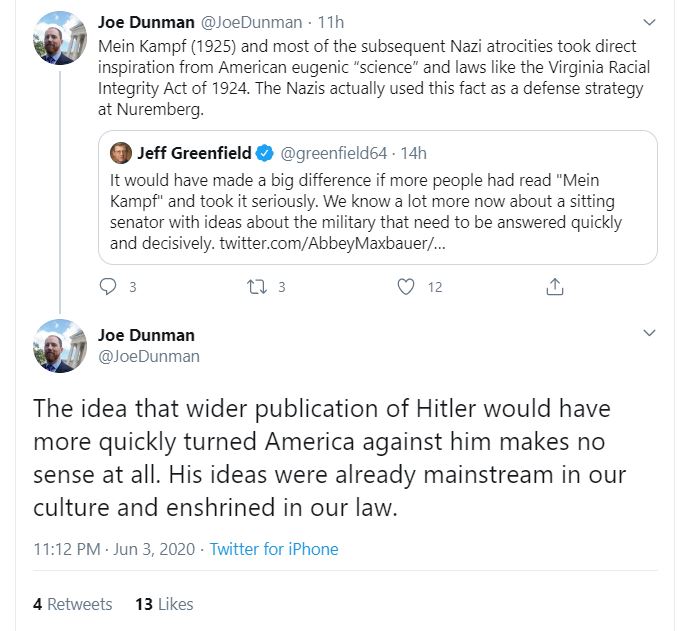
Hilter Skilter, Béarnaise, Gwobbles and the origins of propaganda in American-style capitalism.


Reading this thread at Joe Dunman's Twitter account led me to a feeling of déjà vu.


As it turns out, almost exactly three years ago in this space, I took to the airwaves to correct an error about the career of Joseph Goebbels.

---

That's right; I was wrong. Goebbels got his ideas for propaganda from American advertising, not the other way around.

June 5, 2017

Recently I posted this on social media.

I'm eternally amazed by chain restaurant envy, which always seemed to me an inevitable result of Goebbels-scale national advertising and perception of price point (the latter is skewed, but real enough in many cases). But is it cultural, too? I don't know the answer, but is it a fair question?

Among the responses was this.

Using the Goebbels example is just histrionic.

I replied:

I don't think so. It's the basis of saturation advertising, in the sense of constant repetition. We're exposed to ads every day, hundreds and maybe thousands of times. I believe numerous studies have been devoted to the ongoing subliminal effects even when we think we're tuning it out. Goebbels preached these very qualities in his propaganda dissemination.

In essence, I was arguing that from the techniques of Goebbels, post-war capitalism derived its operational handbook for mass marketing.

I was mistaken.

In fact, Goebbels found inspiration for his propaganda techniques in pre-war capitalism. Big lies and mass-marketing in the service of profit made Goebbels, and not the other way around.

Meet Edward Bernays. You'll want to click through and read the entire essay.

The manipulation of the American mind: Edward Bernays and the birth of public relations, by Richard Gunderman (The Conversation)

“The most interesting man in the world.” “Reach out and touch someone.” “Finger-lickin’ good.” Such advertising slogans have become fixtures of American culture, and each year millions now tune into the Super Bowl as much for the ads as for the football.

While no single person can claim exclusive credit for the ascendancy of advertising in American life, no one deserves credit more than a man most of us have never heard of: Edward Bernays ... often referred to as “the father of public relations,” Bernays in 1928 published his seminal work, Propaganda, in which he argued that public relations is not a gimmick but a necessity:

The conscious and intelligent manipulation of the organized habits and opinions of the masses is an important element in democratic society. Those who manipulate this unseen mechanism of society constitute an invisible government which is the true ruling power of our country. We are governed, our minds are molded, our tastes formed, and our ideas suggested, largely by men we have never heard of ... It is they who pull the wires that control the public mind.

It turns out that Bernays had an international readership.

Bernays’ ideas sold a lot more than cigarettes and Dixie cups.

Even though Bernays saw the power of propaganda during war and used it to sell products during peacetime, he couldn’t have imagined that his writings on public relations would become a tool of the Third Reich.

In the 1920s, Joseph Goebbels became an avid admirer of Bernays and his writings – despite the fact that Bernays was a Jew. When Goebbels became the minister of propaganda for the Third Reich, he sought to exploit Bernays’ ideas to the fullest extent possible. For example, he created a “Fuhrer cult” around Adolph Hitler.

In 2017, we're exposed to advertising (or marketing, or branding) cues thousands of time each day. Whether overt or subliminal, these messages influence actions we blithely regard as "free."

But are they?

Goebbels may have been less concerned with profits, though the result is largely the same.

Its underlying purpose, in large part, is to make money. By convincing people that they want something they do not need, Bernays sought to turn citizens and neighbors into consumers who use their purchasing power to propel themselves down the road to happiness.

Without a moral compass, however, such a transformation promotes a patronizing and ultimately cynical view of human nature and human possibilities, one as likely to destroy lives as to build them up.

Another Bernays citation is here.

He disseminated propaganda for the Government during World War I and tried to brighten Calvin Coolidge's dour image during the 1924 campaign by importing Al Jolson and 40 other Broadway performers to the White House. A master at concealing base drives behind exalted rhetoric, Bernays in 1928 provided this defense of political work: ''Intelligent men must realize that propaganda is the modern instrument by which they can fight for productive ends and help to bring order out of chaos.'' As if to mock this rosy view, Joseph Goebbels became an attentive student of Bernays's theories five years later.

And another.

It is known that Goebbels studied the way advertising companies worked in America. A great deal of his written work was made up of short sentences – as the above indicate. Everything was kept simple so that there could be no misunderstanding as to its meaning.

Finally, this.

Goebbels “took his cue from the model of commercial advertising”.

For Goebbels, “commercial advertising was overtly cited as the model to follow. Whether it was a matter of simplification, constant repetition of memorable slogans, or concentration of propaganda material in regular campaigns, the principles of mass advertising could easily be applied to political propaganda.”

Strictly speaking, I was mistaken to assert that mass-market, saturation advertising for McDonald's, Budweiser or Ford derived from Goebbels.

Under the circumstances, I'm perfectly happy to concede my error.

Sunday, February 23, 2020

Dunman nails it: Bernie Sanders' agenda is "pretty much just 'catch us up to where Western Europe has already been for 40 years.'"


More steaming turds from the screaming skull, but first, you may recall Joe Dunman as one of the attorneys who worked on a fairly important case involving same sex marriage. For those of you doing Twitter, he's a great one to follow.


Here is a typically incisive tweet from Dunman, which needs to be repeated again and again.

“Amazing to me about the anti-Sanders panic is that he’s only slightly center-left, globally-speaking. His agenda is pretty much just ‘catch us up to where Western Europe has already been for 40 years.’”

Yep. Dunman's comment is occasioned by yesterday's good news.

After the Nevada Blowout, It’s Bernie’s Party Now, by Dustin Guastella and Connor Kilpatrick (Jacobite)

Bernie Sanders’s decisive victory in Nevada today shows that he has a working-class base committed to fundamentally transforming our radically unequal political and economic system. He’s on his way to not just the nomination, but the White House ...

... The New Deal was made possible with a new electorate. And just as the mass entry into politics of first- and second-generation Eastern European immigrants brought Roosevelt (and the CIO) to power, Latinos — who are solidly behind Sanders — could very well be the force that helps bring social democracy to America.

Bernie’s staunch anti-establishment outsider appeal and his platform focused on workers’ issues is winning non-partisans, new voters, young voters, and working-class immigrants. That’s not just a savvy coalition for winning the Nevada caucuses, it’s how Bernie Sanders becomes president.

Face it, establishment Democrats — it’s his party now.

Maybe this time we can get the Sanders post-primary (Indiana) victory meal at Pints&union.

Sunday, April 02, 2017

Dunman (and Lady Parts Justice): "Bevin and his allies can’t ban abortion, no matter how much they hate it."

For me, links to essays like Joe Dunman's (below) are helpful segues to further reading.

Consequently, I stumbled across the web page of Lady Parts Justice, which has proven to be helpful and informative over Sunday morning coffee.

Mission Statement

Lady Parts Justice is the first not safe for work, rapid response reproductive rights messaging hub that uses comedy, culture and digital media to sound an alarm about the terrifying erosion of reproductive access so people will get off their asses and reclaim their rights.

About the Name “Lady Parts Justice”

The name “Lady Parts Justice” came from an incident involving a former Michigan state representative and a tireless advocate for abortion rights named Lisa Brown. In 2012, at the same time we were developing our organization, Lisa was fighting against dozens of horrible regressive anti abortion bills in Lansing. In one contentious battle, The Speaker of the House banned Lisa from the statehouse floor for using the word vagina when arguing against a transvaginal ultrasound bill- a bill that would have forced pregnant people to undergo a state mandated transvaginal probe before they could have an abortion. When she asked what she SHOULD use instead of vagina, the Speaker of the House suggested something less offensive like “lady parts.” The actual offense – a politician who was offended by the word vagina yet felt an absolute entitlement to legislate it – inspired us to take Lisa Brown’s fight and expose this kind of hypocrisy by choosing Lady Parts Justice as our name.

Like “Nasty Woman Unite” or “Pussy Grabs Back,” “Lady Parts Justice” is a clap back to yet another extremist politician feeling entitled to legislate bodily autonomy. At LPJ, we don’t connect reproductive parts with gender, and we advocate strongly for the reproductive health and rights of trans men, trans women, and all non-binary people. We believe whatever your gender identity, you have the right to access safe, dignified and affordable reproductive healthcare.

Now, to one of our favorite activist mouthpieces.

Commentary: Bevin and his allies can’t ban abortion, no matter how much they hate it, by Joe Dunman (Insider Louisville)

Ambulance services and hospitals automatically transport and treat all emergency patients no matter where they come from. That’s what they do. If any kind of medical emergency arises, a call to 911 is all you need to secure ambulance transport to a hospital for immediate treatment.

But under Kentucky law, abortion providers must enter into written agreements with hospitals and ambulance services by which they agree to transport and treat abortion patients who encounter “unforeseen complications.” In other words, abortion clinics must go out of their way to get hospitals and ambulances to promise to do the job they’re already obligated to do.

Why? Because in 1998, the Kentucky General Assembly passed KRS 216B.0435, a law that creates medically unnecessary red tape for abortion clinics. Laws such as this are commonly referred to as “TRAP” laws, or Targeted Regulations of Abortion Providers, and they are purposely designed to complicate and burden the provision of abortion services.

TRAP laws have been used to shut down clinics all over the country. And now, they’re being used by Gov. Matt Bevin to effectively ban abortion in Kentucky.

On March 13, the state Cabinet for Health and Family Services sent a letter to the EMW Surgical Center in Louisville, revoking its license and ordering it to stop providing abortions. Why? Because, the cabinet claims, EMW has deficient “transfer agreements” and is therefore in violation of state law.

Saturday, July 16, 2016

Dunman: "'Blue Lives’ do matter, but proposed bill is misguided and tone deaf."

Yet another well-reasoned commentary destined to be ignored, but thanks from those of us who read.

Commentary: ‘Blue Lives’ do matter, but proposed bill is misguided and tone deaf, by Joe Dunman (Insider Louisville)

... Of course, emergency responders and police officers do very important work. But if that’s the prime motivation for adding them to the hate crimes law, why not also add doctors and nurses? Or utility workers? Or pilots? If “all lives matter,” why not add every risky job to the list? Why single out any particular form of employment?

Friday, April 22, 2016

Dunman: "Move Louisville’s absence of light rail a detriment to city’s future."

Green Line, Minneapolis, 2014

Defining the term:

Light rail is a commonly used mode of public transit in North America. The term light rail was coined in 1972 by the Urban Mass Transportation Administration (UMTA; the precursor to the U.S. Federal Transit Administration) to describe new streetcar transformations which were taking place in Europe and the United States. The Germans used the term Stadtbahn, which is the predecessor to North American light rail, to describe the concept, and many in the UMTA wanted to adopt the direct translation, which is city rail. However, in its reports the UMTA finally adopted the term light rail instead.

Then, on to the writer Dunman's customarily persuasive case.

Commentary: Move Louisville’s absence of light rail a detriment to city’s future, by Joe Dunman (Insider Louisville)

On April 14, Mayor Greg Fischer unveiled “Move Louisville,” which is Louisville Metro Government’s transportation plan for the next two decades. In its opening pages (alongside the photo of a smiling, bike-riding Fischer), the plan states its primary goal: reducing “vehicle miles traveled.” In other words, Louisville’s goal over the next 20 years is to get us to drive less ...

Snip.

If you truly want to decrease car reliance through alternative means of transit, you have to give commuters an option that provides shelter from the elements but also moves them around on a predictable schedule independent from other traffic. That option is rail.

But Move Louisville includes no plan for any kind of rail-based transit, which Mayor Fischer dismissed as unrealistic because of our city’s overall low population density.

Granted, he’s right. Much of Jefferson County has very low density, mostly because our planning policies for the past 60 years have financially incentivized sprawl or outright required it as a matter of zoning law. But just because rail transit may not make sense for every square mile of Louisville Metro, it certainly makes sense along certain routes.

Tuesday, December 29, 2015

Joe Dunman on media failures and the Great Mall Riot of 2015.


"I was shocked to hear about the Mall of St. Matthews. I couldn't believe people still shopped at malls." 
-- a clever friend of ours

Saturday, December 26, will be remembered as the Bloody Mall St. Matthews Riot.

Yeah, right.

Estimates of the rioters began in the thousands, and have been dropping each day since the incident began being reported completely out of proportion. Give it another couple of weeks, and it will turn out the mall was completely empty at the time.

Dunman dissects the story/non-story, refers to "local media stenographers" (my heart grew three sizes, natch), and ends with a nod to The Who.

Commentary: Uncritical reporting of one-sided police accounts sparks fear over ‘riot’ at Mall St. Matthews, by Joe Dunman (Insider Louisville).

... Despite a nationwide decline, some malls remain prime gathering places for young people. A policy that youth would no longer be welcome in a mall unless they have a focused shopping agenda or are tethered to a chaperone is absurd, not to mention unenforceable. What would mall security need to do? Search the pockets of every entrant for cash, credit cards, and shopping lists? Tail every teen to ensure they remain securely under the helicopter watch of their parents?

Saturday, August 22, 2015

Walking is not a crime: Dunman and others on the scourges of jaywalking in auto-erotic America.

Photo credit: Vox (below).

I walk.

I walk a lot.

There is me, and there are hundreds of vehicles. Conscious of the disparity between 235 lbs and several thousand, I try to pay attention, but every now and then, I'll get distracted. except that I'm not moving very fast, and comparatively speaking, the vehicles are ... and at this late date, is it necessary to remind readers of how often all of us are distracted while driving?

Of how drivers talk, text, sing, and play with their cigarettes?

Of how they approach an intersection with a one-way street and look only in the direction of oncoming traffic, and almost never the other -- where a walker may be trying to cross?

Of how while distracted, they're usually traveling at an unsafe speed, especially in densely populated urban areas?

When you're walking, you see all of it, because you must do so for the sake of your own safety -- and for the sake of your own safety, you use your own two feet as intelligently and resourcefully as you can. Jaywalking isn't a crime. It's a defense mechanism to circumvent wheeled stupidity, plain and simple.

The Vox piece referenced by Dunman is worthy of a highlight.

The forgotten history of how automakers invented the crime of "jaywalking", by Joseph Stromberg

... "In the early days of the automobile, it was drivers' job to avoid you, not your job to avoid them," says Peter Norton, a historian at the University of Virginia and author of Fighting Traffic: The Dawn of the Motor Age in the American City. "But under the new model, streets became a place for cars — and as a pedestrian, it's your fault if you get hit."

One of the keys to this shift was the creation of the crime of jaywalking. Here's a history of how that happened.

Joe Dunman does a great  job of shining a light on another Fischer administration misstep: Blaming walkers for the behavior of drivers.

On LMPD’s jaywalking crackdown: We should not convert our police into well-armed tax collectors, by Joe Dunman (Insider Louisville)

... The idea that pedestrians don’t belong on the street and should only cross at narrowly defined places is a recent invention of the automobile age. Earlier this year, an illuminating article by Vox explored the history of traffic laws and jaywalking. In the old days now long gone, cities were a space for people, not cars. Now, especially since the Urban Renewal age of the 1960s and 1970s, all public space belongs to the almighty automobile. Where once it was the primary duty of vehicle drivers to avoid pedestrians, we now expect people on foot to get out of the way or risk death.

Not unexpectedly, there's this. How do supposed "Democrats" rationalize it?

It may or may not surprise you that the brunt of “broken windows” policies like jaywalking crackdowns falls disproportionately on the poor and non-white. Minor violations are used as an excuse to harass and financially exploit. In New York, 81 percent of the 7.3 million minor citations and summonses issued by police between 2001 and 2013 went to black and Hispanic people, who comprise much smaller minorities of the city’s total population.

Two years ago, NAC pointed to the following. It's worth a reprint. The passage below emphasizes solutions, but there is more to it. Hit the link, and learn.

Walking is Not a Crime: Questioning the Accident Axiom, by David M Nelson (Project for Public Spaces)

Solutions
There are many things that can be done to keep pushing the message back to a place that values human life first, and speed and efficient movement of automobiles second. On the policy side, get a Vulnerable Users Law introduced into your state legislature. Vulnerable Users Laws shift the burden of evidence onto the more dangerous individual. Drivers are responsible for cyclists, cyclists for pedestrians. I’m a huge fan of these laws, because pedestrians are put on a pedestal. They’ve been popular in Europe and are catching on in the United States.

You can also pursue other policies like Vision Zero, famously applied in Sweden and currently being campaigned for by Transportation Alternatives in NYC. Essentially, Vision Zero is a directive to eliminate all pedestrian and cyclists fatalities in quick order. The central premise being, “that no loss of life is acceptable.” Concerning law and order, you can find local lawyers to represent and advocate for justice on the behalf of pedestrians and cyclists injured or killed by drivers.

You can work to lower the speed of traffic. More specifically, advocate to decrease the range of speeds driven over a segment of road. A fundamental belief in traffic engineering is that differences in operating speed causes higher risks of crashes. Spread can be reduced by lowering speed limits and using roundabouts instead of signalized intersections. The end result is travel times remain the same but maximum operating speed and the range of speeds are significantly lowered. Other geometric changes include narrower lanes, pedestrian refuge islands, neck-downs and Rightsizing.

However, only so much will be accomplished until our local papers and the nightly news starts putting pressure on state DOTs and public works departments to keep our citizens safe on foot. So, first and foremost, pay closer attention to the way that pedestrian deaths are portrayed by the local media in your area, and don’t be afraid to put pressure your local news outlets when you see improper coverage that blames the victim. It is easy to find language in your State Statutes that debunk published misconceptions about crosswalks and jaywalking. We all have the right to walk—and like most rights, it’s one that must be defended.

Wednesday, July 22, 2015

Dunman on personal beliefs, public office, marriage licenses and why Dan Coffey should (but will not) read this.

It couldn't get any clearer.

Could it?

Opinion: County clerks cannot use the power of public office to impose personal beliefs on others, by Joe Dunman (Insider Louisville)

 ... But more troublesome than the logistical problems these bills create is the idea that state or county officials can even have religious objections at all. It’s important to understand that public officials like county clerks are government actors. While they’re at work, they’re not acting as private individuals. They’re acting as the government. When they stand behind that counter and issue licenses, or enforce the law in any way, they effectively cease to be individuals and instead become the government.

“The government” is people. It requires public officials to act in order for it to function. And those public officials swear an oath to uphold the constitutions of Kentucky and the United States (the latter trumps the former). In exchange for the power, prestige and compensation of public office, they agree to enforce the law and perform their duties regardless of their personal religious views. It’s critical that they do so, because neither Kentucky nor the United States is a theocracy.

Thursday, June 11, 2015

A true renaissance (anywhere) "must be sparked by the empowerment of existing residents."

Fundamentally better NA.

Gill Holland made a few good points during his talk last week at the Green Building in NuLu. Given New Albany's recent experience with capital-intensive, gleaming facade and plaque-ready projects, this part struck me hardest.

Gill Holland, Steve Poe talk development in West Louisville, what to do if Humana is sold, by Chris Otts (WDRB)

Government is good at spending a lot of money in one place, like $135 million for the new Omni Hotel downtown. But 135 separate investments of $1 million in west Louisville would transform the area, he said.

Ah, but it would depend on campaign finance opportunities and voting patterns in those 135 areas, wouldn't it?

Joe Dunman recognizes the positives in the chat by Holland and Steve Poe, but he also sees "important differences between NuLu and Portland that ... often get lost in the hype." In several ways, these differences are both significant and relevant to New Albany's position.

I'm not doing Dunman's essay justice by reducing it to a mere paragraph -- and the conclusion, at that. Go to IL and read.

A true Portland renaissance must be sparked by the empowerment of existing residents, by Joe Dunman (Insider Louisville)

... If Portland and the rest of the West End are to enjoy a true renaissance, it must be sparked by the empowerment of existing residents. It can’t be imposed by a few outsiders buying up cheap lots and flipping them, displacing locals in the process. It requires a collective effort with government leadership. Speculators can invest and enjoy returns, but if the city is to improve as a whole, everyone must reap the benefits of neighborhood revitalization.

Sunday, March 29, 2015

Burn Baby Burn: Pence "scorched" by the RFRA firestorm, as we provide legal opinions.

And the best Silent Ron Grooms belatedly can manage is, "But all the other fascists states do it, too."

Verily, the state of Indiana's Holiday Inn Express hotels have been inundated with overnighters since Governor Mike Pence signed SB/HB 101 earlier this week and established the reign of error known as the Religious Freedom Restoration Act. Before moving to a few legal opinions, let's look back on the past week's unpleasantness in our one-party Hoosier paradise:

March 24: Religious freedom: How about freedom from embarrassment?, by David Hoppe (NUVO)

KRAVITZ BLOG: Religious freedom bill may hurt Indy's sports, convention business, by Bob Kravitz (WTHR)

March 25: Tully: Statehouse Republicans embarrass Indiana. Again, by Matthew Tully (Indy Star)

March 27: Local religious leaders, others fire back at Religious Freedom act’s passage, by Jerod Clapp (News and Tribune)

March 28: Seattle, San Francisco mayors join in boycott of Indiana over RFRA, by Madeline Buckley (Indy Star)

And George Takei, and Keith Olbermann, and dozens of other humiliations, great and small. Even Pence's own feelings now have been hurt, along with his presidential prospects, and so damage control is operating full tilt:

Gov. Mike Pence to push for clarification of ‘religious freedom’ law, by Tim Swarens (Indy Star)

Gov. Mike Pence, scorched by a fast-spreading political firestorm, told The Star on Saturday that he will support the introduction of legislation to “clarify” that Indiana’s controversial Religious Freedom Restoration Act does not promote discrimination against gays and lesbians.

Pence breaks into karaoke: "There must be some misunderstanding ... There must be some kind of mistake." The band is Genesis, which seems fitting. 

Following are three explications of RFRA from the legal community. The authors may or may not have stayed in a Holiday In Express, or even someone's airbnb spare bedroom, but at least they're trained, rested and ready.

Opinion: Democracy key in fighting Indiana and Kentucky ‘religious freedom’ laws, by Joe Dunman (Insider Louisville)

So how can opponents of discrimination defeat “religious freedom” laws? There is no easy answer, unfortunately. Laws like RFRA already have been upheld as generally constitutional. They codify a right already present in the First Amendment and don’t single out any classifications of people in their text or application. And limiting the classifications protected by civil rights laws is generally within the discretion of a legislature to do, since civil rights laws themselves are products of the legislative branch.

The Indiana and Kentucky civil rights acts currently omit sexual orientation from protection and there’s no constitutional compulsion to change that. Adding protected classifications is subject to the whim of the voters and those they elect to represent them.

Democracy is the key. Unlike discriminatory marriage bans, “religious freedom” laws like those in Indiana and Kentucky are best defeated at the ballot box. For this reason and many others, state elections matter. Individuals, businesses, and lobbying groups must pressure legislators not to pass and governors not to sign such laws, and vote them out of office when they do.

And:

The Indiana Religious Freedom Restoration Act – An Analysis of Its Controversy, by Matt Anderson (IN Advance)

Perhaps the most frustrating aspect of this law to its opponents is that it comes right after Indiana’s very public and very unsuccesful bid to ban gay marriage. Our own attorney general went state to state submitting amicus briefs in support of laws that would prevent state-sanctioned gay marriage. The state’s arguments at the 7th Circuit were nearly laughed out of the courtroom and were called out for what they were: discrimination based on personal views. The proponents of the IRFRA seem to gloss over this aspect even though the proponents of this bill were the same who had tried to ban gay marriage through Indiana’s Constitution. The exasperation could probably summed up as: “Look, if you hate the LGBT community, so be it . . . but don’t act like this law has nothing to do with it.”

And:

Letter from the legal scholars

We write you as legal scholars with expertise in matters of religious freedom, civil rights, and the interaction between those fields, to offer our expert opinion on the scope and meaning of the proposed Religious Freedom Restoration Acts pending before both houses of the Indiana legislature. The thirty signatories to this letter, many who are Indiana University law professors, agree with the Indiana Supreme Court “that the Indiana Constitution’s religious liberty clauses did not intend to afford only narrow protection for a person’s internal thoughts and private practices of religion and conscience.” We share the view that a commitment to religious liberty is fundamental to a uniquely American notion of pluralism whereby religiously motivated practices should be accommodated in contexts where such accommodation would not result in meaningful harm to the rights of identifiable third parties.

That said, we have several concerns with the language of the proposed Religious Freedom Restoration Acts (RFRA).

Friday, March 27, 2015

Wednesday, February 04, 2015

Invasive species, Volume the Infinity: "Walmart proves once again the rules don’t apply to them."

Maybe Joe Dunman can move to New Albany and be mayor?

Joe Dunman: Walmart proves once again the rules don’t apply to them (Insider Louisville)

Last week, the Louisville Metro Planning Commission approved a proposed Walmart store to fill a large open lot at Broadway and 18th Street. To do so, the commission had to waive some of Louisville’s urban planning rules because Walmart wants to build its store with a typical suburban-style setback and a gigantic front parking lot in a “Traditional Marketplace Corridor Form District.” The rules require buildings to be constructed close to the street in such an area to promote the “traditional visual character, function, and identity” among other important goals.

Opponents of Walmart’s plan sensibly argued that buildings oriented to the street — not set far behind giant parking lots — are safer and more pedestrian-friendly. They’re also aesthetically pleasing and promote the positive urban experience people get on streets like Bardstown Road in the Highlands, as opposed to desolate hellscapes like Preston Highway, the likes of which writer James Kunstler famously described as “the geography of nowhere.”

But if Walmart simply wasn’t willing to move its store closer to the street and put parking behind, preservationists led by Steve Porter suggested an alternative plan that would allow other buildings to be placed street-side, with a parking lot between them and the big box store. A compromise where both the city and the store could get what they want.

Walmart and the Planning Commission were in no mood to compromise, however. The commission’s 8-1 vote in favor of the giant retailer’s suburban-style plan proved once again that what Walmart wants, Walmart gets.

Friday, January 02, 2015

The columnist Dunman looks back at Louisville in 2014.

A river and state line separate us, but it's one big metro area. The trick is to parse the similarities and differences when concocting revolutionary slogans.

I've never met Joe Dunman, but his columns at Insider Louisville have been consistent revelations by virtue of their unabating relevance. We need more writing like his, not less.

Joe Dunman: From bike lanes to the minimum wage fight — a look back at Louisville in 2014 (Insider Louisville)

Over the past eight months I have penned regular opinion pieces for Insider Louisville, mostly about issues of law and government, and since May I’ve covered a lot of ground. No cause (noble or otherwise) should be pursued without periodic reflection, however, so in that light I present a year-end retrospective of my pontification.

Wednesday, December 17, 2014

Dunman: "Combating neighborhood divisions along racial lines."

On Monday, I started trying to come to grips with dissonance in my career choice -- and inside myself. If I knew where the effort was headed, I'd say so right now. Unexplored territories don't have maps.

The PC: If you tolerate this, then your children will be next.


 ... Note that this blanket condemnation, of which I’m sure there have been notable exceptions, includes my own “craft” brewery, so don’t assume I’m making an exception for my own inexcusable personal cowardice. I always thought I'd be the pro athlete, bass player or actor wearing the t-shirt nd standing up for the downtrodden, but right now, as a craft brewery owner, I'm being exposed as fraudulent. I've done done nothing, and at this precise moment, I hate myself for it.

Meanwhile, Joe Dunman keeps getting it right. If not for his commentaries and the food and drink team's advisories, all Insider Louisville would be is breathless business-fluff. I'm reprinting some of the meat below, but go there and read all of it.

Opinion: Combating neighborhood divisions along racial lines, by Joe Dunman (Insider Louisville)

 ... But as the Metropolitan Housing Coalition’s recently released 2014 State of Metropolitan Housing Report shows, the legacy of segregation persists today. African-Americans still are concentrated in the West End and the Newburg area, with minimal diversity elsewhere. The median wage in those areas remains suppressed, and educational achievement is low. Public housing is restricted (mostly by zoning laws) to four out of the 26 total Metro Council districts, with the rich and the poor kept far apart. The “de facto” segregation the busing plan was designed to alleviate still remains.

But make no mistake, as MHC director Cathy Hinko has pointed out, this is not some accident of history. It isn’t really “de facto” at all. Our divided city is the result of intentional policy decisions.

In the 60 years since Brown v. Board of Education, the 50 years since the Civil Rights Act, and the 40 years since Milliken v. Bradley, our country has made strides toward racial equality and integration. But the growing temporal distance between the tumultuous Civil Rights era and the present day has perhaps led us to let down our guard, to assume the battle has been won. It has not.

Sunday, November 16, 2014

Dunman: "Supreme Court should approach same-sex marriage issue from a contemporary constitutional perspective."

I've been linking quite often to Joe Dunman. As noted previously, It's gotten to the point that when I see Joe Dunman's name on the IL mailing, I just click through to read whatever he's written, irrespective of the topic.

"Property values weren’t magically determined by some invisible hand of the market, but by a concerted effort of people and policy to enforce racial segregation."


Thanks to motorized oligarchs like Kerry Stemler, "We still pursue an elusive automobile paradise like a swamp-lost Conquistador seeking the Fountain of Youth."


"Controversial new bike lanes" in Louisville prompt bold new displays of automotive dumbassery.


"The lesson to learn from Hobby Lobby is that employers shouldn’t be in the business of providing health care to their employees."


Southern Indiana same-sex marriage suit a suitable counterpoint to Pence's Brown Suits.


Here is the most recent. Steel-toed boot, meet egg.

Joe Dunman: Supreme Court should approach same-sex marriage issue from a contemporary constitutional perspective (Insider Louisville)

Last week, the U.S. Court of Appeals for the Sixth Circuit became the first federal appeals court to uphold the prohibition of same-sex marriage since a tide of challenges were filed in the wake of United States v. Windsor in 2013. Three months after hearing oral arguments in six total cases from all four states in the Circuit — Michigan, Tennessee, Ohio and Kentucky — the Sixth Circuit ruled in favor of the states ...

... As Americans, we value tradition. But some American traditions, such as slavery, racial segregation and the disenfranchisement of women and minorities, still linger in our legal history. Because of them, it is dangerous to rely too heavily on the past to decide constitutional questions that face us today. It is my personal hope that the Supreme Court will approach same-sex marriage from a more contemporary constitutional perspective.

Saturday, November 01, 2014

"Property values weren’t magically determined by some invisible hand of the market, but by a concerted effort of people and policy to enforce racial segregation."


It's gotten to the point that when I see Joe Dunman's name on the IL mailing, I just click through to read whatever he's written, irrespective of the topic.

Dunman's current piece is a must read.

Joe Dunman: During white flight, lack of racial diversity was by design (Insider Louisville)

... The Bon Air area was a hit. People, including my grandparents with my infant father in tow, flocked in droves. More than 2,000 affordable homes were filled with upwardly mobile young families almost overnight. Between 1953 and 1960, the population boomed to 12,000 residents packed into just over 2 square miles.

Almost every single one of those residents was white — 99.9 percent, in fact. This wasn’t some accident of demography, though. The complete lack of racial diversity was by design — an outcome guaranteed by official and private housing policies in force at the time.