Showing posts with label capitalism. Show all posts

Monday, September 28, 2020

BOOKS: "Capitalism & Disability," by Marta Russell.


My friend Loren is COO at Sweet Behavior LLC, and he mentioned this book a while back. I bought it immediately and read these essays earlier in the month. 

I can tell you is made an impression, and before the reference to capitalism is dismissed out of hand, as many of you will do, I'd recommend at least reading the publisher's tout here. 

There's quite a bit to this. 

Capitalism & Disability

This book comprises a collection of groundbreaking writings by Marta Russell on the nature of disability and oppression under capitalism. 

Spread out over many years and many different publications, the late author and activist Marta Russell wrote a number of groundbreaking and insightful essays on the nature of disability and oppression under capitalism. In this volume, Russell’s various essays are brought together in one place in order to provide a useful and expansive resource to those interested in better understanding the ways in which the modern phenomenon of disability is shaped by capitalist economic and social relations. The essays range in analysis from the theoretical to the topical, including but not limited to: the emergence of disability as a “human category” rooted in the rise of industrial capitalism and the transformation of the conditions of work, family, and society corresponding thereto; a critique of the shortcomings of a purely “civil rights approach” to addressing the persistence of disability oppression in the economic sphere, with a particular focus on the legacy of the Americans with Disabilities Act of 1990; an examination of the changing position of disabled people within the overall system of capitalist production utilizing the Marxist economic concepts of the reserve army of the unemployed, the labor theory of value, and the exploitation of wage-labor; the effects of neoliberal capitalist policies on the living conditions and social position of disabled people as it pertains to welfare, income assistance, health care, and other social security programs; imperialism and war as a factor in the further oppression and immiseration of disabled people within the United States and globally; and the need to build unity against the divisive tendencies which hide the common economic interest shared between disabled people and the often highly-exploited direct care workers who provide services to the former.

Thursday, June 04, 2020

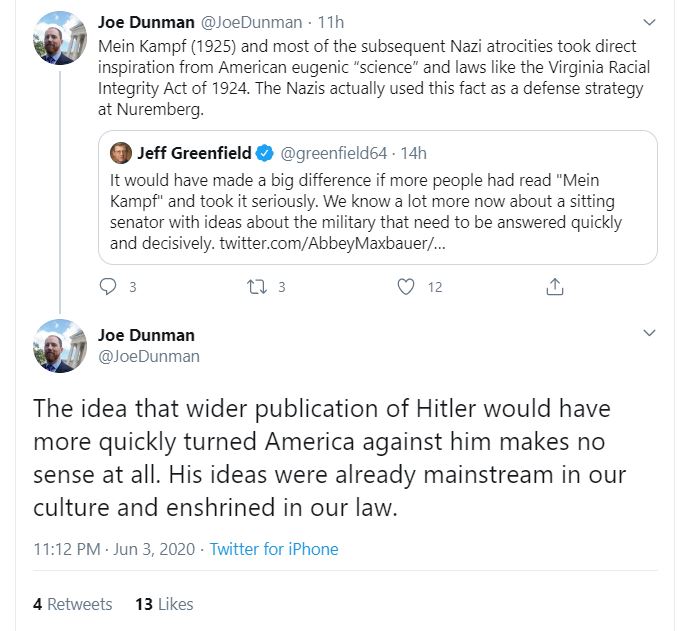
Hilter Skilter, Béarnaise, Gwobbles and the origins of propaganda in American-style capitalism.


Reading this thread at Joe Dunman's Twitter account led me to a feeling of déjà vu.


As it turns out, almost exactly three years ago in this space, I took to the airwaves to correct an error about the career of Joseph Goebbels.

---

That's right; I was wrong. Goebbels got his ideas for propaganda from American advertising, not the other way around.

June 5, 2017

Recently I posted this on social media.

I'm eternally amazed by chain restaurant envy, which always seemed to me an inevitable result of Goebbels-scale national advertising and perception of price point (the latter is skewed, but real enough in many cases). But is it cultural, too? I don't know the answer, but is it a fair question?

Among the responses was this.

Using the Goebbels example is just histrionic.

I replied:

I don't think so. It's the basis of saturation advertising, in the sense of constant repetition. We're exposed to ads every day, hundreds and maybe thousands of times. I believe numerous studies have been devoted to the ongoing subliminal effects even when we think we're tuning it out. Goebbels preached these very qualities in his propaganda dissemination.

In essence, I was arguing that from the techniques of Goebbels, post-war capitalism derived its operational handbook for mass marketing.

I was mistaken.

In fact, Goebbels found inspiration for his propaganda techniques in pre-war capitalism. Big lies and mass-marketing in the service of profit made Goebbels, and not the other way around.

Meet Edward Bernays. You'll want to click through and read the entire essay.

The manipulation of the American mind: Edward Bernays and the birth of public relations, by Richard Gunderman (The Conversation)

“The most interesting man in the world.” “Reach out and touch someone.” “Finger-lickin’ good.” Such advertising slogans have become fixtures of American culture, and each year millions now tune into the Super Bowl as much for the ads as for the football.

While no single person can claim exclusive credit for the ascendancy of advertising in American life, no one deserves credit more than a man most of us have never heard of: Edward Bernays ... often referred to as “the father of public relations,” Bernays in 1928 published his seminal work, Propaganda, in which he argued that public relations is not a gimmick but a necessity:

The conscious and intelligent manipulation of the organized habits and opinions of the masses is an important element in democratic society. Those who manipulate this unseen mechanism of society constitute an invisible government which is the true ruling power of our country. We are governed, our minds are molded, our tastes formed, and our ideas suggested, largely by men we have never heard of ... It is they who pull the wires that control the public mind.

It turns out that Bernays had an international readership.

Bernays’ ideas sold a lot more than cigarettes and Dixie cups.

Even though Bernays saw the power of propaganda during war and used it to sell products during peacetime, he couldn’t have imagined that his writings on public relations would become a tool of the Third Reich.

In the 1920s, Joseph Goebbels became an avid admirer of Bernays and his writings – despite the fact that Bernays was a Jew. When Goebbels became the minister of propaganda for the Third Reich, he sought to exploit Bernays’ ideas to the fullest extent possible. For example, he created a “Fuhrer cult” around Adolph Hitler.

In 2017, we're exposed to advertising (or marketing, or branding) cues thousands of time each day. Whether overt or subliminal, these messages influence actions we blithely regard as "free."

But are they?

Goebbels may have been less concerned with profits, though the result is largely the same.

Its underlying purpose, in large part, is to make money. By convincing people that they want something they do not need, Bernays sought to turn citizens and neighbors into consumers who use their purchasing power to propel themselves down the road to happiness.

Without a moral compass, however, such a transformation promotes a patronizing and ultimately cynical view of human nature and human possibilities, one as likely to destroy lives as to build them up.

Another Bernays citation is here.

He disseminated propaganda for the Government during World War I and tried to brighten Calvin Coolidge's dour image during the 1924 campaign by importing Al Jolson and 40 other Broadway performers to the White House. A master at concealing base drives behind exalted rhetoric, Bernays in 1928 provided this defense of political work: ''Intelligent men must realize that propaganda is the modern instrument by which they can fight for productive ends and help to bring order out of chaos.'' As if to mock this rosy view, Joseph Goebbels became an attentive student of Bernays's theories five years later.

And another.

It is known that Goebbels studied the way advertising companies worked in America. A great deal of his written work was made up of short sentences – as the above indicate. Everything was kept simple so that there could be no misunderstanding as to its meaning.

Finally, this.

Goebbels “took his cue from the model of commercial advertising”.

For Goebbels, “commercial advertising was overtly cited as the model to follow. Whether it was a matter of simplification, constant repetition of memorable slogans, or concentration of propaganda material in regular campaigns, the principles of mass advertising could easily be applied to political propaganda.”

Strictly speaking, I was mistaken to assert that mass-market, saturation advertising for McDonald's, Budweiser or Ford derived from Goebbels.

Under the circumstances, I'm perfectly happy to concede my error.

Monday, May 18, 2020

A tale of two ladders, the "right" one and the broken one.


The books being reviewed:

Deaths of Despair and the Future of Capitalism, by Anne Case and Angus Deaton (Princeton University Press)
Tightrope: Americans Reaching for Hope, by Nicholas D. Kristof and Sheryl WuDunn (Knopf)

The key point to me is this single sentence: "They can’t get beyond wanting to get people on the good ladder, and not dismantle the system of two ladders."

To Be Studied, or Pitied? Two books try to understand the other America, 
and stumble along the way, by Chris Arnade (The American Prospect)

It is easy to get lost in the frustration of navigating a demanding career as a well-educated professional. The absurd cost of college, the low-paying internships and adjunct positions that have to be navigated, and the out-of-reach real estate prices in the few neighborhoods close to those jobs can erase any thoughts of privilege.

For much of America these problems are luxuries, because they come with expectations of something better, and a feeling that someone will listen to you. You might be on the lowest rung of a ladder, but you are on the “right” ladder, and with enough hard work and enough complaining, you can move higher or change things.

Go outside the handful of neighborhoods where professionals cluster, and their problems will immediately seem small. Go to Gary, Indiana, and see street after street of boarded-up homes, abandoned after factories closed. Those who couldn’t leave, almost all black, now live in perpetual decline. Go to Wheeling, West Virginia, and see empty lots of discarded needles, thrown away by people numbing their pain.

In these communities, people are not on the right ladder. Hard work isn’t going to move them higher. Their complaints won’t be published in a New York Times op-ed, and won’t generate thoughtful discussion. Instead they will often be dismissed as the lazy, dumb, racist, or angry ramblings of someone who doesn’t know their place.

snip

While a good job is essential and a more robust health care and social safety net helpful, large parts of America have lost a sense of stability and purpose. The ladder they are on has one rung. That rung is shaky, and they know it. Their parents used to climb that ladder, moving from part-time jobs in high school to a factory job that enabled them to buy a home, marry their sweetheart, build a family, go to church, join a softball league, and then watch their children and grandchildren do the same thing. That ladder didn’t require college. It didn’t require getting into a résumé arms race with your neighbor, and certainly not a bunch of people 8,000 miles away.

Now that ladder is broken, and the people who left town, who went off to Princeton or Yale, climb a ladder that goes into the stratosphere. Many of them look down at the people they left behind and sneer, or laugh, or express pity, if they bother to look down at all. It is humiliating and strips people of their dignity.

A windfall of targeted programs and expanded empowerment zones and a greater social safety net, while helpful, won’t solve this problem. The two ladders are the problem. People who are on the “bad” ladder are not there only because they didn’t have the right opportunities. Many of them didn’t want to go to college. It’s not their thing, it isn’t what they value. They have different priorities, ones that put a premium on faith, place, and family.

Understanding that is hard when you are in academia.

snip

Despite this hard work and genuine empathy, the authors can’t break out of their worldview. They can’t get beyond wanting to get people on the good ladder, and not dismantle the system of two ladders. They don’t emphasize devaluing the meritocracy, as Case and Deaton do, but rather take on the easier feel-good task of figuring out how to get talented young people on their preferred path. Or to use their metaphor, have access to the escalator, so they can escape.

Wednesday, May 06, 2020

"There are layers of tragedy inherent to that capitalistic notion that all is a commodity."


Aarón Cantú:

"This gets it wrong imo. These white Americans are begging for others to return to work and risk death so they can resume their previous levels of consumption - this is clear in other clips."

Here's another quote, attributed to "radical philosopher" Miguel D. Lewis -- who may or may not exist.

"Capitalism is religion. Banks are churches. Bankers are priests. Wealth is heaven. Poverty is hell. Rich people are saints. Poor people are sinners. Commodities are blessings. Money is god."

Prepare to continue sacrificing your bodies to suit the prerequisites of capital accumulation.

Capitalism’s Voracious Appetite: Bodies are the Commodities, by Kathleen Wallace (CounterPunch)

 ... There are layers of tragedy inherent to that capitalistic notion that all is a commodity. These wonders can be extracted, whether it’s through destructive mining, plundering oceans, destroying old-growth forest…….but then this accepted practice carries over from these natural resources to human resources (yes, that phrase is loaded with symbolism—it’s no accident that’s what your job calls you). This has never been more evident in modern America than the push-pull of human worth versus the voracious, victim-hungry economy demands during this pandemic. A testimony to the success of the immersive brainwashing of our capitalist society would be the pro-covid rallies (what else can you call them?) Screaming signs being held by screaming protesters—those demanding that restrictions be removed so commerce can continue despite the risks. The rallies don’t ask for the kind of support the corporations get during these times–no, they request the right to die in order to keep the wheels greased. It’s really pretty astonishing. Like an Aztec saying, please, please take me instead…..”I want my heart cut out for the needs of the sun god!”

Cut to the conclusion.

The only answer is to revisit everything we’ve been taught—all that we have been immersed in from childhood. From that, perils exist, some start to question these things only to be led to an even darker, vindictive place in their minds. The more difficult path is allowing an opening up to new ways of thinking—understanding that the path out will only be through extending rights to others and confronting terrible truths about ourselves—that we feel it’s our right to take from others. It is not. We need to start respecting those who are human, animal, even the mountains and rivers. This is not our usual way of thinking. But this is the only way to get to a future will look like something worth having.

Saturday, May 02, 2020

Ghost juleps on non-race day: "Sadly, the Kentucky Derby no longer is decadent and depraved. It’s just another vacuous capitalist bait ‘n’ switch."


This one's from May 3, 2019, but it goes back considerably further. For those just beaming to Earth from the Starship Whatever, the pandemic has pushed Kentucky Derby 146 to Labor Day weekend in September. This hasn't prevented phantom celebrations of the race that isn't, at least just yet. All of it is suitably surreal, but as Hunter S. Thompson observed a half-century ago, the Kentucky Derby hasn't ever been exactly as it appears -- even when it disappears.

---

ON THE AVENUES HORSE RACE REHASH: Sadly, the Kentucky Derby no longer is decadent and depraved. It’s just another vacuous capitalist bait ‘n’ switch.

Everybody's working for the weekend.
-- Loverboy

(Ralph) Steadman wanted to see some Kentucky Colonels, but he wasn’t sure what they looked like. I told him to go back to the clubhouse men’s rooms and look for men in white linen suits vomiting in the urinals. “They’ll usually have large brown whiskey stains on the fronts of their suits,” I said. “But watch the shoes, that’s the tip-off. Most of them manage to avoid vomiting on their own clothes, but they never miss their shoes.”
-- Hunter S. Thompson

It’s getting better all the time, except when it isn’t. That’s why the Great Pumpkin invented gin.

The insipid cacophony of Blunder Over Louisville has receded from view, and the most recent iteration of Kentucky Derby Festival hyperbole approaches its yearly sell-by date.

Soon our peculiar institution, otherwise known as the Run for the Roses -- or, the greatest two-minute anticlimax in all of sports -- mercifully concludes, freeing the dazed masses to return to exurban multiplexes for repeat viewings of whatever comic-book-derived motion picture drivel currently diverts their attention from facing up to the daily challenges of this decidedly uncivil society.

By then the two-week expanse of festive revelry will have rendered half a month null and void as they pertain to any semblance of useful activity.

Insightfully, though not judgmentally, visitors entering the gates of European cities in medieval times wrote of rampant public drunkenness, especially during celebrations, with people sprawled insensate in the streets amid mounds of garbage and excrement.

Mud, blood and beer; all merely natural states of urban occupancy. Consequently 700 years later, on Sunday, numerous residents of Louisville metro likewise will find themselves lying prone on the toasty tarmac; chewed up, spat out, and duly prepped to begin queueing at local rehab clinics. Let’s hope they bathe first, but maybe cynics like me will get lucky and it will rain all day Saturday.

Meanwhile the world’s foremost horse pimps, with their entourages of low-paid attendants and exploitative regalia, already will have traveled to fresh drugging grounds elsewhere in pursuit of the Triple Crown, which now trails full-contact tiddlywinks in the spectrum of TV sports ratings, but almost made sense back when previous masters like Heywood Hale “Woody” Broun appeared on black and white television doing commentary at Churchill Downs, Pimlico and Belmont Park.

If you’re getting an impression of personal distaste about the Kentucky Derby, that’s only because it’s entirely true. 

As I’ve often observed, ruinous mint juleps and atrociously unflattering hats don’t function as aphrodisiacs in my rarefied world, and yet someone always asks if I’m excited by this most over-rated time of year in Louisville metro.

Nah, but hey -- I’ve mellowed and shit.

It’s fine by me if the Kentucky Derby is your kind of gig, so please go forth and have right at it. Just count me out, and kindly refrain from stepping on my lawn this Saturday unless you’re bringing delicious bottles of Schlenkerla Rauchbier to accompany our projected roast beast.

Then everyone can be happy, as opposed to the flag-waving idiocy of Blunder, when the noise is impossible to muffle no matter how much I drink.

And I drink a lot whenever warplanes strafe my house.

---

For some, especially non-gamblers, the Kentucky Derby is a time to admire the innate beauty of horses. Indeed, they’re splendid animals, albeit regrettably subjected to criminal interference by humans when it comes to thoroughbreds being genetically engineered for the sole purpose of maintaining the custom of wagering and the devastating addiction it often spawns.

Kentucky Derby fest season also is a time for lowlifes like me to straighten up, fly right, and obey the one-percent’s finger-wagging instructions by displaying a proper veneration for upstart new money, inbred old money, ephemeral showbiz glamor, ostentatious (read: tacky) parties, and conspicuous consumption by our presumed “betters” of such a vapid intensity that by all rights the spectacle should impel us to commence the instantaneous honing of curative pitchforks.

Happily, the Kentucky Derby is a time for filling the Crescent Hill Reservoir to the rim with bourbon, and here, at last, we find a genuinely positive attribute of the season, so please do me a favor and save that detestable mint for chewing gum or some of the wonderful chilled yogurt soup the Greeks do so well in summer.

As a lifelong contrarian, I’ll take my bourbon ration served neat, then immediately trade it for requisitely peaty drams of Scotch. On the big day, I plan on stocking plenty of hooch and keeping the doors to the 1117 East Spring Neighborhood Association firmly bolted, because in addition to the horse races, May 4 in the year of 2019 doubles as the last Saturday of invasive voter canvassing prior to the Indiana primary election on the 7th.

I just might be compelled to booby trap my porch with tarantulas and other deadly cargo.

But recall that the calendar was even less favorable to civilized existence in 2018, when Derby Day coincided with Cinco de Mayo, which is fast approaching St. Patrick’s Day as an expression of sheer amateurism among my fellow Caucasians. This year Cinco de Mayo arrives on our post-Derby Sunday, encouraging the oblivious party to keep right on going, and lending a whole new meaning to Day of the Dead.

---

Last year at Insider Louisville, Susan Reigler -- musician, educator, former local restaurant critic and bourbon expert -- sat down with Sara “Bar Belle” Havens for a few questions.

(Reigler’s) affinity — or awareness, we should say — for bourbon came much earlier in her life, when she would spend Saturdays at Churchill Downs with her family.

“The track in those days always smelled of old wood, cigars, popcorn and bourbon — quite a special combination,” says Reigler.

In spite of all my cranky bluster, I can relate to these sentiments. There’s a part of me that genuinely appreciates the old-school, tactile joys of the pre-intravenous ponies, the shabby and dung-laden track, and the laid-back Southern culture that used to characterize this scene.

The native Louisvillian writer Thompson grasped it better than most, and his 1970 account remains essential reading precisely because it deconstructed the mythology and described what the Kentucky Derby symbolized -- what it "was" -- with what it very shortly would become:

(The Texan) had, after all, come here once again to make a 19th century ass of himself in the midst of some jaded, atavistic freakout with nothing to recommend it except a very saleable "tradition."

Around the same time, I can remember Broun doing his televised racing commentaries -- and the man could write, too.

To be great, a horse must have metaphorical wings. In mythology we punished wax-winged Icarus for flying too close to the sun, but in recognition of the nobility of their singlemindedness, mythology has let the chariot horses of Apollo traverse the sky. Race horses do not chaffer over money, get into bar fights or endorse horse blankets and aluminum shoes. They combine strength, grace, beauty and speed as perhaps no other link in the Darwinian chain can manage (cheetahs have funny-looking shoulders).

There was a certain poetic flair, albeit oblivious, to the way the Courier-Journal of old used to cover the varied expressions of Churchill Downs pageantry, a quality of an indefinable “something” both venerable and genteel involving rites of spring, colorful flowers, exclusive balls and parties, and as a last resort, the horses themselves. Customs were handed down from one generation to the next, and honored.

Compared to what the Downs and the Derby have become in this time of celebrity-besotted, Disney-cum-Vegas plasticized swipe-card, UPC-tattooed entertainment experiences, 1970 might as well have been 1905.

Listen, I’m not delusional. Breeding horses for racing, wagering on them, smoking, drinking, eating and all the social constructs draped around the experience always had to do with shaking down suckers, first and foremost.

That's understood, although I submit that during the course of my own life -- perhaps as a result of globalization, or Reagan’s trickle-down, or the entire business of America’s business becoming a 24-hour-per-day psychological waterboarding designed to sell, sell, sell -- most of the tradition and authenticity have been drained away, or perhaps stripped and flipped like the Yankee Stadium demolition and rebuild, yielding an improved model in which every last corpuscle of sculpted cement, fake wood and pastel color is calculated for one reason and one reason alone -- to ensure that fools and their cash are expeditiously parted now, as a racetrack, and then even more so later, somewhere down the way, as a casino.

---

But enough of the Kentucky Derby’s deleterious implications for human civilization.

Let’s talk about beer.

From 2012 through 2017 the “official” beer of the signature institution known as Churchill Downs was Stella Artois, chosen import of AB-InBev’s payola empire. In 2018 the title passed to Corona, perhaps the most vile mainstream corn-choked Mexican lager atrocity known to man.

In 2019, pay-to-place reaches glorious new heights of Goebbelsian categorization, although I'm crushed to learn that there isn't (yet) an Official Hard Seltzer Water of the Kentucky Derby.

  • Corona – Official Import Beer of the Kentucky Derby
  • Budweiser – Official Domestic Beer of the Kentucky Derby
  • Blue Moon – Official Craft Beer of Churchill Downs, the Kentucky Oaks and the Kentucky Derby

The Brewers Association reminds us that Blue Moon cannot be "craft," but no matter. While the Kentucky Derby has spawned or embraced many intrinsic traditions since its inaugural run in 1875, locally brewed beer hasn’t ever been prominent among these predispositions.

After all, bourbon gets you there way faster.

Still, we can surmise that in the oldest of far-off times there’d have been plenty of local beer to celebrate the annual race, at least prior to the idiotic onset of Prohibition, which rendered the United States a planetary laughingstock.

After restorative Repeal, local beer returned, but when the original Falls City swapped its fermenters for a fleet of semi-trailers in 1979, there was nary a single drop of hometown beer left to drown a wretched punter’s sorrows until 1993, when Sea Hero’s triumph may have been marked by a few hardy and pioneering microbrew fans drinking David Piece's Silo Red Rock Ale from a growler on their porch with a radio nearby, because then, as now, the very last situation you'd expect to experience in this life is local beer at Churchill Downs -- where first Stella, then Corona and now Blue Moon is the this-that-or-another "official" mass-market creation of choice, and there’s barely any incongruity worth noting because the multinational track itself has little to do with the schizophrenic city and increasingly impoverished state in which it resides.

Here, there and everywhere: when the real money is at stake, you can be sure that soulless neoliberal capitalism will be oozing through the keyhole, breathlessly drooling in anticipation of sponsorship opportunities, with conceptual coherence always taking a back seat to the sheer weight of numerically amassed ending zeroes.

Maybe next time it will be Michelob Ultra. Anyway, there’s plenty of time for an experiment, so go out and assemble a committee of horse pimps. We’ll see if any of them can spot the difference between the watery, beer-scented banality of Corona and those equally reeking buckets of equine drug-testing residue over there where the inspectors are being paid off.

It’s not a trick question, you know.

Wednesday, April 08, 2020

To repeat, the toilet paper shortage is about capitalist "efficiency," but hey, Joe Biden will fix it, right?


Whenever I think about Joe Biden as the standard bearer for the DemoDisneyDixiecrats, defecation springs to mind -- and with it, the need for toilet paper amid the rigors of the pandemic.

Here's another explanation of the same fundamental lesson: an economic system organized for maximum profit on the part of the producers isn't necessarily built to be resilient in times of crisis.

What Everyone’s Getting Wrong About the Toilet Paper Shortage, Will Oremus (Medium)

It isn’t really about hoarding. And there isn’t an easy fix.

Georgia-Pacific, a leading toilet paper manufacturer based in Atlanta, estimates that the average household will use 40% more toilet paper than usual if all of its members are staying home around the clock. That’s a huge leap in demand for a product whose supply chain is predicated on the assumption that demand is essentially constant. It’s one that won’t fully subside even when people stop hoarding or panic-buying.

And this repeat from last week:

COVID-19 and the “Just-in-Time” Supply Chain: Why Hospitals Ran Out of Ventilators and Grocery Stores Ran Out of Toilet Paper, by Louis Proyect (CounterPunch)

"Hospitals began to run out of masks for the same reason that supermarkets ran out of toilet paper — because their “just-in-time” supply chains, which call for holding as little inventory as possible to meet demand, are built to optimize efficiency, not resiliency."

Saturday, April 04, 2020

"COVID-19 and the “just-in-time” supply chain" ... um, which "ism" is it?


Eureka!

Serendipity is the motive force in life, and I knew there was a reason why I've held onto this roll of East German toilet paper since 1989. Just in the nick of time, too.

Meanwhile, for everyone out there equating empty (sections of) store shelves, depleted masks and missing ventilators with socialism, communism or other "isms" of which accurate definitions are lamentably lacking, have a nice read.

Spoiler alert: It's about capitalism, not those pesky other-isms. 

COVID-19 and the “Just-in-Time” Supply Chain: Why Hospitals Ran Out of Ventilators and Grocery Stores Ran Out of Toilet Paper, by Louis Proyect (CounterPunch)

On March 25th, N.Y. Times op-ed columnist Farhad Manjoo wrote about “How the World’s Richest Country Ran Out of a 75-Cent Face Mask.” The subtitle certainly went against the grain of what you’d read from a page dominated by Thomas Friedman: “A very American story about capitalism consuming our national preparedness and resiliency.”

Manjoo identified just one of many failures of the Trump administration to be prepared for the epidemic. Alex Azar, the HHS Secretary had testified that there were only about 40 million masks in our domestic stockpiles, around 1 percent of what would be required. Like much else, mask manufacturing had migrated to China in the same way as all other textile industries had long ago.

Manjoo put this into context:

Hospitals began to run out of masks for the same reason that supermarkets ran out of toilet paper — because their “just-in-time” supply chains, which call for holding as little inventory as possible to meet demand, are built to optimize efficiency, not resiliency.

I remember first hearing about just-in-time inventory techniques in the 1990s in the aftermath of the collapse of the USSR. Just-in-time was also called “lean manufacturing” or “stockless production.” Management gurus saw it as a way to eliminate waste and continuously boost productivity ...

Monday, March 30, 2020

"The coronavirus crisis has revealed the fragility of a system built on decades of financialisation and globalisation."

Photo credit: The Independent.

Excellent magazine, equally fine article.

Tribune is a democratic socialist political journalism founded in 1937 and published in London. While it is independent, it has usually supported the Labour Party from the left. From 2009 to 2018, it faced serious financial difficulties until it was purchased by Jacobin in late 2018, shifting to a quarterly publication model.

Tear it down.

Coronavirus Has Exposed Capitalism’s Weaknesses, by Costas Lapavitsas

The coronavirus crisis has revealed the fragility of a system built on decades of financialisation and globalisation – but the task for the Left is to offer a real alternative, argues Costas Lapavitsas.

The coronavirus crisis represents a critical moment in the development of contemporary capitalism. To be sure, the crisis has longer to run — and its full impact on the USA, the EU, China, Japan and developing countries remains to be seen. But there is no doubt that it has posed the threat of a massive depression across the world economy. The systemic failures of financialisation and globalisation were starkly revealed by the public health emergency, and the state has become ever more implicated in sustaining this failing system. However, the character of its interventions give no reason to think that there will be a transformation at the top of the political and social hierarchy resulting in policies that favour the interests of working people.

The US government’s decision massively to augment its deficit — and thus its borrowing — while simultaneously expanding the supply of money and driving interest rates to zero, is essentially the same as after 2007–9. Even if a depression is avoided, the medium-term results are also likely to be the same, since the underlying weakness of capitalist accumulation is not confronted. But there will certainly be political contradictions arising from defending the neoliberal order, not least given the demonstration of nation states’ power to intervene in the economy. These will be particularly important in the EU, where the fiscal and health emergency response to the crisis has so far come from individual nation-states rather than the collective institutions.

Casting a harsh light on the inadequacies of neoliberal capitalism, this crisis has directly posed the issue of democratic reorganisation of both economy and society in the interests of workers. There is an urgent need to confront the chaos of globalisation and financialisation by putting forth concrete radical proposals. That also requires forms of organisation capable of altering the social and political balance in favor of working people.

The pandemic has brought to the fore vital issues of social transformation. It has vividly illustrated the imperative of having a public health system that is rationally organised and capable of dealing with epidemic shocks. It has also posed the urgent need for solidarity, communal action, and public policies to support workers and the poorest faced with lockdowns, unemployment, and economic collapse.

More broadly, it has reasserted the historic need to confront a declining system that is locked in its own absurdities. Unable rationally to transform itself, globalised and financialised capitalism instead keeps resorting to ever-greater doses of the same, disastrous, palliatives. The first requirement, in this respect, is to defend democratic rights from a threatening state and insist that working people have a powerful say in all decision making. Only on this basis could radical alternatives be proposed, including large-scale measures such as designing industrial policy to address the weakness of production, facilitating a green transition, dealing with income and wealth inequalities, and confronting financialisation by creating public financial institutions.

The coronavirus crisis has already transformed the terms of political struggle — and socialists must urgently respond.

Thursday, February 27, 2020

"Milton Friedman was wrong. Capitalism doesn't foster freedom — it produces autocratic workplaces and tyrannical billionaires."


To continue a barroom conversation ... a complete essay.

---

Capitalist Freedom Is a Farce, by Rob Larson (Jacobin)

Milton Friedman was wrong. Capitalism doesn't foster freedom — it produces autocratic workplaces and tyrannical billionaires.

For all the changes of the last fifty years, the conservative classics have held their place surprisingly well. Milton Friedman’s Capitalism and Freedom and Friedrich Hayek’s The Road to Serfdom are still featured on Breitbart’s online bookstore. Rush Limbaugh tells his listeners that “Milton Friedman should be the Bible for young people, or anybody, trying to understand capitalism and free markets.” Charlie Kirk, founder of Turning Point USA, celebrates Hayek and Friedman in his book, while Ben Shapiro holds up Friedman as a conservative icon in National Review.

But what then are the liberty and freedom that conservatives celebrate? And does capitalism advance or restrain them?

Freedom is regarded so highly because in a way it contains all the pleasures of life — it’s the ability to do what you want, within the limits of material conditions and a human lifespan. However you like to spend your time, whoever you love, whatever you like to work on or laugh at, all represent the tremendous value of social freedom.

According to John Stuart Mill, the basic principle of freedom was that “the only purpose for which power can be rightly exercised over any member of a civilized community, against his will, is to prevent harm to others.” The philosopher Isaiah Berlin later described this idea as “negative freedom,” or freedom from coercion by others. Berlin also suggested a “positive freedom” — the freedom to do different things, rather than freedom from the choices of others. Instead of asking, “What power centers control me,” positive freedom asks, “What am I free to do with the world’s opportunities and resources?”

The traditional philosophical view of capitalism is that while it does not provide a “positive freedom” to a fair share of the world’s production of goods, it provides a “negative freedom” from economic tyranny by leaving consumers and workers free to choose among different options. This is the view of Friedman and Hayek, and they insist it’s just the right kind of liberty. Many generations of capitalism’s defenders have agreed.

But any realistic review of the market economy reveals a different picture: capitalism limits both positive and negative freedom. It fosters a huge buildup of private power by concentrating individual wealth and entrenching corporate control over markets (along with mercilessly destroying environmental systems and thus the freedom of future generations). Capitalism not only fails to provide a “positive freedom” to a fair share of the economy — it fails to preserve “negative freedom” from the power plays of the 1 percent’s corporate property.

When GM and Ford decided to desert cities like Detroit and Flint for poorer towns and countries, they denied their former workforce any positive freedom to enjoy the industry’s enormous revenues — revenues the workers themselves had created. When Martin Shkreli’s pharmaceutical company hiked the price of a life-saving patented drug from $13.50 to $750, effectively snatching it away from disease sufferers, it drove dependent users into poverty or bankruptcy — a frightening restriction of negative freedom. When Amazon held a sweepstakes to see which North American city would be blessed with its new headquarters, and mayors across the continent threw billions in tax concessions at the company’s feet, Amazon wielded enormous power over the destiny of millions of people — laying bare how capitalist investment decisions can dramatically limit human liberty.

Capitalism’s defenders insist that, as Friedman and his wife Rose wrote in their book Free To Choose, “When you enter a store, no one forces you to buy. You are free to do so or go elsewhere. . . . You are free to choose.” They applied the same argument to workers: if you don’t like your job or career, find another one.

But other figures have seen the market’s alleged negative freedom quite differently. Consider Frederick Douglass, the escaped slave and self-taught intellectual. He concluded:


Experience demonstrates that there may be a slavery of wages only a little less galling and crushing in its effects than chattel slavery, and that this slavery of wages must go down with the other. . . . The man who has it in his power to say to a man, you must work the land for me for such wages as I choose to give, has a power of slavery over him as real, if not as complete, as he who compels toil under the lash. All that a man hath he will give for his life.

Here Douglass was suggesting that markets allow the exercise of unaccountable power — the enemy of freedom. But how could a free person be “enslaved” to wages, with so many different options for purchasing goods and finding different careers?

One answer, as critics of capitalism have pointed out for centuries, is that markets concentrate and often tend toward monopoly. From the well-known Gilded Age monopolies in oil and steel to the Silicon Valley tech giants of today, the dynamics of capitalism generate unbelievable concentrations of private power. And while antitrust law is intended to constrain such monopolies, as the eminent economist Alfred Chandler pointed out long ago, commenting on the 1890 Sherman Act, at best such statutes tend to “create oligopoly where monopoly existed and to prevent oligopoly from becoming monopoly.” Large agglomerations of unaccountable power — not the freedom-enhancing markets of Friedmanite fantasies — are the stuff of mature capitalism.

Douglass’s larger point, however, was that market economies treat basic necessities as commodities to be bought and sold, including food and shelter. Capitalism compels people to find work in labor markets, on such terms as they can find and subject to the tyrannical rule of jumped-up capitalist bullies, from Rockefeller to Bezos.

This is a radical infringement on positive and negative liberty. In order to get the rudiments of life, most people must submit to the utter dictatorship of the modern workplace — the day-to-day schedule changes, the dressings-down, the restrictions on freedom of speech. No wonder Douglass added: “As the laborer becomes more intelligent he will develop what capital he already possess — that is the power to organize and combine for its own protection.” Collective organization by workers — that bugaboo of capitalist partisans like Friedman — was the true guarantor of freedom.

But wait — Friedman and company say they have a trump card: “Since the household always has the alternative of producing directly for itself,” Friedman wrote in Capitalism and Freedom, “it need not enter into any exchange unless it benefits from it.” The power of “exit” restricts the potentially coercive power of the labor market.

Yet Friedman’s picture of the average family is so rosy it borders on the oblivious. What he refuses to recognize is that producing goods typically requires capital, the tools and equipment used to make products.

And capital is enormously concentrated. Inequality scholar Thomas Piketty has found that the richest 10 percent of US households own 70 percent of total national wealth, and the top 1 percent alone owns 35 percent. Crucially, corporate stock, which represents ownership of the productive capital that’s required to make goods and thus enable people to “produce for themselves,” is just as concentrated, with the richest 5 percent of households holding 67 percent of US equities, according to the Economic Policy Institute.

Somehow the Chicago School Nobelist fails to realize that the average individual — the individual around which his entire philosophy is allegedly based — is held hostage to the whims of those who own the productive economy, who can decide how wretched our work lives will be and which cities will get to have an economic future. From break times to ergonomics to maternity leave to acceptable workplace speech, the upper crust calls the shots and makes a mockery of “capitalist freedom.”

Liberals, for their part, are often prepared to push for more “positive freedom” in the form of entitlements to health care, education, and a safe environment. But democratic control over investment and production would represent a far more promising model for liberty, since achieving worker control would replace capitalism’s profit motive with solidarity — the drive to support and collaborate with our fellow men and women.

Doing so would end giant firms’ power to sweep the legs out from under a major city by relocating overseas, or to ruin their employees’ work lives by speeding up production or surveilling them. Decisions made by cooperatives of workers, elected and subject to recall by their colleagues, could be made in a matrix of social solidarity and thus significantly limit the power-mongering we’re used to from today’s corporate world.

We on the Left cannot surrender the language of freedom to the Right. Having a critical analysis of capitalist corporations is great, but socialists must also promote the transformative potential of socialist freedom — both to inspire the hard work needed to change the world and to give our struggles a north star.

In The Road to Serfdom, Hayek grudgingly laments that “the promise of greater freedom has become one of the most effective weapons of socialist propaganda.” Hear, hear!

Tuesday, January 14, 2020

Brand Sussex, Karl Marx and why pitchforks matter.


Harry and Meghan are seceding from the monarchy -- well, except for Harry's inheritance. It's a useful reminder that inherited wealth and not "inventing a better mousetrap" is where the One Percent got all that money in the first place.

Seen in this harsh light, amok capitalism and hidebound feudalism have quite a lot more in common than might be evident. This said, I wish Brand Sussex much luck; someday they may even appear on the cover of Extol Magazine.

But there's really no reason whatever why any of us should give a damn. 

Harry, Meghan and Marx at The Economist

Brand Sussex represents the biggest threat to the monarchy so far

 ... The Sussexes are doing something new. They are embracing capitalism in its rawest, most modern form: global rather than national, virtual rather than solid, driven, by its ineluctable logic, constantly to produce new fads and fashions.

This type of capitalism is the inverse of feudalism. In a feudal society you are bound to your followers by mutual bonds of obligation. In 21st-century capitalism you accumulate followers in order to monetise them. In a feudal society you are bound to plots of land: Harry is the Duke of Sussex while his elder brother is the Duke of Cambridge. In a 21st-century-capitalist society you are propelled around the globe in pursuit of the latest marketing opportunity. It is only fitting that the principal agent of the current debacle, Meghan Markle, is the product of an entertainment business that has done more than any other industry to fulfil Marx’s prediction that “all that is sacred” would be “profaned” and “all that is solid” would “melt into air”.

snip

The daylight that Walter Bagehot said should not be let in upon the magic of monarchy is as nothing to the glare of 21st-century capitalism.

Sunday, November 24, 2019

Eastern Europe's 30-year revival: Has the transition from communism to capitalism been a "remarkable" success?

Czechoslovakia, 1989.

We'll be vacationing in Croatia (briefly) and Slovenia, both components of ex-Yugoslavia, and thus to American minds like mine that were formed during the Cold War, both belonging to "Eastern Europe."

Never mind that Yugoslavia was non-aligned and abstained from the Warsaw Pact. It remains that "central" always was a better modifier, and "Eastern" no longer is monolithic, now mandating the use of the lower case, eastern.

Is the present era the best and worst of times for these formerly communist countries? Here are three perspectives.

First, a rosier-than-not overview.

'This is the golden age': eastern Europe's extraordinary 30-year revival, by Shaun Walker (The Guardian)

Not everything is perfect – as reflected in political flux – but the region is wealthier and healthier than ever before

Maciej Grabski looks out over a panoramic view of the Baltic Sea, from the 32nd floor of the Olivia Star tower in Gdańsk, Poland.

“My children never saw the dark, devastated atmosphere that I remember from the 1980s,” he says. “Many people take things for granted now.”

The tower, built by Grabski’s construction company, is the centrepiece of a new business development on the outskirts of Gdańsk, and filled with the offices of multinational companies. It is next door to the squat, concrete Olivia sports hall, where the Solidarity trade union movement held its first congress in 1981, heralding the beginning of the end for communism in the region.

The economic demands of Solidarity, which had sprung up at the huge Gdańsk shipyard and was led by Lech Wałęsa, rippled through Poland and then the rest of central and eastern Europe during the 1980s. By the end of the decade, borders were open, regimes collapsed and the Berlin Wall, concrete symbol of 45 years of European division, was being pulled down.

What happened next was extraordinary, painful and unpredictable, as an entire region lurched into uncharted territory. Progress was fitful, messy and often unevenly distributed, sowing the seeds in some countries for the recent rise of populism.

But 30 years on from the heady days of autumn 1989, a range of metrics demonstrate that the transition from communism to capitalism has been a remarkable success.

Next, a more cautious take in economic terms.

Can the good run of central Europe’s economies last? at The Economist

The extremely open economies are vulnerable to external shocks

Fifteen years after they joined the EU, the four “Visegrad” states of central Europe (the v4) can be prouder of their economic achievements than of their patchy record on political reform. The Czech Republic, Hungary, Poland and Slovakia have increased their levels of gdp per head dramatically, and are converging with their mighty neighbour Germany. The Czechs are the richest, with a gdp per head that is 73% of Germany’s, followed by Slovakia with 63% and Hungary and Poland with around 57% each—and the gap continues to close, as their growth outpaces that of the behemoth.

Four main external forces have driven the remarkable successes of the four extremely open v4 economies. The first is their access to generous subsidies from the EU, which make up a sizeable chunk of their respective national incomes. Second is the munificent flow of remittances from millions of expat v4 citizens who now live and work in the EU, especially in Germany, Austria or Britain. A benevolent recent economic environment has also helped, especially the success of the German economy, by far their most important trading partner and the biggest or second-biggest investor in each country. And lastly, the four all started from a low base, enabling them to serve as cheap workshops for more developed economies. The danger is that all four of these factors are now petering out.

And, to recall, East Germany always was a special case.

Germans still don’t agree on what reunification meant at The Economist

Discontent may even be growing

On November 9th 1989, as the Berlin Wall tumbled, Hans-Joachim Binder was on night shift at the potash mine in Bischofferode, a village in the communist-ruled German Democratic Republic. Mr Binder, a maintenance worker who had toiled in the mine for 17 years, had no idea of the momentous events unfolding 240km (150 miles) to the east. The first sign something was up was when most of his colleagues disappeared to investigate what was happening at the border with West Germany, just ten minutes’ drive away. Only three returned to complete their shift.

Less than a year later Germany was reunited, capping one of the most extraordinary stories in modern history. Not only had a communist dictatorship collapsed, releasing 16m people from the fear of the Stasi (secret police) and the stultification of censorship. Unlike any other country ever freed from tyranny, the entire population of East Germany was given citizenship of a big, rich democracy. As a grand, if ill-fated, gesture of welcome the West German chancellor, Helmut Kohl, converted some of their worthless savings into hard currency at the preposterously generous exchange rate of one Deutschmark to one Ostmark.

More than 1m Ossies took advantage of their new freedom by moving to the West, where most thrived. Official statistics no longer counted this group—who were disproportionally young, clever, female and ambitious—as East Germans. For those who stayed behind, however, the 30 years since the fall of the Wall have been a mix of impressive progress, often taken for granted, and sour disappointment.

Thursday, October 10, 2019

Harvest Homecoming is the perfect time to ask: "Has Capitalism Become Our Religion?"

We're reminded of the meme quote attributed to "radical philosopher" Miguel D. Lewis.

Capitalism is religion. Banks are churches. Bankers are priests. Wealth is heaven. Poverty is hell. Rich people are saints. Poor people are sinners. Commodities are blessings. Money is god.

Or maybe we're not, given that there seems to be quite little evidence of Lewis' existence apart from here. Still, it's a fine way to introduce the subject matter.

Has Capitalism Become Our Religion? by Daniel Steinmetz-Jenkins (The Nation)

We talk with historian Eugene McCarraher about the myths and rituals of the market, the lost radicalism of the late 19th and early 20th centuries, and the rise of neoliberalism.

One would be hard-pressed to find a form of modern rationalism more extreme than capitalism. The laws of supply and demand and the commodification of goods like health and education strip away the mystery and sense of sacredness that were once a vital part of human life.

Capitalism, Marx observed, tears asunder “all fixed, fast-frozen relations” and “drowns the most heavenly ecstasies of religious fervor…in the icy water of egotistical calculation.” It wrings out of human life every drop of awe and magic and leaves in their place a hardened world of material interests and accumulation. Or so the story goes.

Eugene McCarraher’s new book, The Enchantments of Mammon: How Capitalism Became the Religion of Modernity, offers a different rendering of our modern age—one in which the mysteries and sacraments of religion were transferred to the way we perceive market forces and economic development.

The new world that capitalism created, McCarraher argues, is characterized not by disenchantment but by a “migration of the holy” to the realm of production and consumption, profit and price, trade and economic tribulation.

Capitalism, in other words, is the new religion, a system full of enchanted superstitions and unfounded beliefs and beholden to its own clerisy of economists and managers, its own iconography of advertising and public relations, and its own political theology—a view of history and politics that is premised on the inevitability of the capitalist system spreading across the world.

McCarraher spoke with The Nation about capitalism’s past and present, the lost radicalism of the late 19th and early 20th centuries, Bernie Sanders’s candidacy, and the rise of a new generation of socialists. The following has been edited and condensed for clarity.

Thursday, August 08, 2019

ON THE AVENUES: Unless you open your eyes, “resistance” is an empty gesture.


“When the facts change, I change my mind. What do you do, sir?”

British politician Winston Churchill and economist John Maynard Keynes both have been credited with this phrase or variants of it, although their attribution does not survive scrutiny. Probably it dates to a 1970 interview with an economist named Paul Samuelson, who may or may not have thought he was quoting Keynes:

Well when events change, I change my mind. What do you do?

Rest easy, dear reader. I’m not about to endorse Slick Jeffie for a third term. Actually the phrase came to mind this morning when I caught myself saying, “Well, I used to think that … “

There’s no need to complete the sentence because I say it at least once daily, as pertaining to a wide range of topics. It fits nicely with “there was a time when” and “I was absolutely clueless back then,” emphasizing a never-ending learning curve as a planetary inhabitant.

I suspect the vast majority of human beings are readily capable of acknowledging the need to adjust their thinking to changing circumstances, so long as doing so constitutes perceived material benefit. If not, millions of smart phones would be packed away in Asian warehouses, untouched. Doctors would be treating broken legs with leeches, and instant Ramen noodles might never have been invented.

However far fewer are willing to hold the same yardstick to what they’d undoubtedly refer to as their core “beliefs.” This word alone should tell us something.

Tangible, tactile reality is infinitely swappable, whether mutating from horse-drawn carts to automobiles or insipid Lite beer to an inspired Bavarian Kellerbier. Those only vaguely verifiable (if at all) “beliefs” are tantamount to the enduring human stain, as writer Philip Roth tagged it. Religion, race relations, the role of the sexes; occasionally we’ll permit experiential evidence to erode our pre-conceived notions, but far less often than we “upgrade” our redundant devices for communicating – ironically, a task that renders us increasingly isolated from human all direct contact.

Rock music radio commentator Eddie Trunk was talking about this a few days ago in response to a question about the future of rock as we know it. Trunk offered pros and cons in response, and in my view he correctly identified the digitalization of music in the internet era as a double-edged sword.

It makes all music available at any time, thus theoretically broadening exposure to different types of music and educating listeners about it. Maybe they’ll stop listening to hip hop after hearing Ten Years After or Ratt – or so this notion goes.

At the same time, according to Trunk, the digital revolution has deprived listeners of the joy of waiting anxiously for new music to be released, then rushing to the mall (his reference) to be the first in line for an album or CD, before hurrying back home with friends to crack the cellophane and listen while enjoying a microwaved pizza roll.

Trunk previously has lamented the evolution of outdoor music fests, observing that young attendees seldom are riveted to the music; instead, they’re wandering the grounds consuming gourmet food, craft cocktails and multimedia experiences – if not spending every moment documenting the scene for “live” transmission.

Why don’t they care about the music? I’d say they do, albeit in a different way than during my own youth. The problem is that no one these days wants to pay for it (see journalism, death of), including me, even though I know better.

It occurs to me that while Trunk’s perspective is as dated as my own (he’s in his early 50s), he’s also missing the central element that ties together his case: the communal joy of pre-digital listening.

For better or worse, rock and roll -- the post-WWII cultural phenomenon that morphed into the voice of the Vietnam and Cold War generations worldwide --- became the musical equivalent of a mass political rally, perhaps reaching its apogee in 1985 with the global transmission of Live Aid by means of just then emerging satellite technology.

It is said Freddie Mercury was reluctant for Queen to appear until Bob Geldof reminded the singer that the gig was what he’d always sought: the whole world as attentive audience.

So it was, and one’s like or dislike of Queen aside, Live Aid made possible the band’s subsequent career, before and after Mercury’s untimely death in 1991. By then the baby boomers were well along their way toward rejecting the political and economic lessons of the 1960s, maintaining cultural bona fides with an attachment to increasingly corporate rock while otherwise subscribing to fascism, or Live Aid with swastikas.

But I digress.

All of Trunk’s lamentations point to the same phenomenon, beginning in the 1990s with the availability of home computers and expanding exponentially in the 2000s with smart phones and the like: Progress is isolating us from the communal, shrinking our sense of the collective, and diminishing human contact.

It’s an isolation born of the digital revolution, but it is sadly abetted each time an angry white male (and yes, that’s what they tend to be) sprays a crowd with gunfire. Of course your fear of shooters, Muslims, diseases, dark people and gays cannot be completely dispelled in the comfort and safety of your home, where statistically most accidents continue to happen, with or without purposefully discharged weapons.

Rather, we seek to be reinforced by those of like mind, which in turn means cocooning with Netflix and the Imbecile Supremacy Channel of the moment, handily closing ourselves off from facts capable of changing our minds.

As for me, well, when the facts change, I change my mind.

What do you do?

---

It shocked me at first that Donald Trump had been elected president, although in time the accumulated evidence convinced me to change my mind because Trumpism is not shocking at all. It isn’t an exception, a mutation or an aberration.

Trump as a poster child for capital accumulation, and consequently as the best available conduit for every evasive maneuver in history deployed by the oligarchy to maintain its pre-eminence, is in fact the fruition of American history to the present age, a sum total of founding hypocrisies about race, money and power, as supported full-throat by the GOP, the political party singularly better suited to elites, and only nominally “opposed” by the second of two monopolist political parties, which suckles the very same teats but has grown damningly adept at pretending it doesn’t.

It sucks, and loudly, yet it’s exactly who and what we are.

This brings me to the notion of “resistance,” a word I’ve heard less often as Trumpism has become normalized – and don’t kid yourselves; it has.

To repeat, Trumpism is a natural consequence of our survival-of-the-fittest variant of capitalism. You see, one needn’t have studied botany to know that tomato seeds seldom produce asparagus. Systemic conditions presupposing the manifestations to which one objects cannot logically be altered by any single presidential election cycle.

Most of us, myself ruefully included, have spent the past few decades accepting a default way of living which supports the superstructure of oppression with virtually every transaction. How exactly does one resist a system while continuing to live according to the system’s dictates – with which we otherwise remain in full cooperation?

If you’re in full cooperation with the purely intentional exploitation engendered by robber baron capitalism in its current form, exactly how can you resist it?

You’re accepting and opposing at the same time, but your compromises invariably result in acceptance, not resistance. So, while you’re prattling about your rights, perhaps it might be time to pause and consider whether Americans possess an inalienable right to be entertained around the clock to the exclusion of consciousness about the real nature of things outside, beyond reach of your streaming device?

“Trumps sucks! Oh, by the way, I’ll be holed up for the next 18 hours gaming, screwing and binge-watching pure fiction, and I simply can’t make time to toss a Molotov cocktail at yonder one-percenter.”

Please.

In many places and at various times in history, those undertaking to resist, dissent or rebel have gone into the fight with a clear understanding of the sacrifice involved – often although not always the “supreme” sacrifice, but at the very least grasping the potential price of non-conformity. They’d be giving up comfort, security and much else in order to bring about necessary change and secure a future for their kids.

Returning to social media to make yet another slam-dunk of a riposte visible only to the denizens of our hand-elected silo didn’t free the slaves or bring down the Berlin Wall, yet for today’s “resistance” it’s the risk-free strategy for … what?

You can color me skeptical.

---

Here in New Albany our self-styled local “progressives” surrendered any notion of “resistance” to The Donald when they refused to acknowledge that one of their own is just as capable of being foul as one of “theirs.”

Local “progressives” surrendered the moral high ground as fast as their minivans would carry them by refusing to get involved in Jeff Gahan’s public housing takeover … and David Duggins giggling about TASER jokes … and more recently, the demolition of the homeless camp by Silver Creek as ephemeral beautification projects everywhere are endowed with fat cat funding … and yet again by looking the other way at Gahan’s cash-stuffed political patronage machine … and seriously, the list of Dear Leader’s undemocratic transgressions stretches from Rustic Frog to the loading docks at Mejier’s, and while just about every component of Gahan’s reign has included set pieces borrowed from right-wingers, these so-called “progressive” Democrats can’t move themselves an inch to see how ridiculously little their snarling darling has done when it comes to supposedly core Democratic platform values like seeing to the betterment of the community’s most vulnerable citizens.

Of course, these purportedly “Democratic” platform planks guaranteeing the right to luxury are tethered just as tightly to moneyed elites as the GOP’s. At the end of the day I suppose the cognitive dissonance is just too much for otherwise well-meaning folks who have no intention of negotiating their privileges, irrespective of imagined party affiliation, because after all, the two aisles share common roots by regarding as inevitability of the well-off confiscating value from the underprivileged (capitalism) rather than the other way around (socialism).

As a wee lad, I bought into the bilge. I’ve been changing my mind ever since, not because the facts have changed all that much, but because eyes wide open are capable of seeing far more than when they're glued shut.

Consequently, when it comes to the approaching round of municipal elections, I'll be voting for ... nah, let's wait another week or two for that.

---

Recent columns:

August 1: ON THE AVENUES: The whys and wherefores can drive a man to drink; our lives just ARE, and that's that.

July 25: ON THE AVENUES: Until philosophers become kings, beer and food work just fine.

July 18: ON THE AVENUES: I'm a citizen of the universe, but I can't take a photo to save my life.

July 11: ON THE AVENUES: Trieste, New Albany and the meaning of nowhere.

Friday, May 03, 2019

ON THE AVENUES HORSE RACE REHASH: Sadly, the Kentucky Derby no longer is decadent and depraved. It’s just another vacuous capitalist bait ‘n’ switch.


Welcome to the second annual reprint of this column, with minor updates. In truth, I've barely noticed the revelry of the 2019 Derby Festival season. That's delightful, but of course the bile always remains sequestered off to the side somewhere, eager to ooze out and ruin the carpet.

---

ON THE AVENUES: Sadly, the Kentucky Derby no longer is decadent and depraved. It’s just another vacuous capitalist bait ‘n’ switch.

A weekly column by Roger A. Baylor.

Everybody's working for the weekend.
-- Loverboy

(Ralph) Steadman wanted to see some Kentucky Colonels, but he wasn’t sure what they looked like. I told him to go back to the clubhouse men’s rooms and look for men in white linen suits vomiting in the urinals. “They’ll usually have large brown whiskey stains on the fronts of their suits,” I said. “But watch the shoes, that’s the tip-off. Most of them manage to avoid vomiting on their own clothes, but they never miss their shoes.”
-- Hunter S. Thompson

It’s getting better all the time, except when it isn’t. That’s why the Great Pumpkin invented gin.

The insipid cacophony of Blunder Over Louisville has receded from view, and the most recent iteration of Kentucky Derby Festival hyperbole approaches its yearly sell-by date.

Soon our peculiar institution, otherwise known as the Run for the Roses -- or, the greatest two-minute anticlimax in all of sports -- mercifully concludes, freeing the dazed masses to return to exurban multiplexes for repeat viewings of whatever comic-book-derived motion picture drivel currently diverts their attention from facing up to the daily challenges of this decidedly uncivil society.

By then the two-week expanse of festive revelry will have rendered half a month null and void as they pertain to any semblance of useful activity.

Insightfully, though not judgmentally, visitors entering the gates of European cities in medieval times wrote of rampant public drunkenness, especially during celebrations, with people sprawled insensate in the streets amid mounds of garbage and excrement.

Mud, blood and beer; all merely natural states of urban occupancy. Consequently 700 years later, on Sunday, numerous residents of Louisville metro likewise will find themselves lying prone on the toasty tarmac; chewed up, spat out, and duly prepped to begin queueing at local rehab clinics. Let’s hope they bathe first, but maybe cynics like me will get lucky and it will rain all day Saturday.

Meanwhile the world’s foremost horse pimps, with their entourages of low-paid attendants and exploitative regalia, already will have traveled to fresh drugging grounds elsewhere in pursuit of the Triple Crown, which now trails full-contact tiddlywinks in the spectrum of TV sports ratings, but almost made sense back when previous masters like Heywood Hale “Woody” Broun appeared on black and white television doing commentary at Churchill Downs, Pimlico and Belmont Park.

If you’re getting an impression of personal distaste about the Kentucky Derby, that’s only because it’s entirely true. 

As I’ve often observed, ruinous mint juleps and atrociously unflattering hats don’t function as aphrodisiacs in my rarefied world, and yet someone always asks if I’m excited by this most over-rated time of year in Louisville metro.

Nah, but hey -- I’ve mellowed and shit.

It’s fine by me if the Kentucky Derby is your kind of gig, so please go forth and have right at it. Just count me out, and kindly refrain from stepping on my lawn this Saturday unless you’re bringing delicious bottles of Schlenkerla Rauchbier to accompany our projected roast beast.

Then everyone can be happy, as opposed to the flag-waving idiocy of Blunder, when the noise is impossible to muffle no matter how much I drink.

And I drink a lot whenever warplanes strafe my house.

---

For some, especially non-gamblers, the Kentucky Derby is a time to admire the innate beauty of horses. Indeed, they’re splendid animals, albeit regrettably subjected to criminal interference by humans when it comes to thoroughbreds being genetically engineered for the sole purpose of maintaining the custom of wagering and the devastating addiction it often spawns.

Kentucky Derby fest season also is a time for lowlifes like me to straighten up, fly right, and obey the one-percent’s finger-wagging instructions by displaying a proper veneration for upstart new money, inbred old money, ephemeral showbiz glamor, ostentatious (read: tacky) parties, and conspicuous consumption by our presumed “betters” of such a vapid intensity that by all rights the spectacle should impel us to commence the instantaneous honing of curative pitchforks.

Happily, the Kentucky Derby is a time for filling the Crescent Hill Reservoir to the rim with bourbon, and here, at last, we find a genuinely positive attribute of the season, so please do me a favor and save that detestable mint for chewing gum or some of the wonderful chilled yogurt soup the Greeks do so well in summer.

As a lifelong contrarian, I’ll take my bourbon ration served neat, then immediately trade it for requisitely peaty drams of Scotch. On the big day, I plan on stocking plenty of hooch and keeping the doors to the 1117 East Spring Neighborhood Association firmly bolted, because in addition to the horse races, May 4 in the year of 2019 doubles as the last Saturday of invasive voter canvassing prior to the Indiana primary election on the 7th.

I just might be compelled to booby trap my porch with tarantulas and other deadly cargo.

But recall that the calendar was even less favorable to civilized existence in 2018, when Derby Day coincided with Cinco de Mayo, which is fast approaching St. Patrick’s Day as an expression of sheer amateurism among my fellow Caucasians. This year Cinco de Mayo arrives on our post-Derby Sunday, encouraging the oblivious party to keep right on going, and lending a whole new meaning to Day of the Dead.

---

Last year at Insider Louisville, Susan Reigler -- musician, educator, former local restaurant critic and bourbon expert -- sat down with Sara “Bar Belle” Havens for a few questions.

(Reigler’s) affinity — or awareness, we should say — for bourbon came much earlier in her life, when she would spend Saturdays at Churchill Downs with her family.

“The track in those days always smelled of old wood, cigars, popcorn and bourbon — quite a special combination,” says Reigler.

In spite of all my cranky bluster, I can relate to these sentiments. There’s a part of me that genuinely appreciates the old-school, tactile joys of the pre-intravenous ponies, the shabby and dung-laden track, and the laid-back Southern culture that used to characterize this scene.

The native Louisvillian writer Thompson grasped it better than most, and his 1970 account remains essential reading precisely because it deconstructed the mythology and described what the Kentucky Derby symbolized -- what it "was" -- with what it very shortly would become:

(The Texan) had, after all, come here once again to make a 19th century ass of himself in the midst of some jaded, atavistic freakout with nothing to recommend it except a very saleable "tradition."

Around the same time, I can remember Broun doing his televised racing commentaries -- and the man could write, too.

To be great, a horse must have metaphorical wings. In mythology we punished wax-winged Icarus for flying too close to the sun, but in recognition of the nobility of their singlemindedness, mythology has let the chariot horses of Apollo traverse the sky. Race horses do not chaffer over money, get into bar fights or endorse horse blankets and aluminum shoes. They combine strength, grace, beauty and speed as perhaps no other link in the Darwinian chain can manage (cheetahs have funny-looking shoulders).

There was a certain poetic flair, albeit oblivious, to the way the Courier-Journal of old used to cover the varied expressions of Churchill Downs pageantry, a quality of an indefinable “something” both venerable and genteel involving rites of spring, colorful flowers, exclusive balls and parties, and as a last resort, the horses themselves. Customs were handed down from one generation to the next, and honored.

Compared to what the Downs and the Derby have become in this time of celebrity-besotted, Disney-cum-Vegas plasticized swipe-card, UPC-tattooed entertainment experiences, 1970 might as well have been 1905.

Listen, I’m not delusional. Breeding horses for racing, wagering on them, smoking, drinking, eating and all the social constructs draped around the experience always had to do with shaking down suckers, first and foremost.

That's understood, although I submit that during the course of my own life -- perhaps as a result of globalization, or Reagan’s trickle-down, or the entire business of America’s business becoming a 24-hour-per-day psychological waterboarding designed to sell, sell, sell -- most of the tradition and authenticity have been drained away, or perhaps stripped and flipped like the Yankee Stadium demolition and rebuild, yielding an improved model in which every last corpuscle of sculpted cement, fake wood and pastel color is calculated for one reason and one reason alone -- to ensure that fools and their cash are expeditiously parted now, as a racetrack, and then even more so later, somewhere down the way, as a casino.

---

But enough of the Kentucky Derby’s deleterious implications for human civilization.

Let’s talk about beer.

From 2012 through 2017 the “official” beer of the signature institution known as Churchill Downs was Stella Artois, chosen import of AB-InBev’s payola empire. In 2018 the title passed to Corona, perhaps the most vile mainstream corn-choked Mexican lager atrocity known to man.

In 2019, pay-to-place reaches glorious new heights of Goebbelsian categorization, although I'm crushed to learn that there isn't (yet) an Official Hard Seltzer Water of the Kentucky Derby.

  • Corona – Official Import Beer of the Kentucky Derby
  • Budweiser – Official Domestic Beer of the Kentucky Derby
  • Blue Moon – Official Craft Beer of Churchill Downs, the Kentucky Oaks and the Kentucky Derby

The Brewers Association reminds us that Blue Moon cannot be "craft," but no matter. While the Kentucky Derby has spawned or embraced many intrinsic traditions since its inaugural run in 1875, locally brewed beer hasn’t ever been prominent among these predispositions.

After all, bourbon gets you there way faster.

Still, we can surmise that in the oldest of far-off times there’d have been plenty of local beer to celebrate the annual race, at least prior to the idiotic onset of Prohibition, which rendered the United States a planetary laughingstock.

After restorative Repeal, local beer returned, but when the original Falls City swapped its fermenters for a fleet of semi-trailers in 1979, there was nary a single drop of hometown beer left to drown a wretched punter’s sorrows until 1993, when Sea Hero’s triumph may have been marked by a few hardy and pioneering microbrew fans drinking David Piece's Silo Red Rock Ale from a growler on their porch with a radio nearby, because then, as now, the very last situation you'd expect to experience in this life is local beer at Churchill Downs -- where first Stella, then Corona and now Blue Moon is the this-that-or-another "official" mass-market creation of choice, and there’s barely any incongruity worth noting because the multinational track itself has little to do with the schizophrenic city and increasingly impoverished state in which it resides.

Here, there and everywhere: when the real money is at stake, you can be sure that soulless neoliberal capitalism will be oozing through the keyhole, breathlessly drooling in anticipation of sponsorship opportunities, with conceptual coherence always taking a back seat to the sheer weight of numerically amassed ending zeroes.

Maybe next time it will be Michelob Ultra. Anyway, there’s plenty of time for an experiment, so go out and assemble a committee of horse pimps. We’ll see if any of them can spot the difference between the watery, beer-scented banality of Corona and those equally reeking buckets of equine drug-testing residue over there where the inspectors are being paid off.

It’s not a trick question, you know.

---

Recent columns:

April 30: ON THE AVENUES: Greg Pennell tells his story.

April 23: ON THE AVENUES: Gehenna, Franklin Graham, Jean-Paul Sartre and Fred Astaire lead us straight to Hell.

April 16: ON THE AVENUES: Amid Deaf Gahan's "victory" over grassroots activists at Colonial Manor, the toxic paranoia is no less rancid.

April 9: ON THE AVENUES: It's time for a change, and David White understands that change begins with a whole lotta scrubbing.

April 2: ON THE AVENUES: Donnie Blevins tells his story.