Showing posts with label walking. Show all posts

Thursday, October 29, 2020

Eliminate jaywalking laws: "The core problem lies with street design, not human behavior."

Yes, we've been here before.
    

Walking is not a crime: Dunman and others on the scourges of jaywalking in auto-erotic America.


Like the jaywalker said: "People don’t obey the rules when they’re driving. Why should I?"


But any little chink to be taken from the imperialistic edifice of automobile supremacy is worth a well-aimed Molotov cocktail here and there. 

9 Reasons to Eliminate Jaywalking Laws Now, by Angie Schmitt and Charles T. Brown (CityLab)

They’ve rarely protected pedestrians, and their enforcement is racially biased. Two street safety experts say there are better ways to curb traffic violence.

On Sept. 23, Kurt Andreas Reinhold, a 42-year-old Black man, was trying to cross a street in San Clemente, California, when two officers from a special “homeless outreach unit” stopped him. An altercation ensued; minutes later, Reinhold, a father of two and down-on-his-luck former youth soccer coach, was shot and killed. In a cellphone video of the confrontation, Reinhold can be heard demanding, “Where did I jaywalk?”

This is a particularly troubling example of a pattern we see all too often. Black and Brown people, especially men, are routinely targeted by police for jaywalking or simply existing in public space. Often these stops result in an escalating series of fines and fees. In other cases — as in San Clemente, as well as in Sacramento, Seattle and New York City — they can end in violence.

Especially at a time when there is intense focus on police brutality and racism, Reinhold’s death should prompt us to pause and consider who is truly served by jaywalking laws. Their effectiveness as safety measures appears to be limited: Despite heavy handed and selective jaywalking enforcement, pedestrian deaths in the U.S. have increased rapidly in the last decade. As two of the top experts on pedestrian safety in the country, we think it is time for cities to consider decriminalizing jaywalking or eliminating the infraction altogether.


Here’s why.

  1. Jaywalking is a made-up thing by auto companies to deflect blame when drivers hit pedestrians.
  2. The concept of jaywalking encourages drivers to be aggressive toward pedestrians, and for third parties to ignore or excuse pedestrian deaths.
  3. Our streets are not designed to make walking safe or convenient.
  4. Pedestrians are almost as likely to be struck and killed at an intersection as mid-block.
  5. When pedestrians jaywalk, they are often behaving rationally.
  6. Jaywalking laws are not enforced fairly.
  7. Jaywalking stops are frequently explosive.
  8. The focus on jaywalking reflects the lower political status of those who walk — not the societal harm of the activity.
  9. The safest countries globally allow jaywalking.

snip

Eliminating jaywalking laws may sound radical, but it’s been discussed before in cities such as Seattle. Other places, like Berkeley, California, are experimenting with new models for traffic enforcement that deemphasize police in favor of crash investigators who are trained to help promote infrastructure changes that improve safety. New York Attorney General Letitia James has advocated for removing police from traffic stops, and a new survey shows a majority of New Yorkers support the idea.

Wider reforms and changes to traffic safety enforcement are needed, from increasing diversity within law enforcement to enhanced data tracking, police training, inclusivity and investment in new social and criminal justice programs. Such efforts must be implemented with a vigilant eye towards reversing existing inequities: Early results from so-called “unbiased” enforcement efforts, such as intelligence-led enforcement, used by cities like Oakland, California, show disparities in traffic stops remain. The time is now, not later, to revisit or eliminate laws like jaywalking that are primarily used as a pretext to stop Black and Brown people — and rarely protected any pedestrians in the first place. 

Saturday, October 10, 2020

“Forget Crossing Through The City By Car,” says the Mayor of Paris as automobile eroticists squeal and howl.


Anne Hidalgo is not backing down. Other articles on the topic have pointed out that in terms of Parisian voting districts, the mayor's most strident automobile supremacist critics live outside the central arrondissements, and her support is highest in the center where these changes are occurring.

Paris Mayor: “Forget Crossing Through The City By Car” by Carlton Reid (Forbes)

In the first major interview since her re-election as Mayor of Paris Anne Hidalgo told Le Parisien that her manifesto promise to crack down on motoring in the French capital would be kept.

“We must forget the crossing of Paris from east to west by car,” she told the daily newspaper.

‘The city needs to evolve,” she added.

Comfortably re-elected in June for a second term, she said she intends to create permanent curb-protected cycleways and expand the number of lockdown cycleways, known in French as “coronapistes.” At an urban planning conference later this month she also plans to reveal plans on restricting petrol-powered motoring on the usually car-clogged highways on the upper quays of the Seine.

Paris created 45 kilometers of coronapistes during lockdown, and now a further 10 kilometres of wand-separated cycleways will be added.

Of course the auto supremacists lurk in Paris, too.  

Not everybody is happy with Hidalgo’s plans. In the run-up to the mayoral election, Pierre Chasseray, leader of 40 Millions d'Automobilistes, a group with a claimed 320,000 members and which lobbies against speed cameras and other “anti-motoring” initiatives, said:

“[The Mayor] is wrong to take advantage of the health crisis to accentuate its anti-car policy.”

On the contrary, the “epidemic requires giving space to the car,” he added, more in hope than expectation because space for motorists in Paris has been much reduced over recent years.

As for Reid's conclusion, we know of at least one (local) mayor who remains oblivious. 

The plan, it seems, is for motorists to become an endangered species in many parts of the Paris of the near future. Mayors in other major cities around the world are watching with great interest.

Sunday, February 23, 2020

What would it take to make Paris (or anywhere) a ‘15-Minute City’?

Inconvenient facts for Glasser & Speck.

Ultimately, the "15 minute city" (or less) is is the goal.

It's not taking away your car, just lessening (in ways great and small) the necessity of using is as much as you are now, because there are only benefits to this lessening in the sense of health and well-being for everyone.

Right now, where we live on Spring Street, many amenities are within walking distance. With improved public transportation, there'd be more. Grocery shopping remains a challenge, but if I could leave the car parked most of the time, then use it once or twice a week for groceries, that'd be an improvement. We might find it unnecessary to have two cars, and already have discussed selling one of them.

What has to occur first is this: One must be able to imagine another way, unlike car-centric opinionating bloviators like Lindon Dodd and John Gilkey. As for me, I'll continue to try to offer alternatives to the absence of creative thought so sadly lacking in my aging white male brethren. 

What It Would Take to Make Paris a ‘15-Minute City’ (CityLab):

So close, yet so far: Imagine a city where all your essentials are just a short walk or bike ride from your doorstep: the doctor, your local boulangerie, even your office job. That’s the vision behind a 15-minute city, which is at the center of Paris Mayor Anne Hidalgo’s re-election bid. The plan calls for creating a more thoroughly integrated urban fabric, where stores mix with homes, bars with health centers, and schools with office buildings.

It's a bold plan that counters the planning orthodoxy of separating residential areas from retail, manufacturing, and office districts, and would require reversing car-centric, suburban-style zoning, writes Feargus O'Sullivan. But Paris isn't the first city to explore the concept. Cities from Barcelona to Portland, Oregon, are taking steps to curb car dependency and boost hyper-local development. The question is: Can a city like Paris expand neighborhood amenities without leaving people behind?

Saturday, November 30, 2019

Baylor Family Croatia, Slovenia and Trieste 2019, Chapter 12: The beauty of Lake Bled.


A crowded train brought us from Ljubljana to Bled, where we considered the considerable merits of kremna rezina (cream cake).

Actually the train on Friday brought us to the town of Lesce, a few clicks away from Bled by taxi.

The idea of a railway from Vienna to Trieste, via Maribor and Ljubljana in present-day Slovenia, dates to 1829. At the time, all these locales were Habsburg domains. The first actual through train from Vienna to Trieste finally ran in 1857.

Lesce is not on this line.

Rather, it's on the stretch of railroad extending north from Ljubljana, through Villach in Austria to Salzburg (and on to Munich). I took this picture from the rail car window when we stopped just outside Lesce.


However, as the gateway to Lake Bled, Lesce is less than an hour from Ljubljana.

The point to this digression is that since medieval times, Bled has been a tourist town because pilgrims came to the island church (Church of Mary the Queen, also known as the Pilgrimage Church of the Assumption of Mary, or Our Lady of the Lake).

Then, since the mid- to late-1800s, Lake Bled not only has been a known vacation spot, but a place easily accessible by rail from two of the continent's wealthier population centers.


Friday afternoon was devoted to an orientation stroll with bouts of snacking and drinks. The Christmas market was open (it will be depicted in the next chapter), but in many respects our visit to Lake Bled took place during regional tourism's shoulder season; "summer" ends in October, and then things are relatively quiet until it snows, when winter sports and skiing rev up in the surrounding mountains.

Dinner was taken at our Hotel Astoria Bled, where we shared a somnolent dining room with one other table. Understandably, there was a fixed-price menu with the barest of options, and the bar didn't bother opening. Shrug. This photo is of a beer garden nearby which I'd have patronized, except it was closed for the season.


Saturday morning's breakfast buffet was better. I heartily approved the inclusion of spreadable lard as part of a "local products" table (with cheese, salami and sausage). Lard is better smeared on bread as an accompaniment to beer, as opposed to coffee. But we all make do.


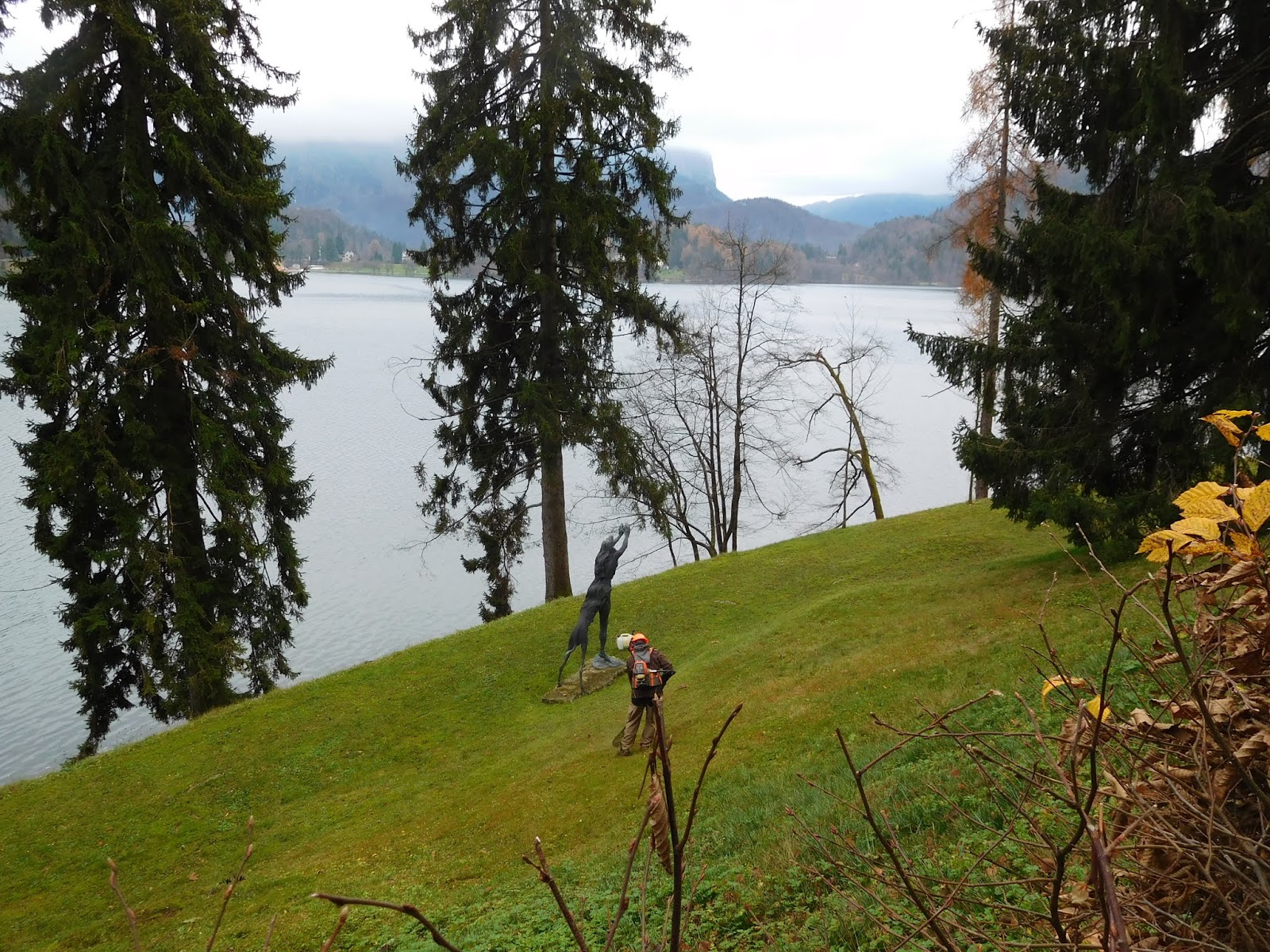
As in Ljubljana, it was expected that we'd be dodging patches of rain throughout the weekend. Luckily most of the precipitation came at night. With the Saturday morning forecast cool and cloudy with little chance of rain, we decided to circumnavigate the lake, a four-mile walk. It was a rewarding hike.

Here are highlights, beginning on the north side of the lake and returning via the south shore.


The next few photos are of the Tito's villa, Vila Bled (now a hotel) and the immediate vicinity.


---


After Saturday's walk we enjoyed a bite at the Christmas market and purchased supplies for sandwiches to eat later in the evening. We'd booked time in the evening at the hotel's spa, which includes hot tubs and saunas. It was a fine, steamy way to wind down from a long, rewarding day.

Next, the Christmas market at Bled.

Thursday, November 28, 2019

Baylor Family Croatia, Slovenia and Trieste 2019, Chapter 8: Weird circular Yugoslav garage architecture and an invigorating walk by the river.


Wednesday had ended with a tour at the Pivovarna (brewer) Union.

At sunup on Thursday, something strange happened because the sun actually came out. It did so again several times during the day, although we were destined to glimpse only a few patches of truly blue sky until arriving in Trieste.

Our chosen sleeping spot, the Hotel Park, refers to itself as the "most urban and green hotel in the centre of Ljubljana," and this description seems fairly accurate. We enjoyed it.

View from the hotel
window on Thursday afternoon.

It's an extensively remodeled late 1960s-era Yugoslav high rise in the middle of a regular neighborhood, quiet and well-situated near the epicenter of town, as well as only a short distance from the railroad station. As already noted, the hotel restaurant is quite good. In addition to a menu of Slovenian standards, there's an entire selection of Indian food. It turns out the chef is from the subcontinent.


With the weather finally clearing, we resolved to spend a casual day walking, resting and snacking while deciding where to partake of Thanksgiving dinner. This brought us back to Slovenska hiša, this time for breakfast.

Nice eggs.


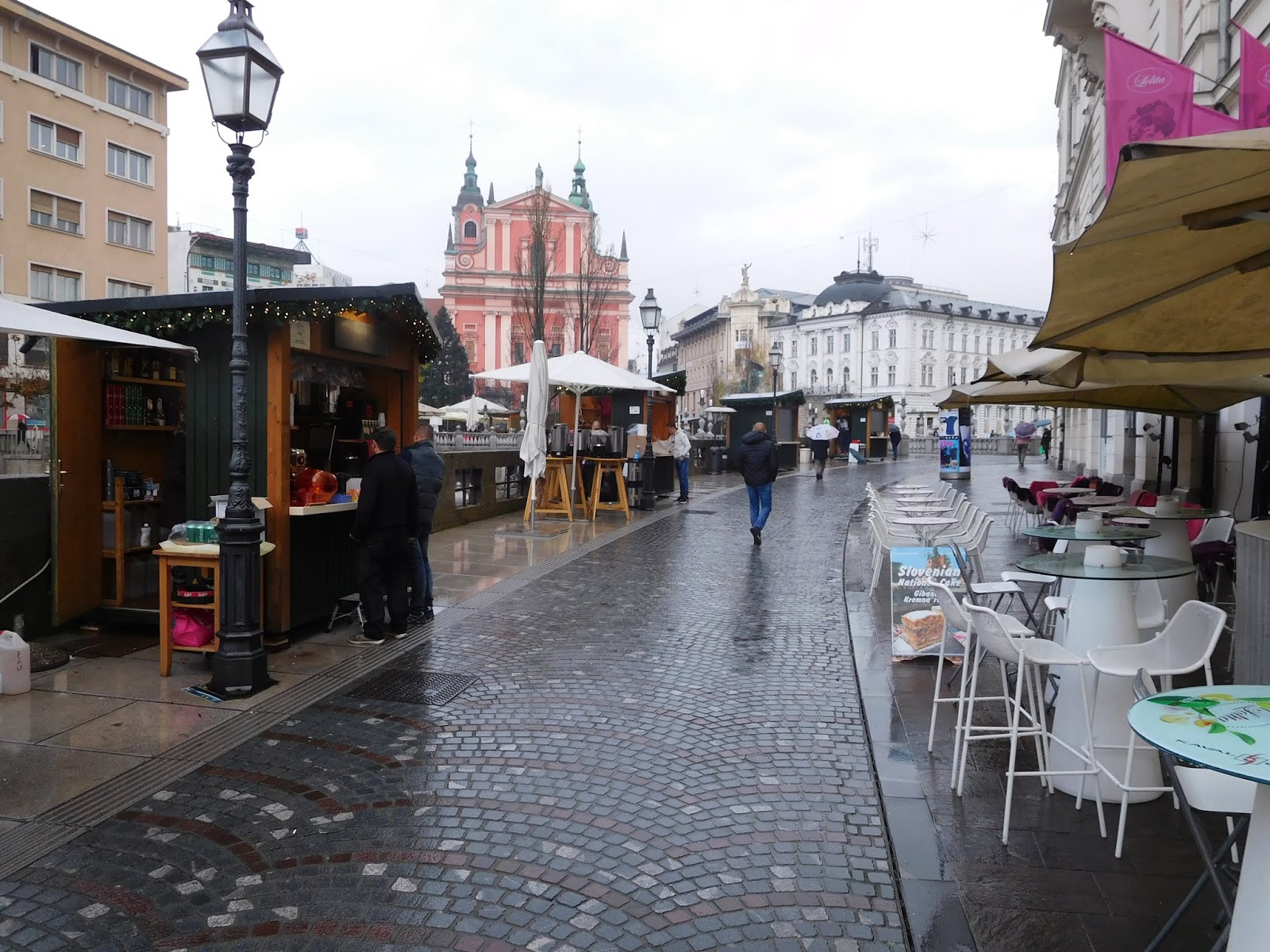
We began our stroll in the old town below the castle, by the market, river and downtown shopping streets.


See the knives and forks?


Then had a morning coffee.


The underground bins are one component of a comprehensive municipal commitment to reducing waste. Learn more at The Guardian: From no recycling to zero waste: how Ljubljana rethought its rubbish.

The longer 25-minute walk riverside walk then began.


Now about that strange double circular structure. It is a parking garage, not a place of residence.


It was confusing at first sight, as it's not easy to see actual automobiles without looking closely. Rather, the individual spaces have all manner of stored items stacked near the windows. Consequently the notion of "parking garage" in this sense seems more about replicating one's home garage rather than temporary hourly or even longer term parking.

TGH-48 Car Park
Garažna hiša TGH-48

Architect: Savin Sever
Address: Ambrožev trg 4, Ljubljana, Slovenia
Completion: 1969

Here the problem of parking in the city was solved with the extremely efficient use of space. Sever developed a system whereby the number of car parking spaces could optionally be increased by adding new stories. The only limitation on adding the stories is the height of the stairways and length of the vehicle access. The two-way traffic system, internal communications, and spacious parking spaces allow safe and simple parking.

I was fascinated by these nearby structures under repair, which turn out to a former sugar refinery dating to 1834 called the Cukrarna.


Our original walking destination was a second-hand shop, which offered this old radio among numerous other trinkets.


By the time we found the shop, the scene had turned almost suburban.


Returning to the city center, we ambled past houses, a hospital and an old industrial space subdivided into art studios, performance venues and a skate park.


For my pal Roz.


A late lunch followed, just salads and drinks. LOO-BLAH-NAH is a local craft brewery; I had a pale ale as well as an IPA, both solid. Diana's choice was rum tea.


Passing through the market again to buy souvenirs, we smelled a stall: fresh kraut.


Nearby is the place that sells wine and fish.


And always another castle view.


After a siesta, Thanksgiving dinner in Slovenia.