Showing posts with label The Breakwater (Coyle site). Show all posts

Thursday, June 18, 2020

A new relocation destination for 8th Street Pizza: Breakwater.


Get the lowdown on 8th Street Pizza at Facebook, and observe the above post earlier today. As of last year, 8th Street Pizza was to have relocated (that's right, from 8th Street) to 141 E. Main.


Homelessness, 8th Street Pizza's move, Clean Socks Hope's mission and an addendum by Exit 0.


However, the building fell through for undisclosed reasons, and now it appears the pizzeria is headed for the short-lived Bliss Artisan retail space at the Breakwater residential development.


From December 28, 2019.

Sadly, Bliss Artisan is closed. The franchise lasted ten months at The Breakwater.

Saturday, April 11, 2020

"Now That's What I Call (Fast Casual) Architecture."


Wait, do you mean the Break Wind Lofts at Duggins Flats wasn't an original and innovative design?


My faith in Flaherty and Collins is crushed -- crushed, I tell you.


Facebook photo credit to Dank Lloyd Wright -- thanks, Clint.


By the way, whatever happened with the Break Wind Subway Station?

August 10, 2016: "Big Dig secret revealed as Mayor Jeff Gahan presents ... the Break Wind Subway Station."


In the absence of the local chain newspaper, we turn to Loueyville media for excerpts from this breaking story.

 ... David Duggins, the city's Millennial Enfluffment Director (MED), told Busyness First that all due credit for the innovative Break Wind Subway Station goes to Mayor Jeff Gahan.

"Obviously, we have no subway in New Albany," said Duggins.

"I mean, an actual subway is your basic pie in the sky mass transit crappola, but the genius of Jeff Gahan is that he instinctively understands what millennials crave, which is the appearance of luxury without anyone's brains getting hurt trying to figure out how those validation machines work."

According to Duggins, the functionality of the Break Wind Subway Station is that it won't be connected to anything, but will serve as a mere symbol of the unattainable for those high-rolling hipsters expected to inhabit the highest-priced apartments in town.

"It's like our city-wide sharrows project," said Duggins. "We paint symbols on the street and declare victory. The intended users have such short attention spans that they never realize none of it leads anywhere or means anything."

"The Break Wind Subway Station serves the same purpose. It's an imaginary quality of life bonus, and it makes me proud to serve a mayor with vision of this magnitude."

Concluded Duggins, "Besides, shit like this is way easy to TIF."

There'll now be a city-wide contest to create a design for the imaginary Break Wind Subway Station signage. The contest will be restricted to whichever graphic artists are hanging out at Quills when Duggins stops in for his latte.

A few of the entries are pictured here ...


 ... along with the winning entry.

Saturday, December 28, 2019

Sadly, Bliss Artisan is closed. The franchise lasted ten months at The Breakwater.


Bliss Artisan opened in January 2019. At some point by November's ending, so was Bliss.

Bliss Artisan Ice Cream & Handcrafted Pizza is to occupy the long vacant Breakwater retail space.


I have little to say; this closing seems to have escaped notice, and I thought it should be noted. As for whether it "means" anything, my hunch is the terms of the lease might tell us a lot. This isn't a good space for a business like this, at least in my estimation.

Martini bar, anyone?

Saturday, March 09, 2019

The Jeff Gahan Money Machine, Part 10: Oh Cripe! Or, the path from Al "Indy" Oak's company PAC leads to Silver Street Park and Breakwater, and probably others.


Previously: The Jeff Gahan Money Machine, Part 9: These west end properties and their ultimate redevelopment surely comprise a rich, albeit tangled, source of campaign finance extractions for our Genius of the Flood Plain.

Some people grow turnips, but during the coming weeks we'll be plucking highlights from eight years of the Committee to Elect Gahan's CFA-4 campaign finance reports. Strap in, folks -- and don't forget those air(head) sickness bags.

Back in June of 2017, we examined the "wet your beak" mob idiom and the shady arena of bond fees: SHANE'S EXCELLENT NEW WORDS: Lawyers, guns, bond issue beak wetting and how Dean Martin anticipated the Mighty Trumpolini.

This blog holds that when it comes to a wetting of beaks, the thirsts being slaked are far more commonly attached to perfectly upstanding citizens (in appearance), who operate according to perfectly legal mechanisms instituted precisely to facilitate a wetting of beaks. It doesn't rule out extortion, but it accepts a level of built-in remuneration not always obvious to Joe Sixpack.

The purpose of the current series is to illustrate that Mayor Jeff Gahan, via his campaign finance vacuum, has been merrily wetting his beak from many of the big dollar projects Team Gahan has initiated since 2012.

While construction itself tends to be subject to competitive bidding, a whole class of design, planning, engineering, architectural, legal and consultation work can be assigned without competitive bidding -- most often by appointed boards, most conspicuously the Board of Works and the Redevelopment Commission.

The same names pop up again and again ... and the deeper you dig, the greater the number of connections between them. As an example, since Gahan's first mayoral campaign in 2011 he has pocketed a crisp, even $10,000 from something called Citizens for Excellence in Government.

2011 ... 500
2013 ... 1,000
2014 ... 3,500
2015 ... 2,000
2016 ... 1,000
2017 ... 2,000
Total ... $10,000

At first it was listed on Gahan's CFA-4 "tip of the iceberg" form as an "other organization," but since 2011 it's been properly filed under Political Action Committee. The state of Indiana concurs.


One might be forgiven for asking, "what sort ideological or single issue advocacy might this PAC be pursuing with its cash?'"

The apparent answer would be: Why, the ultimate ideology, corporate profit, seeing that the head honcho of the Citzens for Excellence in Government and the Cripe Architects firm is the very same guy, one Alex D. Oak.

Alex D. Oak, PE | Chairman & Chief Executive, Partner ... Al Oak joined the firm in the summer of 1972 as a land surveyor. Since then, he has served in just about every area of the firm. In 1992 he became Chief Executive Officer and, with that appointment, made some key strategic changes in the firm’s business and cultural model.

Can we assume that his free spending PAC has helped innovate, fertilizing these "business and cultural model changes?" My, my -- the beaks surely have gotten wet.

And the connection between Cripe, the Citizens for Excellence in Government PAC, Gahan's campaign cash reservoir and taxpayer funding of bright shiny objects?


That's right: Silver Street Park, the involvement of Cripe in which was partially covered in Part 4 of this series.

But that's not all!


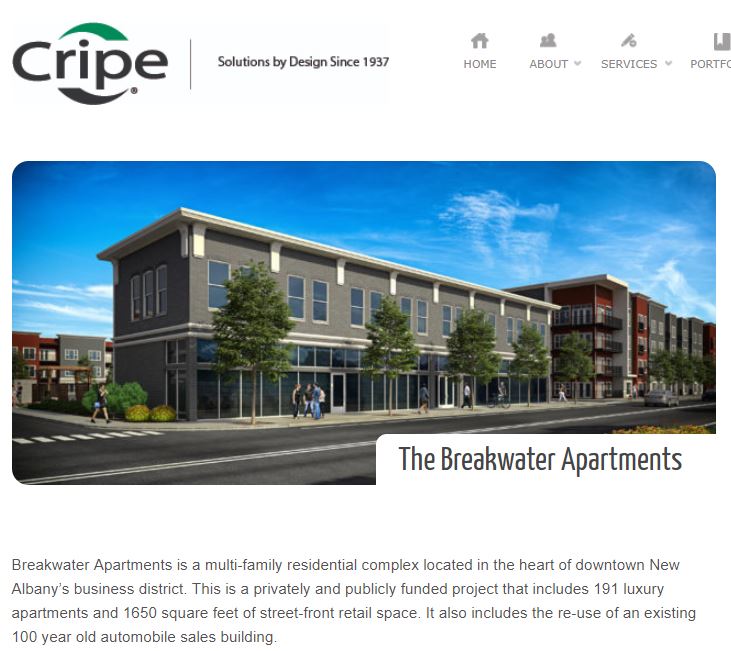
Yes, Cripe also was in bed with Flaherty-Collins on the Breakwater project. We've yet to consider Flaherty-Collins' contributions to Dear Leader's cash-engorged ego, so maybe that's coming next.

After a nice, restorative drink of beverage alcohol.

#FireGahan2019

Rebuttals are welcome and will be published unaltered -- so don't forget spellcheck. If you have supplementary information to offer about any of this, please let us know and we'll update the page. The preceding was gleaned entirely from public records, with the addresses of "individuals" removed.

Next: The Jeff Gahan Money Machine, Part 11: Lawyers from afar, expressing gratitude to Jeff Gahan for their billable hours -- and the curious case of Stan Robison.

Monday, February 18, 2019

"Cheap stick framing has led to a proliferation of blocky, forgettable mid-rises—and more than a few construction fires."


In a moment we'll learn why America’s new apartment buildings all look the same.

First, an aside.

One of our most indelible travel experiences in recent years came in 2016 when we visited Tallinn, the capital of Estonia. Only 30 years ago Estonia was a bedraggled Soviet republic, and once freed to pursue its own post-communist destiny the country has caught up to the times by thinking and acting ahead of the curve.

Today Estonia is a juxtaposition of history and modernity, no more so than in Tallinn, where citizens ride public transportation for free and vote on-line, and also can enjoy dinner atop a glass & steel skyscraper then walk a few blocks to the 14th-century old town for a nightcap.

We spent much of our time in the historic city center, marveling at structures still hale and hearty at age 700, then arrived back home to find construction underway atop the concrete foundations at the Breakwater amid mounds of pre-fab stick/toothpick/matchstick framing.

I'd known for a very long time that construction techniques in America differ from those glimpsed in Europe, fundamentally in the dichotomy of wood versus concrete, masonry and steel. In Tallinn there are numerous example of Soviet-built prefab apartment blocks, but instead of wooden "sticks," the standardized sections were made of concrete.

This time the visual evidence was right down the street from our house, deployed for a project obviously intended to last only a few decades -- or around the time the city's TIF subsidy bonds finally get paid off.

All the while I just kept thinking about those venerable buildings in Tallinn. I've heard good things about the living experience in Breakwater, and here in Anchor City that ship has sailed.

It is as it was intended. Must it be this way? I don't know.

Breakwater fire revisited: Exactly what are the potential dangers of "Toothpick Construction" techniques?

Breakwater, Break Wind: "We got to move these refrigerators, we gotta move these color TV's," or else we'll miss the thrill of public housing demolitions.

Fact-checking Deaf Gahan: He hasn't spent one penny of his own money to welcome another business to New Albany. Taxpayer-financed subsidies? Those are another matter entirely.

Awed throngs gather their headgear as the Toothpick Colossus of Duggins rises again, right there, across from the fire station.


This piece explains it all.

Why America’s New Apartment Buildings All Look the Same, by Justin Fox (Bloomberg)

Cheap stick framing has led to a proliferation of blocky, forgettable mid-rises—and more than a few construction fires.

These buildings are in almost every U.S. city. They range from three to seven stories tall and can stretch for blocks. They’re usually full of rental apartments, but they can also house college dorms, condominiums, hotels, or assisted-living facilities. Close to city centers, they tend toward a blocky, often colorful modernism; out in the suburbs, their architecture is more likely to feature peaked roofs and historical motifs. Their outer walls are covered with fiber cement, metal, stucco, or bricks.

They really are everywhere, I discovered on a cross-country drive last fall, and they’re going up fast. In 2017, 187,000 new housing units were completed in buildings of 50 units or more in the U.S., the most since the Census Bureau started keeping track in 1972. By my informal massaging of the data, well over half of those were in blocky mid-rises.

These structures’ proliferation is one of the most dramatic changes to the country’s built environment in decades. Yet when I started asking around about them, they didn’t seem to have a name. I encountered someone calling them “stumpies” in a website comment, but that sadly hasn’t caught on. It was only after a developer described the style to me as five-over-one—five stories of apartments over a ground-floor “podium” of parking and/or retail—that I was able to find some online discussion of the phenomenon.

The number of floors and the presence of a podium varies; the key unifying element, it turns out, is under the skin. They’re almost always made of softwood two-by-fours, or “stick,” in construction parlance, that have been nailed together in frames like those in suburban tract houses.

The method traces to 1830s Chicago, a boomtown with vast forests nearby ...

Friday, January 18, 2019

Fact-checking Deaf Gahan: He hasn't spent one penny of his own money to welcome another business to New Albany. Taxpayer-financed subsidies? Those are another matter entirely.


It's an election year, so take note of the lead sentence in the propaganda commissariat's latest blurb:


I'm sure he's sufficiently welcoming. After all, Gahan's not the one who paid for the sewer tap-in waivers he graciously awarded Flaherty and Collins in his capacity as sewer board president (that's a paid position, by the way) during the opening stages of the Breakwater development.

From January of 2017:

Flaherty and Collins apparently is offering to lease this (restaurant) space at the low bargain rate and provide something like $50,000 in cash for the build-out (the Green Mouse was told by the restaurateur that it wasn't enough of an enticement to interest him), but the dollars-per-square-foot price fairly skyrockets if the building's owner must finish the space.

Always be aware that as City Hall touts the many restaurants and bars downtown, as though it had anything whatever to do with their founding and operation -- and you can ask virtually any eatery owner to explain where the bulk of the start-up capital originates, this being with them, and not a magical bunkerside ATM -- the fact that the city subsidized the entirety of the Break Wind development means that the city also is subsidizing the eatery or bar that eventually comes to rest in the rough unfinished space. The city might as well be the one writing the check for $50K, right?

I'm not making this point owing to my antipathy for the current occupant, which is real, but rather because it's absolutely true. With Break Wind, the city's been picking winners with your money -- and is picking winners with your money the sort of thing you want Jeff Gahan doing?

Two years and an insurance fire have passed; Breakwater has residents, and now the restaurant space is to be filled. It's all good, or at least as good as it can be, because the same question awaits Gahan's attention -- and the next attempt he makes to answer it will be his first.

To what extent (if any) should City Hall subsidize private, for-profit development with an array of sewer tap-in waivers, tax abatements and other incentives -- enticements generally unavailable to smaller business entities, who must sink or swim by their own merits?

That's because it is perfectly legitimate to continue to ask questions about the applicability of taxpayer subsidies, the precedent of sewer tap-in waivers, the quality of construction techniques, the use of union versus non-union labor, the applicability of giveaways in the cause of "economic development" -- to name only a few issues.

The problem is Gahan is deaf.


8:39 p.m. update:

Given the money the City borrowed to help subsidize Breakwater and the 20-year TIF plan to pay it back, the development being two years old means only 18 more years to go before it contributes a single dime in property taxes to schools and the city general fund -- Jeff Gillenwater

#FireGahan2019

Thursday, September 27, 2018

Bliss Artisan Ice Cream & Handcrafted Pizza is to occupy the long vacant Breakwater retail space.

From the Bliss Artisan Fb page.

The retail space in the Breakwater has been blissfully moribund since the luxury housing complex was built, but now there's to be a tenant called Bliss Artisan.

The business bills itself as ice cream shop that also sells pizza, and began in New Harmony, although the original location went away once the owners began opening sites along the Ohio (Evansville, Tell City, Henderson) in an easterly direction.

This brings them to New Albany, and so perhaps the item of most importance hereabouts is the name "Bliss." It's just a name (a synonym for "utopia"), and not intended as a reference to the well-known Bliss family.

The Evansville Courier-Press provides a glowing overview: Bliss offers artisan ice cream with a side of pizza.

Thursday, June 07, 2018

Apartments above, vacant storefronts below. Why do commercial spaces in mixed use developments remain empty?

Now ... and forever?

Obviously, we have less of a problem with vacant commercial spaces in new developments because there are fewer of these sort of extravaganzas in New Albany than in larger cities.

Our civic tastes run to free-standing strip mine sites on formerly forested hilltops.

The perpetually vacant (though reasonably sized) corner commercial space located within the Break Wind Lofts at Duggins Flats was discussed here in January of 2017.

Two months ago, a local restaurateur told the Green Mouse that the unfinished potential eatery space in the former showroom actually is priced fairly -- for being unfinished.

Flaherty and Collins apparently is offering to lease this space at the low bargain rate and provide something like $50,000 in cash for the build-out (the Green Mouse was told by the restaurateur that it wasn't enough of an enticement to interest him), but the dollars-per-square-foot price fairly skyrockets if the building's owner must finish the space.

Always be aware that as City Hall touts the many restaurants and bars downtown, as though it had anything whatever to do with their founding and operation -- and you can ask virtually any eatery owner to explain where the bulk of the start-up capital originates, this being with them, and not a magical bunkerside ATM -- the fact that the city subsidized the entirety of the Break Wind development means that the city also is subsidizing the eatery or bar that eventually comes to rest in the rough unfinished space. The city might as well be the one writing the check for $50K, right?

I'm not making this point owing to my antipathy for the current occupant, which is real, but rather because it's absolutely true. With Break Wind, the city's been picking winners with your money -- and is picking winners with your money the sort of thing you want Jeff Gahan doing?

Rachel Quednau breaks it down in the article linked below.

The reason these (often) mandated retail spaces remain empty is because they're priced too high and sized too large for indies; cookie cutter developers with little interest in the real world apart from grabbing municipal abatements and incentives don't bother very much to consider what might actually work in these commercial spaces, and they're willing to sit on emptiness rather than put in the effort to learn.

Or: the polar opposite of the patience and pure acumen that our local developers (Resch, Chalfant, the Carters) have displayed over years of grassroots transformation.

And who gets the money? Faraway folks like Flaherty and Collins from Indianapolis -- then it comes back around to the mayor, which was the point from the very start.


It isn't rocket science after all.

What’s up with all those empty commercial storefronts in new mixed-use developments? by Rachel Quednau (Strong Towns)

Milwaukee, Wisconsin, where I live, is going through a massive building phase, with new construction popping up on every corner in and around our downtown and other popular neighborhoods. If you live in any number of mid-sized cities, this is probably a familiar story. And because recent trends in urban planning have encouraged a return to mixed-use developments, those sorts of buildings dominate the new construction landscape. It has resulted in some lovely new ground-level restaurants and shops emerging in areas that previously lacked much street life.

But here’s the more common picture: a cookie-cutter five story apartment building over a vacant commercial space. This image is probably also familiar to you if you live in one of those cities experiencing an urban growth spurt. One might expect this set-up to last a few months, perhaps, while the apartment units are in the process of being filled and the building manager seeks a commercial tenant. But in fact, in my city, it’s not unusual to see a commercial space sitting empty for months and sometimes years. There are buildings like this near my home and, while they may be a shade better than the derelict one-story structures or vacant lots that used to occupy the area, an empty space is an empty space. At the end of the day, a vacant storefront makes the whole street feel neglected and undesirable, and it isn’t fulfilling its purpose.

At first, the whole scene just didn’t make sense to me. What business owner wouldn’t want to move into a brand new space with freshly painted walls, new windows and a blank canvas to lay out in whatever way suited the needs of the business? Why were these storefronts sitting empty?

Tuesday, May 15, 2018

On Spring Street today by Breakwater, a bicyclist riding in a bike lane was hit by a driver.


A friend just wrote that her husband was riding his bike home from work this afternoon on Spring Street and was hit by a driver, who claimed to be "watching for cars, not bikes" while pulling into Spring from a side street.

It happened right in front of Breakwater.

The bicyclist, who was using the bike lane exactly like he should, suffered two cervical fractures in his neck.

And the driver?

Brain dead, but seriously, there'll probably be no other ramifications because there never are.

It's always an "accident" when a cyclist or walker is hit by a driver, isn't it?

When there's further information, I'll update this.


Sunday, November 19, 2017

The building pictured on that meme isn't fast-casual, penny-pinching, developer-driven architecture at all.


Above, I've refashioned a meme about "fast-casual architecture." Before linking you to an explanation of the visual, below is the actual meme. Recently it went viral.


What makes the meme relevant to New Albany? Our fast-casual Break Wind Lofts at Duggins Flats, that's what. Can an interim executive director of public housing afford one of those units?


Ironically, the structure pictured in the viral meme isn't faux luxury housing at all. Rather, it's low-income housing for seniors in a neighborhood of Seattle.

Here's the rest of the story.

The Story Behind the Housing Meme That Swept the Internet, by Kriston Capps (CityLab)

How a popular meme about neoliberal capitalism and fast-casual architecture owned itself.

The Providence Gamelin House opened its doors in Seattle in 2005. It was built to offer safe, affordable housing for low-income seniors in Seattle’s Rainier Vista neighborhood. To occupy any of the facility’s 77 units, residents must be ages 62 and older and earn below 50 percent of the area median income for King County in Washington. Most of them earn far below it: The average annual income for Gamelin House residents is $11,000.

For more than a decade this permanent supportive housing facility has served low-income residents of south Seattle. It’s their home. But the Providence Gamelin House only came into its own at the end of 2017, when an architectural rendering of the project was compelled into service as a meme. Specifically, as a housing meme, which is its own bucket for signifiers of our slide into late capitalism.

The meme surfaced wherever memes surface and spread however memes spread—idk. Eventually it found its way to the desk of Timothy Zaricznyj, director of housing for Providence Supportive Housing, the person who now oversees this alleged gentrification nightmare. (In fact, he manages 16 affordable-housing developments in Washington, Oregon, and California.) Zaricznyj was not exactly tickled. “They chose the wrong project, if they want to slam developers,” he says ...

 ... The fact that this meme depicts modest affordable housing—not penny-pinching, developer-driven Fast-Casual architecture—even inspired a meta-meme backlash ...

 ... The original meme is a vague critique of “architecture by bean-counters” (of which Seattle does not lack for examples) and developers’ thirst for transitional neighborhoods. The Gamelin House was the work of Michael Fancher, an architect who designed affordable housing across the Pacific Northwest in the 1980s and ‘90s. But don’t blame Fancher: Affordable housing is subject to severe restrictions and even worse funding shortfalls.

Tuesday, October 24, 2017

Those drab "luxury" condos and apartments? "Policymakers, pretty much across the board, don't value design."


I'm just trying to figure out why The Breakwater Lofts at Duggins Flats gets an exemption from the street spam ordinance.

Those 'Luxury' Condos Look A Little Drab (WBUR)

In cities like Seattle, Boston, Denver and Charlotte, new "luxury" condos and apartment buildings are going up to meet demand for new housing. But many of these buildings look like simple, plain boxes.

Here & Now’s Jeremy Hobson talks with architecture critic and author Sarah Williams Goldhagen (@SarahWGoldhagen) about what makes these buildings "poor," "boring" architecture, and how monotonous architecture actually negatively affects us.

On why there are so many of these kinds of buildings being built

"There are a lot of different reasons for it. If you separate it out into supply and demand, one is that that's what's being built, so that's what's cheap to build, because the wheels are greased for that kind of architecture. Buy in bulk. That's what the market has been giving and so it's easy to give that. The second reason is that there's a general point of view, both among real estate developers, who are building these buildings, and among clients who are buying these buildings, that good design ... is an unaffordable luxury. And we know two things now: one, it's not unaffordable. It costs just as much to build a well-designed building as a poorly designed building. And neither is it a luxury because the research is clearly showing that people actually respond very poorly to those bad buildings.

Tuesday, September 05, 2017

Grid Control, Volume 25: If Breakwater's overflow parking has been "donated" by AT&T, why weren't crosswalks installed for residents to access it?


I'll keep this one brief.

Looking back to September 1, 2015, we find city officials answering prospective Breakwater parking concerns. The critical passage is underlined.


New Albany apartments receive zoning approval, by Daniel Suddeath (Free pass for DNA Digest)

Project cost now up to $26 million

 ... New Albany Planning Director Scott Wood acknowledged there will likely be a "battle" for on-street parking, but added that's a concern Flaherty and Collins will have to address if it becomes a problem.

Residents moving into a higher market-rate facility will expect adequate parking, and if it's not provided, the apartment owner will hear about it, Wood continued.

"It's going to regulate itself," he said.

He added the apartments constructed adjacent to Sam Peden Community Park were also approved with a parking unit ration of just more than one-to-one per unit, and that the proposed development downtown is in a more pedestrian-friendly environment.

AT&T, which has a location across from the development, donated a 24-space lot to the city to be utilizes specifically for the development.

Flaherty and Collins — which had initially announced a $16 million project before additional features were added bringing the cost to $26 million — also has plans for a 1,600 square foot retail space on the site.

It will likely be occupied by a coffee shop or small restaurant, and would only require eight spaces under city ordinance, representatives with the development team said.

The New Albany City Council approved in July a financing package that will allow Flaherty and Collins to payoff up to $4.9 million in debt for the development utilizing tax dollars earned through the project. The developer will be allowed to use tax-increment financing, or TIF, funds raised through the increased property values from the site to pay back the debt.

The New Albany Redevelopment Commission voted to include the Coyle property in a TIF district prior to the bond vote by the council.

So, if Breakwater residents park across Spring Street amid one of the most poorly maintained corporate structures in the city, the most direct path to their cars does not involve walking one or two blocks east or west, then doubling back, but heading right across the street -- a street recently rebuilt without crosswalks in this spot.

But didn't we just vanquish one-way streets for the stated purpose (among others) of eliminating unnecessary "round the block" trips for drivers?

What about walkers?

Moreover, shouldn't the stop light (or four-way stop) be at 8th Street, not 7th, and shouldn't there be an "enhanced" (hint: enforced) crosswalk opposite Breakwater?

Mark my words: two-way calming effects aside, vehicular speed once again will become an issue on Spring Street from 15th to 7th, and from 7th to 4th, and as high speeds pertains to the latter, it will be on a stretch of street running between 200 - 300 apartment residents and the most direct route both to parking and downtown amenities.

It makes very little sense, though it probably testifies to Jeff Gahan's befuddled desire to do the impossible by making the city walkable without inconveniencing drivers.

---

Previously:

Grid Control, Vol. 24: Deliver me this.


Grid Control, Vol. 23: City's fuddy-duddies losing their minds as the debut for a two-way Spring Street is pegged at August 29.

Grid Control, Vol. 22: City engineer Larry Summers answers our questions about intersection striping errors and the "No Trucks" sign removal.


Grid Control, Vol. 21: Murderous intersection at Spring & 10th to be repaved and restriped -- and, the hocus-pocus with a disappearing "No Trucks" sign at Spring & Vincennes.


Grid Control, Vol. 20: As Team Gahan dawdles, another bicyclist is crushed into mincemeat at 10th & Spring's dangerous dogleg.


Grid Control, Vol. 19: In a positive move, HWC begins righting the wrong cross hatching on Spring Street.


Grid Control, Vol. 18: Finally a few BoW street grid project answers, almost all of them citing "contractor error."

Grid Control, Vol. 17: Judging by the misdirection of this "CROSS TRAFFIC DOES NOT STOP" sign, we now reside in the British Empire.


Grid Control, Vol. 16: What about HWC's cross hatching correction? Will this be finished before or after Team Gahan declares victory?


Grid Control, Vol. 15: Dooring enhancement perfectly epitomizes Deaf Gahan's "biking last" approach to grid modernization.

Grid Control, Vol. 14: Yes, you can still park on the south side of Spring Street during the stalled two-way grid project.

Grid Control, Vol. 13: "Dear Deaf Gahan and minions: FOR THE LOVE OF PETE, STOP TRYING TO BE COOL AND DESIGNER-ISH. YOU'RE NOT, AND IT'S EMBARRASSING ALL OF US."


Grid Control, Vol. 12: Meet the artistic crosswalk design equivalent of dogs playing poker.

Grid Control, Vol. 11: HWC Engineering meets with St. Marks, city officials nowhere to be found.

Grid Control, Vol. 10: City officials predictably AWOL as HWC Engineering falls on its sword over striping errors.

Grid Control, Vol. 9: "This was supposed to be discussed with us," but Dear Leader doesn't ever discuss, does he?


Grid Control, Vol. 8: City Hall characteristically mum as HWC Engineering at least tries to answer the cross-hatching question.


Grid Control, Vol. 7: What will the Board of Works do to rectify HWC's striping errors on the north side of Spring Street, apart from microwaving another round of sausage biscuits?


Grid Control, Vol. 6: Jeff Speck tweets about NA's grid changes, and those missed bicycling opportunities.


Grid Control, Vol. 5: Egg on HWC Engineering's well-compensated face as it botches Spring Street's westbound bike buffer cross hatching.


Grid Control, Vol. 4: But this actually isn't a bus lane, is it?


Grid Control, Vol. 3: TARC's taking your curbside church parking, says City Hall.


Grid Control, Vol. 2: Southsiders get six more parking inches, but you gotta love those 10-foot traffic lanes on Spring.


Grid Control, Vol. 1: You people drive so freaking horribly that someone's going to die at Spring and 10th.


Friday, August 04, 2017

Gahan could have told Moore how to handle these pesky sewer-tap-in waiver requests.


Jeff Gahan and Mike Moore have something in common, as both mayors inhabit the chieftains's chair at their own sewer boards, self-appointed and salaried.

In Jeffersonville, Emperor Mayor Moore is being asked for a dispensation.

New Hope in Jeffersonville asks for city sewer credits, by Elizabeth Beilman (Hanson's Folly)

JEFFERSONVILLE — A local nonprofit organization building affordable housing is asking Jeffersonville officials to credit its sewer fees.

New Hope Services Inc., which is in the middle of building M. Fine on Spring Street, made its request at a city sewer board meeting on Thursday.

Moore is having none of it.

But Mayor Mike Moore, president of the sewer board, didn't seem open to changing the terms of the agreement.

"I wouldn't expect because of policy changes, months after you and I have reached an agreement, I'm not going to go back and start changing all old contracts because the city's changed directions," Moore said.

Surely Moore would have benefited from texting Gahan for the wording of Dear Leader's 1st Commandment of sewage-based subsidies:

NO SEWER TAP-IN WAIVERS EVER UNDER ANY CIRCUMSTANCES UNLESS IT'S LUXURY HOUSING, AWARDED TO DEVELOPERS WHO DON'T NEED THEM.

Lesson: Focus on luxury at the expense of affordability, Mike.

You're a Republican, for chrissakes, and can do this sort of thing without being a hypocrite.

Wednesday, July 26, 2017

The posh luxuriousness of City Hall subsidies, or Fox News and DNA at The Breakwater.


Fox News in the uninhabited Breakwater community space at 9:00 p.m. on Tuesday, July 25. A fusion of hirsute Neo-Hipster veneer shadings with Empty Nester faux chic. Relevant, exciting.

Sadly, the best idea David Duggins ever had lies over there, cold and shivering on the cutting room floor. New Albany badly needs Bocce Ball! Yes, but maybe Dugout was just biding his time, awaiting his transfer at NAHA so that now, a playing field can be installed where the poor people used to live.

As Bluegill observes:

The perennial problem with trying to do half-assed "modern" architecture on the cheap is that it almost always ends up looking just like half-assed "modern" architecture done on the cheap. We now have a big, ugly building that won't age well where most people can't afford to live anyway. Per Reaganomic dreams of the city, we have arrived.

Speaking of Breakwater, Develop New Albany's next networking function will be held in the very same space as the Fox News telecast depicted above. In fact, we are urged to Make Networking Great Again.


But there's even more.

Mayor Jeff Gahan Presents: A special drawing for 100 lbs of cured and rendered TIF Sausage AND a free sewer tap-in waiver! (see full drawing rules below)

(Corporate clients only; zip code must be outside the 47150; pre-approval by Warren Nash is necessary. Certain other restrictions apply. Republicans, public housing residents, John Gonder, Diane Benedeti and staffers of NA Confidential as well as their families past, present or future are ineligible for this drawing)


It reminds me of my conversation with a DNA stalwart.

Me: Your organization isn't helping matters very much.

Him: We're fine the way we are, and I'm tired of people like you criticizing us.

Me: I only do it because your organization isn't helping matters very much.

Him: Well, stop criticizing and join the organization, so as to achieve change from within.

Me: How likely is "change" if you think your organization is fine, and you and the others aren't leaving it?

Him: The Cubs are back in first place!

See you in the funny papers ... though probably not at the Breakwater networking event.

Suits just give me the chills.