Showing posts with label Beer with a Socialist. Show all posts

Wednesday, October 21, 2020

BEER WITH A SOCIALIST: Welcome to 12 days of a beer world that utterly baffles me.

Last week a friend gave me a bottle of Vienna-style lager from KC Bier Co, a brewery in Kansas City. It's a classic European style, underappreciated and too seldom brewed, as well as delicious. Shortly thereafter I bought a six-pack of Bell's Kalamazoo Stout, the label of which clearly states that the recipe is the original, from 1988. It was absolutely beautiful in its unadorned simplicity. 
 
Yep; tasting is entirely subjective, and it isn't necessary for us to agree. Furthermore, I'm not interested in being the old man with clenched fist railing against creativity. It's your money. Nothing against Rochester Mills; haven't been there, and know no one involved. I hope they make a mint, as opposed to infusing a milkshake stout with it. 

This said, I can think of nothing about twelve variously flavored milkshake stouts that speaks to me. So be it, and we move on. 

By the way, how'd that Red Velvet get in there?  

  • Peanut Buttercup Milkshake Stout
  • Imperial Milkshake Stout
  • King Cake Milkshake Stout
  • English Toffee Milkshake Stout
  • Imperial Java (Coffee) Milkshake Stout
  • Michigan Maple Milkshake Stout
  • Gingerbread Cookie Milkshake Stout
  • Chocolate Chip Pancake Milkshake Stout
  • Imperial Triple Layer Decadence Milkshake Stout
  • Red Velvet Ale
  • Double Chocolate Milkshake Stout (Revised Recipe with More Chocolate)
  • Salted Caramel Milkshake Stout
The full press release is here:
 

AUBURN HILLS, Mich. – Craft beer lovers in Michigan, Ohio and Indiana can begin their Holiday shopping and celebrations early with the return of the Twelve Days of Milkshake Stout. Given the popularity and growing consumer demand for this variety pack of beers, Rochester Mills will release their limited holiday edition 12-pack on November 1 online for pick-up at the Production Brewery Taproom in Auburn Hills and at “Better Beer Stores” across their distribution territory. The sampler pack features one, 16 oz. can of each beer in this year’s Twelve-Days of Milkshake Stout draft promotion.

“What began as a crazy idea to take twelve different versions of our Milkshake Stout to twelve bars over twelve days a few years back has grown into a holiday tradition,” said Rochester Mills Marketing Director David Youngman. “It’s the perfect gift for stout lovers, already wrapped and ready to go. Containing one pint of each variant allows you to share and compare with friends or horde for personal enjoyment.”

The Rochester Mills Taproom in Auburn Hills will join more than twenty-five other select premium craft beer bars and restaurants throughout Michigan, Ohio, and Indiana as host locations for the progressive tap takeover event beginning the first week of November. Admission is free and open to the public, ages 21 and up. The progressive tap takeover event will feature the (12) twelve specialty and limited-edition varieties of Milkshake Stout, Rochester Mills’ flagship beer. Each week, beginning the first week of November, two new beers will be tapped and stay on draft until the kegs run dry.

Sunday, July 05, 2020

BEER WITH A SOCIALIST: Believe it or not, "Drunk people can't socially distance."


Yep, it takes a pandemic to grasp that drunks slobber, hug each other, start fights and behave abominably. Been there, seen that. To be honest, done that, myself.

If bars elect to pack them in as though the past six months haven't even happened, we can expect more of the same. It's happening everywhere right now. My loyalty to the food and drink business precludes me from calling out anyone; it's just personal with me now, and there are places I'll likely not go for a very long time into the future.

My main question about the reopening of pubs in the UK is how hard it's been for those still specializing in real ale to prepare when the actual reopening dates have changed. 

No one thinks about living beer during a pandemic, do they?

'Crystal clear' drunk people can't socially distance, say police in England in The Guardian

Police Federation chair says revellers would not adhere to one-metre-plus rules as pubs opened on Saturday

Drunk people are unable to properly socially distance, the chairman of the Police Federation has said as pubs reopened in England for the first time since lockdown.

John Apter said it was “crystal clear” revellers would not adhere to the one metre plus rule as restrictions were eased on Saturday.

Prof Chris Whitty said the pandemic “is a long way from gone” and urged the public to follow social-distancing rules as pubs and restaurants reopened.

But images from London’s Soho showed packed streets into the early hours of Sunday ...

Tuesday, June 09, 2020

BEER WITH A SOCIALIST: I suppose even the racists, fascists and bad actors need their own craft brewery.


Among other things, COVID-19 has proven to be the most effective (albeit inadvertent) truth serum of my lifetime.

The virus is especially effective at targeting and exploiting pre-existing conditions -- in the sense of an individual's physical health, but moreover, the mores and "mental" (British usage) condition of our society overall.

Consequently, given that the American brewing business at all levels, whether macro or craft, always has been (shall we say) "diverse" socially and politically, the coronavirus has made it easier than ever before to see whether your personal system of values is compatible with the brewery (or restaurant, cafe, diner, food truck, espresso stall or weenie stand) you patronize.

The equation need not be restricted to COVID, although it exposed more than a few local operators of the narcissistic anti-science persuasion. The truth serum extends to realities like Black Lives Matter, too.

Lots of folks have operated from the assumption that "craft" beer is left/liberal/progressive matter. They've been mistaken. It's never been quite that simple, and nor should we expect it to be. 

The Steam Hollow Brewing situation in the aftermath of George Floyd's murder has been a staple of the Twitter feed these past few days. Rather than attempt a summary in this space, allow me to redirect you to a site called Absolute Beer, where the story is told clearly and comprehensively.

As a side note, the owners having scrubbed their social media presence, it's not possible to check if they were science doubters during the COVID "lockdown" period. 

Steam Hollow Brewing Faces Backlash for Claiming George Floyd Murder was a Hoax

While millions of people around the country continue to mourn and speak out against last week’s police murder of Minneapolis resident George Floyd, systemic racism, and police brutality, one brewery in Illinois has taken a particularly controversial stance.


Natalie White, the co-owner of Steam Hollow Brewing, based in the small town of Manteno, stated on her Facebook page: “George Floyd isn’t dead, he is a porn star/actor who knows the officer, who isn’t even a real officer. Wake the f up.”

Wednesday, May 27, 2020

BEER WITH A SOCIALIST: Social distancing and the single drinker.


A very timely reminder: For the past 40 years I've always tried my best, at all times and twice on Sunday, to keep at least 6 feet away from the nearest Miller Lite.

The pandemic has strengthened my resolve.

---

Let's begin with some bad news.

Farewell for now to a golden age of drinking, by Schumpeter (The Economist)

The pandemic has hurt the booze business

... Lockdown and its aftermath leaves craft firms most exposed. Some have been bought by industry giants; abi now owns Goose Island and Camden Town Brewery. But many still sell from their own small premises, making it harder to attract social-distancing customers. Even in good times many barely covered their costs. Being small, they have less leverage to force their wares onto supermarket shelves. Some will either be sold or sluiced down the drain. Inevitably, the industry will lose some of its creative fizz.

In addition, two longer-term threats loom on the horizon: demography and drugs. Studies show that Generation z, the eldest of whom have recently reached drinking age, are far less likely to consume alcohol than their elders, says Javier Gonzalez Lastra of Berenberg, a bank. That will affect the drinks industry for years to come, because peak alcohol consumption has traditionally been between the ages of 18 and 34. Partly as a result, in America, historically the world’s biggest drinks market, total alcohol sales volumes have declined for three years in a row. Overlapping with youthful sobriety is cannabis use. A report co-written by iwsr last year found that this was an emerging alternative to booze among the young. Millennials in America accounted for almost half of “dualists”, who both smoke pot and imbibe. Covid-19 could benefit cannabis further. In Schumpeter’s limited experience, pot-smoking has always been something of a furtive activity. That may make it better suited to social distancing than clinking glasses in a pub.

The good news is that a great awakening of regulatory experimentation allowed to survive pandemic states of emergency would help keep us in the game.

Hip Hops: Public drinking -- and changing “stupid American liquor laws”

Rules and regulations are inevitable in any business or profession, but the ones pertaining to beverage alcohol often are a more impenetrable thicket than most, multiplied 50 times for each state in the union, compounded by additional layers of local blue laws, and seemingly imposed for the very purpose of denying that the repeal of Prohibition ever took place.

In the same article there's a list of Louisville area breweries and their current opening status.

Food & Dining Magazine’s "Hip Hops" column is devoted to the beer beat, and an essential component for the health and well being of any city’s beer scene is its core of local breweries. In the broadest of terms, the pandemic has been kind to Louisville’s breweries. Many of ours never closed entirely during the pandemic, and others have reopened.

Here’s a status list with the (incomplete) lowdown, as assembled Sunday afternoon in the company of a tankard of Falls City Bock — and then another, after the first.

Tuesday, May 19, 2020

BEER WITH A SOCIALIST: A belated farewell to Brian O'Donnell.


Three bullet points to begin the week ...

Leading off, I'm six months late to the news, but it's better than not knowing at all. A few days back a weird urge struck me to do a Google search, and I learned that Brian O'Donnell, esteemed owner of the Hi-B (Hibernian) Bar in Cork, Ireland, died last December. I wrote an appreciation at Food & Dining Magazine.

Hip Hops: Brian’s song will play forever more at the Hi-B Bar in Cork

When O’Donnell died last December, the Irish Examiner’s eulogy by Dan Buckley painted a picture of curmudgeonly eccentricity, undoubted erudition and sheer longevity; O’Donnell’s parents had owned the bar since 1924 when he took it over in the early 1960s, and his wife and daughter continued the family tradition when age and ill health compelled him to retire.

O'Donnell was well into his 80s, although his actual date of birth seems not to have been revealed anywhere. It's genuinely true: they don't make 'em like him any longer, and that's too bad.

Every modern theory on hospitality management of which I'm aware frowns on throwing a customer's mobile phone out the open window or banning visitors for chewing gum.

And no, I never consciously modeled my own career as publican (1990 - 2015) on O'Donnell's mindset. He and I met only twice, maybe three times, on those very occasions from 1987 when visiting Cork. However, he struck up a friendship with my cousin. I'd have enjoyed sitting in the corner and listening as they debated politics and sang operatic arias together.

Rest in power, Brian O'Donnell.


Today's second item concerns draft Dogfish Head SeaQuench Ale, which will be sold at Pints&union by the growler starting tomorrow (May 20). SeaQuench is a very new-school way of thinking about formulating a beer, but incorporates old-school styles from Germany in route to urging margarita cocktail lovers to try it. I wrote about SeaQuench at the Pints&union website. Each day this week I'll be adding a short refresher about the draft beers we currently are pouring into growlers for take-away. 

Finally, from yesterday:

One thousand times this: "American liquor laws are pretty stupid. And the COVID-19 pandemic gives us a once in a century chance to change them."


I am delighted, thrilled and hopeful to see these many recent media references to the post-lockdown period as a propitious time to reassess American society's attitudes toward a panoply of head-scratching alcoholic beverage laws.

It's time to get these conversations started.


Wednesday, May 13, 2020

BEER WITH A SOCIALIST: What is a "bar" and what is not; who can open now, and who must wait?

The Frozen Weenie Chronicles of 2014.

Last week my friend Jeff at Riverside Cigars/Match Cigar Bar in Jeffersonville posted a conundrum at this Facebook page.

So, Governor Holcolm says:

Restaurants and bars that serve food may open (on May 11) at 50% capacity with operational limitations. Bar seating will be closed with no live entertainment. Servers and kitchen staff must wear face coverings

But ATC (Alcohol & Tobacco Commission) says:

A business that merely meets the minimum food requirements outlined in 905 IAC 1-20-1 of having hot soups, hot sandwiches, coffee, soft drinks, and milk available does not qualify to open for on-premises sales during stage 2.

So, I have a question. Since when does "meeting requirements" mean one "does not qualify"? Their words, not mine!

The answer: Whenever the ATC says it does -- or doesn't.

However, in fairness to the ATC, if making sense of the laws handed by legislators to the agency is confusing during non-pandemic times, it can only be more impenetrable when some rules have been suspended, others have not, and there exists no real road map for wandering through the maze.

According to the governor's Back on Track economic reopening plan, bars without full food service cannot reopen until Stage 4, which lands on June 14th.

The ATC's official clarification can be found here.

May 8, 2020: Frequently Asked Questions on EO 20-26, Roadmap to Reopen Indiana

  1. What is a “bar area”? The bar area for the purposes of Executive order 20-26 is the counter over which drinks are served. During Stage 2, this area should be for employees only. Chairs should be removed or marked as unavailable. Ordering, serving, and consuming food and drinks for on-premises consumption is prohibited in this area. To the extent that this area is being used for ordering and serving of carryout food orders, a business may continue to do this while following the CDC guidelines.
  2. What is a bar or tavern that must remain closed under Paragraph 10. e. during Stage 2? A bar or tavern is a premises that prohibits the entry of anyone under the age of twenty-one and is not in the business of providing in-person full dining service. A business that merely meets the minimum food requirements outlined in 905 IAC 1-20-1 of having hot soups, hot sandwiches, coffee, soft drinks, and milk available does not qualify to open for on-premises sales during stage 2.
  3. Can a retail restaurant permittee that is limited to customers twenty-one and over allow on-premises dining during Stage 2 at 50% capacity and following other social distancing and sanitation measures? Yes. The bar area must remain closed and the business must provide in-person full dinging service. A business that merely meets the minimum food requirements outlined in 905 IAC 1-20-1 of having hot soups, hot sandwiches, coffee, soft drinks, and milk available does not qualify to open for on-premises sales during stage 2.

It's clear enough to me. Bars not normally engaged in food service on-premise cannot reopen until June 14, and the ATC isn't allowing the frozen weenie dorm fridge or even a food truck to alleviate this interpretation.

My personal view is that all these reopenings are happening too soon, but no one asked me. However, if it's to be now, then it needs to be consistent. My former brewers' guild board mate Shane Pearson (Daredevil Brewing) said it best, encapsulating his viewpoint as well as mine:

"Some of this deciding what is in which stage seems random or just not trusting people to do the right thing. If you have social distancing then most retail businesses should be able to open at the same pace. Lots of room for people to stay under the radar. I've got no issue if they maintain social distancing & other requirements."

Tuesday, May 12, 2020

BEER WITH A SOCIALIST: Read Lew Bryson's latest article or I'll disown your sorry butt.


My Monday column is out at Food & Dining Magazine: Hip Hops: One of those bucket list lager days.

For knowledgeable beer drinkers during my lifetime, lager often has constituted a Jekyll-Hyde proposition. Thirty-five years ago, the American mass-market way of doing lager (fizzy and flavorless) was the original impetus for the “craft” beer rebellion. At the same time, touring the Central European heartland always provides bountiful examples of how satisfying lager can be when traditional thought processes and methodologies are retained.

Otherwise, and as usual, Lew Bryson has the take of first (and best) resort. This truly is a must-read, with a conclusion more optimistic than you might imagine from the header.

"Brewers will be tightening their belts like the rest of us. It’s a scary future, but a little more community feel is going to help get us all through it. If everyone gives a little, fewer people will have to give a lot. After all, it just might save your favorite beers."

Did I mention this essay is a must-read?

Coronavirus Could Kill Craft Beer. Will Any Brands Survive? by Lew Bryson (Daily Beast)

I’ve been watching the craft beer industry collapse over the past few months.

After 20 years of writing about how upstart craft brewers have steadily taken customers from mainstream brands, it’s a shock to see this whole world shatter under the hammer of the coronavirus pandemic.

Given that everything is now upside down maybe I shouldn’t be shocked, but overall, things are pretty grim. The disease has broken the long growth curve of craft beer, which had outperformed the overall category for more than a decade—and it only took a month ...

Tuesday, May 05, 2020

BEER WITH A SOCIALIST: Hip Hops and doing another evolution.


This fact will shock and amaze some readers, but from 1990 through 2001, or thereabouts, I edited a monthly FOSSILS homebrewing club newsletter called "Walking the Dog," so named from the purported English male custom of tending to his canine's critical exercise needs as a pretext for visiting the pub and having one pint of elixir, maybe two.

During this entire 12-year period coinciding with the advent and growth of the Public House, "Walking the Dog" was produced with a photocopier, paper, staples and STAMPS (pub regulars received theirs along with the daily tipple). When it became apparent that a majority of the members had e-mail, we went electronic, a move I've never regretted, not even once.

As with putting up hay the old fashioned-way, one bale at a time on the hottest day of the year just before a thunderstorm, it's something I vowed not to do, ever again.

The point is that "Walking the Dog" began as a simple single-sheet meeting reminder that ballooned into a six-page (or more) monthly collection of beer writing, much of it mine but with quite a few contributions from others over the years.

Looking back, the experience reminds me that in the beginning, I was only barely aware of what beer writing was. It likewise informs me that writing about beer, and having my beer writing perused by folks of like-minded interest, was important enough to me that I tolerated the drudgery of producing it. One writes to be read. Consequently, I kept doing it.

If memory serves, the digital version of "Walking the Dog" was called "The Not Dog," and it would seem to have kept me occupied during the period 2001 - 2005, although I can't recall when I finally gave it up. Perhaps my involvement ceased around 2003, when NABC had started brewing and available time was becoming an issue. 

From 2005 through 2016 was the effective life span of my beer blog, The Potable Curmudgeon, which more often than not dealt with New Albanian Brewing Company news because we were too disorganized to do it at a web site of our own. Concurrently from 2005 - 2008 came a weekly blog called Publicanista! It functioned as a newsletter for NABC, intended to separate the business from the opinionated writer.

I still love the title. However, distinguishing between business and publican never seemed effective in practice. Synonymity? It's a real word.

After my departure from NABC, an aggravating three-year-long negotiation that began in 2015, the beer chat shifted entirely to NA Confidential, where it went from "Potable Curmudgeon" to "After the Fire," back to "The PC" and eventually "Beer with a Socialist" (the title is a joke deriving from a hurried misreading one morning of AtG's "Beer with a Scientist" promotion).

In addition, for roughly a year (2009 - 2010) I wrote a column in LEO called "Mug Shots," until the publication's then-editor tired of me ritually bashing Budweiser -- which spent lots of money on advertisements. Life lessons are hard, especially when swill wins. There also was the relatively short-lived Louisville Beer Dot Com web site, where I did a column by the "Potable Curmudgeon" moniker circa 2011 - 2012, maybe 2013.

At least I think so. They all mix together after a while.

The preceding is a ludicrously lengthy prelude to an announcement that isn't to be described as earth-shattering, but matters to me. I've been contributing beer columns to Food & Dining Magazine since its second year of operation, somewhere around 2005. In the beginning the columns were not given a title. Eventually the magazine's founder and publisher John White chose "Hip Hops" to identify them. 

Given my throwback proclivities of late, "hip" strikes me as deliciously ironic in tone and I intend to keep it.

Last July came the opportunity to serve as F&D's digital editor, a glorified way of describing the task of writing, editing and organizing the web site's face to the world.

And now ... drum roll please ... yet another weekly format for my fermentable musings.

I hope you enjoy them. Henceforth I'll be signposting F&D, not reprinting the contents here. In fact, at this moment, I'm not sure what "here" even means, or "there," and it's not just pandemic uncertainties speaking.

Reinventions come and go, as they must, and the gist that remains is beer. I'll keep commenting about beer. Even better, I'll keep drinking it.

---

Hip Hops: Introducing weekly scribblings about beer and brewing

For more than a decade, "Hip Hops" has been the title of my column for the quarterly print-edition of Food & Dining Magazine. Now it will be deployed on a weekly basis here at the web site to signal Monday afternoon posts about beer: news and notes, events, ruminations and probably a beer travelogue here and there.

Ironically, as the 40th anniversary of my involvement in various sectors of the beer business draws alarmingly closer (2022), "hip" in terms of the avant garde isn't exactly the way I always feel, especially as the word pertains to aching knees and a sagging jowl.

It remains that beer is my life's work. All of my interests collide while savoring a lovingly rendered pint: history, sociology, geography, pub architecture and just the sheer cultural depth of it. Is there a word for this obsession?

Some people call me a beer “expert,” although being painfully aware of how much I don’t know about the topic would seem to preclude it. “Geek” is too techno-adolescent and “snob” is a nasty pejorative. “Connoisseur” and “aficionado” both strike me as pretentious, and Jerry Seinfeld's “soup Nazi” didn’t improve a horrible and objectionable word that should not be used in any context, let alone one pertaining to a beer drinker.

Hence I'm left with simplicity: "I'm a professional beer drinker, and here are a few local beer news items of potential interest to you."

On May 1, three huge components of the Indianapolis beer scene departed all at once: Nuvo, the independent weekly newspaper where my friend Rita Kohn has written for many years about the confluence of beer and society; Brugge Brasserie, since 2005 a Belgian-themed brewery and eatery in Broad Ripple; and the Indiana Microbrewers Festival, which was postponed until a projected return in 2021.


Best future wishes to all the folks involved with these entities. These are tumultuous times for craft beer in America, as noted by the New York Times:
Demand for draft beer dried up, and Bauhaus (Brew Labs, Minneapolis) kegs and cans filled its distributor’s warehouse, with no need for new inventory. On April 21, in a scene reminiscent of Prohibition, the brewery decided to send more than 900 gallons of perfectly good beer down the drain. For Bauhaus and other craft breweries, kegging or canning beer that can’t be sold would be a wasted expense. And the beer is quickly approaching the dates set for peak freshness and quality, which then start to decline.
To my knowledge such a scene hasn't been witnessed in metropolitan Louisville, at least yet. In fact, there's an opening to report. Gallant Fox Brewing in Clifton is open for to-go beer sales.


"We will be open Thursday through Saturday each week from 12-6pm until things return to normal," according to the brewery's Facebook page. "We will post more permanent hours for our taproom at that time."

Louisville Business First has been chasing local stories about the Small Business Administration’s Economic Injury Disaster Loans (EIDL) and Paycheck Protection Program (PPP) funding, and reporter Haley Cawthon learned that Against the Grain Brewery, Goodwood Brewing, Gravely Brewing Co. and Monnik Beer Co. all were approved for PPP loans. The breweries are pursuing different strategies to make use of these loans.

"I do wish there was a little more leeway for businesses in the use of the funds, because it’s really hard to make a blanket statement and say, 'This applies to every business,'" Gravely's founder Nathan Gravely told Cawthon. "Obviously, every payroll and lease structure are all so different from business to business and it’s hard to say ‘Oh here’s this one thing — everybody do it.'"


Personalized improvisation is the watchword of Beer 2020. Mile Wide Beer Company announced its forthcoming Owensboro location back in February, then the pandemic put these best-laid plans on temporary hold, as with the new Monnik facility in New Albany. But Mile Wide's brain trust has found a way to keep their expectant Owensboro fans supplied in the interim.

Owing to COVID-19, it isn't entirely clear when Louisville City FC fans will be able to celebrate in person the advent of their new Lynn Family Stadium. However Falls City Beer has collaborated with the team and the playing field to produce a drinkable commemoration "in limited-edition cans that feature images of the 11,700-seat stadium."

It's a Kölsch-style beer in the fashion of straw-gold ale made famous by brewers in the German city of Köln (Cologne), coming in at 5% ABV and 18 IBU (or, squarely in the range of mass-produced American lagers).
“With the excitement of the stadium opening this year, we decided it was time for a new beer in our collaboration with Lou City FC,” said Falls City Brewing Co. General Manager Drew Johnson. “Our new Lou City Kolsch is a crisp, easy-drinking beer that will be perfect all season long.”
This week's cover photo is from the brewhouse of the Pivovar (brewery) Eggenberg in the lovely Bohemian town of Český Krumlov (Czech Republic), as snapped during a visit in 2004.

Tuesday, April 28, 2020

BEER WITH A SOCIALIST: Sun King’s Keller Haze IPA in growlers, available at Pints&union as of Thursday, April 30.


As a preface to what follows, something more important:

A reminder about Pints&union and the Restaurant Workers Relief Program.

The past six weeks have been surreal, to say the least, and the very last thing any of us saw happening in 2020 was creating a workers relief grocery store on the fly, running it out one door as we maintained the curbside food and drink carryout trade out the other, and having two completely separate operations -- one non-profit, one (barely) for profit -- in a building so damn small.

And now, beer. I've made similar comments at the Pints&union website, but because the inception of the beer blog there coincided with pandemic disruptions (read: no one knows about it yet), they bear repeating here.

On March 25, just after Indiana Governor Eric Holcomb eased restrictions on carry-out alcoholic beverage sales at establishments just like Pints&union, we were ready to pour growlers for one reason only, and that’s because Sun King Brewing Company made cases of their growlers available at cost, and the brewery’s Southern Indiana regional sales representative Chris Cox was willing to schlep a load from Indianapolis to the area.

My friend Kelly Conn, who with his wife Teri owns Pearl Street Taphouse in Jeffersonville, providentially clued me into Chris's offer to truck growlers from Indy to Southern Indiana. I'm grateful to them both for the hookup.

Chris has made several trips since, and as of last weekend I’d personally filled roughly 170 varied growlers for sale to our customers. A tad embarrassingly, in our particular case we didn’t even have any Sun King beers on tap and hadn't for a while, but this didn’t matter to them.

Well, it matters to me, and beer karma is real. This week, having finally cleared some tap space and established a working routine, it’s a good time to doff my chapeau to Sun King and fill some growlers with their newest year-round ale, Keller Haze IPA (as the name implies, a hazy IPA at 6.3% abv).

Sun King's anticipated Keller Haze roll-out last month unfortunately coincided with the coronavirus quarantines; it’s a few weeks later now, but the beer’s still plenty fresh. It's also fun to freshen up the presentation, and pour something that everyone can have a chance to buy (as opposed to the subscription-only Schlenkerla Fastenbier).

There’ll be further information about pricing and such on Thursday at Facebook. Thanks again to the folks at Sun King Brewing Company for their help.

Tuesday, April 21, 2020

My homes away from home are gone, so the SOCIALIST is having BEERS WITH himself.


And with his wife, of course. Let's take a look at the calendar.

Oktoberfest? Nope.

The Fiesta of San Fermin in Pamplona? Canceled.

Poperinge Hop Fest? No word yet, but "no go" would seem to be a foregone conclusion.

I'll concede to no longer being the type who enjoys large gatherings like Octoberfest and San Fermin. Poperinge's triennial paean to the magic cone is vastly smaller and better suited to my preferences. It's clear that all such gatherings will succumb to the coronavirus in 2020.

That's part of the reason why as years go, 2020 already has ceased to exist. For all intents and purposes, we're playing for New Year's Day, 2021.

My reaction to the global pandemic response recalls the words in 1914 of British Foreign Secretary Sir Edward Grey, who remarked to a friend as the United Kingdom's prepared to enter the First World War, "The lamps are going out all over Europe, (and) we shall not see them lit again in our life-time."

The lamps were lighted again, though it took a while. 106 years is one thing, 75 another (since the end of WWII), so nine years is sufficient for the rehash of an essay, given my inability at this late date to even remember the rationale for the original column.

First published in October of 2011, this essay was an attempt to explain the central place that pubs, libations, travel and their wonderful third spaces have occupied in my life.

However first a few words about the current fate of these third spaces.

During the pandemic an atheistic Dionysian public imbiber like me finds himself just as deprived of religious worship as any conventional believer. Without exaggeration, all the things I've truly cherished outside the boundaries of my own home are gone, with their return utterly uncertain, or whether they’re to come back in any recognizable form at all.

Depressing isn’t the word. It’s worse than that, of course in a metaphysical sense and not to be confused with a clinical diagnosis.

Seldom do I reference motion pictures to make a point, but I’m reminded of the Star Trek reboot a few years back wherein Spock watches as the planet Vulcan disintegrates before his eyes.

That’s the last six weeks for me, and for so many of us in the food and drink industry. 40 years and an entire working career, suspended in a flash. Forgive me if I’m unwilling to contemplate life without boisterous pubs with pints in Dublin, or relaxing beer gardens in Bavaria with 2,000 of your best friends. Being unable to go to places and experience them? Might as well amputate a limb or two.

Right now, I can’t fathom it. For me, here in America, pub culture always was the one sure antidote to our failed political experiment. Now the coronavirus has exposed the latter beyond any shadow of doubt, while also depriving us of the means to cope with (cov)idiocracy.

Hemingway’s empty bottle as a means of sovereign action serves no purpose if it cannot be thrown at the oppressor -- and if your oppressor is with you sheltering at home, your problems are far larger than a garden-variety hangover.

I’m not tremendously well. I’ll get better. Revolution works for me; it always has.

As Vonnegut would say, so it goes.

Here’s the 2011 rumination, touched up just a bit to fit my circumstances a decade later.

---

Homes Away from Home (2011 - 2020)

We went for a stroll one Sunday a few years ago and passed a fly-by-night evangelistic church occupying an old shotgun house that had witnessed better days.

A graying middle-aged man I’d never seen before was standing out front, and he waved animatedly as we passed. I stopped and looked at him with as dull an expression as I could muster, but he was undeterred.

“Some Sunday, why don’t you come to church with us?”

I stopped and thought about it.

“Sure, as long as you’ll come to my church with me.”

Now he was the one pausing to think.

“Where’s your church?”

Got him.

“Any pub will do.”

We kept walking. I never saw him again.

---

Often in this space I write about otherwise forgettable days both near and far, and the fact of these days being forever marked in my memory by the presence of beer.

Well, isn’t beer always involved?

Whether opening a growler of lager on my own porch with a cigar nearby, or schlepping bottles filled with ale via bicycle panniers through the Belgian countryside, times are better with beer.

Human life spans are long and short all at once, and most of our days and nights are passed and beyond recall, and yet I’ll never forget that one time in Bohemia, walking to the neighborhood rail station pub tap for pitchers of draft beer, and then spending the afternoon drinking with good, kind, giving people, even though communication was a challenge owing to our linguistic divergences.

On that occasion, we brought the beer back with us, but during the course of my decades as a professional drinker, I’ve preferred my consumption to be on premise, out in the open, and part of the public record. It’s a tightrope I enjoy walking, even if such openness sometimes has resulted in less than flattering recollections, both on my part and in the minds of those forced to witness my drunken antics.

Most of the time it doesn’t come to that, and there is a fundamentally positive dynamic at play. The reason why bars, pubs and other watering holes are the only places I’ve ever truly felt comfortable – my natural habitat, as it were – is in part a statement about my innate proclivities, and also owing to the historical function of those places as third spaces.

Nowadays most of us in America have living rooms of our own, but a social instinct still impels us to find another milieu to spend time apart from home and work, another comfortable spot – perhaps a gym, coffee shop, park bench … or even a church, in a pinch derived from sheer desperation.

Well, churches can be interesting to look at, preferably while drinking at a sidewalk café across the square.

These are functional examples, but all of them a bit dry for my taste. I prefer my third spaces to offer the possibility of consuming beverage alcohol, most often beer. When I’m surrounded by people who feel the same, anything is possible. This is especially true when you’re a wandering stranger, and find yourself welcomed, albeit temporarily, into the public living room of the locals.

It never gets any better than that.

An inviting barroom shifts the perspective of the traveler from the expansive outside looking in, to the inside looking back out ... at times, tightly. From five thousand miles away, you enter a cozy room and ask for a tankard of whatever is made right there, whether in the building, the town or the region.

Granted, one might have a lovely experience in Munich at a mock Pampas restaurant specializing in the beef and wines of southernmost South America, but really, shouldn’t you be going somewhere else for those?

---

The late Bostonian ward-heeling politician Tip O’Neill rather famously commented that all politics is local, and in like fashion, my pathway is leading me inexorably to this conclusion: All beer drinking culture is local.

Although I’m no longer a craft brewery owner, and allow myself a broad range of geographical libational constructs, there remains an essence and primacy to what is being brewed at or near the place one drinks beer.

Truthfully the homebrewer’s self-made bounty is the purest possible example, followed by local commercial brewers and their products. If the beer comes from elsewhere, whether down the road or around the globe, there remains a commensurate importance in choosing genuinely local ownership of the establishments serving it.

I’ll be damned if I’m going to drive all the way to Chico, California, and drink Sierra Nevada at the “neighborhood” chain restaurant, Applebee’s. They may serve it, but chains don’t deserve my patronage.

Returning full circle to the man’s invitation those many years ago to come to church, it may sound as if I’m formulating commandments and theological doctrine. You bet it does. What do you think this philosophy major has been pondering all these years while balanced, at times precariously, atop those thousands of bar stools?

Beer drinking is my sacrament, and pubs are my sanctuaries. When the collection tray was passed, I put all of my money into beer. I got the true religion for sure, but it came from drinking the beer … not the Kool-Aid.

Tuesday, April 14, 2020

BEER WITH A SOCIALIST: A Schlenkerla interlude before filling growlers of Fastenbier.


A month ago COVID-19 intervened just as I was trying to establish a regular writing routine at the Pints&union beer blog. Much of what I had planned to write was intended to address pub culture and the on-premise beer drinking experience, and these came to an abrupt end.

Fast forward a week, and suddenly we were allowed to sell alcoholic beverages for carryout, previously a coin flip of a privilege scattered randomly through the state of Indiana's impenetrable thicket of regulations.

Flipping one's business model overnight may not sound particularly challenging, but it is, and now more than ever before, something's better than nothing. It was good to start moving product again, if far more slowly than before. Beer is better when consumed, not as a museum piece.

There are two points I'd like to make today.

The first has to do with the way Pints&union specifically, and the restaurant business in general, has adapted on the fly to the challenges of the past six weeks.

In our case, Joe Phillips quickly embraced the need to participate in the relief effort for restaurant workers, and consequently we're now operating as a small grocery and commissary kitchen in addition to the evening hours of 4:00 p.m. to 9:00 p.m. Wednesday through Saturday for curbside carryout of food and drink.

Emergency reinventions have a way of becoming harbingers of the future, and I believe the pandemic responses are presaging an upheaval. At this juncture, I highly recommend reading this essay by a food writer in London. What he's saying here is what everyone in the business has been talking about.

Restaurants will never be the same after coronavirus – but that may be a good, by Jonathan Nunn (The Guardian)

 ... We are in uncharted waters: the industry has never seen this before, and all signs point to the likelihood that restaurants as we know them aren’t coming back for a while. To move forward, we must start by examining what we would like to save about the industry, giving space to the things that nourish us and our communities, and discarding what we believe doesn’t deserve to survive. After all, the real danger the restaurant industry faces isn’t annihilation – the danger is that it comes back the same as it was before.

Second, returning to the beer, I spent the past couple of days dreaming about smoked lager, Bamberg, travel and the occasional succulent sausage during the course of campaigning for the cause of all things Schlenkerla. These became Pints&union beer blog posts as a preface to seeing if the pre-selling of growlers from a special keg is an idea with legs.

Bamberg beer forever: Schlenkerla revisited (Part One).


Bamberg beer forever: Schlenkerla revisited (Part Two).


The few, the proud, the smoked: We have Fastenbier growler opportunities for Schlenkerla fans.


Indeed it was. This morning the quarter-barrel of Schlenkerla Fastenbier took less than 40 minutes to sell out, which is gratifying. The growlers will be poured on Thursday morning, paid and collected over the weekend, and then the proceeds will be enough to pay for a few cases of bottled and canned beer to fill in gaps.

We're not making much money this way, but subsistence is the art of survival for the pub, allowing worker relief duties to take place concurrently.

One of four $10,000 LEE Initiative “Grants for Good” is awarded to Pints&union to support restaurant workers relief efforts in SoIN.


The many significant ways, the world with which we re-engage after the coronavirus containment measures cease isn't likely to be the same as the one we inhabited just prior to St. Patrick's Day.

It isn't clear yet exactly what this means. Pouring a keg of Fastenbier dry via growlers on subscription isn't exactly what I thought I'd be doing in mid-April, but it's good enough for me at the present time as we await our new dimensions.

Speaking personally, I hope Schlenkerla and other breweries survive, and their beers continue to be available. At the moment, nothing seems certain.

Tuesday, April 07, 2020

BEER WITH A SOCIALIST: The Schönramer brewery, by way of Birra Tirana and other lager breweries in Europe.


My intent today is to link you to an amazing article by Joe Stange about a brewery about which you've heard little located in the Bavarian countryside, and with an American expatriate brewer (!) who is crafting gorgeous traditional lagers (primarily Helles and Pils, but also a Festbier and Bock). I'll take my time getting there, so it you're the impatient sort, start scrolling.

In any event, the previously unknown Schönramer brewery has occupied a spot on my revised bucket list.

I've been fortunate to visit quite a few "classic" lager breweries during the course of 35 years Euro-wandering. Since the 1980s and early 1990s, obviously much has changed in the brewing business.

Classic is an elastic term. I mean breweries of the old school that hit it big brewing lagers in the 1800s. This isn't to dismiss smaller-scale operations like Schönramer, the Bamberg breweries and so many others.

Again and again, modernity has decreed that breweries of sufficient size, finding themselves folded into large cities, determine it is expeditious to (a) take advantage of skyrocketing property values by (b) giving up prime inner city real estate for adaptive reuse so as to (c) move increasingly automated beer factories into industrial zones in more rural areas. 

Ergo Heineken (Amsterdam) and Carlsberg (Copenhagen). I visited them prior to their moves. Tuborg, sister brewery to Carlsberg, fell victim to rationalization in the early 1990s; brewing went to Carlsberg and the acreage was redeveloped.

Pilsner Urquell and Budvar (both Czechia) and Dreher in Budapest remain where they've always been. I hope Eggenberg in Cesky Krumlov is still in business. It may have been the best quality lager of the lot.

No doubt the craziest of all probably was Birra Tirana in the capital city of Albania, 1994. Here's an extended excerpt from the Albania narrative.

---

Back in the Brewing Business in Tirana.

In contrast to the brewery at Korce, the plant dating from 1952 in Albania's capital city of Tirana is a utilitarian, white-tiled facility resembling a dairy more than a brewery. It was built with Soviet assistance, and looks it. Our ride from the port city of Durres to the brewery in Tirana took us past rustic villages, abandoned and dilapidated concrete irrigation channels, wandering herds of livestock, Albania's sparkling new Coca-Cola bottling plant, row after row of shabbby scialist tenements, and finally a vast lot where the burned-out remains of the city's Communist-era bus fleet reposed in blackened, skeletal lines.

At the time of our visit, the Tirana brewery hadn't yet been privatized, but it was working again. Typically, upon arriving at the gate we encountered reluctance at letting us enter. Eventually a wiry, chain-smoking worker with an impressive five o'clock shadow and darting, nervous eyes took an interest in us and went off in search of the plant director, who couldn't be found -- but by that time we were in, our guide Genci having persuaded someone to make a decision and let the foreigners come inside out of the blazing, midday sun.

Minutes later, we met the "lost" director in the hall, and he hastily grunted retroactive permission to enter, no doubt thanking his lucky stars that he no longer lived in a nation where such negligence might be rewarded with a trip to the eastern Albanian ore mines or the dungeon-like prisons of the citadel in Gjirokastra with its handy rooftop garden once used by firing squads, but now serving as a convenient point from which to survey the ancient hilltop town and surrounding mountains.

We were met by a diminutive, white-coated brewmaster who happily led us around the spartan, functional plant and answered questions through our interpreter. Like the older brewery in Korce, Tirana's brewery had ceased to function for quite some time. According to the employees, it closed because the former brewery bureaucrat had been paid off by entrepreneurs who were engaged in importing Macedonian Skopsko Pivo and who were intent on eliminating the local competition.

Only one style, a Czech-style pilsner, was being brewed at the time of our visit. Hops are purchased from Germany and barley from Italy. Yeast bought in Italy is being cultured in a so-called laboratory; some was foaming merrily in a kitchen-sink sized steel receptacle.

After 5 to 7 days of primary fermentation, the beer is pumped into the secondary tanks in the basement for 21 days of lagering at near-freezing temperatures. As we enjoyed the contrast in temperature between the frigid lagering cellar and the sunbaked streets outside, the brewmaster's assistant tapped off some two-week old, unfiltered Tirana's Best and proudly offered glasses to each of us. It was surprisingly tasty, and it was better than most of the Italian imports on sale in Albania.

Later, we sampled the filtered, bottled, final 11-degree product and noticed the lack of labels -- they haven't quite gotten to that yet, but they hope to soon. Appropriately, the beer is priced to sell below the lowest-priced imports; this is a sound strategy in a country as poor as Albania. On both sampling occasions, first in the cellar and then at the bottling line, we were joined in our tasting by the wiry, chain-smoking employee from the guard shack, who had accompanied us the entire route through the brewery.

As we surveyed the women from the bottling line, who were taking a break as the line was repaired, I spotted our guide discretely posted behind a machine, taking a final, furious drag on his smoke as he removed the cap from an unguarded bottle and drained most of it in one swallow. In my view, it was his well-deserved reward for being responsive to the visitors, and I thanked him for it.

---

Two lager links. First, from the UK.

Don’t like lager? Think again, by Melissa Cole (The Guardian)

Lager has a bad reputation, but there are so many varieties made under this ancient brewing method to delight in

Now the Schönramer story. I drooled just reading it.

Greatest Drinkability: The Bavarian Brewer's Art, by Joe Stange (Beer and Brewing)

In the foothills of the Alps, Schönramer Brewmaster Eric Toft is a tinkerer and fine-tuner of highly addictive lagers.

... There are now more than 1,500 breweries in Germany, and the Private Landbrauerei Schönram is not one of the big ones; it brews about 94,000 barrels a year. Meanwhile the village of Schönram has only about 380 residents. The brewery sells 90 percent of its beer within a 40-mile radius.

More than three-fourths of that is the same kind of beer: Schönramer Hell.

It’s a daily staple. If you lived there, you could have it brought to your house. “We self-distribute nearly everything,” says Brewmaster Eric Toft. “We have four trucks that do home delivery, like the milkman.” You don’t even need to be home. Leave a key with the driver and some euros on the table; they’ll make change, put beer down in the cellar, and take away the empties. See you next week.

Another illustration: The Schönramer brewery built the small church across the street in 1853, largely for its employees—including those at the maltings, now defunct—but also for all the locals who walked for miles to fill the brewery’s pub on Sundays. The priest received compensation in the form of beer—156 liters per month.

Today, in keeping with tradition, Schönramer’s 55 employees—like those of many other German breweries—get a monthly beer allotment in addition to their take-home pay. It’s not as much as it used to be. Today, they receive “only” 120 liters. That’s the equivalent of roughly 56 American 6-packs. Per month ...

Friday, April 03, 2020

BEER WITH A SOCIALIST: Prohibitionists see an opportunity amid COVID-19's onslaught.


But riots would violate social distancing, right?


Beer writer Andy Crouch, who is from Massachusetts:

"Liquor stores are filling growlers out of kegs in the back of a truck in customers' driveways. There are no liquor laws anymore. How we go back to "normal" after all of this is beyond me."

Here in Indiana, watching as dozens of alcoholic beverage laws vanish (temporarily) overnight has been like watching the Warsaw Pact crumble in 1989. The Indy Star explains, focusing on a key point.

Indiana, once a last bastion of blue laws, considers alcohol sales 'essential', by Chris Sikich (Indianapolis Star)

Political watchers say it's unlikely anyone had to make pleas to the governor, or at least plead very hard. Andy Downs, director of the Mike Downs Center for Indiana Politics, said there would be civil unrest if the government had tried to outlaw alcohol when everyone was stuck at home.

"He's doing something that both meets demand and doesn't create a new problem," Downs said.

He said (Eric) Holcomb's likely chain of thought was quite logical.

"Grocery stores are open and would have continued to sell alcohol," Downs said. "So that means liquor stores had to be an essential service too (to ensure an even playing field). And if we're trying to make sure that restaurants can survive, that means people who order food for carryout absolutely should be able to get their booze there rather than create more risk by travelling elsewhere."

According to a high-powered medical authority, it isn't so simple. Peter P. Bach says that continuing to allow the sale of alcoholic beverages during the pandemic, when people are compelled to stay at home with their loved ones, only enhances domestic violence.

Consequently, a new reason for prohibitionism.

Ban alcohol sales during the pandemic, by Peter B. Bach (Boston Globe)

Domestic violence appears to be rising and states need to shut down liquor stores until home isolation is no longer needed.

Millions are beaten and injured annually in the United States by drunken domestic partners and parents, and that is when times are good. With the economy tanking and families locked together because of stay-at-home orders to combat the spread of the coronavirus pandemic, domestic violence rates appear to be soaring. This requires an urgent response: States should immediately order the closures of liquor stores. They can reopen when home isolation is no longer needed.

And yet this: "Most adults drink rarely or not at all. Just 10 percent of adults account for 75 percent of all alcohol sold, consuming 10 or more drinks per day."

No question that confinement of families, sudden demands to oversee home schooling, precipitous job loss, and worry over an invisible viral predator are the ingredients of a toxic domestic brew. But alcohol is what turns it into a second invisible public health crisis.

Most adults drink rarely or not at all. Just 10 percent of adults account for 75 percent of all alcohol sold, consuming 10 or more drinks per day. That kind of excessive use impairs judgment, engenders anger agitation and dysphoria, and can lead to violent behavior.

Reducing access to alcohol during the crisis will reduce the frequency of home violence. Finland’s liquor store employee strike in the 1970s as well as Sweden’s curtailment of liquor store sales on certain days in the 1980s, both had that effect. South Dakota imposed twice daily sobriety breathalyzer checks for individuals with multiple arrests for drunk driving last decade. That worked too. Not only did drunk driving rates fall, but so did calls for domestic violence — both by about 10 percent.

These data could support curtailing liquor sales at any time, and reducing domestic violence was one of the motivations for the temperance movement a century ago. But our response to the coronavirus pandemic itself is what makes this move appropriate now and for the duration of home isolation, as the isolation frustrates an array of safeguards we have in place to identify domestic abuse in the first place.

The reasoning leads to a predictable place: "These data could support curtailing liquor sales at any time, and reducing domestic violence was one of the motivations for the temperance movement a century ago."

And, we recall how the temperance movement a century ago played out, eh?

Tuesday, March 31, 2020

Sam is stepping away from Sam's, but the institution abides with new ownership.

Photo from Payne-Koehler Road in 1980, with
the Fourth Dam Tavern (future Sam's) on the left.

Sam Anderson is stepping away from the restaurant biz. Below you'll find the local chain newspaper's coverage.

Sam as an individual and Sam's as a bar/restaurant are iconic institutions in New Albany. "Legend" is overused, but entirely appropriate in this instance. How many local eateries have been in business for the better part of 37 years under the same name and ownership? Sam is the link between the Lancaster's and South Side of old, and the explosion of new dining and drinking establishments today.

I believe the footprint of the original Sam's now lies beneath asphalt near the intersection of Charlestown Road and Blackiston Mill Road. In olden times it was called Kamer's Tavern, then became Fourth Dam Tavern for a very long period. It's what the business was called when I attended university at IU Southeast.

It will suffice to say that the Fourth Dam Tavern was a dive in the old-school sense, not at all cuddly in the contemporary parlance. The door on the Blackiston Mill Road side, which was used by customers, was less than a sidewalk's length from passing cars. It was insane.

I turned 21 in 1981, which proved briefly embarrassing when revealed to staffers in the joints where I already was a regular. Around the same time Fourth Dam Tavern closed, and the new owner remodeled it into a German-themed eatery (no joke) called the Gasthaus. The redesign includes stucco and exterior murals of Bavarian scenes, pained by a local artist Rene Delisle, who died in 2002.

Gasthaus lasted maybe two years, and was followed by a short-lived bar and grill called Ye Olde Mill Inn. Then in early 1984 came Sam's.

Friends of mine knew Sam from high school, and we all became immediate barflies. This will come as a shock to some, but one of the beers Sam kept around for us was Michelob Classic Dark in bottles. We drank the living hell out of that one, along with St. Pauli Girl, Beck's and (yes) draft swill when money was tight.

Sam's under Sam was an institution. Let's hope it stays that way under the news owners -- and, by the way, the fire at the original location of Sam's was in December 2013, not 2014. Minor point, I know. The reason I remember is that is happened right before Christmas.

Sam's Food & Spirits founder stepping away from business, by John Boyle (News&Bune)

After nearly four decades, Sam Anderson is selling his namesake restaurant, which has been a part of the Floyd County community since opening in 1984.

BEER WITH A SOCIALIST: The most recent ATC amendments to the previously recent carryout alcohol amendments.


One of the unforeseen side effects of traditional phone books going the way of the dodo and Edsel is that I'm precluded from using the image to illustrate Indiana's ridiculously huge collection of statutes pertaining to beverage alcohol.

Still, I'll mildly note that phone books are as obsolete as Indiana's approach to beverage alcohol regulation.

This is no fault whatever of the Indiana Alcohol and Tobacco Commission (ATC). Politicians erect an edifice of laws pertaining to beverage alcohol (and more significantly, taxation), and the ATC acts as the special police unit to enforce these statutes. Often the ATC is compelled to adjudicate weirdly conflicting statutes.

The commission is by no means perfect; its own interpretations clash at times, and as with any entrenched bureaucracy, there are those who consider themselves as priestly guardians of the Latin Mass, with no intention of seeing it translated into the vernacular at the risk of common people comprehending it.

In the main, I've found the ATC to be pleasant and helpful. Most of the complaints permit holders have about Indiana's bewilderingly complex alcoholic beverage laws are better directed to the state legislature, where the sausage is made.

But what of Dry-Sausaged Pastry IPA in our time of COVID-19?

Those of us in the food and drink business who derive sustenance from the sale of alcoholic beverages on-premise initially were kneecapped by COVID-19 curve-flattening measures that included prohibition for drinking on site. Governor Holcomb responded quickly by loosening age-old alcoholic beverage carryout rules (they vary by permit type), if nothing else allowing us to deplete inventory (read: ballast) while trying to find a channel for safe navigation amid these treacherous waters.

It's only been nine days since the governor revised the playbook, and the ATC has been defining and redefining the details ever since. It simply cannot be easy for the commission to relax its own time-honored enforcement mechanisms during the current crisis, but they're grinding it out. 

Over the weekend State Representative Ed Clere brought to my attention another of these ATC modifications to the governor's temporary changes -- or, "Amended Rules under Executive Order 20-05."

I called the ATC's District 4 office in Seymour to verify what I thought I was reading, and received confirmation:

Amended Floorplans
The Chairman orders 905 IAC 1-41-2(e) temporarily suspended to the extent that it does not include areas where alcohol is sold to a person located in an area for pick up immediately adjacent to the licensed premises. The Chairman further orders that all licensed premises are automatically extended to include the areas where alcohol is sold to a person located in an area for pick up immediately adjacent to the licensed premises, including a parking lot area for vehicles.

Carryout of Alcoholic Beverages at Clubs
The Chairman has temporarily suspended the provisions of 905 Indiana Administrative Code 1-13-3 to the extent it requires alcoholic beverages to be consumed on-premises, thereby allowing holders of club permits to sell alcoholic beverages for carryout consumption.

This means that licensed establishments now given a temporary dispensation to serve carryout alcoholic beverages can include these with the food when employees literally carry out the bags to customers waiting outside, most often in their cars. Customers needn't come inside any longer to get their alcoholic beverages, which the commission realized would defeat the broad purpose of curbside service.

Because the ATC's fundamental mechanism for regulating licensed establishments is the floor plan, the commission's temporary point of view is that floor plans now extend outside the building to the closest parking spaces where curbside customers await their orders. These might be the first row of parking spaces nearest the door at The Exchange's parking lot, or the street spaces nearest the entrance at Pints&union. It's my belief that as long as an establishment's curbside service plan of operation is direct and sensible, there'll be no issues.

Interestingly, yesterday the ATC released another "battlefield revision."

March 30th, 2020: Parking Lot Restaurants / Tailgating
The Governor’s executive order prohibits in person dining services, including service to vehicles for in person dining. The Governor’s Executive Orders are designed to eliminate large gatherings and maintain social distancing. Parking lot restaurants will be considered a violation of the Governor’s Executive Orders and will be treated accordingly.

"Parking lot restaurants" cannot be the same thing as someone hitting the drive-through at Rally's and parking while consuming burgers. Better that than driving while eating.

Rather, it seems to suggest that somewhere in Indiana, a food service establishment in search of loopholes decided to begin "waiting" on individuals in cars the way they'd do so at tables -- and that's a no-no.

The moral of the story? I'm actually quite hesitant to offer one. Interpretations and reinterpretations will continue through the duration of the special/temporary regulatory period, for as long as the coronavirus emergency persists.

And THAT might be a while.

Tuesday, March 24, 2020

BEER WITH A SOCIALIST: In Indiana, the carryout adult beverage playing field is leveled ... temporarily.


On Monday (March 23) the governor of Indiana released two significant executive orders: 20-08 (Directive for Hoosiers to Stay at Home) and 20-11 (Relating to Carryout Consumption of Alcohol).

At the Indy Star, Domenica Bongiovanni explains.

Restaurants and bars now have a chance to make more money from carryout during the coronavirus outbreak — as long as they don't defy directives to keep their dining rooms closed.

Two of the four executive orders Gov. Holcomb issued on Monday deal with ensuring people stay away from each other and boosting local businesses crunched by restrictions meant to slow the spread of COVID-19.

Executive Order 20-10 enforces stiff penalties for establishments that continue to allow patrons to dine on their premises. Executive Order 20-11 relaxes the rules on carryout consumption of alcohol to relieve some of the financial hardship that specific alcohol permits could cause during the public health emergency.

It came as a mild surprise to me that draft beer in growlers was included in the easing. Future implications?

Later in the day the Alcohol & Tobacco Commission got on with the fine print.


Ultimately there came a key clarification: Those establishments selling bottles, cans and growlers must do so inside their establishments; not for delivery, and no curbside.

This being Indiana, for the ATC to restrict carryout sales to customers walking inside the building seemingly contradicts the governor's aim to keep them out in favor of curbside. The gist of Holcomb's comments on Monday as they pertained to alcoholic beverages is that there'll be zero tolerance for any establishment serving any product for on-premise consumption.

So, what does it all mean?

I think it all means that until March 31, and perhaps afterward if the order is renewed, establishments previously licensed to sell alcoholic beverages on-premise only, now enjoy the same privileges as others with the requisite carryout addendum.

They must make the transaction indoors, and it looks as if this dispensation extends to refilling growlers BUT after digesting yesterday's various announcements, it also appears that enforcement by all agencies amid the newly loosened regime will focus on social distancing -- those taped-off navigation channels and spaced X markings.

People coming inside to get a growler filled must wait. They probably should be instructed where to wait; it's better for everyone's safety AND the added benefit is a way for establishments to cover their butts. The state clearly is saying that businesses allowed to remain open will be "graded" by their compliance with social distancing. I suggest taking this seriously.

My hunch is the more taps installed, the greater interest in growlers on the part of retailers -- and the ATC's follow up post actually did specify "permissible" containers (growlers, howlers and crowlers). Obviously those restaurants now able to fill growlers probably don't have any on hand; furthermore, filling incoming growlers brings us back to the possibility of unsanitary containers and potential enforcement activity by the health department.

Also this: Excepting growlers of beer, the alcoholic beverages sold have to be pre-packaged. We're not being allowed to batch cocktails and serve them for carryout with a roll of toilet paper crowning the jug.

How all this plays out in terms of the wholesalers isn't known to me at this time. I know they're watching. I don't know how quickly carryout sales will deplete existing stocks. The CDC says the coronavirus can live up to 24 hours on cardboard. We're already sanitizing all incoming.

This is how I see the playing field today. However, we're likely to witness numerous revisions and supplemental straitjackets as the days progress. Stay nimble, people.

Tuesday, March 17, 2020

BEER WITH A SOCIALIST: Pubs in Ireland with plenty of beer in August, 1987.

Hitchhiking to Lanesville from Ireland, 1987.

During the late spring and early summer of 2017, I finally got around to digitizing some of the old slides from ancient times. It occurred to me to tell the story of the 1987 European Summer, posting roughly on the same date the photos were taken, albeit 30 years later.

Now it's 2020, and an exceedingly dry (on-premise) St. Patrick's Day owing to the measures mandated by Indiana state government as we seek to flatten the curve of COVID-19.

Pints&union might as well be “A Pub with No Beer.”

The following repeat of the post documenting August 2, 1987 is prompted by a recent Facebook conversation.

Brad, I was mistaken. It was 30, not 20. For the rest of you, read on to learn what I'm referring to.

---------------------

30 years ago today: Wonderful countryside and birthday pints while in Kenmare.

Previously: 30 years ago today on THE BEER BEAT: Stouts galore in Cork, Kinsale and the Hibernian Bar, but in Ballinspittle, not so much.

---

Barrie and I had a week to roam before returning to Cork for the U2 concert, and so into the countryside we went.

Day 107 ... Friday, July 31
Cork → Kenmare. Scenic bus ride (Wander Inn)

Day 108 ... Saturday, August 1
Kenmare. Walk into hills to the north. Not great weather afterward

Day 109 ... Sunday , August 2
Kenmare. Football replay. Coachmen's Inn for 30 points. Drunkenness (walk along bay, through woods)

First, a brief beer digression.

At some point during our time in Ireland, Barrie and I entered a pub and struck up a conversation with the woman working behind the bar, who turned out to be the pub's owner.

She was delighted that we were American, happily divulging that she'd put Budweiser on tap the day before, because the great American lager was only then being introduced to the Irish market in earnest.

Coaster evidence.

As gently as possible, we explained that drinking Budweiser really wasn't why we had come to Ireland, but thanks anyway.

She persisted. Did we happen to know that Budweiser was brewed under license in Ireland, not imported from America? We didn't. Weren't we curious? Perhaps we'd like to buy a pint each of Budweiser and see for ourselves if it tasted the same?

After a humorous negotiation, we convinced her to give us a half-pint each, and we'd taste test the Budweiser for her. Don't worry; we tipped well.

Somewhat anticlimactically, to me Irish-brewed Budweiser tasted almost exactly like Irish-brewed Harp Lager. Fortunately, we didn't see much more of Budweiser during the trip, but I suppose it was adequate as a calibration beer.

Returning to the narrative, from Cork we caught a bus to Kenmare. The bus spent part of the journey traversing a segment of the Ring of Kerry, the scenic regional road route. In fact, we'd chosen Kenmare because it was said to be the "jewel" of the Ring of Kerry.

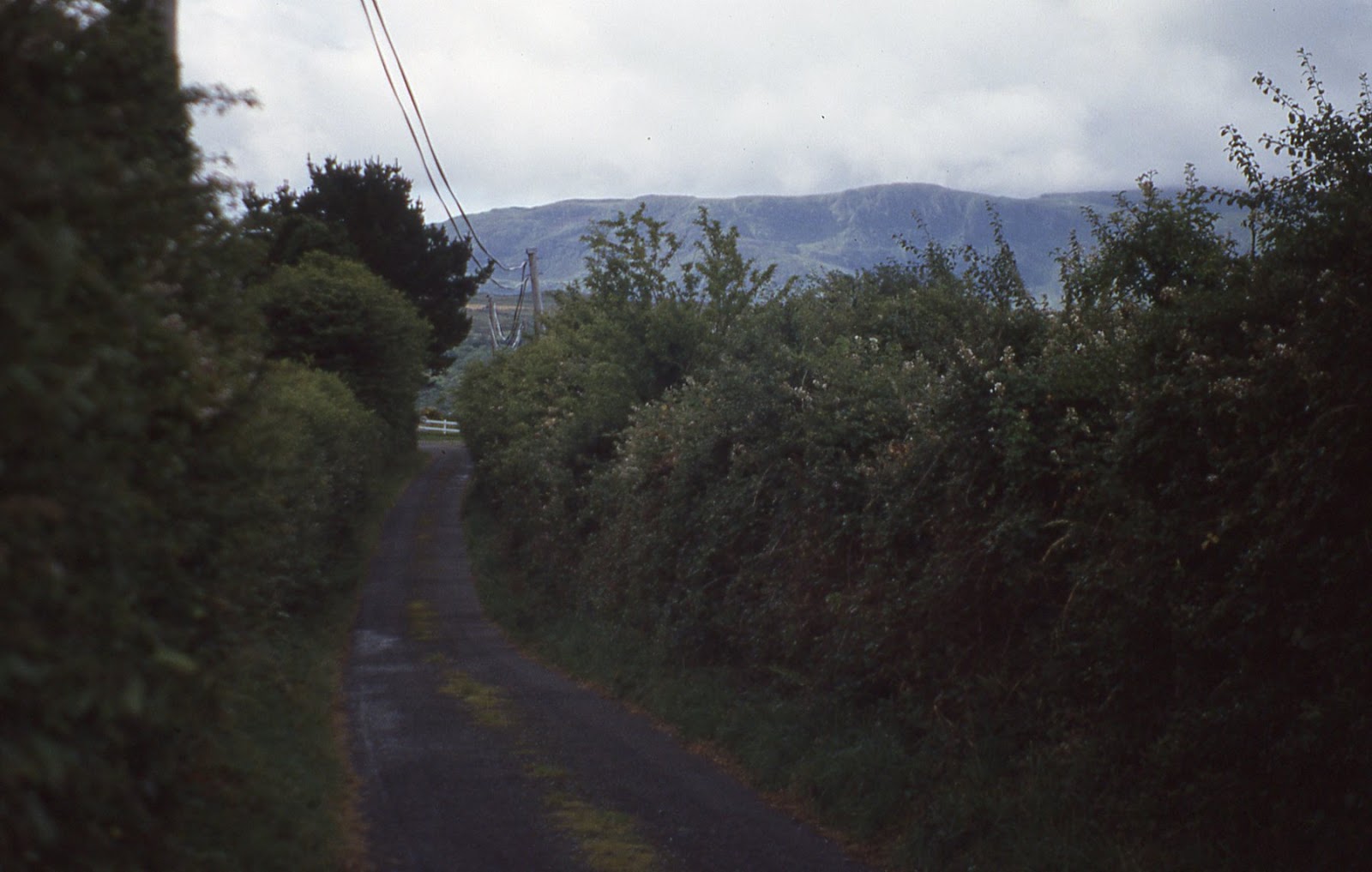
Indeed, it was a friendly little town amid evocative countryside. The town sits where Kenmare Bay ends, roughly 30 miles from the sea. There was blue water, green hills and ample black ale.

There are no surviving records of where we lodged in Kenmare. My fickle memory insists it was a guesthouse or small hotel of some sort. I wrote the words "Wander Inn" in my notes on the arrival day. There still is a pub by this name, and now it has a bed & breakfast upstairs, but the name just doesn't sound right. Maybe it's the place with the Budweiser landlady.

(Upon further reflection, I believe it was the Kenmare Fáilte Hostel)


The relevant point about Kenmare was that one didn't have to walk far from town for "rural" to begin, and we did just that. The hike on our second day in town took us north, toward what I have learned is the direction of Killarney National Park.


Sunday, August 2 was the signature Kenmare moment, when we adjourned to a pub called The Coachman's Inn for a one-day-early celebration of my 27th birthday.

Gaelic football was on the telly, and Barrie was buying. A tad light on cash given what we'd likely be spending, he asked if The Coachman's Inn accepted plastic. It always was a good idea to ask first. Without exaggeration, I'd estimate that in 1985 and 1987, only 10% of the places where I ate and drank in Europe accepted charge cards.

Coachman's did, though for reasons unknown it was against policy to run a tab. Barrie would have to pay up front for what we planned to drink all evening long.

I was annoyed, but typically Barrie wasn't. He made a great show of quick math, counting on his fingers and speaking nonsense German; with everyone laughing, he then told the bar man to charge for 30 pints of Guinness and two servings of beefsteak and potatoes.

Shrugging, Barrie further noted that if need be, we could always give the pints away to someone else. If memory serves, the final tally was 16-14 in favor of Ottersbach -- and nothing at all was given away.


Kenmare in 1987 (above) and 2011 (below). It's gotten much more colorful.


Next: Skibbereen, Baltimore and our last days in the Irish countryside.