New Albany is a state of mind … but whose? Since 2004, we’ve been observing the contemporary scene in this slowly awakening old river town. If it’s true that a pre-digital stopped clock is right twice a day, when will New Albany learn to tell time?
Showing posts with label 1987 European Summer. Show all posts
Showing posts with label 1987 European Summer. Show all posts
If Donald Niebyl created a calendar with these images I'd snatch one up.
My only visit to Yugoslavia when constituted as such came in 1987, for only a couple of weeks, and these buildings fascinated me, as did the "Spomenik" monuments Niebyl has been chronicling the past few years. This link from March, 2020 also includes a summary of my chronology on the topic.
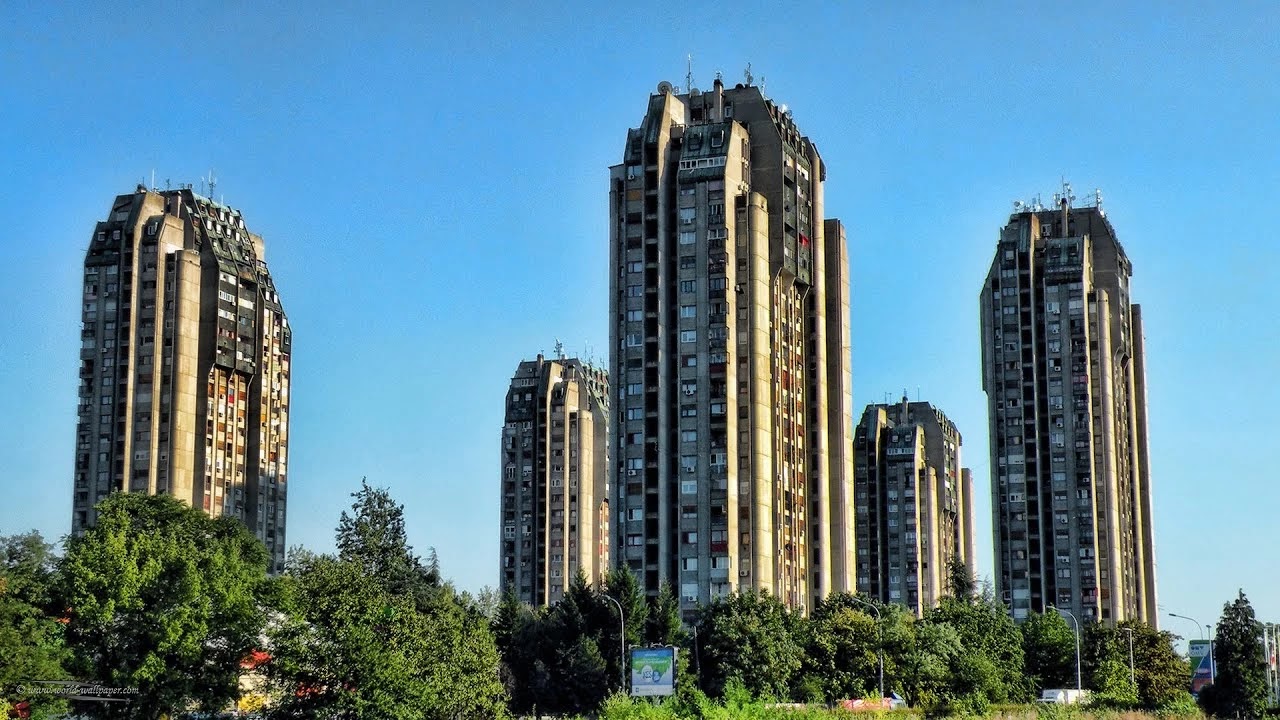
Among the most monumental and landmark structures ever built during the era of Yugoslavia were its many soaring high rise towers and skyscrapers, of which many pushed the envelope of engineering and inspired a nation to look towards the future. While the country of Yugoslavia has ceased to exist for nearly three decades now, the many iconic and charismatic skyscrapers built during that era continue to inspire and speak to not only the old Yugoslav generation, but also the new youth generation who never lived in that former nation, as well as people around the world who are drawn in by their unique and bold architecture. However, for all of the fame and fan-fare surrounding many of these structures, many have barely been written about and few meaningful words dedicated to their history. In fact, my entire impetus for writing this article was that when searching for a listing of the seemingly straightforward query of "what were the tallest buildings of the Yugoslav-era", I found no authoritative articles related to that question or any serious investigation into the topic.
During the late spring and early summer of 2017, I finally got around to digitizing some of the old slides from ancient times. It occurred to me to tell the story of the 1987 European Summer, posting roughly on the same date the photos were taken, albeit 30 years later.
Now it's 2020, and an exceedingly dry (on-premise) St. Patrick's Day owing to the measures mandated by Indiana state government as we seek to flatten the curve of COVID-19.
Barrie and I had a week to roam before returning to Cork for the U2 concert, and so into the countryside we went. Day 107 ... Friday, July 31
Cork → Kenmare. Scenic bus ride (Wander Inn)
Day 108 ... Saturday, August 1
Kenmare. Walk into hills to the north. Not great weather afterward
Day 109 ... Sunday , August 2
Kenmare. Football replay. Coachmen's Inn for 30 points. Drunkenness (walk along bay, through woods)
First, a brief beer digression.
At some point during our time in Ireland, Barrie and I entered a pub and struck up a conversation with the woman working behind the bar, who turned out to be the pub's owner.
She was delighted that we were American, happily divulging that she'd put Budweiser on tap the day before, because the great American lager was only then being introduced to the Irish market in earnest.
Coaster evidence.
As gently as possible, we explained that drinking Budweiser really wasn't why we had come to Ireland, but thanks anyway.
She persisted. Did we happen to know that Budweiser was brewed under license in Ireland, not imported from America? We didn't. Weren't we curious? Perhaps we'd like to buy a pint each of Budweiser and see for ourselves if it tasted the same?
After a humorous negotiation, we convinced her to give us a half-pint each, and we'd taste test the Budweiser for her. Don't worry; we tipped well.
Somewhat anticlimactically, to me Irish-brewed Budweiser tasted almost exactly like Irish-brewed Harp Lager. Fortunately, we didn't see much more of Budweiser during the trip, but I suppose it was adequate as a calibration beer.
Returning to the narrative, from Cork we caught a bus to Kenmare. The bus spent part of the journey traversing a segment of the Ring of Kerry, the scenic regional road route. In fact, we'd chosen Kenmare because it was said to be the "jewel" of the Ring of Kerry.
Indeed, it was a friendly little town amid evocative countryside. The town sits where Kenmare Bay ends, roughly 30 miles from the sea. There was blue water, green hills and ample black ale.
There are no surviving records of where we lodged in Kenmare. My fickle memory insists it was a guesthouse or small hotel of some sort. I wrote the words "Wander Inn" in my notes on the arrival day. There still is a pub by this name, and now it has a bed & breakfast upstairs, but the name just doesn't sound right. Maybe it's the place with the Budweiser landlady.
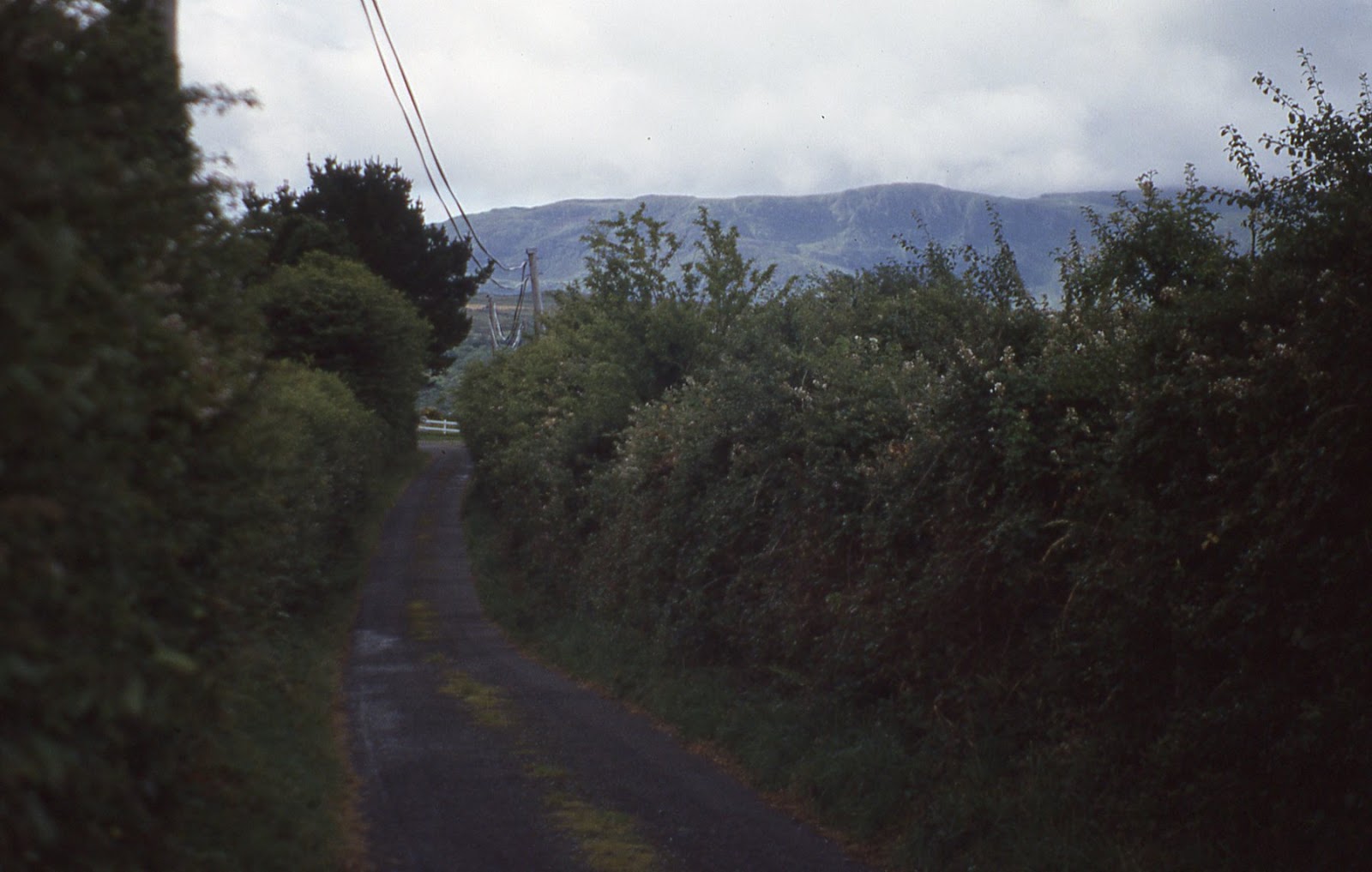
The relevant point about Kenmare was that one didn't have to walk far from town for "rural" to begin, and we did just that. The hike on our second day in town took us north, toward what I have learned is the direction of Killarney National Park.
Sunday, August 2 was the signature Kenmare moment, when we adjourned to a pub called The Coachman's Inn for a one-day-early celebration of my 27th birthday.
Gaelic football was on the telly, and Barrie was buying. A tad light on cash given what we'd likely be spending, he asked if The Coachman's Inn accepted plastic. It always was a good idea to ask first. Without exaggeration, I'd estimate that in 1985 and 1987, only 10% of the places where I ate and drank in Europe accepted charge cards.
Coachman's did, though for reasons unknown it was against policy to run a tab. Barrie would have to pay up front for what we planned to drink all evening long.
I was annoyed, but typically Barrie wasn't. He made a great show of quick math, counting on his fingers and speaking nonsense German; with everyone laughing, he then told the bar man to charge for 30 pints of Guinness and two servings of beefsteak and potatoes.
Shrugging, Barrie further noted that if need be, we could always give the pints away to someone else. If memory serves, the final tally was 16-14 in favor of Ottersbach -- and nothing at all was given away.
Kenmare in 1987 (above) and 2011 (below). It's gotten much more colorful.
Rest assured, it isn't lost on me that my fascination with this "brutalist" subject matter probably isn't shared by more than a half-dozen denizens of New Albania. In point of fact, knowing this empowers me.
Somewhat in reverse chronological order, let's begin with the screenshot of the above tweet from Donald Niebyl's highly recommended Spomenik Database account.
"After my article last week about my visit to Hotel Zlatibor in Užice (Serbia), a Polish traveler reached out to inform me he was one of the last to stay as a guest at the hotel in 2019. I've included his rare photos and amazing description in an update to my article."
As context, here is the former hotel's address in Užice, Serbia.
Niebyl's Hotel Zlatibor article follows. Bear in mind that my first and only visit to Yugoslavia prior to the civil war and breakup came in 1987, six years after the Hotel Zlatibor was built. That year I traveled by bus from Dubrovnik to Belgrade, which took 10-12 hours and stopped for a break at the Tjentište War Memorial (see the story below).
Looking just now at the map, I almost certainly passed through Užice as well. Youth. It's wasted on the young.
Once one of the most famous and architecturally stunning hotels of the Yugoslav-era, Hotel Zlatibor in Užice, Serbia sat for years in a state of neglect after the 1990s. In 2020, the process of gutting and dismantling the hotel's interior began with the aim of transforming it into apartments. Today I accessed the hotel for one last glimpse of this icon of Yugoslavia.
The story of how Niebyl began distracting me on Twitter a few years back is told here.
Donald Niebyl, a biologist from the US, created the Spomenik Database to tell the stories behind Yugoslav World War II memorials - but locals were sometimes bemused by his enthusiasm for these long-neglected monuments.
I now have Nielbyl's book, and also another by photographer Jonathan Jimenez. The spark that lit this particular flame occurred in 2017, when I resolved to scan and catalog slides from the 1987 European Summer, at long last learning what those symmetrical sculpted objects on the hillside actually were. On December 2, 2018 it was tied together.
This minor obsession began with a photograph I took very long ago at a rest stop during a bus trip from Dubrovnik to Belgrade, in what then was called Yugoslavia ...
... followed by the helpful intervention of the internet 30 years later, enabling a positive ID.
UPDATE: "Tjentište War Memorial, Yugoslavia, then and now." The two fractal walls of the memorial were erected in the 1970’s to remember Operation Fall Schwarz, otherwise known as the Battle of the Sutjeska. The military action took place during World War II and saw Axis forces attempt to rout a group of Yugoslavian forces and capture their leader.
If you're the Twitter type, the author of a new book about these memorials maintains an informative presence: Spomenik Database.
The Spomenik Database is an educational resource intended to catalog and demystify the abstract WWII monuments (spomeniks) of the former-Yugoslavia.
As for the book itself, this holiday season it would make the perfect gift for your favorite beer-slinging fan of brutalist monuments.
Spomenik Monument Database, a book by Donald Niebyl Spomenik – the Serbo-Croat/Slovenian word for monument – refers to the pioneering abstract memorials built in Josip Tito’s Yugoslavia between the 1960s and the 1990s, marking the horror of occupation by Axis forces and the triumph of their defeat during World War II. Through these imaginative creations, a forward–looking socialist society, free of ethnic tensions, was envisaged. This publication brings together more than 80 examples of these stunning brutalist monuments. Each has been extensively photographed and researched by the author to make this book the most comprehensive survey available of this obscure and fascinating architectural phenomenon. A fold-out map on the reverse of the dust jacket shows the exact location of each spomenik using GPS coordinates.
Of course, you realize that some day soon, I'll be trying to talk D into a journey to hunt spomeniks (and brutalist structures) in former Yugoslavia.
"To ask why the Jews have been killed is a question that shows immediately its own obscenity."
-- Claude Lanzmann
Apart from it being unpronounceable by most Americans, the Polish city of Oświęcim (aws-ven-chim) seems innocuous enough until you realize it's known to the wider world by its German name, Auschwitz.
“The Auschwitz concentration camp (Konzentrationslager Auschwitz) was a complex of over 40 concentration and extermination camps operated by Nazi Germany in occupied Poland during World War II and the Holocaust. It consisted of Auschwitz I, the main camp (Stammlager) in Oświęcim; Auschwitz II–Birkenau, a concentration and extermination camp built with several gas chambers; Auschwitz III–Monowitz, a labor camp created to staff a factory for the chemical conglomerate IG Farben; and dozens of subcamps. The camps became a major site of the Nazis' Final Solution to the Jewish Question.”
Auschwitz-Birkenau was one of many camps designed primarily for genocidal extermination: Chełmno, Bełżec, Sobibór, Treblinka, Majdanek and Jasenovac are some of the others. In numerical terms the Jews were killed in horrifically greater numbers, but the Nazis also murdered political opponents, Slavs, Roma (gypsies), homosexuals, Soviet POWs, and anyone else who objected to Hitler's new world order.
A Frenchman named Claude Lanzmann (1925 – 2018) somewhat serendipitously came to play an out-sized role in documenting these atrocities by combining the mediums of film and oral history.
Lanzmann was born into a secular Jewish family in Paris, and while they hid during the German occupation of France in World War II, Lanzmann joined the French resistance at 17, smuggling small arms for the fight against the invaders.
After liberation, Lanzmann went to university, studied philosophy, worked (and famously played) with Jean-Paul Sartre and Simon de Beauvoir, and eventually became a filmmaker. In 1973 he was contacted by the Israeli Ministry of Foreign Affairs, which offered financial backing for a documentary about the Holocaust (a term meaning “burnt offering” which Lanzmann found objectionable).
Nearing 50 years of age, Lanzmann agreed to the proposal and spent the next 11 years crafting the epochal nine-and-a-half-hour-long Shoah (or “catastrophe”). I believe the Israeli financing dried up very quickly, but he persevered. There have since been sequels using the many hours of interviews filmed for the original.
Shoah remains visceral and essential viewing for anyone wishing to understand what happened to Europe’s Jewish population at the hands of the Nazis. It is an unconventional and brutally effective documentary, describing factual historical events without the use of archival footage or tacky reenactments.
The hour is late, and what Lanzmann achieved probably could not be repeated today. The 75th anniversary of Auschwitz’s liberation was Monday, January 27, and obviously the number of people with active memories of the period has dwindled considerably. It is reckoned that fewer than 400,000 Holocaust survivors remain with us in 2020. The fact there are even this many given the number of deaths testifies to the sheer scale of their incarceration.
Naturally many more of them were alive in the 1970’s, and so were those ordinary people in places like Poland capable of bearing witness. Lanzmann filmed dignified Jewish survivors, serenely acquiescent Poles and even an entirely unrepentant SS officer, albeit the latter surreptitiously with a hidden camera. They all lived through cataclysmic and unspeakably horrible events that took place primarily in areas of dense pre-war Jewish population, which became saturated with planned centers of systematic slaughter during the Nazi occupation.
To record these memories and recollections, Lanzmann traveled to a dozen or more then-Communist locales in Poland and Eastern Europe. He also made side excursions to Israel, Germany and elsewhere in the world, reflecting the post-war diaspora of victims and perpetrators.
Lanzmann organized their recollections into stories woven together with consummate skill, and as the hours pass, there is an emotional crescendo guaranteed to leave the viewer both drained and fearing for the future of humanity. It’s true that we manage somehow to survive our own seemingly boundless stupidity. It’s unclear how we do it.
At the time Shoah was released, its director was fiercely criticized for including footage that unflinchingly exposed lingering anti-Semite tendencies on the part of ethnic Poles, this coming at a time when Poland -- through the activities of the Solidarity trade union movement and a sitting Pope -- was being lionized by anti-Communists throughout the world as the best extant hope to commence the toppling of the Bloc’s socialist dominoes.
And so they were, but to this very day the arguments about Poland and the Holocaust have not been resolved. They likely never will.
In 2018 the Poles overstepped, passing a law that would have criminalised stating that the Polish people had collaborated in the Holocaust. In fact, while some Christian Poles heroically saved Jews, most did nothing—and others helped kill them. Many Jews saw the law as whitewashing the long history of anti-Semitism in Poland and other European countries besides Germany. The Poles eventually scrapped the law, but Israel showed its own prejudices last year when its foreign minister claimed that Poles “imbibe anti-Semitism with their mothers’ milk”.
Lanzmann’s Shoah documentary occupies a place in my consciousness utterly impossible to overstate. I first saw Shoah in its entirety several months after my mother videotaped the film from public television during the summer of 1987, precisely as I was traveling in Europe, including a passage through Poland and a visit to the Auschwitz memorial.
For ten straight days in 1988, I set the alarm an hour early each morning and gradually absorbed the film in bits, pieces and chunks before heading off to work. It may have been the culmination of my free-lance, post-graduate education, voraciously soaking up books and documentaries about European history, culture and any related matters in an effort to achieve greater understanding during my periods of continental travel.
In spite of everything I was sure I knew about life back then, these mornings in front of the tube in 1988 were profoundly uncomfortable. Shoah is about death, and in a manner we’re unaccustomed to considering. I’ll never forget it.
---
My visit to Auschwitz came on July 11, 1987.
I’d been in Krakow with my friend Barrie (who now teaches history at Scribner Middle School) and two fellow travelers from Florida. We’d taken an unscheduled detour from the Soviet/Baltic/Poland youth and student package tour, hopping a Friday afternoon train from Warsaw and learning the dubious (and embarrassing) value of handing the conductor $5 cash for our fare, then watching aghast as he evicted people from their rightful seats for us to sit.
The displaced made no objection whatever, and we rationalized: It was the awful Commie system to blame.
On a Saturday morning, after overnighting in Krakow for $2.50 per person amid aging furniture in a pensioner’s shabby flat, we rustled a few grams of greasy salami and bread, then found the dingy bus station in the city’s crumbling and neglected downtown, joining several dozen Polish weekend trippers on the bumpy, grinding, two-hour journey to Oświęcim.
There were no English speakers around to help, but we managed to guess the correct stop near the entrance to the Auschwitz museum. Once there, we paid our fees and wordlessly passed through the numbing exhibits inside the old brick pre-war Polish army barracks buildings of Auschwitz 1, a strangely bureaucratic and tidy introduction to the supreme horror a few hundred meters away at Birkenau, the epicenter of the assembly line death camp.
You’ve probably read or heard about the rooms filled with abandoned luggage, eye glasses, artificial limbs, shoes, children’s toys – all confiscated from prospective victims as they were paraded from cattle cars to perish within minutes of passing through gates that read, “Arbeit Macht Frei” … or, work will make you free.
Intense? Chilling? Insane? Yes, and so much worse than these or any other inadequate words we might choose, yet only pretending to encapsulate some measure of emotion about a crime scene possessing a degree of industrial aspiration to cold-blooded murder well beyond the imagination of a twenty-something Hoosier bumpkin.
Or the same bumpkin at 60.
After two hours, we’d had enough of it. To get back to Krakow for the return to Warsaw later that evening necessitated a short walk into the center of Oświęcim, where we boarded a train that ran roughly half the distance back to the Krakow before abruptly disgorging us at a rural rail crossing point to change trains.
The day had become hot and sultry, and activity at the station was ploddingly minimal. There was a simple buffet offering plates of mystery meat in gray sauce, but we weren’t so much hungry as thirsty, and not merely thirsty, but fairly desperate for an adult beverage or three to ease the transition from wartime Auschwitz back to dilapidated 1980’s-vintage Poland.
Pivo? Wodka? Vino?
Alas, there was no succor for the bibulous at the teetotal train station. Resigned to temperance, and waiting at the platform, we could see green fields and crops in the distance beyond the tracks. People wearing their best were walking in little groups toward the settlement; surely even in a Polish farming town there’d be something happening on a summertime Saturday night.
Right before the train finally limped to rest, a horse-drawn cart clattered across the weathered cobblestones nearby.
I’d been looking at the older folks among the crowd at the station. With memories of Auschwitz still raw, it’s obvious what I was thinking, and I kept those thoughts to myself. Later, watching Shoah, the parched rail platform reverie and the native Poles populating it came back to me with a vengeance, and wouldn’t let go as the film unspooled over those mornings of otherwise forgotten days, as Lanzmann meticulously peeled away the dusty layers of memory and forced the viewer to think.
What did it all mean?
This is by no means a denunciation of Poland and the Poles, or a doomed attempt at facile erudition with respect to their places in the historical record, only an observation that there are times when very little about anything makes sense, especially when one’s own senses are being burdened with the unsettling melancholy of time.
Or, of time passed.
It has been almost fifty years since Lanzmann’s film went into production, and certainly all the survivors he chronicled are dead. The people I saw in Poland in 1987 are thirty years older, and many of them have died, too.
There was a time when I felt reasonably confident that a majority of readers understand the Holocaust as empirical fact and don’t require daily reminders. Glancing each morning at the endless, repetitive and triumphant Twitter proclamations of American idiots with moth-like attention spans, I’m no longer quite as sure. Sadly, the revisionism extends to Europe, where anti-Semitism continues to poison minds today.
Nature or nurture – or both? We’re classified at birth as human by biological default, but mustn’t we actually learn how to be human? If no one is there to teach us what it means to be human, or if our purported mentors shirk their responsibility, aren’t we condemned to repeating these instances of man's inhumanity to man?
In 2006, a new translation of Elie Wiesel’s Night appeared on the paperback bestseller list (Wiesel died in 2016). How many Americans know anything at all about Wiesel, much less can say they’ve read this or other books written by him?
In Shoah, Lanzmann interviews Dr. Franz Grassler, one of the Nazis “administering” the Warsaw Ghetto. A mere quarter-century removed from his duties, Grassler’s memory repeatedly failed him.
Claude Lanzmann: You don't remember those days?
Franz Grassler: Not much. I recall more clearly my pre-war mountaineering trips than the entire war period and those days in Warsaw. All, in all, those were bad times. It's a fact we tend to forget, thank god, the bad times more easily than the good. The bad times are repressed.
Forgetfulness of history to this magnitude is something too many of us have become proud to seize as a birthright. I can't tell you why ignorance always seems to be in fashion. All I can do is promise to denounce it -- and to watch Shoah again in its entirety later this spring.
One of the bedrock, greatest-hits-variety stories from my Euro odysseys during the era of the 1980s is the tale of arriving Friday evening by train in Ljubljana and being greeted by scores of drunk young Slovenian army conscripts.
Diana is sick and tired of hearing me repeat the saga, so it will suffice to say that 32 years later, I was thrilled to revisit the scene. The station building dates to 1849 when the railroad from Vienna to Trieste was being completed.
I didn't realize that since 2003 there has been a small commemorative plaque at the station honoring a migratory writer's mistake.
On 19 October 1904 (James) Joyce and Nora Barnacle spent the night in Laibach. En route from Zurich to Trieste Joyce and Nora got off the train in Laibach (now Ljubljana in Slovenia), thinking it to be Trieste, and had to spend the night in a park.
These days it's probably difficult getting away with spending the evening in a park. Not that I've ever done that sort of thing traveling ...
I came stumbling into Slovenia, then part of Yugoslavia, in May of 1987. The previous two weeks had been spent in Italy, and unsurprisingly the Italian wine was ludicrously inexpensive. So was beer, but apart from the solid Birra Dreher in the north, the ones I tried were merely serviceable and didn't impress me very much.
I'd been drinking wine regularly, and in retrospect, I was ready for a well-turned, old-school, full-flavored lager.
Well, maybe not THAT old-school.
Happily Yugoslavia proved to be stocked with a few honest lagers, some of them firmly hoppy lagers. After all, Slovenia grows hops.
Attempts to grow hops in Slovenia date back to 1844. Saaz hops and Bavarian hops were brought to the region but did not grow well. A British hop, mislabeled “Golding,” was imported instead, and it flourished. The resulting hops, now known as Styrian Golding, are probably a derivation of Fuggle, not English Golding. Still, they have become the cultivar that is most closely associated with Slovenia. Some Styrian Golding is also cultivated across the border from Slovenia in neighboring Austria. Another uniquely Slovenian cultivar is Bačka. It has a murky background, but is probably of central European origin. Bačka was one of the primary hops of the region through much of the 20th century. Today, Slovenia has a large variety of bitter and aroma hops to offer, most of which are produced from local breeding programs. See bačka (hop), fuggle (hop), and styrian golding (hop). Once a region of the former Yugoslavia, Slovenia accounts for about 2% of the global hop production.
Union beer in Ljubljana was a malty, delicious example of Yugoslav's beery wares. As I was to learn, so were Laško (Slovenia), Karlovačko (Croatia) and Nikšićko (Montenegro). In 1987 I readily found the Union brewery in Ljubljana while out walking. Here are then-and-now photos.
On both photos, the building on the left is the malthouse, which has been remodeled into a pub. 32 years ago I bought a couple of bottles at a shop, and had a draft with my meal at the Ljubljanski Dvor pizzeria. To my palate at the time Union was quite good, and as of our arrival in Ljubljana this past November, I hadn't tasted a single one since 1987.
(As a side note, in present-day Slovenia craft beer culture is strong, and bottled IPAs were available at most of the establishments we patronized. As for the mass-market brewers, after a long history of competition between Union and Laško, they were merged under Heineken in 2016. In terms of character, I believe a Czech analogy is apt: Laško is Pilsner Urquell to Union's Budvar ... in Triple AAA ball.)
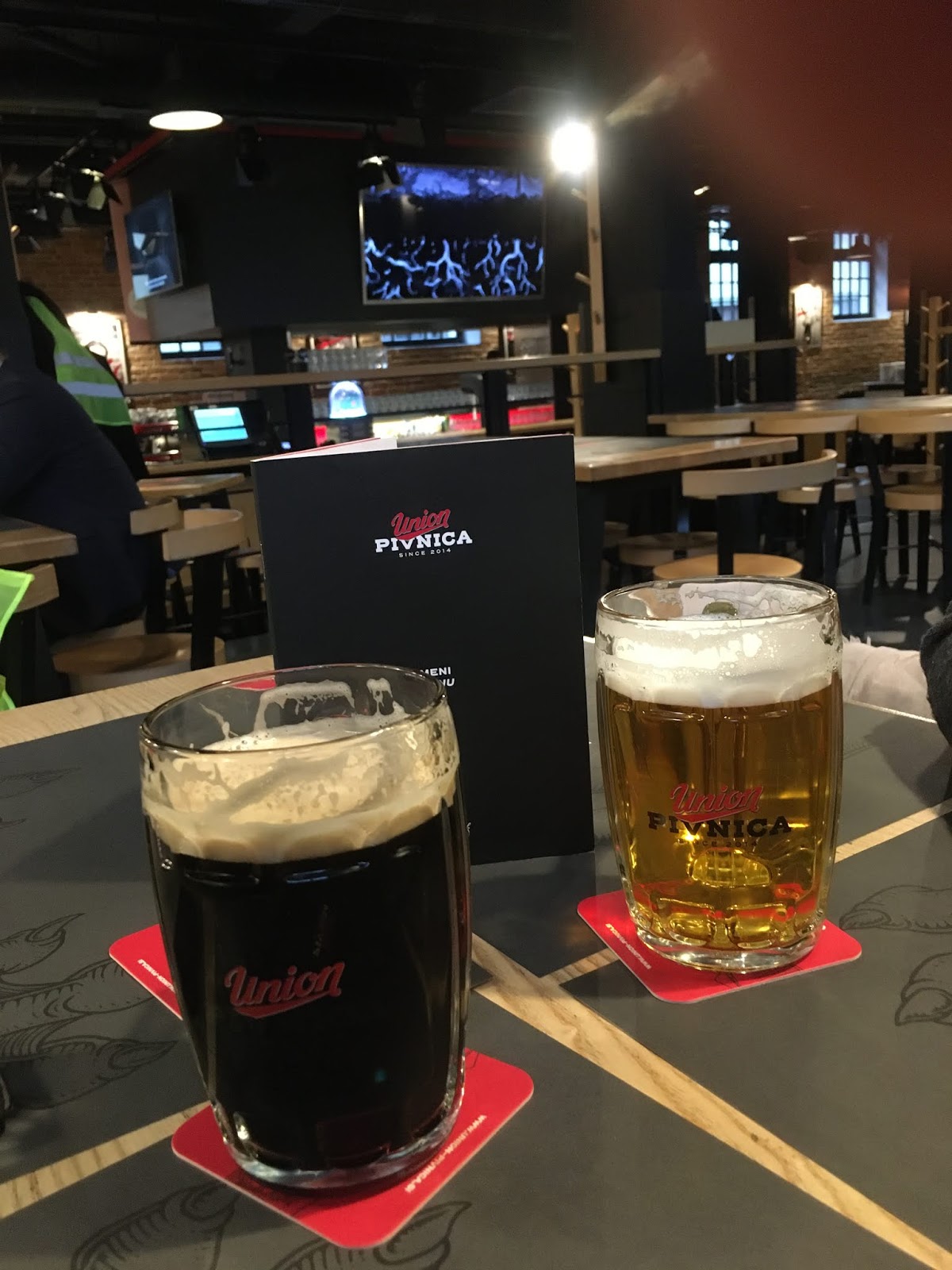
Our first round of beers on Tuesday evening at Slovenska hiša included an unfiltered golden lager from Union, which was Keller-like and center of the target. A broader range of beer styles now are being brewed at Union's pivnica (pub), located at the former malthouse adjacent to the recently modernized brewery. Among these was a dark lager along schwarzbier lines. It was delicious.
Behind the beers, above the bar, you can see the video screen. It was endlessly looping the promotional video that leads this post. As we waited for the tour to begin, I couldn't take my eyes off of it, and now the "divining" dragon is certain to be an indelible memory of our 2019 vacation.
Watch it.
Diana and I were the only persons to take the Union brewery tour at 4:00 p.m., but our friendly and enthusiastic guide didn't alter the usual 1.5 hour presentation in the least. We got the full Monty, and it was informative and exhaustive. I was not allowed to photograph inside the brewery (as though "proprietary" is a concept in brewing circles), and so the following photos were taken in the museum section.
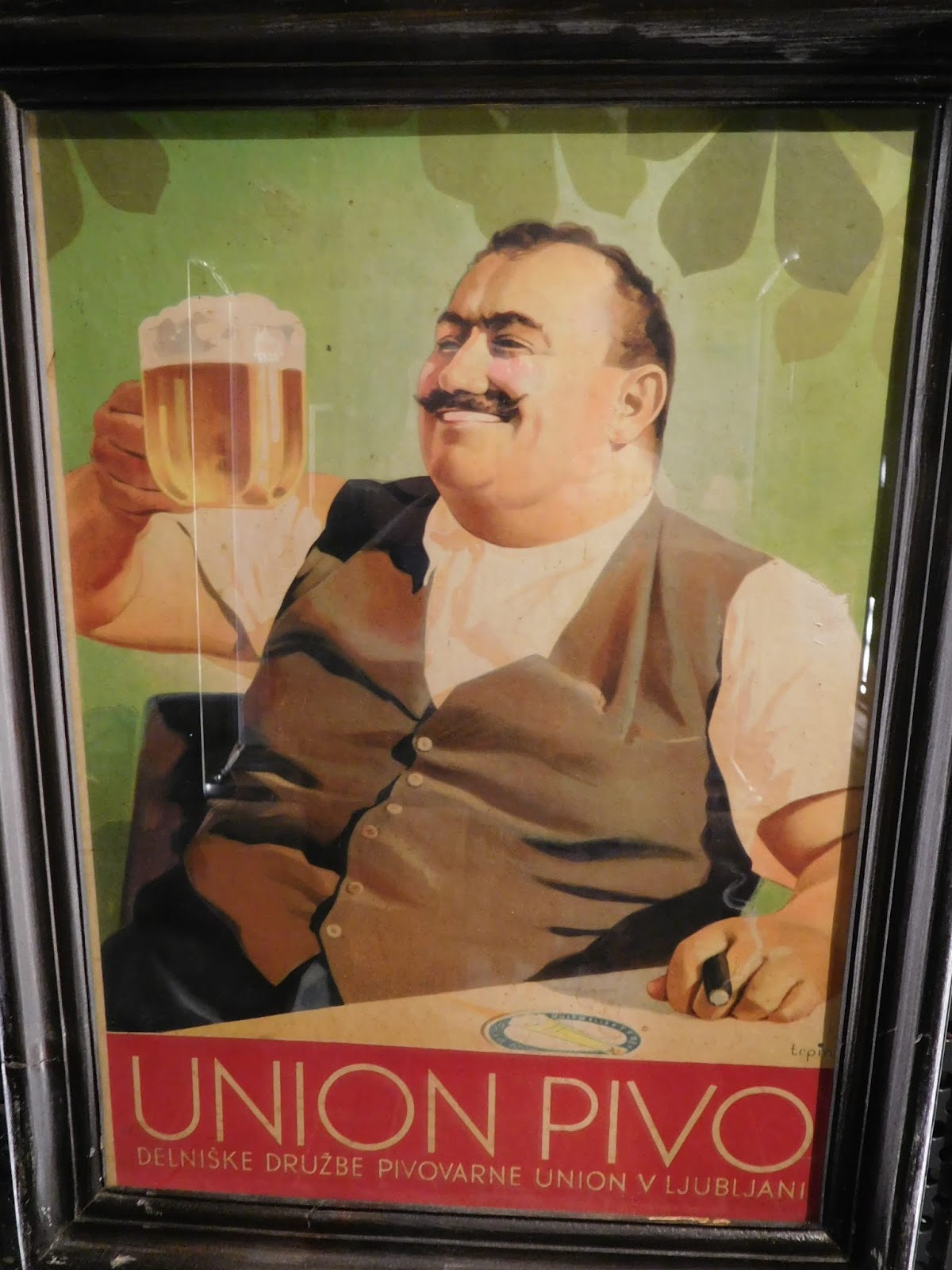
This advertising poster of a mustachioed man hoisting a pint was explained to us as an example of upward mobility in the period between the wars. The man's mustache, cigar, vest and rotund body type all were intended to attest to his status as a successful businessman with disposable income to spend on the good things in life. It remind me just a bit of the famous Birra Moretti logo in Italy.
Wednesday evening ended with meals at the above-average Hotel Park restaurant, which seemed to function as a community hangout as well as a tourist's choice for a nightcap. That's a rare combination.
NA Confidential's mask-free policy on reader comments.
NA Confidential believes in a higher bar than is customary in the blogosphere, and follows a disclosure policy with respect to reader comments.
First, you must be registered with blogger.com according to the procedures specified. This is required not as a means of directing traffic to blogger.com, but to reduce the lamentable instances of flaming and personal attacks on the part of the anonymous.
Second, although pen names are perfectly acceptable, senior editor Roger A. Baylor must be informed of your identity, and according to your preference, it will be kept confidential.
To reiterate, I insist upon this solely to lessen the frequency of malicious anonymity, which unfortunately plagues certain other blogs hereabouts.
You may e-mail Roger at the address given within his profile and explain who you are. Failure to comply means that your comments probably will be deleted -- although the final decision remains ours.
Thanks for reading, and please consider becoming a part of the community here, one that is respectful of the prerequisites of civilized discourse, and that seeks to engage visitors in substantive dialogue.




 horses.jpg" width="320" />