Showing posts with label brutalism. Show all posts

Monday, October 26, 2020

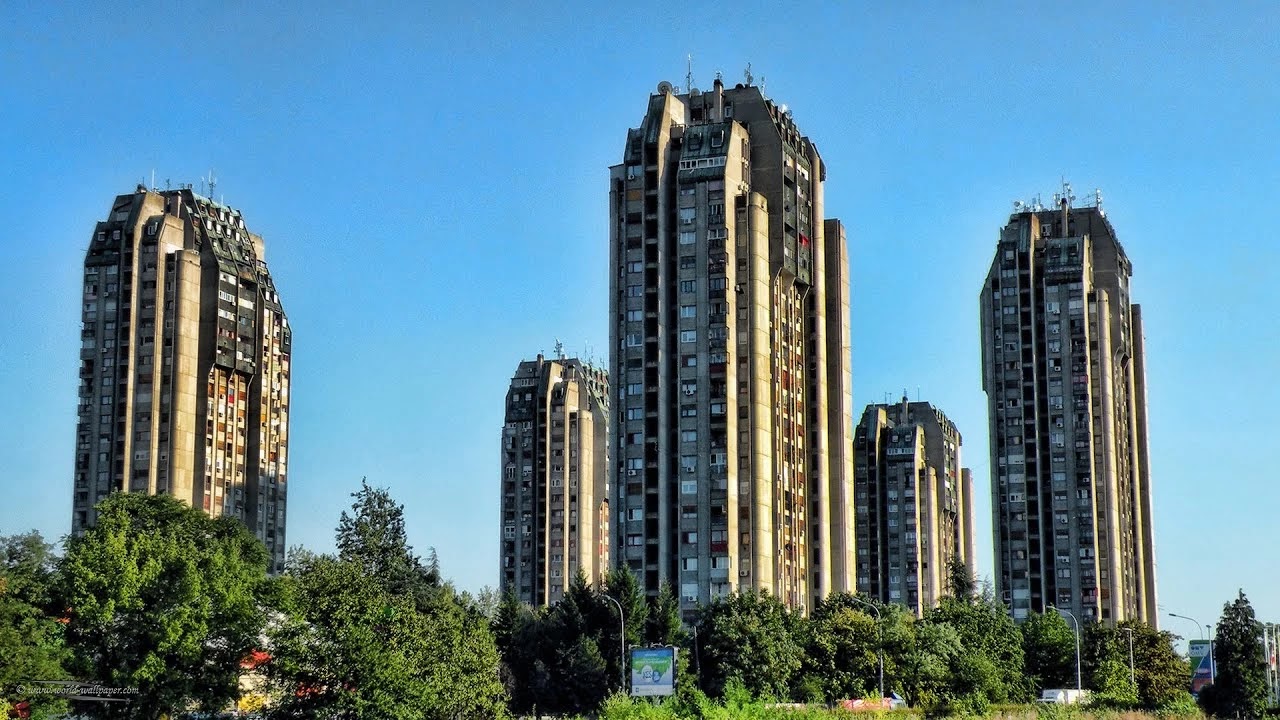
An absolute fascination with "The 15 Tallest Skyscrapers of Yugoslavia."

If Donald Niebyl created a calendar with these images I'd snatch one up. 

My only visit to Yugoslavia when constituted as such came in 1987, for only a couple of weeks, and these buildings fascinated me, as did the "Spomenik" monuments Niebyl has been chronicling the past few years. This link from March, 2020 also includes a summary of my chronology on the topic.

Farewell to the Hotel Zlatibor in Užice, Serbia ... and further tales of the spomeniks (memorials) in former Yugoslavia.

I've never had a sufficient grounding in architecture to know very much about any of this. But the interest remains just as strong.    


Among the most monumental and landmark structures ever built during the era of Yugoslavia were its many soaring high rise towers and skyscrapers, of which many pushed the envelope of engineering and inspired a nation to look towards the future. While the country of Yugoslavia has ceased to exist for nearly three decades now, the many iconic and charismatic skyscrapers built during that era continue to inspire and speak to not only the old Yugoslav generation, but also the new youth generation who never lived in that former nation, as well as people around the world who are drawn in by their unique and bold architecture. However, for all of the fame and fan-fare surrounding many of these structures, many have barely been written about and few meaningful words dedicated to their history. In fact, my entire impetus for writing this article was that when searching for a listing of the seemingly straightforward query of "what were the tallest buildings of the Yugoslav-era", I found no authoritative articles related to that question or any serious investigation into the topic.

Monday, August 24, 2020

Between the Clock and the Bed.


Since the contested election in Belarus, I've been riveted, as perpetually fascinated by these European locales. In watching coverage of the protests, as well as a few older documentaries, it finally occurred to me that Minsk (where I passed through during USSR times but didn't stop) retains so very much of that old Soviet feel that it's uncanny.

In short, always be suspicious of perfectly clean urban areas. They're more Disney-fied than real, and usually for all the wrong reasons (and I'm no fan of Uncle Walt, mind you).

Imagine my delight in this ...


Minsk: Owen Hatherley on the world's most complete, and most surprising Soviet city (The Calvert Journal)

Whether hostile or complimentary, all accounts of Belarus will mention the extreme Sovietness of its capital, the equally extreme cleanliness and lack of commercial pollution and/or vibrancy. This leads to some interesting errors. Historian Andrew Wilson, in his otherwise convincing critique of the Lukashenko regime, The Last European Dictatorship, describes its dominant style erroneously as Brutalist. Nothing could be further from the truth. Minsk is arguably the greatest neoclassical European city of the 20th century, with most buildings in the city centre resplendent with colonnades, baroque archways and romantic skylines of spires, obelisks and heroic sculptures, all on an axial plan integrated with landscaped parklands around the river Svisloch. This is the direct result of one of the least known episodes of the Second World War — the intensity of resistance in Soviet Belarus to the Third Reich. It deserves to be as well known as that of Poland or Yugoslavia, but isn’t, largely because it isn’t useful to anybody much, save perhaps Lukashenko’s unpleasant government.

... and by extension, this.

Melancholy of obsolete futures at (The Critic)

Alexander Adams on Soviet Brutalism and where to read about it

Brutalism has seen a surge in interest among young people keen on bold uncompromising Modernist design. Whole books of moody photographic studies of concrete buildings are snapped up by fans of urban life and retro design. A crop of new books explores the Brutalism of socialist states.

While Constructivism and avant-gardism in fine art came to prominence during the October Revolution, it was suppressed in favour of Socialist Realism by the mid-1930s. In architecture more adventurous forms and materials persisted, although in the minority. Under Stalin there was a degree of stylistic conformity and austerity, yet adventurous architecture was not seen as “bourgeois formalism” as it was in art. Following the death of Stalin in 1953, historicism receded and a greater variety of art, design and architecture (including Modernist architecture) became possible.

While supposedly for the masses, many of the showpiece constructions were moribund from the start: inverted ziggurat hotels that were barely occupied and shopping centres with few consumer goods to offer. Much of this architecture was completed less than a decade before the economic and political collapse of the Eastern Bloc.

In postcards, gargantuan apartment buildings — veritable terrestrial ocean liners — tower over public spaces, making farm-near-me/">miniatures of two-tone buses and Trabants. Third-Worldism (also called the Non-Aligned Movement) was a political position of the mid-century decades that apparently offered advantages of alliance to states that pledged to remain equidistant between socialism and democratic capitalism. In practice, most post-colonial states in Africa, South America and South Asia following Third-Worldism did turn to the two superpowers, which provided strategic assistance in return for favourable trading status or military co-operation, thus forming indirect and unstated alliances rather than outright ones.

These are the books described in the article. I can't afford to buy them all, but I wish it were possible. Come to think of it, I just might, anyway.

Consumer Culture Landscapes in Socialist Yugoslavia – Lidija Butković Mićin, Nataša Bodrožić, Saša Šimpraga
East German Modern – Hans Engels
Imagine Moscow – Deyan Sudjic, Jean-Louis Cohen, and Richard Anderson
Soviet Metro Stations – Christopher Herwig
Architecture in Global Socialism – Łukasz Stanek

Thursday, February 07, 2019

Learning to love examples of architectural Modernism and Brutalism, and lamenting a missed opportunity to emulate Kaliningrad.

All the way back in 2014, I had a stunning Brutalist vision for our municipal overlords.

From Königsberg to Kaliningrad, but not back again, though maybe ...

The building to the rear, which never has been used, testifies to the vitality of one-party rule. Give Floyd County Democrats a chance to copy it, and it will be standing where the Reisz building is now.


Alas, they're far more brutal as bribe-engorged political hacks than architectural thinkers. It must be something in the water(y beer). Just imagine if Kaliningrad's unfinished House of the Soviets inspired Jeff Gahan's House of the Anchors. 

Ah, but I digress and proffer an apology to Brutalists who are sure to express outrage at being compared with New Albany's "Mayor for the Eternal TIF."

21 ‘Ugly’ Buildings That Aren’t Ugly at All, by Eric Grundhauser

Atlas Obscura readers share their love for specific structures they feel have been unfairly maligned.

IT’S EASY TO PUT TOGETHER collections of beautiful, soaring buildings that perfectly encapsulate today’s hottest architectural trends. But who will speak for the edifices that have gone largely out of favor since they were first constructed? The imposing behemoths and the strangely angled stars of yesteryear’s design fads? Atlas Obscura readers, that’s who. We recently asked members of our community to tell us about the “ugly” buildings they love, and you weren’t shy in sharing your appreciation for your favorite misunderstood structures.

While the style certainly doesn’t have a monopoly on unconventionally attractive architecture, the majority of the responses we received pointed to brutalist institutional buildings—especially those featured on college campuses. But overall, what all of your nominees ultimately have in common is a way of inspiring devotion in spite of (or sometimes because of) the way they appear on the outside ...

A sad story from Scotland:

Modernist ruin is an 'albatross around our neck' says church (BBC)

St Peter's Seminary in Cardross, near Dumbarton, was built in 1966 as a training college for priests.

It was once described as a "modernist masterpiece" but closed in the 1970s and lay empty until a plan emerged to turn it into a cultural centre.


However, that plan was shelved and the building is now set to remain a ruin.

Speaking personally, I've developed a liking for certain examples of Brutalism, some of which are just as deserving of preservation on grounds of "history" as the usual examples preferred locally. Personal evolution. Imagine THAT. 

---

Related:

Brutalism: If we're intent on spending $10,000,000 ... might as well make it interesting.

1987 European Summer: "Skopje, capital city of Macedonia, is a dream world for lovers of cosmic concrete communist-era architecture."

But Black Sabbath: "Britain's Second City Fights to Save Its Brutalist Architecture."

More brutalism in sclerotic thinking than architecture, at least in Nawbony.

Sunday, December 02, 2018

Spomenik Monument Database is a book I simply must have.

From the book.

This minor obsession began with a photograph I took very long ago at a rest stop during a bus trip from Dubrovnik to Belgrade, in what then was called Yugoslavia  ...


 ... followed by the helpful intervention of the internet 30 years later, enabling a positive ID.

UPDATE: "Tjentište War Memorial, Yugoslavia, then and now."

The two fractal walls of the memorial were erected in the 1970’s to remember Operation Fall Schwarz, otherwise known as the Battle of the Sutjeska. The military action took place during World War II and saw Axis forces attempt to rout a group of Yugoslavian forces and capture their leader.

If you're the Twitter type, the author of a new book about these memorials maintains an informative presence: Spomenik Database.

The Spomenik Database is an educational resource intended to catalog and demystify the abstract WWII monuments (spomeniks) of the former-Yugoslavia.

As for the book itself, this holiday season it would make the perfect gift for your favorite beer-slinging fan of brutalist monuments.

Spomenik Monument Database, a book by Donald Niebyl

Spomenik – the Serbo-Croat/Slovenian word for monument – refers to the pioneering abstract memorials built in Josip Tito’s Yugoslavia between the 1960s and the 1990s, marking the horror of occupation by Axis forces and the triumph of their defeat during World War II. Through these imaginative creations, a forward–looking socialist society, free of ethnic tensions, was envisaged.

This publication brings together more than 80 examples of these stunning brutalist monuments. Each has been extensively photographed and researched by the author to make this book the most comprehensive survey available of this obscure and fascinating architectural phenomenon. A fold-out map on the reverse of the dust jacket shows the exact location of each spomenik using GPS coordinates.

Thursday, October 11, 2018

Gdansk and the Falowiecs: "Can Poland’s Faded Brutalist Architecture Be Redeemed?"

Falowiecs, Gdansk.

Thanks, W.

Gdansk, here we come -- well, in a bit. While other tourists remain marooned in the heart of the rebuilt old town, I'll be looking for the bus that takes me to the Falowiecs. I'll have a beer, and perhaps a sausage.

This might be of interest to some. It's where Lech Wałęsa lived during the time of Solidarity.

Before Lech Wałęsa was thrust into the limelight and into the history books from the beginning of the 1980s, he lived like most of his co-workers in one of the huge housing developments which were built up around the city. While the picture of a grey socialist tower block may not be most people’s idea of a desirable residence, to have your own flat in Zaspa and similar developments were long-term ambitions for most Poles.


I've underlined a relevant passage in this excerpt because it's what I've been telling people since the 1980s; there are at least as many things right as wrong about the Falowiecs.

Can Poland’s Faded Brutalist Architecture Be Redeemed? by Akash Kapur (New York Times)

Long derided as relics of an oppressive regime, the country’s Communist-era buildings are being given a second look, and a new life.

... Gdansk, in the north of the country, at the edge of the gray Baltic Sea, is the home of Solidarity. In many ways, it is the birthplace of Eastern Europe’s anti-Communist revolution. Here, I visited one of the most formidable housing developments in Poland, and indeed the world: the gargantuan apartment blocks known as the Falowiecs. Erected in the 1960s and ’70s, these eight massive complexes undulate in the form of a wave (fala means “wave” in Polish), some stretching for almost a half-mile; they are among the longest blocks on the planet, collectively housing an estimated 12,000 people.

I visited a family that resided in the largest Falowiec, at Obroncow Wybrzeza Street, right next to a McDonald’s. Michal Jaskiewicz, who lived with his partner and infant son in the building, inherited his 410-square-foot one-bedroom apartment from his grandmother, a member of Solidarity. As he showed me around the Falowiec, he spoke of an aging population, and of how many younger Poles had rejected these Communist buildings. They were inspired instead by a version of what he called “the American dream”: moving to a stand-alone home in the suburbs, buying a car, commuting to work.

We took an elevator to the 10th floor. From up there, it was easier to appreciate the scale of those buildings — the way they stretched like vast centipedes over the flat land, surging toward the sea. We discussed the curious fate of buildings like these across Poland — some had been preserved, some had been torn down, others were simply neglected and crumbling into disrepair.

Lately, though, Jaskiewicz had noticed a new trend. Many of the same young people who had left these buildings for the suburbs were gradually returning. He explained that, for all the faults of Communist housing, the spaces were actually better thought-out, and in many ways more livable, than the suburban sprawl that members of his generation had sought. The housing estates were self-contained units that included schools, grocery stores, hair salons and a range of other conveniences. He talked of an emerging communist chic that was rejuvenating the reputation of these buildings. Speaking of his own family, he said, “It’s true these places don’t have such a good reputation. But we have a good life here.”

Wednesday, June 20, 2018

Wednesday, May 31, 2017

1987 European Summer: "Skopje, capital city of Macedonia, is a dream world for lovers of cosmic concrete communist-era architecture."


Previously: Tjentište War Memorial, Yugoslavia, then and now.

Thirty years ago today, I was concluding my first and only visit to Skopje, then located in the country called Yugoslavia, now independent Macedonia.

It's a story I've never gotten around to retelling, and won't try today, but the short version is that with absolutely no warning, I arrived one morning at the workplace in Skopje of an earthquake engineer and seismologist who'd chatted with me on a train earlier in the trip, given me his business card, and told me to look him up if my travels brought me to Skopje.


No doubt the late Radojko Petkovski expected me to call first, but he merely shrugged, smiled, made coffee and later that afternoon, opened his apartment to a complete stranger from America, exhausting his limited English, awarding me his couch for sleeping, showcasing the local sights during the scant free time he had, putting me on a roundtrip bus to Lake Ohrid or a daytrip, and finally driving me back to the bus depot very early in the morning for my getaway to Bulgaria.

I bought the beers. It was the least I could do.

A few days ago, when at long last the slides of Skopje were scanned and digitalized, the only one that really grabbed me (apart from the two of us toasting) was the massive building seen above, snapped as I was walking on the other side of the Vardar River.

Surely it was among those early experiences marking the beginning of a long, continuing fascination with the architectural choices pursued in the East Bloc after the war, albeit it with a twist: Skopje's disastrous 1963 earthquake, which Rade explained to me, and which formed the impetus for his choice of career.

It turns out that the building I photographed in 1987 was, and remains, the post office complex.

It turns out that there's a whole back story to Skopje's brutalist architecture, one with parallels to the Bloc's cement fixation, but from a different conceptual origin in the earthquake's aftermath.

And, it turns out that the Internet source of this information, Yomadic, is drop-dead amazing web site. Readers with any interest at all in modern architecture are encouraged to click through and view the photos, if nothing else.

COMMUNIST ARCHITECTURE OF SKOPJE, MACEDONIA – A BRUTAL, MODERN, COSMIC, ERA, by Nate (Yomadic)

Skopje, capital city of Macedonia, is a dream world for lovers of cosmic concrete communist-era architecture. There is a reason that no other city on Earth has as many examples of brutalist architecture. There’s no tactful way to say this – the abundance of magnificent structures, is all due to a catastrophic earthquake that killed over 2000 people, and destroyed more than half of the buildings in this ancient city. In 1963, Skopje was flattened. In 1965, Japanese architect Kenzo Tange was selected as the winner of an international competition to redesign, and rebuild the city centre.


Napier – the small New Zealand city where my travelling partner Phillipa was born, suffered a similar fate. The great quake of Napier in 1931 occurred right at the peak of the Art Deco movement. Napier was destroyed, and then rebuilt, all in the early 1930’s. As a result, the city can rightfully claim the title of “art deco capital of the world”. Back in Skopje, 1963, the architectural trend wasn’t art-deco, it was modernist, with a particular focus on concrete brutalism. Unlike Napier, Skopje has yet to capitalise on its architectural heritage. I would suggest a new tourist slogan – “Skopje – Brutalist Capital of the World”. Perhaps it’s not as catchy.

Examples of brutalist architecture – a style typified by geometric themes and raw concrete – occur all over the formerly communist area of Yugoslavia.

Of all the places I visited back in 1987, Skopje probably has changed the most. The author explains.

Unfortunately, the Macedonian authorities do not share the same love of this contemporary architectural heritage. Many of the brutal and modern buildings of the communist era remain in government hands, and yet many are being allowed to decay. It won’t be long before some are past the point of no return. In a country that is suffering horrendous unemployment, you could be excused for thinking that the not-exactly-wealthy Macedonian government simply doesn’t have the time, resources, or money to maintain these buildings. However, this is not the case.

Skopje is currently in the thick of a construction boom. Museums, upgrades to Parliament House, decorative bridges, and more are being constructed everywhere. There are hundreds of bronze statues being erected all over the city center. I have never seen so many statues in one city. This initiative is all about Macedonian identity. The issues are deep, and the history is complex, but essentially the government has decided to prioritise, create, and invest in the ancient/historical Macedonian identity – at the expense of maintaining the absolutely unique and contemporary stock of buildings that were created in the second half of the 20th century.

Next in the 1987 travel chronicle: Five days in Skopje with the greatest seismologist of them all.
Wednesday, August 10, 2016

But Black Sabbath: "Britain's Second City Fights to Save Its Brutalist Architecture."

It's nothing to do with sheer brutality, this architectural brutalism.

Bold, brash and confrontational, there can hardly be a more controversial – or misunderstood – architectural movement than Brutalism. Its very name is misleading, causing many to condemn its concrete creations for their apparent "brutality". Brutalism's etymology actually lies in the French béton-brut – literally "raw concrete" – the movement's signature material. But Brutalism was concerned with far more than materials, emerging in the early 1950s through dissatisfaction with existing forms of Modernism, from which it aimed to make a conscious departure while at the same time recapturing its original heroic spirit.
The members of Black Sabbath grew up in Birmingham just after the Second World War, and will conclude the band's final tour there.

Coincidence?

Britain's Second City Fights to Save Its Brutalist Architecture. But is it worth preserving? by Feargus O'Sullivan (City Lab)

In Birmingham, England, there’s a fight afoot to save some of the city’s most striking buildings from the wrecker’s hammer. The buildings’ defenders insist that current redevelopment plans are threatening a vital part of the U.K. city’s architectural heritage. This group may well be right (and their concern familiar from elsewhere), but the places they’re defending aren’t the most obvious pawns in a struggle over historic preservation.

None of the structures in question pre-date 1960, and all of them heavily feature concrete, that most reviled of building materials. That’s because Birmingham is the latest battleground in the worldwide debate over what is currently the 20th century’s most contested architectural style—Brutalism.


The library (below) has been demolished.

Sunday, September 22, 2013

More brutalism in sclerotic thinking than architecture, at least in Nawbony.


In the interest of fairness, and coming a week after the latest New Albany historic homes tour (which we very much enjoyed), here's a look at recognition for brutalist architecture in the UK.

And what is brutalist architecture?

It's largely what we skipped over in New Albany. When we demolished buildings here, more often than not we designed vacant lots to take their place, and did not even bother with rebuilding. Of course, there are exceptions. I imagine the Riverview Towers building might qualify as brutalist, although it's a bit dull and Bulgarian to fit, at least in my opinion. Bluegill, if you're reading, please weigh in.

Perhaps we can give protection to brutalist vacant lots? Especially the unused ones with asphalt.


UK's brutalist architecture celebrated as four postwar buildings get listed status; Bunker and electricity substation are among structures awarded Grade II and Grade II* protection, by Peter Walker (The Guardian)

Given that diehard critics of postwar architecture already liken its creations to bunkers, warehouses and electricity substations, they could be forgiven for feeling simultaneously vindicated and horrified at the news that the government has now granted protected listings to precisely such structures.

They are among four constructions built between the 1950s and 1980s – the last is a slightly less forbidding Mies van der Rohe-inspired steel and glass home – given Grade II or II* status on Friday by the government.

The news coincides with Brutal and Beautiful, a new exhibition by English Heritage, which advised on the listings, examining the nation's attitude to our recent architectural past ...