Showing posts with label Union Pivo. Show all posts

Thursday, November 28, 2019

12 Days of Slovenia & Trieste (Part 5): The Ljubljana Beer Guide, or beer with a socialist in an ex-socialist country.

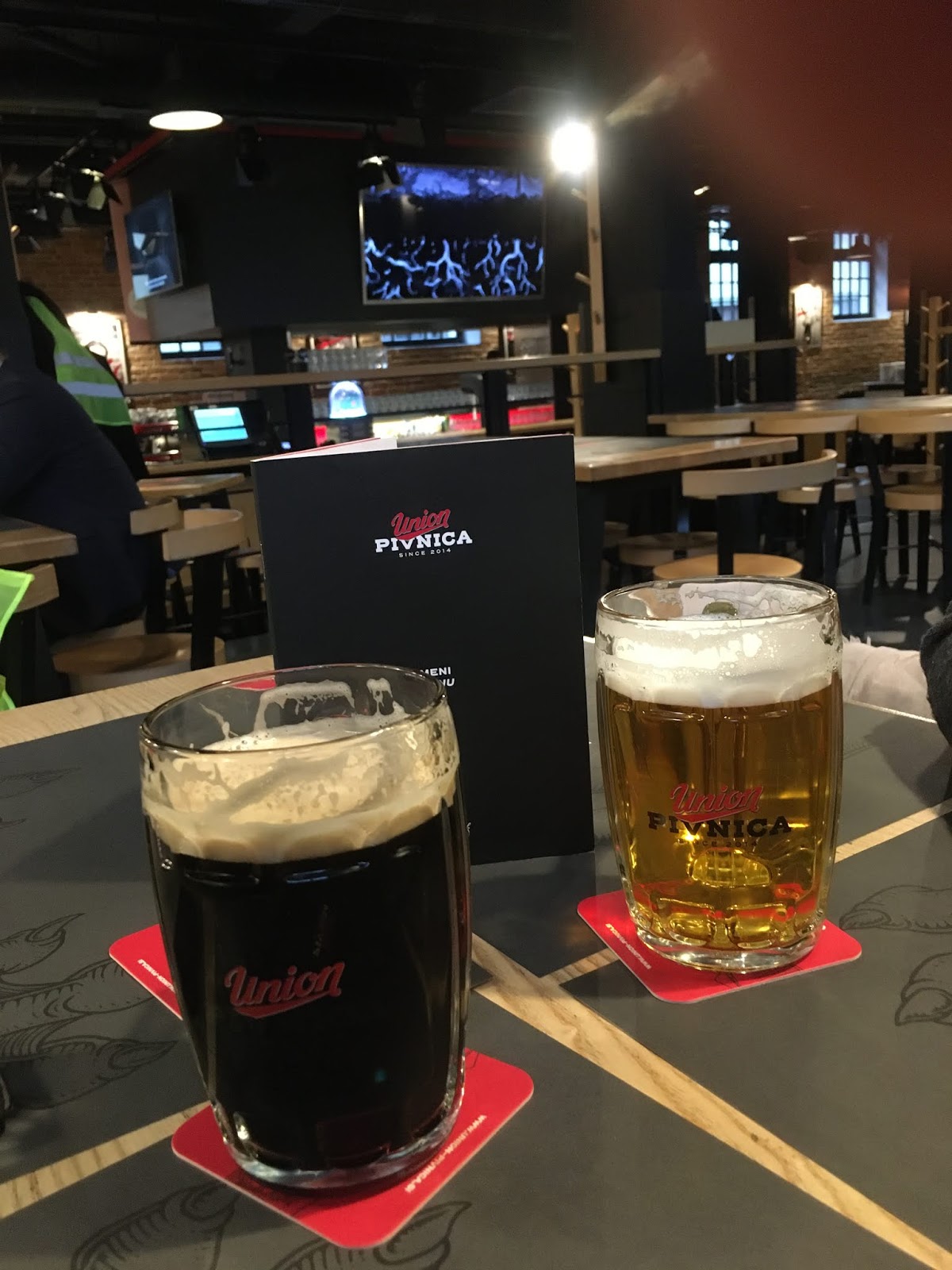
Union Pub.

It seems that Ljubljana, Slovenia is a hot spot for craft beer, which also is the case in Tallinn (Estonia), where we visited in 2016.

As recounted earlier, I was much enamored of the local Union Pivo ("beer") when gliding through Ljubljana in 1987, this being the golden lager from a brewery founded in the 1800s, and not to be confused with Pints&union in New Albany.

Tellingly, today's Union brewery (owned by Heineken and merged with Laško, another Slovene brewery) has installed a restaurant and pub inside the old malt house, where a small brewing system produces new styles for on-premise drinking. I definitely want to go there.

As for the myriad beer options of the craft variety, this guide looks quite promising. We have three days, which is time enough to skim the surface.

The Ultimate Ljubljana Beer Guide and the Biggest Lie in Slovenia, by Tjaša Janovljak (Prostly)

If you were to hear the phrase “Slovenia’s biggest lie”, you might think that it would have something to do with our tendency to exaggerate our heroic history or to downplay the small size of our country. But that’s not the case. Slovenia’s biggest lie is, in fact, about drinking, and its one I’ve heard my entire life: “Let’s have one beer.”

It should come as no surprise that my fellow citizens have embraced the so-called craft beer revolution like so many others around the world. And, like in many other countries, it began slowly in our capital and spread throughout Slovenia resulting in the unprecedented growth of craft breweries, gypsy breweries and craft beer bars. It got insane – so insane that no sane person ten years ago would have been able to imagine how many different beers are now available. Even people who work in the beer industry aren’t able to provide an exact number of breweries in Slovenia, let alone the number of different beers being produced across the country.

So, to help you get your bearings in Slovenia’s capital, here’s a guide to the best Ljubljana beer bars, breweries, and bottle shops by a born and raised local who appreciates a refreshing pint.

Wednesday, November 27, 2019

Baylor Family Croatia, Slovenia and Trieste 2019, Chapter 7: The Union beer and brewing tour, with requisite dragon.


Previously we stopped at the National Museum of Contemporary History in Ljubljana.

I came stumbling into Slovenia, then part of Yugoslavia, in May of 1987. The previous two weeks had been spent in Italy, and unsurprisingly the Italian wine was ludicrously inexpensive. So was beer, but apart from the solid Birra Dreher in the north, the ones I tried were merely serviceable and didn't impress me very much.

I'd been drinking wine regularly, and in retrospect, I was ready for a well-turned, old-school, full-flavored lager.


Well, maybe not THAT old-school.

Happily Yugoslavia proved to be stocked with a few honest lagers, some of them firmly hoppy lagers. After all, Slovenia grows hops.

Attempts to grow hops in Slovenia date back to 1844. Saaz hops and Bavarian hops were brought to the region but did not grow well. A British hop, mislabeled “Golding,” was imported instead, and it flourished. The resulting hops, now known as Styrian Golding, are probably a derivation of Fuggle, not English Golding. Still, they have become the cultivar that is most closely associated with Slovenia. Some Styrian Golding is also cultivated across the border from Slovenia in neighboring Austria. Another uniquely Slovenian cultivar is Bačka. It has a murky background, but is probably of central European origin. Bačka was one of the primary hops of the region through much of the 20th century. Today, Slovenia has a large variety of bitter and aroma hops to offer, most of which are produced from local breeding programs. See bačka (hop), fuggle (hop), and styrian golding (hop). Once a region of the former Yugoslavia, Slovenia accounts for about 2% of the global hop production.

Union beer in Ljubljana was a malty, delicious example of Yugoslav's beery wares. As I was to learn, so were Laško (Slovenia), Karlovačko (Croatia) and Nikšićko (Montenegro). In 1987 I readily found the Union brewery in Ljubljana while out walking. Here are then-and-now photos.


On both photos, the building on the left is the malthouse, which has been remodeled into a pub. 32 years ago I bought a couple of bottles at a shop, and had a draft with my meal at the Ljubljanski Dvor pizzeria. To my palate at the time Union was quite good, and as of our arrival in Ljubljana this past November, I hadn't tasted a single one since 1987.

(As a side note, in present-day Slovenia craft beer culture is strong, and bottled IPAs were available at most of the establishments we patronized. As for the mass-market brewers, after a long history of competition between Union and Laško, they were merged under Heineken in 2016. In terms of character, I believe a Czech analogy is apt: Laško is Pilsner Urquell to Union's Budvar ... in Triple AAA ball.)

Our first round of beers on Tuesday evening at Slovenska hiša included an unfiltered golden lager from Union, which was Keller-like and center of the target. A broader range of beer styles now are being brewed at Union's pivnica (pub), located at the former malthouse adjacent to the recently modernized brewery. Among these was a dark lager along schwarzbier lines. It was delicious.


Behind the beers, above the bar, you can see the video screen. It was endlessly looping the promotional video that leads this post. As we waited for the tour to begin, I couldn't take my eyes off of it, and now the "divining" dragon is certain to be an indelible memory of our 2019 vacation.

Watch it.


Diana and I were the only persons to take the Union brewery tour at 4:00 p.m., but our friendly and enthusiastic guide didn't alter the usual 1.5 hour presentation in the least. We got the full Monty, and it was informative and exhaustive. I was not allowed to photograph inside the brewery (as though "proprietary" is a concept in brewing circles), and so the following photos were taken in the museum section.


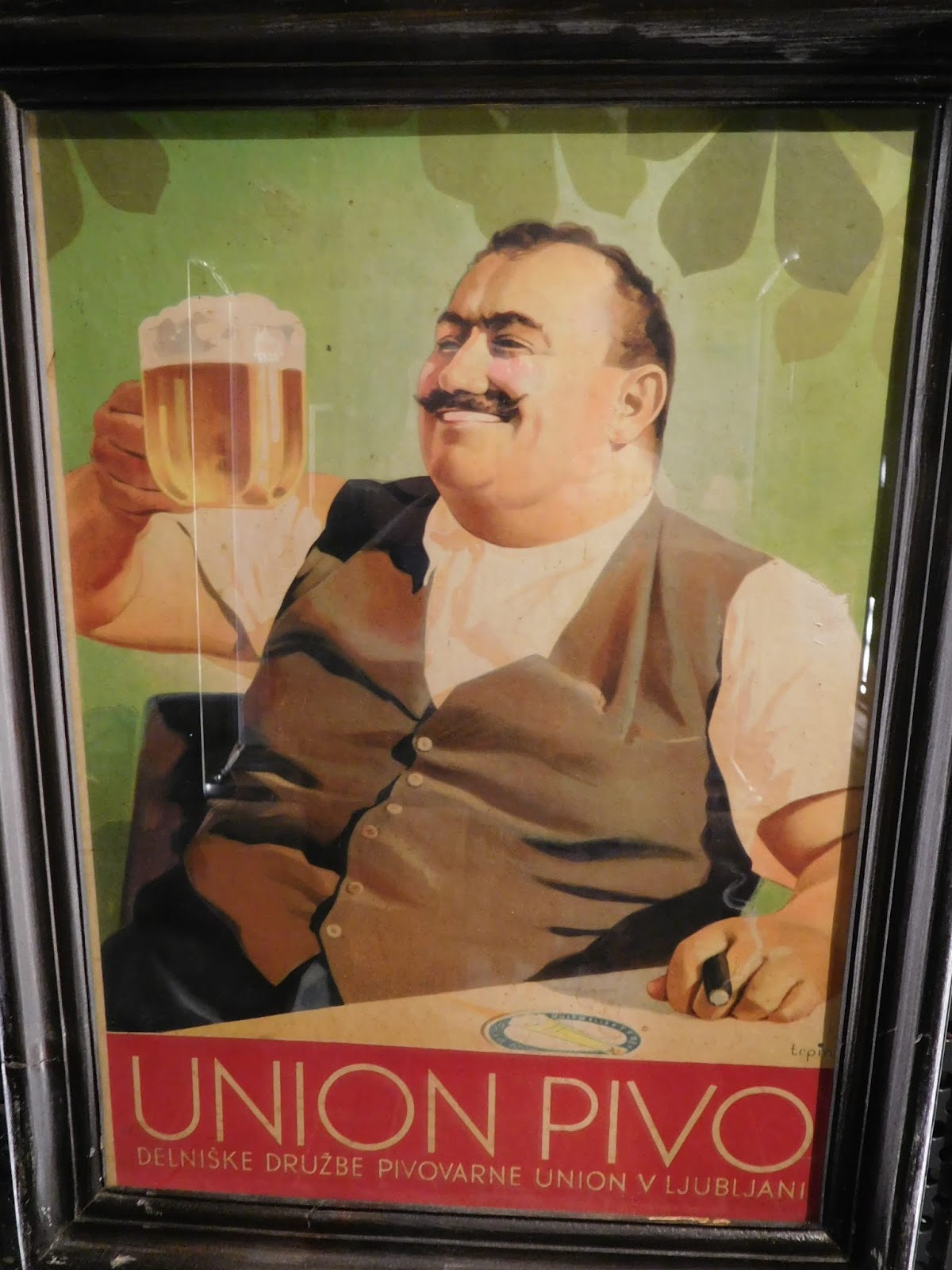
This advertising poster of a mustachioed man hoisting a pint was explained to us as an example of upward mobility in the period between the wars. The man's mustache, cigar, vest and rotund body type all were intended to attest to his status as a successful businessman with disposable income to spend on the good things in life. It remind me just a bit of the famous Birra Moretti logo in Italy.

Wednesday evening ended with meals at the above-average Hotel Park restaurant, which seemed to function as a community hangout as well as a tourist's choice for a nightcap. That's a rare combination.

On Thursday, we began with a long walk, then celebrated a Slovenian Thanksgiving.

12 Days of Slovenia & Trieste (Part 4): In 1987, Ljubljana was an introduction to Yugoslavia.

Yesterday, all my troubles seemed so ... um, strike that.

Actually yesterday I recounted the story of the ill-advised evening train to Ljubljana (Slovenia, then Yugoslavia) from Trieste. Remind me to never again arrive in a strange city at 10:30 in the evening on a Friday, especially when the conscripts have gathered for their final night on the town, and all the suggested hostels are padlocked.

Now the Slovenia tale continues.

---

FINDING MY WAY OUT OF SLOVENIA, 1987

Early on a Saturday morning in Ljubljana -- now the capital of independent Slovenia, then a major regional city in Yugoslavia -- things began settling down within range of almost sensible.

The youth travel office directed me to Dom Tabor, a hostel somewhere in the center of Ljubljana that evidently remains in operation three decades later. Today's Google street view of Dom Tabor conjures no memories, but in 1987 it had available space for a Saturday night, albeit not in the cheaper dorm rooms of my preference.

Instead, I was billeted in a single room. For my second night in Yugoslavia, I'd be paying only double my daily budget for a bed, not triple like the disastrous night before. This was progress, I suppose; still, my scant notes indicate annoyance at the relatively high prices of Slovenia.


Insofar as my brief travel experiences informed me, Slovenia seemed out of place, tied to Yugoslavia and at the same time feeling far more Central European than Balkan. The hilly setting in Ljubljana reminded me of Salzburg, in Austria, and the red tiled roofs were a Mediterranean flourish resting atop imperial-era Habsburg buildings.

In fact, without belaboring the point, the Slovenes were under the dominion of the Holy Roman Empire for a millennium, then the Austrian for another 400 years. Only in 1918 did the European powers-that-be assign them to the newly created Yugoslavia. It was an uneasy marriage, and Slovenia artfully slipped away from Yugoslavia in 1991, with little blood shed.

The violence came later, to the south.

In Ljubljana in 1987, there were snarling dragons guarding the old downtown bridge and a teeming Saturday morning market in the square; tarnished copper stains on buildings with chipped columns; the widespread occurrence of chain smoking and public spitting; and a curious aroma in the air that eventually registered as coal smoke, which I hadn't experienced in metro Louisville since childhood.

In the old town, there was a little pizzeria by the river, and I splurged on a small pie accompanied by draft Union Pivo, tasty lager from the hometown brewery, which I managed to locate later while walking after the sun finally came out.


However, I'd already learned it was more cost effective to drink from the bottle -- and by my reckoning, I needed more than one beer.

On Saturday afternoon, fearing none of the stores would be open, I abruptly strolled past a line of people waiting to enter one, which was doing business with the door propped open. Emerging with three half-liter bottles of Union, it was time to sit on a park bench and gaze at the hilltop castle.

Where the suburbs began, so did the unpainted gray housing blocks, which were Yugoslavia's (and the East Bloc's) solution to warehousing its postwar population. In these neighborhoods there proved to be more examples of commerce than I'd imagined, mostly products being vended from wooden kiosks: cosmetics, street food, flowers and newspapers.

At last mildly buzzed and relaxed, it was time to reflect. Determined to meet my lodging budget, I determined to keep moving, returning to the formerly chaotic train station on Sunday afternoon to find it placid and normal, the employees no longer overwhelmed by drunkards. In retrospect, I might have chosen a smaller Slovenian city than Ljubljana and regrouped, but it was a short hop of three or so hours to Zagreb … and a fateful meeting.

---

In January, 2008, it finally occurred to me to search the Internet for some of the names I'd recalled from my travels decades earlier.

One of them was Radojko Petkovski, whose name promptly surfaced in a handful of listings, each attesting to his collaboration on fairly recent seismology studies, fully befitting an apparent post-Communist career advancement for a man whose 1987 business card identified him as an earthquake engineer working for an institute of earthquake studies in Skopje, Macedonia (Yugoslavia).

The second class cars on the Yugoslav "express" train from Ljubljana to Zagreb weren't terribly crowded. Seated opposite me was a conservatively dressed, well-groomed man probably in his late 30s, quietly reading a newspaper. When the conductor came past to check tickets, there was momentary linguistic confusion.

The man smiled, spoke to me in accented English, and answered the conductor. As the door shut, enclosing the claustrophobic old-fashioned compartment, I was handed a business card and an elemental conversation ensued.

He asked me to call him Rady. He spoke a bit of English, and naturally I spoke none of the Yugoslav languages. There were to be future implications to the fractured dialogue, but for the moment, it was quite pleasant to engage with a local.

Soon we pulled into one of the intermediate stations, and resting on a siding adjacent to us was a train filled with dazed young soldiers looking out their windows.

I'd been trying to explain the scene at the station in Ljubljana, and Rady nodded; he'd seen it, too, and proceeded to explain what I'd witnessed, noting that the rowdy specimens I experienced were draftees being shipped out for basic training, as were the meek (hungover?) soldiers glimpsed outside our window. They may have been one and the same.

Soon we had arrived in Zagreb, and Rady made it a point to invite me to Skopje for a visit. I told him it might not be for a couple of weeks. His card was filed in my pouch, and we said goodbye.*

---

As it turned out, the youth hostel in Zagreb had a suitably priced bunk bed for one night only, after which a school group was coming on Monday to fill all the spaces.

I recall having a few mugs of cheap lager beer on a patio outside the train station, with time for a walkabout. Interestingly, the only observation I saw fit to record was "construction work on Trg Republike," this being the central square in Zagreb. When Croatia became independent, the name was changed to Ban Jelačić Square.

What was the construction about? Here's the answer, courtesy of the Yugoslavia Virtual Museum.

The 1987 Summer Universiade, also known as the XIV Summer Universiade, took place in Zagreb, Yugoslavia. It involved participants from 122 countries and over 6,000 individual sportspersons and members of teams.

The city of Zagreb used the event to renovate and revitalize the city. The city's main square (Republic Square) was repaved with stone blocks and made part of the downtown pedestrian zone. A part of the Medveščak stream, which had been running under the sewers since 1898, was uncovered by workers. This part formed the Manduševac fountain that was also covered in 1898.

This was the work I saw occurring, two months prior to the main event,

On Monday morning, I hopped aboard a train into the interior, eventually passing out of Croatia and into the rugged mountains of Bosnia-Herzegovina. My destination was Sarajevo, and a date with Archduke Franz Ferdinand.

To continue to follow the 1987 story: THE BEER BEAT: Praljak, Yugoslavia's civil war, the brewery in Sarajevo and the bridge in Mostar.

---

* I did visit Radojko Petkovski later in Skopje, dropping by his office unannounced; he promptly offered me his living room couch and was a joy in every respect.


My first stab at these recollections came in 2008, later to be updated frequently until finally/maybe finished in 2017.

Back in 2008, when I found several internet references to Radojko Petkovski in the context of seismology, there was a dim memory of Rady being divorced or separated, with a young son who didn't always stay at his apartment with dad. I can't recall whether or not I met his son, who'd have been quite young. It's all too hazy after all these years, but I believe I did.

Still in 2008, just a few months after mentioning Rady here at the blog, I received a note appended as a comment to the Yugoslavia story:

I googled the internet for the same reason as you did, and I found your text. My father was Radojko Petkovski, Prof D-r. seismologist, who maybe you met in the train, probably returning from his visit to his brothers in Slovenia. It gives me a smile to see that he made an impression on you during yours short trip together.

Sadly, he passed away on 1st of June 2007.

Best regards,


His son, Milan


P.S. I can write you what happened after, since most of my youth has gone through that bloody period, but it will just ruin my smile.


I never got in touch with Milan, and in the larger scheme of things, I've no idea whether Rady was a "good man." At the advanced age of 59, I'm no longer certain how we measure such things, or whether we even can. But, for those few springtime days in Skopje, and in that far-off time, he was extremely nice to this fumbling and disorganized budget traveler ... and I'll never forget the hospitality. Thanks, and rest in peace.

Tuesday, November 26, 2019

Baylor Family Croatia, Slovenia and Trieste 2019, Chapter 4: Ljubljanski Dvor, and other memories of the time before.


We'd arrived in Ljubljana for three nights, and it was love at second sight for me.

During our stay in Ljubljana, my thoughts naturally returned to the only previous time I'd been there, 32 years ago for two nights and a scant full day. I haven't retained much about that far-off time, just a few disconnected vignettes, shadows and a ghost or three.

Understandably much has changed. Perhaps the most prosperous city in then-Yugoslavia, Ljubljana now is the bustling and hospitable capital of an EU member nation, and the journey from dinars to Euros would have been lengthy by any measurement. How different have we become as individuals now, as opposed to then?

Such a random connection surfaced for me as we wandered the streets of Ljubljana in 2019. I remember eating a pizza and drinking a beer as my midday meal on Saturday in 1987, at a place that struck me at the time as new and perhaps even trendy. I recalled it was by the river, and seemed quite the capitalist venture in a socialist country.

As we were walking by the river, I looked across the way. There was a pizza joint on the other side called Ljubljanski Dvor, and something about it struck me; we'd already eaten, so I snapped a photo of the building (above) and resolved to research it after returning home.

This I have done. It's the very same place, a pizzeria founded in 1986, just a year before my first appearance in Ljubljana. I remain dumbfounded that at the age of 26, a small personal-size pizza and draft beer would have come anywhere close to filling me up.

Maybe that's why I weighed 205 lbs then, not (redacted) now.

Here are a few other photos in Ljubljana, then and now. First, throwback Union Pivo (beer) signage.


The brewery itself.


The central market.


And, one of the denizens of Ljubljana's dragon-embellished bridge.


Next, the Ljubljana Castle.

Monday, December 11, 2017

30 years ago today: (May) An introduction to Yugoslavia in Ljubljana, then Zagreb and the way to Sarajevo.


Previously:

30 years ago today: (May) Hillsides in Perugia, Gubbio, Assisi -- and the end of Italy '87.

ON THE AVENUES: Welcome to wherever you are, and come to think of it, Ljubljana will do nicely.

A disorienting transition from capitalism to socialism went like this.

Day 30 ... Friday, May 15
Perugia → Firenze → Trieste → Ljubljana ... $23 hotel room!

Day 31 ... Saturday, May 16
Ljubljana. More rain; Dom Tabor.

Day 32 ... Sunday, May 17
Zagreb. Hostel; construction work on Trg Republike.

Remind me to never again arrive in a strange city at 10:30 in the evening on a Friday, especially when the conscripts have gathered for their final night on the town, and all the suggested hostels are padlocked.

Early on a Saturday morning in Ljubljana -- now the capital of independent Slovenia, then a major regional city in Yugoslavia -- things began settling down within range of sensible.

The youth travel office directed me to Dom Tabor, a hostel somewhere in the center of Ljubljana that evidently remains in operation three decades later. Today's Google street view of Dom Tabor conjures no memories, but in 1987 it had available space for a Saturday night, albeit not in the cheaper dorm rooms of my preference.

Instead, I was billeted in a single room. For my second night in Yugoslavia, I'd be paying only double my daily budget for a bed, not triple like the disastrous night before. This was progress, I suppose; still, my scant notes indicate annoyance at the relatively high prices of Slovenia.


Insofar as my brief travel experiences informed me, Slovenia seemed out of place, tied to Yugoslavia and at the same time feeling far more Central European than Balkan. The hilly setting in Ljubljana reminded me of Salzburg, in Austria, and the red tiled roofs were a Mediterranean flourish resting atop imperial-era Habsburg buildings.

In fact, without belaboring the point, the Slovenes were under the dominion of the Holy Roman Empire for a millennium, then the Austrian for another 400 years. Only in 1918 did the European powers-that-be assign them to the newly created Yugoslavia. It was an uneasy marriage, and Slovenia artfully slipped away from Yugoslavia in 1991, with little blood shed.

The violence came later, to the south.

In Ljubljana in 1987, there were snarling dragons guarding the old downtown bridge and a teeming Saturday morning market in the square; tarnished copper stains on buildings with chipped columns; the widespread occurrence of chain smoking and public spitting; and a curious aroma in the air that eventually registered as coal smoke, which I hadn't experienced in metro Louisville since childhood.


In the old town, there was a little pizzeria by the river, and I splurged on a small pie accompanied by draft Union Pivo, tasty lager from the hometown brewery, which I managed to locate later while walking after the sun finally came out.


However, I'd already learned it was more cost effective to drink from the bottle -- and by my reckoning, I needed more than one beer.

On Saturday afternoon, fearing none of the stores would be open, I abruptly strolled past a line of people waiting to enter one, which was doing business with the door propped open. Emerging with three half-liter bottles of Union, it was time to sit on a park bench and gaze at the hilltop castle.

Where the suburbs began, so did the unpainted gray housing blocks, which were Yugoslavia's (and the East Bloc's) solution to warehousing its postwar population. In these neighborhoods there proved to be more examples of commerce than I'd imagined, mostly products being vended from wooden kiosks: cosmetics, street food, flowers and newspapers.

At last mildly buzzed and relaxed, it was time to reflect. Determined to meet my lodging budget, I determined to keep moving, returning to the formerly chaotic train station on Sunday afternoon to find it placid and normal, the employees no longer overwhelmed by drunkards. In retrospect, I might have chosen a smaller Slovenian city than Ljubljana and regrouped, but it was a short hop of three or so hours to Zagreb … and a fateful meeting.

---

In January, 2008, it finally occurred to me to search the Internet for some of the names I'd recalled from my travels decades earlier.

One of them was Radojko Petkovski, whose name promptly surfaced in a handful of listings, each attesting to his collaboration on fairly recent seismology studies, fully befitting an apparent post-Communist career advancement for a man whose 1987 business card identified him as an earthquake engineer working for an institute of earthquake studies in Skopje, Macedonia (Yugoslavia).

The second class cars on the Yugoslav "express" train from Ljubljana to Zagreb weren't terribly crowded. Seated opposite me was a conservatively dressed, well-groomed man probably in his late 30s, quietly reading a newspaper. When the conductor came past to check tickets, there was momentary linguistic confusion.

The man smiled, spoke to me in accented English, and answered the conductor. As the door shut, enclosing the claustrophobic old-fashioned compartment, I was handed a business card and an elemental conversation ensued.

He asked me to call him Rady. He spoke a bit of English, and naturally I spoke none of the Yugoslav languages. There were to be future implications to the fractured dialogue, but for the moment, it was quite pleasant to engage with a local.

Soon we pulled into one of the intermediate stations, and resting on a siding adjacent to us was a train filled with dazed young soldiers looking out their windows.

I'd been trying to explain the scene at the station in Ljubljana, and Rady nodded; he'd seen it, too, and proceeded to explain what I'd witnessed, noting that the rowdy specimens I experienced were draftees being shipped out for basic training, as were the meek (hungover?) soldiers glimpsed outside our window. They may have been one and the same.

Soon we had arrived in Zagreb, and Rady made it a point to invite me to Skopje for a visit. I told him it might not be for a couple of weeks. His card was filed in my pouch, and we said goodbye.

---

As it turned out, the youth hostel in Zagreb had a suitably priced bunk bed for one night only, after which a school group was coming on Monday to fill all the spaces.

I recall having a few mugs of cheap lager beer on a patio outside the train station, with time for a walkabout. Interestingly, the only observation I saw fit to record was "construction work on Trg Republike," this being the central square in Zagreb. When Croatia became independent, the name was changed to Ban Jelačić Square.

What was the construction about? Here's the answer, courtesy of the Yugoslavia Virtual Museum.

The 1987 Summer Universiade, also known as the XIV Summer Universiade, took place in Zagreb, Yugoslavia. It involved participants from 122 countries and over 6,000 individual sportspersons and members of teams.

The city of Zagreb used the event to renovate and revitalize the city. The city's main square (Republic Square) was repaved with stone blocks and made part of the downtown pedestrian zone. A part of the Medveščak stream, which had been running under the sewers since 1898, was uncovered by workers. This part formed the Manduševac fountain that was also covered in 1898.

This was the work I saw occurring, two months prior to the main event,

On Monday morning, I hopped aboard a train into the interior, eventually passing out of Croatia and into the rugged mountains of Bosnia-Herzegovina. My destination was Sarajevo, and a date with Archduke Franz Ferdinand.

Next: THE BEER BEAT: Praljak, Yugoslavia's civil war, the brewery in Sarajevo and the bridge in Mostar.